

What Do Providence and Messianism Have to Do with the Judicial Reform? (Column 584)
How the duty of hishtadlut empties belief in providence
The column returns to the author's view that in our generations God does not actively intervene in the world, or at least that we have no factual basis for claiming otherwise. Against the common religious picture, which sees national history and fateful events as the work of God, he argues that the concept of hishtadlut in practice empties belief in providence: believers act like people who do not believe, and every outcome can always be explained after the fact as what God wanted. The result is a thesis that is not empirically testable and hardly changes behavior.
When belief in providence does change behavior: from the Brisker Rav to Rabbi Herzog
To show that the question of providence can nevertheless have practical consequences, the column brings the story of Rabbi Herzog trying to prevent the Brisker Rav from leaving Jerusalem in the War of Independence on the grounds that the Third Temple will not be destroyed. The Brisker Rav replied that when people shoot, you run, which illustrates Haredi pragmatism: even one who declares that everything is in Heaven's hands still behaves by the ordinary rules of caution. Precisely the Religious-Zionist stance, which sees the national process as guaranteed redemption, may justify waiving realistic hishtadlut — and for him this is a rare but dangerous example of belief in providence having practical effect.
Why the current crisis is not just about the reform, and why the government cannot hide behind the voters' will
The column lists a long series of economic, security, diplomatic, and social warnings around the reform and the government's conduct, and stresses that much of the damage is already happening. In his view, the dispute is not only about the wording of the reform laws but about the government's broader reckless policy, and the defense of the majority's will is demagogic: the polls do not indicate broad support, and even if the protest contributes to part of the damage, a government is responsible for weighing all the costs rather than gambling with the state for a negligible legal gain. Even if some of the warnings are exaggerated in his eyes, for example the talk of an emerging dictatorship, a responsible government cannot ignore almost the entire array of experts and senior officials without very high confidence that they are wrong.
Why the insistence looks like a gamble on providence
He finds it hard to believe that all coalition members truly think the warnings are fake, certainly not Netanyahu and parts of Likud. He therefore looks for a deeper explanation for the irresponsibility, and suggests that alongside cynicism, Haredi interests, indifference to the state's fate, and a captive electorate, a Religious-Zionist assumption is also at work: that the state is on an irreversible path of redemption, so God will somehow fix the problems. Without such a component, it is hard to understand why they insist on paying such a huge price for a marginal achievement.
The two assumptions that make the false confidence possible
The column distinguishes between two separate assumptions: that God is involved in what happens, and that we also know His policy and know that it necessarily leads to redemption rather than destruction. The first assumption alone is not enough, because the same God could also bring destruction, as happened in the past. The confidence that Israel cannot be harmed therefore rests on an additional claim to know the intention of providence, and the column recalls in this context the destruction of the Temple, the Holocaust, and his father's warning that there is no principled reason why another Holocaust or catastrophe could not happen.
What messianism means here
He rejects the usual use of the term messianism as if the main issue were an immediate drive toward a halakhic state. In his view, the core feature of messianism is reliance on meta-historical considerations while discounting, even if only partially, realistic historical ones. In that sense the coalition's policy is indeed deeply messianic: mainly with Smotrich, Ben Gvir, and parts of Likud, though the other partners are pulled along for their own reasons. Here he only marks out the definition and says that the next column will unpack its positive and negative elements.
The praise for Smotrich's redemptive conduct exposes the failure
The column uses Rabbi Menovitz's praise of Smotrich for acting out of a redemptive rather than historical consciousness to show that the failure is not accidental but ideological and cultivated. When an entire beit midrash is sure that destruction is impossible because God is leading a redemptive process, the result is leadership that discounts practical considerations. Menovitz's attempt to combine this with the language of hishtadlut and pragmatism also fails: if there is no insurance policy, there is no basis for absolute confidence; and if the confidence is absolute, hishtadlut becomes an empty slogan.
The problem is not only the intellectual contradiction but the practical price
The column's conclusion is that the combination of a theology of providence, redemptive certainty, political interests, and double-mindedness produces a very dangerous policy. The debate about the logic of faith matters less than the fact that this outlook may lead the state to a real catastrophe.
The current turmoil in Israel has once again stirred in me somber reflections on the questions of providence and messianism, and I will try to lay them out here.
The Debate About Divine Involvement
More than once I have presented here my view that in our generation it appears that God is not actively involved in the world. Things occur by the way of nature, in accordance with the laws of nature and people’s choices. The conventional religious outlook projects biblical depictions onto our present reality, according to which God is involved in the world to some degree. One can argue that “there is no blade of grass that stirs without an angel over it telling it, ‘Grow’,” meaning that everything that happens depends on the Holy One. There are intermediate views that hold that God is partially involved—for example, that events affecting the Jewish people as a whole, or at least fateful events, are in His hands. The contemporary redemption is a good example, as religious-Zionist views regard the present processes of the ingathering of Zion as the work of God. When the process stalls or regresses (the Disengagement, Oslo), we are told that such is the way of redemption, like the dawn that breaks little by little. There are delays and local reversals, but the direction is clear, deterministic, and irreversible.
I have already pointed out more than once the folly in the notion of “hishtadlut” (the supposed obligation to “do one’s part”), which does not hold water logically, and which even those who swear by it do not truly believe. I argued that it is essentially a cloak for disbelief in divine involvement and providence. It is a kind of mental duality, a phenomenon I discussed in column 199 and in columns 575 – 576. In any case, it seems that the notion of “hishtadlut” drains the belief in providence and divine involvement of any factual content. In practice, those who believe in divine involvement behave like those who do not. This also turns the notion of involvement into an unfalsifiable thesis (for, as we recall, “God doesn’t work for us,” and therefore whenever what is expected does not happen, we have an excellent explanation). As is known, we are forbidden even to put God to the test, so this thesis cannot be subjected to an empirical trial. And even in the one area where testing is permitted—tithing (and perhaps charity)—no one has actually done so, and not for nothing. Without having checked, I surmise that systematic attempts to test it would come up empty. I also suspect that others who do believe in divine involvement do not undertake such trials because, deep down, they know I am right.
Practical Implications
If so, there would ostensibly be no practical implication to the question of divine involvement in the world. There are implications for prayer and petitions to Him, which I have discussed in the past, but not behavioral implications for how we conduct ourselves in the world. Even those who believe in such involvement conduct themselves in practice as if they do not, for there is the “obligation of hishtadlut.” Yet it seems we can nevertheless find practical implications.
There is a well-known story from the beginning of the War of Independence: Rabbi Herzog heard that the Brisker Rav was about to leave Jerusalem and feared a collapse of morale. He went to persuade him not to leave and told him that we have a tradition that the Third Temple will not be destroyed.[1] The Brisker Rav replied: And I have a tradition from my father’s house that when they shoot, one must run. I will not address the validity of inventions that rely on such obscure traditions (like the “tradition” that in the future the halakhah will be decided in accordance with Beit Shammai), though the fact is that many adopt them. In any event, to my mind this story is instructive on several levels.
First, it reflects the difference between religious-Zionist ideology and Haredi pragmatism. But what is more important for our purposes is the implication for the question of “hishtadlut.” The Haredim certainly declare that everything is in God’s hands (except for the founding of the state, which of course is the work of the sitra achra), but when there is shooting, they make sure to run. In other words, their belief in total providence does not contradict the “obligation of hishtadlut,” which empties that belief of content. It reminds me of the notice we received during the Second Gulf War that the small yeshiva where our son studied was about to be closed because of the danger of missiles. We wrote then to the mashgiach that we had naively thought that Torah study protects us all from missiles, but apparently that did not persuade him (if this is “beri heizka”—a clear hazard—I don’t know what isn’t “beri heizka”). In practice, those who declare that everything is in God’s hands conduct themselves like the last of the unbelievers. But that is what we saw above. What is more relevant here is what happens on the religious-Zionist side of the divide. Here we can see a rare practical consequence of belief in divine involvement. Rabbi Herzog in effect proposes not to engage in the hishtadlut that the situation demands, relying on a divine promise that we will not lose the war. That is, his belief in divine involvement led him to adopt a different practical policy. This is a rare case. I assume he would not instruct a private individual in this way (to pray instead of going to a doctor), but his belief in the redemptive process of the people of Israel as a whole was enough to ignore the practical imperative of hishtadlut.
The Current Situation
Amid the stormy debate over the judicial reform, a situation has arisen in which various experts warn of the state’s deterioration—economically, legally, diplomatically, in security terms, and of course socially. Eighty percent of new startups are being incorporated abroad. The shekel’s value is dropping, the stock exchange is plunging, and there are warnings of a credit-rating downgrade. People are moving money and investors are pulling out of investments in Israel. Experts warn that we are on the brink of a severe economic recession. Our foreign relations are in tatters (especially with the United States and the Abraham Accords countries). People are emigrating, and many others are considering it. The army faces a serious readiness crisis and a cohesion crisis. The social rift appears irreparable. And I have not yet mentioned (in my view dubious) warnings of the end of democracy and an emerging dictatorship. These are outcomes that will be very hard to fix, and some of them are already materializing today. These are not merely warnings about the future. The future could, of course, be even worse.
It is important to understand that I do not mean only the reform legislation. I have written more than once that the reform is not the main issue here, but the government’s policy and its considerations. Not a few are now coming to realize this. The ramifications I described are not a direct product of the reform but of this government’s general reckless policy (just yesterday they announced an across-the-board cut in order to transfer another 165 million shekels to the Haredim and the yeshivot).
It is also important to reject the claim that this is the will of the majority and that we must not allow a loud minority to dictate policy and overturn the elections. It is worth looking at the findings of the poll published in Israel Hayom (not in Europe the day before yesterday, nor in Haaretz tomorrow) regarding public support for the government’s moves (it’s worth seeing the full results here):
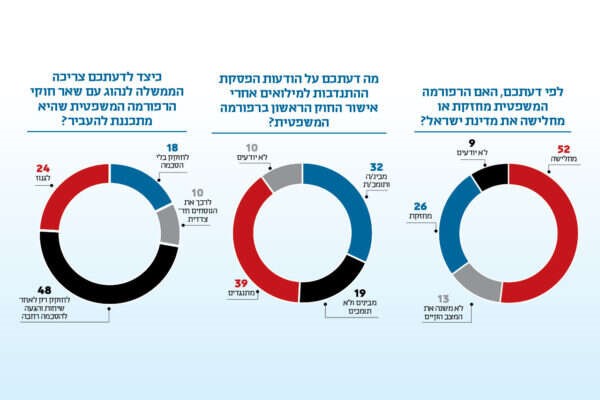
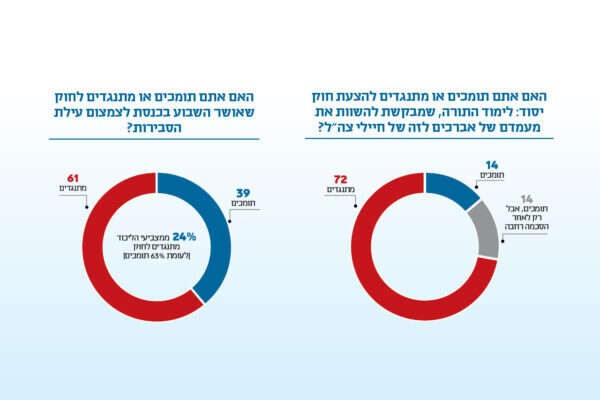
This is of course just one poll among many. These results have been entirely consistent over months, and as noted it was neither conducted nor published on a typically left-wing platform. Against this backdrop it is clear that the talk about implementing the will of the majority is cheap demagoguery. True, a government has the right to implement policy even if it lacks majority support at a given moment, but when its policy is outrageous both in itself and in the public’s eyes, it cannot shelter behind majority support. Let them not tell me they are implementing the voter’s will, because they most certainly are not.[2]
It is important to understand that even if those who claim that these outcomes are mainly the product of the protest, and not only of government policy and legislation, are right (I also think there is truth to that), it does not really matter. In practice, the outcomes are outcomes that we will all suffer from, and the government bears responsibility to conduct itself with consideration for all the pieces on the board. It cannot shift responsibility onto someone else.[3] Beyond that, I also do not understand how anyone thinks that the paltry gain in passing the curtailment of the reasonableness doctrine (which has almost no legal effect) is worth the king-sized damage.
Others claim that all these warnings are leftist “fake.” (No problem—Tali Gotliv has already explained to us that Golani soldiers can be pilots too.) Sometimes they even bring other experts who claim otherwise. Perhaps they are right, though I very much doubt it (to understate the point). But one must understand: a private citizen can form an opinion about the seriousness of these warnings as he wishes. His opinion has no importance and he bears no responsibility for the results. But a government that makes policy and is responsible for the outcomes must be sure beyond a reasonable doubt that all these warnings are indeed fake. Almost the entire senior civil service (much of it appointed by them) warns against the government’s policy, and to ignore all that they would have to be certain that it is political fakery. Is there sufficient basis for such an assessment? Is the government’s assessment that there is nothing to these warnings itself not political? I greatly doubt it.
Back to Providence
Since in my view, although this coalition is the sum of all deficits and there is no blemish you will not find in it (“You are entirely fair, my love, and there is no blemish that you do not have”), not everyone in our government is a complete fool. I assume that at least some of them (especially Bibi) know that there is substance to these warnings—or at least are not certain there isn’t. So why do they nonetheless insist on ramming through a vacuous curtailment of the reasonableness doctrine and paying all these prices? Is the need not to yield to the “military putsch,” as they demagogically and baselessly dub it, worth these outcomes? Is it really worth plunging us all into the real danger of ruin? We have already become accustomed to their stupidity. To their conservatism and primitivism—of course. To their lies and corruption—obviously. To their trampling self-interest and indifference—this is the defining feature of this coalition. But to the irresponsibility and to the results for which they themselves will be responsible—how is it that they are not afraid of that? Are they counting on the stupid public to keep voting for them even if the state is in utter ruin? Will most of us truly go on casting ballots for “Bibi,” “Deri,” “Ben-Gvir,” “Goldknopf,” “Smotrich,” or “Avi Maoz,” even from the depths of the sea? To tell the truth, in light of what has been so far, I cannot rule it out.
Here we have a wondrous combination of cynicism and a stupid electorate out of the Likud’s school, a captive public of the Haredi parties whose vote for them is in no way contingent on their actions and achievements, and as for the religious-Zionist parties, it seems they and their devotees are following the path of Rabbi Herzog, of blessed memory. They are relying on providence.
It goes without saying, we are reminded, that we have a firm tradition that the Third Temple is not destroyed, and therefore we must not be daunted by economic, diplomatic, social, or security problems. Since we are on a sure path to complete redemption, and since everything this coalition does is “for the sake of Heaven” (that is, for the sake of the desecration of His great name), they are certain that the Holy One will take care of the problems and all will be well. The experts, to be sure, have their place, and their assessments are apparently substantive—or at least cannot be ruled out with certainty—but that is only in the secular fleshly eyes of the ignorant and rational masses. In the spiritual crystal eyes of our saintly rabbis, the “cliffs of the land” (that is, all those responsible for the greatest desecration of God’s name since the creation of the world), it is clear there is nothing to any of this, for such is Israel’s safe and irreversible redemption. Nothing can stop a mystical, meta-historical, supra-natural process like our complete redemption. Certainly not small, earthly economic or security considerations that could halt the “repair” (i.e., wrecking) of the world under the Kingdom of Shaddai.
I have no other explanation for this appalling irresponsibility. It appears to be the result of blind faith that the State of Israel cannot be harmed regardless of what we do—and certainly if it is done “for the sake of Heaven” (that is, the looting of the public treasury in order to sustain and entrench Haredi parasitism that is ruining and will ruin us all). Add to this religious-Zionist ideology the Haredi self-interest and indifference, and the fact that Bibi and the few of his Likud colleagues who remain sane have been taken captive by this motley collection of delusional idiots, and you have the scandalous conduct of this union of abominations.
Two Wrong Assumptions
Behind this deranged policy lie two distinct assumptions: (a) God is responsible for what happens. (b) His policy is clear to us, and He is leading us safely to redemption. From these two assumptions one can derive the conclusion that, should problems arise, He will sort things out for us. Both assumptions are needed to live within this delusion, for even if God is involved in everything that happens, how do you know that He will not destroy the state? After all, He (?) has already done so at least twice in the past. Note that the “tradition” I mentioned is responsible for the second assumption (hence the Brisker Rav, who shares the assumption that God is responsible for everything that happens, still is not sure that the state will not be destroyed, or that we will not be defeated in war).
It is worth remembering that whenever a disaster happened to us—or to any other people—I am sure that a few years earlier no one believed it would happen. Before the destruction of the Temple, I am sure everyone lived in tranquility and did not believe that such a catastrophe could befall them in their days. So too before the Holocaust; and so too in our own times. This is a common mistake: people assume that the familiar situation is necessary and could not be otherwise. In my estimation, unlike previous warnings, today there is indeed a non-zero chance of ruin—or at least a real catastrophe—in our state. It is no longer far-fetched.
I recall an event in Elkana, where I lived with my parents and siblings until I married. My late father, the elder of the community, who in his youth experienced the Holocaust in Budapest, Hungary, was invited to a panel on whether another Holocaust is possible. The other speakers confidently explained that the Third Temple is not destroyed and another Holocaust cannot happen. But he, as one who experienced the Holocaust, said almost matter-of-factly: I see no reason why a Holocaust could not happen again. We would do well to take into account that the situation we are in is neither guaranteed nor necessary. It seems that many components of our coalition of horrors are not truly considering that possibility.
What Is Messianism?
Many accuse this government (and the Kohelet Forum) of “messianism.” Usually what is meant is a tendency to impose a halakhic state here and thereby bring the Messiah. This is, of course, a disconnected discourse. None of the coalition’s components includes such a goal among its near-term objectives. They certainly want to impose more “Judaism” and exclude other ideas, but this is not truly heading toward a halakhic state, at least in the near term (in the coming terms).
In a paper my daughter, Bruria, wrote with my help, she analyzed the messianic features of religious Zionism. To do so, one must define the concept of messianism and distinguish its negative and positive components, and that is what I intend to devote the next column to. Here I will only say that the principal component of messianic conduct is reliance on meta-historical considerations and the (even partial) disregard of realistic, historical considerations. That is what we see here. This is especially true of the religious-Zionist components of the coalition (Smotrich, Ben-Gvir, and parts of Likud), but as I explained, they are dragging along all the rest, each for his own reasons (Haredi self-interest and indifference, or Bibi’s coalition constraints).
Therefore I actually agree that there is a very strong messianic component in this coalition’s policy. Their messianism is not expressed in striving for a halakhic state, but in ignoring realpolitik and acting according to meta-historical considerations. What I described above reflects this outlook and conduct. Sadly, this is not only a practical consequence of the belief in active providence but a policy liable to lead us all to disaster.
Smotrich’s “Redemptive Conduct”
Last night, as I was writing this column, I came across this article in which Rabbi Manovitz, head of the Golan Yeshiva, praises Smotrich for his “redemptive conduct.” Unlike Bibi, who conducts himself with historical awareness (this is entirely true in my view, which is why I find it difficult to reconcile it with his current policy, which is manifestly anti-historical), Smotrich and his party conduct themselves in a “redemptive” manner. Do not be mistaken: in Rabbi Manovitz’s eyes, and apparently in the eyes of many like him, this is praise, not criticism. Not only do they conduct themselves thus; they do not even contemplate the monstrous error in such conduct. It is considered praiseworthy.
Here are two paragraphs with the essence of the flaw:
He gave an entire lesson on Messiah son of Joseph and Messiah son of David. The study itself doesn’t matter, nor does it matter that he is well-versed in these things because he is a man of Torah—none of that matters. What matters is that he says to himself and to us: Look, what interests me is my role in this process. I do not live with historical consciousness; I live with redemptive consciousness and ask myself: What does the Master of the Universe want from me in this process?
There is no one here in our beit midrash—neither student nor rabbi—who thinks we are on the eve of destruction. There is no such thing. We are students of the Rav and of Rabbi Tzvi Yehuda; we think there is a redemptive process here. The difference between us and those who rejoice in the State of Israel but do not understand that there is a redemptive process is the difference between heaven and earth. We think there is a process that God is leading, and we are joining it.
I am sure Smotrich’s lesson on Messiah son of Joseph and son of David was instructive and profound—after all, he “understands” the topic (well, no one really understands it, which does not stop everyone from giving comprehensive lessons on it)—but I would recommend he stick to such lessons instead of leading us all to disaster. There is no student in the beit midrash who thinks disaster and ruin are possible—but that is precisely the problem. This redemptive fixation, with which they brainwash the youth, and whose products ultimately become our political and rabbinic leaders. Rabbi Manovitz also educates his students to conduct themselves “redemptively,” and blessed be God, it bears fruit. Thus has the messianism we now witness come into being. A pack of rowdy punks are implementing their rabbis’ doctrine under their active guidance and direction and are leading all of us to the abyss. If this is not messianism, I do not know what is.
By the way, Rabbi Manovitz there does not forget to pay the obligatory lip service to the “duty of hishtadlut”:
Rabbi Manovitz emphasized that this does not mean Smotrich has an insurance certificate. “Do not ask whether there is an insurance certificate here, whether you are a person like the finance minister, and I do not know pragmatists like him. Even his fiercest opponents speak of his learning curve at the Transportation Ministry, of how quickly he learned what that ministry is, and how quickly he learned the economic system. No one thinks he receives divine messages and lives by them.”
He notes that this “redemptiveness” does not prevent our revered leaders from weighing realistic considerations, and yet it is still the redemptiveness that guides them. But in practice, it seems they definitely ignore those considerations. And that is no wonder, for the thesis of “hishtadlut” is indeed untenable. If one adopts the belief in divine involvement with the two assumptions noted above, it follows that one should not engage in realistic hishtadlut. If no one thinks destruction is possible and if redemption is guaranteed, as Rabbi Manovitz says, then why fear it and/or act to prevent it?! If there is no insurance certificate, whence the certainty?! Has he anything against logic?! If his analytical Talmudic lessons look like this as well—saying one thing and its opposite sentence after sentence? Religious sloganeering and mental duality will have to answer. But my problem is not people’s logic; I have largely lost hope there. Our problem—all of ours—is the practical outcomes of this harebrained “logic.”
[1] Not that I understand why that promise—even if one takes it seriously—guarantees that the Brisker Rav would not be killed by a bullet, or even that Jerusalem would not fall. The Old City of Jerusalem, as we recall, did fall—until redemption “recovered” nineteen years later, in the Six-Day War.
[2] I have already explained (see for example column 553) that even if this were indeed the voter’s will, that would not delegitimize protest and opposition to changing the rules of the game.
[3] Moreover, this current coalition, when in opposition, tried to torpedo on its own—sometimes successfully—government measures, including those that were to its liking and, by its own lights, good for the country (such as visa-free travel to the U.S., applying Israeli law to settlers in the territories, taxes on disposables and sugary drinks, and much more). And we have not yet spoken of refusing to accept election results, which is not our direct concern here.
Discussion
I’m shocked by the amount of anger and venom in you.
“There is a marvelous combination here of cynicism and a stupid voting public, straight from the Likud school” (and that’s not the only statement in that style).
That’s the kind of statement that suits a nihilistic Tel Aviv cynic; I don’t recall you speaking like this in the past. Are you thinking of going into politics?
I don’t understand why the reform has scrambled your mind like this, but it’s sad to read.
Indeed, this fellow is living in a real fantasy. It’s enough just to see this quote that is brought as support for the current coalition:
The people of Israel must inherit the land designated for them, and be a treasure among all the nations, the elite and the moral exemplar of the entire world.
3 questions:
1. Regarding Haredi pragmatism – where does it disappear when their extremist leaders (nearly all of them, if not all) put their entire public into a torture rack of poverty, ignorance, and control? When a kollel fellow lives on next to no money, that’s more a “redemptive outlook” than “it is a tradition accepted by me that when they shoot – you run away”…
2. About what you wrote in the last line of the notes to the article: “And we haven’t even spoken about not accepting the election results, which is not our direct concern here” – forgive me, but then (in the previous Knesset), as now, the results were decided by a hair, with a slight tilt in favor of the right. What tipped the scales in favor of the “government of change” was Bennett’s decision, when he found himself the swing vote (what the Haredim once were), and he decided to go for broke because he has no “Council” to prevent him from taking an executive role, and luck played in his favor. In other words – in the previous Knesset, the right’s bitterness was directed against the very political game, not the election results; and today as well, the bitterness of the left and center is directed against the way the game is being played (which is not dirty, but clumsy, piggish, revolutionary rather than evolutionary, and brutish, with a tentative tendency to poke a finger into both eyes of the opposing camp, and apparently with no capacity for restraint – but unfortunately it is definitely within the rules, in my opinion, contrary to your view in this article and previous ones).
3. As I see it, all politicians are infected with messianic conceptions, each according to his own stream; otherwise they wouldn’t have ridden their idea all the way into the Knesset… Just think: wasn’t Ben-Gurion messianic, with a personality cult to boot? The socialists (and the Haredi backroom operators) and the progressives who think money grows on trees – don’t they have a destructive messianic consciousness? The people of talks and diplomatic negotiations of every kind – aren’t they messianic priests wading knee-deep in the blood of sacrifices?? From everything I try to scrape together to find some party that was purely pragmatic, and not pragmatic-for-the-sake-of-climbing-and-taking-over (did someone say Arab parties?), maybe, just maybe, the General Zionists somewhere in the mists of the state’s early days. So why are you so worked up about Smotrich? Because he’s in power? Because according to his rivals his method is harmful? Go and see who his rivals are – those willing to do absolutely anything for international recognition, including peace sacrifices and the like. So this is a carcass and that is a torn beast. Something megalomaniacal and bad has come over the whole right, but before that it also came over the left. There isn’t a single one who is clean and free of megalomania, and rest assured that the “change” government, of blessed memory, if it had lasted longer, would have begun and perhaps continued and concluded flirting with “peace” ideas in the Oslo and Camp David style. So maybe everything I wrote will sound like whataboutism, but truth must be told: politicians by their very nature, nearly all of them, are messianic – one this way and one that way. So the word “dictatorship” is very, very frightening (considering that the dictator in his waning days, may he have a full recovery) to all of us, but apparently our memory is very short, because most of these actions, extreme as they are, already existed here in the past (and true, there is really no reason to bring them back, but the minimum required of the older folks protesting is to look in the mirror), and on the other hand a messianic left-wing policy is also very, very frightening, and costs us blood.
1. Pragmatism is a function of goals. This policy is meant to preserve separatist Haredism, and therefore it is completely pragmatic. The Haredim will give up any value except what threatens Haredism (its existence, not its values).
2. I’m not going to get into those vile comparisons again. At the moment, the government does not represent the public, and therefore its policy is not the will of the voter.
3. I explained the messianism of this coalition. You are judging all the others by statements, not by actions.
The first one whose mind the reform scrambled is the average Likud MK.
Unlike what Michi writes, the voting public is not stupid – at least not from those I know. Quite a few of the people who voted Likud in the last election (and contrary to how the left tries to portray it – they voted with full awareness that there would be an attempt to carry out reform in the justice system), with all that – are deeply disappointed with the party’s conduct.
Let’s just start with their boorishness in the media. Add to that the complete zero in the ability to control the coalition. The failure to put a brake on Haredi greed (which is running wild even without internal leadership to moderate it a bit; in case anyone hasn’t noticed – today the Haredi media, which tends to the far right, is actually the one controlling the MKs; there are no significant “great sages” at all) and so on and so on.
If only they had acted with composure – I’m not even talking about agreeing with the opposition on certain things (at the very least regarding the rules of the game about separation of powers, that’s called for; regarding the other things – Haredi conscription and budgets, settlements, media, etc. – the opposition can talk to the lamp, as it always was and always will be, since in the end those are the things for which we gathered on election day, and afterward the parties made their deals, for all the sorrow in that; unlike the rules of the game themselves (needless to say, from the whole whirlwind they wanted to carry out in the reform, nothing and a half remains. De facto the protest won. All that remains is to collect the pieces in the form of a unity government, which will unfortunately be parity-based to the utmost and not practical at all, but that is what Providence has decreed upon us)) – they would have bought the government’s future – not for another 4 years of fully fully fully right-wing rule, but for another 8 and more (we would have won the next election too). But greed killed the cat.
2. These are not vile comparisons. This is reality. Both governments, this one and the previous one, were based on the same group deals in practice (Bibi-Haredim-Religious Zionism on one side, and the anti-Bibi camp on the other), and with Bennett “removing the obstacle,” this is what resulted. As for your actual point – indeed the government is far from representing its voters (even the Haredim). Each one is pulling in his own direction: one toward his long-term vendetta against the system, another toward getting himself out of trial (though that’s not all that plausible), a third toward pouring as much gasoline as possible on the fire, and the rest of the clowns surrounding the top blossom – toward accumulating as much airtime in the media as possible. But this has nothing to do with the “election results,” which, as stated, and as the media nowadays takes pains to remind us, were almost evenly balanced.
3. Not true. To judge the messianism of the bureaucrats and ministers in the Rabin or Barak governments – is that to judge by statements and not by actions? The semi-dictatorship of Mapai – is that judging by statements and not by actions? The destructive ideas of left-wing progressivism (and its twin in the form of Haredi puritanism) – are those statements and not actions?
How was the quote about burning Huwara not mentioned? A masterful combination of messianism and stupidity the like of which, in my opinion, hasn’t been seen here since the establishment of the state. A finance minister whom no Western country is willing to admit to a meeting…
As for Bibi and historical consciousness: that may perhaps have been true in 2015 (and even here I have my doubts). Today the dominant consciousness is that of the wife and the son (history books will yet be written about how much suffering the country underwent because of that woman and that man). The man is destroying the State of Israel with his eyes open. And because he is very smart, and also a genuine liberal (a capitalist who strongly believes in decentralization of power, including with regard to the Supreme Court), and messianism is very foreign to him, I have no doubt that he certainly knows how much future economic damage he is causing here with the parasitic Haredim and with the incitement within the nation, which is entirely the fruit of his magnificent creation. Therefore the conclusion is that he is wicked.
We’ve already seen how they accused him of corruption, what didn’t they pin on him, and it all turns out to be a stitched-up case. The only politician who truly understands economics.
Even Yaron Zelekha, who is not enslaved to the left’s brainwashing, argues that the reform does not harm the economy.
Rabbi Michi is in a panic. And congratulations on your acceptance into the leftist mafia.
Of course this is the will of the majority. And of course policy is not conducted according to polls. Put simply, whoever opposes the reform is simply saying that the vote of coalition voters is worth less. Plain and simple. The reform is simply the implementation of the election. It’s not an election promise. It is part of the electoral process itself, so that it will have meaning. So Rabbi Michi is telling us that there are coalition voters who think their vote is worth less – not only than that of the other side, but even than the votes of the Arabs. Even if it were actually true today that only a minority support the reform (and it is not a minority among the Jewish public), even then the reform should be passed, because the majority cannot decide that the vote of an individual from the minority is worth less than the vote of its own camp (with respect to future elections). I’m pretty sure that if I explain what I just said to everyone who voted for the coalition in the election, you’ll get a majority. And maybe yes. Maybe there are some coalition voters who understood that in the current situation their vote is worth less, and they decided to move to the camp where their vote (?) is worth more. That is, they decided to exchange their original belief for a “belief” that will grant them more profit and honor. Meaning, they have no confidence in themselves, since the masters on the left decided this for them: “Trust us, because you are forbidden to trust yourselves.” But if it’s possible to try to engineer the readers’ consciousness, why not. That’s what happens to consciousness engineers. He too used to be one of those (environmental influence – the strongest tool for shaping people’s thoughts).
True. What Rabbi Michi is really saying is that Likud voters basically do not believe in themselves and therefore choose and place trust in people whom they think one must not trust, and therefore oppose having their electoral choices supervised by a group of people from the superior race who are not elected by them, who do not share their values, who themselves think their vote is worth less – and even less than that of the Arabs (!) – and who also despise and hate them. Why not.
Quite apart from that, there is a good chance the polls are engineered. It doesn’t matter who commissioned the poll (by the way, veteran Israel Hayom readers know that it is really no longer right-wing since the Bennett government, since Boaz Bismuth left and Mrs. Miriam Adelson decided to change direction, but Rabbi Michi knows nothing), but who conducts it. A lot depends on how the questions are phrased. And don’t forget that people who work in the media are leftists by the very nature of their profession (like all the professions of externals and image: marketing people, sales, advertising, lawyers, media people, and so on…) and at a time like this, a time of war, where one must die rather than transgress (just as Haaretz kicked out Gadi Taub because of the reform), every lie is justified. And Rabbi Michi will join that with all his might.
And of course the last and biggest lie: the transparent warnings that the reform harms and will harm the state. But no. What harms it are the protest, the rioting, and the instability. This is a classic case of blaming the victim: “You have a pretty face. Isn’t it a shame if it gets ruined?” Those are basically the warnings.
There is no point in there being a state in which we will be slaves and also shed blood for its existence. The idea of establishing the State of Israel, which cost and costs blood and much sweat and money, is of a free Jewish people in its land, not a subjugated Jewish people in its land. The Haredim were smart and grasped this from the very beginning.
Truly mentally ill.
Assuming I understand that you are a “sane” right-winger: are you saying that there are Likud voters who truly think their vote is worth less (and even less than that of the Arabs)? Does that seem logical to you? They are just trying to curry favor with you. In my experience, people like you (more left-wing types) are hard and bitter people, and therefore the Likud voters you know will tell you what you want to hear, but that is not what they really think in the depths of their hearts. After all, they voted Likud after the prosecutor’s office and the media fought Bibi, and they don’t really believe he’s guilty, and naturally they already know how corrupt the prosecutor’s office and state institutions are. Do you think a Likud voter (or any normal person whatsoever) would care more about Haredi greed and about the fact that his representatives in the Knesset (whom he knows very well) say what they really think in the media and do not maintain a fake statesmanlike demeanor, than about continuing to remain second-class citizens? That they would carry out moves that equalize their vote only with the agreement of the other side…? That the other side should agree that their vote has equal worth? Real equality is not received. It is taken by force, against the will of the other side.
In my own environment too there are people (leftists) who try to engineer my consciousness, like you. I give them a chilling stare and remain silent. Very quickly they are the ones trying to curry favor with me… The protest will subside only if the MKs panic. But this is the right’s war of independence (and in fact of the Jewish people).
I didn’t see the video, but someone like you, who talks about people living in a movie, suffers from extreme lack of self-awareness. Yes, the left is upright and moral. There is no selective enforcement at all. No lies and no consciousness engineering. Responsible and gentle people, not violent at all. Truly an example to the whole world.
What will be, R. Michi? Just when you return to writing about important matters, does the kelippah of politics jump on you? נישט געפערלעך…
Regarding effort: 1) It certainly helps psychologically. I do what I can to the very end, and if it doesn’t work, I make peace with reality. After all, someone who lives this way is neurotically immunized.
2) As I understand it, when people say that the Holy One, blessed be He, intervenes in historical processes, they mean in the cumulative sum. You see what has taken place here economically and militarily over the last 75 years, and even before that with all the aliyot, etc., and you feel that the result is enormous beyond the sum of its parts. Even secular people relate to the state as a miracle (except for Leibowitz, who in his view already 20 years ago thought the state should have collapsed. Which teaches you something…).
The work of human hands, with a heavenly aroma. The aroma is the involvement.
Is this your first time here on the site?
1. In your opinion, is there no room for a consideration similar to “he who desires peace should prepare for war”? That is to say, if the right keeps compromising for the sake of compromise and in order not to destroy the state, it will get nowhere. Every time it will surrender to bullying, and it will be impossible to move forward.
2. This is a side issue in the column, and maybe you addressed it in the past, but I’ll write it anyway. Regarding your claim about the illogical logic of Rabbi Minovitz. Seemingly these are exactly Mordechai’s words to Esther: “For if you remain silent at this time, relief and deliverance will arise for the Jews from another place, but you and your father’s house will perish.” (Granted, I heard an interpretation that the first part of the sentence is a rhetorical question, but it sounds less like that, and the letter “vav” before the word “you” belongs there less. In any case, the interpretation of the verse interests me less than the attitude toward the classical interpretation.) Meaning, there really will be a general salvation for the people of Israel and in the end all will be well, but that doesn’t mean things will be good now if you don’t act. What is wrong with that logic?
A compromise proposal
On many things I agree with the judicial reform,
but the Haredi and religious parties have made every effort to show that the goals are not judicial justice but jobs and seats.
What is the problem with the religious parties? Don’t they contribute to the state? Don’t they work? Don’t they serve in the IDF?
On the contrary. Yaron Zelekha argues that it will help. And that’s just common sense. You don’t need to be an economist for that.
Why lie? Smotrich agreed to forgo sectoral benefit and a job and a seat so that a right-wing government with Arabs would not be formed. Ben Gvir would have done the same. They are as far from jobs as can be. Even Merav Michaeli said about Smotrich that he is a man of principle.
1. The question is not whether it helps psychologically, but whether it is true. Someone who adopts a delusional worldview because it helps him psychologically – psychologists have names for that. But let us just say gently that he is childish.
2. I did not deal here with that debate (whether the Holy One, blessed be He, is involved in the world or not). I only pointed out problematic implications of that view.
A public service announcement: the column is not about whether the reform is good or who is to blame for the situation we’ve reached. These things are mentioned only barely, in incidental side remarks that are not essential to the matter. The column is about the fact that, given the existing situation in which continued legislation causes damage (regardless of whose fault it is), it is problematic to continue solely out of the mistaken thought that “it’ll be fine.”
Guys, you really need to drink a glass of water and read what is written before reacting in anger; it’s a shame for your health.
1. There is room for such a consideration, and I mentioned it too. But there is such a thing as common sense and proportion. And this is not a surrender of the right. There is a clear majority in the public against these outrageous moves, and a large part of the right is there too. And not only the right that voted for Sa’ar and Bennett and Lieberman and Yoaz Hendel, but also the right that voted for Likud. See the data I brought. The right also does not surrender every time to the left. There are certain steps where it is proper to “surrender” (actually to understand that you were wrong). The desire to win at any cost led to the passage of a law with no practical significance whatsoever (the reduction of the reasonableness doctrine) at a terrible cost, and by the way, also at the cost of the rest of the reform clauses, which are more significant and now will be harder to pass.
2. I have written more than once that I do not deal with the Bible. I only wonder, according to your view, why it was so important to Mordechai that Esther act if in any case nothing depends on it?
As for our matter, the problem here is those (few) cases in which considerations of realpolitik are ignored. Especially when this is done for aims that are in no way related to the sake of Heaven, but the opposite (to a desecration of God’s name). Ask yourself: if the economy collapses and the army falls apart and our foreign relations crash and society is torn apart and many people leave the country, but relief and deliverance will arise for us from another place in fifty or a hundred years, is that worth reducing the reasonableness doctrine? And perhaps the relief and deliverance will come in a state that will arise in another five hundred years, after we have all drowned in the sea. Is that too worth reducing the reasonableness doctrine?
I have written more than once that I too agree with the necessity of a reform, though not in the format they are trying to advance, and in no format is it really acute. It certainly is not the most important issue on the agenda and is not worth the crazy prices we are paying for this non-reform reform.
A nice remark. One sane voice in deranged Sodom. One only has to add the theological aspect that I added here.
I’m also in favor of burning Huwara. What is messianic about that? Just plain common sense and straightforward justice. The question should be asked about you.
Besides, the state (the collection of institutions, officials, and buildings) exists for the people of Israel, not the other way around. If the people of Israel gain freedom at the cost of destroying the state, then all credit to Bibi for having the courage to do it. That would be a first-rate act of leadership. That’s fine. From the left’s point of view Begin too was a murderer. Destruction of the state (for the sake of building the people of Israel) is less serious than murder, no?
I thought the purpose of the finance minister was to serve the Jewish people, not to curry favor with the hypocritical Western countries. It’s time to stop being beggars. Otherwise there is no dignity at all in the state’s existence.
There is no comparing progressivism to any religion, not even to the most extreme Haredim there are (Neturei Karta). It is the most messianic religion there is, and the most obtuse and fanatical. It is a religion that has no God (His nonexistence is its god, which is also the god of the religion of atheism. It is identified in unity with its official deity, which is the empty god of equality. That is, both are manifestations of the same entity).
As one of the commenters here wrote very nicely, the main battle is whether a right-wing person has a vote worth less than that of a left-wing person; and if you say that that of Haredim is indeed worth less, then you have the Arabs against them, whose vote is worth even less than that of the Haredim. In other words, this is a battle over the freedom of the right versus subjugation under left-wing people.
Now, in your opinion, does that not justify all the costs this freedom entails? (the destruction of the economy, the army, etc.). In my innocence I learned that people fought to the death for freedom, and rightly so: he who in the end eats the stinking fish will also be driven out of the city. That is, דווקא in the long term the economy will flourish, etc. This seems to me a very realpolitik consideration.
Is the freedom of the right-wing public not worth the damage caused by the protest?
Maybe things won’t be fine in the short term. But someone who surrenders to slavery will worsen his situation in the long term even in the very area for which he surrendered to that slavery. That’s what we learned from the Holocaust and from the Jews of Europe. And conversely, the establishment of the state cost much blood and money, but in the long term it turns out that this investment repaid itself (at least for people on the left) plus a handsome return.
There most certainly is surrender by the right. Never mind that it is impossible to count opposition voters as right-wing (what kind of right is someone who supports the High Court and his state-of-all-its-citizens and affirmative action for Arabs? Someone who is for the Land of Israel but against the people of Israel. I would go back to the 1948 lines in exchange for the reform and for there to be a distinctly Jewish state in which Jews prefer Jews to foreigners without shame or apology), but even if we assume for the sake of argument that there really are (despite the fact that it makes no sense at all) Likud voters who oppose the reform – should I, as a Smotrich voter, not use my power as a necessary part of keeping Bibi and Likud in power so that my vote will not be worth less than the vote of the rest of the public? In this matter, the majority of the public has no significance. It cannot decide (provided I contribute to society to the best of my ability) that my vote is worth less (with respect to future matters and future elections). Am I supposed to give it up because it has costs? That is what the Haredim did. But you yourself come to them with complaints that they do not enlist and do not contribute in taxes when they are slaves in this state. In their great wisdom they were clever enough to exploit the situation for their own benefit and decided to sell their vote to the highest bidder. Do you want all coalition voters to become Haredim too?
I thought this was unnecessary because it is the main content of the column, but since the rabbi requests it:
Public service announcement 2: the main thrust of the column is to refute the “it’ll be fine” approach. The rabbi argues that this comes mainly from a theological thought that the Third Temple will not be destroyed. This thought is actually made up of two assumptions: A. The Holy One, blessed be He, intervenes in what happens in the world and imposes His will. B. We know His will, and His will is that the State of Israel will not be destroyed. The rabbi disputes both assumptions, but even in the view of someone who believes that the Holy One, blessed be He, intervenes in the world (assumption A), assumption B is still baseless, and proof of this is the view of the Brisker Rav and the generally pragmatic conduct of the Haredi public. Therefore the assumption that “it’ll be fine” and the State of Israel cannot be destroyed is mistaken, and therefore one must not rely on it in order to continue legislating the reform.
Maybe the rabbi should find an editor who will summarize the main argument in the political columns; it would save a great deal of heartache for the angry commenters and the readers 🙂
Who told you that “it’ll be fine” does not refer to the long term? Of course there are prices in the short term. Besides, fighting for freedom has always been beneficial. Even the Bar Kokhba revolt, which failed at the cost of much bloodshed, led to the Romans never again imposing decrees of religious persecution on the Jews until the end of the empire (and on the Jews of the land there were no such decrees at all until the establishment of the state).
By the way, the supposedly nonessential part of the article is no less important to him. He makes the effort, again and again, to repeat his utterly foolish contempt for the genuine right and never misses an opportunity. I think that conveying that message is no less important to him than conveying what was supposed to be the central message of the column. Maybe the reverse. Maybe the central message of the article is once again to slander the right and engineer consciousness (out of a desperate and pathetic hope that maybe someone will switch sides after the insults), and the intellectual part is only a cover and wrapping for that and is the side issue here.
There is no contradiction between making an effort and believing that God is providentially involved.
Bezalel Smotrich can in his soul be certain that everything is from God, and at the same time make an effort (without going crazy).
The mental state of someone who believes + the intensity of the effort shows providence from the Creator.
If we bring this into the practical world of each and every one of us –
If I received a certain diagnosis from a doctor (that is the effort), I do not go for a second and third and fourth opinion, etc. (there are no shortage of people who, out of excessive effort, have already gone to an enormous number of opinions).
Another example: I was at a job interview, I answered to the best of my ability and understanding (that is the effort). I do not now go on worrying and being under pressure about when they will get back to me. I do not keep calling the interviewer/recruiter every so often to ask, “Did you accept me?” (and certainly I do not go flatter them so that they will accept me).
This whole matter is a system of different balances between effort, trust in God, and the mental stance in which I find myself.
For me it is very simple and coherent. All that is needed is not to present it in black and white, and then everything works out.
Absolutely. If you don’t think, everything works out. Just don’t take logic too hard.
2. The government represents the current will of the public almost by definition. Anyone who votes for the Knesset also votes for his vote being equal to that of others. So of course the public voted in favor of the reform in the election, and it is to this public that the government is obligated. It is not obligated to polls, and indeed must not rely on polls. Besides, if there really are Likud voters who are against the reform, this means that the choice not to be slaves of the left is not worth to them the costs of the reform (which the masters on the left are causing them). That is, they choose slavery for the sake of quiet. Is there anyone who thinks that Mizrahi Likud voters, who constitute the overwhelming majority of Likud voters, don’t care about their honor? Especially when it comes to basic and essential honor? I don’t see even Ashkenazim who don’t care about it.
I understand that there is difficulty in dealing with the argument I brought (which is fairly simple), to ridicule my response, and to keep clinging to “black or white,” but that does not change the fact that my argument is correct –
Effort without going crazy = genuine faith in God.
But it seems to me that after a response or two I understood the mindset and have exhausted my visit to the site.
All the best
1. It seems to me that it can be estimated that the great majority of right-wing voters support reducing the reasonableness doctrine (a law lacking importance; I really do not understand why one should oppose it unless one fears that this is the beginning of legislating the rest of the laws). Why should one surrender to bullying over such a law?
By the way, in my opinion Bibi passed this law in order to throw a bone to the right and that’s the end of the story of judicial reform. But time will tell.
2. The Bible was not the issue. I already gave an opening to explain the verse otherwise. I meant that the verse in this understanding explains the logic by which people act. As I said, it is not correct to say that nothing depends on it. “But you and your father’s house will perish” means that there will indeed be people who will be harmed if Esther does not do something. But in the end the people of Israel will overcome the problem.
It may be that this is not worth reducing the reasonableness doctrine. But the point is that a person will have a certain peace of mind, that even if not now, then within five hundred years or less or more, relief and deliverance will arise for the Jews. I did not come to discuss the details of the present case, only to say that this is the logic of trust and calm.
Regarding the question of what Bibi thinks, it is pretty clear to me that he understands the situation very well and has no intention whatsoever of passing a significant reform. As you yourself wrote, reducing the reasonableness doctrine does not have much significance, and it passed only in order to create the feeling that something is being done, for the voters who are in favor of it (even if they are a minority, it is certainly a significant minority that votes for coalition parties). Many within Likud are already saying that they will not vote for other laws without broad agreement. The moment the reform is halted, or something passes by agreement and without demonstrations against it, the world will understand that the whole thing was a storm in a teacup.
Of course, regarding the actions of the government that are not connected to the judicial reform, you are right that they are terrible, but the “reform” serves as a smoke screen and no one notices that.
Since most of the holy audience at this site belongs to the graduates of “Religious Zionism,” who sucked messianism with their mother’s milk, their ability to accept that messianism can lead to destruction is similar to the ability of a German in the 1930s to understand that the thousand-year Reich would collapse 988 years ahead of schedule.
They are first-first-first-class citizens, and therefore if most of them vote that the sun should rise in the west and set in the east, that is their right, and any other behavior by the sun will be further proof that they are oppressed second-class citizens.
“The left is upright and moral” – the problem lies in the flattening you are doing to the spectrum of opinions. Nothing the rabbi argued here is in any way equivalent to the claim that the left is upright and moral.
Consciousness engineering – the rabbi remarked that in his opinion there is a lot in the protest’s actions that created the majority in the polls against the reform (if by consciousness engineering you mean the deeper sense, style Channel 14, we are not in a situation that allows us to discuss anything at all).
Selective enforcement – how is that connected to anything that is happening in this post? (Unless it is to give yourself an explanation for why it is proper to hate leftists.)
The state exists for all its citizens, including those who are not part of “the people of Israel.”
The rabbi keeps complaining that people live by unfounded theories such as providence. I recommend that in his spare time the rabbi watch the series “How to Become a Cult Leader,” where they professionally review various cults with all kinds of bizarre and unfounded theories, and then the rabbi will see that the situation among our people is not all that bad.
I will not defend such a state with my blood, and no Jew should either – or any state whatsoever. I am not fighting for institutions; I am willing only to defend the people of Israel (who are not ashamed of that concept and for whom the greatest sin is racism). Besides, if that is so, then the state is like Russia. Do you think the Jews were supposed to enlist in the Tsar’s wars?
And no. The state exists for the Jewish people. It is its only place in the world. A foreigner who does not think so – as far as I am concerned his citizenship can be revoked (I am not interested in granting citizenship to Arabs, nor to the non-Jewish immigrants from Russia, useful as they may be). He should not pay taxes and should not vote for the Knesset.
Of course it is related to the morality (which it lacks) of the left.
From the outset, after all, the whole excuse for the protest is that the corrupt government will do whatever it wants. And that assumes that the protesting side is morally superior to the government and its voters. Except that in the past these guys were the ones who invented the red notebook. Maybe they are afraid that we will make a blue notebook in revenge. Their fears point to what they themselves would do if they were fully in power. Like the Arabs who fled in ’48 because they thought we would do to them what they had intended to do to us. True, the days of the red notebook have passed, but the mentality has not passed; it has only grown stronger over the years. They do not see the right at all. It does not exist for them.
Channel 14 is amateurish at consciousness engineering in what you call “the deep sense” compared to the other channels. It says directly what it thinks. The others (like you) try to smuggle their messages in as incidental side comments that are supposed to be self-evident to every “reasonable” and “sane” person, and not subject to discussion at all.
The left is much more messianic, and its messianism is much more frightening than that of the right. It goes far beyond money on trees. Think of communism and multiply by ten. And communism was itself worse than Nazism. And if we are talking about deeds rather than statements, I point to the riots in Seattle by the progressives there. And there is no point in distinguishing between the progressives there and those here, because since progressivism is anti-national and pro-global, with respect to progressives “the whole earth is one workshop” (they are all the same).
Israel Hayom is really no longer a right-wing newspaper (the article claims it is actually left-wing now):
And here too:
To tell the truth, your column is a bit funny. Whereas most of your columns are reasoned to the utmost, and ask about moral and philosophical principles,
this column is exactly the opposite: it marks the target, the things you don’t like, and then derives the proofs backward.
All right then, let’s argue about the infrastructure of the majority decision in elections to the Knesset, the nature of polls and their influence on public decisions as a result.
And about polls (and what is your evidence? “Polls on a non-leftist platform.” That’s about the level of information from which average rabbis derive fateful public decisions.)
I also don’t like many of the public statements, and the stupidity found in broad swaths of the Knesset members, but that is an opportunistic argument, not a principled one.
A. The claim that the importance of the reasonableness doctrine does not justify the harm brought in the wake of the protest against it is equally true in the other direction. After all, you support all those steps that harm the economy and the army. However, if the reasonableness doctrine is so insignificant, that should not justify such harm.
Apparently you would answer that your support for that harm is because the reasonableness doctrine is only the first slice in the salami method, or because all the government’s actions are bad in your eyes. But that same claim serves the government’s supporters equally well. They understand that the protests against them are intended to deny their legitimacy to govern (as can be seen in the video of the protest leaders at Forum 555 from three years ago; the reform is not the background to the protests but only the trigger), and therefore they insist even on laws that are not in themselves so significant, because of the strategic implications. That is equivalence.
B. As I understand it, you argue that in biblical times there was providence and intervention. In your opinion, could Hezekiah king of Judah do whatever he wanted, since given the prophecy of prosperity he received there is no point in effort? Presumably not, because the prophecy is not an insurance certificate but is stated under certain conditions (if Hezekiah had jumped off the roof, presumably the prophecy that added fifteen years to him would have been canceled). Since that is so, there is no reason why a person cannot believe that the establishment of the state is part of the process of redemption, without that harming his consideration of realistic factors. As far as I can tell, that is the case with Smotrich too, even if some rabbi adorns him with various embellishments. If you did not find a logical explanation, I offered you one in the first section; even if you do not agree with it, there are those who do.
I explained this in the column. Partial providence does not contradict human effort.
How do you know that Smotrich believes in complete providence?
It is actually a pro-left platform: meaning it is “sane” right-wing. Here is an article that mentions this in passing:
I have no information. I explained in the column why I suspect that at least regarding the “redemption” he has complete confidence. Like almost all of Religious Zionism, and as his host, the head of Yeshivat HaGolan, also confidently assumes.
“It is worth remembering that every time a disaster happened to us, or to any other people, I am sure that a few years earlier nobody believed it would happen. Before the destruction of the Temple I am sure everyone lived in tranquility and did not believe such a catastrophe could happen to them in their days. Before the Holocaust this was also the case, and so it is in our own time. This is a common mistake, because people assume that the situation familiar to them is necessary and cannot be otherwise. In my estimation, unlike previous warnings, these days there is definitely a non-zero chance of destruction, or at least a real catastrophe, in our state. It is no longer far-fetched.”
This is exactly how it was before the disengagement – how many really believed it would actually happen?
It seems to me there is also a quasi-practical consideration that allows Religious Zionists – and especially the Hardalim – to ignore the government’s outrageous conduct. I think many of them have simply reached the conclusion (in one way or another) that in order to prevent the next Oslo or the next disengagement, one may swallow every frog and even let the Haredim do as they please. Of course, the messianism you described allows them to delude themselves that there will be no price for this.
A nice theory.
The theory is this: there are people sitting in the government doing foolish things with disastrous consequences.
The reason these smart people behave this way – because they believe in the foolish providence you claim.
Wow!!!
After all, if the “messianists” had been the anarchists at the Kaplan demonstrations, or the reserve refusers, or those taking their investments abroad – the theory would have sounded better. Why are they destroying the state? Because that is what needs to be done; we won’t think about the damage.
But what can you do? The “messianists” are on the side that seeks dialogue. On the fair side that wants to implement the will of the majority!
Fine, leave it – facts won’t change reality.
Speaking of the celebrated poll, I believe it reflects the truth. But it presents a false picture!! And I will explain.
“Who supports a Basic Law on Torah study?” Obviously not many people, especially in the current situation. What does that have to do with anything?
“Who understands the draft-dodgers?” If the wording of the question had been “Should draft-dodgers be punished?” then the true results would be reflected, and in my opinion a high percentage would say yes. What does “understand them” have to do with anything???
“Do you support reducing the reasonableness doctrine” – obviously everyone in the opposition is against it; another 10% of the coalition think there should be broader agreement. Fine. Most voters claim this is a matter of their very soul.
“Does the reform weaken” – obviously it weakens. But one cannot surrender to the anarchism which in essence is against the government. Greater damage will result if the reform is not passed.
“What should be done with the rest of the reform” – a large majority thinks it is desirable, with softening and broad agreement.
A poll whose questions are directed toward producing a majority that will vote against. Cf. Bibi’s method: “Peres will divide Jerusalem.”
It gives the false appearance that the government is failing. That the protesters are on the side of light as opposed to the darkness of the government.
And if the questions are biased, I rather suspect that the poll results are biased too.
It is enough for us to recall the declaration “It will not happen” that led many believers (myself included) to take far-fetched steps and invert their reason, as an example. People bought houses, planted fields, etc., as though nothing would happen. Not to mention the psychological preparation that did not exist for adults, youth, and children whose entire world changed before their eyes. Who will judge their case? Who will adjudicate their cause?
What are you trying to say?
What is unclear? Out of blind and messianic faith, thousands of people continued to behave as if there would be no disengagement. The rabbis and parents who preferred to encourage denial of reality bear great responsibility for the suffering caused to their children.
No small part of the suffering endured by the residents of Gush Katif was caused by their unwillingness to internalize that they were really going to be uprooted from their homes, for the reasons described by Rabbi Michael. Among other things, this led them not to cooperate with the body established by the state for the purpose of compensating them and giving them money/alternative housing. Obviously the administration was not perfect either – it was a public, bureaucratic body – but it was clear in real time that many people suffered far beyond what they needed to because of their unwillingness to speak with the administration.
The question is how much the considerations you define as “realpolitik” are indeed so catastrophic, and whether we really are on the brink of destruction, or whether there is mainly a *catastrophic atmosphere* here. It is no secret that many of the strong institutions in our society are controlled by people who have a very intense ideological opposition to any reduction in the authority of the Supreme Court. The ordinary public, which you so disdain, manages to understand this, and less ordinary people have written explicitly about it (for example: Shmuel Trigano, “The New Dominant Ideology: Postmodernism,” 2012 – for those interested). Given that these strong institutions currently have two parallel interests: 1. not to destroy the state in which they subsist quite powerfully; 2. to stop the judicial reform – the idea of the atmosphere-but-not-really-catastrophe theory is not so far-fetched. Now, how do we know whether this is atmosphere, or whether we are indeed facing long-term consequences? By using healthy judgment. Indeed, the economic market is reacting. But reacting to what? It is reacting to this hysterical and exaggerated protest, which is based on absolutely nothing, especially after the initial proposals were taken off the table. So when the noise ends, things will rebalance. I have no doubt it would not be difficult to identify other periods in our history during which the economic market reacted to social dramas. But who would want to show that? No one. Which brings us to the last point, which several commenters here have repeated (thank God, there are sane people in Sodom!): people are being brainwashed. They are being pumped 24/7 with the message that we are approaching disaster, equipped with people in suits and with lots of authority who pump it too – and presto, here we have reached this situation. And don’t let them lie to you: this is not a conspiracy. We live in an age of ultra-liberal mass media fully, fully mobilized, and this is happening in other places in the world too.
Alongside the fact that there is good reason to think we are in an atmosphere of catastrophe and not a real catastrophe, there is another issue: there is a public here whose mouth they want to shut. To you this is not important, of course, because they are a herd of fools and blah blah blah cynicism cynicism contempt contempt….
An entire public of people whose set of values does not overlap with that of the High Court, certainly not the ways of balancing between those various values. They have things to say about dealing with infiltrators, about the legitimacy of separation between women and men in various institutions, about the death penalty/deportation for terrorists, and on and on and on. And they want to influence the way their state decides these issues, and they do not want their mouths shut. Democracy, and all that! That is a very strong consideration in favor of continuing with the reform, even if not in the format its architects initially chose for it.
The residents of Huwara are not citizens of the state in any sense. I would be happy if sovereignty were applied in Judea and Samaria, but that has not yet happened.
The surrealistic period in which we are living is making me identify with a position that I once rejected: that the justice system does not need corrections at all right now. The conduct of our politicians makes me think they need to be restrained even more. Also, if one is going to fix the justice system, one should first fix distortions far worse in our governmental system, such as the Chief Rabbinate, separation of religion and state, a corrupt governing culture, etc. Why should we fix the justice system first of all? Do we want to commit suicide?! If we desire life, we must demand that the justice system not be rebalanced without addressing the far more severe distortions that have existed in our system for many years.
These days, when precisely such a corrupt gang is advancing corrections in the justice system, provide the best propaganda possible for the importance of a strong court in our Levantine region.
Exactly
But the court, the prosecutor’s office, and the police are the corrupt gang of long standing. The gang of the rule of law. A judge who rules not according to the language of the law but inserts his own agenda into it is a criminal. About the prosecutor’s office and the police there is nothing to talk about at all. Elections are the balance against politicians. Your feeling that they do whatever they want is brainwashing by the left and Rabbi Michi. In the previous government the left did whatever it wanted (political appointments, Norwegian laws, personal laws [the defendant law], handing over territory again on their own authority). The prosecutor’s office, for its part, has since the 1990s been assassinating every candidate for minister (from the right, of course) whom they don’t like by opening an investigation whose end result is that the investigated person is found innocent, but his appointment is thwarted. Supercalifragilisticexpialidocious selective enforcement. The jurists are enemies of the Jewish people. In such a situation, let’s say the other side also feels that it is entitled to what is permitted to one side. The very fact that you ignore all this shows that this lie, which is greater than any corruption whatsoever (since it is accompanied by a deep self-conviction that whatever you do is truth because there is no truth and justice [the postmodernist conception, the religion of the left]), shows that you too are a man of lies. In fact the justice system does not require reforms but a D9 – total destruction. But we are conservatives and do not like revolutions (I also think the reform laws should have been passed quietly, slowly, without declaring anything. Like the High Court did. But no one believed how unfair the left could be). We do not destroy an old world to its foundations before building something in its place. Because in truth all the activist judges should have been removed, if not put on trial for acting without authority.
What you are saying is that there should be a strong king who casts a veto over parliament, as they wanted in the period of the French Revolution. What stupidity.
A few comments on things you wrote:
1. Regarding the addition to the kollel stipend that you mentioned, I understood from the media that this was an increase resulting from a technical error of miscalculation and not from any new deliberate addition.
2. It may be that passing the law to reduce the reasonableness doctrine will דווקא bring compromise between parts of the nation closer, because it will signal to the opposition that they cannot continue insisting in the negotiations only on what they want; in other words, it is a negotiating tactic.
3. The experts who warn of harm to the economy start from the assumption that the reform will lead to harm to democracy and therefore the economy too will be harmed, but this is really begging the question. The right too would agree that if democracy is harmed then the economy will be harmed as well. They simply disagree about the starting premise of harm to democracy. And that is already a question in which an economic expert has no comparative advantage.
4. If the government backs down from passing the law reducing the reasonableness doctrine, protests may arise from the right, and the government must calm them too. Especially since the bone it threw them is very small, as you wrote.
I would be happy for your response.
Regarding 3: the literature in question in economics does not deal with something amorphous like harm to democracy, but with quantifiable things such as concentration of power, the ability and willingness of those holding power to make non-substantive decisions, preservation of the rights of minority groups, the importance of property rights in the eyes of the government, and the like. On the indices of these characteristics, any reasonable person can see that the current government and its members are moving in less desirable directions, and I am being restrained in my words. Therefore the experts’ warning regarding the government’s conduct is in place and should be heeded.
1. I did not go into the details of this addition. But why does it matter if it was already promised earlier? It is still very problematic money. Is an old injustice not an injustice?
2. I hope you are right.
3. Not true. The problem is not only democracy but the government’s policy, which the reform merely enables more easily. Beyond that, assessments of whether or not there is democracy are no less important than the situation itself. As is known, in economics expectations are part of the subject itself.
4. A wise man does not enter situations that a clever man knows how to get out of.
So regarding 4, if I understand you correctly, the move of reducing the reasonableness doctrine is a clever move given the current situation?
No. I wrote, by way of “if you insist”: in my view this is not wise, but even if it were clever, a truly wise person would not have entered such a situation.
N (?) – get updated – Smotrich’s record was broken by Dan Halutz.
(Search online – Halutz, Titus.)
And regarding messianism – there were people who said one could make a covenant with Arafat.
And even when they saw Arafat’s words about the “Hudaybiyyah agreement,” they did not open their eyes –
and our rabbi already explained how people live in cognitive doubleness.
So who is the messianic one and who is the destructive one? The right or the left?
Yisrael – do you live in Israel?
The administration functioned very badly – and moreover – the government promised the court
that everything was fine, that everyone had a solution – which turned out to be nonsense.
I did not determine that – the State Comptroller did.
(The Supreme Court could have understood that half a year and even a year are too short a time,
but back then it was “reasonable” – which explains why there is no trust in the “higher-ups.”)
Only thanks to the Supreme Court did the evacuees receive mountains of money. I recommend reading Nehemia Strassler’s articles on the subject (and I also know from firsthand sources; the sums they received were truly crazy).
What nonsense. People are not opposed to courts but to judicial activism. This is not a case of judicial activism.
If you take the Arabs out of the equation, a majority of the public does support the reform. Far more than 64 mandates.
For similar reasons for taking the Arabs out of the equation, one should also take out the Haredim and some of the religious. And presto, a majority of the public opposes the reform.
Did you check the polls on the wording of the Law of Return, the Oslo Accords, the evacuation of Gush Katif, the gas agreement with Lebanon, etc.?
And what about other countries? Does pension reform in France ring a bell? Where do you live? Invent democracy by referendum and then we’ll talk.
Another solution as a public service announcement: a serious diet in news consumption (whether you’re a Channel 12 type or a Channel 14 type) and in brainwashing – and a redeemer comes to Zion. Suddenly it turns out that everything is just fine 🙂
Similar considerations to what?
There is a reasonable logic in the constitutive foundations of the state of the Jews to give only Jews influence (style: “a king from among your brethren”), even if this is a democratic state with equal rights for people of all nations, and especially when dealing with an ideological enemy of the state of the Jews. Haredim and some of the religious – as far as I have checked – are Jews.
With God’s help, 6 Elul 5783
Contrary to the words of the author of the post, Rabbi Isaac Herzog’s belief that the return to Zion in our generation is a preparation for redemption – that very belief demanded of him an enhanced duty of effort. As a leader he saw himself obligated to be with his people in the time of their struggle. Therefore he returned to the Land to be with the public at the time of the danger of German invasion; and therefore he remained in besieged Jerusalem in order to strengthen the besieged public, and in both decisions – the believer merited to see salvation. The land did not fall into German hands, and Jerusalem did not fall into Arab hands.
With blessings, Fish”l
However, in situations that clearly seemed hopeless, such as Gush Etzion in its final days – Rabbi Herzog acted, according to what I remember reading, and made efforts with the British and Israeli authorities to enable an orderly evacuation of the defenders of the bloc, in order to prevent their falling into enemy hands. An optimistic view of the process as a whole does not contradict the duty of caution in its details.
For my words (in the last paragraph) – see (for now) in the “Gush Etzion timeline” (on the Kfar Etzion Field School website), 4 Iyar 5708: “After the fall of Kfar Etzion in battle, David Ben-Gurion, in consultation with Chief Rabbi Herzog, ordered that the surrender of the defenders of the bloc be arranged.”
With blessings, Fish”l
In any case, even from the perspective of seeing the process of national revival in our generation as a stage on the way to redemption, on the one hand there is room for the aspiration that the state be more “Jewish,” but on the other hand part of the preparation is the creation of unity and national consolidation, which seemingly invites the aspiration to create change precisely through broad agreement.
On the other hand, yielding to rioters who try through violence and threats to cause economic and political collapse – that too is not fitting for statesmanlike behavior. Especially since it is reasonable that the “elites” do not really want to carry out the threats, for economic collapse will not benefit the moneyed classes, and it may be that the threats are nothing but the tactic of the “chicken game,” meant to “bend the rival.”
Interesting is the article by Rabbi Yaakov Ariel, “The Council for National Unity” (in Besheva, Parashat Shoftim), in which he proposes that spiritual leaders from all sectors join together in order to formulate a “social covenant” that would dispel the fears of both sides: those who fear extremism in the “Jewish” element, and those who fear extremism in the “democratic” element.
With blessings, Fish”l
In my humble opinion, what Netanyahu did, when he saw that attempts at agreed dialogue were not progressing, was to pass a narrow law of “abolishing the reasonableness doctrine,” expecting that it would reach the High Court. In practice, when his representative was asked by the High Court whether he would obey the ruling, he answered in the affirmative.
In this way Netanyahu rolled the ball toward the High Court, whose judges also understand the problematic nature of disqualifying a Basic Law. In this way he “covered himself” whichever way it goes. If the High Court approves the law – then it has approved it; and if it does not approve it – then Netanyahu will make clear to his partners that he made the effort…
To my mind, that is his greatness. Unlike many cowards who do not dare express a sharp and honest opinion, Rabbi Michi says things in a direct, blunt, and in my view correct way. What do cynic, nihilist, and Tel Aviv have to do with it? You have to be blind not to see the failures of this government. The Holocaust happened yesterday in historical terms, and it seems we learned nothing.
Rabbi Herzog’s initiative to evacuate the defenders of the bloc began two days earlier, as Dov Knohl describes: “‘That night’ between Tuesday and Wednesday (the eve of 3 Iyar), many in Jerusalem had restless sleep. Rabbi Herzog turns to district headquarters and asks for permission to appeal to the Red Cross in order to evacuate the defenders of the bloc. He is told that for this one must receive approval from the national headquarters in Tel Aviv” (Gush Etzion in Its War, pp. 460–461).
Another proposal raised by district headquarters, which was also rejected, was to send forces from Jerusalem to assist the defenders of the bloc, thereby violating the ceasefire in Jerusalem. What was done was an unsuccessful attempt at aerial assistance by bombing enemy forces and dropping ammunition to the defenders (ibid.). Only after the massacre at Kfar Etzion on 4 Iyar did Ben-Gurion order (in consultation with Rabbi Herzog) that the defenders of the bloc surrender to the Jordanian Legion.
This order marked a change in Ben-Gurion’s policy, since at first he opposed every evacuation of a Jewish settlement, and later he also ordered the evacuation of besieged Atarot out of the understanding that there was no point in conducting a hopeless struggle. The one who disagreed with Ben-Gurion was the commander of the Jerusalem District, David Shaltiel, who from the outset thought the defenders of the bloc should be evacuated to Jerusalem.
In contrast to the district commander, the district operations officer Ben-Zion Eldad and the bloc commander Moshe Zilberschmidt thought that the bloc had an important role in defending Jerusalem by delaying Arab transport bringing forces to the enemy besieging Jerusalem and by diverting enemy forces. Moshe organized the forces for constant attack on Arab transport to Jerusalem, and hoped that with the declaration of the state the bloc could serve as a “springboard” for lifting the siege on the Negev. That strategy turned out to be impossible after the battle on 25 Nisan, when tanks and artillery of the Legion entered the attack on the bloc.
In any case, the believing Rabbi Herzog was more pragmatic than Ben-Gurion…
With blessings, Fish”l
The material I brought and the analysis are based on the work of Livnat Vardi (under the supervision of Dr. Chaim Shalem of Efrata College), which relied heavily on the article by Motke Golani in the collection Gush Etzion until 1948.
For Rabbi Herzog’s halakhic guidance to the besieged people of Gush Etzion, see Karni Eldad’s article, “Halakhah under Siege,” on the Makor Rishon website.
With blessings, Fish”l
In the comment “And Before That,” in the last line
… in the article by Motke Golani, “Jerusalem District Headquarters and Gush Etzion in 1948,” in the collection Gush Etzion – From Its Beginnings until 1948 (published by Yad Yitzhak Ben-Zvi, viewable on the “Kotar” website).
It is good to read these sharp and clear words against this regime coup, and I cannot but agree regarding the theological analysis that explains the mindset of religious right-wing voters and their representatives. It would be interesting to read how the author understands the connection between the settlements and messianic ideologies.
You once wrote a fine column explaining why Ukraine must not compromise on a quarter of a centimeter vis-à-vis Russia – even though it led to war and chaos and destruction. Now copy-paste that here. If they had surrendered on the reasonableness doctrine, the situation in the justice system would never change. In fact, it would have been almost impossible to lead any move once there is such a simple weapon for toppling every decision of the government. This is not a stupid public; it is a public that is tired of being silenced by aggressive force and understands that surrender here will only worsen the situation.
Second, the Likud MKs too are in fact in favor of reform by agreement (most of them), except that in order to reach agreement one has to present an extreme position (that was in fact also the intention from the outset: to present the most extreme reform in order to compromise later, which of course turned out to be a fatal mistake). If you compromise from the start, the next compromise will already eat away three quarters of your initial position (“two are holding a cloak”…). So in fact the government is trying to advance the view of most of the public, which is to advance reform by agreement, and the way to do that is through presenting an extreme opposite position. In any case, given the current boiling point, it seems this will not pass one way or the other.
Speaking of a redemptive consciousness, I highly recommend reading the piece by R. (Prof.) Yoel Elitzur, a very dear man. The consciousness from which the piece was written is one of God’s providence in our return to the Land, and more. Here it is: