

What Is Poetry: V. Between Poetry and Literature (Column 111)
Why the previous model could not distinguish poetry from literature
The essay begins by admitting that the earlier model, about the relation between information and a poetic dimension, was not enough to distinguish poetry from literature. Both genres belong to the poetic pole: both a poem and a novel are judged not mainly by the information they convey, but by the added value produced through reading. Therefore the component p, which represents information, does not define poetry or literature; it only explains why they are sometimes hard to identify when they are mixed with information. The component q, which represents the intensity of the poetic dimension, is what determines how poetic or literary a text is. In that sense poetry and literature resemble one another, and both differ from pure prose.
Literature works through a described world; poetry works directly on feeling
From there the essay moves to the central distinction. In literature, the words and sentences describe some world, usually fictional, and in it “something happens”: there is a story, situations, characters, and events. In pure poetry this is not necessary at all; the sentence can stand as a linguistic structure that describes neither a real fact nor even a fictional reality. Literature therefore resembles prose on one side, because its sentences describe situations, but differs from it because its aim is not to deliver the facts but to arouse feelings and insights through them. This yields three different routes: in pure prose the route is text ← facts; in pure poetry, text ← feelings/insights; and in literature, text ← facts/events ← feelings/insights. This also explains the different toolboxes: the novelist can work through plot structure, sequence of events, and situations, whereas the poet is forced to work more abstractly through form, line breaks, rhyme, meter, and wordplay.
Authorial intention completes the definition, so not every reader response is art
The essay adds that the definition depends not only on the text as read, but also on the reverse route in the creator. In prose the creator starts from facts and makes them into text; in poetry he starts from feelings and creates a text meant to arouse feelings; and in literature he starts from feelings, builds situations out of them, and then translates those situations into text. Therefore the creator’s intention is part of the diagnosis: if a reader draws insights from a phone book, a cloud, or a cat, that is not an artistic experience. Here the essay rejects a radical version of deconstruction according to which whatever the reader produces is enough; it insists that there must be some connection, however very abstract, between what the creator meant to do and what is produced in the reader.
Three pure poles explain why actual texts are mixtures
After making that distinction, the essay proposes a map of three pure poles: pure prose, pure poetry, and pure literature. But those poles are conceptual abstractions, not actual texts one can easily find. In practice, most works sit between them as mixtures in different proportions, and that is why there is intuitive confusion between ballad, poem, play, hymn, story, epic, and so on. Thus the Song of Deborah and the Song at the Sea combine descriptions of events and situations with passages that describe nothing and operate directly as poetry. Thinking in terms of pure poles makes it possible to see that what previously looked like a collection of exceptions is really one continuum of intermediate shades.
Why the Iliad is closer to literature, and what that means for Aristotle
The essay applies the model to the Iliad and the Odyssey and argues that despite their poetic form, at base they are works closer to literature: they tell a story and describe events, rather than working mainly by the direct route of pure poetry. Line breaks and meter can preserve a “poetic aura,” but that does not change the basic classification. This also leads to a rereading of Aristotle’s definition of poetry, which identified the poet with one who describes what could have happened. According to the essay, Aristotle was really grasping a category that included literature and poetry together, because in his time the modern distinction between them had not yet crystallized. That is why fiction appears for him as a central poetic criterion; today one can see that it chiefly characterizes literature, not poetry as such.
Line breaks alone do not create poetry: Joshua 12, Muadib, and Rav Kook
From here the essay examines test cases that look poetic only because of their form. The list of kings in Joshua 12 looks almost like a broken-up “shopping list,” but it may be that the lineation was meant to turn it into a victory song or a monument, and therefore it contains a real poetic dimension rather than a merely formal trick. By contrast, the lineation imposed on Muadib’s prosaic paragraph is, in the essay’s view, a gimmick pure and simple, because it adds no significant q and merely masquerades as poetry. On the other hand, Rav Kook’s poem on the laws of Hanukkah, although it uses true information, is much closer to poetry: the information is not presented directly and simply, and the formulation itself is plainly poetic. Hence the important conclusion: the height of p, that is, how much information a text contains, does not determine whether it is a poem; it can only conceal the poem-like quality and make identification harder. The basic decision depends on q and on the creator’s intention.
A joke belongs to literature; metaphor and code are usually prose; some songs are like “photography”
The essay extends the map to similar phenomena as well. A joke is not poetry, but it is not pure prose either, because it uses a situation to evoke a response rather than to convey information; therefore it is closer to a certain kind of literature. Metaphor and code, by contrast, are usually still prose: they merely transmit information in another language or another code, so long as the words continue to function as means for conveying meaning. Another example is songs such as “Flight 3525” or “Pנס בודד”: although they are perceived as songs, the essay suggests seeing them at times as closer to literature, because they describe almost realistic situations in order to evoke mood and catharsis. The analogy is artistic photography: as with a photograph, there is here a “photographing” of a situation, except that the aim is not to report it but to say something through it.
The point here is clarification: a map that sharpens intuition but does not replace judgment
At the end the essay stresses that the whole move does not promise a sharp, mechanical definition, but conceptual clarification. The test of clarification is that it can sometimes correct one’s initial intuition: a text first called a “poem” may turn out, after analysis, to be closer to a story. The pure poles themselves are ideals, not empirical entities, but for that very reason they are useful for classifying actual phenomena as mixtures. The essay admits that in the end intuitive judgment is still required in order to assess intention, poetic value, and generic status; even so, such a map has major theoretical value, because it provides a systematic language within which one can conduct disagreement, compare examples, and open the way to further study and research.
With God’s help
In the previous column I presented a fairly complex picture of poetry in its various forms. But it is easy to see that even this picture is far from sufficient. The indication of this is that if you try to use it to distinguish poetry from literature, or even to distinguish among the different varieties of poetry (ballads, sonnets, lyric poetry, long poems, dramas, hymns of praise, poems describing nature or historical events, modern and postmodern poetry, and the like), you probably will not succeed. Beyond the difference in contents, which of course is less important for our purposes, there are different kinds of poetry here. Why is it really so difficult to distinguish among them? One might have thought that one reason is that we lack measures of poetic quality, but in my assessment that is not correct. The differences do not lie in the quality of the poetry but in the genre. Beyond that, I already clarified in the previous column that here I am not looking for criteria of poetic quality, but rather trying to touch on its very definition as poetry. My goal here is to make a diagnosis and define what a poem is, what kind it is, and to what extent it is a poem and not a story, and not to discuss its qualities and the criteria that determine them.
Yishai wrote in a comment on Column 109:
If I understand correctly, then according to you the difference between fiction and poetry is their distance from instruction manuals or a telephone book. It seems to me that everyone’s intuition understands that this is not correct, so the definition of poetry is lacking.
I replied there to Yishai that he is right, and as I have already written here several times, both poetry and literature lie at the poetic pole of the picture. The difference between them is not in the degree of poetics, or in their distance from the telephone book (pure prose). In the terminology of our model, literature and poetry can both belong to pole (1,1), or to any other point on the two-dimensional spectrum of the type-three metamorphosis. Therefore the picture described up to this point gave us no tools for examining the relation between poetry and literature. Eilon wrote similar things as well. He argued that in order to complete the picture it is important to pay attention to the distinction between literature and poetry, and as we shall see below, this will also illuminate the difference between various kinds of poetry. That is what I intend to do in this column, which will summarize and complete the picture I have presented in this series of columns.
The similarity between literature and poetry
The point of departure is to ask ourselves what exactly distinguishes literature from poetry within the poetic pole. As we saw in the previous column, the value of p plays no role at all in defining a text as poetry or prose. Pure prose has a high value of p, but if one adds form and poetics to it (some value of q) it can become an excellent poem (though not a pure one, because it is mixed with information). In such a case the text is entirely a poem, except that it also has a dimension of information (pure prose), but this does not necessarily interfere with its poetic quality and force. We saw that the existence of p in the model is intended only to explain why it is sometimes difficult to identify that this is indeed poetry, because it is mixed with information and therefore looks similar to prose. Essentially, it has no role at all in the definition of poetry. We also saw there that poetic quality has no role in the very definition of poetry either (only in evaluating its quality). q represents the intensity of poeticity and not its quality, and this is what determines the degree of the text’s poetic character.
With regard to literature, one could repeat the process we have gone through so far and arrive at a model of the same form that describes it. It too is not meant to convey information to us. Literature is usually fictional, and therefore the facts and situations described in it are not intended to convey information of any kind. It too has poetic qualities that do not pass directly through the factual content of the sentences, but are generated in us through reading them. Even if one writes a historical novel whose plot is true, its literary value is still not judged by its fidelity to the facts or by the amount of information it contains. At most, one may say that it contains more information (its value of p is higher), but the degree of literariness in it (not its worth as literature, but the extent to which it is literature rather than prose) is determined only by the poetic dimension superimposed on those facts. The conclusion is that formula (3), which I proposed in the previous column to describe poetry, can also describe literature:
GPq = p X I + q X F
(I represents information and F represents form or added poetic value), and here too only q determines the literary value of the text, while p is meant to remove the information from the picture so that we are left with the pure literary-poetic dimension.
The differences between literature and poetry, and between both of them and pure prose
So much for the similarities, but our concern here is mainly with the differences. First, the role of words in literature is different from their role in a poem. The words and sentences describe some world (usually an imaginary one). In literature, unlike in a poem, something happens. There is a story. Again, there are poems in which something also happens, such as ballads that describe a military victory (certain parts of the Song of Deborah), but my claim is that such texts should be treated as an intermediate shade between literature and poetry, and not as pure poetry. My methodological assumption here, exactly as in Column 109, is that we must begin by identifying the pure pole of literature, and from within it we will be able to discern intermediate shades. The pure pole of story is a description of fictional reality. But that is not enough. A dry description of fictional reality is not literature. There are various formal qualities in the way it is written. A story is not distinguished from a history book only by the truth of the facts described in it (for a historical novel can be faithful, and in principle even completely faithful, to the facts). A history book is not literature unless its author is careful to present the facts with those same literary qualities. But in that case he is simply writing a historical novel and not a history book.
True, we have seen here that in literature, unlike in a poem and similarly to prose, the purpose of the words is to describe situations. But it is important to clarify that the situation itself is not a fact, since it is fictional. And even if it is real, it is still clear that the purpose of the literary text is not to convey factual or any other information to the reader. Here too, in essence, the goal is to arouse feelings and insights in him through the facts described in the text. In that sense, despite the differences, literature resembles poetry. Its purpose is poetic and not informative.
If we summarize what we have achieved so far, literature resembles poetry in that its purpose is to arouse insights and feelings in the reader, not to convey information to him. It resembles poetry also in that this is done through poetic qualities that accompany the words and sentences, and not through the words and sentences themselves as such. A change in the structure of the sentences will turn the book into a different one, whereas in an encyclopedia entry this is certainly not true (so long as the meaning is preserved). The added value of literature is not necessarily connected to the specific words chosen. Unlike pure prose, where the content completely dictates the words, in poetry and literature there is a degree of arbitrariness in the choice of words.
These are probably the reasons why literature and poetry both belong to the poetic pole, standing together opposite pure prose. What distinguishes the two? What lays out the additional axis that lies wholly within the poetic pole? Literature uses words and sentences as pure prose does. The role of the words is to describe situations and facts (including, of course, psychological facts about the thoughts and feelings of the characters). In a poem, a sentence need not describe anything at all. A poem can present a sentence that describes nothing whatsoever. Even a refrain like “From foaming wave and cloud I built myself a white city” does not really describe anything factual, or even a fictional reality. The poet places words side by side, but the sentence does not describe an event or a reality external to it, not even a fictional reality. In literature, by contrast, the sentences do describe reality (usually fictional), and in that sense it resembles pure prose. But as I explained, it differs from pure prose in that its purpose is not the conveyance of factual information.
From here one can derive the main differences between literature and poetry. Literature uses situations in order to achieve its purpose, whereas the poem does not. If in poetry there is only a two-stage route that leads from the writer and his text to the reader: text → insights/feelings, then in literature there is a three-stage route: text → facts/events → insights/feelings. Pure prose, of course, is also described by a two-stage route: text → facts/events.
It follows that the poem can use only formal structures and wordplay in order to arouse feelings and insights, whereas literature can also play with the situations themselves (adding or removing various components from them), and of course also with the order of description and development. The structure used by the writer is a structure of content and less of the formal shape of the text. The poet does not have this element. In that sense his toolbox is more limited, and therefore obligates him to reach higher levels of abstraction. On the other hand, the poet can also use formal devices such as fragmentation, rhyme, and meter, which the writer of literature is not supposed to use (and if he does, he is really creating a text that is not pure literature but some shade between literature and poem).
Graphic description
This map can be described in the form of a triangle with three poles: text, facts, and feelings. In terms of the movement from the text to the reader, the map is as follows:
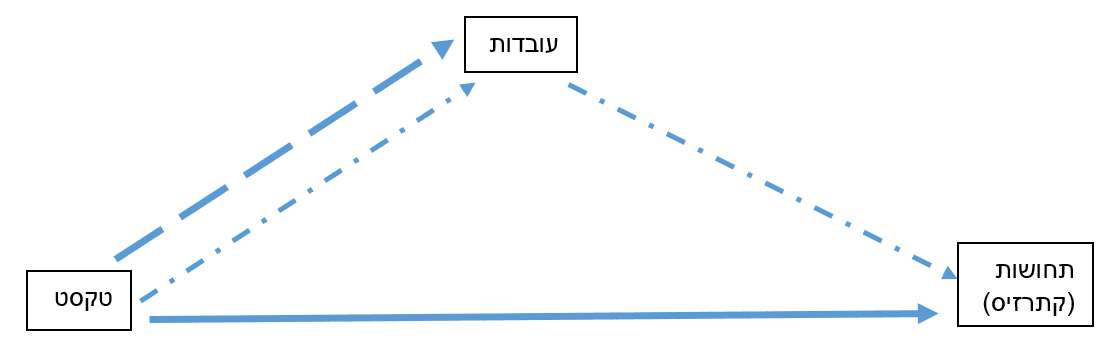
Legend: the broken arrow from the text to the facts (real facts) is pure prose. The solid downward arrow from the text to feelings is pure poetry. And the dash-dot-dash arrow from the text to facts (usually fictional) and from there to feelings is pure literature.
The relation between the process of creation and the process of reading/decoding/interpretation
In the work of the creator of the text, the route from the creator to the text is of course reversed. In pure prose he begins from the facts and creates from them a text (whose purpose is to return and create those same facts in the reader). In pure poetry he begins from feelings and creates from them a text whose purpose is to create feelings (not necessarily the same ones he had) in the reader. And in literature he begins from feelings and creates situations that express them, and from those he creates a text that describes those situations (this stage is an almost prosaic process, though it contains formal-poetic elements), and all this in order that the opposite route should occur in the reader (from the text to facts to feelings). One can reverse the directions of the arrows in the diagram above and obtain the routes on the side of the creator instead of those on the side of the reader.
As I already wrote in one of the comments, the definition of a given text as literature or poetry depends also on the creator’s intention and not only on the text itself. One can now see why. In all these texts something passes, however abstract, between the creator and the reader. The complete route is really a combination of the diagram above with the complementary diagram that describes the creator’s work. Thus feelings or facts that are present in the creator pass through the text to the reader (even if the creator is not aware of this at all). If the first part of the route is missing, for example when a person derives certain insights from contemplating a telephone pole, a cloud, or a housecat, this cannot be seen as an artistic experience. This is certainly not reading poetry and not reading fiction. Human agency is essential to the definition of art. My assumption here is that, contrary to the radical conceptions of deconstruction, there must be some connection, sometimes a very abstract one, between the author’s intention and what is created in the reader. Otherwise there is no difference between a text created intentionally and a natural landscape. These points will return to us in the next column when we return to the discussion of Torah study and Hasidism (yes indeed, you heard correctly: I am not done with this yet).
Implications: intermediate shades
From the picture described so far, it follows that there are three pure poles: pure prose, pure poetry, and pure literature. We must now give thought to the intermediate shades, and see why the picture of poetry and literature appears to so many of us so complex and confusing. As I explained in Column 109, the reason is that we relate to all shades of poetry as one block, and the variability and diversity do not allow us to define poetry. The same is true of literature. Once we have defined pure poles, the way is opened to understand that the full range of diverse phenomena before us is nothing but a collection of intermediate shades combining pure poetry and pure literature, pure literature and pure prose, or pure poetry and pure prose, in different proportions. This is how the complete map is spread out before us, and once we understand this, the picture becomes more intelligible.
Thus, for example, the Song of Deborah is really a composite of literature and poetry. Certain parts do not describe situations or facts at all, while other parts do describe facts (including emotional facts), but do so in a poetic way. Some parts have a poetic formal structure, and others merely use pathos that is closer to literature than to poetry. The same is true of the Song of the Sea.
Let us look for a moment at the Iliad and the Odyssey. They describe events (probably not historical), and therefore they are closer to literature than to poetry. In their external form there are poetic elements, but there is a significant literary component here. Yishai wrote in his comment on Column 107:
An interesting test case — there is a Hebrew translation of the Iliad and the Odyssey into prose (Aroeti’s), and there are translations that preserve the poetry. The noticeable difference is that the poetic translations preserve the meter and Aroeti does not, and this is also the reason Aroeti shifted to prose — he thought that preserving the meter while also translating accurately was too difficult a task. Even so, it seems to me that the reader feels there is a great difference between the two translations (even if one were to divide Aroeti’s lines in an ostensibly poetic way). Of course the content is identical, so that is not what creates the difference.
I am not familiar with those translations, but the move from poetry to prose indicates that what we really have here is literature and not poetry. It may be that one of the translations chooses to leave a more significant poetic flavor in the text, but fundamentally this is literature and not poetry. The reader’s feeling that there is a difference between the translations stems from the built-in difficulty of identifying and understanding poetry, a difficulty that leads the human creature to present a poem differently from literature or prose. And now our habit is activated, and therefore when we see poetic form we tend to decide that this is a poem. Since the meaning of poetry is not conveyed through the meaning of the words and sentences, the fragmentation into lines creates a sense of poetry and perhaps also arouses poetic feelings in us (catharsis). But with regard to works like the Odyssey, it seems to me that this classification is not precise. In the background of these remarks lies, of course, another important question, namely what the creator intended: literature or poetry. Was his intention to tell a story or to arouse feelings not connected to the content of the words and sentences? It seems to me that from this perspective too, the Odyssey is a story and not a poem (see the historical note below).
Yishai adds there in his next comment the following:
Two more interesting cases I thought of:
- Joshua 12. Here we have a grocery list (well, not grocery, but a list) that received line breaks and became poetry (unless we understand that the lineation really does not reflect poetry). True, Homer too has lists (the Catalogue of Ships is especially well known), but there it is part of an epic and not an independent poetic passage consisting entirely of a list.
It seems to me that the author was not joking, as in Muad’Dib’s example above, but that he really did see this as poetry. It seems to me that one can learn from this about the subjectivity of poetry: at that time something like this was considered poetry, but we need not go so far as to empty the concept and say that poetry is whatever I decide. Apparently the author’s contemporaries saw this as poetry because it aroused something in them. If we define poetry (also) by what it arouses in the reader (let us suppose for the sake of the argument a definition like: a passage that uses some stylistic means to arouse strong emotions), then of course the definition will be reader-dependent, but it is still a definition with content.
The breaking into lines of the list of kings in the book of Joshua is, at first glance, quite similar to the lineation that Muad’Dib applied to my remarks (see Column 107). Here too we have prose with some poetic dash, but it is still difficult to call it a poem. However, on second thought it seems that the matter depends on how we interpret why the Bible chooses to write this list in poetic form. It seems to me that the intention was to turn it into a victory song. There is a song of praise here for the victory we won over those 31 kings. In fact, this is a monument, and the difference between a monument and a list of people lies in the connotation that accompanies the list (glorification or humiliation, thanksgiving or lament). If indeed the purpose of the book of Joshua is also to convey the list of kings itself, then there is a high value of p here, but this does not detract from the text’s poetic value (q). By contrast, the lineation that Muad’Dib applied to my remarks does not add any significant value of q, while its value of p remains what it was. There this is indeed nothing but a gimmick.[1]
In that same comment Yishai brings another example:
- Rabbi Kook’s Poem on the Laws of Hanukkah (and others like it). Here it seems to me that most readers, both then and now, would not really see this as a poem. It makes use of stylistic devices found in poetry, but is not itself a poem. It seems that poets invent all kinds of techniques that help them write something worthy of being called poetry, so that these techniques indeed become an important characteristic of poetry and something that contributes greatly to poeticity, but these techniques can also be taken over into the writing of other things, something one might call ‘a poem by virtue of its external appearance.
In this case too, the poem is composed of information (the laws of Hanukkah), upon which a poetic structure is superimposed that presents it in the form of a poem. Therefore there is a text here with a significant value of p. Yet from looking at the poem itself (there is a link above) it emerges that unlike the list of kings in the book of Joshua, here the informational component is much less significant. The wording is plainly poetic, which cannot be said of the list in the book of Joshua (which is nothing but a completely prosaic list of names). It may therefore be assumed that the author’s intention (Rabbi Kook’s) was not to convey information to us, since the laws of Hanukkah can be written in a simpler and clearer way. His purpose here was probably entirely poetic, and therefore although he uses true facts, what we have here is a poem. The fact that we are dealing with true information admittedly makes the diagnosis more difficult, because the text G is composed of two components and not only a poetic component (q), but this does not detract in any way from the text’s poetic value. In the list in the book of Joshua, the value of p is very high. This is essentially pure information with a fragmentary formal structure superimposed on it, and no more (similar to Muad’Dib’s gimmick in my remarks). In Rabbi Kook’s case, by contrast, the wording too is poetic and the information is very indirect and unclear. Therefore there the value of p is lower. As I explained, the value of p, whether high or low, does not make the text less poetic, but at most makes it harder for us to determine that it is a poem, since it is hidden behind the information or mixed into it. The fact that there is information mixed into the poem does not change anything essential, but perhaps conceals its true nature somewhat. That is precisely why the analysis we have done here is useful: to expose these hidden characteristics. The list in the book of Joshua is mixed with a more significant informational component, and therefore its poetic character is more concealed. But that does not mean that it is necessarily a less poetic text. That will be determined by the value of q and not by the values of p.
The historical development of the genres under discussion
In note 6 to Column 107 I cited Aristotle’s definition (Poetics, pp. 49-50) of poetry:
It is clear that it is not the poet’s task to recount what actually happened, but what could happen, that is, what might occur according to probability or necessity – for the historian and the poet differ from one another not in that one tells his story in measured language and the other not in measured language, but in this they differ: one recounts the events as they were, whereas the other – as they might be. Therefore poetry is more philosophical and loftier than history, for poetry speaks chiefly of the universal, whereas history of the particular.
And I wrote about this:
It seems highly implausible to me that the difference between prose and poetry lies on the axis of fiction versus reality. There are poems that describe reality (like parts of the Song of Deborah), and there is prose that deals with fiction (almost all literary fiction). It seems to me that in Aristotle’s time these genres as we know them today did not yet exist.
Now I can say this more precisely: Aristotle defined literature, not poetry. He was referring to ballads and mythic stories like the Odyssey and the Iliad, for in those days there was no modern poetry and also no fiction in its contemporary sense (both of these are fairly new phenomena. The modern novel was born deep within the modern era). Above I pointed out that these texts lie in the space between literature and poetry, and in fact are closer to literature. The distinction between poetry and literature did not really exist for Aristotle, and when he speaks about poetics he includes literature and poetry together. Therefore, from his point of view, fiction is a central poetic criterion. In our period these genres have developed, and now it is possible to distinguish between them in a sharper and clearer way, and today we understand that fiction characterizes literature (and not necessarily even all of it), and not necessarily poetry. The question whether this development is invention or discovery is an interesting philosophical question. Here I will only say that in my view it is discovery, that is, not merely change but progress. We brought into actuality a distinction that was hidden from the eyes of the ancients, or at least more blurred for them.
Implications: similar phenomena — jokes, metaphors, and codes
After Column 110, a discussion arose about codes, metaphors, and jokes. In all these cases the text does not convey to us the information embedded in its literal meaning, and the question was whether we should view them as different kinds of poetry.
With regard to a joke, I was asked there:
Is there a place for ‘joke’ on this complex map?
And I replied:
I think a joke is pure prose, isn’t it? True, the ‘information’ it conveys is a bit different, but then this is simply a subdivision within the pole of pure prose. But this really does require discussion, because the goal is to make one laugh and not necessarily in this way. That is, the goal is not the information contained in the joke. And this requires further consideration.
That was halfway through the process, and so I really did not know how to answer. Now we can answer more clearly. A joke is meant to arouse feelings in us through a situation (usually fictional, though not necessarily), but clearly not merely to report what happened. Therefore we can now determine that a joke is indeed not poetry, but it is also not prose. It is a certain kind of literature (which can of course be good or bad).
As for a metaphor (not necessarily a dead one, that is, one whose meanings have already become fixed and become part of the language. A new metaphor too works in principle in the same way), I argued there that this is pure prose, not even literature (or at least almost not literary. q is very small). When one says something metaphorically, one intends to use a word the way words are used in ordinary language. The only difference is that we are dealing with a word that usually serves in one meaning, and the metaphorical use gives it a different meaning. Still, so long as it is understood that this is the meaning of the word, there is no literature here and no poem, but rather the conveyance of information through the plain meaning of the word, except that this is done in a language slightly different from what is customary. It is as though I conveyed information to you in English within a Hebrew text. I illustrated this there by means of the metaphor “heartache.” It is clear that the intention is not to physical pain that a person feels in his heart (like pain in the leg). This is a metaphor meant to express a mental state, and yet it is clear to the reader that this is the meaning of the term in this context, and therefore from his point of view this is an entirely prosaic text (except that it is not written in ordinary Hebrew). I added there that in cases where there is an ordinary word to describe what I wish to convey to the reader/listener, and I nevertheless choose a metaphor (not because of shifts in meaning, however subtle), then perhaps one can speak here of a poetic, literary, or lyrical aspect. But that is not the usual use of metaphors.
The same is true of a code. There too we are dealing with a move to a different language, but every expression and word in the text still has a perfectly ordinary meaning. It is an esoteric language, but entirely prosaic (“perazit,” in Rabbi Kook’s terminology).
Another example: Flight 3525 and the art of photography
With all due distinctions, and with apologies to the connoisseurs among us, I would like to return here to the above-mentioned song by Avi Ohayon, which was brought in Column 110 (near note 7). On the map I have now sketched, one can determine that it is really more literature than poetry. The text does indeed describe facts that are apparently entirely prosaic, actual events from everyday life, but of course this is a fictional reality. Ohayon uses this fictional reality in order to convey feelings to us and not information (for there is no information here. The events did not happen). In that sense it is closer to literature set to music than to poetry.
Therefore there is a certain justice in what Hevroner wrote in the comment in which he brought this song with undisguised irony. He compared it to the poem made from my opening paragraph (Muad’Dib, see Column 107). But at least on the principled level he was mistaken. This song may resemble literature more than poetry, but it has no pretension whatsoever of conveying information. It describes factual situations, but it does so with the aim of arousing feelings. So true, it is not really a poem, but neither is it prose of pure information (a grocery list). By contrast, my opening paragraph was intended to convey information, except that it was presented in fragmented form as though there were a poem here.
If we take a song that in my eyes has far higher qualities, such as A Lone Lantern by Yosef Dar and Haim Gouri (with a wonderful melody by Sasha Argov and a marvelous performance by Hatarnegolim), one can say the same things about it as well. Almost all of it describes situations from life, admittedly fictional but situations that could have been and whose like indeed existed in the world. Its purpose is of course not prosaic, because it is not intended to convey information to us, but neither is it pure poetry; rather, it is something closer to literature. Its purpose is to arouse poetic catharsis in us, to convey feelings and moods and not facts.
Here is the place to remark something about the art of photography. In fact I should have brought this up in Column 109, when I discussed the relation between information and added poetic or artistic value. The art of photography too is very confusing, and in light of the picture described here it should be clear to us why. Unlike painting, photography uses true information. The situation in the photograph existed in reality, and the photograph merely conveys it to us. Therefore, apparently, this is prose and not art. And yet, it seems to me that it is correct to see artistic photography as art. The photographer’s choice of which situation to convey and in what way to do so adds the artistic dimension (q) on top of the information (p). A press photographer, by contrast, aims to convey visual information to us, and therefore he is not an artist but a kind of reporting journalist.[2]
In this terminology, Avi Ohayon’s “poem” or A Lone Lantern are in fact photography. They photograph a concrete and realistic situation (though fictional, of course), but this is literature and not prose, since their intention is not to convey the situation to us but to say something through it. He is not a press photographer but an artistic photographer (again, without addressing the artistic quality. Here I am concerned only with classification and categorical analysis).
Methodological note
We reached the conclusion that Avi Ohayon’s text is really literature and not poetry. One could raise here a principled difficulty regarding my entire move. After all, from the outset we defined this as a poem, and after the analysis that is meant to clarify the intuitive concepts of poem and story, we arrived at the conclusion that this is a story and not a poem. Seemingly, this means that the analysis and the picture proposed here missed the very thing I was trying to define.
Here is the place to return to the discussion in Column 108, where I discussed the usefulness of a clarificatory definition (as opposed to a constitutive definition). I explained there that what concerns us here is a definition whose purpose is to conceptualize and elucidate concepts that we understand intuitively, and not to constitute new concepts. And nevertheless, I explained there that conceptualization can change our answers to various questions. If at the intuitive stage we would have answered that this is a poem, now after the analysis the conclusion is that this is a story. This is in fact the second benefit that was mentioned there for the clarificatory definition, which can sometimes bring about a change in diagnosis as a result of the definition, as compared with the intuitive diagnosis.
The only criterion that can be proposed in order to examine this process is whether we have a sense of self-evidence, that is, whether we have become convinced that this change better hits our original intuition than what we thought before. If so, then apparently we have nonetheless succeeded in capturing the meaning of the intuitive concept, and that capture brought a clarity that changed its meaning for us, or at least our understanding of its meaning. And certainly there is here a marked improvement in our ability to use the concepts under discussion explicitly and systematically. If at the beginning the questions embarrassed us, now we can answer them. As I wrote above, this does not entirely remove our subjective evaluations (how does one determine poetic value), but it helps us place and direct them, and use them in order to make decisions.
Summary: definition and elucidation
I pointed out that although in this series I am looking for a definition, what I mainly mean is elucidation. There is no chance of arriving in these fields at definitions with mathematical sharpness, and therefore the heart of the move is the clarification of the picture. I did this through the understanding that what we have here is a collection of phenomena that are different expressions of one fundamental phenomenon that appears in different proportions, and this is why it confuses us. From here the need to identify the pure poles that lay out this picture is clear (its mathematical basis, in the sense of mathematical spaces).
I explained that these poles are mere abstractions (or at most Platonic ideas). There is no actual text that is pure poetry, pure literature, or pure prose. All these are abstractions that I created here in order to clarify the complex picture. Therefore the “identification” of the poles is really an intellectual identification and not an empirical search. One may say that we create these poles and do not locate them. In actual phenomena, that is, in texts we encounter in life, there is in each one some poetic dimension and perhaps also something quasi-factual. Every actual text is a combination of these two (as formula (3) that I proposed above shows), and nevertheless it is important to conceptualize and define them, because the construction of these poles enables us to present the whole range of phenomena as different mixtures of the poles we have created, and thus to clarify the confusing picture before us.
We saw here that once we did this, we can answer all sorts of questions that we could not answer before we set out. We now have tools to define and classify the phenomena and understand the meaning of the intermixture among them and the confusion it creates in us.
A closing note
As the reader rightly understands, the picture described here does not make our intuitive and subjective evaluations superfluous. When we come to determine an author’s aims, as well as the poetic or informational value of a text, there is no avoiding the exercise of intuitive judgment. My remarks contain no criteria or measures that will determine all this. The picture here is intended only to direct us and to give us a conceptual framework within which the discussion can be conducted in a more systematic way. A computer presumably will not be able to make do with this picture and, by means of it, produce an output containing a diagnosis of where every text stands on the poetic map. And yet it has theoretical value.
But there is another aspect that gives meaning and importance to this move, and I will note it briefly here. Freud’s psychoanalysis was the first to propose a system of concepts and principles within which psychological discourse, discussion, and research could be conducted. In my amateur assessment there is not much connection between the psychoanalytic picture he proposed and reality. As Karl Popper already determined, there is certainly no science here. What we have is a collection of speculations and creative inventions for which there are no clear indications of any connection whatsoever to reality. And yet, despite all the criticisms that have continued to intensify down to our own day, it is important to understand that the value of the Freudian map and conceptual system is enormous. Before that framework was proposed, we had no lexicon at all within which a discussion could be conducted. Think what you would do if you had to begin the discipline of psychology now. Without any system of concepts and without categories and a mental structure (invented), we have no way to classify the phenomena, judge them and find dependencies and relations among them, determine parameters for quantitative measurements, and propose theses that can be discussed and subjected to tests of confirmation and refutation. Even someone who does not accept the Freudian picture can conduct a discussion within it. Even in order to disagree with Freud, one can formulate a claim in his terminology and thereby subject it to empirical test. Without that terminology, it would not have been possible to conduct a discussion at all.
At least in this sense, the proposal of a conceptual map and systematic principles is important. Even if someone should dare disagree with what I said here (woe to him), he must admit that now we have a way to formulate the dispute between us and examine it on different examples. Moreover, the map described here also enables us to propose lines for the continuation of the discussion, the analysis, and the research. It is now possible to classify the kinds of poetic feelings (catharsis), the different aims of creators, the different formal components that can be used (this, of course, is often done, and the kinds of poetry are classified by them), and so on. A systematic picture, even if one does not accept it, opens the door to further systematic discussion, and of course also brings the discussion that has already taken place into an overall framework.
[1] As I noted there, if the purpose of the lineation was to demonstrate the built-in ambiguity of the concept of poetry, then perhaps one can see this lineation as turning the prosaic text into a poem (adding q), precisely as I explained here regarding the list of kings in the book of Joshua.
[2] Of course here too there are poles and intermediate shades. A press photographer may do his work in an artistic way, and then there will be in him a mixture of artist and journalist. A journalist who writes prose can also do so by means of various literary and artistic devices, and then he creates a mixture. Still, the poles help clarify the meaning of the mixture and therefore to address the complex picture and analyze it.
Discussion
If this isn’t a joke but a serious remark, I don’t understand it. I explained very clearly what the existing differences are and which differences are illusory (as with the difference between the flight and Agnon, which are both literature. Again, my apologies for the comparison).
With God’s help, 24 Tevet 5778
Aristotle suggests two characteristics of poetry: (a) the description of what ought to have been. (b) seeing reality in the form of a generality that connects the particulars.
Regarding characteristic (a), “the description of what ought to be” — I would amend Aristotle’s definition a bit, and say that the poem confronts (explicitly or implicitly) the “present” (what is happening / what was) with the “desired” (what ought to be), and from this confrontation emotion arises, whether sorrow and pain or joy and hope.
Regarding characteristic (b), viewing reality as a single whole that has an overall meaning — where Aristotle compared poetry to science, which also connects particulars into a generality — one should distinguish that whereas science gives a precise definition, poetry speaks in the language of metaphor, emphasizing certain details in the picture, and the reader/listener grasps the moral or meaning intuitively.
Thus the poem about the flight describes the experience of falling in love by likening it to soaring to the heavens; thus Naomi Shemer, in her song “White City,” describes the differences between a person’s feelings during the daytime hours, when one turns outward, dazzled by the rush and froth of the city’s vibrant life, where the individual seems like “fine dust” on the glittering scarf of the “white city” — that city which, in the disappointment of twilight, will become dark and threatening — and it is דווקא the warmth and love in the private domain that are the point of light!
In both of these poems, the effect of confrontation (characteristic a) is also emphasized — in the poem about the flight, the confrontation between earth = routine and heaven = powerful emotion; and in the poem “White City,” the confrontation between day = externalization and night = inward gathering.
Bialik also addressed poetry’s ability to experience deeply both the uniqueness and the togetherness in reality, in his essay “Revelation and Concealment in Language” (on the Project Ben-Yehuda website), to which Ramda linked in column 109.
Regards, S. Z. Levinger
The basis is always the fundamental definition: prose tends toward ordinary spoken language, whereas poetry was originally intended, in its historical source, to be sung with melody, and in the broader definition — to be read with intonation.
From the formal difference derives the difference in content. For expressing feelings, poetry and intonation are well suited, rich in metaphors and abundant in imagination; whereas for conveying clear and precise information, prose language is fitting.
Regards, S.Z. Levinger
I’m sorry if I was misunderstood, but this is a very serious remark.
I’m not saying anything new — the rabbi already noted that if, according to the definitions, we reached the conclusion that 5325 is a story and not a poem, then the definitions do not describe poetry as it is grasped intuitively.
That is the point I’m dwelling on.
The definitions blur all the intuitive distinctions, and not only that, but also the measures of quality for poems and stories.
The series of columns started out very promisingly — that a definition would come that organizes intuition and sharpens it, but now what I feared has happened to me. The definition is logical but does not match the feeling.
Since I don’t have concrete refutations, and certainly not alternative models, I’m withdrawing, and seriously moving on to another art form (classical music and jazz. Seriously).
In any case, thank you very much for the enlightening columns.
I admit and confess that I did not follow every word of all the columns and comments, but in my opinion, the written human work, any in-depth logical analysis of it, should begin with a logical analysis of the soul.
What is the difference between a phone book, Agnon, and 5325? A phone book conveys information, whereas Agnon and Moshe Peretz convey a state of mind (feelings, etc.). The qualities differ not only in linguistic register and in the situation chosen for description, but in the entire psychic dimension represented in the work.
One first has to investigate the nature of the soul (does anyone have any idea?) in order to reach serious conclusions regarding its written expression. That is my opinion, and apologies for not engaging with what was said in the columns.
*Another thing
I connect with the rabbi’s remarks regarding the different forms of written creation. The boundary between works is not sharp, as with heaps.
To the comment “The poem as confrontation and generalization,” paragraph 4, line 2:
…dazzled by the rush and froth of the city’s life…
That is why I referred to column 108, where I explained the meaning of conceptualization and why it does not have to fit initial intuitions (although, as I wrote here, it should indeed convince us intuitively now).
With God’s help, 24 Tevet 5778
Even in a text whose content is completely “prosaic,” whose purpose is transmitting information rather than expressing feelings, there is added value to poetic form. The rhythm, the division into short lines, and consequently the intoned reading — make it easier for the reader or listener to absorb the information and retain it in memory.
Thus, for example, the halakhic poem, which was a common genre in rabbinic literature, made memorizing the laws easier. And thus, for example, the stages of the Passover Seder were marked in the form of a poem with rhythm and rhyme, which facilitates memorizing the stages. How easy it is to absorb and remember the poem:
“Kaddesh u-rechatz, karpas yachatz, maggid rachatz, motzi matzah
Maror korech, shulchan orech, tzafun barech, hallel nirtzah
In a world in which writing was an expensive thing, not equally accessible to all — both because of the cost of writing materials and because of the masses’ lack of reading and writing skills — poetry served as the most efficient way to transmit knowledge to a broad public and preserve it for generations.
Once reading and writing became widespread, with the creation of the alphabet that drastically reduced the number of signs, and with the spread of paper and parchment, and with literacy becoming accepted as a value that should belong to everyone — the value of poetry as a central means of transmitting wisdom and knowledge was blunted, and its role as an artistic means of expressing feelings increased.
Regards, S.Z. Levinger
Indeed, now I see that you devoted a column to the matter of conceptualization that goes against intuition. In any case, I remain with the remark that the concept of written creation depends on the concept of the human soul. To understand the former well, one must understand (or clarify) the latter.
In the absence of an anthropology, we are left with the emptiness of the analytic. What about music, heroes, myths, language, and more?
A big white elephant stands in the middle of the room, and you, like in the parable of the blind men, inform us: an elephant is a pipe, an elephant is a pillar, an elephant is a wall.
I couldn’t decipher this riddle (that is, I didn’t understand a single word).
The blind man is trying to discover what is in the room. He thinks the trunk is a pipe, etc. Y.D.’s claim is that your attempt to define a poem is similar to that of the blind man, meaning that you only manage to touch parts of it but not see the full picture, and therefore your definition does not capture the thing at all.
I allow myself to sum up with a poem(?) by Meir Ariel:
How many beautiful words were scurrying here
and there, and suddenly a certain matter happened to come their way.
They circled it, surrounded it, arranged themselves before it
in a row and said: How are we for you?
It said to them: Beautiful, beautiful, but where are you
and where am I.
They went back and mixed into one another, went back and arranged themselves
before it in a different order and said, “How about now?”
It said to them: Much more beautiful, but you are you and I am I.
They went back and got mixed up again, went back and arranged themselves before it.
It was silent and answered them not a word.
Let’s take the example of Avi Ohayon’s song, where in the end you found yourself with the strange conclusion that it is actually narrative prose. I admit that from a literal reading I can definitely understand how you reached that conclusion. On the other hand, just from reading I can hear him singing the song (without knowing the performance itself). The rhythm here is too prominent for me to miss it. That is, its being a song depends not only on the language but also on another medium that does not appear in the analysis at all.
What is this medium? How is it connected to the human being? What is the image of the human being connected to the medium? These and more are simply missing from the analysis. The result is an abstract analytical analysis that is not connected to the phenomenon in its wholeness, but takes segments of it, analyzes them, and then comes out with bombastic declarations.
With God’s help, 24 Tevet, a reply to Y.D., according to the shortness of my hand!
Into the house to gather, the philosopher seeks, and to pass under the lintel, an endless elephant.
And he has no choice but to limit the scope, and break the form into factors,
In order to give a definition, clear and illuminating, one that can be explained, understood, and conveyed.
And by the nature of things, when one breaks things down into details, one does not exhaust them, but one draws near.
Every definition restricts and is not perfect, yet it gives a “handle,” even if diminished.
Faithfully yours, S.Z. Levinger
In the title:
To grasp infinity — one must contract it…
In the last line:
And every definition restricts, …
Regarding the methodological remark, I would add and say that if a certain definition did not have the effect of (in this example, say) changing our attitude toward something we thought was a poem into a story, for example (and vice versa), and we always changed the definition so that it fit what we thought before the definition, it would become trivial and worthless (too many ad hoc assumptions to plug holes). Too artificial. And the stronger this effect is, the more valuable and important the definition is. That said, there is a core with a critical mass of examples for which the definition really is supposed to fit our intuitive perception of them; otherwise this is not a theory but simply another name for something else. And a definition is after all a theory. It is supposed to describe the reality we perceive and explain it, not tell us that it is not reality and that we are imagining things. In other words, a good definition, like a good theory, has a successful balance (like everything in life) between fitting that core — describing the reality we know — and the new things we learn from it — changing our perception regarding examples that are on the periphery. And that is exactly what a definition does: in the area of the concept’s periphery, it sets a fence and a boundary. And what will happen, of course, with any boundary-drawing is that certain things that were on the periphery will end up outside the boundary, and that other things that were traditionally considered outside, but were also close to the periphery, will come inside it and be included in it. It is similar to the theory of relativity: it has a core, which is its agreement with the Newtonian limit at low velocities and weak gravitational fields. (This is a famous example of Bohr’s famous correspondence principle, which has always existed in physics.) By contrast, at high velocities and strong fields, its wondrous effects come into expression. In fact, all its beauty and power are concentrated in this peripheral area. This area teaches us what is stirring beneath the Newtonian surface and about the true nature of reality. So these examples need to be studied carefully, because that is where the full interest of the rabbi’s definition lies.
And I will only add that the boundary of the definition of poetry, as I said, is a fractal boundary. At every scale one can discover new details in it and new curvatures. There will always be more and more complicated examples, some of which will be poetry and some not. (And although I’m already on a roll, I’ll stop here.)
Greetings to the rabbi.
I followed the entire course of the argument closely, and I have two comments on it:
A. An enlightening argument, showing important techniques of definition and conceptualization, and even if there are a few specific reservations about the conclusion, the argument itself and the tools presented in it are excellent and important.
B. And even so, I agree with the comments of Hevroner, Y.D., and Yishai: even if this definition is completely precise and gathers all the data already known to us about poetry, prose, literature, and what lies between them, the following question remains: does someone who has gone through the whole argument understand what poetry is? Or, in Mary’s room version — if he now hears a poem for the first time, will he discover something new? It seems to me that he will, and therefore, although the definition gave an important sense to the word “poetry,” I do not think it included all of its meaning…
..The intention, of course, is that “words,” or definitions, cannot always describe a “matter” precisely.
With God’s help, 25 Tevet 5778
In his early notebook “Metsiut Katan,” section 77, Rav Kook distinguishes between “shir” and “zemer”:
“Zemer will be called the movements whose product is to stir the senses, and by that means they are intermediate in stirring the soul… but shir is only the idea that stirs the essence of the soul” (p. 130).
The rabbi explains the distinction between the senses and the soul:
“And behold, man is composed of soulfulness, which is the very essence of the name man, and the animality of the senses has an animal source, but the intellect is his soul” (p. 131).
Man’s essential nature is his soul = his intellect. Therefore there is a distinction between “poetry,” which expresses the idea that stirs the intellect, and “songs,” which stir the senses and only indirectly influence the intellect. Hence the Torah is likened to “poetry” and not to “songs.”
And this is close to Aristotle’s distinction, according to which poetry expresses the “idea,” “what ought to be,” and the overall vision of reality.
Aristotle compared poetry to philosophy, and the Sages interpreted “And now write for yourselves this song” as referring to the entire Torah, which stirs and elevates the intellect.
We thus learn that what stirs sensations is, according to Rav Kook, only in the category of “zemer.” “Poetry” is judged by the conceptual-intellectual “added value.”
Regards, S.Z. Levinger
Yishai, that is a declaration, not an argument. There is nothing I can do with it.
Y.D., you assume that everything set to music is a song/poem. I disagree, just as not everything written in broken-up lines is a poem (see the Muadib example). In my opinion, this is not a local dispute. This claim shows that you missed the entire significance of the argument.
At most, you could claim that in Ohayon’s song there is a poetic component (q) that is not zero, unlike Agnon. I am willing to accept such a claim, but it already leaves the entire analysis intact.
I completely agree, and I also wrote that. Still, it is not right to fall silent and not try to clarify, even if not to define. The model I proposed leaves enough degrees of freedom to reflect exactly your claim. And still, in my opinion there is value in the definition I proposed, and I have already elaborated on this at length.
Ailon, I completely agree. And I also wrote that.
Mario, Mary’s room is actually evidence to the contrary.
After all, what Mary’s room shows is precisely that a definition is not meant to provide immediate (sensory) understanding. On the contrary, its purpose is to build the theory that accompanies immediate perception, not replace it. Just as electromagnetism is not meant to give a person a sensation of colors. So is electromagnetism inaccurate? Or does it not include everything? That is a misunderstanding.
After all, that is exactly what I did: I found a definition that indeed does not provide, and is not supposed to provide, immediate perception. And if you agree that I did that, then you really do not agree with the responses of those you mentioned.
And regarding what you wrote, that the definition does not include the “full meaning,” that expression bears two meanings. From your reasoning, it seems you mean that it does not contain immediate perception, but as noted, it is not supposed to contain that. By contrast, if you mean that it is not precise in certain cases, that is a different criticism, but you neither showed nor argued that in your reasoning. One should remember that I sketched a metamorphic model, and it is intended precisely to show the complexity and the gray areas.
I must say that the responses here ignore all the methodological clarifications I elaborated on throughout the posts, and I did so precisely in order to answer these claims. In my opinion, they have no substance.
With God’s help, 25 Tevet 5778
To Ramda — greetings,
The fragmentation of a poem contributes to absorbing the message and internalizing it by dividing it into short portions that allow the reader or listener to focus on the distinctive statement in each line. This is true both in expressing feelings, in describing facts, and in presenting arguments.
In Muadib’s exercise, the fragmentation appears arbitrary, and therefore it tries to make the effect of fragmentation look ridiculous, but the failure lies in the fact that Muadib’s fragmentation has defects.
I will offer here my own proposal for meaningful fragmentation of the words, and it seems to me that the “poetic” presentation has clarifying added value:
What is poetry? / R. Michi
Toward Shabbat Shirah, which is approaching for good, I began to reflect
What is the definition of poetry, as opposed to prose, for example
And are there additional categories on this axis, for example:
Psalms seem to me not to belong to prose, but also not to poetry
So perhaps psalms are a third category?
Regards, S.Z. Levinger
Incidentally, regarding Psalms —
it seems to me that according to your conclusion one should say that the Psalms are pure poetry, in their focus on expressing the poet’s feelings,
To Rabbi Michi,
Not everything that is set to music is a song/poem, but every song/poem has rhythm (and by this definition I do indeed exclude all kinds of word-lists pretending to be poems). From rhythm it is very easy to move to melody, and that is indeed what often happens — or to lose the rhythm, at which point one moves into prose.
I do not know what it is in rhythm and melody that stirs us, but it seems that this speaks to different sides of the brain that are not activated by mere information.
About this it is said: the operation succeeded, but the patient died. You performed an analysis according to all the rules and methodological clarifications, but in the end you came out with illogical conclusions. Now, from our perspective, the burden of proof is on you — to find some unsupported assumption. I understand that in your view this is an argument you have been thinking about for many years, but still, sorry, you have not convinced us.
(Do not say, “Accept my view,” for they are permitted and you are not permitted.)
Because of the ongoing lack of understanding here, I am considering writing another column. You have been warned.
The patient is very much alive, and the conclusions are completely logical. Your remarks are simply a misunderstanding.
1. If Agnon were set to music, then by your method would that be a song/poem? So what is the difference between Ohayon’s flight and Agnon?
2. According to your method, is a poem without meter not a poem? That is patently unreasonable.
But we are repeating ourselves.
Every poem has rhythm? You are really inventing a completely new language here. In the language commonly used by ordinary human beings, that is simply not true.
It seems to me that a summary of the whole argument was already promised (in one of the previous columns or in the comments). It would be a shame to miss that.
Does the rabbi think there is room to define poetry as Wittgenstein once defined the word “game”? That is, that there is no precise definition of the concept of poetry, but only a sequence of overlapping and intersecting principles among different kinds of poetry, so that we have an intuitive concept of what poetry is on the basis of those intersections.
Until the 1950s, rhythm was one of the central characteristics of poetry. It seems to me that the liberation from the shackles of poetic meter was one of the harbingers of the postmodern spirit, which is prepared to stretch every existing concept and pour into it a meaning that empties and neutralizes it.
From a combination of formal characteristics — meter, rhyme, imagery, and wordplay — and content characteristics — such as an emphasis on expressing feelings — poetry has turned into a jumble of strangeness and vagueness, whose lack of definition is the most fitting definition of it.
Have you become, in old age, a postmodernist?
And still, even when they broke the shackles of meter and rhyme, the fragmentation into short lines remained a central characteristic. This fragmentation marks a mode of reading recommended by the poet. See the entry “Line (verse)” in the literature lexicon on the Matach “Virtual Library” website. And I have already mentioned the words of Yehuda Gezbar (“A Modest Note on: What Is Poetry?”, on the “Back Cover” website), who argues that poetry is not a type of text but a “form of reading,” which the fragmentation into short lines marks how to perform. (Assuming this is not arbitrary fragmentation, which is also acceptable according to the religion of postmodernity in which “all faces are equal,” and the stranger it is — the better 🙂
Regards, S.Z. Levinger
It seems to me that the complaints here in the comments are that in the end there are too many cases that have been taken outside intuition. Clearly one can and should distinguish between ancient poetry and modern poetry, but the fact is that everyone defines them under the inclusive category of poetry, as opposed to narrative prose. There are also enough non-ancient poems that have a plot. So one can discuss Flight 54249 and say that in fact it is not a poem, and here the definition helped us find an exception, but when it excludes a large part of what is considered poetry, then the definition no longer has much value.
It seems to me that they also did not address the problem on the other side, of non-poetry. A text whose sentences do not describe something — say, a postmodern article. Is that poetry?!
At the end of the process it became clear that you missed something (but that gives you an opportunity to write another 5 columns…).
I think one needs to weigh several variables, each of which can increase the poeticness, and the question whether there is a story here is only one of them. This is a very problematic way, because in the end, of course, no one gives numerical values to the variables, and when there are several variables to weigh, this leaves an almost infinite margin of vagueness to decide everything ad hoc, but it seems to me there is no choice.
I tried to think with my wife whether there is a difference between “Ayyeh Pluto,” which we perceive as a story, and “Latayul Yatzanu,” which we perceive as a song/poem. The conclusion is that “Latayul Yatzanu” contains a collection of experiences and not a story with a plot like in Pluto, and that this is more characteristic of a poem (but that does not mean that everything with a plot is not a poem).
Another interesting case my wife raised — Sticker Song.
I don’t remember promising that. I don’t think the overall picture turned out too complicated. All in all, it is a set of fairly simple principles, so the summary is rather self-evident. But perhaps I will write a summary before the next column, which I will probably add after all in light of the problematic nature of the comments here.
To the best of my judgment, I did not miss anything, and so far I have not seen even a single exception. What you and others here call “exceptions” stems from a lack of understanding of the meaning of the argument, and I will have to return and explain this in the next column.
What is true is that the definition is not mathematical, but I stated that from the outset. And after all, on that point you all agree, that there is no possibility here of giving a black-and-white definition. So what is the problem with what I did? All I did was give this complexity/vagueness a clear and sharp form, one that will also bring all the cases under it and also explain the meaning of the (mistaken) feeling that it cannot be defined.
Of course, if you don’t have the energy for another (five) columns, you are welcome to give up. You can certainly remain in your complete lack of understanding and enjoy it. That is perfectly fine.
If you think again, you will see that this fits exactly into my definition. Again, a misunderstanding.
Adir, indeed there is. And that is exactly what I did. But unlike Wittgenstein’s despair, in my opinion one can move forward and describe the complexity. He assumes that either one can define sharply or one must give up on definitions, and on that very point I disagree with him. Incidentally, in his later book that is exactly what he does (through the concept of language games and the like).
1. Agnon has no rhythm, and therefore it is impossible to set him to music.
2. As I recall, rhythm is not identical with meter. The chapters of Psalms are not strict about meter or rhyme, and still one who reads them can feel an inner rhythm.
The feeling of rhythm is the bridge between melody and prose that marks a poem.
Y.D., does Lasky’s poem have rhythm? In your opinion, is it not a poem? And so too regarding much of modern poetry.
A point for thought: while reading, I wasn’t completely convinced that Flight 5325 is a story and not a poem, and I think I have a theory why.
The role of melody within this whole fabric is somewhat elusive. On the one hand, it seems that it can be a characteristic that adds to the immediate feeling a poem is supposed to convey, just like rhyme or line-breaks, and it seems to me that this is the original purpose of melody in songs. But melody also has another role, an independent one, completely different from the whole scale of parameters described here, which concerns words alone. The fact is that there is music without words (classical music), or that one can dance to a song with music (I assume no one reads a poem by Bialik and bursts into a vigorous dance). All this leads me to think that “song/poem” nowadays is a shared name, where one of its meanings is indeed the one the rabbi defined, and the second is simply a melody that happens also to have words. Flight 5325 is not a poem in the first sense but more of a story; but it is certainly a song in the second sense, and in fact I assume that even the phone book, if someone bothered to set it to a catchy enough tune, would fairly quickly be called a song.
Rabbi Michi, you’ve managed to make me lose every intuition I had about poetry.
I can no longer distinguish between Flight 23234, Agnon, Gronich, and a phone book.
I’ve switched to classical music (until you get there too).