

When Will It Be Better? (Column 681)
The song became an intellectual event — and that itself is ridiculous
The rabbi opens with irony about how a dance song from Galgalatz managed to spark supposedly deep discussion among rabbis, thinkers, journalists, and news sites. He even mentions an AI-written response “in the spirit of his thought,” and presents the very public mobilization to interpret, correct, and report on the song as a symptom of wildly inflated proportions.
The problem is not that the song is shallow, but that people treat it as if it were a work of religious thought
The column does not defend the song’s content. On the contrary: the rabbi makes clear that on the level of ideas, this is a text “at the level of kindergarten children,” fitting, in his view, for Breslov and its rabbis. But precisely for that reason, he thinks the embarrassment lies not in the existence of such a lightweight song, but in the attempt to conduct a faith-and-halakhah debate about it as though it were a binding theological text.
You dance to a song; the criticism should be aimed at the lessons that teach this seriously
The rabbi distinguishes between a party song and Breslov-style lessons that convey the same message as Torah. In a song, he argues, most people are not thinking about the lyrics at all, just as dancers in other songs are not engaged in theology. So the criticism would make far more sense if it were directed at those who preach these messages seriously, and at the public that absorbs them as Judaism. There, he says, there is room for a sharp discussion about spiritual decline and about infantilism posing as faith.
The musical setting is actually a kind of repair: at least it creates entertainment instead of ideological nonsense
According to the column, turning the infantile message into a catchy song actually improves the situation: the text gains the value of light entertainment instead of remaining a lesson made up of triviality and wasted Torah-study time. The rabbi deliberately pushes the point and suggests setting all the ideological materials of that crowd to music instead of handing out pamphlets; that way, at least something more fitting would come out of them.
That is why he refuses to join the “deep discourse” around the song
From here follows his conclusion: he is embarrassed to contribute one more argument to the detached discussion surrounding the song. His view of the content is already well known, but this is simply not the right medium for that discussion. He even says he will hum the song for his own enjoyment while ignoring its content, as people do with most songs, even if with poets’ songs he himself usually does pay attention to the words.
Not every pop song needs to be measured against the Guide for the Perplexed
At the end, the rabbi adopts Avraham Elitzur’s remark: the other songs on the chart are not built out of quotations from classical Jewish thought either, so it is absurd to demand that this hit, of all things, pass the test of a theological system. The closing conclusion is that things will be “better” when people stop drilling into a song like this as though it were a central religious issue.
Lately the hit “Even Better” (aka: “Always Loves Me”) has flooded the media in all its forms. I’ve just been informed it even won Galgalatz’s weekly chart. I assume you’ve all encountered the lively intellectual-philosophical discourse the song has sparked. Who hasn’t weighed in—rabbis and thinkers through columnists and journalists. Since I’m not on social media, I assume that everything I have seen on the matter (and I’ve seen quite a bit) is only the tip of the iceberg. People have also asked for my opinion about the song and even more about the conversation surrounding it.
As it happens, even before I’d heard about the song, a few weeks ago I was sent a piece by R. Eldar Goldring (may he be blessed), from the yeshiva in Gush Etzion, who created an answer song in the spirit of my approach, generated by AI under his guidance. I must say the text is a bit mechanical and grandiose (AI, after all), but in my opinion the result isn’t bad at all. Though, with all my many shortcomings I’m no expert, it seems to me just by common sense that it’s a bit hard to dance to rap—and on that note (as it says there, there):
It’s so hard to write tears
Hard to bear the silence
It’s so hard to sing tears
And who will grant us comfort.
So each of you is welcome to offer, as consolation, a more rhythmic melody.
Here and here, for example, you can find examples of substantive, learned discussion of the song’s content. Personally, I find it a bit embarrassing that the subject of discussion is a dance track for Galgalatz parties. By contrast, see below the intellectual exchange between two Torah luminaries before whom the sun itself is but a candle at noon:
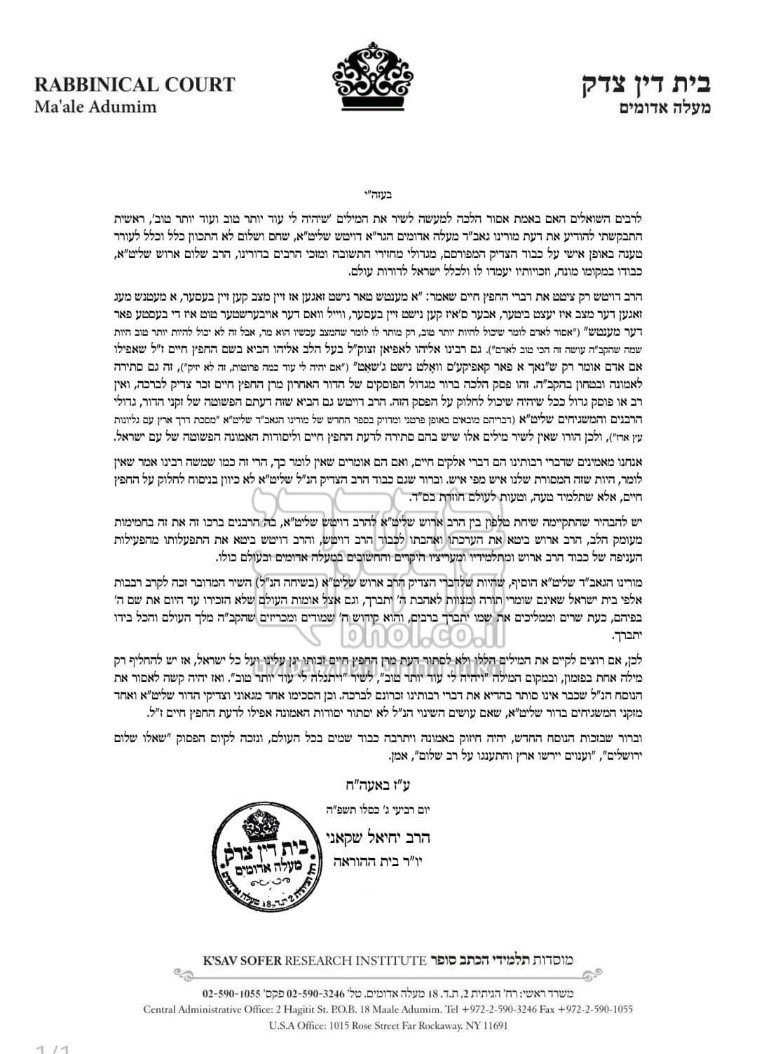
And of course there’s also a news report about this very profound discourse in a special bulletin on B’Chadrei Chareidim. The public mustn’t miss the latest updates in theology and halakha, and how to repair what that vile singer distorted when he dared to disagree with the Chafetz Chaim—whose every word, as if seated in the Chamber of Hewn Stone, came straight from the Divine. Take note of the genius of fixing everything by changing a single word. “How lovely on the mountains are the feet of the herald, a voice that brings tidings and says.”
I confess, to my shame, that I wrote in that thread that I intended to write a column relating to the song and the discussion about it, but now I feel that would be truly embarrassing. We’re dealing with a text at kindergarten level, befitting Breslov and its rabbis and Galgalatz (sometimes I get the impression that everything there and there is like that), but it’s very catchy and quite charming. There’s nothing wrong with partygoers jumping to this song. It’s certainly no worse than frenzied, “exalted-devotion” dancing with closed eyes to “My God, my God, why have You forsaken me” during the Simchat Torah hakafot.
Who even thinks about the words while singing?! Do you really think the dancers at Galgalatz are pondering theology as they play the song or dance to it? I could understand if such criticism were directed at those who go to hear the inane Breslov lectures in which these infantile messages are delivered (I think there are thousands of fools like that—“my father chastised you with whips”). There is indeed much room to discuss that. How did we come to be such a “generation of knowledge,” and how is this infantilism perceived as Judaism in our wretched times.
And behold—in this very case someone came along and repaired this infantile text by setting it to a lively, pleasant tune, so that now the text has at least some value. Not theological, God forbid, but what’s wrong with light, pleasant entertainment?! It’s vastly more valuable than the original as delivered in a lecture—most of which is nothing but bittul Torah and preoccupation with nonsense. What’s wrong with that? This is what they’re boiling over about? For my part, I’d suggest taking all the “ideological writings” of these folks and setting them to music. Instead of pamphlets, hand out cassettes at intersections, and suddenly everything will look better and better (as it is said: “Therefore it shall be said today: On the mountain of the Lord it shall be seen”). So precisely here, when the great repair has begun (a booklet unto itself), people choose to discuss the song’s theological and ideological layer? Diggers… And I say this as an indefatigable digger myself. But I’m a stickler for the rules: “When do we dig, and when do we not dig.”
In short, I feel embarrassed to contribute my part to the detached discourse surrounding the song. I’m sure you all know what I think of its content—to the extent one should think about the content of a song or of a typical Breslov lecture (songs—sometimes yes; those lectures—never). So I hope you’ll forgive me for not fulfilling your request and not adding my share to this deep theological-intellectual discussion. I’ll allow myself to hum the song for my own enjoyment, for the elevation and rectification of the souls of all Breslov Hasidim wherever they are, and of their “toite Rebbe” (if he only dreamed of the collection of distortions that would issue from his spiritual loins), while ignoring its content entirely. After all, that’s what you all do with almost every other song.
Admit it: even with songs by Alterman or Natan Yonatan, most of you usually ignore the text. I, by the way, generally do not. Poet-songs, by virtue of being such, are in my view one notch higher. It’s simply a completely different kind of enjoyment. Incidentally, I once heard on the radio that this is a uniquely Israeli phenomenon, since abroad people don’t set poems to music.
I have nothing left but to conclude with a succinct paragraph by Avraham Elitzur (and thanks to Hayuta Deutsch for the pointer):
Someone wrote to me here that “Always Loves Me” is a nice song but contradicts most of Jewish thought through the generations, and I’m here to report that out of a historical catastrophe I’ve just listened, for the first time in my life, to the entire Galgalatz weekly chart, and I’m pretty sure the other 19 songs there are not exactly quotations from the Guide of the Perplexed either.
“And the words of the wise are gracious.”
So when will it be better—indeed, even better? When they stop drilling into our brains…
Discussion
Dr. Roi Yuzvitz interviewed Haim Navon about this song
Roi Yuzvitz interviewed Rabbi Haim Navon about this song
Roi Yuzvitz interviewed Haim Navon about this song
I heard that Roi Yuzvitz interviewed Rabbi Navon about this song.
Same as above.
Same as above.
What, really?
Yes.
Hello Rabbi,
I agree with you on the subject of Hasidic courts, and certainly regarding contemporary Breslov Hasidism.
I’m interested to know whether the writings of Rabbi Nachman themselves, if you’re familiar with them, also sound like nonsense to you?
I once tried reading Likkutei Moharan, but there were so many things there that seemed strange to me that I said either I’m missing a great deal of knowledge in Kabbalah and maybe it’s all drawn from there, or else what I have before me is nonsense. And it’s hard for me to think that, since after all these are things attributed to a respected rabbi.
That’s nice, but did you hear that Dr. Roi Yuzvitz interviewed Rabbi Haim Navon about this song?
I’m not familiar enough. But my impression is that like other Hasidic writings, when you study it, you learn whatever you see in it—that is, yourself. It’s a Rorschach blot.
I’m debating with myself which is better (and even better) – the post or this comment thread.
I haven’t laughed like this in a long time, from both of them.
Ever since I started praying in a strictly Litvak minyan, I discovered that Lecha Dodi and the Kabbalat Shabbat psalms also have words.
But surely you forgot that they have a melody. By the way, in my opinion the main thing there is the melody, and for a reason not very far from what was said in the column.
Didn’t you say this is a uniquely Israeli phenomenon, since abroad they don’t usually set poets’ works to music?
In Rabbi Alkabetz’s time, did they also used to set the poems to music? Or did they just say the words like Litvaks?
My dear friends, the song deals with reconciling the conception of divinity with the existence of the world in light of the idea of perfection.
Always only good…
And even better, and even better….
I personally (and I believe I’m not the only one) generally do not like songs without words
(you can discuss what the rule is for songs in a language I don’t know, but that would take us too far afield),
and certainly not songs with incorrect words.
The song implants the words (like the songs on Simchat Torah) and does so without criticism,
as opposed to classes/lectures.
After our Rabbi—to Lod.
Apropos criticism of songs,
I would ask whether, according to the outlook of the local rabbinic authority, my honored teacher and rabbi, the song “The good, the good, the good, for Your mercies have not ended, and the Merciful One, for Your kindnesses have not ceased, for forever, for forever, for forever we have hoped in You”
does this song accord with my teacher and rabbi’s outlook? For after all, already since Nachshon Wachsman (and even before that), “His mercies have ended and His kindnesses have ceased.”
And behold, I saw a sign from Heaven: this Sabbath they called up a child for Musaf and he said, “the good, for Your mercies have ended,” and even when they corrected him, he repeated his mistake again. Still, I was afraid to rely on the verse this child in the synagogue quoted to me. Perhaps it was an act of Satan.
And the recommended correction at the moment is: “The good, the good, the good, for Your mercies have ended and Your kindnesses have ceased, for the world is already getting along, and getting along.”
Awaiting your reply. Thank you
It seems that the honorable rabbi did not understand the idea of Breslov in particular and the idea of Hasidism in general, and therefore he is dismissive, but one must be familiar with matters of this world and not only with the acts of Creation and the Divine Chariot, and that is how it is: Hasidism and Breslov provide a psychological response to something that people cannot understand intellectually. For example, a person does not know the future through his intellect, but if he thinks that God loves him and that things will be good, he will feel better; it is an existing fact in reality that this is what will happen. It is not that if he delves into his intellect he will thereby know what will happen in the future. This is a layer that his intellect cannot grasp, and therefore psychologically this does good for people in the world. Aside from the melody, the insistence on discussing the song in intellectual terms, in matters where the intellect is incapable, is not psychologically healthy, and it is psychologically harmful preoccupation.
So why did you write that I don’t understand? That is exactly how I understood it. What you don’t understand is that someone who believes in order to be encouraged is an atheist in distress, and his faith is a tranquilizer pill.
Famous fools’ commandments
Famous fools’ commandments
What you did here, in your relatively short article, is even better…