

More on Ockham’s Razor
With God’s help
BeDad – 2012
Michael Abraham
Senior lecturer and head of the Beit Midrash for outstanding female doctoral students, the High Torah Institute, Bar-Ilan University
Home address: Glicenstein 5/4, Petah Tikva, 49559.
Telephone: 03-9170387
Mobile: 052-3320543
E-mail: [email protected]
Abstract
This article was written in response to an article by Matan Binyamin, who compared the obligation to judge favorably with interpretation according to Ockham’s razor. In both cases, he argues, the interpretation in question is aimed not at truth, but at a value-based or aesthetic goal.
In this article I dispute his two principal claims, and therefore his conclusion as well: the obligation to judge favorably does not require deviation from factual truth. Likewise, Ockham’s razor is a means of arriving at truth (and not merely an aesthetic principle). Because the misunderstanding concerning the razor principle is so widespread, I have appended an appendix containing a proof of my approach.
Michael Abraham
Senior lecturer and head of the Beit Midrash for outstanding doctoral students, High Torah Institute, Bar-Ilan University
Home address: Glicenstein 5/4, Petah Tikva, 49559, Israel
Tel: 03-9170387
Cell phone: 052-3320543
E-mail: [email protected]
Abstract
This article was written in response to Matan Binyamin’s article, in which he argues that the Jewish-law duty to judge favorably is similar to Ockham’s razor, because in both cases the aim is not factual truth.
In this article I explain why I disagree with both claims, and in the appendix I offer a proof for my interpretation of Ockham’s principle.
More on Ockham’s Razor
Introduction
In his article in issue 24, Matan Binyamin drew a comparison between the principle of Ockham’s razor and the demand to judge favorably. In both cases, he argues, we are dealing with an interpretation that does not conform to the facts as they really are ("ontological truth," in his terminology), but is made on the basis of other considerations and evaluated by different parameters ("existential truth," in his terminology).
His argument may be summarized as follows:
- The demand to judge favorably is not intended to arrive at factual truth, but to arrive at a coherent picture of the world (in a way that does not necessarily contradict the facts), so that the person we are judging comes out as innocent as possible. The interpretation may be far from common sense and of very low probability, and it is measured in moral rather than factual terms.
- Ockham’s razor as well, which serves us in science and in all areas of our thinking, is an interpretive principle that does not aspire to reach truth but to simplicity and convenience. Here he relies on Hawking’s book A Brief History of Time, and in a note he mentions my article (which was not published; see the proof here in the appendix), in which I presented a proof against this view.
- From the comparison between these two cases, Matan Binyamin argues that in certain cases where ontological truth is not attainable, existential truth should be preferred to ontological truth. It appears that his intention is to explain the logic of the demand to judge favorably (existential truth at the expense of ontology) by means of the scientific use of Ockham’s razor.
To undermine the conclusion, it would be enough to undermine one component of the argument. But here I found myself disagreeing with all three at once. In this short article I will try to explain why, and to present an alternative picture. The positions presented in Binyamin’s article are based on very widespread assumptions, and therefore clarifying this issue is important even beyond the dispute over one specific thesis or another. In the following three sections I shall address the three points above one by one.
A. Judge Every Person Favorably
The first point on which I disagree with Binyamin is the way he interpreted the obligation to judge favorably. The Mishnah in Avot (1:6) states:
Joshua ben Perahiah and Nittai the Arbelite received the tradition from them. Joshua ben Perahiah says: Appoint for yourself a rabbi, acquire for yourself a friend, and judge every person favorably.
In Binyamin’s view, this obligation requires us to adopt strained interpretations of reality for moral reasons, even when we are convinced that the interpretation is incorrect. True, he notes that one should not adopt impossible interpretations (that is, interpretations directly contradicted by facts).
One may add here the well-known story about Rabbi Chaim of Brisk. He was asked: everything created has a reason and a purpose. For what purpose, then, was a crooked mind created? Rabbi Chaim answered: in order to judge favorably. His assumption was that judging favorably is to be done with a crooked mind.
As evidence for his interpretation, Binyamin cites the incident related in tractate Sabbath 127b. There we find a laborer whose wages were not paid. The laborer (whom the commentators identify as Rabbi Akiva) offers there very strained interpretations that justify his employer, as against the obvious interpretation that the employer is simply wicked and unlawfully withholding wages.
But this is contradicted by the interpretations of the medieval authorities (Rishonim) on the Mishnah in tractate Avot. For example, Maimonides there writes:
And judge every person favorably—this means that if there is a person whom you do not know, and you do not know whether he is righteous or wicked, and you see him doing an act or saying something such that, if interpreted one way, it is good, and if interpreted another way, it is bad—interpret it as good, and do not think badly of him. But if he is someone known to be righteous, and famous for good deeds, and an act of his appears whose characteristics all indicate that it is a bad act, and it can be judged a good act only with very great difficulty and by a remote possibility—you must interpret it as good, since there is some possibility that it is good, and it is not permitted to suspect him; about this they said: "Whoever suspects the innocent is afflicted in his body." And similarly, if he is wicked and his deeds are known, and afterward we saw him doing an act whose indications all point to its being good, yet there is a very remote possibility that it is bad—you must be wary of him, and not believe it to be good, since there is a possibility that it is bad, as Scripture says (Proverbs 26:25): "Though he make his voice gracious, do not trust him, for seven abominations are in his heart." And if he is not known, and the act tends toward one of the two extremes, then as a matter of virtue one should judge him favorably, whichever way it may seem to incline.
Maimonides rules that there is an obligation to judge favorably only where both possibilities are equally in play. But where, in light of our acquaintance with the person who acted, a different interpretation is called for, there is no mandate to bend reality.
The same emerges from the interpretation of Rabbeinu Ovadiah of Bertinoro there, who wrote:
And judge every person favorably—when the matter is in the balance and there is no decisive tilt one way or the other. For example, a person whose deeds we do not know, whether he is righteous or wicked, and he did something that can be judged favorably and can also be judged unfavorably—it is an act of piety to judge him favorably. But a person established as wicked may be judged unfavorably, for they said only that one who suspects the innocent is afflicted in his body [Sabbath 97a], which implies that one who suspects the wicked is not afflicted.
Rabbeinu Yonah, in his commentary there, elaborates on the matter and writes similarly:
And judge every person favorably. This speaks of a person about whom we do not know whether he is righteous or wicked. And if we know him, and he is an average person, sometimes doing wrong and sometimes doing right, and he does something that can be judged unfavorably and can be judged favorably upon consideration, or even if according to appearances it inclines somewhat more toward the negative side, if there is any aspect by which he can be judged favorably, one should say that he intended something good. But this does not apply to a wholly righteous person or a wholly wicked person…
He explicitly speaks of an obligation to judge favorably only where the two sides are evenly balanced (= of similar weight), or at most where there is a slight tilt in favor of the negative side (for every person has a presumption of propriety). But it is clear that one is not to twist logic in interpreting reality.
What emerges from the words of all these medieval authorities is that even when one judges favorably, one is not to distort logical judgment. When we see an impeccably righteous man pursuing an engaged young woman, the plausible explanation is that his wife sent him to return something she had forgotten at the young woman’s house. By contrast, if we see a wicked man doing this, the plausible explanation is that he wishes to harm her. Thus taking the character of the person involved into account is a thoroughly logical consideration, and the obligation to judge favorably is mainly meant to forbid us from adopting non-necessary interpretations in the negative direction. In any event, it certainly is not meant to instruct us to adopt illogical interpretations.
Let us also recall that regarding evil speech, the Chafetz Chaim writes that one may not accept the report as definite fact, but one must still take it into account. That is, in every case the issue is not decisions that are illogical, but rather refraining from adopting unnecessary negative conclusions.
And in the final analysis we must ask ourselves: if indeed, in contexts of judging favorably, there is a reasonable explanation that we reject in favor of a strained but more "moral" explanation, then this does not meet the criteria that Binyamin himself sets. He writes that only where factual truth is inaccessible to us should one prefer "existential" truth. But here factual truth is accessible to us, so why should we nevertheless prefer "existential" truth?
More broadly, the term "existential truth" troubles me already on the semantic level. Rabbi Dessler, in his book Michtav MeEliyahu, writes that when we lie for a justified reason, this is not "falsehood" but "truth." Falsehood, on this view, is what ought not to be said, not what fails to accord with factual truth. Claims of this sort create discomfort. I prefer the formulation that this is a permitted falsehood, not that it is truth, because it is not truth. If truth too becomes a travesty, and can be defined arbitrarily, what remains for us in our world? By the same token, the term "existential truth" seems to me very problematic, and it reminds me somewhat of George Orwell’s famous words in his book 1984, where he deals with communist brainwashing: "War is peace, freedom is slavery, ignorance is strength." The fact that a falsehood is justified does not turn it into truth. Put differently: this is not outright permission, but override. The term truth should always mean correspondence to reality. If some thought is morally correct, that does not make it true. The term "existential truth" blurs a meaning that it is very dangerous to blur, particularly in a postmodern world in which truth is under heavy (and mistaken) attack.
Let us now clarify the incident in tractate Sabbath, from which it appears that Binyamin’s approach is correct. At first glance, very strained explanations are offered there, and the laborer (Rabbi Akiva) prefers them to the obvious explanation. How are we to understand this in light of the medieval authorities cited here? Two possible explanations may be suggested:
- The incident described in the Talmud is an extreme case, and no practical rule should be derived from it. Perhaps there is room to praise one who behaves this way (if he understands that his words do not accord with the truth, but are morally becoming), but we are not required to act that way. For example, the Sages tell us that our forefather Abraham fed the angels who came to him three tongues with mustard, and slaughtered three calves for that purpose. It is not reasonable to think that each of us is required to waste three calves in order to feed his guests tongues. They can make do with pieces from the drumstick of a single calf. The story about Abraham is meant to present hospitality in an extreme and exaggerated fashion in order to motivate us to act, but it is not a model for practical implementation. It may be that Rabbi Akiva’s approach in this case likewise offers not a practical model for imitation but only a theoretical one.
- More likely, that laborer knew his employer, and therefore it was clear to him that the man was righteous and would not withhold wages without justified reason. And regarding a righteous person, the above medieval authorities wrote that one should not convict him even where the interpretation that justifies him is extremely strained. As we explained, the reason for this is not an obligation to be generous toward righteous people, but the fact that with respect to righteous people such explanations are not strained at all. In relation to a righteous person, the hypothesis that a given action of his was done out of wickedness is not plausible either logically or factually, and therefore we do not assume it about him. In other words, this is not "existential" truth but factual truth. Indeed, it is more accurate simply to say that it is the truth (for there is no such thing as "existential truth").
B. Ockham’s Razor
Let me preface by saying that one can find the principle of Ockham’s razor in several halakhic contexts. One of the best-known is Rabbi Chaim of Brisk’s interpretation of the Talmud at the beginning of Hagigah, which presents three signs of a deranged person. The Talmud explains there that none of the signs by itself is an indication that the person is deranged, because each has an alternative explanation, and so too when two of them appear. But a person who behaves like a deranged person in three different contexts is deranged. There we do not seek an alternative explanation. This is a use of Ockham’s razor, for we adopt the simplest explanation, even though it is not unique and not even necessary (it may be that there are three different explanations, one for each symptom).
Now I will ask Binyamin and the reader: if you see a person who in three different contexts behaves like a deranged person, on what would you bet on the ontological plane? Is that person deranged, or is this merely an accidental accumulation? There is no doubt that all of us understand that it is far more plausible (though not necessary, of course) that the person is indeed deranged. Why not assume three different explanations? After all, the explanation that he is deranged is certainly not necessary. The answer is that we assume Ockham’s razor is a way of arriving at truth, and not merely a practical (or existential) tool. The mistake in interpreting Ockham’s razor as a subjective tool not meant to lead to investigation of the truth stems from the analytic approach that sees every unproven and non-certain claim as arbitrary. But that is a mistake. There are claims that are not certain yet are reasonable, and there is no reason not to adopt them. Ockham’s razor is a tool that brings us closer to truth, even if it is not certain. Therefore, the conclusion that the person is deranged is more plausible on the ontological plane than the conclusion that he is not. This is not existential truth, and Ockham’s razor is a tool for clarifying truth.
I should note that Rabbi Kanievsky, in his commentary to tractate Tohorot (Kehillot Yaakov to tractate Tohorot, no. 47), expands this and argues that all presumptions established after three occurrences (three years of possession in land, menstrual cycles, an ox with an established propensity to gore, and the like) are based on the same mode of thinking. The underlying idea is that it is not reasonable to adopt three different explanations for three phenomena if we have a single alternative explanation that accounts for all three at once.
We are not dealing here with an existential or subjective principle, but with a principle that we regard as a tool for arriving at truth (in its ontological sense). Why declare an ox dangerous if we do not think it is such? If it is indeed not ontologically clear that it is dangerous, then the burden of proof rests on the one who seeks to extract payment (= the injured party). The same is true regarding menstrual cycles; there too our aim is to arrive at a situation in which there is genuine concern for seeing blood. These are not subjective games played for various reasons, but a device meant to identify real points of concern.
We see that every time we put a hand into fire, the hand is burned. Shall we conclude from this that the statement that fire always burns hands placed within it is an existential truth? Is it not factual truth? This is an absurd claim. The accepted scientific assumption is that what recurs is probably true. This is the principle of induction, and we rely upon it as a device for reaching factual truth. David Hume’s well-known challenge to the principle of induction is empirically refuted (see the appendix to this article). It seems to me that Matan Binyamin’s challenge here is based on a confusion between the claim that this truth is not certain/necessary (= the problem of induction) and the claim that it is subjective and existential. The first claim is of course correct, but the second decidedly is not.
Another example of the use of Ockham’s razor in Jewish law is the tzad ha-shaveh inference (the common-denominator inference, or building a paradigm from two texts). In the mechanism of tzad ha-shaveh (= the rule of building a paradigm from two texts), we infer from a law that exists in two different source cases to the existence of that law in a third place (= the target case). Every such derivation, without exception, appears in a situation in which each of the source cases has a unique characteristic that undermines the similarity between it and the target case. Only the combination of the two "does the work"—that is, succeeds in proving the existence of the law in the target case.
To understand this structure, let us use the following example (Bava Kamma 6a): our purpose is to prove that a stone, a knife, and a load that fell in an ordinary wind and caused damage obligate their owner to pay. The Talmud tries to derive this from a pit, and rejects that because perhaps a pit is liable since no other force is involved in it. It then tries to derive it from fire, and rejects that on the ground that fire has the special property of moving and causing damage. It then returns and learns from both together (from the common denominator of the two, namely that they are one’s property and their safeguarding is one’s responsibility, a side that also exists in one’s stone, knife, and load).
Without entering into the details of this mechanism,[1] one can see that there is yet another possible way to explain the source cases such that the conclusion cannot be derived from them: fire is liable because another force is involved in it, and a pit is liable because its creation is from the outset for damage, whereas one’s stone, knife, and load, which have neither of these features at all, are not liable for payment. In every appearance of tzad ha-shaveh in the Talmud, a similar question arises (this is what is called the refutation from the stricter side; see Ketubot 32a and Makkot 4a and parallels), and we never make such a refutation.[2]
The reason we choose the explanation of the common denominator and not the alternative explanation (of a different explanation for each source case) is Ockham’s razor. The explanation that in both cases the same factor grounds the law is preferable, in our eyes, to the explanation that grounds the law in two different factors. Now let us think: is it plausible that this is "existential truth"? Is it proper to innovate a law or a punishment on the basis of an existential truth that is not factual? Why should the tortfeasor not say that the burden of proof rests on the claimant who demands payment from him? We are forced to conclude that here too we are dealing with a tool that reaches truth (not with certainty, to be sure, but with high probability).
This mistake in interpreting the razor principle is very widespread, and therefore I decided to offer here the proof for my approach (on the basis of my unpublished article, cited by Binyamin). The argument presents a statistical proof against the "existential" approach to Ockham’s razor in science (and in general). I show there that the razor principle is a device for reaching factual truth and not merely a subjective way of arranging the information in our possession. This requires neither mystical conceptions nor considerations connected to quantum theory that supposedly prove that human consciousness influences reality (see Binyamin, note 4). In order not to interrupt the discussion, the proof appears as an appendix to this article.
It is important to note that quotations such as Einstein’s, where he remarks that his theory is the simplest possible, but does not rule out the possibility that the correct theory is more complicated, do not touch this discussion at all. No one claims that the simple is necessarily correct. The claim is that the simple is probably correct, even though in certain cases that may not be so. Science does not pretend to be as certain as mathematics or logic, and doubt always follows in its wake.
Immediately after the quotation, Binyamin writes: "Obviously, preference for Einstein’s theory does not indicate even in the slightest what reality is." Really? Do not the many confirmations of that theory’s a priori predictions indicate that it is more correct than its competitors? Here again there is an unjustified identification of lack of certainty with doubt and arbitrariness. Indeed, the simple explanation is not necessarily the correct explanation, but it is certainly reasonable to assume that it is the correct explanation. That, of course, was Einstein’s intention as well. Einstein means to say that another theory that explains reality is conceivable, but in his view it would be more complicated. He did not present such a theory, and I know of no such competing theory that explains all the facts. But even if there were such a theory, and it explained all the facts in a more complicated way, the assumption according to Ockham’s razor is that the simpler theory (Einstein’s) is probably the correct one. Theoretically it is possible that this is not so, but it is entirely reasonable to think that it is.
The main evidence for this is that Einstein’s theory predicted results that were later observed with astonishing precision. Is that not evidence of its truth? Of course, one can always propose ad hoc another theory that fits those results after they have already been observed. But a theory’s success in experiments whose outcomes it predicted a priori is a clear measure of its correctness. This distinction too is discussed further in the appendix.
C. The Comparison Between the Demand to Judge Favorably and the Razor Principle: The "Sanctity" of Science
Binyamin’s reliance on Stephen Hawking seems to me problematic. This is an ad hominem fallacy (an appeal to authority, particularly to irrelevant authority). In note 9 of his article Binyamin notes that in my article, which had not yet been published at the time, I prove the claim that Ockham’s razor is a tool for factual truth, and nevertheless he chooses for some reason to rely on Hawking’s unsupported words (Hawking does not argue for his claim). Hawking is certainly an important scientist, but to the best of my judgment he is a rather weak philosopher. Be that as it may, I would not recommend that anyone rely on an unargued claim of someone merely because he is the one making it.[3]
More generally, even if we were to assume that the previous two claims were correct (that the obligation to judge favorably requires us to act on the basis of considerations that bear no relation whatsoever to factual truth, and that Ockham’s razor too is such an "existential" device), I do not see how the existence of one problem constitutes an explanation or justification for behaving problematically in another context. The fact that in science we do something unsupported and unjustified cannot justify doing so in other fields. If I were actually to accept this mistaken interpretation of Ockham’s razor, at most I would throw all scientific laws into the dustbin of history (which of course I do not do, because in my view science does reveal the truth about the world, or at least approaches it). I do not see how the fact that one group of people (scientists) does things without argument or justification provides justification for another group (students of Torah, or servants of God) to do such things. It is like an English-English dictionary in which one incomprehensible word is explained to us by means of a collection of ten words that are even less comprehensible.
A common phenomenon in the world that seeks to connect Torah and science is to take a puzzling phenomenon that exists in the scientific world (quantum theory receives no small amount of abuse in such contexts), and use it to justify a halakhic phenomenon that is no less puzzling.[4] It appears as though science and scientists are endowed with a halo of sanctity, and therefore every puzzling phenomenon or statement in scientific contexts requires no justification. On the contrary, they confer some of their sanctity upon Torah, and thus difficulties and problems found there are resolved. I cannot imagine someone writing an article that justifies Ockham’s razor by means of the Mishnah that requires one to judge favorably, or the like. Nor have I seen anyone justify problematic statements of Hawking and his ilk on the basis of a puzzling Mishnah or baraita.
About this my children would ask: and if some scientists told you to jump off the roof, would you jump? As for me, I have always preferred an English-Hebrew dictionary.
Appendix: A Statistical Proof Against Empiricism and in Favor of Rationalism[5]
In my criticism of section B, I argued against a widespread approach that treats the principle of Ockham’s razor as a merely aesthetic principle. Because this mistaken approach is so common, I found it appropriate to devote an appendix to an empirical-statistical proof in favor of the opposite approach. The argument is fairly simple, but I do not know of a sharp and clear presentation of it, and therefore I offer it here.
The Actualist-Informativist Conflict
In the philosophy of science of recent generations, two basic approaches have confronted one another. Following Ze’ev Bechler, we shall call them here "actualism" and "informativism."[6]
Actualism is an approach that sees only actual facts as scientific information. Scientific laws, theoretical entities, and scientific theories, all of which have a non-actual character (they are not present before our eyes), are not understood by this approach as claims about reality, but as claims about the scientist or the scientific community. According to actualism, theory is nothing more than a convenient and useful arrangement of the totality of scientific facts in the relevant domain. According to this approach, the added value in theory beyond its being a collection of the particular facts observed empirically contains no information about the world. Hence the theoretical entities that the theory employs are merely convenient fictions used within the language that science develops in order to arrange efficiently and conveniently the totality of known facts. In other terms, such an approach may be seen as extreme empiricism, that is, a position that sees observation as the exclusive instrument for accumulating information about the world. According to this position, the generalizations our thinking makes on the basis of observations add information beyond what we have directly observed, and therefore they cannot contain information about the world; at most they provide us with processing and a certain form of presentation of the empirical information.
This is precisely Binyamin’s approach to the principle of Ockham’s razor. The razor helps us build a theory that contains the relevant facts, but he sees the theory as a subjective arrangement of the facts and not as a claim that is factually true (but only "existentially" true).
Informativism, by contrast, is an approach that some would call "naive," which sees the scientific enterprise as a process of progress and accumulation of knowledge about the world. According to this approach, scientific theory makes claims about the world itself. For our purposes, this approach sees the razor principle as a tool for progress toward factual truth. Those who hold this approach maintain that theoretical entities may exist (though not necessarily. There may be false theories, or phenomenological theories—those that do not purport to make claims about the world but only to offer a convenient description of a set of facts that constitutes a scientific domain). Informativism sees scientific theory as a claim containing empirical content beyond the totality of known empirical facts that form the basis from which the theory was created. In other terms, this approach may be seen as rationalism, for it expresses the position that the products of our thinking as such (and not only of empirical observation) can contain some information about the world.
Let us take Newton’s theory of gravity as an example. The facts are that different bodies fall to the earth. Newton proposed a generalization according to which every two bodies with mass attract each other, and as a particular case, objects with mass are attracted to the earth. Up to this point this is a phenomenological theory, for it merely describes what happens by means of a general law. The theoretical explanation Newton proposed for this phenomenon is that masses exert a force upon one another, called gravity, and this force causes the mutual attraction of bodies with mass toward one another. This theory is the result of applying Ockham’s razor, for it is the simplest generalization of the relevant facts. Now, actualism sees only the physical facts as factual determinations about the world. Objects do indeed fall to earth. But on its view, the generalization that there exists attraction between every two objects with mass is merely a conjecture, since we have not checked all bodies with mass in the universe. Moreover, the force of gravity, which is the theoretical entity that generates these empirical phenomena, is no more than a fiction whose purpose is a convenient, intelligible, and useful presentation of the facts. We conceive the world as though there really were such a force between every two masses. But since no one has observed this force itself (it is not an actual entity), we have no way to claim that it indeed exists in reality. Informativism, by contrast, sees gravity as an existing entity that operates in the world, and which produces the phenomena we observe. On its view, Ockham’s razor that yielded the theory brought us closer to factual truth.
The same dispute also affects the conception of the role and status of experiment and its results. According to the actualist approach, scientific experiment is not a means of progress toward building a theory that more fully corresponds to reality, but a means of gathering yet another scientific fact belonging to that scientific domain, and inserting it into the fictive theoretical structure. The builder of the theory will have to take this additional fact into account as well, and include it too in the (fictive) theoretical structure he creates. The success of the experiment is nothing but confirmation that the fictive language used by the scientific community does not yet require change. It still correctly describes all the facts known to us. According to actualists, the failure of an experiment is not the refutation of some claim about the world, but the addition of one more bit of information that forces us to change language (and sometimes also the theoretical entities included in it), or to build a different theory that can contain and represent the new information as well. Now, instead of a force of gravity we will have to define another theoretical concept that will organize all the facts for us.
By contrast, according to the informativist approach, theory makes claims about the world, and therefore scientific experiment is a touchstone for the validity of the theory. If the experiment succeeds, it serves to confirm the claim that the theory indeed describes the world correctly (that a force of gravity does in fact exist). If the experiment fails, the theory has been refuted. In such a situation the conclusion is that there is no force of gravity in reality, and therefore the theory cannot serve as an adequate description of the world. We must now look for another theory that will fit the totality of the facts (including the latest one).
Under each of the two wings of this schematic description there are many shades and sub-shades of different approaches in the philosophy of science, but for our purposes this general schema is sufficient.
Does This Philosophical Dispute Concern an Empirical Question?
These two approaches conceive the world, and especially science, differently. Actualism sees the world as a collection of particular facts. Laws are subjective, or inter-subjective, constructions that are carried out within the scientific community, but are certainly not descriptions of the world itself. Even if we assume that theoretically there are such general laws in reality itself (it is not clear on what basis we assume this), we have no ability to discover them by empirical means. Empiricism allows us to discern only particular facts, not general laws. Informativism, by contrast, sees the particular facts as various expressions of general laws of nature. Science is supposed to come as close as possible to a full description of the true laws, those that really exist, and therefore they also constitute a reliable description of the world itself. The conclusion from what has been said so far is that this dispute is not merely a dispute about philosophical interpretation alone, but concerns factual reality. It is quite clear that this is a factual dispute, concerning, for example, the existence of the theoretical entities produced in scientific theory. The question whether there is a force of gravity or not is a factual question, and therefore a dispute about it is a dispute about a factual matter.
We must now ask ourselves whether there is an empirical way to decide this factual question. It is commonly thought that there is not. At first glance, it seems that both of these approaches are located in the theoretical-philosophical world, not in the empirical sphere. They concern only meta-science, and the meaning of the scientific process, not its contents. That is, although this is a dispute about facts, it is not a scientific dispute, since we do not necessarily have an empirical way to decide it.
This is a description from the angle of the content of these positions. But one can also examine them from the methodological aspect, and in this examination too it seems that there is no real difference between the two approaches, for both describe the scientific process in exactly the same way. According both to the actualist approach and to the informativist approach, science is supposed to generalize the facts known to it, and to do so by means of theoretical entities and a theoretical construction that unifies them into a coherent structure, and finally to test itself by performing experiments that test predictions of the theory it has created. The success of the experiment leaves the structure in place, whereas its failure forces us to replace the theory.[7] At first glance, the difference between these two approaches concerns only the meaning of this process, and not its form and characteristics. It is therefore no wonder that these two approaches continue to confront one another throughout history (see Bechler) without clear resolution. The temporary swings of the pendulum in this dispute are the result of fashions more than of arguments, and certainly not of experiments. The accepted conclusion is that the decision between these two positions is not subject to any empirical test. And indeed it is no wonder that even Bechler, throughout his entire book, does not propose any test that would decide in favor of his sharp informativist position and against the actualism he so detests. He deals more with describing the two positions and preaching in favor of informativism while denouncing actualism, and very little with principled argument. Moreover, in the absence of any possibility of deciding the dispute, it would seem that we ought in fact to choose actualism, for Ockham’s razor instructs us to choose the option in which the number of entities is as small as possible. This argument sharpens the need for a genuine justification in favor of informativism, if indeed we wish to hold it.
The Reasons for the Dispute
We have seen that the actualist-informativist dispute concerns reality. We have also seen that there is no empirical way to decide it. So why did such a dispute arise in the first place? If the facts do not allow us to formulate any position, what nevertheless leads different thinkers to adopt either of these two views? The matter becomes clearer against the background of the last determination, namely that Ockham’s razor is what tips the scales in favor of actualism. It thus turns out that the roots of the dispute lie in a priori thinking and not in the factual world.
To understand this, I will first risk a guess: a large majority of scientists (this is certainly true of those personally known to me) hold the informativist approach, which is the more intuitive one. There is no reason to assume that there is a law of gravity if there is no force of gravity in reality that produces it (according to actualism, this is a fictive theoretical entity created by us only for the sake of completeness and theoretical convenience). By contrast, most philosophers of science tend, to some degree, rather toward the actualist direction (see Bechler on this). For them, informativism is naive, since it adopts the assumption of the existence of entities that we have no way to confirm empirically (and here Ockham’s razor points the other way).
What leads actualist thinkers so far from intuition? If indeed there are no empirical facts that oppose informativist intuition, then why depart from it? Why assume that there is a law of gravity but no force of gravity that produces it? It turns out that the reason for adopting an actualist conception is indeed not located in the factual domain but on the philosophical plane. There is a philosophical problem that accompanies informativism, and because of its clearly philosophical character, many scientists are probably unaware of it.
As stated, informativism conceives scientific theory as a description of the world itself. It sees scientific theory as something beyond the totality of facts that form its basis. But since David Hume, it has been clear that the generalizations that form the heart of every scientific theory, and the conceptualization of the theoretical entities within it—entities that cannot be directly observed (at least at the stage of constructing the theory, for otherwise they would not be "theoretical entities")—are the product of inductive thinking, not of empirical observation. Such a generalization has an a priori character, and therefore it is difficult to ground the claim that it is supposed somehow to correspond to the facts in the world, or even to say anything about them. The particular facts that form the empirical basis of the theory are facts we observe directly (through the senses or through measuring devices). But the theoretical generalization carried out on their basis is an a priori structure, dependent on the world of the scientist or the scientific community (what Thomas Kuhn calls a "paradigm"), on their way of thinking and conceptual world, and as such it cannot make claims about the world. Another person, or another community, would arrive at a different theoretical structure. For this reason, the actualist argues, theory cannot contain additional empirical information beyond the collection of facts that constitute it. It is an outgrowth of the community that uses it, and not of the facts. It seems that apart from Ockham’s razor, this is the main basis for the adoption of actualist approaches, and it is located entirely in the philosophical sphere, not in the scientific-factual one.
Solutions That Offer a Philosophical Basis for Informativism
Kant tried to cope with the Humean problem and offered a way to ground scientific generalization by an original path. The possibility of seeing theory as a description of reality itself despite its a priori-subjective source, Kant argues, lies in the constraints that constitute the phenomenal world (the world of appearances, or the world as it appears to us, as opposed to the world as it is in itself) with which science deals. According to Kant, science does not deal with the world as it is in itself, but with the phenomenal world. We see processes in certain ways only because the constraints of our cognition (which Kant calls transcendental principles) dictate that these forms appear to us that way. The generalization, he argues, is indeed a product of our thinking, but the world with which we deal is also not independent of our thinking. We do not observe the world as it is in itself, but the world as it appears to us, and this is a product of the categories within which our thinking and cognition operate. Judgments derived from the transcendental method are called by him "synthetic a priori judgments" (judgments that make claims about the world—hence synthetic—and at the same time are a priori, that is, not derived from observation).
A similar consideration would lead us to the conclusion that the laws of nature, which are generalizations of the particular empirical facts, are a kind of synthetic a priori judgments. According to the Kantian proposal, they are possible and valid precisely because they do not concern the world itself (the noumena) but the picture we have of it (the phenomena).
As far as I know, in the entire history of philosophy there is no other answer to Hume’s skeptical arguments; that is, there is no alternative to the Kantian proposal. And for our purposes, there is no other philosophical grounding for our ability to draw conclusions by a priori-rational means about the world itself. It follows that there is likewise no other persuasive explanation or basis for the conception that sees theoretical entities as real entities, and theory as a set of claims about the world—in other words, for informativism.[8]
The Problematic Nature of the Kantian Grounding – The Example of Newton’s Second Law
However, as many have written, the Kantian grounding is problematic.[9] Let us take as an example Newton’s second law, according to which: F = m a. F is the force applied to the body, m is the mass of the body, and a is its acceleration. For the purposes of the discussion, let us assume that this law was obtained from a generalization made on the basis of several particular empirical observations. In several trials in which a given force acted on a body of given mass, we saw that the acceleration that developed matched the calculation yielded by Newton’s second law. We now generalize this and determine that this is the relation between acceleration and force in every case in which a force acts on a mass.
What is the basis for this generalization? Actualists will say that in truth we have no reasonable basis for it, but this generalization is efficient and convenient, and meanwhile it also fits all the facts known to us, therefore we use it as long as possible—that is, as long as no experimental result is observed that does not satisfy this law. Informativists, by contrast, see Newton’s second law as a claim about the world. The world itself behaves this way, and from these experiments we discovered the essential and true relation between force, mass, and acceleration in the world itself.
The obvious question is what justifies seeing precisely this generalization as the true one. After all, the facts could have been generalized in infinitely many other ways, all of which would fit the totality of the facts (as we shall detail below). At this point the simplicity of the theory enters the discussion. It is usually accepted that the simplest generalization is the correct one.[10] But it is clear that the fact that a given generalization is the simplest is no guarantee of its empirical validity. Why assume that simplicity is an appropriate measure of the way reality itself behaves? Simplicity is the result of the structure of our thinking, but the world need not take our form of thinking into account. For this reason, actualism holds that simplicity is indeed a relevant criterion for the adoption of a theory by the scientific community, because it guarantees the theory’s efficiency and usefulness (even if not its truth). Informativism, by contrast, sees the criterion of simplicity as an indication of truth, for in its view theory describes the world as it is in itself, and not only the mode of thinking of the scientific community in the relevant field. What justifies such a "mystical" conception? How would the informativist explain the connection between simplicity and truth? How does he arrive at the assumption that there is correspondence between our form of thinking (from which simplicity is derived) and the world in itself?
The Kantian argument for the synthetic a priori explains that human cognition has transcendental constraints (prior to experience) that shape the world in such a way that it appears to us in forms derived from the constraints of our thought and cognition. In our example, the meaning of the Kantian explanation is that these constraints prevent us from noticing a body that accelerates with an acceleration not proportional to the force applied to it. For this reason we see bodies accelerate according to Newton’s second law, and so too we shall always continue to see them. According to Kant, this is not a claim about the world in itself but about the world as it appears to us; but that is the world with which science deals.
But this claim is highly problematic. Is a phenomenon in which a body with mass accelerates according to the square of the force, or according to some other function of the force, not available to sensory observation? It would seem that there is no impediment to our perceptual systems noticing and registering accelerations that do not conform to Newton’s second law. Suppose we have before us a body whose mass is 2 and the force applied to it is 4. If this body develops an acceleration of 3, shall we fail to notice it (in this case the Newtonian law predicts 2)? Even if there are transcendental constraints that build our thinking a priori, why should we assume that these same constraints also compel our perceptual cognition? Does anyone really think that physically our eyes would be unable to detect a body moving with an acceleration proportional specifically to the square of the force? How can the existence of some force in the world affect our sight and prevent it from observing phenomena that in other situations it has no problem observing? Normally our eyes can observe a body accelerating at 3, but according to Kant this is true only when an appropriate force acts upon it. In another situation we simply will not succeed in noticing it. Why can we not see the body accelerating at 3 even when a weaker force acts upon it? This sounds like an absurd argument, and certainly a highly speculative one (no one has proposed any mechanism to describe these mystical effects on our cognition).
It thus seems very difficult to justify in this way the conception that Newton’s second law, according to which acceleration is proportional to the force applied to the body (with mass as the coefficient of proportionality), is indeed a correct description of the world. Moreover, this law’s fit to the totality of the facts known to us is not unique. As we shall see below, one can propose innumerable other generalizations that would likewise fit the totality of the facts known to us.
We can now see why actualism is indeed the philosophically called-for conception concerning the status and significance of scientific theories, even though informativism is more intuitive. It is now understandable why philosophers of science, who by their nature are more aware of this philosophical problem, tend more in the actualist direction, unlike scientists who grasp their work in a more intuitive and less philosophical way.
The Proof of Informativism: A Statistical Implication of the Philosophical Dispute
I now wish to argue that, contrary to common belief, the actualist-informativist question is in fact empirically decidable. I shall offer here a statistical consideration that proves informativism. If the argument I propose is valid, then the actualist-informativist dispute is decided in favor of informativism, and not merely on philosophical grounds, but on wholly scientific grounds. Of course, the philosophical difficulty that exists with respect to informativism, which we pointed to in the previous section, still remains. Later we will try to indicate a possible direction for its solution, but that is not our main concern here. For our purposes, the significance of a proof in favor of informativism is that Ockham’s razor is a device for grasping factual truth, and not a subjective tool that serves us only for convenience and efficiency.
Let us now return to Newton’s second law and examine it anew. Let us assume that we performed a set of five experiments on a body of mass m, and measured its accelerations for five values of force acting upon it (1-5). The results of the experiment are shown as small hollow circles on the graph drawn here:
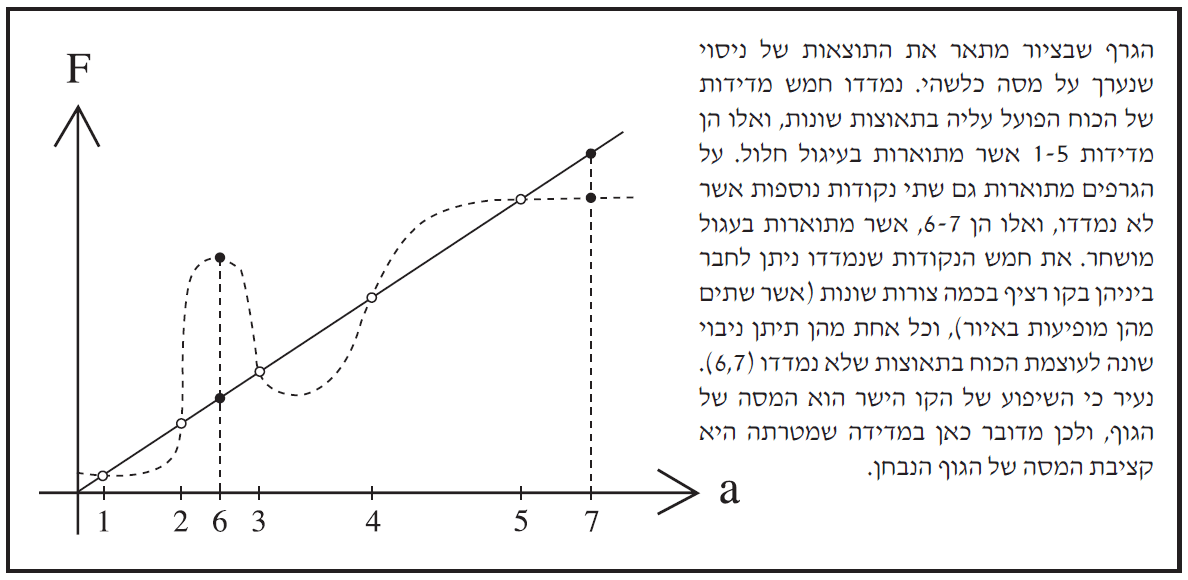
The five results lie on a straight line, and therefore the obvious generalization in light of the principle of Ockham’s razor is to draw a straight line connecting them, whose slope is the mass of the body being measured. This is the simplest generalization. In such a situation the scientific community decides that the relation between the force and the acceleration developed by the body upon which the force acts is a linear relation, and that the coefficient of proportionality is the mass. The law of nature we have found in this experiment says that there is a direct proportion between force and acceleration (this is Newton’s second law).
However, it is a simple mathematical fact that there are infinitely many other forms of generalization for these five results, all of which will fit all five. Or, in other words, there is an infinite number of continuous curves that pass through the five particular facts, that is, the five given points in the graph. Let us note that the number of possibilities is not merely large, but infinite (indeed, uncountably infinite). One of them is drawn as a dashed line on the graph above, and of course there are infinitely many such possible curves.[11] In his article Binyamin argues that we reject the possibility of a non-straight line because it is not sufficiently simple, and we have no interest in complex possibilities that have no empirical implication. Below I will show where he is mistaken.
How shall we decide among the different possibilities? What is in fact the correct theory, or the correct general law, for the results of this experiment? As stated, it seems that we will take the simplest option among them, namely the straight line. The actualist will explain that this is the more convenient option, and we adopt it so long as it has not been refuted (parallel to Binyamin’s claim above). In his eyes, there is no claim here about the true relation between force and acceleration, but a presentation that is the most efficient and compact for the five particular facts known to us, and their organization in a simple mathematical expression. The informativist, by contrast, will say that the straight line is the correct option, which probably also describes the world itself adequately. Unlike the actualist, the informativist also tends to think that a future experiment will confirm this law. Of course, the informativist too will agree that a future experiment may refute this thesis, and therefore he sees it as a conditional fact, dependent on future empirical results.
As stated, according both to the actualist and to the informativist, the next stage of the research will be to conduct an additional experiment at another force intensity, and to measure the acceleration in that case (see points 6-7 on the graph). If the experiment "succeeds"—that is, if the acceleration value at these points is also found on the straight line—the theory remains in place (conditionally true, according to the informativist; efficient and convenient, according to the actualist). If the experiment "fails"—that is, if the result is not found on the straight line—the theory is replaced. The new law will be the graph of the simplest line that passes through the six empirical facts known to us (the first five and the point representing the last measurement). In such a situation, according to the informativist the theory has been refuted, and according to the actualist the language must be replaced. Up to this point there is still no practical difference between them, as we have already seen above.
But now let us ask ourselves this question: what is the probability that the next result (the sixth in number) will indeed also fall on the current graph (that is, on the straight line)? Here, surprisingly, it turns out that the answer depends on whether we proceed from an informativist point of view or from an actualist point of view. Once we see this, we have found an empirical distinction between these two "philosophical" approaches.
Let us begin with a description from the actualist point of view. As stated, there are infinitely many possible generalizations of the five given points, and the straight line is only one line chosen arbitrarily (for considerations of convenience alone) from among them. There are also infinitely many possible results for the future experiment (all values are in play a priori). If so, the probability that the next result will also fall exactly on the straight line is exactly zero (in inverse proportion to the number of possibilities).
One must remember that, according to the actualist, the five known points do not help us at all in knowing the general law of nature, or the "correct" line. The line conveniently describes only the results already measured, and says nothing whatsoever about the future. On the actualist’s view, all lines are in play, and in the absence of other information the probability of all of them is equal. He chooses the straight line only because of its simplicity, not because it is more correct. If so, on his view the five known results do not hint to us anything about the correct line, and therefore do not hint at the result of the next experiment either. On his view all the lines are equiprobable, and therefore the probability that any one of them is correct is one divided by the number of possible lines—that is, 0.
By contrast, the informativist sees the straight-line generalization as a preferred generalization (for on his view Ockham’s razor is a tool for knowing factual reality). To be sure, it is not a certain generalization, since a future experiment may refute it, but he certainly regards it as a general result obtained from the first five experiments. He sees it as a description (the best one for the moment) of real reality, and not merely as an efficient and convenient tool for arranging the five facts already in his possession. In his eyes, the straight line is the best and most correct proposal for describing reality as it appears to us thus far, for on his view simplicity (= the razor principle) is a criterion of truth. Therefore the probability that the next experiment will confirm the straight line is not 0, but a higher probability. Of course, he will not be surprised to discover that the next experiment, the sixth in number, yields the result expected according to the law of the straight line. What does he think the probability is that this will indeed happen? To be sure, it is not certain (if he is a sober and logical informativist, who takes into account the possibility of error), but it is clear that the probability is not zero. The various possibilities are not equiprobable in his eyes, and therefore one must not calculate the probability according to the number of possibilities.
The basic point is that the statistical consideration from the informativist point of view is different from that which emerges in the actualist picture. From the standpoint of informativism, the infinitely many possible generalizations are not equivalent to one another, even a priori. Therefore the probability of each outcome is different as well. The simple possibility is preferred, because on its view the simple claim is the one that carries information about the world. The simple generalization was chosen because it is more correct and not merely because it is more convenient. Since it is not chosen arbitrarily, from the informativist point of view the probability that it is correct is not equal to all the others; that is, it is not 0.
Of course, the informativist too expects that quite a few experiments will fail. But without entering into a statistical estimate of the number of experiments expected to be "successful" (which is, of course, a very complex question), it is clear that their percentage among all the experiments carried out is not expected to be zero. For the proof here, that is enough.
Let us note that we have still not justified this "strange" position, which sees simplicity as a criterion of truth, but for the purposes of the present discussion we treat it as a hypothesis empirically tested against the actualist hypothesis. The question of the philosophical justification of the informativist assumption will be discussed briefly below.
The Statistical Proof Against Actualism
Up to this point a statistical consideration has been described, but we have not yet pointed to its empirical aspect. How does one empirically test and decide the actualist-informativist dilemma? As we have seen, whenever any specific experiment succeeds or fails, there is no problem in that, neither from the standpoint of the informativist nor from that of the actualist. After all, some result has to emerge in the experiment even according to the actualist.
In order to decide this dilemma, let us ask ourselves whether statistically, in the history of science up to our own day, the number of times in which experiments carried out to test theoretical hypotheses succeeded in corroborating the theory is negligible. Has science in fact almost never succeeded in predicting the results of experiments? If that were so, then even in the twenty-first century we would still be in complete scientific darkness. Every scientific generalization would be refuted in every experiment carried out to test it, for the chance of succeeding in such an experiment is zero (since the generalization is arbitrary), and therefore it would have to be replaced by another, and so on without end. Every experiment would bring about a replacement of theory, and there would be no progress. According to actualism, there is no a priori chance that precisely the generalization we chose arbitrarily, only because of its simplicity and convenience, would also stand the empirical test in the next experiment. The result of the actualist assumption is that science could not have succeeded in formulating even a single law of nature that withstands any empirical test whatsoever (or a single scientific language, in their terms, that could fit any set of facts without changing anew in every single experiment).
To sharpen the point, I will add that from such a point of view we would be forbidden to get into a car or an airplane, since the experiments we conducted in order to formulate the laws of physics that underlie those technologies, and so too the experiments of the technology itself, are baseless. There is no chance that the generalizations yielded by those experiments will also work in the next experiment, which we are about to carry out now (this very flight, in which we are about to take off). According to actualism, the airplane was built on the basis of generalizations that, apart from their theoretical simplicity, have absolutely nothing to do with factual truth—that is, with real reality (exactly as Binyamin suggests in his article).
We can now see how an empirical test of these two theses can be carried out. In fact, it was carried out long ago. The matter is simple: one should conduct a survey of the scientific experiments carried out throughout history, or in our own period, and see what percentage of the experiments succeed in supporting the theory. In what percentage of scientific experiments are the predictions of the theory under examination confirmed? Alternatively, one should ask whether science has indeed been standing still since its inception, or whether we are in fact progressing. The fact that there is a non-zero percentage of successful scientific attempts—that is, experiments in which the theory correctly predicts the result (these are the experiments that confirm our theories)—constitutes an empirical (statistical) proof in its own right against actualism. From an actualist point of view there would be no chance of seeing a successful experiment, even one, in any scientific field.
In summary, the fact that not all scientific experiments fail, and that there are several scientific theories that withstand empirical tests and succeed in predicting the results of future experiments, is in itself a clear-cut empirical-statistical proof against actualism. According to actualism such a phenomenon is impossible (that is, of exceedingly low probability).
A Note on the Actualist Approach to Statistics
At this point the actualist may claim that the statistics used in this proof do not say anything about the world. After all, the argument presented here is based on the informativist conception, according to which statistics says something about the world, and not only about the question of how we view it. At first glance, this argument begs the question.
But even actualists cannot make this claim. Let us preface by saying that a complete skeptic cannot be moved from his position in any case, but actualism is not skepticism. For example, it does accept as valid the facts that we observe directly. It does not cast doubt on our sight or hearing. And certainly it does not cast doubt on mathematics or logic. Its problem is only with scientific generalizations and with theoretical entities.
Now to the argument itself. First, it is difficult to imagine someone who does not accept statistics as a claim about the world and its behavior. Statistics is not a scientific generalization and does not include theoretical entities. This is an assumption accepted by every rational person. Even the actualist will agree that adding oranges to a basket is described by the laws of arithmetic, though that claim too is a claim about the physical world.
But more than that, even if statistics says nothing about the world, the actualist too agrees that it is an important scientific tool, and at the very least agrees that on the methodological level it is what should guide us as to how we ought to act and infer conclusions (we have already seen that there is no methodological difference between actualism and informativism). Yet the sting of the argument presented here is that this "philosophical" meta-scientific problem is decided by scientific tools. The statistical consideration, even if it is only methodological in the eyes of the actualist, dictates to us the meta-scientific conclusion that the laws of science are true and not merely convenient. And from another angle, at the very least we can infer from the actualist argument presented here that we, as researchers or as human beings, ought not to place trust in the laws of science with respect to the future. Even if this conclusion concerns only us, its directive is the scientific directive called for, and as such it is accepted even by the actualist. But do actualists not fly in airplanes? Do they not treat the laws of science as though they predict reality well (and not merely describe the past, that is, summarize the totality of the facts known)? Certainly not. For the refutation of the actualist thesis, that is sufficient.
The Philosophical Justification of Informativism
Even after we have empirically proved the informativist position, the philosophical difficulty to which we pointed above remains in place. How can one explain the fact that a priori generalizations that are made arbitrarily (that is, by choosing in a non-empirical way one generalization out of infinitely many possible forms or generalizations) do in fact often succeed in predicting the results of experiments? At first glance, the particular empirical facts collected by direct observation (in the previous example, these are the first five measurements) cannot serve as justification for the generalization we chose. As we have seen, there are countless other generalizations, all of which fit the same totality of facts (such as the dashed line in the graph above), and we reject them for a priori rather than empirical reasons. This is essentially Hume’s "problem of induction": what is the justification for the scientific generalizations we perform? As we already mentioned above, this is in fact a mirror image of the Kantian problem of the synthetic a priori: how can we make synthetic claims by a priori means? As stated, the Kantian transcendental method does not offer a convincing solution to this problem.
But this time we are already standing before a fact, and not before a merely rationalist motivation. As we have seen, our ability to perform justified generalizations (though not necessary ones) is a statistical fact. We see science advancing in an empirically unequivocal way, and in so doing we confirm informativism, and therefore this fact cannot be ignored. We are now left only with seeking a theoretical justification for this fact, and not with asking ourselves whether it is indeed correct. The question with which we must deal is not whether informativism is right, or whether actualism is. The question is how it happens that informativism really works.[12] The escape into actualism (which, as we explained above, is itself a result of this very problem) is no longer a possible alternative, for it has been empirically refuted, as we have now seen.
In my books Two Carts and That Which Is and That Which Is Not I showed that the only way to explain this surprising fact is Husserl’s path of "eidetic seeing" (contemplation of ideas). It appears plain that the human being has the ability to discern the laws of nature directly. Contrary to common belief, generalization is apparently not really an a priori procedure—that is, an inference carried out wholly in thought—but a cognitive procedure, or more precisely, a procedure that has cognitive components. When we observe the five experimental results described in the graph above, we do not merely measure five particular acceleration values, but succeed in "seeing" through these particular experiments the general law reflected in them. In Edmund Husserl’s formulation, the particular experiments are "transparent" to us, and through them we discern the general law that underlies them, that is, the correct generalization, and can choose it non-randomly from among the infinitely many other generalizations. Our intuition instructs us how to generalize correctly. Intuition is not a faculty of thought alone, but also of cognition. We have no escape from the conclusion that generalizations are the product of empirical cognition and not only of a priori thinking. Our intellect sees the result, and does not merely think it.
Even if this assertion sounds somewhat mystical, it is difficult to deny it. Actualism, which assumes that the human being does not possess such an ability, and therefore refuses to see in theory any factual content beyond the totality of the particular facts that constitute its empirical basis, is a mistaken position. That position is continually being refuted, empirically, throughout the scientific process.
The rational human being, as distinct from the rationalist, ought first of all to recognize the facts, regardless of their character, and only afterward to seek a reasonable explanation for them. Denying facts merely because they sound mystical may be a rationalist position, but it is certainly not a rational one. In our case it does not withstand the test of empirical reality.
Summary: Back to the Principle of Ockham’s Razor
The conclusion from our discussion is that, contrary to what is commonly thought, each of the two positions in the actualist-informativist question is not merely a philosophical hypothesis, but a claim that has empirical content. Moreover, we have seen that the actualist-informativist dilemma can be decided by empirical tools. We have further seen that actualism is in fact a refuted claim, and continues to be empirically refuted thousands of times throughout the history of science. Every experiment that has ever succeeded is another layer in the ongoing statistical refutation of the actualist position. And despite all this, for some reason not a few thinkers continue to hold this approach, and even their opponents usually argue with them on the philosophical plane rather than on the empirical one (see, for example, Bechler). Binyamin’s article is an excellent example of this phenomenon, for he adopts the subjectivist thesis about the razor principle as though this were a merely philosophical question, whereas this question has been decided and continues to be decided all the time on the empirical level.
Several conclusions follow from this. One is that scientific theories are claims about the world, as informativism argues, and not merely an efficient and convenient language for the use of the scientific community, as the actualists claim.
To understand the connection to the matter before us, one should note that the straight line in the diagram brought above is the result of the application of the Ockhamian razor principle. As we have seen, there are infinitely many possibilities for drawing a line through all the points measured in the experiment. Why do we choose the straight line? Because it is the simplest. Is this necessary? Certainly not. Is this an "existential" truth? Here we have proved that the answer is emphatically no. Ockham’s razor has been repeatedly confirmed throughout the history of science as a first-rate tool for arriving at factual truth. Its subjectivist interpretations do not withstand critical scrutiny. The burden of proof now shifts to Hawking and his colleagues.
[1] We discussed this at length, as well as the mode of operation of the logical hermeneutical rules in general, in the book Logical Hermeneutical Rules: Non-Deductive Inferences in the Talmud, Michael Abraham, Dov Gabbay, and Uri Schild, London 2010. See also our two articles in issues BeDad 23 and 24.
[2] Admittedly, in the Makkot passage there is a tannaitic dispute on this matter, but in our aforementioned book (see there pp. 63, 121, and especially at the beginning of the sixth chapter) we explained that this dispute applies only in special cases (when the refutations are halakhic rather than factual), and we also explained the logic of this there.
[3] Incidentally, by virtue of that same super-authority, at the beginning of his new book Hawking rashly declares the death of philosophy. I discussed at length the phenomenon of famous scientists who arrogate to themselves the authority to make claims in philosophy and fail in embarrassingly obvious fashion in my book God Plays Dice.
[4] I pointed to another example of this phenomenon in my article "What Is Halut?", Tzohar 2.
[5] The argument was first published in my book That Which Is and That Which Is Not, Beit El 2005. The summary brought here is based on Appendix B of my book God Plays Dice, Yediot Sefarim, 2011. Binyamin cited it from Middah Tovah 97, 2009, where it appears in a more compressed form.
[6] See Ze’ev Bechler, Three Copernican Revolutions, University of Haifa and Zmora-Bitan, Haifa 1999. The entire book is devoted to describing the history of the actualist-informativist confrontation. As far as I can see, throughout the book Bechler does not offer a concrete argument against actualism, and does not even discuss its philosophical basis. He contents himself with a historical description of the oscillations of this philosophical-scientific pendulum, and it seems that his assumption is that the resulting picture itself is enough to convince the reader of the absurdity of the actualist approach.
In what follows I shall allow myself to present in general terms the claims and approaches of the actualists and informativists, without citing specific sources, since these matters appear in very great detail in that book.
[7] This description too is somewhat naive, for one must reach a critical mass of failures before replacing a scientific theory, and of course it is very difficult to define that criterion. One can always save theories by adding ad hoc assumptions and entities, and those additions too have a critical mass, until the theoretical structure (the paradigm) collapses. For our purposes here, these details are not important.
[8] On this, see Hugo Bergman, Introduction to Epistemology, chapter 9 ("The Rationality of the World"), where he surveys several different answers given to this problem and rejects them one by one. See also his book Thinkers of the Generation, especially the introduction.
[9] I expanded on this from the philosophical angle in my book Two Carts and a Balloon, especially in the second unit; and in the scientific context see my book That Which Is and That Which Is Not.
[10] The concept of "simplicity" is itself not univocal, and Bechler discusses that as well.
[11] A simple proof of this is to describe a theoretical curve in the form of a fifth-degree polynomial, with six coefficients as parameters. The constraint that will determine the values of the coefficients is that the polynomial pass through all five results of the experiment. There is no doubt that there are infinitely many solutions consisting of such sextuples of coefficients. If we choose a polynomial of higher degree, we will obtain yet more infinitely many solutions.
For a similar consideration, see Ludwig Wittgenstein, Philosophical Investigations, translated by Edna Ullmann-Margalit, Magnes, Jerusalem 1995, sections 143-245, in the discussion of rule-following. Wittgenstein shows there, in the same mathematical way, that there are infinitely many possible ways to continue any given numerical series, and each of them has its own mathematical logic. There is no simple, or natural, continuation in any objective sense.
[12] This reversal of formulation is Kantian, and not by accident. Kant made it quite clear that he does not ask whether synthetic a priori judgments are possible, but how they are possible.
Discussion
Focus on what I wrote. Do you think we would be unable to notice a body accelerating at 3? That is like someone claiming that in fact all our laws of nature are wrong, but every time we observe, a demon changes reality so that it fits them.
Is that a philosophical solution to any problem? I can offer a hundred such solutions for a penny (maybe it’s an angel, or perhaps a nature embedded in the law itself, etc. etc.).
Indeed, his principle is emptied of content. That is exactly my criticism of his words.
The gist of the argument in the article is:
According to actualism, statistically, no prediction should ever turn out correct in an experiment. In reality, many predictions do turn out correct, and from this it follows that actualism is not correct.
But as best I understand, this proof too is based on Ockham’s razor, since the explanation that actualism does not fit the statistics because actualism is false is only the simpler explanation, while theoretically another explanation could still account for this. And in general – does statistics itself not belong in an essential way only to the informativist world?
I agree that the statistical argument does indeed push the actualist approach (already under enough pressure from intuition as it is) into a particularly small and crowded corner, but apparently it still does not defeat it completely, and someone stubborn enough from the outset to cling to that approach – against the intuition of all humanity, throughout all generations – could, as I understand it, continue to insist on it even against the statistical argument.
This proof is not based on Ockham’s razor but on probabilistic considerations. Of course, probabilistic considerations do not yield certainty, just as nothing else in the world does. But there is a difference between going against an unfounded intuition (which indeed may turn out to be mistaken) and going against a probabilistic calculation. Someone who is stubborn can never be defeated.
A nice argument, but only because I’m not versed in the field. Kant, as it happens, I know in depth, and your dismissal of his argument, how shall we put it, reveals how superficially you know him. You have never read the entire Critique of Pure Reason. Mr. In-a-hurry, run-run. Producing innovations at an alarming rate…
A. In which of your books do you discuss Ockham’s razor at length?
B. You wrote in the article that the way to explain the choice of the simple formula as the one that describes the laws of nature is “that a person has the ability to discern the laws of nature directly.”
But even when a person recognizes that laws of nature exist, why does he perceive specifically the simple graph as such? It may be that the law of nature he is seeing is far more complex. ?
C. The explanation of the intellectual ability to discern the laws of nature can explain why specifically there we choose the principle of Ockham’s razor. But this principle guides us in many, many more things besides the laws of nature. So it is not clear what the basis is for using it in those other things.
For example – halakhic considerations like the common denominator. Legal considerations, where one uses the simplest description of reality even at the price of putting someone in jail. And so on.
What is the basis for using Ockham’s razor in such cases? Cases in which there is no access to the eyes of the intellect to see them.
A. For example, True but Unstable.
B. I didn’t understand the question. What you see is precisely the simple law. Not with the eyes. With the eyes one sees the results of the local experiments. But the generalization from those experiments can be made in several ways. With the eyes of the intellect one sees that the simple generalization is the correct one.
C. Again, I didn’t understand. Exactly as in the scientific context, so too in every other context. The eyes of the intellect show us that the simple is the correct one. Precisely our fleshly eyes may perhaps be more relevant to the scientific context. But why do you assume that the eyes of the intellect are relevant only there?
A. In Two Carts and a Hot-Air Balloon as well?
B. Thanks
C.
I don’t think this can be seen everywhere. For example, when there is a nighttime murder scene in which Reuven was murdered.
At the murder scene there are Shimon’s fingerprints on the safe, he was photographed walking around the area at night, etc. etc.
When Shimon came to court, he claimed that in fact Gadiel murdered Reuven, but because he hates Shimon he tried to frame him. And in any case he was walking around the area because his grandmother lives there, etc. etc.
We will not believe Shimon’s story and will put him in prison. Why? Because of Ockham’s razor.
This is an example of a story where the “eyes of the intellect” will not be able to discern things. And still we prefer the simple story.
In the halakhic sense as well there are no ‘eyes of the intellect’ that observe the halakha. And still we accept the principle of Ockham’s razor.
Whether this is in the famous crazy-man parable, or even any Talmudic kal va-chomer, or the common denominator, etc.
This principle also serves us in our private daily lives when we are not observing before us an event happening in the present (like an empirical experiment), but rather analyzing causes for an event that happened and that we did not see.
A. I don’t remember. Maybe. More likely in the second one (That Which Is).
B. I think you do not understand my use of the term “eyes of the intellect.” Anywhere that something seems reasonable to us (by virtue of Ockham’s razor or something else), I assume that we have seen the truth with the eyes of the intellect. Thus, if you get the impression that Shimon is lying and was not framed, then with the eyes of your intellect you understand that he is lying. The same applies on the halakhic plane and to kal va-chomer, etc.
This does not mean, of course, that we have no biases and that the eyes of the intellect always work. Not at all. But the assumption is that evidence is required to move us away from the intuition.
A/B thanks
C. How can you cognize a reality that occurred in the past?! That is absurd.
I cognize the present, not the past. The present is the person before me, and the question is whether he is lying or not.
That is not the understanding of Ockham’s razor. At most, that belongs to the laws of testimony concerning lying witnesses.
I will give an analogy for a place where it is not relevant to make that argument: for example, in the case of the Book of the Guide, when I look at handwriting written across a page. I will have two possibilities for interpreting it: one person wrote it, or two people wrote it.
The accepted interpretation following the principle of Ockham’s razor would be to interpret it as having been written by only one person. And so long as I have no reason to assume that someone else wrote it, I will prefer to stick with the minimum.
But why? I do not see with the eyes of the intellect how many people wrote the text, because this is an act done in the past! There is no idea of causality that I am encountering now.
My feeling is that this is going nowhere. I have explained what I had to explain, and in my opinion these are entirely simple matters. Apparently we do not agree. That is perfectly fine.
Maybe the rabbi will explain one last time how he learns that there is only one writer to the letter by means of auditory logic?
(Previously you spoke from the side of the defendant, that he is probably lying. Here that is not relevant.)
This is not even auditory logic, but simply learning from experience (some hold that this is an intuition; I do not think so). Usually, a book written like that was written by one person.
In my estimation we have fully exhausted this. I will not answer further unless there is some new point here.
Is it necessary that originally the term “kaf zekhut” belongs to the scale-pan? There is a verse in Job 9:30: “If I wash myself with snow water and cleanse my palms with lye.” The meaning changes. Then naturally the Mishnah is speaking about a case where it is unclear whether his hands are clean or not. But if it is clear that his hands are filthy or that his body is filthy, then certainly there is no place for mercy. (Or, in a more acquitting interpretation, one could say that if all we see is his hands and they are filthy, we would still assume that his body is not filthy; but if we see that this is a filthy person, then certainly there is nothing to be merciful about.)
In any case, this principle should be accepted for the reason that harming an innocent person is more serious than acquitting a criminal.
As for Ockham’s razor, it is not a scientific principle but a psychological indicator of a person’s sanity: someone who hears a reasonable explanation of things and still prefers an unreasonable explanation has a problem.
The principle in its original form is not correct; the number of causes of things is not what determines it, but rather the overall plausibility of the different explanations.
And the link between judging on the side of merit and the razor is in weighing the probability that he is a criminal against the probability that he is innocent. But the central question is how much more severe the harm to an innocent person is than the acquittal of a criminal, and that is no longer connected to the razor at all.
An interesting literal interpretation of the term “kaf zekhut,” but I do not see how it changes anything for our purposes.
The question of balancing harm to the innocent against acquitting the criminal does not pertain to the non-legal plane. Here we are dealing with the question of what is true, not with the question of what to do in practice.
To say that the razor is a psychological principle, and to explain it by saying that someone who hears a reasonable explanation and prefers an unreasonable one—this is a contradiction in terms. Reasonable and unreasonable belong to the objective plane, not the psychological one. It is like saying that the claim 2+3=7 is a problem in psychology and not in mathematics, because whoever does not understand that it is 5 has a psychological problem.
True, the razor comes to determine what is plausible, but that is true only by virtue of a person’s everyday experience, which shows that simpler explanations are correct the overwhelming majority of the time. And thus human beings conduct themselves in daily life by intuition without ever learning the formulation of the principle. This is a psychological principle that takes shape over time in every person with common sense who lives in reality and tries to understand it.
Someone who, after it is explained to him why 7 is not equal to 2+3, understands the explanation but still thinks and believes that it is, has a severe psychological problem.
Again you have returned to psychology (as in the response to column 204 on false consciousness). You are conflating psychology with cognition here. The two are far apart. This is not about learning the principle but about an intuitive and perhaps empirical understanding that it is correct (that there is a correlation between simplicity and truth). What does that have to do with psychology?
The article raised a few questions for me.
It seems from the article that the grounding of the informativist position is fundamentally empirical – thanks to many cases in which we apparently did succeed in predicting the laws of nature, for example in Newton’s second law. And because the chance that it is a direct proportion is negligible, we have therefore proved that we discovered the valid law.
But this is not at all clear to me, because for every segment of the graph that we did succeed in predicting relative to the current experiments, one can continue it by infinitely many different curves that could continue the prediction not toward the straight line (for example, from masses of 5–50 kg f=ma, but for larger masses f=m^2a).
2. What happens if there really were an aspect of reality that is very complex and not simple—for example, as in the previous example I gave, for 5 specific experiments carried out with medium masses we would get a straight line, but the laws of nature would change for significantly larger masses. According to the rabbi’s approach, would we “see” in advance that the line is complex, and therefore not assume that it continues forever in a straight way?
3. Following 2: why is Ockham’s razor usually presented as saying that it is always preferable to choose the simple option? Surely it depends very much on the intuition regarding the particular case? And if it is a universally correct criterion, who ensures that reality always operates in a simple manner? Does God prevent us from encountering complicated cases? (Even in court testimony.)
1. I think the foundation of Ockham’s razor is intuitive. The empirical-statistical argument is brought only as evidence for that. You cannot derive the razor principle from experience because of David Hume’s circle (proving induction by induction). One can show that it works and that a statistical calculation shows that this is unlikely unless the razor is correct.
As for your argument, in my opinion it is mistaken. Of course one can continue to infinitely many different curves that fit the previous prediction. The question is how many of them will fit future prediction. The big difference in my argument is that I am speaking about successes in future experiment, not explanations of what has already happened (of those, there are millions for a penny).
2. There are very complicated laws in nature, such as quantum theory or relativity. But even to them we arrive by means of the razor principle. This principle does not say that the theory must be simple, but that the correct theory is the simplest among those that explain the facts. Mark this well. Beyond that, of course some of our predictions are refuted by future experiments. My claim did not say otherwise. It was based on the fact that this is not always the case, and that is enough to prove my point.
3. I have no idea. The fact is that it works. I assume God sees to it (or evolution, which we too discovered on the basis of the razor principle).
1. If I understand the claim correctly, this is not a proof of the correctness of the law but of the correctness of our method. (And therefore indirectly of the correctness of the law.)
2. If there are predictions that are refuted in future experiments, does that not mean that we are not endowed with such a metaphysical intuition?
If this is a case of point-by-point cognition for each and every phenomenon, there should not be any difference in our capacity to perceive among the different phenomena. If so, why do we succeed only with simple phenomena, whereas complex phenomena require from us processes of many trials and confirmations, and even that does not always work?
3. At the end of the article the rabbi used Ockham’s razor mainly with respect to the laws of nature. In conclusion, does he extend this also to the beginning—learning the words of our sages, presumptions, and so on? Because if so, the difficulty here is greatly strengthened. Fine, the laws of nature—the Holy One created them simply. But in everyday events there is no reason to assume that the event with the simplest explanation is indeed the correct one. If so, one must assume that there is constant providence preventing events from occurring whose explanation would be complex. And that is already quite forced.
I did not understand the claim that evolution can, by its power, ensure that the simple thing happens, for it did not create the laws of nature; at most it occurs in accordance with them.
In any event, it seems to me officially that the rabbi can at this very moment add notebook 4.5 to the Notebooks of Faith: “The Proof from Simplicity,” which proves constant providence over creation at every moment so that cases with complex explanations do not appear. And in particular he can announce this on Friday eve before Passover, which shows the greatness of His wonders and His kindnesses, blessed be He, beyond telling, especially in understanding His world.
2. No. Intuition is not a hermetic tool that is always right. The existence of intuition means that you are more correct than a shot in the dark. I did not understand the end. I am not speaking about perceiving events but about their explanation.
3. The world operates according to laws. Therefore, presumptions that deal with its conduct are also affected by the laws.
Surprisingly enough, notebook 4.5 already exists. See Notebook 4, parts one and two. That is exactly the argument there.
2. Suppose so… ¬_¬
The question was that when the law is significantly more complex than a regularity involving linear dependence between the dependent variables, it will be much harder for us to find the dependence in such a case. For example, in quantum theory there are those who speak of hidden variables that have still not been found.
But if this is cognitive seeing and not only analytical thinking, then the difficulty of discovering the law should be of the same degree and not different. Because this is cognition, not thinking.
3. I was not speaking about the lawfulness of the world; there indeed one can see this as a certain physico-theological proof. Rather, I was speaking about our everyday understanding of the reality around us, which is composed largely of the actions of free agents.
For there too, according to the rabbi’s approach, there must be providence such that every act done under the sun, when people wish to understand it, will be understood in the simplest way, and therefore many cases for which the explanation would be complex will be prevented from occurring. (That is, there is also providence over free choice itself.)
2. Suppose so… ¬_¬
What I meant was that when the law is significantly more complicated than a law of nature with linear dependence between the dependent variables, it is much harder for us to discover its regularity. For example, as in quantum theory, where some speak of hidden variables that have still not been found. But if our way of discovering the laws of nature is rooted in cognitive seeing and not only analytical thinking, then the difficulty in discovering a complex and complicated law as opposed to an easy law should be of the same degree and not different. Because this is a cognitive process, not a process of thought.
3. I was not speaking about the lawfulness of the world and its derivatives; there indeed one can see this as a certain physico-theological proof.
Rather, I was speaking about our everyday understanding of our surroundings, which deals mainly with the actions of free agents. There too, according to the rabbi’s view, there must be providence such that every act done under the sun will have to be understandable in the simplest way, and consequently many cases whose explanation would be complex will be prevented from occurring.
2. I didn’t understand.
3. I do not see a difference between everyday understanding and understanding the laws of nature. After all, you are not speaking about understanding the mechanism of choice itself. For that there is no causal-lawlike explanation at all. Thus, for example, the decision whether to believe a person speaking to me that he is not lying or not depends on the laws of nature. He indeed chooses whether to lie or not, but my understanding of him depends on how his body language depends on his decision to lie. And that is a natural phenomenon governed by the laws of nature.
3. There is no direct law of nature that affects the creation of body language according to the Boolean value of the statement. There may perhaps be a long evolutionary process within the framework of the laws of nature that characterized body language when a person intends to lie. But even in that case it is not at all clear that there is any identity between simple laws of nature and the emergence of simple phenomena with a defined systematic structure like body language; that is an arbitrary assumption.
Likewise, identifying that the person in front of me is lying is rooted in analogy and not necessarily in Ockham’s razor, unless perhaps the rabbi holds that all our analogy is built on the razor principle? Or perhaps because this is a cognitive capacity, the rabbi does not distinguish at all between the different philosophical principles, because we simply “see” the truth. So both analogy and the razor principle are only interpretations and characterizations that we gave after we had already seen the “truth”.
But since we are dealing with the razor principle, I will give a somewhat more successful example than the rabbi’s.
When we heard of an experiment by a dice-player who got 100 sixes in a row, and we do not know how he did it—whether he threw 100 separate dice simultaneously or one die a hundred times. Statistically, both ways lead to the same result. But one is simple and one is complex. And because, as is known, dice-playing is not exactly a proper occupation, we do not know its psychological effects, that is, which experiment he would prefer to choose (he has no problem wasting his time aimlessly and in alarm).
Would the rabbi claim that the experiment was indeed done with one die or with a hundred?
1. There definitely is a system of natural laws that affects the connection between truth value (more precisely: awareness of the truth value) and body language. In fact it probably completely determines that connection. The polygraph is based on this.
2. Indeed, almost all our thinking and analogies are built on the razor. See the first book in the series Talmudic Logic, where we show this explicitly. Also in the two articles in Badad that appear here on the site about the logical hermeneutical principles.
Here is part one of it:
https://mikyab.net/%D7%9B%D7%AA%D7%91%D7%99%D7%9D/%D7%9E%D7%90%D7%9E%D7%A8%D7%99%D7%9D/%D7%9E%D7%99%D7%93%D7%95%D7%AA-%D7%94%D7%93%D7%A8%D7%A9-%D7%94%D7%94%D7%92%D7%99%D7%95%D7%A0%D7%99%D7%95%D7%AA-%D7%9B%D7%90%D7%91%D7%A0%D7%99-%D7%94%D7%91%D7%A1%D7%99%D7%A1-%D7%9C%D7%94%D7%99%D7%A1/
And here is part two of it: https://mikyab.net/%D7%9B%D7%AA%D7%91%D7%99%D7%9D/%D7%9E%D7%90%D7%9E%D7%A8%D7%99%D7%9D/%D7%9E%D7%99%D7%93%D7%95%D7%AA-%D7%94%D7%93%D7%A8%D7%A9-%D7%94%D7%94%D7%92%D7%99%D7%95%D7%A0%D7%99%D7%95%D7%AA-%D7%9B%D7%90%D7%91%D7%A0%D7%99-%D7%94%D7%91%D7%A1%D7%99%D7%A1-%D7%9C%D7%94%D7%99%D7%A1-2/
3. If I had no indications that dice exist in the world, obviously I would prefer the claim that there is only one die and that this was a single die thrown repeatedly. But here the question is only probabilistic, since I know that there are many dice in the world and there is no obstacle to his throwing a hundred dice. Therefore I do not see a difference between the options. This is a question of what a person chose when both options are equally available to him. By the way, my inclination is that even in such a case there is an advantage to one die (why assume he gathered and obtained a hundred different dice? But if 100 dice are lying before him, there is no difference between the options).
Is it possible to propose an intermediate position between actualism and informativism that accepts the equations of physics but not the theoretical grounding given to the equations? That is, by experiment I verify that my equations work, but I have no way to show that my theoretical grounding (the existence of a “gravitational force”) is the correct grounding.
That is roughly actualism.
Then I did not understand your proof from statistics. Everyone agrees that the formula predicts; the dispute is whether our theoretical grounding is correct.
My claim is that the very fact that the formula predicts means that actualism is mistaken. Actualists do indeed think that the formula predicts, and that does not contradict their position. But they are wrong about that, and that is what my argument is meant to show.
1. I would not call the connection between awareness of lying and the creation of body language “laws of nature”; at most, products of the laws of nature. But if that is indeed so, then in any case you have not added anything.
2. After skimming the articles, you reminded me that once, when I was in yeshiva, I asked the rabbi there: what is the source of the authority of Hazal? He opened a volume of Kovetz Shiurim before me and said: when you finish learning the whole thing, and you still have questions, then we can talk. And off he went…
In any event, are the articles you attached those that are brought in the appendix to the book True but Unstable? In any case, after I study it I will be able to speak.
3. If I understood correctly, Ockham’s razor applies only where there is no indication concerning the number of entities? But the common claim is that “When there are two explanations of equal value for the same phenomenon, one should prefer the simpler or more economical explanation” (Wikipedia – modern formulation). According to the description in this quote, it seems that here too there is a preference for choosing that the experiment was conducted with only one die.
Likewise, I saw in another responsum on the site that you wrote that in a case where we have before us a patient, and he has 10 symptoms of a disease,
and there are two diseases that can explain the appearance of the symptoms (when the probability for each is 1:10), and there is one disease that can explain it (when its probability is 1:100), there is a clear preference for choosing the one disease as the cause of the symptoms—although according to what you say here, that is not clear at all.
1. Chinese.
2. The difference is that in my articles exactly what you asked is explained.
3. Ockham himself spoke about entities, but by extension his name is also used to describe economical or simple theories in other senses. In my opinion, if a hundred dice are lying before him, there is nothing simpler about that one die.
As for the diseases, I am somewhat hesitant about that (it depends on other things as well, such as independence between the diseases, of course).
3. You wrote that if one die or a hundred dice are lying before him, there is nothing simpler about that one die.
If so, how do you define “simplicity”? If not by way of number of entities, economy in explanation, and the like.
I define simplicity as the way that seems preferable to me. Circular, of course. In my opinion you will not find an independent definition, and still this principle gives direction.
I did not entirely understand what you meant by the phrase “the way that seems preferable to me.”
Did you mean to say that if you were the one throwing the dice, you would prefer throwing one die rather than a hundred? (And then this applies only to the example of a human being.)
Or did you mean that throwing one die really does seem more correct? And the concept of ‘preferable’ means what sounds more plausible to me, and Ockham’s razor is only a “rule of thumb”.
I meant that it is a rule of thumb. But clearly you are right that typical behavior plays a role in choosing an explanation.
Hello, I would appreciate it if you could clarify a point for me.
You wrote the argument you make here also in the fourth notebook.
There you present this argument as an undermining of the theological proof, and you refute it by saying that it is a circular argument, because it is an attempt to ground trust in cognition on the basis of experience, which itself also comes from cognition.
Whereas here you explain that it is not a circular argument, because it is not based on experience but on a probabilistic consideration.
I hope I am being sufficiently clear. Thank you very much.
I did not understand. Write what the argument is and why you think it is circular.
In the fourth notebook you present the “theological” proof: if we assume that our senses / scientific capacity to understand the world came into being by chance, then there is no reason to rely on them. Since we do in fact rely on cognition, we are therefore implicitly assuming that it was created by an intelligent factor.
Against this proof you present an attempted rebuttal: one could say that we trust cognition not because we assume it was created by an intelligent factor, but because experience shows that it correctly describes reality.
There you reject this rebuttal: because it is a circular argument, an attempt to ground trust in reason and cognition on experience, which itself also relies on that same cognition.
By contrast, here you write: “David Hume’s well-known objection to the principle of induction is empirically refuted.”
And you explain that here we are not talking about grounding our rational cognition by means of experience (regarding which Hume claims that this is circular), but about a probabilistic proof that in practice it works.
I am asking why not make the same claim that you make here against Hume also with respect to the theological proof.
One could argue that our trust in the senses or in induction is intuitive (just like the razor), but that a probabilistic consideration proves that it works.
Now I understand. Excellent question.
My argument is that one cannot build trust in the senses and in principles such as induction and causality (our whole epistemic system) on experience itself, because that is circular.
But the fact is that we do have trust in our epistemology (the “theological” formulation) and that it works (the “philosophical” formulation). This proves that there is a force underlying this reliability (the “philosophical” argument) and this trust (the “theological” argument). And that is God.
Experience by itself is not enough, but the very fact that trust exists proves by implication that we are assuming something outside experience: God.
Put differently: the probabilistic calculation only shows that it works, but the question still remains how it can be that it works. Random formation cannot explain this. That is the essence of the “theological” formulation’s perspective on this argument.
And another formulation: you certainly can apply the probabilistic argument there as well, and claim there too that we see that it works. But then you must ask yourself how it came about that it works, rule out random formation, and thus necessarily arrive at God.
Thank you very much.
Sorry for the long-windedness, but I am still having difficulty.
According to this explanation, it is not clear to me what the difference is between the philosophical formulation and the theological formulation.
The theological formulation asks why we place trust in the senses – to which one can answer: because of a probabilistic consideration.
Now one can ask how the senses actually came into being. But that is precisely the philosophical formulation. It is not a theological formulation.
Thank you very much.
From the Wikipedia entry “Ockham’s razor”:
Probability theory shows that a complex theory – that is, one containing many parameters – will be strengthened more slowly by observations: that is, each observation will strengthen the simpler theory more than it strengthens the complex theory. For problems and models defined in a formal way, the razor can be seen mathematically in the Akaike principle. For scientific theories it is difficult to quantify the criterion – for example, one cannot know what the probability is that an observation is mistaken, or formulate precisely the free parameters of the compared models and the statistical effect of the observations on them. Nevertheless, probability does indeed justify Ockham’s razor as a scientific rule of thumb
Hello Rabbi. You wrote:
“But this claim is very problematic. Is a phenomenon in which a body with mass accelerates according to the square of the force, or some other function of the force, not available to sensory observation? It would seem that there is no obstacle at all to our perceptual systems distinguishing and registering accelerations that do not accord with Newton’s second law.
Suppose we have before us a body whose mass is 2 and the force applied to it is 4. If this body were to develop an acceleration of 3, would we be unable to notice it (the acceleration in this case according to Newton’s law is 2)? Even if there are transcendental constraints that a priori structure our thinking, why assume that those very same constraints also compel our cognitive perception? Does anyone really think that physically our eyes would fail to notice a body moving with an acceleration proportional דווקא to the square of the force?
How can the existence of some force in the world affect our vision, and prevent it from observing phenomena that in other situations it has no problem observing?
Usually our eyes can observe a body accelerating at 3, but according to Kant that is true only when an appropriate force acts on it. In another situation we simply would not be able to notice it. Why wouldn’t we be able to see the body accelerating at 3 even when a weaker force is acting on it?
This sounds like an absurd argument, and certainly a very speculative one (no one has proposed a mechanism to describe these mystical influences on our cognition).”
I do not understand the claim.
In my humble opinion, it is clear that Kant’s principle applies also to our cognitive perception, and not only to our thinking.
After all, on the basis of this principle he also explained our cognition of time and space, which are prior to our thinking.
On the contrary, it is the latter that depends on them, and without cognition of them we could not think anything at all,
since all our thought is built within the concepts of space and time, no?
Moreover, otherwise his principle is emptied of all content,
for his whole aim was to clarify that all our empirical experience (which includes, among other things, seeing and measuring) is limited by the transcendental laws that shape it, no?