

On Peshat and Derash (Column 370)
‘Before the blind’ shows why there is no reason to uproot the peshat
The column opens with the dispute around “before the blind do not place a stumbling block.” Minchat Chinukh infers from Rambam and Sefer HaChinukh that apparently only two midrashic applications remain: improper advice and enabling sin. But he rejects this reading: there is no reason whatsoever to say that derash erased the plain prohibition against physical stumbling, and all the more so, given the rule that “a verse does not leave its plain meaning,” it is more correct to see the two midrashic laws as additions to the peshat. The fact that Rambam and HaChinukh did not mention this remains unresolved, but Ramah serves as evidence that the peshat can certainly remain in force.
The problem arises only if one assumes that derash is supposed to deliver the verse’s plain meaning
In his view, the question of how the Sages derive meanings that do not emerge from the wording of the verse wrongly assumes that derash claims to present the verse’s literal meaning. That is not so. Derash operates within a different system of rules, and therefore even when it does not contradict the peshat it need not be a precise rendering of the verse’s words. From here also comes his critique of the apologetic approach, which tries in every case to show that derash is “the true peshat” because the literal reading has difficulties: this is unnecessary over-defense.
Rambam and Ramban agree that derash is not the depth of the peshat, but disagree about its status
In his discussion of the second root, Rambam holds that laws learned from derashot are true, but are not the very content of the verse and therefore are not counted as Torah commandments. Peshat is the meaning of the verse; derash is branches growing out of the root. Ramban disputes his interpretation of the rule that “a verse does not leave its plain meaning”: not because the peshat is exclusive, but because it may not be uprooted even when the verse is expounded. In his view, in most places the verse bears both the peshat and the derash, and only in exceptional cases is there real displacement. So both reject the identification of derash with “the depth of the peshat”; the dispute is whether derash is an additional interpretation of the verse or an expansion of it.
The Vilna Gaon: the Torah is deliberately phrased so that both channels remain open
Through the example “If there is anxiety in a man’s heart, he shall yashchena,” the Vilna Gaon explains that the difficulties in the peshat and the difficulties in the derash are not a flaw but a design. The verse is written so that it does not fully close itself to one reading, in order to obligate us to hold both readings together. From here also comes his criticism of the modern attempt to force derash into line with peshat: both come from the same Torah, but they are not one track. This picture is closer to Ramban, though it can be pushed into Rambam as well.
In ‘an eye for an eye,’ one can move from parallel tracks to combination
At the end, he also presents the combining possibility. Where there is no contradiction, as with ‘before the blind,’ the halakhah simply includes both the peshat and the derash. But even where there is a contradiction, as with ‘an eye for an eye,’ one can argue that both interpretations participate in shaping the halakhah: the peshat points to the damager’s eye, the derash replaces the eye with money, and the result is payment of the value of the damager’s eye. The conclusion is that peshat and derash are not rivals between which one must always choose; sometimes derash adds to peshat, sometimes it stands alongside it as a parallel track, and sometimes precisely their combination creates the full halakhic meaning.
On Peshat and Derash
Some time ago I was asked in the Q&A (not for the first time) about the contradiction between the peshat (plain sense) of the verse “an eye for an eye” and its derash (money in place of an eye). I answered that question by way of several fundamental principles for understanding the relationship between peshat and derash, and here I wish to expand a bit more on this troubling matter. I will not take up the question of whether those who expound derash do whatever they please, or whether there are rules that govern their activity. To my judgment it is clear that there are rules and a fairly ordered methodology of derash (obviously not a rigid logic), even if it is not fully transparent to us. Still, the problematic (and at times contradictory) relationship between the midrashic product and the wording of the verse demands clarification.
Does derash displace peshat?
There is an impression (also in the questioner above) that derash is a way to bypass peshat—that is, to wrench the verse from its plain sense and put in its place the exegete’s reasoning. But one should know that in most cases the derash does not replace the peshat; it is added to it. Thus, for example, the derash from the verse “You shall fear the Lord your God”—to include Torah scholars—does not come to negate the mitzvah of fearing God, but to add to it the obligation of revering Torah scholars. The derash offers a different reading of the verse, but not a contradictory one. A prominent example that illustrates this principle can be found in the halakhic authorities cited by the Minchat Chinuch regarding “before a blind [person]” (lifnei iver).
The verse in Parashat Kedoshim states (Leviticus 19:14):
“You shall not curse the deaf, and you shall not place a stumbling block before the blind; and you shall fear your God: I am the Lord.”
And the Sefer HaChinukh, commandment 232, writes:
Not to cause the innocent to stumble on the road.
Do not cause Israelites to stumble by giving them bad advice; rather, when they ask for counsel, guide them in what we believe is upright and good advice, as it is said [Leviticus 19:14], “and before the blind you shall not place a stumbling block.” And the language of the Sifra: before one who is blind regarding a matter—if he seeks counsel from you, do not give him advice that is not fitting for him. And our Sages said [ibid.], let not a man say to his fellow, “Sell your field and buy a donkey,” while his real aim is to encircle and take it from him.
And this prohibition also includes one who aids a transgressor in committing a sin, for he thereby leads him to be tempted to transgress again. From this angle our Sages said [Bava Metzia 75b] with regard to lender and borrower on interest that both transgress “before the blind,” etc.
He mentions here two applications of this prohibition: the ban on giving improper advice and on causing another to sin. For some reason he does not mention the peshat of the verse: the prohibition on physically tripping a blind person—or a person in general. I note that the Rambam, too, in Laws of Murder 12:14, cites only these two applications:
Anything forbidden to sell to a gentile is forbidden to sell to an Israelite who is a bandit, because one is thereby strengthening the hand of a transgressor and causing him to stumble. Likewise, anyone who causes a “blind” person to stumble in a matter and gives him advice that is not fitting, or who strengthens the hands of transgressors—who are blind and do not see the path of truth because of the desire of their heart—transgresses a negative commandment, as it is said, “and before the blind you shall not place a stumbling block.” If someone comes to take counsel from you, give him advice that is fitting for him.
And in the Minchat Chinuch there, §4, he infers from here that in their view this verse is taken entirely out of its plain sense and there is no prohibition of physically causing someone to stumble on the road:
From the words of the author of the Sefer HaChinukh and from the words of the Rambam it would seem that this verse of “before the blind” is taken entirely out of its peshat; that if one placed an actual obstacle, a stone, before a blind person, he does not transgress—so it appears from the author’s opening words and also from his writing that [the case of]… And if this too were included in the prohibition, it would be an act, and if he holds that since it is possible to transgress without an act there are no lashes—he has already written many times in the name of the Sha’agat Aryeh that if in this matter it is impossible to transgress without an act, then it counts as an act and there are lashes. Still, I do not understand: since it is stated in Yevamot that throughout the entire Torah a verse does not depart from its plain sense, except for the verse “and it shall be that the firstborn which she bears” [Deut. 25:6], and the Ram ban writes that the meaning is that even the peshat is expounded, even though many things are alluded to—except for that verse whose peshat was uprooted entirely—if so, here too, though what is alluded to is true (unlike the Kutim and Sadducees, may their names be blotted out, who explain only by the peshat), nevertheless this law is also true: that it is forbidden to cause the blind to stumble on the road. Whence do we know that the explicit peshat is not included in the prohibition? I saw in the Mishneh LaMelech, Laws of Loans, ch. 4, s.v. “the Kehillot Gedolot wrote,” that he gives a reason that “before the blind” is juxtaposed to “the deaf,” and it also says “and you shall fear your God,” etc.; but “Cursed is he who misleads a blind person on the road” [Deut. 27:18] is literal. And there he further writes that since there is no act, even though he transgresses an oath—as it says, “Cursed is he who misleads,” and “cursed” is an oath—nevertheless he is not disqualified [as a witness], since there is no act; it is like one who swears to eat and does not eat. To my mind this is difficult: shall we remove the verse entirely from its peshat? And if one misleads a blind person on the road—e.g., he placed an obstacle before him—perhaps he also violates the prohibition, and the curse applies to him as well; if so, there are lashes and he is disqualified for testimony; and perhaps this applies also to a gentile if he misleads him, for the prohibition applies to him as well, as explained above. It is difficult. I saw in Torat Kohanim (Sifra), cited in the book Korban Aharon, that the Kehillot Gedolot and other greats addressed why our Sages removed this from its peshat, and he brings the points we wrote from the Mishneh LaMelech, and adds his own reasons. To me it is difficult that the baraita expounds this also, but it is not necessary to remove it from its peshat, for the peshat is also true. Yet according to what the Kehillot Gedolot himself wrote—that the term “give” (titen) is only fitting as “place” (tasim) (see there)—it seems that the peshat is as expounded; it is difficult. And see Onkelos’s translation: regarding “do not give [your seed] to pass to Molech,” he translates “give” (titen) as the Hebrew titen, whereas here in Kedoshim, regarding “before the blind you shall not give,” he translates “do not place.” It seems he holds like the Kehillot Gedolot, that the meaning of the verse is as expounded; it is difficult.
The explanations he cites are quite puzzling. For even if the Kenesset HaGedolah is correct that there is a midrashic hint in the verse that it speaks of “and you shall fear your God”—i.e., of commandments and not of tripping (and what of improper advice?)—it is clear that the midrash comes to add, not to replace, the peshat of the verse. I see no reason in the world to remove the verse from its plain sense, rather than interpret it by way of peshat in addition to derash. Moreover, there is the Talmudic rule “a verse does not depart from its plain meaning.” To the best of my knowledge there is no hint to the contrary in the words of our Sages, and I see no logic to do so. The conclusion is that these two applications come in addition to the prohibition that arises from the peshat of the verse against physical tripping. Admittedly, it remains to be explained why Rambam and the Sefer HaChinukh do not mention this.
Indeed, the Rema (Rabbi Meir of Rothenburg?) in Bava Batra 26a (s.v. “within the flow of speech”) cites this verse as a source for the prohibition to cause damage:
The reason is that although his actions did not affect the very body of the injured object, nevertheless the act itself by which his actions had effect is prohibited; for it is forbidden to cause anything from which harm will come to people—either because of “before the blind you shall not place a stumbling block,” or because of “love your neighbor as yourself.”
Clearly, he understood that there is a prohibition on physical tripping; otherwise one could not derive from here the ban on causing damage.
The relationship between peshat and derash[1]
The question mentioned above and similar ones assume that derash seeks to arrive at the meaning of the verses as such, and is bound to what emerges from their language (the verbal formulation). From here follows the question of how the Sages offer interpretations that clearly do not arise from the language of the verses and do not fit them.
But this assumption is far from simple; in my view it is mistaken. First, in those places where derash removes from peshat (like “an eye for an eye”), there it is clear that the derash does not seek to reach the peshat of Scripture. But even in other places (like “before the blind,” in my understanding) the midrashic interpretation adds, atop the peshat reading, another layer—and this added layer is not bound to the verbal peshat of the verse. It is produced within a different exegetical system—midrashic and not purely philological.
David Neshke, in a series of three articles in HaMa’ayan (1977–78), addresses the question of the relationship between peshat and derash and presents three approaches: (1) the apologetic—holding that derash is the depth of peshat; (2) the parallel—holding that derash and peshat are parallel explanatory planes; (3) the combinatory—holding that peshat and derash are two different interpretations that join together to create the full interpretation (even where there is a contradiction between them, as with “an eye for an eye”; we will see this at the end of the column).
The first approach ties derash to difficulties that exist in the peshat reading. What looks like the simple, literal meaning of the verse is difficult; hence it is obvious that this is not the verse’s peshat. According to this approach, the midrash reveals the depth of the peshat. It is a reading of the verse that also takes into account broader considerations than the verse’s literal wording; therefore, it is the verse’s true peshat. This is an apologetic approach, because it is clearly incorrect. It comes to answer the difficulties raised by those who mock the darshanim and the fact that their reading bears no relation to the verse’s language, concluding that they do whatever they want. But, as we shall see, there is no need for such apologetics. The midrashic reading is not bound to the verse’s language at all; rather, it follows a different set of hermeneutic rules (the middot of derash) that generate an additional reading parallel to the philological reading, which is the peshat.
Maimonides’ hermeneutic
In the Second Principle (shoresh 2), Rambam discusses the status of laws that arise from midrashic derivations. In his view, such laws are “rabbinic” (divrei soferim) (I will not enter here into the ancient debate about his intent; see about this in the book Yishlach Shoreshav, in the essay on the Second Principle, and in Ruach HaMishpat, Gate Two), and they should not be counted among the 613 commandments. Clearly, underlying his view is an assumption about the relationship between peshat and derash. Indeed, within his words there he writes about the Bahag (Baal Halakhot Gedolot), who counted among the 613 also commandments that arise from derashot:
And their foolishness goes further still: when they find a derash in a verse that would require, by that derash, doing some action or avoiding some matter—and all of these are undoubtedly rabbinic—they count them among the commandments, even though the plain sense of the verse does not indicate any of those matters.
Counting a commandment that does not arise from the peshat of Scripture is, in his eyes, folly. Only the verse’s peshat is de’oraita and fit to be counted among the 613.
Immediately thereafter he explains the root of the mistake:
Together with the principle with which our Sages, of blessed memory, have benefited us—namely their statement (Yevamot 11b, Shabbat 63a): “A verse does not depart from its plain meaning,” and that the Talmud seeks in every place and says, “What is the verse itself speaking about?” When they find a verse, they derive many things from it by way of explanation and proof…
Rambam claims that the Bahag counted laws derived by hermeneutic rules even though the Sages taught us that a verse does not depart from its peshat—meaning, in his understanding, that only peshat is a Torah-level commandment. This is the key point in the discussion, but before I return to it, I will cite another remark of Rambam that appears there:
And perhaps you will think that I refrain from counting them because they are not true—whether the rule derived by that measure is true or not. This is not the reason; rather, the reason is that whatever anyone derives are branches from the roots that were given to Moses at Sinai by way of explanation, and these are the 613 commandments. Even if the one deriving them were Moses himself, they should not be counted.
Clearly, even laws derived from midrash are true, but they are branches that grow from the roots given to Moses at Sinai. Torah commandments are only those written explicitly in the verses—that is, the roots, not the branches. The midrashic laws are expansions of the verse’s content, not what lies within the verse itself.
It is important to note that there are two innovations in his words here: (a) the parallel approach—peshat and derash are two different readings (that is, it is incorrect that derash is the depth of peshat); (b) peshat is the only true interpretation of the verse. Rambam assumes that there is only one correct interpretation for a verse, and that is its peshat. Peshat exposes the verse’s content, whereas derash is an expansion of the verse’s content (branches growing from the roots), but not an additional interpretation of it. Therefore, in his view, a law derived by derash is not de’oraita, because it is not in the verse. Rambam holds a view similar to the parallel approach, but in fact it is a fourth view: according to him, derash is certainly different from peshat and does not purport to expose the philological peshat (“the depth of peshat”), but in his view derash is not an interpretation at all. An interpretation of a verse exposes its content and meaning; derash, by contrast, is an expansion of the verse’s content, not the exposure of its meaning.
Rambam and Ramban—A dispute
I now return to Rambam’s claim against the Bahag. We saw that Rambam proves his view from the Talmudic rule that a verse does not depart from its peshat. He assumes that the meaning of this rule is that only peshat is the interpretation of the verse, and anything else is not an interpretation (but an expansion). But this is, of course, not the accepted explanation of this rule. Ramban, in his glosses there, presents against him the accepted explanation of this rule, which reflects the usual parallelist view of the relationship between peshat and derash:
And behold, the Rabbi [Rambam] has hung this collapsing mountain by a hair. He said [pp. 53–54]: “the principle with which our Sages have benefited us—namely, ‘a verse does not depart from its peshat,’ and that the language of the Talmud searches in every place and says, ‘what is the verse itself speaking about?’” Heaven forfend! For all the midrashim that are principal in matters of commandments do not have a verse departing from its peshat because of them; rather, all are included in the wording of Scripture, even though they expand it by inclusions. And the midrash of the honor of Torah scholars from “You shall fear the Lord your God” does not remove the verse from its peshat. And likewise if we say that “when a man takes a woman” is by money, this does not remove it from its simple meaning and peshat. And not all the ets and gams and inclusions and exclusions and “akh” and “rak,” and the rest of the midrashim—all of them. Rather, the verse includes all, for the peshat is not as the words of those who lack knowledge of language, nor like the view of the Sadducees. For the Book of the Torah of the Lord is perfect; there is in it no extra or missing letter; all were written with wisdom.
He explains that “a verse does not depart from its peshat” means that even when we expound the verse, we may not ignore the peshat (as did the halakhic authorities I cited above from the Minchat Chinuch regarding “before the blind”).[2] The wording of Scripture includes both peshat and derash.
He then adds what I noted above: in most cases derash does not remove Scripture from its peshat (it does not contradict peshat) but adds to it:
And they did not find any midrash that is principal in commandments that removes a verse from its peshat, except for the derash on “and it shall be that the firstborn which she bears” (Deut. 25:6), as they mentioned in Yevamot 24a…
He then returns and summarizes his position:
And so it is everywhere that they expound by way of parable and allegory: they believe that both are true—inner and outer… And this is their intent everywhere this is mentioned in the Talmud: not that they intend to uproot the gezerah shavah and inclusions and such midrashim—Heaven forfend!—for the intent is only that they not remove it entirely from its peshat. And that is their statement: “A verse does not depart from its peshat.” They did not say: “A verse is only according to its peshat.” Rather, we have its derash along with its peshat; it does not depart from either; the verse can bear all, and both are true.
He sharpens that Rambam’s exegetical stance—that each verse has only one correct interpretation, namely peshat—is incorrect. The verse includes both peshat and derash together. This is precisely the parallel view.
Note that both Rambam and Ramban do not adopt the position that derash is the depth of peshat. Both see peshat as a parallel reading not bound to the peshat of Scripture. Therefore, it is clear that according to both there is no difficulty in the contradictions raised between halakhic midrashim and the plain sense of the verses. Derash is not bound to peshat. Not for nothing did Neshke argue in the article cited that views that see derash as the depth of peshat are apologetic. The difference between them is only whether derash should be considered an interpretation of the verse at all (Ramban), or rather an expansion of it (Rambam).
In many cases a derash is offered as a resolution to difficulties that arise regarding peshat (superfluity, duplication, imprecision, contradiction or mismatch against another biblical source, and so forth). Many commentators, especially contemporary ones, often show why it makes sense to read the verse according to its derash, since the literal peshat suffers from problems (like those listed above). This approach implicitly assumes that the contradiction between the verse’s wording and its derash requires reconciliation, and their explanation in effect sees derash as though it is the depth of peshat. In their view, since the literal peshat suffers from difficulties, it is implausible to see it as the verse’s true interpretation. The derash, they think, presents the more correct interpretation (since it resolves the difficulties that exist in the seemingly simple literal reading). At least in certain cases, according to this view it is specifically the peshat that is not the interpretation of the verse, but only the derash. As noted, this runs counter to the views of both Rambam and Ramban.
The Vilna Gaon on the parallel view
R. Menashe of Ilya brings, in the name of his teacher the Vilna Gaon, an example through which he explains the relationship between peshat and derash. It concerns an aggadic midrash on the verse in Proverbs 12:25:
“Anxiety in a man’s heart will make it stoop, but a good word will gladden it.”
(Note that the vocalization is yashchennah with a right-facing shin, meaning “make it stoop,” as opposed to the common reading yesichennah, “let him speak it out.”)
The Gemara (Sanhedrin 100b) brings two conflicting derashot:
“Anxiety in a man’s heart—let him yaschennah.” R. Ami and R. Assi: one said, “Let him remove it from his mind,” and one said, “Let him speak of it to others.”
R. Menashe of Ilya, in the introduction to his book Binat Mikra, brings the following explanation in the Gaon’s name:
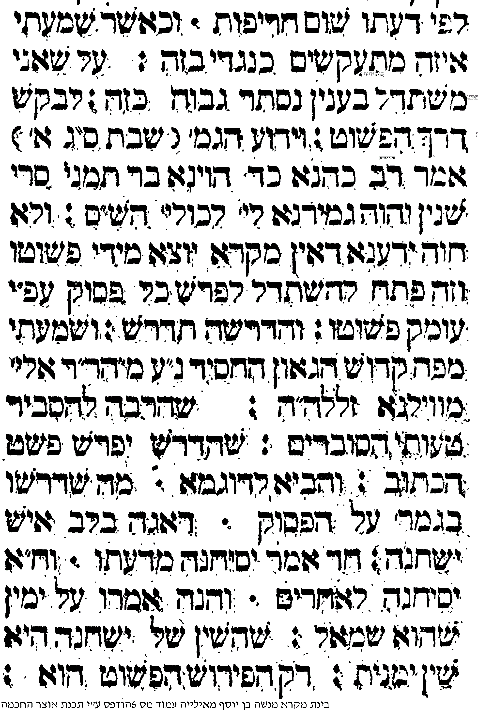 |
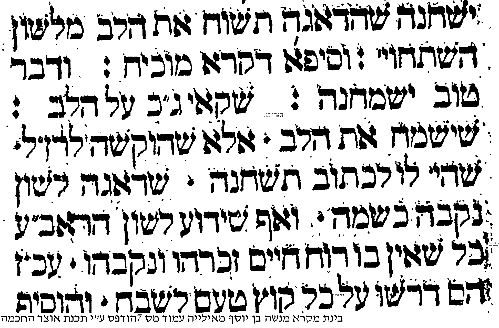 |
His claim is that derash does not come to interpret the peshat of Scripture (this is, of course, the parallel view). The peshat of the verse is that anxiety causes the heart to stoop (this is the reading with a right-facing shin), and this is one of the readings brought in the Gemara. But the second sage was troubled by why the initial verb form is masculine (yashchennah, “will make it stoop”). If anxiety causes the heart to stoop, then the subject of the verse is “anxiety,” which is feminine, and it should have been written with a feminine initial form: tashchennah (“will make it stoop”).[3] The Gaon explains that from here the second sage inferred that one must read the verse with a left-facing shin (from the root “to speak”), i.e., that the person should “speak it out,” and this is why the initial form is masculine (since now the subject is “man”).
We arrive here at two readings, both rooted in the verse: there is the philological reading, and despite its difficulties, that is the peshat. However, those very difficulties direct us to seek another reading—midrashic—which of course is not without its own difficulties (chiefly, that it does not enter neatly into the verse’s literal wording). The Gaon contends that the verse is written deliberately in a way that leaves neither reading flawless. The difficulties that exist regarding the peshat (which lead us to derash), and likewise those regarding the derash (why it was not written explicitly in the wording of the verse), are intentional—to tell us that we should interpret it both ways together.
Two remarks
From the Gaon’s proposal it follows that these two readings are necessarily not in conflict. If they were in conflict, then each would retain the difficulties that are hard for it. The only solution is that both readings are correct. Admittedly, when there are two readings in halakhic derash, there will be cases in which we cannot realize both, and at least on the practical plane we will have to choose one of them (paying money or taking out an eye). But even in halakhic derash one can remain with the notion that both readings are correct; only that one is meant for implementation (this when there is a contradiction between the readings, as with “an eye for an eye”). In aggadic derash, however, there is generally no practical dimension. It is about a conceptual insight; therefore, if both readings are true, we are left, in conclusion, with both.
I add that the picture the Gaon presents seems to fit more with Ramban’s view than Rambam’s. He essentially sets the two readings on the same footing with respect to the verse. One could perhaps reconcile it with Rambam’s view as well, by assuming that the philological reading is the peshat—despite the difficulties—and the midrashic reading is not an “interpretation” but an expansion (branches growing from the roots).
Conclusions
What follows from this for our matter? It is important to understand that the Gaon draws our attention to a point that is easy to miss. When we expound the verse “an eye for an eye”—[as] money—and suppose we can show that the philological peshat, namely the actual removal of the eye, is difficult for some reason, so we are compelled to the midrashic reading (that it is money). This is precisely the claim of those who maintain that derash is the depth of peshat. But even according to them, it is still unclear why the Torah does not write explicitly “money for an eye.” Instead of writing a verse whose peshat is literally “an eye,” but there are difficulties that force us nevertheless to read it as money, it would have been preferable to write explicitly that one must pay money.
Those who adopt the view that derash is the depth of peshat usually propose resolutions to the difficulties in peshat, but they do not explain why the Torah did not write the midrashic reading explicitly within the plain wording. Why did it leave it to a derash that removes the verse from its philological reading? A complete picture of the relationship between peshat and derash should include both the difficulties in the peshat that lead to derash and also an explanation for why the verse itself is nevertheless phrased so that its philological meaning is the peshat and not the derash. The Gaon’s view offers such a complete picture with an explanation. As we saw, he explains that the difficulties are deliberate—to direct us to interpret the verse in both readings together. What emerges from his approach is the parallel view. And so it is brought in the book Ben Porat about R. Menashe of Ilya:
He received a lesson from the mouth of the Gaon that those who labor to force homiletical derivations to align with the peshat do not act well. Even if their intent is desirable, their actions are not correct, for derash is far from peshat and the two will never converge. Though they were hewn from one quarry, the Lawgiver who set His Torah before Israel placed within them the signs to find a resting place also for derash—and when our Sages, by the Lord’s hand, knew to expound on every jot, nevertheless their pathways are different and will never unite.
The combinatory approach
Even in the case of “an eye for an eye,” where derash contradicts peshat, some have explained that the literal phrasing comes to say that it would have been fitting to take out his eye (though then we are left with the result that the peshat of “an eye for an eye” really is an eye). This is an explanation similar to the Gaon’s approach, in that it also offers an account both for the verse’s wording and for the difficulties that arise from the peshat of Scripture.
I note that Neshke, in his articles there (and as I have already mentioned here in the past), explained differently the relationship between peshat and derash in “an eye for an eye.” He argues that both readings—peshat and derash—contribute to the formation of the law itself. For example, in the case of “an eye for an eye,” there is a view in the Talmud that the damager pays the value of his own eye (and not the victim’s). The explanation he offers is that the peshat instructs us to take out the damager’s eye, and so the law is decided. At the same time, the derash tells us to take money from him instead of the eye—and this, too, is the law. Therefore, the result is that we take the value of the damager’s own eye. This is a combination of peshat and derash together. Note that if the verse were interpreted only by its peshat, we would require him to have his eye removed; if it were written only by its derash (“money for an eye”), we would require him to pay the value of the victim’s eye. When the verse is written in a way that compels both readings—and as we saw, in such a case we interpret the verse in both ways together (as we saw in the Gaon’s example)—the halakhic result differs from both prior possibilities: the damager pays the value of his own eye. This is the approach I called above “the combinatory approach,” by which the peshat and the derash are joined together to generate the halakhah.
Note that here I presented an application of this approach regarding a case in which derash contradicts peshat (“an eye for an eye”). In such cases we need a more complex construct, like the one I described here, which fuses the two conflicting readings and creates from them a superstructure that includes both. By contrast, as we saw above, in most cases there is no contradiction between peshat and derash (as we saw with “before the blind”), and in such cases it is obvious that we combine the two readings. But in those cases it is a simple combination, for the halakhah contains a simple sum of peshat and derash: a prohibition on placing a physical obstacle, a prohibition on giving improper advice, and a prohibition on causing another to sin. So too in the example of “Anxiety in a man’s heart—yaschennah.” There, too, it is a case in which there is no contradiction between the two readings (they are different, but not contradictory), and the Gaon combines them in a straightforward joining.
[1] See, for example, Column 355 and much more here on the site.
[2] Interestingly, Rambam there leaves the derash as the law, and, in effect—as we saw—leaves only it without the peshat.
[3] For some reason he ignores the word’s ending, which should have been masculine (“yashchennu”—i.e., the man, or the heart), and not feminine (“tashchennah”).
Discussion
Chayota, because that is a very difficult explanation. It turns the derashot into a complete waste of time, and from the Talmudic give-and-take it is clear that the Tannaim and Amoraim took the derashot seriously (hence the whole lengthy give-and-take about the hermeneutical principles by which the Torah is expounded).
What I thought about this derash (and I’m probably not the first), and its connection to the peshat—and this is basically what Hanshke says—is that in fact the derash says that one may pay “eye-ransom” (that there is an option of redeeming the injurer’s eye). And since one can, that is what one does. Just as with an ox that was forewarned and killed a person: according to the straightforward peshat, the owner is liable to death, except that there is an option (which apparently depends on the wishes of the victim’s family or on the court’s willingness) to give a life-ransom. And according to the derash, that is what is always done. So too here: the derash said that this is not merely an option but what must be done. (And this also explains both the opinion in the baraita in the Gemara that one must literally put out an eye, and the Gemara’s interpretation that even according to that opinion it is not literal.) Life-ransom is a concept common in the Tanakh, and apparently also in the ancient world. It also parallels “the redemption of one’s life from Sheol.” The option of giving eye-ransom existed in the background of Torah law, as part of the conceptual world of penal law in the ancient world, and it would have existed even without this derash. The derash only said that the ransom must be given, and that the original option will not be carried out here. But you cannot write laws of ransom without writing the death itself in the case of the ox that kills, or the literal putting out of the eye in our case.
For some reason, my comment isn’t showing up. I’ll write it again. Not for nothing is it not appearing, because there is no such possibility. The Sages cannot establish Torah laws however they please. And if they did so, that’s their problem. I do not worship them, nor am I in their camp. I hinted at this at the beginning of the column.
A more corrected response:
What I thought about this derash (and I’m probably not the first to think of it) and its connection to the peshat—and this is basically what Hanshke says—is that in fact the derash says that one may pay “eye-ransom” (that there is an option of redeeming the injurer’s eye). And since one can, that is what one does. Just as with an ox that was forewarned and killed a person: according to the straightforward peshat, the owner is liable to death, except that there is an option (which apparently depends on the wishes of the victim’s family or on the court’s willingness) to give a life-ransom. And according to the derash, that is what is always done. So too here: the derash said that this is not merely an option but what must be done. (And this also explains both the opinion in the baraita in the Gemara that one must literally put out an eye, and the Gemara’s interpretation that even according to that opinion it is not literal.) Life-ransom is a concept common in the Tanakh, and apparently also in the ancient world. It also parallels “the redemption of one’s life from Sheol.” The option of giving eye-ransom existed in the background of Torah law, as part of the conceptual world of penal law in the ancient world, and it existed (apparently also as part of unwritten Torah law) even without this derash. The derash only said that the ransom must be given and the original option cannot be carried out here. But you cannot write laws of ransom without writing the death itself in the case of the ox that kills, or the literal putting out of the eye in our case.
Another example of this is, for instance, the law “You shall take no ransom for the life of a murderer who is guilty of death; rather, he shall surely be put to death.” For a modern person, this law is not at all understandable. If a legal system says that a person must be executed, why does it need to command a prohibition against bypassing the execution through the payment of ransom (which, by the way, in the Tanakh is several times called “bribery”)? What is the hava amina at all? (If someone does not obey the instruction of the legal system, why would he obey the legal system’s instruction not to bypass it?) Rather, the Torah was a “directed” system of law (in the Rav’s phrase)—not a “constitutive” one—of penal concepts and laws that were its real-world background. In that background, one can commute a death penalty (or a punishment of amputation) into a payment called “ransom,” equal to the value of the person or the limb. Therefore the Torah forbids this (it is literally one of the 365 prohibitions). Now, in the ancient world you could see someone paying eye-money in court, and you would ask some student standing on the side: but it says “an eye for an eye”? And he would not understand at all what you wanted (from his point of view you would be someone with reading-comprehension problems). He would answer you: “But he is paying ransom.” In their eyes, such wording means that both options are open, and the option of payment cannot be stated before the first option is stated, and therefore that is how it is written. It is just that apparently there was a tradition that narrowed the range of options to the option of payment alone. In the period of Hazal, the ancient world was still present and still in the background of the mind of anyone reading Scripture. It is just that in their period, because of the spread of Greek philosophy and logic, concepts and claims became sharpened into more unambiguous concepts (the first law of logic) and unambiguous claims. So in their period it was necessary to sharpen the point that there is a tradition that only the second option is the halakhah written in this verse. This midrash narrows the meaning of the verse (as opposed to “You shall fear the Lord your God,” which broadens it), but it does not replace (or contradict) its original meaning.
Chayota’s words are of course absurd, for Hazal believed in Torah from Heaven, and therefore never imagined that they had such authority!
(Unless Hazal used the interpretive and midrashic tools within the framework of the authority that the Torah, as Torah from Heaven, gives them—in order to give certain commandments a renewed interpretation in accordance with the needs of the time, as Rabbi A. I. Kook suggests regarding the offering of plant-based sacrifices in the Third Temple in place of animal sacrifices in the previous Temples. But in any case, that has nothing whatsoever to do with what Chayota is saying.)
Not a waste of time. This is their way. The Sages took many freedoms for themselves and translated the Written Torah for their own time and period. With all due respect, and while carefully preserving the hierarchy. But their freedom was enormous. If only we had that.
They did so many things as they saw fit. Torah laws that were effectively annulled and turned into “expound and receive reward,” changes that Torah laws underwent in various areas, which were converted into Oral Torah in a completely different way. I assume you can give examples better than I can.
Something along these lines can be found in the book by Hazi Cohen and A. Evron: The Transformation Approach: A New Method in Torah Interpretation, Jerusalem 5779 [2019].
You have apparently seen a book called Gemara once (Bava Kamma 83b), where it says that without the interpretive innovations we would have thought there are two options (whether the injured party or the injurer chooses—not specified): an eye or money, and the teaching revealed to us that it is money and only money:
“The Merciful One said: ‘An eye for an eye.’ Might one say an actual eye? etc. For it says: ‘You shall not take ransom for the life of a murderer who is guilty of death’—for the life of a murderer you may not take ransom, but you may take ransom for major limbs that do not grow back… I might have said: if he wants, let him give his eye, and if he wants, let him give the value of his eye. Therefore it teaches us from an animal: just as one who strikes an animal pays compensation, so too one who strikes a person pays compensation.”
Yes. But at the time (first-year shiur), these things told me nothing. They were right before my eyes and I did not see them. Failure to understand the reality causes this whole Gemara not to be understandable (not the hava amina, not the conclusion, and not the entire discussion at all. Just empty verbiage). But the moment one understands, these derashot become almost part of the peshat-data of the Torah, with plain common sense.
Just so you understand: from that whole Gemara I remembered that there is an opinion saying “an eye for an eye” literally (and I did not remember that even that opinion is interpreted by the Gemara as not literal). One studies and remembers nothing. Even though supposedly one understands what one reads. But that is not really understanding. For a modern person (a speaker of modern Hebrew), the meaning of the word kofer is money paid to save a son who was kidnapped, on condition that a sum of money be paid or else he will be killed. Anyone who reads Tanakh and Gemara understands that the meaning of the word kofer there is slightly different. And he also technically understands the discussion. But he does not really understand the reality, and then the derash is technical—mere fine distinctions in the usual Gemara style (which really is not like that). Intellectually, I would have compared it to an ox forewarned that gored a person and killed him. They compared it to one who strikes an animal and it dies. There was logic in the background here.
In short, what I’m saying is that if you meant that someone might want to curse me for not remembering an explicit Gemara, he would actually be blessing me. Because I arrived at it a priori, from studying Tanakh alone and using plain common sense. In fact, only now can one even begin to understand and study all the discussions there about “Would it enter your mind that ‘an eye for an eye’ is literal?” Each Tanna uses a kind of reasoning to reach the conclusion that it is not literal. It’s just that what is done in this kind of study in the teenage years is not to think about what you are learning (which is what really learning means), but to load the mind with a burden of dry data and remember masses of Gemaras and poskim without truly understanding the processes underlying those data—that is, the Torah logic. And thus they produce zombies with Torah education (a kind of donkeys carrying books).
All I meant to say was that this is one of the famous Gemaras in the country, and it is mentioned and cited again and again, so obviously you saw it firsthand or secondhand or thirdhand and forgot it, and then thought you had thought of it on your own. The idea that ransom lies in the background of the Torah and Hazal’s innovation is limited only to ruling out the direct route (“an eye for an eye”) is old hat, and you came and added spices (interesting ones, but you did not spread some bright hidden light). In any case, yasher koach, and I was only making a marginal note.
I didn’t understand.. doesn’t tashchena go back to de’agah (=feminine)? Who said it goes back to “a man’s heart”… the anxiety itself lowers the heart…
I didn’t understand.
Am I the only one to whom it seems that the column didn’t fully end? Something seems cut off.
Emmanuel, how would you explain Hazal’s derash on piggul?
Contrary to the words of the honored author, it seems to me that from the Rambam’s remark that was quoted—“Perhaps you may think that I refrain from counting them because they are not true, whether the law derived by that principle is true or not true; that is not the reason…”—it is clear that they indeed are not necessarily true, but that is not the reason they are not de’oraita (rather, it is because they are not a root principle; they are not the peshat of the verse). It is clear that they are not necessarily true, since a later Sanhedrin can interpret differently.
That it is expounded for one who thinks of taking it outside its place?
To Bava Kamma
Bless you. In any case, I hesitated whether to comment again, because maybe it would seem petty (it is a marginal note, as you said), but despite that I decided it was important. So then, as far as I know about myself, this thought is in some sense original. Where I come from, this is not such a famous Gemara, because not that much effort is invested in studying halakhic midrashim. Maybe you are a son of the ancient world, but for me personally—and I imagine for many others—the biblical concept of kofer did not come with our mother’s milk. As far as I can run through my memory, I do not know of hearing anything on this subject since my yeshiva days in first-year shiur (and even then we studied the chapter ha-hovel only superficially in the evening seder). In any case, over my personal world there was indeed spread a bright hidden light, and I ground, at least for myself, flour from ripe wheat. I promise you that even if a year ago you had put this Gemara before my eyes again, it would not have told me anything, nor would I have remembered anything from it after some time. It would have been just another midrash of fine distinctions from other places (ransom for the life of a murderer and for major limbs), and comparisons to other places (what is this concept of “major limbs” anyway? Did you ever ask yourself? Why not just limbs? Apparently the expression means “principal limbs,” like all those construct phrases that alternate—“holy men”/“men of holiness”—and it means limbs that protrude outside the body, like the head—that is, hands and feet and fingers. But then what about the eyes in the present case? And what if he took out his kidney?). Comparison and refutation, comparison and refutation. As far as I was concerned, they could just as well have brought in the laws of tithes there too. In short, I would not really have understood this midrash at all.
In fact, my brother (who is also now engaged in studying the straightforward peshat of Scripture and also remembers Hazal’s midrashim in Rashi on the Torah) told me that he once told me that this midrash means “eye-ransom” (he really understood it, though he did not elaborate beyond that—perhaps not even to himself; he lacked the spices, as you put it). So I forgot even what he had told me, despite the fact that I told him then that I needed to think about it. It may be that if I had not gone through my whole personal process of understanding on my own, I probably would never have understood it. I had to go through several chapters of Psalms, Job, Proverbs, and Isaiah for this concept of kofer to become a living concept (like the chair I am now sitting on). Only after those could I begin to understand the Torah itself.
For my own part, I’m not sure whether you really understood what I said either (though it seems you did). Because you should have understood it from studying Tanakh alone and from knowing the midrash that “an eye for an eye” means monetary compensation—and that’s all. If you heard it from the Gemara, then you skipped the stage of understanding: they simply told you this and you memorized it. But understanding is literally seeing with one’s own eyes—seeing the world through the eyes of the people who lived in the biblical and rabbinic periods. Did that happen for you?
In any case, if you meant piggul in Parashat Kedoshim, where the midrash says that since one who thinks of it as outside its proper time was already discussed in Parashat Tzav, therefore apply it instead to one who thinks of eating it (or throwing its blood or burning its fats) outside its proper place (and despite the next verse, one is still not liable to karet for eating it)—well, I don’t know. This is a very difficult midrash from two angles:
1. First of all, according to the straightforward peshat, there is no such thing anywhere in the Torah as piggul in the halakhic sense—namely, a thought of eating outside the proper time. There is only notar, and one who eats notar (from the flesh of the peace-offering) renders the original sacrifice abhorrent (which had been offered two days earlier). That is, he causes the Holy One not to accept the sacrifice retroactively. The root p-g-l apparently alternates with b-ch-l (which does not appear in the Bible, but whose meaning is nausea and revulsion, which are the opposite of favor—for it says “it is piggul; it shall not be accepted”), or with the root p-g-r, since a carcass too, like carrion, is something revolting to eat among the wealthy, and certainly would not be acceptable to God.
The entire command there is that the sacrifice be acceptable to God, like the prohibition against offering a blemished animal. The midrash in Parashat Tzav expounds (apparently by the halakhic logic that one cannot affect time backward) that that section deals with one who thinks of eating it outside its proper time, because it says “he who offers it—it shall not be reckoned,” and from here it somehow learns that only at the time the sacrifice is offered can it be disqualified, and that it is disqualified because of the offerer’s thought. Thus the halakhic concept of piggul is created. As stated, this is a derash.
2. In Parashat Kedoshim this section is repeated, and the midrash expounds that it does not speak about one who thinks of it outside its proper time, because that was already discussed in Parashat Tzav. But in this way we move even farther from the straightforward peshat, because even one who thinks of it outside its proper time can somehow, under classic midrashic pressure, be squeezed into the meaning of the words of the verse. But “outside its proper place” does not fit in, not even under a twenty-ton press.
3. As though just to complicate matters still further, in the next verse (in Parashat Kedoshim) the Torah says that one is liable to karet for eating it. Then the midrash (by force of a limiting expression said regarding one who thinks of it outside its proper time in Parashat Tzav—“the person who eats from it shall bear his iniquity”: “from it” and not from its fellow, meaning from the flesh of that which he had thought to eat outside its proper place—and apparently on the basis of the halakhic logic that going outside place is less severe than going outside time, just as notar is more severe than meat that went outside its proper place; though that itself, karet for notar, is learned from this verse) says that once again this verse cannot be about one who thinks of it outside its proper place, but rather (where according to the straightforward peshat it was speaking simply of notar, and certainly not of a thought outside place) it is actually speaking specifically of notar (which is surprising twice over, despite the fact that I said this is the straightforward peshat. For the derash told us to read all these sections as though they are about a thought outside time, and now in one verse it took it from a thought outside time to a thought outside place, and in the following verse not only does it not continue with outside place, it does not even return it to a thought outside time, but takes it out to notar, which is not connected at all), and it comes to teach us that one is liable to karet (which is not explicitly written anywhere regarding notar. And this is strange, because “he shall bear his iniquity” in Parashat Tzav does not mention karet, and it seems to me that they learn by verbal analogy from our verse that there the intention is karet, which creates a circular loop of derashot and limiting expressions regarding liability to karet and the implications of that for what each verse in this section in Kedoshim is talking about). So according to the midrash, this section is not read continuously at all. And not merely a discontinuity between two forms of piggul (outside place and outside time), but a discontinuity of piggul and notar, which is a second-order discontinuity from the perspective of midrashic discontinuity. From the perspective of the midrash, reading this verse as dealing with notar is itself a derash and not peshat. This is really, really strange.
In short, this is a midrash many times more complex than “an eye for an eye” meaning money. (It is somewhat similar in structure to the derash on “the firstborn that she bears,” from which it is hard to extract a fluent reading of the verse in its midrashic sense. Here we are talking about a fluent reading of the whole section.)
I was mistaken. I remembered that the root b-ch-l does in fact appear in the Bible: “My soul also loathed them” in Zechariah. That is, in the same sense of revulsion.
In short, to summarize the level of difficulty of the section in Kedoshim, it is as follows:
1. According to the straightforward peshat, it speaks of notar (just as the straightforward peshat is that the section in Tzav speaks of notar).
2. According to the midrash from Parashat Tzav, here too it ought to deal with piggul outside its proper time (just as the midrash says that the section in Tzav deals with piggul outside its proper time).
3. According to the new midrash, the first two verses are expounded as usual about outside its proper time. But in the third verse (“And if any of the flesh of the sacrifice of his peace-offerings is eaten on the third day”), the midrash changes and says that it deals with one who thinks (of throwing its blood or burning its fats) outside its proper place, even though this does not fit the words at all.
4. In the fourth verse, the midrash again changes the subject and says it is speaking of notar (it cannot be explained that this verse too is again dealing with outside its proper time, for it too was already repeated in Parashat Tzav).
5. The conclusion that the fourth verse speaks of notar is by force of derash and not by force of peshat (which, as I said, is also notar).
6. Karet for piggul outside its proper time (which is what Parashat Tzav speaks about) is learned by verbal analogy from the fourth verse above, which deals with notar.
7. From the outset we said that that verse deals with notar because there is no karet for piggul outside its proper place.
8. From the outset, piggul outside its proper place does not incur karet because of a limiting expression written in piggul outside its proper time (“the person who eats from it shall bear his iniquity”—from it and not from its fellow), even though karet for piggul outside its proper time itself is learned from notar, which itself incurs karet only because we could not interpret that verse as dealing with piggul outside its proper place.
In short, there is here a kind of circular loop that causes the same section to speak about three different matters—piggul outside its proper time, piggul outside its proper place, and notar. And now one has to explain how the midrash is written here in depth beneath the simple peshat of a single section dealing with one matter, namely notar.
With God’s help, 4 Adar 5781
Logic requires that a failing that occurred on the third day—eating the notar—should not retroactively turn a sacrifice that was properly offered into “piggul.” And the verses too fit very well. Verses 6–7 are the explanation of what is said in verse 5: “You shall sacrifice it so that it may be accepted.” And how will the sacrifice be accepted? When it is done so that the sacrifice will be eaten on that day and the next, and not on the third day.
Regards, Yaron Fishel Ordner
But verse 7 speaks of one who thinks of eating it outside its proper place (even though it says in it “eating on the third day”).
To Emmanuel—greetings,
The peshat of the verse speaks about the acceptability of the sacrifice through the thought that it be eaten in its proper time and not outside its proper time. From the repetition of what was already said in Parashat Tzav, we learn by the principle of “if it is not needed for the matter” that a thought of outside its proper place also disqualifies. But there is no karet here, since this was not stated explicitly.
Regards, Yefa’or
I didn’t understand the comment. The Rambam himself wrote that they are true. The fact that one can disagree and interpret אחרת does not mean that it is not true. Can one not disagree with a peshat interpretation? What is the connection? This is the truth, as far as my understanding reaches.
Again, the peshat of the verse (the straightforward peshat) again speaks of notar.
With God’s help, 5 Adar 5781
To Emmanuel—greetings,
Perhaps one may say in a somewhat different direction, based on the verse in Parashat Tzav (7:18): “And if any of the flesh of his peace-offering is eaten on the third day, it shall not be accepted; he who offers it—it shall not be reckoned to him; it shall be piggul…”—that one who eats the notar on the third day “shall not be accepted” in the eyes of God, for (as Ibn Ezra says) “his gain has gone out in his loss”: even though he offered with proper intent, he later spoiled it by despising God’s word, distancing himself after having drawn near, and he is no longer acceptable in God’s eyes, even though his sacrifice has not become piggul.
And even more severe is “he who offers it” with this intention—that his sacrifice “shall not be reckoned to him” at all as a sacrifice, but “it shall be piggul,” and is not considered a sacrifice at all (as Ibn Ezra says, that “piggul is not holy”). The personal disqualification, that he is not acceptable in God’s eyes, is created also in one who eats the notar, thereby showing that he has now distorted his path and does not care about “giving pleasure to his Creator”; but that the sacrifice itself should be invalidated and not reckoned—that depends on the offerer whose intention from the outset was to eat it outside its proper time.
Regards, Yefa’or
“It shall not be accepted” is a value statement—the man who is lax in the laws of the sacrifice is not acceptable to God, even though from the halakhic standpoint his sacrifice still counts for him and is not “piggul,” since it was offered properly.
Such a statement, whose meaning is evaluative rather than halakhic, is the statement “Any man of the house of Israel who slaughters an ox or a sheep or a goat in the camp, or who slaughters it outside the camp, and has not brought it to the entrance of the Tent of Meeting to present it as an offering to the Lord before the Lord’s tabernacle—blood shall be reckoned to that man; he has shed blood…” (Leviticus 17:3–4),
where certainly the intention is not that he is halakhically considered a murderer, for his punishment is karet and not death by human hands. It is a value statement, that “Scripture regards it as though” he had murdered the poor animal whose blood was spilled for nothing.
Regards, Yefa’or
The command “She shall not go out as the slaves go out” was likewise explained by the author of Or HaChayim as a value statement—that it is not fitting that a maidservant remain “stuck” for six years with her master; rather it is fitting that the master come to the decision “marry or release”: either designate her for himself or for his son, or let her be redeemed and go free.
That is the ideal. In Parashat Re’eh (Deuteronomy 15), the Torah explains the bediavad: if the Hebrew maidservant was left “stuck,” neither designated nor redeemed, then she goes out at the end of six years and also receives a severance gift.
On a similar matter, I still have a nice sentence to this day that I tell people in your name. Rabbi Michi said: what is the difference between pilpul and derush? Pilpul is correct logic with an erroneous inference; derush is erroneous logic with a correct inference.
Nicely put, and thank you, but the fact that Scripture does not depart from its plain meaning does not mean that the plain meaning of Scripture is the literal meaning. “Before the blind you shall not place a stumbling block” can, in its plain meaning, mean not to give unfair advice and the like—that is, there is a level of meaning so closely bound up with the words that it can override the literal interpretation. It is like “You shall not curse the deaf,” which even in the plain meaning of Scripture expresses that one must not curse any person, even if he does not hear it.
Not an exact formulation. I have a column about that.
True, if by “literal interpretation” you mean it in a very narrow sense. But there are metaphors and various rhetorical devices that are part of the peshat interpretation.
It really does sound as though your understanding is more alive than my (still) dry understanding, and that is probably indeed an advantage of someone who thinks things through for himself. I did not know this Gemara passage from my nonexistent breadth in Gemara, but from the fact that I saw it (and the Rambam on top of it) cited again and again by people who mentioned the example of “an eye for an eye.” So for me the matter that ransom for major limbs is possible is as explicit in the Torah, and therefore I knew it even without knowing anything about the ancient world. Though, incidentally, there is kofer even today and not only in the ancient world; I once saw a segment on Kan about mediators in the diverse Arab society in Israel, and there one of the mediators explains that although by law “the killer shall be killed,” peace is greater, and therefore they do indeed make do with ransom.
“Major limbs” is a term borrowed from the twenty-four major limbs (well known) in the case of a slave, and apparently they wanted to say that even though they do not grow back and it is like “half a killing,” one still takes ransom. Whether a slave goes free when his spleen is removed (something they knew in the past was possible to survive), that really would have to be checked in halakhah. [May my Master forgive me, but the truth is that I see the world only through my own eyes, and all other things I classify under various headings of zoology.]
This is the segment I mentioned. I remember a different wording, but I didn’t find it right now.
https://youtu.be/Nqw_qBMfTTQ?t=634
The main point of the column was nicely expounded, but still a few remarks by the wayside. It came out rather long, but I would still ask for your reply at least regarding section A.
A. The words of the Minchat Chinukh. It seems to me that the words of the Mishneh LaMelekh (Malveh ch. 4 hal. 5) are understandable, and not as the Minchat Chinukh understood them, and your objections too—that the explanations are puzzling, etc.—will be resolved. The Mishneh LaMelekh says there that “Cursed is one who misleads a blind person on the road” deals only with a physical stumbling block, and therefore one who misleads his fellow into sin and violates “before the blind” is not under “cursed” and therefore is not disqualified from testimony. But certainly “before the blind” also includes a physical stumbling block (and one who violates that indeed is disqualified from testimony). And just to explain why Hazal broadened “before the blind” to include prohibitions and bad advice, while not broadening “misleading a blind person,” the Mishneh LaMelekh comes and suggests that in “before the blind” it says “and you shall fear your God,” i.e. a matter of a commandment or unfair advice, because it is entrusted to the heart (as Rashi says on the Humash), and therefore it is not expounded only according to its plain sense but also broadened. [And incidentally, even from the standpoint of the derash itself, since unfair advice is included, then certainly a physical stumbling block is included as well.] Everything falls into place very well.
[B. After explaining the dispute between the Rambam and the Ramban, you wrote that many commentators, especially contemporaries, see the derash as if it were the depth of the peshat. That is basically the apologetic approach (not a fifth approach), and in all my days I have never seen a contemporary commentator who holds that way.]
C. The words of Rabbi Menashe of Ilya seem weak to me.
C1. He said that Rav Kahana’s words in Shabbat 63 are an opening for trying to interpret every verse according to the depth of its peshat. I do not see the connection, and the Gemara’s intent in Shabbat is well known and not that. There they deal with the verse “Gird your sword upon your thigh, O mighty one, your glory and your majesty,” and expound that it is a metaphor for words of Torah. But of course the metaphor itself must also be true, and therefore the verse also implies that an ordinary sword too is glory and majesty for a warrior. When one explains that the verse is a metaphor and expounds the referent, then of course the metaphor still remains true, for one does not make a metaphor out of something false. If the enemy is likened to a lurking bear, it is understood in passing that a lurking bear is a dangerous thing; they would not liken the enemy to a bleating sheep. This stands in no opposition to derash; on the contrary, it also follows from the correctness of the derash. So there is no opening here for any “trying,” etc. (And one can debate what Rav Kahana thought initially.)
C2. The Vilna Gaon explained that the plain sense of the verse is that anxiety lowers the heart, and said this is forced, because it should have been tashchena with a tav, etc. But the peshat is not that at all. Its plain sense is that the person should talk out the anxiety, and there is no forcedness at all (“Anxiety in a man’s heart—he should talk it out”). And indeed it remains unclear why the Amoraim went off to expound derashot and call right left. Perhaps they merely used a wordplay and explained how one talks out anxiety—by distracting his mind from it or by speaking of it to others (in which case this has nothing at all to do with strained readings and double interpretations, etc.). [Incidentally, the Gemara does not have the reading that the anxiety lowers the heart.]
C3. In any case, I do not understand why the Vilna Gaon latched onto such a weak example. After all, in every derash of Hazal there is some linguistic or interpretive reason. Obviously in all Hazal’s derashot they had some reason for devising a derash; they did not simply jump to expound. So what the Vilna Gaon found special here, I do not know. Like a man seeing a forest and saying, “Look, here is a tree.” [Here I am looking, for example, at al tikrei in tractate Berakhot in sequence: “Happy is the man whom You discipline, O Lord, and from Your Torah You teach him”—do not read telamdenu (“You teach him”) but tilmedenno (“You teach us from it”): from the Torah you learn that everyone whom the Holy One desires He crushes with sufferings, etc. That is, they interpreted teyasrennu as sufferings and pain, and then the plain sense bothered them: what do sufferings have to do with Torah? And so they interpreted as they did. “Who sets desolations in the earth”—they expounded shemot (“names”), because it does not say shemamot or neshamot. “There is none holy like the Lord, for there is none besides You”—they expounded: there is none to outlast You; unlike the nature of flesh and blood, whose handiwork outlasts him. This is because in the Tanakh there is no word bilti with a suffix (bilto, biltam, biltecha), only here biltecha, which is strange, so they explained it as a verb of wearing out, and then the suffix belotecha joins naturally as with every verb.]
D1. The general idea of parallel interpretations arising from problems in each side on its own seems already explicit in the Gemara: “You may infer two things from it” (in some of the occurrences. And perhaps this is precisely the Rambam’s note when he called it legufei and also “and one may expound from it”). In searching I saw several examples of cases where each interpretation has some wrinkle, and therefore both interpretations stand.
D2. In a translation, because by its very nature it cannot add connecting words and explanation (such as “or perhaps one may interpret differently,” and the like), there are cases where it loads two interpretations together, and it seems that it intends to combine them as one. For example, Targum Onkelos on Genesis 49:11, “Binding his foal to the vine,” translates: “Israel will surround his city,” etc., “the righteous will be around him on every side.” Rashi writes there that Onkelos translated it about the King Messiah—“vine” means Israel, “his foal” means Jerusalem—and also translated it in another sense, “vine” means the righteous, etc. (And similarly in the next verse there.) And Targum Jonathan, for example, on Jeremiah 23:10, “And their course is evil,” translates: “because they go in the evil desire of their soul, evil shall come upon them,” that is, because they ran (merutzah) of their own will, evil will come upon them—a double interpretation of the word bemerutzatam. And so too, in my opinion, in Isaiah 22:18, “He will surely wind you around and around,” he translates: “He will remove your turban from you, and your enemies will surround you like a ball.” This is a double interpretation regarding winding: one as written in Ezekiel, “Remove the turban and lift off the crown,” and another that the enemies will encircle him like a turban that surrounds the head, as commentators wrote on keter and atarah as language of encircling—“Mighty bulls of Bashan have surrounded me,” “Saul and his men were surrounding David.” And the Targum of the Megillot on Lamentations 1:1, “She has become tributary,” translates: “she returned to be lowly and to give them tribute,” a double interpretation of the word mas (the principle is the same, but two shades of meaning to the word). And there, 3:51, “My eye affected my soul because of all the daughters of my city,” it translates: “because of the destruction of all the districts of my people and the disgrace of the daughters of Jerusalem my city” (this can be discussed). And there are more examples. This seems to me to be a feature unique to translations, and I do not know of anyone who has noted it.
In fact, the Arabs of today, in terms of their consciousness in general, are more or less as they were a few centuries ago. In general, the whole Eastern world (Asia, Eastern Europe in some sense, Africa, Latin America, Polynesia, the Eskimos) is stuck dozens if not hundreds of years behind the Western world in terms of consciousness (though not necessarily technologically). Therefore the kofer that exists today among the Arabs is indeed that same kofer from the ancient world, because they themselves are the ancient world.
Likewise, of course I knew the 24 major limbs of a slave. But “major limbs” in the midrash in the chapter ha-hovel did not come from those 24 limbs; rather the reverse. “Major limbs” was a living concept (and not a halakhic concept) in the ancient world, and in human beings they counted 24 of them, and that had practical implications for the laws of slaves. I can guess that the concept existed in a general way among animals too, and they had a different number. I was trying to understand, again, what they meant when they spoke about it. It was not a dry halakhic definition.
I don’t know much, but why think that “major limbs” is a living concept and not only a halakhic one? They made a paradigm from tooth and eye, which are written in the Torah, and arrived at those twenty-four. How is that different from any other tzad ha-shaveh they make?
I already have experience. This is the fruitful approach. At first, for me everything was abstract, modern Brisker definitions. Little by little, every such definition disappeared and became a living (fundamental) concept. Have you ever wondered how there has been no definition of the labor forbidden on Hol HaMoed from the Gemara until today? You won’t find one. Trust me. All the halakhic books from then until today just copy and paste their predecessors in this respect. It took me years to understand that for the Amoraim and Tannaim there simply was no definition of the concept of labor; it was a natural fundamental concept like “horse.” There was no need to define for any ignoramus what forbidden labor is. They simply told him that labor is forbidden, and afterward said what is permitted (preventing loss, etc.). The same is true, by the way, of the labors of Shabbat. Even though supposedly there are definitions there. The whole concept of primary categories and derivatives is built on that understanding. Why talk about the labor of curdling as a derivative of building? Why not call it the labor of building from the outset? There would be no practical difference in that terminology. After all, that is how actions forbidden on Shabbat are classified today (under the labors mentioned in the Gemara).
There are basic concepts that cannot be formulated in a short and clear positivistic way. Regarding Shabbat, I do indeed remember that there are opinions that first of all one knows something is “labor” and therefore forbidden, and only at a second stage does one assign it to the primary labor most similar to it. That is, there does not really need to be a derivation from the primary category to the derivative; rather every labor is “labor,” forbidden in its own right because it is simply sufficiently significant “labor,” except that for warning, etc., there is a classification into primary labors.
But what does that have to do with major limbs, where all they did (as far as I know; I haven’t checked now) was a mah ha-tzad that really makes sense: what is similar to tooth and eye? As a fairly close approximation, I too today would reach the same generalization without any living concepts.
Sorry, I commented by mistake in the wrong place (a bit higher up).
It’s all right. Yes. But Hazal did not simply compare them to every limb they saw; they generalized and said “major limbs.” Where did that generalization spring from? The common denominator was a generalization, not 24 analogies (I don’t understand how an eye protrudes from the body, but never mind). In listing the limbs, they call them, by the way, “the head of the torso,” “the tips of the ears,” etc. (What does that mean? Do ears also have legs and ears of their own? What does it mean to cut off the tip of the ear? Does that leave the rest of the ear’s body? If you cut the torso of the torso—and not its head—can that torso itself not give birth to a child torso of its own? 🙂) There is here an unclear concept that is critical to understanding the law.
A corrected response (a sentence appeared there that was unrelated):
It’s all right. Yes. But Hazal did not simply compare them to every limb they saw; they generalized and said “major limbs.” Where did that generalization spring from? The common denominator was a generalization and not 24 analogies (it is not clear to me how an eye protrudes from the body, but let us say it does). In listing the limbs, they call them, incidentally, “the head of the torso,” “the tips of the ears,” etc. (What does that mean? Do ears also have legs and ears of their own? What does it mean to cut off the tip of the ear? Does that leave the rest of the ear’s body? If you cut the torso of the torso—and not its head—can that torso itself not give birth to a child torso of its own? 🙂). There is here an unclear concept that is critical to understanding the law.
A. I didn’t check the Mishneh LaMelekh inside. My remarks dealt with the position brought in the Minchat Chinukh, according to which there is no prohibition of causing someone to stumble with a physical obstacle.
But now I have looked inside, and this is his wording:
“It is possible to say that he holds that the verse ‘cursed is one who misleads a blind person on the road’ refers to its plain meaning and not to one who misleads his fellow into sin. The verse ‘before the blind’ is different, either because of the juxtaposition to ‘the deaf,’ or because it says ‘and you shall fear your God,’ and as the commentators wrote, therefore we do not expound it according to its plain meaning but as one who misleads his fellow into sin.”
From here it seems that the Minchat Chinukh is right. The Mishneh LaMelekh really understands that “before the blind” does not deal with causing a physical stumbling at all (“we do not expound it according to its plain meaning, but as one who misleads his fellow into sin”).
B. I have seen many such people. Mainly from the beit midrash in Gush, who look for the depth of the peshat. I think Rabbi Shilat too goes this way. They try to show, from comparisons and other broader considerations, that the plain meaning of the verse is monetary compensation and not an eye. You can see this from their method, which justifies the derash only by difficulties in the peshat. In my view this is not necessary (though it is possible, as one sees in the Vilna Gaon). For example, if there is a verbal analogy “under/under” (in “an eye under an eye”), then one can learn from it that it means money even without there being difficulties in the peshat interpretation and without comparisons to other places. With this, your comment in section C3 is rejected (there you assumed that there is always some difficulty in the peshat that leads to the derash. That is by no means necessary).
D2. Interesting.
Why “a very difficult explanation”? It is a tendentious falsehood, and that is what it should be called.
I also answered you above in the appropriate place. And as a continuation of that, I’ll say that the 24 major limbs are relevant not only in the laws of slaves but also in the laws of leprosy. A leprous lesion does not convey impurity because of living flesh if the lesion is on one of those twenty-four major limbs. So this is not just a generalization from tooth and eye but something more general.
A. Okay. But I understood that wording as I wrote—that one does not expound it only according to its plain meaning (like “misleading the blind”), but also broadens it. For in order to explain the Maharit there, the Mishneh LaMelekh has no need at all to arrive at the point that “before the blind” does not also deal with physical stumbling; it is enough for him to say that “misleading the blind” deals only with physical stumbling. So why would the Mishneh LaMelekh volunteer to invent unnecessary novelties without reason?
As for C2, I am not dealing with the formal hermeneutical principles but with the other varied teachings of Hazal. Not that I am a great expert, but everywhere I remember seeing a derash, it was fairly easy to find some wrinkle that led Hazal to it. On the contrary, I would be very surprised to see a collection of derashot with no basis.
I saw 🙂 but I have nothing to add, and I need to think about it a bit.
With God’s help, 5 Adar 5781
It is worth noting that we also find in the Torah “a life for a life” in the sense of payment, namely: “One who strikes the life of an animal shall make restitution—a life for a life” (Leviticus 24).
As for “And if men struggle and they hit a pregnant woman… if there is harm, then you shall give a life for a life” (Exodus 21), the Sages disagreed whether the intention is an actual life. Some hold “an actual life,” because even though he did not intend to kill the woman, he did intend to kill his fellow. Others held that even here “a life for a life” means money, because he did not intend to kill the woman.
In any case, certainly the law of “a life for a life—literally” applies only to one who kills intentionally, and from this it stands to reason that in the adjacent verse too, “an eye for an eye, a tooth for a tooth, a hand for a hand, a foot for a foot, a burn for a burn, a wound for a wound, a bruise for a bruise,” only one who injures intentionally receives bodily punishment, and not one who does so accidentally. This also seems implied by the words of Rabbi Eliezer in the Mekhilta, that “an eye for an eye—literally” is only in the case of intention.
According to the parallel between “an eye for an eye” and “a life for a life,” which teaches that only in a case proven by witnesses and warning that the injury was intentional—one may assume they referred to an irreversible punishment of cutting off a limb, as a capital matter in every respect, and carrying out such a punishment was almost impossible, so that almost always the injurer had the benefit of the doubt that perhaps it was accidental.
Therefore it seems that even if theoretically there is a halakhah of “an eye for an eye—literally,” in practice they feared that perhaps it was accidental, and they also feared that the bodily punishment could not be carried out in an exactly proportional way, for often the amputation of a limb can lead to death or to much graver injury as a result of complications.
Therefore it seems that they always preferred the possibility of ransom, which the Torah ruled out only in the case of a murderer by his own hand, but explicitly allowed in a case of causing death through negligence, as stated regarding an ox forewarned that killed a person: “its owner too shall be put to death. If a ransom is laid upon him, then he shall give the redemption of his life, whatever is laid upon him.” Likewise, in one who caused a miscarriage there was given the possibility of a monetary penalty: “as the woman’s husband shall impose upon him, and he shall give it by the judges.”
In short:
It stands to reason that “an eye for an eye—literally” applies only where it was proven with complete certainty that the injury was intentional (like “a life for a life”); it also stands to reason that certainty was required that the injury would be carried out with exact proportionality and would not become complicated into death or severe physical injury. For that reason, the possibility of redeeming bodily punishment with monetary ransom was always preferred.
Regards, Yaron Fishel Ordner
It is worth noting that in the days of Hazal bodily punishments and death penalties were accepted. And in the cases of people prone to violence, even the Sages did not hesitate to impose severe bodily punishments, as is said of Rav Huna that he “cut off a hand” of a person prone to striking, relying on the verse “And the uplifted arm shall be broken,” and this by virtue of the authority given to the court to punish extrajudicially in order to deter.
I think that by “true” he means a message from God (as, for example, the plain interpretation of a halakhah le-Moshe mi-Sinai), which is certainly correct.
A point that for some reason was not raised here:
Many have noted that regarding bodily punishments (for example “then you shall cut off her hand”) it says “your eye shall not pity,” and it is puzzling for this to be said about a monetary liability.
With God’s help, 5 Adar 5781
In Sifrei it is explained that “and she seized him” refers to a situation where she endangers his life, in which case he may be saved by cutting off her hand; this is rescuing the pursued, not punishment.
Regards, Yefa’or
With God’s help, 5 Adar 5781
What R. Menashe of Ilya brought in the name of the Vilna Gaon, that anxiety lowers (= humbles) the heart—this is also brought in the Vilna Gaon’s commentary to Proverbs (ad loc.). The Targum, Saadia Gaon, and Rabbenu Yonah (there) also went in this direction.
Even according to the other commentators, that the person should lower (= diminish) the anxiety, practical guidance is still needed: how does one do this? And here the Amoraim outlined the two ways: “he should remove it from his mind” or “he should speak of it to others.”
And Rashi already explained that both ways are interpreted in the end of the verse: “but a good word makes it glad.” One may explain that the easing of anxiety is done by diverting one’s thoughts to “a good thing.” And one may explain that “a good word” means words of advice or comfort that he hears from his fellow, to whom he told his problem.
Regards, Yefa’or
I mentioned the verbal analogy. For example, lah-lah from slave to woman, and so too most of the other verbal-analogy derashot. Incidentally, a fortiori inference and binyan av also do not arise from wrinkles in the peshat but from similarity or hierarchy between the source and the target. True, there it is usually not a parallel interpretation of the text but a conclusion inferred from it (and indeed it requires investigation why this is included among the hermeneutical principles).
What was there to raise? This is yet another excellent example, one among many, of what I wrote—that derash is not bound to the wording of the verse.
Is there no difference between the formal halakhic hermeneutical principles and the rest of Hazal’s derashic teachings? The formal principles, even the textual ones, are a world unto themselves. But don’t the other teachings too (which are both very varied and do not sound as though they are tradition-based) also often begin from some problem in the verse? (Like the al tikrei I mentioned, or various derashic interpretations: “It will please the Lord more than an ox or a bull”—mishor par interpreted as “more improved,” because what is the point of the duplication “ox bull”?) And of course this is not the apologetic approach but still a parallel one: the difficulty does not indicate the correctness or exclusivity of the derash, but only points to a problem in the peshat on its own.
Incidentally, I did not find a way to scan systematically Hazal’s derashot that are not among the formal principles, so I made do with searching al tikrei. But I remembered that in one of the articles on Middah Tovah that I read recently there appeared your tremendous idea to establish a general database of all Hazal’s derashot, segmented and catalogued. Has this advanced? Maybe some institute was interested in establishing such a Wikipedia?
In paragraph 3, line 4
…advice or words of comfort that he hears…
Yashchena (with a shin) was explained by the commentators as from the language of “our soul is bowed down to the dust”—it has been bent low and brought down.
It occurred to me to suggest another direction, that yashchena is from shukhah (“pit”), as if “he should throw the anxiety into a pit.” Or perhaps from the Aramaic shichya, “running” (as in: “that reaches him in one run,” Shabbat 107), that he should run the anxiety out of his heart.
Regards, Yefa’or
Where have we heard that shichya means running? Rashi means that the one who stoops bends quickly in order to catch it before the animal escapes. In Aramaic ochi means speed, but without a shin.
I do not think there is a categorical difference between them. Moreover, there are also other derashot that in my opinion are not based on a wrinkle but on reasoning (for example, inclusions/repetitions, such as “and he shall send” / “and she shall send” regarding an agent). I think that al tikrei is usually not really a derash but a hint or embellishment, and as far as I recall there certainly are cases of it that are not based on wrinkles (“Do not read ‘your sons’ but ‘your builders’” in aggadic midrash; in my estimation there is no difficulty whatever in the peshat).
There are the four books of A. Z. Melamed, which as far as I recall collect all of Hazal’s derashot, Tannaitic and Amoraic. But of course they are not classified.
You are probably right (I need to know more).
In “Your children shall all be taught of the Lord” / “your builders,” one can say that the whole context deals with building, and that is why they expounded it. It is not really a difficulty, but the derash ties the verses together more strongly.
“One who strikes the life of an animal shall make restitution—a life for a life.” That is a different story. There it is clear that the intention is not death even in the straightforward peshat. There the meaning is to make good an animal life to the man in place of the animal life that you took from him. Leshalem means to make whole. That is, in place of what you diminished for him. And it used the words “a life for a life” because at first it says “one who strikes the life of an animal shall make it good,” so it has to complete it by saying that he shall pay a life for a life. The proof is that later it says simply “one who strikes an animal shall make restitution,” full stop. In short, this is compensation for damage (the value of the injured party), not ransom (the value of the injurer). It is like in Parashat Mishpatim, regarding an ox that causes damage: “If one man’s ox gores another’s ox and it dies… he shall surely pay an ox for the ox, and the dead one shall be his.” There too it says “an ox for the ox,” and the meaning is money. This is similar to Jacob’s words to Laban: “That which was torn by beasts I did not bring to you; I bore the loss of it.” What he chata—that is, what was lacking—he had to make good. And also in Job, “Will He make restitution on your terms?” In short, payment is always damage. With ransom it says giving. And with a penalty too it says giving: “the woman’s husband shall exact it, and he shall give,” “and they fined him one hundred silver pieces and he gave them to the girl’s father.” Payment is for objects—making good what is missing (the fire, field, or vineyard, the ox). Money (ransom or penalty) is given, not paid.
And in Bava Kamma, regarding which one it is that the verse says “and the dead one shall be his,” there is a dispute there. It seems to me that the Gemara brings a proof for one of the sides: “Do not read yeshalmena (‘he shall pay it’) but yashlimena (‘he shall make it whole’).”
To T”G—a gut tag,
Rabbenu Hananel explained in Beitzah 24b: “be-chad shechaya—that is, like one run, without needing to rest in between.” It is possible that Rabbenu Hananel had the reading, like the Arukh, be-chad shehaya, meaning that one does not need to pause in the middle of the run in order to rest.
Rashi there did not mention running at all, but explained: “be-chad shichya—in one motion, as he stoops over it to catch it, it cannot slip away from him.” According to this, it would seem that in order to catch the animal one need only bend down and not run after it, and this is a different interpretation from that of Rabbenu Hananel.
Also from Meiri it seems that there are two interpretations here: “that reaches him in one shichya, i.e. that he reaches it in one bending motion; and some read: ‘in one shehiya,’ that is, that he reaches it in one run.” But in Shabbat 106 it seems that Rashi combined the two interpretations: “shichya—running, as he stoops to seize it.”
According to what you brought, that ochi means “he hurried,” it is possible to say that shichya in the sense of “running” derives from the shaf‘el form of ochi. The aleph of ochi is apparently not a root letter, but belongs to the af‘el pattern, and the root is y-ch-y, to which is attached the shin of the shaf‘el pattern (as in shi‘bed from avad, shichlel from kalal, and shikhnea from kana).
Regards, Menashe Fishel Zochmir (M.F.Z.)
So in the end it turns out that the only source for explaining shichya as meaning “running” is Rashi in Shabbat 106, who wrote “running, as he stoops to seize it,” and about that I said that Rashi did not come to explain the word shechiyah as “running” (even if he did not have the reading rahit in the Gemara), but to qualify that of course we are speaking of a quick stooping in order to catch, not a slow stooping. What he means is that the enclosure is not so tiny that the animal cannot move at all and one can catch it casually; rather its room for maneuver is limited, and therefore a quick stretching out of the hand suffices to catch it in time. For Rashi explained shichya as “he stoops to seize it,” and how can one combine two different explanations together?
Therefore there is no reason to arrive at the idea you wrote, that shichya is a shaf‘el form (and indeed I too intended to hint at that); rather it is good for us to explain it simply as stooping, bending, and it is interestingly close in sense to bowing down.
Incidentally, what you suggested above—that the Amoraim too understood that the person should “talk out” the anxiety, but merely added practical guidance as to how to do so (in which case “he should remove it from his mind / he should speak of it to others” is not an interpretation of the word itself, but merely wordplay)—I too suggested this in another message below, section C2.
And R. H. Y. Kohut (Arukh HaShalem, entry shehiyah) suggested, based on the Arabic word asha’ah, whose meaning is: casting, throwing. According to this, “Anxiety in a man’s heart, let him cast it away” is explained beautifully.
With the blessing of “Throw away all your yoke; keep learning Torah more and more,” M.F.Z.
file:///C:/Users/nehama/Desktop/%D7%90%D7%A0%D7%A6%D7%99%D7%A7%D7%9C%D7%95%D7%A4%D7%93%D7%99%D7%94%20%D7%99%D7%94%D7%95%D7%93%D7%99%D7%AA%20%D7%93%D7%A2%D7%AA%20-%20%D7%9E%D7%A9%D7%9E%D7%A2,%20%D7%A4%D7%A9%D7%98,%20%D7%A4%D7%A9%D7%95%D7%98%D7%95%20%D7%9B%D7%9E%D7%A9%D7%9E%D7%A2%D7%95%20%3B.html
See the article on the Da’at website
That is a link to a file on your computer. For it to be accessible, you need a link to a website online or the title of the article so it can be searched for.
I didn’t find here the possibility that there is no need at all to reconcile the two. The Sages changed the biblical law, which—like the laws of the ancient world—sought to literally put out an eye, and turned it into a monetary fine. Similarly, the Sages changed biblical law just as they did in other areas. The change was made through interpretation, in order to refine its meaning.