

More Pleasing to the Lord Than an Ox or Bull (Column 386)
The coalition deadlock and the first proclamation against any reliance on an Arab party
The column opens with the political background after the elections: neither bloc has a majority without an Arab party, and Netanyahu’s practical option is reliance on Mansour Abbas’s Ra’am, at least from outside the coalition. Against that backdrop, rabbis from Rabbi Tau’s camp issued a proclamation declaring that one may not rely in any way on an Arab party, and even grounded this in a Torah prohibition based on ve-horashtem and desecration of God’s name. The rabbi stresses that he himself could understand pragmatic arguments against such a move, for example creating a precedent that would give Arab parties the role of kingmakers for the long term. But those arguments are barely stated; instead, a political position is presented as an absolute Torah ruling.
The distinction between pragmatic Haredi politics and ideological Hardalism
From here the column moves to a broader diagnosis: Haredi politics, despite its image, often behaves pragmatically and is willing to bend its rhetoric in order to achieve results. Hardalism, by contrast, tends to present itself as ideological, rigid, and consistent, with every move measured against slogans elevated to the status of eternal Torah. In his view, the first proclamation is a textbook case of that pattern: even when, pragmatically, their camp needs Abbas in order to form a government closer to its positions, the option is rejected in the name of absolute principles. He adds that the problem is not ideology as such, but the childishness of blind attachment to it and the disguising of a political judgment as halakha.
Why the ve-horashtem argument looks selective rather than genuinely halakhic
The rabbi especially attacks the selectivity of invoking ve-horashtem. In his view, the same speakers are not alarmed by a government marked by corruption, lying, Sabbath desecration, general non-halakhic conduct, or other violations that they themselves should regard as severe, yet passive reliance on Arabs is presented as the supreme threat to the soul of the nation. For that reason, he argues, this is not consistent halakhic sensitivity but a Torah cover for a political struggle. The claim of desecration of God’s name also looks implausible to him: it is hard to argue that the great scandal of Israel, in the eyes of the world, would be the very inclusion of Arabs in the democratic game.
Rabbi Tau’s later version: from Torah prohibition to sanctification of God’s name within days
The central move in the column is the shift to the second proclamation, signed by Rabbi Tau alone. Here, according to the rabbi, an almost total reversal takes place: what had previously been forbidden in the name of Torah now becomes something that carries sanctification of God’s name, unity, and national necessity. He mocks the fact that halakhic and faith-based categories that are supposed to be stable are overturned within two days, and notes that not everyone within that camp accepted the turn. The flip-flop itself matters to him no less than the new content, because it exposes how terms like desecration of God’s name, sanctification of God’s name, and ve-horashtem are being used here as flexible rhetorical tools.
The internal contradictions of the second proclamation: unity, Meron, Bibi, and Ra’am
The column breaks the second proclamation into a series of difficulties. Quotations from Rabbi Tzvi Yehuda are drafted once to support the prohibition and then again to support the permission; the Meron disaster and the call for unity suddenly serve as the explanation for the change, even though the connection to the new permission is unclear; and praise for Netanyahu comes even though the writer is plainly willing to overlook a whole range of far graver moral and halakhic problems. The rabbi also stresses the paradox: fear of a state of all its citizens leads דווקא to legitimizing reliance on an Arab party, and the aspiration to Jewish unity produces a coalition against roughly half of the Jewish parliamentary representation. Above all, the criteria for sanctification and desecration of God’s name remain completely vague, which makes them easy to move around as needed.
The conclusion: not a return to ideology but the adoption of pragmatism without honesty
At the end, the rabbi argues that the whole episode shows that the old gap between Hardalism and Haredi politics is shrinking. Outwardly, the language of ideology, the soul of the nation, and da’at Torah remains; inwardly, an ordinary pragmatic calculation is operating, and at times it may even be reasonable. Had it been said honestly: we misread the map, there is no Torah prohibition here, but the political alternative is worse — that could have deserved respect. What troubles him more than the mistake itself is the assumption that enough people will accept the reversal and the weak arguments as a serious Torah revelation.
As is known, the Torah instructs that a court that errs must bring a communal sin-offering (“par he’elem davar shel tzibbur,” Leviticus 4). Since, in my estimation, the dozens of rabbis who signed the proclamation in the “Mishnah Rishonah” of Rabbi Tau and his sect, against relying on an Arab party in a coalition, do not intend to bring a bull, let this column be an atonement for their sin in place of a bull. And I also pray that this column will benefit anyone who erred regarding the mitzvah to heed the words of the Sages (see Horayot 2b), and especially those who erred in diagnosing who qualifies as a sage.
Mishnah Rishonah
As is known, after the last elections (number four in the current series—may they multiply), a political deadlock emerged in which neither side had a sufficient majority to form a coalition except with the assistance of an Arab party (at least so long as the corrupt-liar, may he live long, insists on continuing to serve as the chief of the “Indian tribe” or the Hasidic court known as “the Likud Party”). The only possibility for the enlightened ruler in question to form a coalition is to rely, actively or passively (abstention, or outside support), on the Ra’am party led by Mansour Abbas. This is an Islamic party that in recent months has shown a surprising and uncharacteristic spirit of pragmatism.
The fear of forming an unholy coalition of that court with the Haredim, the Kahanists, and the Hardal camp, with a pinch of Islamic seasoning (admit it—this is a magical composition), somewhat dissipated among the faithful of Israel like myself after the publication of the rabbis’ proclamation of the first edition (“Mishnah Rishonah,” as it is now dubbed), in which they express their opinion—Torah-truth in God’s own name via Moses our teacher, no less—that one must not rely in any way whatsoever on an Arab party, and they even rule that this involves a biblical prohibition. Here are their pearly words:
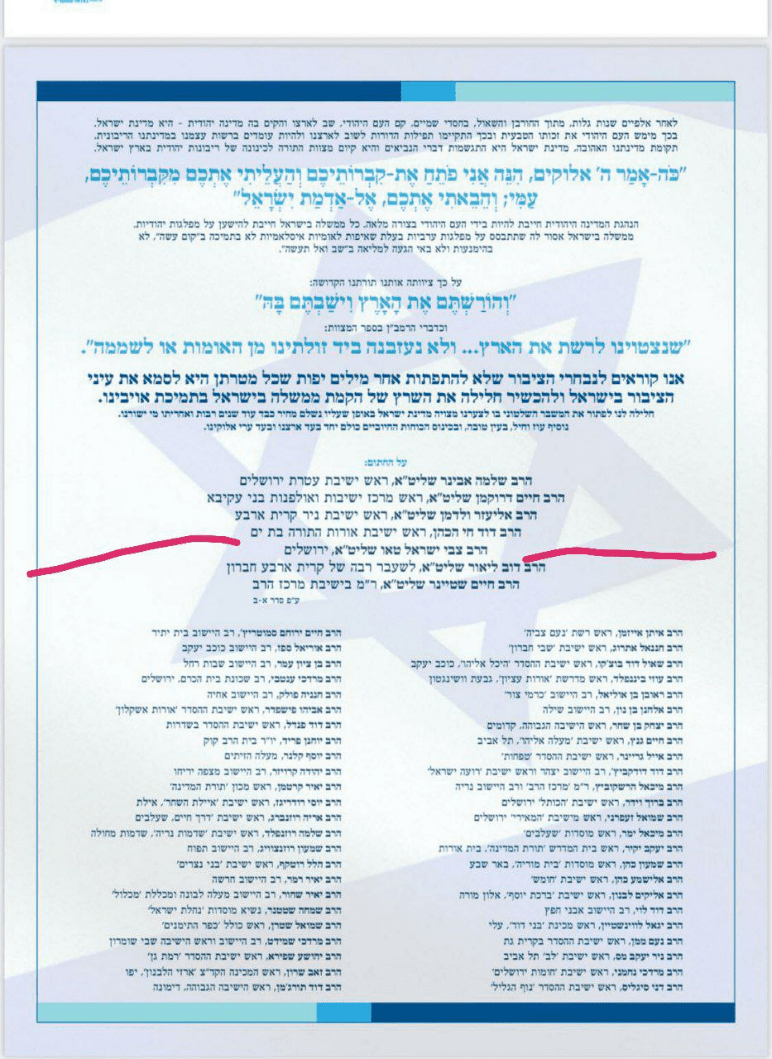
Note that the number of signatories fulfills the verse “let not the mixture be lacking” (see Ramban, Bava Batra 76b, and elsewhere), and it seems we have here a majority of the “great Sanhedrin,” both in structure and in number. In any case, as your straight-seeing eyes will behold, reliance on the Arabs entails a biblical prohibition of nullifying the positive commandment of “you shall dispossess the land,” as well as a desecration of God’s name (as will be explained below), and therefore one must not budge from this. “No counsel and no wisdom can prevail against the Lord.” That is the Mishnah Rishonah.
Initial Analysis: On Ideology, Pragmatism, and Haredism
One of the most prominent differences between the Hardal camp and the Haredim is the degree of pragmatism. Haredim, contrary to their image, are very pragmatic. In the end they weigh matters with common sense (or crooked sense), and make realistic decisions that will bring about the outcomes they desire (usually not mine). The Haredim do not cling too tightly to ideological declarations. For them, ideology is good for conversations in the beit midrash and synagogue, or for op-ed writing, but not for life. There, they act purposefully and efficiently for their interests. At most they are prepared to supply excuses about “Da’at Torah” for decision-makers whose choices are ideologically inconsistent—depths of thought no mere mortal can fathom—and that’s that.
By contrast, the Hardal camp is a very ideological and very non-pragmatic sect (see on this in column 19). It clings to its slogans, and every step and decision is tested in the crucible of ideological examination (which, of course, is always presented as Da’at Torah, transmitted directly from the Holy One via the Rabbis Kook to Rabbi Tau; see the beginning of Pirkei Avot). What fits is good, and what doesn’t—an uncompromising, tough, rigid ideological jihad. That is true for their conduct as private individuals, and certainly as a group. Naturally, it is quite hard for all of us to deal with consistent, hardline ideologues—but there is indeed something to admire in them (and also something not to admire. Over-attachment to ideology is somewhat childish. Whoever matures understands that life is always more complicated. See The Little Prince, chapter “The Lamplighter”).
This proclamation is a marvelous expression of that mode of conduct. Although the only way to bring their representatives into the government and to form a government in their spirit (at least relatively) is to rely on Abbas, that, of course, is out of the question for them. Relying on Arabs is vile pragmatism that stands in frontal opposition to the sparks of light of the Torah of Israel, founded upon holy mountains—or tiger mountains—which some call Ideology. One must not surrender to the Antichrist, that is, to the unholy combination of the New Israel Fund, the European Union, the detested left, and abominable liberalism (i.e., anyone who is against Bibi), who stand beneath every green tree and behind everything that happens in the universe (as if they were “haters” and “terrorists”). Such pragmatic conduct is dismissed out of hand because it stands in direct contradiction to ideology (sorry—to our eternal Torah, which shall not be replaced).
Note that one could have raised entirely nontrivial pragmatic arguments for this ostensibly “non-pragmatic” policy. Reliance on an Arab party is a problematic precedent, since until now no serious actor in Israeli politics—including centrist and left parties—has dared to establish a government that relies on Arabs. If the right were to do so now, naturally it would grant license to all who follow (speaking according to their view, not mine). Such a step could make the Arabs into the balance of power (like the Haredim), and that could significantly change Israeli politics for a long time to come. And indeed, the right has already been certified—both the man and the amulet—in blazing the trail for surrendering parts of the Land of Israel, in security failures, and in unceasing helplessness; and now it could also blaze the trail for integrating the Arab parties as a major central force in our politics. With such a right, who needs a left?!
But, as noted, that is a pragmatic argument that would never cross the holy lips of our light-sparkling leaders. And indeed, that argument didn’t really surface. What did surface was an ideological argument in rabbinic garb: a strict, grave prohibition of our holy Torah (which apparently harms the soul of the nation, in case you didn’t know). That is faithful testimony to the ideological path of our Hardal cousins.
I am not even speaking of the baseless tendentiousness of their interpretation of “vehorashtem” (“you shall dispossess”), which of course serves as a cloak for a political argument (only one mustn’t say so openly). Just look: it does not bother them that this government is composed of people who transgress every prohibition in the Torah (foremost among them our esteemed prime minister), who promote corruption and lies at every step, full of bowl-lickers, nobodies, and spineless folk. Nor are they troubled that the state as a whole is not based on halakha and that its laws do not truly take halakha into account. None of that includes any prohibition, and certainly none of it harms the soul of the nation the way the passive nullification, by grama and with a shinui, of the positive commandment “vehorashtem” does (i.e., relying passively on Arabs outside the coalition). Their infantile talk about “vehorashtem” is uttered as if the entire rest of halakha were kept here scrupulously, and all that remains is to ensure the little tip of the yod—that there not be outside support from an Arab party. And again: this is not a political consideration, Heaven forbid, but pure Da’at Torah and pristine halakha. The sole cloud shading our kashrut and the purity of the cruse of pure oil of the State of Israel (the foundation of God’s throne in the world) is “vehorashtem.” The whole world will tremble when it hears that in Israel Arabs are allowed to participate in the democratic game, and what a desecration of God’s name will be created thereby. Terrible, terrifying.
No wonder, then, that your faithful servant, after reading this wondrous proclamation—the Mishnah Rishonah (as it was then called)—leaned back in his armchair with great satisfaction, knowing that the righteous person’s work would be done by others. There are those who will see to it for me that a government led by Bibi will be prevented. I wrote then on WhatsApp that the Hardalim are like the Palestinians: they never miss an opportunity to miss opportunities. Excellent, as far as I’m concerned. Except that then, to my surprise, there came a Mishnah Acharonah (final version), and smacked me on the head.
Mishnah Acharonah
Did you think “no counsel and no wisdom can prevail against the Lord”? Well, you were mistaken. There may be no wisdom against the Lord, but counsel—there is. And you’ll be amazed: this counsel, too, was given to us directly from the mouth of the Holy One, blessed be He (there is nothing not hinted at in the Torah), via the Rabbis Kook to Rabbi Tau. It seems they have exclusivity with Him. And here are his golden words in the later edition proclamation, published yesterday, which with the flick of a hand turned yesterday’s biblical prohibition and harm to the nation’s soul into today’s sanctification of God’s name:
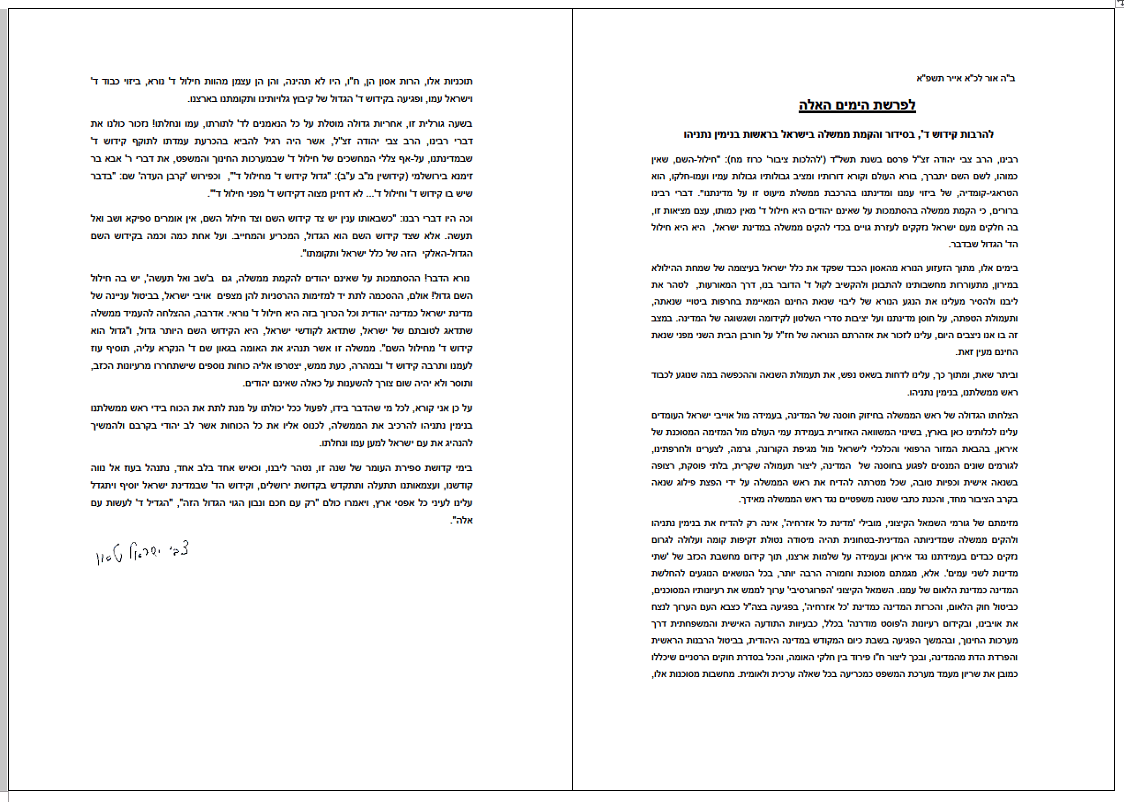
Indeed, a marvelous demonstration of Maimonides’ ninth principle: “And this Torah will not be replaced.” The status of women, Heaven forbid, cannot change by even a hair’s breadth over two thousand years; but the laws of sanctifying and desecrating God’s name, and the commandments of “vehorashtem” and “lo techonem,” undergo a shift from end to end within two days. “The right hand of the Lord is exalted; the right hand of the Lord performs valiantly.” Happy is the eye that saw all this; our souls faint at the report alone.
By the way, to complete the picture I note that quite a few rabbis oppose this Mishnah Acharonah, which bears only his signature. They hold fast to the Mishnah Rishonah (like Rabbi Druckman).
A Collection of Notes
Beyond the wondrous halakhic and ideological flip-flop—from desecration of God’s name and a biblical prohibition to the lightning-birth of sanctification(s) of God’s name that outweigh all of these with a mighty hand and an outstretched arm (a question remains whether this is merely “overridden” or fully “permitted”)—it is worth making a few remarks about this marvelous riddle-text from the “prince” of our generation (as it is said: “Princes of wind and no rain”):
A. Needless to say, this too is not, Heaven forbid, a political-pragmatic consideration. It is solely a halakhic and Torah consideration in pure Da’at Torah, possible only for one who knows the mind of the Most High and is familiar with the crucible of the God of knowledge. The proclamation begins with a quote from our teacher Rabbi Tzvi Yehuda (Rav Tzvi Yehuda Kook), who already foresaw in his holy spirit what was going to happen and warned us. Only, that quote matches the Mishnah Rishonah, and contains a severe prohibition and desecration of God’s name in relying on Arabs, Heaven forfend. But the proclamation also ends with other words of Rabbi Tzvi Yehuda that bolster the new Mishnah. “Words of Torah are poor in one place and rich in another.”
B. Next in the proclamation, how could it be otherwise, we come to the events in Meron, which turned the whole Torah on its head. Why? I don’t know—but admit it, some explanation is needed for the fascinating flip-flop that occurred here. Ah, I forgot the war against baseless hatred and the need for unity. Rabbi Tau’s move is meant to bring us unity at this difficult hour. Wonderful—though to be honest, I actually notice much more unity today, after Meron, than last week. But who am I, and what are my insights, compared to the word of the Lord from Jerusalem?
Well then, because of the need for unity within the people of Israel, there is no choice but to unite with the pure cruse of oil—Abbas—who acts in God’s name and for Zion’s sake will not be silent; and this, against about half the members of Knesset who are impure and detested Jews, many of them further to the right than our esteemed and corrupt prime minister. Preventing baseless hatred and fostering intra-Jewish unity—did we say that already?
C. Now, of course, come the expected words of praise and adulation for our above-mentioned prime minister, who stands steadfast against his pursuers (=the Antichrist). This is no surprise, since the man and the amulet were already certified in a letter of praise and encouragement from the author of this Mishnah Acharonah to President Katsav, who was convicted of rape and indecent acts. Still, our esteemed prime minister and proud Jew is merely a liar, corrupt, hedonist, openly adulterous, Sabbath desecrator, eater of non-kosher meat, and one who has relations during a woman’s period. He does not, Heaven forbid, transgress the grave prohibition of “vehorashtem” by grama, which harms the soul of the nation. Oh, I forgot—actually he does transgress it. In the eyes of the author of the Mishnah Acharonah, Bibi apparently descends into the filthy alleyways to rescue all the sparks in the depths of impurity. Therefore, all the faithful of Israel should support him, and not those accursed, spineless leftists like Bennett, Sa’ar, Gantz, Bogie Ya’alon, and their aides. Ah, and I forgot the wicked Ibtisam Mara’ana. How can she be compared to the renowned Righteous Among the Nations—Abbas?
D. Fear of the Antichrist who promotes a “state of all its citizens” leads Rabbi Tau directly to side with bringing an Arab party into the government (at least passively). You have no stronger war against the “state of all its citizens.” In addition, the fear of division that will be sown among the Jewish public now (this very week—last week this fear did not exist) leads him to side with a coalition with Abbas against about half of the Jewish Knesset members. Now an amazing unity will reign among the Jews, and all the Arabs will know their place. Scum that they are. How wondrous are the ways and logic of our master, to whom no secret is hidden.
E. At this fateful hour (meaning right now, not fifty hours ago, when matters were far less fateful), we must remember the words of the Holy One as voiced by Rabbi Tzvi Yehuda (Pirkei Avot there, there), that we do not defer sanctification of God’s name on account of desecration of God’s name. This principle was renewed just now thanks to Rabbi Shimon bar Yochai, may his merit protect us, and only Rabbi Tzvi Yehuda, in his holy spirit, managed to discern this principle even before last weekend. Not for nothing did our Sages write: “Whoever takes counsel from the elders will not stumble.” True, the criterion for what counts as sanctification and desecration of God’s name is still unknown to us. Likewise, none of us knows the measure—how great is “great” and how not? This was not entrusted to ordinary mortals (those who do not “remember” Rabbi Tzvi Yehuda’s instructions—just as our master, the prince of our generation, himself did not remember three days ago). This is “the secret of the Lord to those who fear Him,” to whom He makes known His covenant.
F. It is further written in this Mishnah Acharonah that we must ensure a government that has proven itself in caring for Israel’s sanctities (see: Meron), that will represent the Holy One, lead the nation with pride, and upon which the name of the Lord is called (=Bibi).
G. The foolish justifications offered in this proclamation, of course, mask a completely political-pragmatic calculation (legitimate and sensible in itself), in lofty and exalted language. This is an attempt to cover for absolute detachment from reality, for a wrong reading of the map, and also for matchless hypocrisy. Beyond all that, it seems to me that these justifications indicate that the main difference between the Hardalim and the Haredim is vanishing. The attachment to ideology remains on the surface; inside they are already entirely pragmatic Haredim (apart from a few chapters of Psalms once a year). In this sense, the map, at least, becomes simpler. By the way, I am in favor of pragmatism—but I prefer it to be open and transparent, honest, and above all without bombast and claptrap.
He should have written candidly something like this: I erred earlier and misread the map. There is no “vehorashtem” prohibition in such a coalition; I was simply wasting your time. Only, I thought it was a politically bad step, and now it has become clear to me that the alternative is worse. There is certainly room to honor one who admits his mistakes—if that were the case. But the continuation of this phraseological discourse guarantees continued conduct as it has been until now.
H. What troubles me most in this conduct is that the writer apparently estimates there will be enough fools to buy the nonsense he is selling here. He assumes there will be many who will treat his words as if there were a halakhic argument here, and will forget all the prohibitions of the Torah that he himself innovated ex nihilo only a few days ago, and will not notice the baselessness of the arguments themselves. They will also continue to listen seriously to the words of the redeeming Torah and to the “faith of our times” issuing from the holy mountain, fresh each morning. I am troubled not by his very assessments of reality, but by the impression that in this case he actually knows reality not badly at all. Among his flock there will apparently be not a few of this sort. “Only a wise and understanding people is this great nation.”
Apropos a wise and understanding people, I can only conclude with a quotation from the end of the words of the author of the Mishnah Acharonah, the prince of our generation, which descended upon us, the masses, directly from the heights of the holy mountain in Jerusalem, in the very formulation of the author of the report:
In the days of the holiness of the counting of the Omer [this holiness prevails only after Lag BaOmer, of course] of this year, let our hearts be purified, and as one man with one heart, let us proceed with strength to our holy abode, and may our independence be elevated and sanctified with the holiness of Jerusalem; may the sanctification of God’s Name in the State of Israel increase and grow great upon us before the eyes of all the ends of the earth, and may all say, “Only a wise and understanding people is this great nation,” “The Lord has done great things with these.”
If there is anyone here who still does not see how, following the Mishnah Acharonah, the name of the Lord is called upon us (via a government of Bibi and Litzman, Ben Gvir, Gafni, and Miri Regev, with the new seasoning Mahmoud Abbas), let him stand. If there is perhaps among us a base fellow who suspects that this people is not really the wisest and most understanding of all the nations—let him stand. And perhaps some even do not see, with their fleshly eyes, the sublime sanctification of God’s name that is created thereby before all nations and the ends of the earth, when all see how all the faithful of Israel, as one man, support a liar, a corrupt man, and an adulterer for prime minister—and even view it as a sanctification of God’s name—and deny Arabs the right to participate in Israeli democracy—let him stand. And perhaps some of those base fellows are not impressed by the zigzags and the excuses uttered with an air of gravitas as if this were a new giving of the Torah—then it is a sign that their eyes are dimmed from seeing. They apparently do not understand the depth of the “faith of our times.”
Discussion
Woe to the generation whose most ridiculous people are childish clowns like Tau and Kanievsky
This is not a dichotomy but a general description. Obviously there are exceptions, but as a rule this is an accurate description. The example you gave is actually an example in support (or a slap): the father is not willing for his son to get on the train because it is dangerous. He uses slogans about exile to justify it. That is ultra-pragmatism. The religious-Zionist, by contrast, will get on the train anyway, in an unpragmatic way, because that is his ideology.
They disdain doctors until they need them, and then they hysterically look for the very best doctor (because that is, of course, the required hishtadlut). And so too regarding many other things.
A substantive response to Michi’s remarks:
He called Bibi “the corrupt liar.”
Michi forgets to mention that Bibi is indeed a liar and corrupt (apparently that is indeed so), but he is one of the best prime ministers the people of Israel have ever had:
By many parameters, Israel handled the coronavirus really well. The health system was prepared.
The economic situation in the country is very good during Bibi’s rule; thank God, it seems we are also emerging nicely from the economic crisis of the coronavirus.
There are peace agreements with a number of Arab countries (and apparently many more to come), with Bibi at the head of the system.
Israel’s security situation is reasonable. The security problems are not over, but the average Israeli can go out of the house and feel safe, thank God.
Therefore, one can also understand to a certain extent why, despite Bibi being a liar and apparently also corrupt, 30 mandates continue to go with him.
Why did Michi choose to mention mainly Bibi’s negative sides?
Because it suits his article.
Intellectual honesty and objective writing?
Not with Michi.
Michi’s second lie –
Notice what Michi writes in order to present the rabbis in an unflattering way:
“that one must not rely in any way whatsoever on an Arab party . . .”
Well then, a quick glance at the picture Michi himself brings clearly shows the truth:
“it must not be based on Arab parties ***with Islamic nationalist aspirations***”
Come on, Michi. Fine, present a half-truth, but not to notice the content of the letter that you yourself uploaded and that proves how much you are bluffing? You are simply a hack.
In truth, the rabbis would probably have no problem at all with an Arab party without nationalist aspirations on the soil of the Holy Land, may it be rebuilt and reestablished speedily in our days, and that recognizes a Jewish state. Just read critically what Michi writes.
All right, that’s enough for now; I will expose the rest of Michi’s nonsense later on.
By the way, if someone wants to respond to what I wrote, then write something substantive in response as well, and not just something in the style of “you’re an idiot and stupid and not worth responding to.”
And you are a devoted reader of this site, heaven forbid, not because the contents interest you, but in order to open the blind eyes of its blind admirers, right?
My opinion was exactly like yours, word for word, and I even saw a blessing in it, that there had been a softening in the ideological being of Har Hamor. But after a more in-depth examination of the text, I think this is not a pragmatic compromise but a courageous ideological decision.
In the first edition, Tau adhered to the tradition he had received from his teacher Rav Tzvi Yehuda (from Mount Sinai, of course), that the value of racism is the most sacred value we have, and it must be pursued without compromise to the very last paving stone in Shechem.
After writing all this, Tau remembered the world of values that he himself crowned at the top of Judaism’s value ladder (from Sinai, as above) – the values of LGBT-phobia.
And so, in a courageous ruling, in the vein of “the words of the master versus the words of the disciple,” Rabbi Tau ruled that the values of LGBT-phobia take precedence over the values of racism, and one may be even a little bit not racist, heaven forfend, for the sake of the exalted goal of persecuting feminists and LGBT people.
Thank God, we merit to see the word of God alive and breathing, and the spirit of Rav Tzvi Yehuda taking on a new form in his disciple and successor, like Rabbi Eliezer, who never said anything he had not heard from his teacher and yet merited to say “things that no ear had heard”
BS”D, 22 Iyar 5780
Even in the “later edition,” Rabbi Tau did not retreat from the principled determination that a situation in which the government of the State of Israel is based on gentiles who deny the belonging of the land to the people of Israel is a “desecration of God’s name”; rather, from a practical standpoint it became clear that the alternative was installing a far-left government that would harm not only the Jewish character of the state, but also the security of the state and the wholeness of the land. A government led by Lapid, Gantz, Michaeli, and Zandberg—in the best case would not withstand the pressure of Biden and company, and in the worst case would gallop toward far-reaching concessions to the Palestinians and the destruction of settlement in Judea and Samaria.
Necessity requires, in Rabbi Tau’s view, supporting a right-wing and Jewish government that Netanyahu will establish, and although reliance on Mansour Abbas the Islamist is a terrible “desecration of God’s name,” in Rabbi Tau’s opinion we have no choice but to submit to this necessity, relying on the guidance of the Jerusalem Talmud, “Greater is sanctification of God’s name than desecration of God’s name,” as interpreted by Rav Tzvi Yehuda Kook, that even where there is an aspect of desecration of God’s name in yielding to necessity—the sanctification of God’s name that will eventually emerge from it is greater.
Indeed, in the ideal—in the ox of the first man—the horns, “raising the horn of the people of Israel,” precede the hoofs, the practical mode of conduct. But in practical life the “ox” is born in a lowly state, without the horns of splendor and glory, and its hoofs, its earthly conduct, precede the horns of splendor and glory. This is the virtue of the thanksgiving-offering, the ability to thank God even for an incomplete reality, מתוך faith in the future that will bring the completion of the enterprise: “For God will save Zion and build the cities of Judah, and they shall dwell there and inherit it. The seed of His servants shall possess it, and those who love His name shall dwell therein.”
With blessing, Amiyoz Yaron Schnitzler
For you – a substantive response
The designation of our revered prime minister as a liar and corrupt (and one may ask whether all the achievements of the State of Israel are thanks to him, and if not whether it would be better without him—but this is not the place) was intended for a rhetorical purpose – presenting the distorted scale of values from the house of Tau, which lovingly accepts lying and corruption but does not compromise by a hair’s breadth on the laws of “you shall not show them favor.”
Regarding the matter of Abbas’s nationalism – there are two answers to this. First: calling the Arab parties ones with nationalist aspirations was meant only as an added insult and as supportive rhetoric for the central prohibition – giving Arabs a seat in the government.
And further: nowhere have we seen that Abbas retracted his nationalist aspirations, so the qualification, even if it were in its proper place, would not change the ruling
Paragraph 3, line 3
…of the “thanksgiving-offering,” the abilityto thank God even…
There, line 4
…out of faith in the future that will bring…
Thank God, Amiyor serves as a living example of the method of learning in the study hall of our generation’s prince, may he live long.
In response to every difficulty one should repeat what the rabbi said in slightly different words and season it with irrelevant verses that illustrate that the repeater himself did not understand the rabbi’s words.
Happy are we that we have merited this!
It may be that in the “first edition” Rabbi Tau still expected some kind of thaw in the “bad blood” between Netanyahu and Gideon Sa’ar and his faction, a thaw that would have made unnecessary the step that is objectionable in principle, namely reliance on Ra’am. Once Rabbi Tau despaired of the possibility of establishing a right-wing government with Sa’ar joining it, the only unavoidable choice left was between a left-wing government relying on the Joint List and a right-wing government relying on Mansour Abbas.
With blessing, Yaron Fish”l Ordner
For various directions in analyzing Mansour Abbas’s position and the question of his sincerity, I referred in my comments on the column “Confused? Change the Axis System.” It may be that he grasped that דווקא a right-wing government could improve the real problems of Israel’s Arab public. This requires further study.
What is less understandable to me in the conduct of “Religious Zionism” is the emphatic determination that they would not support, even from the outside, a government Netanyahu establishes based on Ra’am.
For even if Netanyahu is mistaken and even sins in relying on Ra’am – is that a reason to topple his government, or at the very least to threaten to do so? Can a small party of 6 mandates dictate to a party representing a quarter of the people that it must change its policy?
It would have been more correct to say that we oppose and greatly fear Netanyahu’s move, but with no alternative and out of gratitude toward him – we will not topple his government, even if we refrain from joining it. We are allowed to acknowledge our weakness. And our meager political power.
In short: in my humble opinion, a sharp protest against Netanyahu’s move to establish a government reliant on Ra’am is in place, but voting against such a government is beyond our strength and our ability.
With blessing, Yifa”or
Rabbi Ronen Luvitch compares, in an article he published a few years ago, the concept of sanctification of God’s name in the thought of Rav Tzvi Yehuda’s disciples with that same concept among the disciples of Rabbi Amital and Rabbi Lichtenstein at Yeshivat Har Etzion. The article is academic, well-based, and very long; I’ll summarize it briefly in the concluding paragraph:
“The one path was charted by Rav Tzvi Yehuda Kook and his disciples from Yeshivat Mercaz HaRav, whose doctrine is based on emphasizing national motifs, and even oppositional ones. Those who walk this path hold that the degree of success of the people of Israel in the world is the central parameter determining the degree of sanctification of God’s name or desecration of God’s name in the world. These rabbis based themselves on the words of the prophet Ezekiel and developed an approach according to which the State of Israel represents the nation as a whole, and as such it also represents the standing of the divine presence in the world. In light of this, the state’s success in the diplomatic and military arena are the clearest expressions of sanctifying Heaven’s name among the nations of the world.
The other path that emerges from the writings of Rabbi Yehuda Amital and his disciples from Yeshivat Har Etzion, as well as from the words of additional rabbis close to them in spirit, also relates to the conduct of the State of Israel as carrying great weight with respect to the index of sanctification of God’s name in the world. However, from its perspective it is not the state’s successes that are the determining factor, but rather its degree of morality. This morality is determined in accordance with accepted norms of human morality. The pattern of thought of this approach is not national-oppositional, but rather is based specifically on universal values and places before its eyes Israel as a state that should play according to the ethical scale practiced among the nations.”
And here is the link:
https://toravoda.org.il/%D7%A7%D7%99%D7%93%D7%95%D7%A9-%D7%95%D7%97%D7%99%D7%9C%D7%95%D7%9C-%D7%94%D7%A9%D7%9D/
Too many words, word games, and cynicism. Sometimes it’s even hard to understand, but regardless it’s just unpleasant to read (even for admirers, pardon me). What is it about the Kavniks that drives you out of your mind? Write substantively and maybe you can even persuade someone
In my humble opinion, you are being imprecise, to put it mildly. In all the interviews I heard, Bezalel Smotrich and Itamar Ben Gvir made the distinction between the possibility of relying on an Islamist party with nationalist aspirations to throw us out and whose leader supports terrorists (not a decade ago, but only a few weeks ago), and their willingness to serve the Arab public as well. If a party composed of Arab public figures committed to public service and not to violent struggle were to arise, then I am convinced Religious Zionism would have no problem.
Another point: it’s possible Netanyahu is corrupt. Though two things must be noted in that context: 1. He has held the highest office for about 15 years, and his corruption is still perceived at the lower end of the corruption scale. 2. The form of corruption he is accused of (favorable coverage) unfortunately taints many people.
Yoni, when I read your words, I paused for a moment and considered whether there was something to them and perhaps I should reexamine my attitude toward them.
I came up with three characteristics that bring out cynicism and mockery in me toward this ridiculous gang: 1. Their childish and stupid approach. 2. The pathos and seriousness that accompany it, and the feeling as though they are descending into the fiery furnace of the world and of Torah, and as though the world rests on them (= the central world yeshiva). 3. Despite all that, quite a few fools are drawn after them at least somewhat (even the opponents, usually accompanied by some inferiority complex). The proof is the various publications as though this collection of clowns is “the rabbis of Religious Zionism,” and not only in the notices they themselves issue but also in general media treatment.
These three characteristics cause severe damage to religious-Zionist society. Not only to its public image but also in essence. Therefore, in my opinion, it is important to burst the balloon of importance surrounding these fools.
Rabbi Yitzchak Hutner explained the Gemara, “All mockery is forbidden except mockery of idolatry,” as follows: the reason why it is permitted and proper to mock idolatry is the nature of this sin. Idolatry is assigning enormous importance to something unimportant (wood and stone). Mockery sticks a pin into an inflated balloon of importance. Therefore it is proper to apply it to idolatry. This is exactly the situation here. I am not claiming, of course, that they are idol worshipers in the halakhic sense, but the foundation of idolatry (enormously magnifying emptiness and turning it into the living God) is very much present among them.
And from here you will understand that to write about them in a serious and substantive tone is really insulting and improper. You do not relate substantively to a small stupid child who is talking nonsense. In principle you should not relate to him at all. You find it necessary to do so only because there are those who do not notice that this is a stupid child. But a serious response to him creates a situation as if he is worth serious attention. In what I wrote I made entirely substantive arguments, but I did so in a cynical formulation. That is a substantive response, and in these circumstances it is also very appropriate in my view.
Are you sure these remarks are posted under the right column? The note at the end about Netanyahu seems connected to an aside of mine (though not a correct one). But regarding the beginning, it isn’t clear to me what it refers to.
Worth illuminating a few things that were apparently forgotten:
“Fear the Lord your God” – this includes Torah scholars.
The article is not written in a constructive critical way, but in a cynical and contemptuous one.
If we show contempt for our rabbis, what do we expect from the media and their ilk?!
Contempt for rabbis is somewhat reminiscent of the stories from before the destruction of the Temple, and when it comes from within our own public, it hurts all the more.
If you had lived in the time of the destruction and heard Rabban Yohanan ben Zakkai say, “Give me Yavneh and its sages,” what would you have said about him?!
It is possible and necessary to criticize, but it depends how it is conveyed.
Precisely putting the LGBT issue, gender, and identity at the top of the priority list in Har Hamor shows that sanctification of God’s name or desecration of it is on the moral plane from their perspective. (I’m not claiming they are right.)
Bingo 🙂
Thanks for the reminder. On this occasion I too will mention two sayings of Hazal:
1. Any Torah scholar who lacks understanding—a carcass is better than he.
2. In a place where there is desecration of God’s name, one does not give honor to the rabbi.
And especially when someone takes for himself the crown of Torah scholar and rabbi and lords it over the public.
If I had been living in the time of the destruction and heard Rabban Yohanan ben Zakkai’s request, I would have applauded him. Pragmatism worthy of praise, with no internal contradiction and without presenting glittering and pathetic false appearances. Exactly the opposite of what we see among the Dylan sect.
See also my reply to Yoni above.
BS”D, 21 Iyar 5780
Seemingly there is room to distinguish between the case before us and the precedent set by Rav Tzvi Yehuda, who denied the legitimacy of Rabin’s government that arose as a “minority government” relying on Arab votes.
Rabin’s government at the time represented a minority among the Jewish public, a minority that imposed itself on the majority through Arab votes. Reliance on the Arabs distorted the will of the Jewish voters.
By contrast, in the case before us, the right-wing bloc under Netanyahu has a clear majority among the Jewish public. Reliance on Ra’am only strengthens the choice of the majority of Jewish citizens.
With blessing, Yifa”or
I’m interested to know whether you have the same attitude toward the rabbi from whose power all this derives – Rav Kook
But on the other hand, it may be said that although reliance on Ra’am’s votes only strengthens the choice of the majority of Jews – the very reliance on Arab votes expresses an improper principle, one that hands the decision and the determination of control in the State of Israel over to gentiles.
And I have already suggested the practical direction of outside support while sharply protesting the reliance on Arab votes. In my humble opinion, that is the maximum Religious Zionism can do in view of its meager political power (the meager power of the religious-national camp 🙂
With blessing, Yifa”or
And another thing: has the rabbi ever spoken with Rabbi Tau directly or attended one of his lessons?
And another thing: has the rabbi ever experimented with origami made from light-blue Bristol board with floral decorations in a golden hue?
A response to “Gra”:
I didn’t ask people to respond to me. I asked that if someone responds, he should respond substantively.
I appreciate you very much for choosing to answer substantively.
Regarding the response itself –
A. Nice that you agree with me that Michi presented Bibi in a very partial and unserious way.
What you wrote, that it’s legitimate for Michi to write this in order to show that the great Rabbi Tau, may he live long, lovingly accepts lying and corruption,
that is of course untrue, and it is neither nice nor serious that you write this way.
The great Rabbi Tau, may he live long, does not lovingly accept lying and corruption.
He accepts Bibi as the best prime minister currently available to the people of Israel.
Next time you write, try to advance one step further—not only to answer substantively,
but also to answer seriously.
B. You back up Michi’s lies by saying that in the notice the “national-Palestinian” matter is only an excuse,
and that from Rabbi Tau’s perspective there is real racism that wants no Arabs at all in the government.
Do you have a shred of evidence for that?
For in truth we know that Abbas and his party indeed have nationalist aspirations for Arabs on the soil of the Land of Israel,
so that certainly is not an “insult” directed at them.
Regarding what you wrote in the last two lines, I didn’t really understand, and the truth is that from what I can understand it stands
in contradiction to what you wrote above
A response to “Agalon”:
I am not the issue here.
The issue here is Michi’s content.
I simply identify him as a hack.
In column 375 you came out against tendentious discourse. Here in column 386 you received pragmatism with understanding. What is the difference between the two?
In both there is one secondary principle that is given up (perhaps temporarily) for the benefit of another more important principle. That is what Abbas does, as you wrote in the column; if Rabbi Tau had explained himself that way there would have been nothing to complain about. And Rabban Yohanan ben Zakkai did the same, and you wrote in the comments that you would have applauded him. So now why not support personal legislation, or subordinate the status of the High Court to the question of whether the High Court advances the goals I want to advance, rather than to the question whether it is “right” democratically for judges to take powers from the Knesset, etc.
In my opinion this is not a stupid question, and when I try to formulate a possible answer I arrive only at differences in shades of a slippery slope.
[Speaking for myself, I think it is very right to have a position. Some things are important and some are much less so. The important things determine the position, and everything else should be subordinated to them. The only problem is that everyone participating in public debate tries to paint himself as though he discusses each thing on its own merits, and yet magically it almost always comes out fitting his position. I think one should simply say directly: this is my position, these are my basic goals and my strategic goals, and everything else is tactical maneuvering. I have mentioned before and will mention again the book “The Bridge on the River Kwai,” because in my opinion it captures important insights.]
In this subthread, as far as I’m concerned, you are indeed the issue, and you rather intrigue me. Why do you devote your precious time to diligently studying the words of a hack in columns and Q&A? I assume the content of course adds nothing to you, and you only read and write here so that the public of fools here may see the light you are shining upon them, right?
Definitely not.
Not really. 🙂
No. And to tell the truth, I have no great motivation to do so. What I know of him does not arouse in me a strong desire to know more. A person makes choices in life and chooses people from whom it is worthwhile to learn and with whom it is worthwhile to meet.
I am not engaged in pragmatist philosophy but in pragmatic conduct. In politics there is certainly room (not unlimited) for pragmatism.
I am against positions because they are not honest. Their price is enormous, and therefore even consequentially it is a mistake to conduct oneself that way. When everyone speaks from a position, it is impossible to talk. You raise arguments and reasons, and the other person does not listen at all and does not respond to the point but lies again and again. That itself is damage that almost outweighs any other damage (because discourse is very important for the functioning of a society, and today there is no discourse in Israel. That is worse than adopting a mistaken policy, which tendentiousness is meant to prevent). There you have a pragmatic consideration against tendentiousness and position-taking.
By the way, I cannot even accept your claims here as reflecting your position, because you testify about yourself that you speak from a position, and therefore it is possible that you do not believe anything you say. That empties discourse of meaning. It is a bit like the permission to say things in the name of a great man so that people will accept them from you. It has enormous harms; let that permission be buried and not said.
I too am dealing only with pragmatic conduct and not philosophy. In your words here it says that only the lie is the problem, not the position itself. That is, someone who says explicitly: I support this personal legislation because it advances my goals, and if it were against my candidate I would oppose this legislation with all force and might—you have no problem with that. Half the public debate is mutual accusations of “hypocrisy,” and in my opinion that is usually a stupid argument; hypocrisy testifies precisely to pragmatism and a hierarchy of principles, and it deserves praise.
I didn’t understand. If I do not believe what I said, that means that in my opinion it is indeed important to form an opinion on every issue “on its own merits” and not from a position. But if that is my opinion on the merits and nevertheless I spoke from a position, that means that my opinion is in fact reflected in my words—that the position is more important than the local opinion. In any case, my personal opinion is presumably less interesting here; maybe when I have grandchildren someone will bother listening to my little reflections. [It reminds me of an argument of yours against determinism. And also of the problem of believing people who claim they hold by the categorical imperative. But that is already drifting away.]
This casuistry is too much for me. If you are not telling me what you think, there is no point in discussing, no matter what the reason is. Even this very discussion is pointless and meaningless.
I do have a problem with that, though a lesser one. Laws that are not general and not equal are a problem.
All right, there are always problems. Giving up Jerusalem in exchange for Yavneh and its sages is also a problem.
But here it is clear that I am saying what I think. When people accuse hypocrisy or lying in discussion A, that means there is something even more important (discussion B) over which there is a general dispute, and which they are trying to protect and to conceal.
But what did I say here? I said that the explanation for the wondrous fact that everyone is always speaking from a position is that positional principles really are much more important than all the incidental principles that each time people happen to argue about as though unrelated to the central dispute. And only in order to streamline public discourse, it is truly advisable to say honestly: I have a position; I am sacrificing a knight for the queen and I do not care whether the knight is important or not important. You want to take my queen too and expect me to agree that it is worth defending the knight, and that way you’ll take my queen—but I won’t let you. Health and happiness. That would really streamline most public debates and save all the tiresome accusations of hypocrisy.
There is no reason at all to suspect lying in such a position—because if I argue for a general position out of some position, that means I really hold the opinion that the position determines things. What is casuistic about that.
As I said, if you put it on the table, the problematic element is lessened. And still I oppose using the lawbook to advance a person or a local idea unrelated to the purpose of the law. The game becomes ruleless and force-based. One cannot play such a game. A law is supposed to have a more stable and fixed status, as a framework for the political-civic game. The moment one bends it this way and that for the sake of some local achievement or other, there is no law in the state. By the same token, I too will violate the law in order to achieve some local gain, and of course my rival will do the same. It is impossible to conduct oneself that way.
It is not for nothing that people do not put the position on the table, and therefore the accusations of hypocrisy are certainly correct.
This whole discussion is unnecessary
In the end there is a hard decision here:
Either to sit in a government with an enemy from within, of the Jewish people
Or to enable a government of the worst enemies in spirit that the Jewish people have—perhaps actual traitors—the hard left (the progressives) and those dragged after them (Lapid, Gantz, and ליברמן). In any case, the evil of these is the hardest of all (as in the time of David, when they were righteous but many died in war because of the talebearers among them) + those enemies from within from the first option.
Although ostensibly it is clear that the second option is worse, it is still a difficult decision because of its long-term effect and significance. I myself am a liberal and not a conservative, but progressives are a hundred times worse than conservatives.
Rabbi Michi has already been captured, in his foolishness, by the unceasing propaganda day and night (like the fixed laws of heaven) of the left against Bibi, who today represents those who believe in the state of the Jews, through constructing a reality and implanting the image of Bibi as “a liar and corrupt,” and of the Likud members as a collection of corrupt people like him. That’s what they have been doing since Bibi was born, roughly speaking. They build a story, believe in it, and sell it to anyone willing to listen. They are the talebearers David speaks of all the time in Psalms, and Rabbi Michi has been taken in by them (the sect that accepts slander). Bibi is presumably no less upright than all those people from the left who ran the state from the days of Mapai onward. And Rabbi Michi has joined the progressive left (even though in his views he does not really belong to them), and he has already once revealed here his opinion that he truly supports a state of all its citizens. In practice, he only wants (without knowing it) to lower the spirit of the Jewish people dwelling here. Anyone who still believes in that, I suggest he keep away from him and not enter this site, as I myself have already been doing for a long time. All the power of the left is in their mouths. Stay away from them and they will evaporate. My whole response here is only for anyone who still believes in the state of the Jews for the Jewish people. Once the site belongs entirely to people who think like him and only they respond here and talk among themselves about how they are knights of justice and integrity (as the left always likes to do), then we will have won (the Jewish people dwelling here in the land). And then I too will disappear from here forever.
I see here on the site all the commenters who try to apologize and say that maybe Bibi really is such-and-such etc., but still etc. Just stop with that. That is exactly what the left and Rabbi Michi are trying to sell you. But there is nothing here at all. It is impossible to know anything about Bibi, just as it is impossible to know anything about the effectiveness of conversion therapies, because of the strong emotions all sides have on the subject. Everything you hear in the news is passed through framing and omission of details—not intentionally, which is even worse—they simply do not see what they do not want to see, what they believe in, because from the outset that is all they see, and then with astonishing tirelessness they babble about it knowingly to anyone willing to hear. It does not seem at all that they have free choice in the matter. It is truly an addiction and a mental illness. Whoever is unwilling to adopt the same methods as the left (which is not merely to lie but truly to live in falsehood—in a reality it constructs in its imagination for its own benefit; that is the deep core of the left and of progressivism—postmodernism and the world of narratives and denial of the reality of objective truth) must simply keep away from them as from fire. Rabbi Michi has become, without realizing it (self-awareness is not his strong side), part of them.
You are giving here a pragmatic argument (like the argument in previous columns against communist utopia) and not an argument on the merits. That is, your big argument against positions itself comes from a position of defending the integrity of society in general, and not because there is something inherently correct in the argument itself. Just to clarify.
People do not put the position on the table, but in practice they act that way. Actions speak louder than words.
After all, I wrote that my argument is pragmatic. But when the utility in question is the very possibility of discourse and reasonable conduct, that carries very great weight. It seems to me we have exhausted this.
BS”D, 37th day of the Omer, 5780
To T”G – greetings,
Rabbi Tau explicitly explains his practical concerns about the establishment of a left-wing government, “whose diplomatic-security policy would from its very foundation be lacking in uprightness and liable to cause heavy damage in our standing against Iran and in standing for the wholeness of our land, while advancing the false notion of ‘two states for two peoples.’”
Beyond that, Rabbi Tau fears that “their tendency is far more dangerous and severe in all matters of weakening the state as the nation-state of our people… in canceling the Nation-State Law and declaring the state a state of all its citizens, in harming the IDF as the people’s army poised to defeat our enemies, and in promoting postmodern ideas in general, in distorting personal and family consciousness in the education system, and in the continued harm to the Sabbath as the sanctified day in the Jewish state, in abolishing the Chief Rabbinate and separating religion from state … in a series of destructive laws that will of course include entrenching the judicial system as the decisive authority in every moral and national question.”
In short:
A left-wing government may bring corruption both on the diplomatic-security plane and on the value plane, and therefore Rabbi Tau holds that the establishment of a left-wing government may bring a more severe desecration of God’s name than the desecration of God’s name involved in partnering with Ra’am in the leadership of the state. Therefore the decision of the Jerusalem Talmud operates here (according to the interpretation of the author of Korban Ha-Edah): “In a matter in which there is sanctification of God’s name and desecration of God’s name… we do not set aside the mitzvah of sanctifying God’s name because of desecration of God’s name,” or in other words: “this is the law of pragmatics.”
With blessing, Feyvish Lipa Sosnovitski Dehari (owner of the old platform)
[I understood long ago that you are “Ailon,” who used to be here once, said exactly the same things, swore solemnly that he would leave the site, and in the end came back. I personally would actually be glad if you stayed, because your comments allow me to sharpen my positions inwardly, but these loud threats and the feeling as though you are saving the fools from going to perdition are a bit ridiculous, sorry.]
A small note
Anyone who has spent a little time on the site and knows me knows that I am not a great lover of Haredim and Hardalim (to put it mildly). I have many comments showing what I think of them. The whole method I described of the left imposing their views on everyone else also exists among the Haredim and Hardalim (whose great leader is Rabbi Tau), but at a much lower intensity. In fact, the thing I truly detest is self-righteousness (all the self-styled world-fixers). There are two kinds of self-righteousness. Self-righteousness from the right—conservative self-righteousness. And self-righteousness from the left—the liberal self-righteousness, which is really progressive self-righteousness. And I testify as a thousand witnesses that the latter is a hundred times worse and more dangerous than the former. Throughout the whole world and especially here in Israel. Because conservatives at least believe in reality and truth, since they have something to lose from ignoring it (the Haredim have large families; they are not interested in their offspring dying in wars). They also believe in the Jewish people and in the shared fate they have with the non-conservatives. The second group of self-righteous people has no boundaries and will destroy the whole world if it does not line up with their view.
In this case Rabbi Tau has a very strong argument, and that could also explain this reversal. I personally have no problem with the Kahanists (except that they are Hardalim). Thanks to Rabbi Michi and the left, racism has become in my eyes the lightest sin in the universe. I would prefer a racist a million times over a traitor.
(I didn’t really understand why this was addressed to me. I’m not interested in Rabbi Tau’s words as such.)
There is no threat here. I truly have no interest in responding here at all. I hardly visit the site anymore (one must not be in bad company). I am not at all interested in saving the fools, but in saving myself. Saving the fools is the profession of the left and Rabbi Michi, so I too have no problem saving the “fools” (the naïve ones), at least for my own salvation. After all, Rabbi Michi says explicitly, in this article, that this is what he wants to do (it bothered him that naïve people are drawn after Rabbi Tau, and rightly so, one might say, a little). And I truly and sincerely have no interest in persuading Rabbi Michi or you of anything. There is no point in that. I have become convinced that Rabbi Michi is no longer interested in truth (he still doesn’t know that. But his lack of intellectual honesty keeps peeking out more and more as time passes. Lately he is truly an expert at ignoring arguments that disturb his worldview). I only want the people who already think like me and are alarmed and feel bad and are afraid of what people like you will think of them. Once there are none of those left, I will be able calmly to stop responding (I won’t feel the urge to respond). Because it turns out that this mental illness of progressivism is contagious. And what can be done—it affects me too even if I sit at home and engage in abstract thought. One needs to do something small for one’s own sake
To T”G – greetings,
My remarks were written in response to your words (12:14, line 3) that if Rabbi Tau had explained his words with a pragmatic argument—there would have been nothing to complain about. To this I showed that indeed Rabbi Tau does argue with a pragmatic argument.
I have a strange custom: when a discussion is held about so-and-so’s words, I look at the words under discussion 🙂
With blessing, Pilso”d (owner of the old platform)
At any rate, the discussion here is ancient, and Rabbi Yehuda bar Shmuel Ibn Abbas already summed it up: “He said, Have you seen a light shining on top of Mount Myrrh? And they said: We see nothing but myrrh.” 🙂
With blessing, Pilso”d
The fact that Rabbi Tau is willing to go with Bibi despite his being corrupt דווקא shows pragmatism.
It is ridiculous to hear sermons about corruption from the owner of this site, who praises the military advocate general and his other corrupt cronies.
The mockery of ideology is also unclear. From the transmitter of the teaching we learned that this is the advantage of Torah study over the other sciences: distilling practical practice in light of abstract principles. It turns out that someone who actually tries to do this in practice is rewarded here with buckets of scalding water.
Because of my commitment to the principle of kindness, I tried to decipher this riddle and respond, but in my poverty I succeeded only partially. But from your words I learn that my logic is apparently not much, so perhaps the problem is with me:
1. Who is this military advocate general whom I praise, and who are his corrupt companions? In my poverty I did not merit to understand. Who is even the military advocate general today?
2. Indeed, Torah is supposed to guide us in light of abstract principles, but clinging to abstract principles (as in positivism) is a recipe for disaster. As far as my feeble understanding goes, there is no contradiction here at all, and I have explained this more than once. Guidance is not the same as rigid adherence.
BS”D, 22 Iyar 5780
To Moshe – greetings,
Rabbi Tau does not trust the slanders against Netanyahu, and this is what he says:
“We must reject with utter revulsion the propaganda of hatred and vilification concerning our honorable Prime Minister Benjamin Netanyahu. The great success of the prime minister in strengthening the resilience of the state, in standing against our enemies who rise up against us to destroy us here in the land, in changing the regional equation, in shaping the stance of the nations of the world against Iran’s dangerous plot, in bringing medical and economic relief to the State of Israel in the face of the coronavirus pandemic—has unfortunately and disgracefully caused various elements… to create incessant false propaganda, saturated with personal hatred and ingratitude, whose entire aim is to depose the prime minister by spreading divisive hatred among the public on the one hand, and by preparing legal writs of hatred against the prime minister on the other.”
With blessing, Feyvish Lipa Sosnovitski Dehari
That is exactly what I am saying here.
“to create incessant false propaganda, saturated with personal hatred and ingratitude, whose entire aim is to depose the prime minister by spreading divisive hatred among the public on the one hand, and by preparing legal writs of hatred against the prime minister on the other”
I sign on every word. Only one must add that this propaganda also has another aim: the overarching progressive aim. “We shall destroy the old world to its foundations”…… (without the continuation)
It is beyond me how Rabbi Michi does not see this. Perhaps his (justified) hatred of Haredim and Hardalim is driving him out of his mind and leading him to undermine the very foundation that keeps the Jewish people here, in the land and alive. He will be hurt by this many times more than he was hurt by the (somewhat ungrateful) treatment he received from the Haredim with whom he came into contact.
I have no trust in the slanders against Netanyahu. Nor should any right-winger. One must really fortify oneself against these evil tongues (these lying tongues). Voters of Likud and of Religious Zionism, both Hardal and moderate, should stop going to the army if the left rules here. Not that I would want the reverse to happen. But even as things stand, the presence of leftists in the army already harms it considerably. Most of the army is right-wing, only it serves the left-wing chain of command (which sees to preserving itself as such). In the end, you defeat the Arabs with spirit, not with technology and moralism.
By the way, the very situation of a government half of whose members are Haredim, Hardalim, and Islamists truly gives me severe stomach pains (on the level of extortion). Even though these are not all that Hardal, and overall they are people I have no problem with except for the Hardal bug in some of them. I voted for them. And not for Bennett, who is usually my first choice, if only because I became convinced that in order to be prime minister he would give up the fight against the courts and everything important to the right. But the one who created this reality and fought for it tirelessly was precisely the progressive left, which grants equal voting rights to every creature with breath in its nostrils on earth without any relation to his degree of commitment to the state. This is part of the progressive religion. Until they disappear, the state will always be squeezed to its last breath. That is the real problem. There is no point complaining about the Haredim for their lack of participation in the state. Nor about the Arabs (whose participation is in the destruction of the state). They rent out their votes in exchange for money. That is a deal the other side is not obliged to enter and chooses to do knowingly. But what is there to say about the left, for whom there is no state at all (that is, no people)? They are far more fanatical in their religion than any other religion. And they are fundamentally immoral. Morality will always be constructed in such a way that in the end they will be the righteous and upright ones (for morality is relative and a matter of moral narrative and all kinds of nonsense like that). Therefore there is the feeling that by their own lights they are always genuinely convinced they are right. Their accusations of corruption are unbearable in their level of hypocrisy. By their own lights they cannot even be corrupt, because their narrative will always be adapted so that they are right. In any case, every immoral act will be validated as one serving a great and true goal, so they themselves will not even be corrupt.
These people are simply unbelievable.
Another response to “Agalon”:
I’ll answer.
First, to be clear, Michi, despite being a hack in his columns, is a smart person.
I do not “study diligently” all his columns (I didn’t enter the ones on Platonism at all), but only certain columns.
These will usually be columns related to political discourse, free choice, and faith (and even there only if they are not drowning in philosophizing and endless verbiage, most of which is irrelevant to anything)
Michi’s content adds something for me in the sense that I see how a person can pull the wool over his readers’ eyes, and I actually enjoy understanding Michi’s ability to pull the wool over his readers’ eyes under the guise of “good and well-defined arguments.” Exactly as people like to watch TV shows like “The Impostors,” etc.
In addition, as you noted, I expose Michi’s bluffs, and that too gives me a certain enjoyment.
In line 4
…in bringing medical and economic relief…
“And to distinguish between the carcass and the torn animal, that this is permitted and that is forbidden”
More power to you for the precision in matters of carcasses
BS”D, 38th day of the Omer, 5780
A halakhic note (to the decisor) –
A torn animal is also forbidden, as it is written: “You shall not eat flesh that is torn by beasts in the field.” The stringency of a carcass is that it also conveys impurity, as it is written: “And if one of the beasts which are yours for food dies, he who touches its carcass shall be unclean until the evening; and he who eats of its carcass shall wash his garments and be unclean until the evening; and he who carries its carcass shall wash his garments and be unclean until the evening” (Leviticus 11:39–40).
With blessing, Yifa”or
So it turns out that Ramda has a different Torah in which carcasses are forbidden but torn animals are permitted.
I thought you were actually from the Hardal camp. In what, for example, do you disagree with them or with Rabbi Tau?
I am very far from Hardalism. In fact, in many things I am very close in my views to Rabbi Michi:
Although I do not support separating religion and state, I do not think it is so critical (except for the issue of determining Jewish status according to halakhah and anchoring that in the laws of the state for the purposes of the Law of Return and nationality), and on this too I agree with him regarding the desecration of God’s name created by the control of the rabbinate by Haredim or people with a Haredi mentality, though not against the institution itself and its aims. Broadly speaking I do support the Chief Rabbinate.
I also do not believe in halakhic rulings as a means of educating the public (what he calls second-order pesak), but in halakhic rulings in their purity. Though the subject still requires discussion.
I do indeed hold with Rabbi Michi that whoever comes to innovate prohibitions bears the burden of proof, not the one who permits. I also do not believe in holy lies (though I understand the reality on this topic is more complex).
I believe there are correct and true things that are derekh eretz, which preceded Torah, and there is no need to attribute them to Torah in order to act for them (everyone believes this, but the Haredi mentality tends to turn every positive thing into a mitzvah, as if there is no such thing
I believe in general and scientific education (this too belongs to the part of derekh eretz. It is part of a person’s knowledge, what he acquires in passing from child to youth and from youth to adulthood. One who lacks this has a certain kind of lack of understanding)
I can’t stand sociology (I don’t believe in social engineering; the Haredim love that very much)
I can’t stand the childish Haredi mentality. And it has penetrated deeply into the Hardal stream. And he indeed already said in this article that the Hardalim are becoming more and more like actual Haredim.
I can’t stand the culture of pashkevils and the culture in which anyone you dislike becomes a heretic and an apikores (this, by the way, is also a mentality of the left. There the heretic and apikores are the fascist and the racist). I’m referring to the 2013 story with the elections to the rabbinate and the move by Rabbi Tau’s students to “inform on” him to Rabbi Ovadia.
The whole LGBT issue does not burn in me at all (although I oppose such marriages on grounds of common sense and not on Torah grounds—except that I do support marriage in Israel being according to the law of Moses and Israel, which of course rules out homosexual marriages—but I do not think one should fight the secular over this to the point of separating from them, although this would of course require opening books of genealogy). But indeed their progressive madness and their tendency to impose their worldview forcefully make me suspect that perhaps Rabbi Tau is right on this matter.
I have no objection to private (Orthodox) conversion courts if there is oversight ensuring that they provide the halakhic level of conversion they promise to provide (something like what Rabbi Michi suggested regarding kashrut matters). I am in favor of a free market even in the halakhic sphere.
Following from the previous point, I have no objection to non-state kashrut that would not need approval from the rabbinate, except that they provide the level of kashrut they promise to provide.
One could go on and on here…
I am also relatively quite similar to Rabbi Sherlo in many things, except that with him too I can’t stand his left-wing naïveté (I don’t have complaints against him as I do against Rabbi Michi. He is simply naïve and believes left-wing people. I actually count that to his credit. It stems from his easygoing nature).
Correction: in the fourth paragraph:
I believe there are correct and true things that are derekh eretz, which preceded Torah, and there is no need to attribute them to Torah in order to act for them (everyone believes this, but the Haredi mentality tends to turn every positive thing into a mitzvah, as if there is no such thing as optional domains in which common sense decides. The Haredim are afraid of anything in which God is not mentioned, even though God also created the optional domains. And that is why in their schools they simply cannot study “nature,” and they call it “the wonders of the Creator.” I cannot stand this lack of self-confidence)
I do not understand what the problem is with reading the content of what is said and deciding whether to accept it or not.
I do not automatically accept everything I read; I examine it and decide whether it seems right to me or not.
I will not read sites that teach me nothing new and do not present things in a way I had not thought of. But if there is a site, like this one, that does do that, I will read it even if I do not agree with certain assumptions.
It sounds as though you are saying that there is no such thing as examining something with our own minds, and that we are automatically influenced by words we read. I don’t know whether this stems in you from some radical outlook that there is no truth and only the form of expression is what causes people to change their minds, or whether you don’t delve into the content of things and make do with headlines.
There is of course no problem. But that is not what I am talking about. It is really the distinction between clarifying the truth in matters of slander and accepting slander. And if indeed we are talking about matters of faith and thought etc., then there is no problem here. Rabbi Michi is relatively honest in such matters, but a bit stubborn, which is legitimate. But the site does not do this in every subject. And the subject in which it does not do this is not a side issue but a critical one. The subject is Bibi’s alleged corruption. For in every subject Rabbi Michi discusses, he assumes this as a kind of absolute truth (just as the media do), and all the discussions begin under that working assumption. And he pushes it propagandistically again and again, tirelessly, beneath the threshold of consciousness. And what can you do—if a lie is repeated many times it becomes truth (in the consciousness of the hearer). That is exactly incitement. If there were a discussion of the matter and one defined what corruption is (a meaningful definition—one under which not all human beings would fall as corrupt), and examined whether this person or that one falls under it, then fine. But otherwise it is simply propaganda, and it has a negative influence. After all, people are not merely reporting dry news, but news charged with meaning. Does anyone here in the land listen to Al Jazeera? It is not only because of its lack of credibility but because of its stated aim to harm the morale of the Jewish people and inflame the spirit of the cities.
And not everyone is as critical as you. I am of course addressing those who trust my words and do not have the strength or sufficient ability to pass Rabbi Michi’s words under the rod of criticism. I said that I am not doing it for their welfare but mainly for my own. I am addressing those who already feel that something is wrong and do not know what to say and begin making excuses. Whoever does not feel that—I am not addressing him. He indeed needs to do his own research independently as you described. But once the truth becomes clear, one must not remain in the company of the mistaken or the liar (unless there are new reasons to reexamine our ways and we have reason to think that that person has new information we have not heard before or that we missed). I have the feeling that in these matters Rabbi Michi is no longer interested in truth. One must keep away from such a person because he is bad company (from people of evil speech one must keep away; and after all, one may suspect slander). In short, reality is complex.
And perhaps you should give me a little more credit rather than deciding something about me when you do not know me at all. I’ll say something similar about you: I have the feeling that you are trying to curry favor with the owner of the site and his supporters—to be part of the cool and correct crowd.
If you were saying that you are shedding light here on some complicated move that is hard to follow, I would understand. But we are talking about an issue every Israeli knows, and especially—an issue that is very emotional. Personally, I think Bibi should be replaced for other reasons, but the corruptions themselves trouble me less, and I also have the feeling they “framed” him.
There are much more “shocking” bottom lines on the site than the claim that Bibi is corrupt, but there are not many with the same level of emotional charge. I don’t know whether you responded to those too, but if not—this issue is not a good starting point.
I also do not find progressive positions on the site at all, but rather almost a full-fledged war against progressivism, so I think you are attributing to this place things that are not really here.
Granted, the rabbinic claim depends on Torah teachings, and that is what the column is about. But between the lines it sounds as though you support integrating Arabs. In principle, Smotrich’s main claim is that they support terror, they have an Islamic ideology they want to realize, and they lie as part of a practice, as we have seen before with Hamas, etc. The other Arab parties, among them Palestinian nationalists who mainly want to ride left-wing stupidity in order to achieve goals—in Israel as in the whole world—and the left today are in a much worse state than the right, utterly stupid in my eyes and exploited to the utmost. In short, no one would object to Arabs if they were in normal parties; there simply are none. I at least know that a substantial portion of the rabbis signed on that proclamation mean what I wrote here. To attribute them to Har Hamor-style messianism is just a mistaken generalization.
There actually is a very complicated move here. Who knows what goes on in the innermost chambers and in Bibi’s intentions of the heart? Do you know whether what is broadcast to you on the news on these matters is even true? What oversight is there over them? Do you have no doubt that if they could lie and invent things (and there is no need for that; only suitable framing and constant preaching are needed), they would not do so if they thought it would serve their purpose? Who would review them? The courts and the prosecution, who are on their side? I claim that regarding Bibi it is impossible to know anything. I wrote in my first response that it is impossible to know anything about Bibi, just as it is impossible to know anything about the effectiveness of conversion therapy because of the strong emotions all sides have on the subject. Regarding other topics, I do not respond if I agree with him or if I think the truth can be easily clarified through arguments. Indeed Michi is not progressive, but he is drawn after them. The whole war against Bibi is basically the advancement of the progressive religion. He too would sign onto these words of mine (at least that this is what Bibi’s many supporters think), so he is joining that war without realizing it. Besides that, he once said that he supports affirmative action, which is the grandfather of progressivism. So I really do not know what he thinks. Know that people are very influenced on this issue (and in general) by what others think (no matter how critical they imagine themselves to be), and there is no doubt that you are among them too unless you live cut off from everyone and have no personal contact with any person in the country. The influence of one’s surroundings is a very powerful thing. Much more than people think, both for bad and for good. There is a joke that says that if you tie a donkey to a tree at the Technion, after four years it too will have a degree (though one could interpret the joke as about the lack of value of a bachelor’s degree, and enough said). Even in your response I sense a kind of attempt to be sophisticated so that you come out looking smart in the eyes of all sides: on the one hand, “Obviously Bibi should be replaced…” and on the other hand, “I’m not naïve and I don’t trust the prosecution either.” The issue is not the content of your words but the wording. Why use the word “replace”? What is wrong with choosing someone else because you think he will attend to the things you believe in? Why not choose someone you think is more suitable to be prime minister? Why does it seem to you that you happened, by chance, to focus on the negative approach of “getting rid of” Bibi and not on the positive approach of choosing someone in whom you have confidence? You did not phrase it that way by chance. I am not trying to needle you, but really that you should try to understand why you think what you think, beyond the content itself. This is not empty psychologizing. In emotional cases, indeed, most
By the way, know that at root I am fond of Rabbi Michi (of the first Rabbi Michi), and I have gratitude toward him (also toward the second Rabbi Michi), and perhaps I should have more. I wish I could write that I write my words out of loving rebuke. That is not so, unfortunately. I simply cannot stand idly by when I see the propaganda against Bibi and the right (I simply do not watch the news, from any site), and when Rabbi Michi joins it, I cannot contain myself for rage.
I am very, very sorry about what is happening to him and about the harsh things I write here against him on his site. If only God would enlighten his eyes in this matter. I sometimes feel guilty and think that perhaps people like me are pushing him into the emotional position he is in, and that I should just be silent.
I do not support integrating Arabs. The correct wording is that I do not oppose it categorically. It is a practical question, and as I wrote, in my opinion the practical argument against integrating them is quite reasonable and holds water. By the way, the fact that they support terror has almost no practical significance in my eyes (would they transfer money to Hamas? Bibi does that better than they do).
And by the way, nowhere did I attribute this to their messianism. I spoke about the rationales they put forward (prohibitions and halakhot instead of a legitimate political argument)
Who are his supporters? I haven’t seen even one leftist here in ages
Lefty, you are not up to date. The left today has long since ceased to have anything to do with economics or society or foreign or domestic policy. The left is anyone who opposes Bibi, such as: Bogie, Sa’ar, Bennett, Hauser and Hendel, and little me as well. See the entries: “left-wing government,” “the left bloc,” and the like.
Indeed true. And that is what I wrote too. But he hides it behind hollow rhetoric in a halakhic or “deep” philosophical formulation (yeah, right).
It is indeed a code name. “Right-wing” means anyone who does not belong to “white Israel.” Some of them, too, are no less white. I am talking about the Haredim, Religious Zionism, the Sephardim, and those who in the past were called “Herutniks.” Many of the latter today (Sa’ar and Bennett, for example) think that the left will lovingly accept them into its midst (after all, they too are educated whites, unlike the other barbarians—the Haredim, Sephardim, and Hardalim), but they do not know how jealous the communist left is for its religion. Ben-Gurion himself (who was much better than today’s leftists and was a real national leader) called Begin “a fascist” and “that man.” In the 1980s the left called him “a murderer.” Right now they are a tool in the left’s war against Bibi (the Begin of today), but afterward their fate will be like that of Begin (the nobleman) himself. That is exactly the aim of the left (unconsciously for most of them) in all the slander against Bibi: to drive that wedge into the right and split it between the modern white right and the rest of the barbarians. After all, there are not many believers in their positions in this country.
But the code name also causes people really to act against their own beliefs, even though they are not aware of it. It is a process of slow drift that occurs beneath the threshold of consciousness. For most human beings, their beliefs serve their ego, and in the end they will believe anything (even that which contradicts their original intuitive belief) that advances them socially, even if they are not aware of it. Will Bennett not give up his positions in order to be prime minister? And will Sa’ar not do the same? The rationalizations will come afterward.
Correction: at the beginning of the first paragraph:
Who knows what goes on in the innermost chambers and in Bibi’s intentions of the heart? Do you know whether what is broadcast to you on the news on these matters is even true? What oversight is there over them? Do you have no doubt that if they could lie and invent things (and there is no need for that; only suitable framing and constant preaching are needed), they would do so if they thought it would serve their purpose?
At the end of the first paragraph
In emotional cases, indeed, an absolute majority of human beings are very influenced (if not entirely) by the opinion of the society to which they are exposed (whether to be drawn to think the same thing or to think the opposite and say the opposite deliberately in everything—which is a negative image of being swept along))
What supporters are there here? Almost all the commenters just fight with him all day. Strange site
Supporters with a pseudo-intellectual aura, a crowd of “people in the know” for whom “anyone with eyes in his head can see that Bibi is corrupt etc.,” and who deck themselves out in feathers of fake morality and integrity.
The truth is that I really do think that about Netanyahu (that he is corrupt), but I don’t remember seeing anyone like that here. Is there anyone here who votes for a party that isn’t Gimmel/Shas/Smotrich/Bennett/Likud? That would be a refreshing change. And even if you find one, surely you won’t find five. On right-wing issues you are waving your fists together with the whole herd, but you feel like Don Quixote fighting against public opinion. I don’t get it
Winroth on Netanyahu:
A genius among geniuses, a true patriot, not corrupt
Ron Dermer on Netanyahu: Gulliver – all the others are Lilliputians beside him.
These figures knew Netanyahu up close.
We have their opinion, which judges him favorably, and the opinion of Rabbi Michael Abraham, who thinks otherwise.
So judge every person favorably.
Indeed, a model of balanced and selective quotation, in the best demagogic tradition. Never have we heard anyone among Netanyahu’s acquaintances say that he is corrupt. It’s only me against Winroth and Dermer. I’m convinced.
I read the “later edition” twice and did not find there any approval for relying on a Muslim party. On the contrary, there is a call to support Netanyahu in establishing a government of Jews only. So what is all the fuss about? Where is the change from the “first edition”?
Read the letter again. It says that this is a preferred solution over participating in a government that will cancel the Jewish identity of the state.
Regarding the pragmatism of the Haredim, I once tended to think in this dichotomy, but over the years I saw that it isn’t so, at least not among the Lithuanians. They have become so ideological that it’s truly disgusting. See Moshe Gafni and the well-known arrogance. He is dying for Israel to be small and weak and for the prime minister to be called Ahmad Tibi (his good friend), especially in order to justify Rabbi Shach’s ideology, who for his part said, “may the Messiah not come even in another two thousand years.” I won’t argue like my brothers in the Kav yeshivot about the “revealed end,” but I at least have gratitude toward the state for its security and economic success. Last week an Arab slapped a Lithuanian yeshiva boy on the Jerusalem train, and the student’s father’s response was that we were in exile and we are still in exile and we accept reality, therefore we will not ride the train, because we are not like the nationalists… No gratitude at all toward the real-world order that sends Mossad agents to blow up laboratories in Iran, or toward the nationalist Shin Bet people thanks to whom some Bnei Brak fop can throw a shtender at his enemy in Ponevezh. In short, you can’t describe as pragmatic a society that leaves its sons foolish, just to preserve ideologies that developed after the Holocaust