

What Is Poetry: D. The Complex Map (Column 110)
Why metaphor, code, and graphic line-breaks are not necessarily poetry
The column sharpens the definition from the previous installment: poetry conveys its message not only through the literal meaning of the words. But not every departure from the plain sense is poetry. In metaphor or code there is an additional language that conveys information, not necessarily poetic-formal value; and a graphic chopping-up of a prose paragraph can also be a mere gimmick if it does not create a feeling, insight, or layer that is not reducible to information.
There is a continuum of poeticity, but the heap paradox is not enough
The column accepts the comment that there is a gray zone: as in the heap paradox, here too there are clear cases and borderline cases, so it makes sense to speak about degrees of poeticity. But he stresses that a simple quantitative continuum still does not solve the problem. The difficulty is not only where to place a text on one axis, but what the right axis is for describing the relation among information, poetry, and literature.
Type-1 metamorphosis: one intensity model for one dimension
In the first model there is one quality that grows or weakens, like black versus white or heapness. This is the model behind the solution to the heap paradox: there is no binary transition, but a gradual increase in the intensity of the same quality. But for poetry this is not enough, because information is not the absence of poetics, and poetics is not the absence of information.
Type-2 metamorphosis: mixing two different poles still creates the wrong dependence
The second model describes a blend of two different qualities by means of one parameter, like mixing blue and yellow or moving between two faces. One might think this is the right model for the move from information to poetics, but the column rejects that: in poetic or literary texts, more information does not entail less poetics, and vice versa. One can take a text that conveys information and add a genuine poetic dimension to it without subtracting from the information it contains.
Escher's Sky and Water shows that the models are analytical tools, not rigid templates
The discussion of Escher's Sky and Water is meant to show that the same object can be interpreted differently depending on the level of observation. At the level of the individual creatures one can see two separate processes, while at the level of the rows or flocks a different kind of metamorphosis appears. The conclusion is that the models help characterize structures, but one has to decide in advance what exactly is being examined.
The two-dimensional model: information and poetics are two independent variables
From here the column moves to type-3 metamorphosis: p measures information and q measures poetics, without one coming at the expense of the other. The relevant map is a square rather than a line: one can have zero information and zero poetics, pure prose, pure poetry, and also a text that contains both full information and full poetic value. The central claim is that to decide whether a text is a poem one must neutralize the informational component and inspect q; the value of p does not define poemness, but may only make it harder to recognize.
Why Flight 5325 is a poem, while a chopped-up paragraph usually is not
Against the claim that it is only prose cut into lines, he argues that the song Flight 5325 is not meant to convey information about an actual flight, but to use a fictional situation in order to evoke feelings. Therefore it is a genuine poem, even if one can argue about its poetic quality. By contrast, an informative opening paragraph that is broken into lines usually remains pure prose, because line-breaks by themselves do not add a real poetic dimension.
The model is not meant to judge quality or replace human judgment
The column distinguishes between poemness itself and artistic quality. Even if one can assign numerical values to p or q, those values are not an objective measure, and certainly not an algorithm that replaces a human reader. The goal of the model is more modest: to direct attention, sharpen what one is looking for, and distinguish between the transmission of information and the poetic dimension of the text.
What this solves, and what is still left for the next column
In sum, the column argues that the distinction between poetry and pure prose requires a two-dimensional model, not one simple continuum. But he also admits that this model still does not explain the difference between poetry and literature, nor even between different shades of poetry. Those distinctions apparently depend on additional dimensions that are neither the amount of information nor merely the strength of poetics, and the next column will deal with them.
With God’s help
A clarification and sharpening of the definition we arrived at
In the previous column I presented the definition of the concept of poetry that Arieh proposed in a comment on column 107, and I said that it seemed to me the most apt of those proposed there (although there were several close definitions):
Poetry is a text that conveys its message not only through the plain meaning of its words.
In essence, I proposed there a fairly similar definition: poetry expresses something not through the literal meaning of the words. This is unlike what I there called ‘pure prose,’ which is a text whose concern is the transmission of information through the plain meaning of the words.
It is important to clarify here more fully what I already clarified in the comments. A question arose there as to why, according to my definition, metaphor is not poetry, since there too the meaning of the text is not the literal meaning of the words. By the same token, the question arose why some code or cipher is not poetry, for in those cases as well the meaning of the text is not identical to the literal meaning of its words. I explained there that in both of these cases the added value is not poetic-formal. In other words, the meaning in these cases is indeed the literal meaning of the words, except that we assign them an additional literal meaning beyond the ordinary one. Still, there is no creation here of feelings or abstract insights, but only the transmission of information. In fact, this is a different kind of language, but within metaphorical or coded language we are writing pure prose that conveys information and nothing more.
A continuum of poeticity
I will open this column with the following remark in that same message by Arieh:
This definition is very short and concise, but it is too broad (too many texts pass the filter). On the other hand, it is clear that what is caught by the sieve simply is not poetry (=texts whose message is conveyed only through the plain meaning of the words).
What seems right to me is that there is some sort of continuum here—the more elements there are beyond the plain meaning of the words, the more ‘poeticity’ there is in the text.
So of course there is a gray area, but there is also black and white.
Just as his first remark anticipated my column 109, this remark of his anticipates the present column (110). He is really telling us that the definition I presented is only the axis on which the more complex map must be laid out. Well then—after opening with a word of praise for Arieh, I will now go on to present the complex map spread out over that axis.
The heap paradox
Seemingly this can be described by means of the heap paradox, which I have already mentioned more than once. Let us consider the following three claims: 1. One gravel stone is not a heap. 2. If there is a cluster of gravel stones that is not a heap—adding one gravel stone will not change its status. 3. A thousand gravel stones are a heap. Each of these sounds very reasonable, but the three of them do not fit together. Which of them must we give up? As I explained, it is reasonable to give up the second, and replace it with the following claim: adding one gravel stone changes the status slightly. What lies behind this change is that the expression ‘heap’ is not binary. It is not true that every cluster of gravel stones is either a heap or not a heap. It is more correct to say that there is a continuum of levels of heapness, and as stones are added the degree of heapness increases. I have already mentioned in the past that this is true of every everyday concept (as distinct from mathematical concepts, which are in fact pure ideas).
The axis: poetics versus information
As we saw in the previous column, once two poles are defined it is easier to clarify the nature of the axis that connects them and leads from one to the other. The axis that takes us from the pole of pure prose, information, to the pole of pure form is the poetic axis. At every point along the middle of the axis there is a different measure of information and of poeticity, which determines how close we are to one pole or the other, that is, to what extent this is poetry or prose.[1] This model can help us examine a text before us in which information is mixed with poetic value. We will ask whether it is poetry or prose, and to what extent it is poetry. After that we will ask whether it is poetry or literature. Moving between two such poles in effect lays out a continuum of different shades of poetry/prose, and perhaps this is the root of the perplexity surrounding the definition of the concept of poetry.
In light of what has been said so far, it is very tempting to think that the root of the perplexity regarding poetry also lies in the fact that the concept of poetry lies on a continuum, exactly as in the heap paradox, and therefore no shade of it can be sharply defined as poetry or non-poetry. Following what we saw above, perhaps it is more correct to say that each of the different genres has a different degree of poeticity.
But as people already noted around the previous posts (for example Yishai and Eilon), it is difficult to place poetry vis-à-vis literature on a simple quantitative axis of degree of poeticity. There are other parameters in the background that we must not ignore. Even with regard to literature, it is not clear that it contains less poetics than poetry. It seems more like a different kind, and not merely a different quantitative measure of the same kind. Pure prose was defined as a text with zero poetics, but both literature and poetry contain a poetic component at different levels. So what, then, distinguishes literature from poetry? As we shall see below, even the different shades of poetry themselves are hard to place on a simple quantitative axis like that of the heap paradox. So what distinguishes them, and what do they share in common?[2] It seems that a more complex model is required here, one that will describe the relation between pure poetry, literature, poetry in its various shades, and pure prose.
We have seen a process of metamorphosis that takes us from pure prose to poetry, but there is also some other metamorphosis between poetry and literature, and likewise with respect to the different genres of poetry. In this column I will focus on defining poetry as against pure prose, and in the next column I will address the relation between different kinds of poetry and between them and literature. To enrich our toolbox, I will begin by defining three different types of metamorphosis.
A first type of metamorphosis
If we place the colors black and white at the two sides of some axis, the shades in the middle will be different shades of gray (the closer to black, the darker the gray, and vice versa). A mathematical description of such a metamorphosis can be:
(1) BP = p X B
where B is a unit of black color, and BP is the shade of black under discussion (the color black, at intensity p). The intensity of the shade (p) ranges from 0 to 1. The state B0 when p=0 of course describes the color white, and the state B1 is a completely black color (p=1). The scale running between the two poles is determined by the value of p, each value giving us a different shade of gray (a larger p gives a darker shade of gray).
It is important to understand that this model, that is, formula (1), is what describes the conclusion we drew above from the heap paradox. There too, the degree of heapness would be defined exactly in this way (B is heapness, and the parameter p determines its intensity, that is, the degree of heapness). But it is clear that this is not enough to describe the complex map of poetry. Even if we do not yet bring literature into the picture, a metamorphosis between information and poetics requires two dimensions of quality. The metamorphosis in formula (1) describes a monotonic attenuation of one qualitative dimension (one intensity parameter—p, and one qualitative dimension—B), and that model is too sparse for our needs.
A second type of metamorphosis
In the first type of metamorphosis, the color white is simply the negation of black (the absence of black, or the absence of color altogether). Such is the case in the metamorphosis of heaps. There too there is one qualitative dimension (heapness). But information is not the absence of poeticity, and poeticity is not the absence of information. Here a metamorphosis with two independent qualitative dimensions is required.
And indeed, there are metamorphoses between two states, where one is not the simple negation of the other. Think of a metamorphosis between the color blue and the color yellow. Neither is the simple negation of the other, and the various syntheses (mixtures in different proportions) create different shades of green. Here it is not enough to describe how much blue there is or how much yellow there is. One must offer a more complex description that shows how much of each of them is present in the shade under discussion.
The mathematical description of this process is:
(2) gP = p X Y + (1-p) X L
where gP is the shade of green (green) at intensity p. Y is the color yellow (yellow), and L is blue (not B, so as not to confuse it with black).
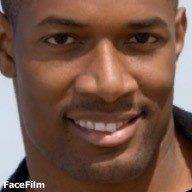
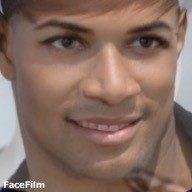
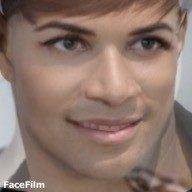
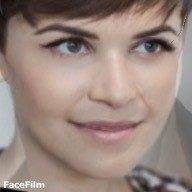
An example of such a metamorphosis can be seen when one takes two faces of a couple, a man and a woman, and creates different composites from them in different proportions (some like to claim these are the options for what their offspring will look like). See, for example, the metamorphosis in the table here between the black man on the right and the white woman on the left, whose faces I chose at random online:[3]
 |
 |
 |
 |
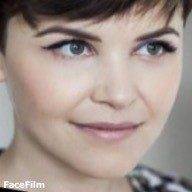 |
The faces become more and more similar to the pole (the man or the woman) as they approach it. How does one make such an image? Schematically, one can do it by means of the metamorphosis formula above. Every image in the middle of the scale is built for some value of p. The hue of each point in the image is determined by the formula given above, where p multiplies the intensity of the corresponding point in the image of the man and (1-p) multiplies the intensity of the corresponding point from the image of the woman. Every value of p gives a different image, with p=1 giving the image of the man, while p=0 gives the image of the woman. Increasing the value of p means, in effect, moving rightward in this table. In the picture I have of course brought only three stations out of a continuous metamorphic process. The full continuum can be seen in this video.[4]
This is a model that contains one intensity parameter (p) acting on two qualitative dimensions (Y, L). If we wish to apply it to the definition of poetry, it is natural to define the two qualitative parameters as follows: information and poetics (form). The map of poetry in its various shades will be described by formula (2) above, which describes the transition from the pole of information to the poetic pole (poetry and literature).
But it seems that this model too does not suit our needs. It is not true to say that the more information a text contains, the less poetics it has, and vice versa. There seems to be no connection between the amount of information and the poetic quality of texts in poetry and literature. For example, one can take a completely prosaic text and give it a form that adds a poetic tinge, and this will turn it into a poem (at least to some extent). In other words, the quantity of information does not seem to interfere with classifying the text as a poem. True, the essence of the poem is the poetic dimension within it, but there is no necessity to remove the information. A text can convey information to us and also possess considerable, or even full, added poetic value.
It is important to understand that I do not mean what was done to my text in the first column (107). There it was a visual game and not the addition of genuine poetic value. But there are situations in which poeticization adds a real poetic dimension to the information being conveyed. In such situations there is no impediment to defining the text as a poem of maximal poetic value, except that it also has the value of prose (=the transmission of information). This brings us to the model of a third type of metamorphosis.
A third type of metamorphosis
One should note that up to this point we assumed there is a relation between the dosage of yellow (p) and the dosage of blue (1-p). But this is not necessary. Between yellow and blue there can also be a third type of metamorphosis, in which there is no relation between the two dosages:
(3) GPq = p X Y + q X L
GPq likewise denotes a shade of green like gP, but here it is built as the sum of two independent intensities, that of yellow (p) and that of blue (q). Each of these two intensities can range from 0 to 1 (for the sake of simplicity), but there is no relation between them. There can be a green that contains the full yellow color and the full blue color (q=1, p=1). This is a state not essentially different from the state p= 1/2 in the previous metamorphosis (gP), except perhaps in the overall intensity (and likewise with every other case in which p=q). But unlike the previous metamorphosis, here there can also be a state with no color at all (q=0, p=0), which is of course impossible there. In short, in the case of GPq, one does not come at the expense of the other.
The metamorphosis of this type, unlike the previous two, is two-dimensional. It contains two qualitative dimensions (Y, L) and two quantitative intensity parameters (p, q). If the previous metamorphoses could be presented on a strip running from one pole to the opposite pole (with the value of p changing—and the difference between them being what stands at the two poles, that is, on the two sides of the axis—two different pictures facing each other, or one picture versus its absence or inversion), as in the face table above, here we must draw a two-dimensional square (whose coordinates are p and q). What shall we place at its four poles? It is only natural to place there the four combinations: no poetic value and no information (p=0,q=0), no poetic value and full information (1,0), full poetic value without information (0,1), and full poetic value with full information (1,1). The two-dimensional spectrum between them describes the complex map of the poetics of poetry. Of course, the degree of poeticity depends only on the value of q.
Exercise: Sky and Water
A well-known example of artistic metamorphosis can be seen in M.C. Escher’s famous drawing, Sky and Water:[5]
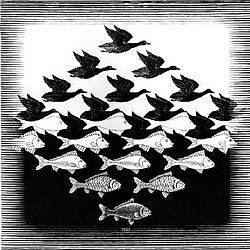
To which of the three types described above does it belong? I suggest that, as an exercise, you try to diagnose this.
And here is the answer I propose. Seemingly we have here a third-type metamorphosis, since the picture is two-dimensional and contains two different creatures (a fish and a bird), each of which appears at levels between 0 and 1. In other words, there are here two intensity parameters with two qualitative measures. But if you pay attention, the metamorphic transition occurs only along the vertical axis and not along both axes. The horizontal axis is completely uniform (nothing happens when one moves from right to left at the same height).[6] Therefore, ostensibly this is an example of the second type (two qualitative measures with one intensity parameter). But that too is not precise, for there is not really a transition here from fish to bird. The fish disappear and the birds appear, but not at the expense of the fish. No fish turns into a bird or vice versa, and in fact these are two independent processes. The conclusion is that if one looks at the individual creatures, there is here a combination of two first-type metamorphoses that occur in opposite directions: a fish that gradually disappears toward the sky, and a bird that gradually disappears toward the water.
And yet, if we look at the level of whole rows one above the other, we see that as one proceeds downward, each row yields a combination of more fish and less bird. That is, at the level of the rows one can see here a second-type metamorphosis. And what if we look at the plane of the complete formations? Here it seems that, as one advances upward (toward the sky), a flock of birds gradually appears at the expense of the school of fish that disappears, and vice versa. If so, on this plane too we have a second-type metamorphosis.
This, as noted, was only an exercise. We now return to our discussion.
The complete model of poetry
If we adopt the richest picture, where the two qualitative measures are poetics and information, we will obtain different shades of poetry. Thus, if we have a text that conveys information and we add to it a poetic quality (=form), even without reducing the information, we obtain a poem (which admittedly also expresses information). Again, one does not come at the expense of the other, and therefore this is a third-type metamorphosis. Of course, the judgment of such a text as poetry will be made only according to the poetic dimension and by disregarding the information in it. In the proposed picture, a poem is represented by two qualitative measures (information and poetics) and two intensity parameters (p measures the information and q the poetic quality). Of course, the determination whether this is a poem and what its quality is depends solely on q. We must strip away the information, since it is not relevant to the evaluation of the text’s poeticity (though it does not interfere with it either), and what remains is the poem. To sharpen the point, let us discuss the example brought by Hevroner in response to column 107. He brought the following poem there:[7]
| Seven-thirty in the morning, the clock rings As always, as is its habit, it ruins my sleep I pack a suitcase, drink coffee in a rush In just two hours I’m on a flight at Ben-Gurion |
I order a taxi, take one more turn around the house
Checking I haven’t forgotten anything
Passport in my pocket, in another second I’m already in the sky
Oh, how pleased I am right now
Flight five three two five
I’m already excited
Suddenly you come over to me
Hi, hello, a seat by the window
You want to switch, you ask quietly
I’m not sure
So let’s switch for now
I laugh, you flash me a smile
The pilot announces
In another second we’re already in the sky
Fasten your seat belts two hours have already passed and we’re in the air
Turns out there’s chemistry between us from wall to wall
You order a red cocktail and tell me about a dream
Diving into your eyes from the very first glance
One more drink, we drink together, holding hands
You smile at me
Magic in the skies—it’s crazy, up here in the sky
To find the one and fly
Flight five…
The plane lands, we’re still hand in hand
Collecting the suitcases, maybe
Go on, order a taxi, you smile to the sky
Love like this is surely no mistake
Flight five…
A love like this can be found only in the sky
Fasten your seat belts
Seemingly this really is pure prose. They are simply describing different situations here, only writing it in a fragmented form. Not for nothing does Hevroner remark in his opening:
Actually, I think the rabbi’s poem would succeed, certainly in a place where this thing does.
He compares this to the ‘poetic’ presentation made in column 107 of my opening paragraph, and in effect implicitly assumes that there is no poem here but rather prose that has been abused.
But it seems to me that he is mistaken. Without committing myself to the artistic value of this poem, in my opinion it is nonetheless a genuine poem. The reason is that the purpose of the text is not to convey information about the situation. It uses one specific concrete situation in order to arouse in the reader or listener various feelings that are not necessarily connected to it. In that sense there is poetic value here (forgive the exaggeration; I am speaking on the principled plane), that is, a poem. In fact, from this perspective it is clear that there is no informational component at all in this text, even though it describes a real situation. The situation is fictional and not really important to the discussion. The person who wrote the words did not intend to tell us about a certain flight, or about flights in general, and certainly not about anything that happened on one. Therefore, within our model, one may say that this is a poem of the type (p=0, q=0.1). It contains 0 information (that is, information that is the text’s purpose to convey to the reader), and it contains only the poetic dimension. I took the liberty here of judging that its poetic quality is rather poor (therefore I set q=0.1).
To sum up, in this poem the situation is only a medium intended to convey a poetic message or feelings, and therefore it is a poem. By contrast, my opening paragraph in that discussion is just pure prose, and chopping it up is merely a gimmick that adds no poetic tinge. Therefore it is reasonable that here we are not dealing with a poem at all. The relevant values are: (p=1, q=0).[8]
Several important comments
- It is important to emphasize that the purpose of my analysis here is to define poetry and not to judge it. Therefore I am not proposing measures here to determine the value of q. I set the value of q for the poem above by intuition alone, and of course one may disagree. What is important to me is to claim that this is a full-fledged poem (a pure poem, p=0), even if its poetic quality is poor (q is small).
- If I wanted to be more precise, I would have to set the value of q according to the degree of poeticity in it and not according to the quality of the poem or its poetics (the quantity of poetics, not its quality). Therefore, it may actually be more correct to say that q=1 in the previous poem, since it is entirely a poem (its tendencies are poetic). One could also set the value of q lower if, in one’s opinion, there is a weak poetic dimension in the poem (in the sense of how far the text is poetic, that is, how far it is a poem, and not in terms of its artistic value). After that one may perhaps judge its quality, and here set an additional dimension whose value is 0.1. A more precise model should distinguish between these two parameters, but I will not enter into that here, if only because I have no ability to assign values to either of the two measures, neither the quantitative one nor the qualitative one. It is hard to judge poetics. Beyond that, as stated in item 1, my purpose in the analysis here is only to determine whether we are dealing with a poem, not to judge it.
- Here, of course, the question arises: if we have no ability to determine these quality measures, and not even the quantitative measures themselves (how does one determine the value of q? Clearly this is only a matter of feeling), then what is the purpose of the whole analysis? Seemingly even the ‘precise’ picture proposed here does not really help us determine the nature (is it a poem?) and quality (how good is the poem?) of the text before us. So what is the point of it?
My answer is that this is not the purpose of the analysis and of the model proposed here. I do not know how one could replace the human being in determining the intensity and poetic quality of a text (to what extent it is a poem at all, and what its quality is). What I wanted to achieve here is only a way to guide and focus the person, so that he knows what to look for and what to try to define. In that way one can sharpen his insights, so that he knows to ask whether he stands before a poem and what its qualities are. Once we have established the framework of the discussion, it is not my intention here to offer a substitute for human evaluation and judgment, and I also do not have unequivocal quantitative measures to describe it. My purpose here is not to replace the human being with an automatic algorithm.
Summary
I have presented here a fairly complex picture of poetry in its various shades. We saw that the value of p plays no role whatsoever in defining a text as poetry or prose. Pure prose has a high value of p, but if one adds form and poetics to it (increases the value of q), it can turn into a full-fledged poem,[9] though not a pure one (because it is mixed with information). In such a case the text is entirely a poem, except that it also contains a dimension of information (pure prose). The pure prose component (the information) does not necessarily interfere with the poetic quality and intensity. The existence of p in this model is intended only to explain why it is sometimes difficult to discern that we are indeed dealing with poetry, but essentially it plays no role in the very definition of poetry itself. I also noted that q, in its qualitative sense, likewise plays no role in the very definition of poetry, but only in evaluating its quality. Here I deal with q in the sense of the intensity of the poetics and not its quality, and in that sense what determines the degree of poeticity is precisely the value of q. In order to diagnose whether a text is a poem, we must neutralize p and examine what remains.
To conclude, it is easy to see that this picture is far from sufficient. If you try to use it to diagnose poetry as against literature, or even the different shades of poetry as against one another, you will not succeed. One of the reasons for this is that the differences are not on the plane of the amount of information each contains, nor are they differences in the intensity of q. Therefore our model still does not give us tools to define and clarify the differences between shades of poetry and between them and literature. It follows that we still lack additional measures that are unrelated to the quality of poetry (I already clarified above that this is not what I am looking for). Can one make progress toward such a distinction between shades of poetry and between them and literature (on the poetic plane and not on the plane of quality)? On that, in the next column.
[1] The question of where literature is located will be discussed below. It is not a simple midpoint between pure prose and pure poetry.
[2] Incidentally, throughout I will ignore the different shades that exist within literature. They are not relevant to our discussion, since from the standpoint of their poetics they all fall into the same category, unlike the different shades of poetry. This will become clearer in light of the picture that will be presented below.
[3] My son Yossi created this sequence and the video brought below using the FaceFilm software. My thanks to him, and of course also to Oren the editor, who helped me insert this into the table and the file.
[4] A similar halakhic metamorphosis between robbery and lying (through denial, theft, oppression, and deception) appears in the verses in parashat Kedoshim. On this see the article A Good Measure, 5765, on parashat Kedoshim (here, article 30). For another discussion of metamorphosis and logic, see volume 12 in the Talmudic Logic series, Fuzzy Logic and Quantum States in Talmudic Thinking, College Publications, London 2015, in the third part. There we compare briefly between the first two types of metamorphosis, but the discussion in the post here is more detailed.
[5] The drawing is taken from Wikipedia, entry ‘Sky and Water’.
[6] The situation here resembles what we saw above regarding poetry. There too there are two qualitative measures, but the degree of poeticity depends only on one of them (q).
[7] Its official name is: Flight 5325, lyrics by Avi Ohayon.
[8] Perhaps if we choose to see the chopping-up as a demonstration of the essence of a poem, one can indeed see in it an addition of poetic value on top of the information; that is, there is some shade of poem here because the text comes to show something that is not conveyed through the verbal medium (the plain meaning of the words, the information in them).
[9] Deliberately I do not write ‘an excellent poem,’ because I am speaking about its very being a poem, or the extent to which it is a poem, and not about its poetic quality.
Discussion
With God’s help, 16 Tevet 5778
Physical reality is square and fixed like a table, subject to laws and boundaries that cannot be crossed. But upon the fixed table, a person spreads a tablecloth, which gives a unique personal meaning to the fixed reality and is subject to change.
The tablecloth can be a meaningless nylon cover that says nothing but functionality and adds nothing to the table; the tablecloth can be white and simple, lending the table a graceful simplicity; and the tablecloth can be sparkling, radiant, and multicolored, enriching the heart with its hues. And the tablecloth can signify festivity and the splendor of holiness.
And we wish the birthday celebrant that the grace of the years, and the impressions they have left upon the soul, will find favor with those who study them and will pour grace upon what is yet to come!
With blessings, S. Z. Levinger
I didn’t see a picture of a non-man. There is a picture of a woman here—perhaps that’s what you meant? 🙂
Many thanks for the blessings.
In fact, two days ago I received birthday greetings by email after the greeter saw on Wikipedia that I have a birthday. I took a look (to understand what Wikipedia wanted from my birthday), and to my surprise I discovered that I’m in good company: Rabbi Chaim Kanievsky and Rabbi Prof. Daniel Hershkowitz. Mazal tov to all of us and to all Israel. 🙂
It’s the 15th of Tevet, isn’t it?
(I offered my greetings in the thread on the question “Conclusive Proof for the Torah.”)
Rabbeinu, perhaps you didn’t read the column (even though you wrote it), because the column explains precisely that there is a picture here of a non-man, or at least not a pure man :).
As for a code, it’s of course true that this is simply another language, but regarding metaphor that isn’t really correct. You can call it a “language” just as one can speak of the language of poetry, but then the word “language” is being used metaphorically.
For a moment I thought there was a problem with that, but on second thought indeed—metaphor is a poetic device, and it will not appear in what you call pure prose.
Is there room for a “joke” in this complex tablecloth?
I didn’t quite understand.
Clearly poems were not written as sadistic abuse of words, but as a creation whose purpose is indirect manipulation of the readers’ feelings (just as Rabbi Peretz, may he live long, tries to drive his listeners into a “frenzy” or “madness”); but if abuse of words that yields a strange text, like the rabbi’s piyyut, causes the reader to sink into all kinds of “complex” reflections—what is the point of distinguishing between that and poetry? (The strange texts produced by Nadav Shnerb’s generator may not have the philosophical value of Rabbi Kook’s writings, but why do they lack literary value in the way the latter’s writings have it?)
I think a joke is pure prose, no? True, the “information” it conveys is a bit different, but then that is a distinction within the pole of pure prose. But it really does deserve discussion, because the goal is to amuse and not necessarily in this way. That is, the goal is not the information contained in the joke. And this requires further study.
Indeed, if people knew that the texts they were reading were written by a generator and not by a person with a jacket, a pipe, and incense, they would surrender themselves to them less (there would be less immersion in deep feelings and musings).
Therefore, I propose that poets learn from magicians.
Magicians, as is known, almost all do the same tricks. If one magician were to publish the tricks, the entire profession of magician would evaporate (they would retrain as clowns). The poets should agree among themselves that the generator will do all the work for them, and they, for their part, will keep a vow of silence and meanwhile be able to work at a real job ( 😉 ).
Thought-provoking. First, I thought one should distinguish between a new metaphor and a metaphor already in use. The latter is really just an ordinary word, although its meaning differs from the simple meaning of the word. For example, “heartache” is a metaphorical expression, since the heart does not actually ache, but on the other hand it is clearly not a poem. I am conveying information to you that is the meaning of the expression “heartache.” Such a metaphor is completely prose (in the next column I will deal with literature, and then this will become clearer). As for a new metaphor, that does require discussion, since I am coining its meaning now. And still I think that when the reader understands the new meaning, from his perspective it is like the old metaphor—that is, a word in pure prose.
And perhaps one should discuss a situation in which I could use a regular prosaic word and nevertheless choose a metaphor. Here there is apparently a poetic consideration and not only information (though in my opinion this is closer to literature than to poetry). But where the metaphorical expression is the natural one, in my opinion this has nothing whatsoever to do with poetry.
As I wrote in the note, I completely agree. If the fragmentation of my words conveyed an indirect message or aroused a feeling in the reader, there is room to see this as a poem.
If so, all the labor of defining a poem is really for its own sake (in practice, almost any unclear text could be considered a poem)
Not exactly. There has to be intention in creating the poem, and it has to arouse in us some poetic feelings (this includes both the character of the feelings and the way they are produced). When I walk past an electric pole, feelings and insights may arise in me, and that does not turn the electric pole into a poem. Here I am already returning to the question of studying Hasidism, but we will get to that later.
A metaphor that has already lost its metaphoricity and become just an ordinary word is usually called a “dead metaphor,” that is, one that has already lost its meaning (that is, one from which only its prosaic meaning remains, so that the additional dimension that is the meaning of a metaphor has been lost—it has been worn away).
Of course there are degrees here. For example, the use of “heartache” still expresses something more than “sorrow”—if in the previous column you gave an instruction booklet as an example of pure prose, then in a Prozac information leaflet I would definitely be surprised to find “heartache” in place of “depression” (it’s not exactly the same thing, but I don’t know a medication for sorrow that I could use as an example).
It seems to me there are cases where the metaphor really has been completely worn away (perhaps, for example, the description of a metaphor as “worn-out,” which is itself a metaphor for metaphor, is completely worn out), but in such cases no one even calls it a dead metaphor anymore, because people have already forgotten that it is a metaphor, and the fact that it once was a metaphor becomes part of its etymology (it seems to me there are words that, according to linguists’ hypotheses, we know only as a metaphor and their old usage has been completely forgotten, but I don’t have an example at the moment).
Well, that is not the definition the poet had in mind.
A definition must draw a sharp boundary. I need a criterion in order to distinguish between a poem and something that is not one. It is exactly the same problem as the sorites paradox. The change the rabbi wanted to make is not good. There is binarity in the concept of a heap. The role of a definition is to explain the reality as experienced before our eyes, not to replace it with another one (at most to broaden the everyday sense). There too there is no definition for a heap, although everyone agrees that a set of 2 garments is not a heap of clothes, whereas according to the rabbi’s approach there is some heap-ness in it, and likewise with 100 garments, which everyone agrees are a heap. What happens in the middle (between 2 and 100) is strange and depends on the nature of the objects being piled, or the people observing them, or the places; but if we were to investigate everyone’s consciousness we would find a common denominator for what every person would call a heap. (And that is for future brain research.) So the rabbi only added another independent axis of information to that of poetics; the rabbi only showed how complicated the matter of finding a definition for poetry is. The rabbi should have given precise P and Q. That is the whole trick. Otherwise we are almost back to the position of the book that failed to find a definition and claimed there is none. In the analogy to a heap as well, the rabbi argued that there is no such thing as poetry, only a degree of poetry-ness, and even that is not that, but only a degree of poetics and information. Now we will also ask what poetics is, and it will turn out that that too has no definition, only a degree of poetic-ness that is not clear at all because we do not know what poetics is. Part of the issue is also the ability to quantify poetics. Fortunately, we know what information is, or at least how to quantify it.
The rabbi is behaving like the mathematicians with respect to the set of all sets, who claimed it does not exist because it could be built from simpler sets (to point to its existence constructively. There was of course also a paradox there).
Have a good day
And in all the wordplay here I somewhat missed that the dead metaphor itself shows this point. “Worn-out” is not synonymous with old as opposed to new; rather, it expresses something like not shiny / dazzling / sharp. From this it follows that there is supposed to be some kind of shine or sharpness in metaphor, which is of course beyond the meaning.
I disagree. Even a non-worn-out metaphor carries a verbal message, except that it has not yet become fully fixed in the language. In the end one is coming to convey a message of some kind of information, and not merely to evoke a mood or a poetic effect. If there is such a pure metaphor, then perhaps one really can say that it (or the text containing it) is a poem.
If the poet is you, then I accept your word that this is not what you intended. But since I wrote it, the relevant poet is me, and I did mean this. In my opinion this definition is certainly useful and constitutes significant progress even without giving quantitative criteria for these measures. I explained this at the end of my remarks, and I will return to this point later.
I didn’t understand. You wrote in the column that a poem also has a message or information and does not come only to create a mood. When I choose “heartache” instead of sadness, there is something in that, and you will probably agree with me that “heartache” would not appear in a medication leaflet.
With God’s help, 18 Tevet 5778
And regarding the question “What is poetry?”—I will refer here, without endorsing or dissenting, to Yehuda Gezbar’s proposal, “A Humble Note on ‘What Is Poetry?’” (on his site “The Back Cover”). There he argues that poetry is not a type of text but a “mode of reading.” If I understand him correctly, whether a text is poetry is determined by the reader who reads it as poetry, while perceiving meanings or feelings beyond the literal meaning that is fixed and enduring.
With blessings, S. Z. Levinger
Since today is the 93rd birthday of R. Shlomo Carlebach, of blessed memory, I will note that this is indeed what he did with the verse “Is my father still alive?” whose literal meaning is Joseph’s question about Jacob, “Is he alive?”
R. Shlomo not only set the words to music, but poured a new meaning into them. From a question, the words became an emphatic declaration, and “my father,” Jacob, became “our Father,” including both our Father in Heaven and our father Jacob, for as long as his offspring are alive—“the people of Israel live”—so too Israel our elder still lives. And the people of Israel live not only physically but spiritually as well, alive and vibrant.
Haven’t we now returned to the definition “a poem is what I decided is a poem”?
A point that recurs here again and again is that the definition as a poem depends greatly on the purposes of the writing—and on the writer’s intention (can there be a poem that was written involuntarily, or on its own? After all, according to the definitions, it was not written *in order* to create such-and-such feelings. On the other hand, it was also not written in order to convey information. In a certain sense, everything written there is not information at all—like deriving something from an electric pole). It is true that there is a subtle difference between “people decided that this is a poem” and “it was created for poetic purposes,” but it is not such a great difference.
With God’s help, 18 Tevet 5778
Both a poem and an electric pole transmit powerful currents, but in a poem there must be an additional component—the reader’s ability to absorb the feelings hidden within the poem! A poem is therefore comparable to a transformer that processes the powerful current and pours it into short, accessible forms!
With blessings, S. Z. Levinger
And something like this I mentioned already (if I remember correctly in the discussion on post 108): Leah Goldberg’s definition that a poem is “a full world concentrated in a few lines.”
I somewhat apologize. In my haste, the last paragraph escaped my notice. Otherwise I would have saved my remarks for the final column. I did not say the rabbi’s remarks are meaningless (I wrote that the rabbi mapped out the field of this inquiry. And even on my view, precise P and Q would not be enough to finish the problem. What do these numbers say? What stands behind them such that they are these rather than others? I also think there are more independent dimensions, but this is not the place to elaborate). Indeed there is progress in them. But—and this is a big but—from here to a definition of poetry, the matter still seems to me far off, unless in the last column the rabbi pulls some card out of his sleeve. And I will explain:
From conversations we had, I remembered how the rabbi defined poetry (up to the current column; what is here is new to me). I waited patiently until now, and I would like now to express my opinion about the definition of poetry. First, I do not know how much background the rabbi has on the subject, but I want to remind the rabbi that to this day, as far as I know, there is no agreed definition of the concept of a fractal. I happened to read the introduction (as fascinating as the whole subject) of a book called Fractal Geometry: Mathematical Foundations and Applications by Kenneth Falconer. It can be viewed here
http://www.dm.uba.ar/materias/optativas/geometria_fractal/2006/1/Fractales/1.pdf
In the introduction, in the usual way, he tries to find a definition for this creature, and each time he finds a new creature that we would also want to define as a fractal but that does not fit the current definitions. So he seeks a new definition that will preserve the previous creatures defined as fractals and, on the other hand, also define the new creature as a fractal. Surprisingly, this works. Yet time after time a new and even more wondrous creature appears and insists on not entering the prison house of the definition. After several attempts (six, I think) he gives up and then suddenly claims that perhaps it has no definition, and that the concept of a fractal should be treated like the concept of life, which also still has no agreed definition. I thought that was not a random example. These creatures (fractals) are based essentially on infinity. This property allows them to “adapt” to any existing system of definitions in order to exceed its boundaries by creating a new creature that exceeds that system of definitions. Quite similarly to evolution, which allows life to produce new unfamiliar creatures (out of familiar ones) in order to survive in any environment, however difficult. Life is capable of reinventing itself in order to survive. So too fractals. Yet the marvelous thing in the whole story is that the attempts at definition were not in vain at all. The definitions grew deeper and exposed new layers of understanding in the concept, even if they did not succeed in capturing it in full. It seemed that of every criterion proposed, one could say that most known kinds of fractals (every fractal is created by some simple pattern or formula) satisfy it. It seemed that there is a series of definitions that converges toward a limit, which is the full definition of a fractal, yet never reaches it……..
It seems to me that the same is true of poetry. Poetry too is a “living” concept, like life and fractals. I actually claim there is an entire class of such living concepts. They have the property that for every definition given to them, human consciousness can construct, or discover, an exceptional example that will destroy the definition. They are not static. They are “dynamic,” “alive.” (One of my first examples of this was the concept of “motion” as opposed to the concept of “position.” I won’t go into it now, but my claim is that motion is more than a change of position (or alternatively that a “change” of position in reality is more than simple algebraic subtraction), or alternatively that a line is more than the sum of all its points, and that time is more than the sum of its static moments. I don’t have room to do this here, but this is how I think I solved Zeno’s three paradoxes. More precisely, I uprooted them from their very foundation. I showed that the paradoxes do not even get off the ground. The higher-order concept relevant here is infinity. They are trying to grasp finitely (to define in static, dead terms, in my language) that which has no end—to define, to put a fence and boundary around, that which has no fence or boundary). The concepts of motion, change, continuity, infinity, life, and many others should be called “higher-order concepts” or “supra-definable” concepts. They are called supra-definable because one can approach them by means of a convergent series of definitions, but the limit does not exist on the line (hard convergence…).
In addition, the ability of these concepts to exceed any definition given to them is built into them, just as number theory will manage to escape any decidable axiomatic system by means of a Gödel theorem adapted to that system. Here too it will be possible to write a poem using the given definition in such a way that it will still be a poem and yet will not fall under the definition.
In short, one can approach the definition of the concept of poetry infinitely, but never arrive at the definition. For every given definition, the next day a poem will be invented that exceeds the definition (and one can even use the definition itself in order to compose it), yet the definition will cover an additional quantity of many more poems and deepen our understanding of what poetry is.
Well, that was long, and although there is much more to say, I will end here.
Not information. Perhaps a message.
In a medication leaflet, “heartache” would not appear because it is not a medical condition that has a treatment. If there were a medication that treated heartache and not sorrow or something like that, then it would indeed appear there.
That is a sufficiently significant difference.
A poem does not convey information but is intended to arouse some feelings, even if only pleasure (catharsis). The poet’s decision that this is a poem is a necessary condition (as opposed to a poem written by itself, which is not a poem but a telephone pole), but that is not the definition. A poem is also made of words, but that is not unique to poems. So that is a necessary condition and not a definition. The definition is: a text intended not for conveying information but for arousing feelings through the structure and not through the literal meaning of the words.
All this may be true, and I agree with it. What I am doing is the beginning of the convergence process you described. The exceptions challenge this definition, but usually they can somehow be incorporated by refining the definition. Not for nothing have I already said several times that my aim is to clarify and not necessarily to define.
Poetry reveals a handbreadth and covers two; it arouses in us an intense desire to uncover what is concealed. Each person discovers and interprets what he has uncovered differently, in a way connected to his past, his upbringing, the sounds that enveloped him in the past and fill him in the present, together with his vision of the path ahead.
I have to say I didn’t really understand the benefit of the whole long discussion of types of metamorphoses, only to say that here there is a metamorphosis with two parameters, one of which is not at all relevant to the definition of a poem…
It seemed obvious to me from the very first moment that for the purpose of defining a poem there is one vertical axis here (metamorphosis of the first kind) whose relevant parameter is q…
Trying to understand whether I missed something
A picture of a non-man on a Torah website?!