

What Is Poetry: B. Methodological Preliminaries (Column 108)
Why the methodological preface matters more than the result itself
The column explains that the goal of the series is not only to arrive at a formula called a definition of poetry, but to demonstrate how one defines concepts that seem obvious and yet collapse when hard questions are asked about them. So before offering an answer to the question what poetry is, one must understand what kind of answer is being sought, what it can provide, and what it is wrong to expect from it.
An arbitrary mathematical definition versus a definition that tries to match the meaning in use
In response to a commenter who argued that every definition is an arbitrary axiom, Rav distinguishes between two kinds of definitions. The first kind resembles mathematical definitions: one can consistently decide that a democratic state is a state near the sea, and as long as consistency is preserved there is no internal error. The second kind tries to formulate precisely a concept that already exists in our language and understanding; here it absolutely makes sense to ask whether the definition is correct or mistaken, because it is supposed to match what we really mean. This is the only sense in which Rav seeks to define poetry. If it turns out that people use the concept incorrectly, the point is not to impose a new dictionary on them, but to show that they themselves can recognize that their understanding was partial.
Even arbitrary definitions are not blind, but that is not the real dispute here
Rav adds that presenting mathematical definitions as wholly arbitrary is simplistic. Creativity is required there too, and one usually looks for fruitful concepts about which interesting things can be said. Some even see that fruitfulness as a sign that the concept expresses an idea that preceded the definition. But this Platonic dispute is not decisive here: whether poetry is a real idea or a human creation, one still has to clarify what the concept means that all of us are using.
Why define something that supposedly already seems clear: theoretical clarification and practical revision
The column stresses that a definition of the second kind is not supposed to invent a new concept but to conceptualize an existing intuition, and therefore it may initially sound almost self-evident. Even so, it has two benefits. On the theoretical level, it dispels fog and enables us to answer questions that previously embarrassed us even though we thought we understood. On the practical level, it may also change judgments: once the concept is sharpened, we may decide differently whether a given case falls under it and what its value is.
The intersection of convex shapes: how a good definition turns intuition into proof
To illustrate the theoretical benefit, Rav uses the concept of convexity. Intuitively, we all know how to recognize a convex shape, but it is very hard to prove from the visual picture alone that the intersection of two convex shapes is always convex. Once convexity is defined so that for any two points inside the shape, the straight segment connecting them remains entirely inside the shape, the proof becomes almost trivial: two points that lie in the intersection lie in each of the two shapes, and therefore the segment between them lies in each of them, and thus also in the intersection. The example shows that the definition does not replace intuition and does not teach from scratch what convexity is; it relies on intuition, and perhaps even concentrates within it the original difficulty. But once the definition is found, it provides a sharp tool that allows us to think, prove, and distinguish in places where intuition alone gets stuck.
Multiple intelligences: when a definition exposes our mistake and when it simply misses the target
The practical benefit is illustrated through the discussion of multiple intelligences. Rav recalls his criticism of expanding the concept of intelligence into eight different kinds, a move that sometimes appears to serve a politically correct agenda: if one broadens the definition enough, everyone becomes a genius to the same degree. But here he qualifies that claim: when the conceptualization of an intuitive concept yields conclusions that contradict our previous judgments, there are two real possibilities. One can say that the definition failed and does not capture the original concept; or one can say דווקא that the original intuition or its previous application was shallow, and that the definition taught us something new and more correct. Therefore one should not automatically reject a conclusion merely because it is politically convenient, just as one should not automatically accept it for that reason. The test is whether, after the definition, there emerges a sense that it really does fit deeper intuitions of ours and corrects old mistakes.
What this methodology promises before the definition of poetry itself
From here Rav returns to poetry. He clarifies that the main move leading to the definition in the next column will actually be fairly short; most of the work here was to prepare the ground for understanding why, even if the result sounds similar to formulations that have already been suggested, its value is different. If the definition is good, it should do for poetry what the definition did for convexity: not merely phrase a familiar feeling, but make it possible to answer the embarrassing questions from the previous column, and perhaps also to change or complicate our judgment about certain texts, whether they are poetry and to what extent.
With God’s help
The previous column was devoted to presenting the problem. We saw that the formal features of poetry (rhyme, meter, melody, lineation) will apparently not lead us to safe harbor. We also saw there that the many and varied manifestations of what we call poetry seem very confusing and apparently refuse to fit under one general heading. Which of them is worthy of the title poetry, or alternatively, is there something common to all of them? This column is devoted to preliminary methodological questions that illuminate and clarify the meaning of the move that will be made in the coming columns.
I ask readers’ forgiveness for the apparent (or perhaps not merely apparent) length and pedantry, but it is clear to me that without it the meaning of the move will not be clear, and questions will arise about it that I am trying to remove in advance. As stated, my goal is not only to arrive at a definition of poetry but also to demonstrate the methodology and its implications. These columns should be viewed as a series of lessons/lectures on definition in general and the definition of poetry in particular.
Two Kinds of Definitions
One of the first commenters on the previous column, Yochai, wrote the following sentences in the course of his remarks:
| In searching for a definition there is a complexity that you have not sufficiently addressed. A definition is a kind of axiom, some assumption, that cannot be put to the test or disputed; it is not the product of a logical procedure or empirical testing. Especially since poetry is a somewhat spiritual subject, on the border of the pseudo-sciences, the expectation of a lucid definition is a bit exaggerated
For example, you refuse (and rightly, in my opinion) to accept "postmodernist" definitions of poetry, such as "whatever I regard as poetry" and the like, but you have no real objection to this definition; you simply disagree with it intuitively. Therefore, when you define (in the upcoming post, with God’s help and without making a vow) what poetry is, you will ignore many texts that are defined—in common parlance—as poetry, and claim that the masses are mistaken, etc. In short, there is really nothing to discuss regarding definitions, unless you ask what is called poetry in everyday language—and you probably will not get an answer to that… The only possibility I can see is to ask what the Torah/Hebrew Bible calls poetry. In short, one simply creates a definition and is not really bound by anything, and one can always claim that what is called poetry today is a mistake due to superficiality and lack of understanding, etc. (as many concepts are distorted today; see, for example, ‘God’) |
And I replied to him:
| Hello, Yochai.
You are very mistaken in your understanding of the concept of a definition. In your remarks you are referring to a mathematical definition, which is arbitrary and stipulated by us (that is how it is usually presented. In a moment Ilon will come here and protest vigorously, and with a certain measure of justice). But I am speaking about the definition of concepts where there is right and wrong. If there is a concept that we use and understand, its definition should capture its true meaning. Here a definition is open to criticism and judgment in terms of right and wrong. In the first sense (the mathematical one), you can define a democratic state as a state near the sea. That is of course your right, and no one is supposed to argue with you so long as you are consistent. But in the second sense this is nonsense, because it does not capture the meaning of the concept of a democratic state as we use it. I am looking for a definition of poetry in the second sense. And if I tell people they are mistaken (and I do not think I will do that), it will be only in the sense that they are mistaken about their own understanding; that is, they themselves too should acknowledge the mistake after I explain it to them, and understand that they have indeed defined incorrectly the concept that they themselves use. |
I will not go into this distinction at too great a length here, but it is important to clarify already now that the definition I am seeking is of the second type. I am trying to understand what poetry is, and not merely to propose for it a consistent but arbitrary definition of the concept. In that sense, there is a quasi-scientific undertaking here, since my aim is to hit upon some fact and describe it correctly. Therefore, the definition I propose certainly should and deserves to be judged in terms of right and wrong, unlike definitions of the first kind.
The question whether poetry is an idea that exists in the nature of the world or an artificial creation of human beings (the question of the Platonism of the idea of poetry) is not important for our purposes here. I am looking for the meaning of the concept of poetry to which most of us refer, and in my opinion there certainly is such a concept and it has a meaning that can be made clear. Searching for and finding such definitions is a kind of art. It requires analytical ability and the exercise of intellectual skills, and sometimes creativity as well. Just to sharpen the point: definitions of the first kind require only creativity, since there is no attempt there to capture something in objective reality. It is a purely arbitrary definition. Here, quasi-scientific skills are also required.
It is important to understand that although it is customary to treat definitions in mathematics as arbitrary (I do not entirely agree), that does not mean that they are merely things pulled out of thin air. Anyone familiar with the matter knows that they require creativity. The creativity here is not observational, since according to this non-Platonic conception the definition is not supposed to capture some concept in objective reality, but it is still incorrect to say that the creativity involved here is a blind mechanism.
Mathematicians speak in this context about a fruitful definition—that is, one that yields a concept about which as many interesting, deep, and nontrivial things (statements, or theorems) as possible can be said. Not every concept that we define ad hoc is fruitful in this sense. There are definitions that are not creative enough, about which almost nothing interesting can be proved; that is, they have no mathematical potential. Others (like Ilon, mentioned in my reply to Yochai, and I join him in this at least partially; see the second section of my book Shtei Agalot, in the discussion of the existence of concepts and ideas) will say that a concept’s being fruitful means that it expresses some idea that existed even before we defined it, and even before we used it. That is, they identify creativity with a kind of "empirical" power of discernment (with the mind’s eye) regarding the fruitfulness of the concepts under discussion.
I will not enter that dispute here, because as I explained, it is not important for our discussion. Whether the concept of poetry is rooted in reality itself (the Platonic approach) or is a human creation, it still requires a definition. What, in fact, do we mean when we speak about poetry?
Two Ways a Definition of the Second Kind Can Add Something
The question that arises here is: what is the point of engaging in definitions of the second kind? If they do not teach us something we did not already know, why are they important at all?
First, it is important to clarify that a definition of the second kind is not supposed to teach us something new. We are speaking of concepts that we understand intuitively, and the role of the definition is to conceptualize and clarify them for us (and perhaps also to synchronize us with one another, in order to clarify the discourse and remove the fog that surrounds it). The art of definition is not the art of inventing or creating something new (though creativity is required here), but of conceptualization—taking what is unexplicit and unformulated and casting it into words with as definite a meaning as possible. Therefore one should not expect the process we are undertaking here to yield conceptual revolutions. On the contrary, many readers may feel that perhaps this does not innovate anything. It repeats previous claims (some of which I mentioned and others will still be brought), and it itself is not sufficiently clear and sharp, so it is doubtful how much it has added.
To that I say that the purpose of this process is to dispel the ambiguity presented in the previous column. It was no accident that I opened with a series of embarrassing questions, which in fact concern a concept we thought was clear to us, and presented it as an empty vessel. This can arouse the feeling (expressed in the postmodern statements of despair mentioned there, and in many others) that it really is empty. I claim that after the definition the questions asked there will receive answers, and that itself means that we have nevertheless done something. This is a significant change from the situation without a definition, where although we thought we understood, it was still difficult for us to answer those questions.
So yes, when we are faced with a poem, we can usually identify that it is a poem, and in many cases also judge whether it is good or not. But that does not mean there is no value in a definition. To sharpen the point, I will indicate two benefits that such a definition may give us:
- The theoretical benefit. The definition gives us reflection, a self-view of what we think and do even without it. The indication of this is that after the definition we can answer questions about the concept that previously we could not answer.
- The practical significance. In certain cases the definition will also change our mind. After we define poetry, our judgment as to whether something is a poem or not, and of course also our evaluation of its quality, may change.
I will now try to clarify each of these benefits through a discussion of an example.
- An Example of the Theoretical Benefit: Convexity and Concavity[1]
A geometric shape is ‘convex’ if all its boundaries bend outward (they have a ‘belly’), and none of them is indented inward. For example, a circle is a convex shape. A ‘concave’ shape is the opposite. It is a shape that also has boundaries that bend inward. For example, the shape of a banana, or a bowl (!), are concave. Note that these two examples are not concave on all their sides (is there such a thing as concavity on all sides? I imagine mathematicians can tell us there is, although intuitively it probably seems to you that there is not). For our purposes, a concave shape is not a shape all of whose boundaries bend inward (even if such a shape exists), but a shape that also has such boundaries—that is, at least some of its boundary is of that kind. What about boundaries that are straight lines? Have no fear: mathematicians will not leave such a hole in the definition or in the theory (mathematics is not part of the pseudo-sciences). For our purposes, a straight boundary counts as convex. Thus, for example, a triangle is a convex shape (because all its boundaries are straight. The three meeting points, that is, the corners, also protrude, and therefore they too preserve its convexity).
Now let me pose a riddle to you (for those of you who have not yet read or heard this favorite example of mine). We define the intersection of two shapes A and B as the shape C that is created in the following way: if we place shape A on top of shape B, then shape C, which is formed by the area common to them both, is their intersection. Of course, one can also intersect three or more shapes with one another. Such an intersection is the shape formed by the area common to all of them. There is a mathematical intuition that says that the intersection of any collection of convex shapes, however they are placed on top of one another, will always yield a convex shape. And so the riddle is this: is that true? If so—prove it.
To make things a bit easier, I can give an initial, fairly simple hint. There is no need to prove the theorem for every number of convex shapes. It is enough to prove it for the intersection of two shapes. Extending it to any number is trivial (intersect the third with the result of intersecting the first two, which is itself already one convex shape, and so on).
This theorem may seem obvious on the intuitive level, but if you tried to rise to the challenge, I assume you discovered that it is not at all easy to prove. In order to prove it, it seems one has to take into account all the ways two convex shapes can overlap, and think about all types of convexity and all types of shapes, and verify that in all situations and possibilities not even a single case is created in which the intersection shape has a boundary, even a partial one, that is concave. For example, if a certain segment of the boundary is created by a combination of two boundaries of the intersecting shapes, one has to make sure that no concave boundary line is created there. I very strongly recommend that the reader try to think of a way to prove this theorem in a mathematically precise way for all types of cases and situations before continuing to read.
I assume the ordinary reader did not manage to prove it. Precisely against the background of that difficulty, we can now see how the definition comes to our aid. First, as our mathematician cousins teach us, one must define precisely the concept that is intuitively clear to us, the ‘convex shape’. In mathematics, it is customary to define it as follows: a ‘convex’ shape is a shape such that if we take any pair of points inside it and connect them to one another with a straight line segment, the entire segment passes within the shape—that is, there are no points on the segment that lie outside the shape.
| Concave shape (part of the line segment lies outside the shape)
|
Convex shape (the entire line segment lies within the shape)
|
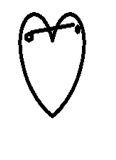
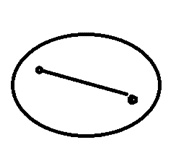
The reader who thinks a little about this definition will see that it is simple and intuitively fits the concept of a convex shape as we know it. I remind you that this is, of course, a definition of the second kind.
Now let us continue and use this definition in order to prove the above theorem, and we will see that now it really is trivial (the reader is invited to try again now). Let us define the shape C that is obtained from the intersection of the two convex shapes A and B. We take any two points inside shape C and connect them with a straight line segment. If the entire segment lies inside C, then it is convex. That is what we need to prove.
By the very definition of shape C, it is clear that these two points also lie inside shape A and inside shape B (otherwise they would not be in C). We know that A is convex, and therefore the segment connecting those two points lies entirely inside A. In the same way, it can be proved that the entire segment also lies inside B. And if the entire segment lies inside A and inside B, then by definition it also lies inside C (which includes all the points that lie both in A and in B). We have therefore proved that for every two points in C, the segment connecting them lies entirely inside C. From the definition it follows that C is convex. QED.
It is worth noting that we did not use our visual intuitions here at all, and we did not try to survey the whole range of possible convex shapes and/or the various possibilities of overlap between convex shapes. Even so, it is clear that all of these were certainly in the background. They served us at the stage of defining convexity itself, but only at that stage. Once we arrived at a definition that adequately exhausts the concept of convexity, all that remained was to work on an abstract logical plane, without any visual dimension.
The reader who is not versed in the subject has just received a light lesson in mathematics. Our purpose was to show that by means of a good definition we succeed in reaching things that, without a definition, it would have been very difficult for us to reach, or alternatively we might have reached mistakes. On the one hand, there is no doubt that such a definition would not have been possible had we not already been equipped with the concept of convexity intuitively. Someone who would like to teach a person not equipped with that intuitive understanding what convexity is by means of the abstract definition would probably not succeed. This definition merely translated the intuitive concept into a more precise formal form, but it is in no way a substitute for the intuitive understanding that precedes it. On the other hand, can one therefore claim that such a definition has no importance (after all, we all intuitively understand the concept of convexity)? Certainly not. The definition is what enabled us to prove the theorem, and of course it clarified the concept of convexity for us, even though it was understood and known to us beforehand as well. Creating the definition involved gathering the information known to us and casting it into a lucid, concise, general, and sharp framework, which gives us a clear formal tool for identifying convexity.[2]
This example shows us that a definition which on its face seems trivial and self-evident can clarify the concept for us (which we thought from the start was completely clear to us), and can even enable us to answer questions that embarrassed us before we defined the concept in question. This is the first benefit of definition mentioned above, the theoretical benefit.
- An Example of the Practical Significance: Multiple Intelligences
At the end of Column 35 I briefly discussed the definition of intelligence and the idea of multiple intelligences. In recent years, the concept of intelligence has been expanded, and several other kinds of abilities have been brought under that heading. Today people speak of multiple intelligences (eight in number), including emotional, motor, and several others. I argued there that this expansion is apparently flawed, and that it constitutes a good example of science in the service of political correctness. In essence, the aim of this expansion is to place us all on the same plane. If we broaden the definition of genius enough, we can say that every person is a genius. There is no better and worse and we are all equal, and redemption has come to Zion. Here, however, I want specifically to qualify that statement.
My claim there was the following. We have always had a conventional concept of intelligence. People knew how to point out that Einstein or Maimonides were very intelligent, and that I was less intelligent than they were. This was usually connected to intellectual and scholarly abilities. Then the researchers of intelligence (Howard Gardner, Perkins, and Sternberg) came along and distilled out of this intuitive conception several characteristics that define the concept (in effect, they performed a definition of the second type, one that tries to conceptualize a vague intuition about what intelligence is, an intuition that all of us already had beforehand). And lo and behold, after this process of distillation it turned out that there are other human abilities endowed with those same characteristics. In effect, the concept expanded. If so, those sages concluded, these abilities too fall under the heading of intelligence, since the definition indeed includes them all and fits them all. As stated, that is how Zion received its politically correct redeemer.[3]
But this attractive package contains a thorn. The starting point of this move was an initial intuition regarding the concept, and the definition was supposed only to distill and better conceptualize the content of that intuition (this is a definition of the second kind)[4]. And then it turns out, to our amazement (or not), that this conceptualization leads to results different from those yielded by the intuitive conception. People who were intuitively regarded as unintelligent are now perceived as intelligent. The unavoidable conclusion is not that we were mistaken in the past (that is, that the definition taught us something), but that the process of conceptualization simply failed. The characteristics distilled from our initial intuitions do not really capture the concept they were trying to grasp.
So why did those sages (intelligent ones?) choose specifically the second option: to throw away the intuition and remain with what was distilled from it? My claim there was that wondrous are the ways of political correctness. The agenda of political correctness caused them to adopt precisely that interpretation. As stated, this theory is very appealing to many people today, because it enables us to relate to every person as intelligent. Now not only Einstein or Maimonides are wise and intelligent, but also I, the cobbler next to me, the shoe salesman on the next street over, the soccer player on team X, and even the Rebbe who writes amusing Hasidic quips. These have intellectual intelligence, and those emotional, motor, musical, or naturalistic intelligence, but everyone is equally a genius.
But here I want to point to another option. Perhaps the definition really did sharpen our intuitive conceptions, and now we really do reach different conclusions. The process of analytical clarification that we carried out in the course of the definition clarified for us that when we previously relied on intuition, we were mistaken. The process of distillation was in effect a kind of inquiry that taught us the correct and more precise concept of intelligence. We indeed discovered that I too have intelligence, and not only Einstein and Maimonides.
Political correctness may indeed lead to the tendentious and arbitrary adoption of the second interpretation, but one must beware of an anti-political-correctness policy that would cause us to adopt the first interpretation no less automatically (in general, it is not recommended to adopt conclusions automatically, and certainly not to subordinate their truth to the benefit we will derive from them). It may be that even if the motive of political correctness is invalid in our eyes (and it is indeed invalid in my eyes), the conclusion of those "repairers of the world"—literally and homiletically—may still be correct. It may be that the definition really did broaden our horizons and lead us to conclusions different from those we reached intuitively. As our sages of blessed memory said: just because you are paranoid does not mean they are not after you (ibid., ibid.). The criterion for this could be the new feeling that arises in us after the process of definition. If at that stage we indeed feel that the definition correctly captures deeper intuitions we possess, and that their previous application (the one before the process of definition) was mistaken and superficial, that is a sign that the definition has taught us something and has made us aware of mistakes we made.
This is an example of the practical implications of the process of definition (the second benefit presented above).
Further References
For anyone who wants to understand these two benefits better, I recommend reading my article on Kula and Chumra as well as my article What Is Halut.[5] In those cases too, we are dealing with the conceptualization of a notion that supposedly all of us understand, and many people could offer you phenomenological descriptions of it even without having given it explicit thought. And yet, to the best of my judgment, one can see there how much the conceptualization helps and clarifies vague points, and to what extent it yields the two benefits presented here.
Link to the Next Columns
The reader no doubt expects by now a long and systematic process that will bring us to the longed-for definition of poetry, especially in light of the many preliminaries up to this point. But in fact this is one fairly short basic move (which will be described in the next column), and what will come after it is only the picking and arranging of the fruits it yields (in effect, the two benefits described in this column).
Already here it is important for me to warn the reader against the feeling that the result of this move is very similar to previous formulations (among them some that already arose in the discussions after the previous column). That is indeed true, but the systematic methodology and the form of progression toward the definition make it more significant, clearer, and more useful, in the two senses described here. Beyond conceptual clarity, questions that were not answered in the previous phase can be answered after we arrive at the definition (exactly as we saw above in the example of convexity and concavity). We will also see that some of our answers to the question whether a certain text is a poem may change, or at least become more complex. I will return to this important point after the main move of definition/clarification that will come in the next column, and then I will again try to show what I have written here.
[1] See this in my book Shtei Agalot VeKadur Pore’ach, note 27.
[2] In lesson 3 here I discuss the question whether this definition really made a leap—that is, whether we really proved here the theorem we originally wanted to prove. My claim is that it did not. We proved a theorem that deals with a collection of mathematical shapes, but we have no proof that this theorem is true for all the actual shapes in our world that we intuitively perceive as convex shapes. The claim that this definition includes all those shapes (which is certainly true to the best of my understanding) cannot be proved. In effect, the difficulty we encountered at the beginning when we came to prove the theorem before the definition is now hidden inside the creation of the definition itself (this is the law of conservation of difficulty).
[3] By the way, as far as I know, most psychologists do not accept this claim. Many of them argue that there are fundamental factors that underlie all these abilities; that is, these are expressions of one and the same underlying capacity. Personally, I am actually doubtful about this, for a talented athlete is not always successful in human relations or in physics, and vice versa. I am only claiming that even if these abilities are different, it is not necessarily correct to say that they all deserve to be called intelligences.
[4] Some see this as a definition of the first kind, but according to that, the conclusion has no meaning beyond what is built into it. If this is a definition that created a new concept rather than conceptualized an existing one, nothing normative can be inferred from it, at most a recommendation to change our dictionary. What we have not succeeded in establishing is that I am a genius like Einstein, but only that both Einstein and I are X, which, by chance (or not), some people recommend calling ‘intelligence’ as well (in order to confuse us).
[5] I have other articles that deal with definitions. The subject of defining concepts that seem clear and self-evident is very dear to me. For I discover again and again how useful and necessary such definitions are, and how lacking direct engagement with them is. People assume self-evident meanings for these concepts, and thus arrive at vagueness, lack of clarity, and even mistakes. Admittedly, until now I have hardly engaged directly in the question of the definition itself. These columns are an opportunity to deal with it (though the site does contain a series of audio lessons on the definition of concepts. See here).
Discussion
I would like to sharpen the question: is the difference between the two types of definitions mentioned in the article the same as the difference between formal logic and material logic?
A more side question: if I am standing inside a balloon, is it correct to view the shape of the balloon as a shape that is entirely concave?
1. I don’t think so. A definition is not logic. Logic deals with inferences, not with defining things.
2. An amusing question. If I understand correctly, you are essentially asking what the shape of the object complementary to the balloon is (color black the whole outside except for the inside of the balloon). As far as I understand, that is indeed entirely concave according to the intuitive definition. But the definition of concavity that I proposed in my remarks does not define concavity at a point, only concavity of a shape, and therefore it does not allow us to answer your question whether it is concave at every point. This is an interesting difference between the mathematical definition (which speaks about the shape as a whole) and our intuition (which was in fact described as a property of the boundary line and not of the shape).
Of course there is also the problem that this is an infinite open shape and it is hard to define its outer boundary, though there are no points there that lie outside it), and therefore I assumed here that at infinity it has no boundary (as though everything connects to itself). I am not sure such a shape is well defined mathematically. But whatever may be the case at infinity, it is enough for us that at the inner boundary the condition of convexity is not satisfied in order to determine that it is concave (for as I wrote, concavity does not require concavity everywhere). Except that your question whether it is entirely concave (at every point) is not necessarily well defined here. But let the mathematicians among us come and have their say.
Yisrael and Rabbi,
Regarding the question of convexity. I am not a mathematician but I have some background. As far as I know (although there is a whole mathematical field of convexity), the answer is no. Concave is only shorthand for not convex. If you wanted to define concavity positively, similar to convexity (“entirely concave” or alternatively “anti-convex”), then one would
have to speak about one of two things:
1. As the rabbi said, a set that is concave at every point (on the boundary). That is, for a planar shape (one that lies in the plane like the shapes the rabbi drew and whose boundary is a closed line), it would have to have something like the negative curvature of functions (positive second derivative) at every point on the boundary (the line bends toward the “inside of the shape”). The situation at infinity is irrelevant. The only boundary of this set (the complement of the sphere, its outside) is the sphere’s own boundary. All the other points outside the sphere are considered points that belong to its interior.
In two-dimensional Euclidean space (our ordinary plane), you can see that there cannot be any such thing. In higher dimensions perhaps something like this could exist for a surface-shape (one whose boundary is a line, and which is embedded entirely within a surface, not necessarily a flat one), but for higher-dimensional sets (parallels to a sphere whose boundary is a closed surface, and entities of even higher dimensions) I suspect not. I know of the surface H2, which has constant negative curvature at every point (this is the curvature of a surface, not a line, something a bit different. You can read about it on Wikipedia. H2 is the entity opposite to the boundary of a sphere, which is called the sphere S2, where there is constant positive curvature at every point). It is a wondrous entity that cannot be imagined or drawn in any space of any dimension however large (it cannot be embedded in any Euclidean space Rn). The entity Yisrael is actually looking for is not H2 but something slightly different. Something that has bulges into the sphere at every point on the boundary. Mathematicians may invent (discover) such a thing, but I suspect its fate will be like that of H2. But one can still develop intuition for them. Like for four-dimensional bodies.
2. And if we relate to the definition of convexity as a property of the whole set, then something a bit more monstrous: a set in which there is no pair of points such that the straight line connecting them lies entirely inside the set. Again, this is surely an even more monstrous creature than the two surfaces in the previous example, and no doubt it has already been discovered. But again, you will not be able to imagine it with the eyes of flesh. One can develop intuition.
I mean, of course, that I’m not a professional mathematician. But it doesn’t seem to me that this is what the rabbi required………………
Not a definition of a shape, but what geometry teachers usually call a circle (as opposed to a disk) is a set of points such that any line between two points belonging to the set includes no other point belonging to the set.
Eilon, if I understood correctly, H2 is exactly the entity I asked about.
Simply, I took a completely convex shape (the surface of the balloon—a closed surface—a two-dimensional object in three-dimensional space), turned the inside and the outside around (I stood inside the balloon), and asked.
The same question can also be asked about a circle (a one-dimensional object in two-dimensional space): from the point of view of someone standing inside it, is it correct to define its boundary as a completely concave shape?
According to your illuminating remarks, if I understood them correctly, the answer regarding H2 depends on the definition of concavity, and regarding the circle the answer would be yes.
But as I understand it (as much as a layman in the field can), in H2 too we are relating only to the closed surface, and not to the infinite space “inside” it (that is, to a two-dimensional entity in three-dimensional space, not to a three-dimensional entity), and therefore what Yishai said about the circle is also true of H2: both are completely concave shapes.
By the way, offhand it seems to me that in this way one can also define convexity/concavity of a line (and not of a two-dimensional shape), and thus answer the question of concavity at every point that came up here. Concavity at a point is if for that point there exist two points on the line on its two sides such that if they are connected by a straight line, no point on it belongs to the line. A line all of whose points are concave is entirely concave. I’m not sure this holds water (I need to think more), but we’re just amusing ourselves a bit…
1. Michi, allow me to explain what connection I saw between the two definitions and the two logics. In your remarks the following statements appeared:
“A mathematical definition is arbitrary and given by us. In that sense, you can define a democratic state as a state close to the sea, and nobody will argue with you as long as you are consistent.”
“But I am talking about defining concepts where there is a right and a wrong. A definition that has to hit upon the true meaning of the concept. And in that sense, the above definition is nonsense, because it does not hit upon the meaning of the concept ‘democratic state’ as we use it.”
“There is here a kind of scientific work, since my goal is to hit upon some fact and describe it correctly.”
What emerges from these statements is that in the first kind, the criterion approving a definition is consistency (that is, non-contradiction). As far as I understand, this is also the criterion defining formal logic: it deals only with the form of the propositions and their consistency (that is, with the connections and relations between the concepts composing them), and not at all with their content (with the correctness of the constituent concepts themselves).
Whereas in the second kind, a correspondence and accurate fit to reality and to objectively existing facts is required. That is to say, there is here a relation to a certain content of the term (namely the defined object), just as material logic relates to the truth of the constituent concepts (and also of the propositions formed by combining them).
I emphasize that I am not saying the two definitions are the two logics, but that one thing distinguishes the first two from the last two: the difference between dealing with form and dealing with content.
You already wrote to me that I do not understand what formal logic is, and I would be glad if you would point out exactly where my mistake is here.
2. You also wrote in the holy tongue:
“I tell people that they are mistaken, in the sense that they are mistaken in understanding themselves. That is, they themselves too should admit the mistake after I explain it to them, and understand that indeed they did not define correctly the concept they themselves use.”
“The question whether poetry is an idea existing in the nature of the world or an artificial creation of human beings (the question of the Platonism of the idea of poetry) is not important for our purposes here. I am looking for the meaning of the concept ‘poetry’ to which most of us refer, and in my opinion there definitely is such a concept and it has a meaning that can be clarified.”
Seemingly, according to Occam’s razor, one should not posit the Platonic existence of ideas, when it is enough for us to relate to “concepts” as you describe them here: “a meaning to which most of us refer,” “the concept they themselves use.”
My question, then, is why you hold the view that ideas have an “external” existence?
(Sorry for asking despite your emphasizing that this is not important for the present discussion).
Yes. That’s also what I initially thought. What the rabbi means to say (and this seems to me the right way to formulate it) is that we should define convexity at a point (on the boundary) if the tangent to the boundary at the point lies outside the shape (the set of its points, aside from the point of tangency, is disjoint from the set of points of the shape). Otherwise the point will be concave (if there is not a single tangent or the boundary is a straight line, the definition can be refined). One can generalize this for higher-dimensional bodies with a tangent plane, etc. A body all of whose boundary points are concave will be defined as concave. But this is a trivial definition because it follows from it that all concave sets are simply the complements of convex sets, and it adds no new information. I was trying to think of something non-trivial. My first definition included the concave sets according to this definition and also some other strange ones (they would be fractals). The second also included a kind of trivial concave sets (simply a discrete collection of separated points), but also ones that weren’t.
No. It’s not H2. And I intentionally spoke דווקא about H2 because of that. The entity you spoke of is one whose curvature is indeed constant at every point but is still considered positive. The reason they did not define it as negative—which is indeed what they do for planar shapes with a boundary that is a line (the line turns one way—positive curvature, the other way—negative)—is that this would not have been fruitful. And that is also an example of one of the beautiful things in mathematics: they defined it in a way that answers the intuition of how to quantify curvature of a surface and at the same time is fruitful. And one of the products was the discovery of H2. A point on a surface with negative curvature is not a mountain peak or the bottom of a crater but a saddle point. This is not hard to explain, but this is not the place. I highly recommend Wikipedia https://he.wikipedia.org/wiki/%D7%A2%D7%A7 %D7%9E%D7%95%D7%9E%D7%99%D7%95%D7%AA . If you don’t have a background in calculus, just look at the picture there.
The link is this https://he.wikipedia.org/wiki/%D7%A2%D7%A7%D7%9E%D7%95%D7%9E%D7%99%D7%95%D7%AA
H2, by the way, is a (continuous) surface such that every point on it is a saddle point. Of course you can’t imagine it, because it cannot live in 3-dimensional space (nor in any higher dimension either).
1. If you meant only to make a distant analogy, then fine. But there is nothing here beyond that. Definitions of the first kind (and also the second) are not tested by consistency, although of course they need to be consistent. In fact they are not tested in any way, because that itself is the property of definitions of the first kind: that there is no relevant test for them. They simply are what they are, and that’s it. Therefore the connection to formal logic is tenuous, if it exists at all. Beyond that, a definition, even of the first kind, is not something formal but has very concrete content. Therefore formal logic (= formal) has nothing to do with this.
2. I explained this in Two Carts (second section). Because of the principle of causality, I assume that if there is an experience within me then it has an external source (= the object that creates it). Likewise, if there is in my soul a defined and distinct concept, I tend to think that it has an external source that generates it, and from it I drew this understanding (this is a kind of anthropological argument).
I do not know whether the analogy is apt. The definition of convexity applies from the outset to a measurable reality, and therefore it can also be defined formally and measurably without too much difficulty. Poetry is a qualitative phenomenon, and therefore its definition will have aspects in different directions that the definition of concavity does not have. That does not mean that the definition you give will not shed light on the concept of poetry; I am only explaining the difficulty that exists in the sciences dealing with these human phenomena.
Plato, following Parmenides, defined poetry as dealing with the world of appearances rather than with reality itself, which is logical, and as such poetry presents suppositions instead of giving reasons. In other words, poets simply lie with beautiful words.
With God’s help, 9 Tevet 5778
To Y.D. — Greetings,
For Plato, the ideas are not imagination but the foundation of reality. Material reality emanates from the world of ideas (and Rabbi Zvi Yehuda Kook explained that regarding Plato are directed the words of the Zohar, that among the sages of Greece there are some close to the ‘path of faith’).
Regards, S.Z. Levinger
I forwarded the matter to my son, who is currently studying mathematics, and this is what he wrote to me:
1. When you speak about “boundaries,” you assume that a convex set in R^n has some direction in which one can naturally proceed, and determine the curvature at the point one encounters on exiting: if the curvature is positive then the shape is convex, and if the curvature is negative the shape is concave. The problem is that there are convex sets whose boundary is not differentiable at all and there is no natural direction in which to proceed (see for example here. This is an example that is rather hard to sketch/imagine).
True, these are somewhat strange shapes, but they illustrate that the naive definition does not properly capture the concept of convexity, and moreover there will be strange sets that will be “both convex and not convex” according to your definition (sets such that if we encounter their boundary from different directions we get opposite curvatures).
2. I did not understand the definition of the “intersection” of two shapes. One can “place” shape A on top of shape B in many different ways, and obtain different “intersections.” What is the way in which this placement is performed? In general, an intersection (in the usual sense, without motions) of convex sets is convex.
3. I saw that in the comments you spoke about “convexity at a point.” Convexity in the mathematical sense is a property of a set and not of a point. The definition you proposed for convexity at a particular point on a curve, to the best of my understanding, coincides with the claim that the second derivative at that point is negative. And of course, if there is no second derivative then one cannot define convexity/concavity at a point at all.
And to this I wrote back to him:
1. I was speaking about “decent” shapes (with a continuous boundary). All in all, what we are looking for here is a precise definition for the intuitive concept, which certainly deals with such shapes. In that context there is apparently a relation between the convexity of the whole shape and the convexity of its boundary.
2. Intuitive intersection means placing it in whatever orientation you like. This is a shape (triangle or square and the like), not some particular collection of points in the plane. Therefore one can move the shape and place it in different orientations on its fellow.
3. The second derivative has to be defined in the path-wise sense and not in the usual sense. Even so there is a problem, for these shapes (according to the definition in section 2) are not necessarily placed in some particular location on the plane but move around on it. Therefore one has to define the derivative relative to an internal coordinate system of the shape (which moves with it). Wouldn’t the definition I proposed there work for “decent” shapes? I have a feeling that it would.
In fact, take any graph in the X-Y plane, whose derivatives are defined relative to the X-axis. There too it seems to me there is an equivalence between the claim that the second derivative is negative at every point (for example: y= -x^2) and the claim that around every point (in a punctured neighborhood of it) there is a pair of points such that the line connecting them does not intersect the shape. Am I not right? Of course such a line is not closed and therefore is not a complete boundary of a shape in the plane. Therefore one needs a derivative in an internal coordinate system, as I wrote.
I agree about the difficulty, and therefore I made clear that my intention is to clarify and not necessarily to define. We can discuss after the next posts what exactly I have done.
Here is the continuation. Nachman:
1. When you narrow the discussion to “decent shapes,” you assume that your question is well-defined in this context. That is, that the intersection of shapes of your type yields a shape of your type. This is not always true. For example, the intersection of two circles, which are convex sets with smooth boundary, yields a new convex set whose boundary is not smooth (it has a “break”). True, such a break is isolated and it is easy to overcome it in the definition of convexity you proposed (the curvatures from the sides converge nicely and their limit has the same sign), but it is not clear that this is always the case.
Note: a possible claim is that the intersection of two convex sets with smooth boundary yields a set whose boundary is piecewise smooth. And perhaps even a bit more than that: the intersection of convex sets with piecewise smooth boundary yields a convex set whose boundary is piecewise smooth. I tried to think about this a bit and I do not know if it is true. One has to be careful with such claims because there are fairly strange convex shapes.
P.S. True, you are a physicist, but one should not underestimate mathematical formalism. Sometimes one can formulate claims that sound plausible, but it turns out that they are meaningless or not even well-defined. True, sometimes one can neglect such things, but sometimes they indicate that the discussion is not using the right essence of convexity, but is actually discussing something else altogether (which may be interesting, but then it is important to understand it correctly).
2. Note that translating and rotating a convex set yields a convex set. Therefore the claim you presented is equivalent to the claim that an ordinary intersection of convex sets is a convex set.
3. Note that a path derivative too is indifferent to translation and rotation of the image of the path, and there is no dependence on the coordinate system! This is a function whose domain is simply the unit interval [0,1] and whose image is two-dimensional or n-dimensional. Therefore rotating and translating the image do not change it (this parallels the fact that in an ordinary derivative adding a constant g(x)=f(x)+c does not change the derivative, and that changing variables g(x) = f(x+c) zzz does not change the derivative).
I:
Originally (in the book Two Carts) I pointed out that the question about convex shapes begins from our everyday world. I argued there that the mathematical solution does not really answer it, but rather answers a question translated into the language of mathematics. It deals with convex shapes in the mathematical sense, but their equivalence to what we call convex in everyday language is of course not proven. From this I argued that the mathematical theorem does not really provide a certain answer to the everyday question.
1. I accept your claims that the definition of “decency” needs to be expanded (perhaps piecewise continuous, or continuous but not necessarily differentiable. Not for nothing did I speak in my remarks not about differentiability of the boundary but about its continuity). And still, this is a better translation of the everyday question. I am not underestimating formalism, but only pointing out that the transition to a formal formulation may miss the question from which we started (which is a question in everyday language). I did not deal with this in the post here, because I only used that example for my purposes. In Two Carts I speak more about it.
2. Indeed. That is exactly what I said. Therefore placing one shape on another should not change anything even if one moves or rotates them.
3. Precisely for that reason I said that one needs a path derivative and not differentiation relative to a rigid external axis (according to which a closed shape like a circle cannot be differentiated).
With God’s help, 9 Tevet 5778
To Eilon — Greetings,
This is how you create a smiling icon 🙂
Click ‘colon’ : and then close parentheses ) and together the two are better, for a smile on the lips 🙂
May you be doubly blessed, with a blessing from heaven, and illumined by the light of life
As prayed by S.Z. Levinger
And as for the discussion itself:
The problematic nature of defining poetry concerns only what has been called poetry in recent decades. Before that it was clear that poetry was intended either for singing in the literal sense or at least for intoned recitation. Accordingly, the basic characteristic was rhythm.
Putting speech into a measured framework forced the poet into a concentrated expression of the idea so that it could be cast into relatively short lines, and from this followed the second characteristic of poetry: expression beyond the simple literal meaning, use of figurative expressions and wordplay, which enable the little to hold the much.
In recent decades the concept of poetry has undergone great expansion that exempted it from some of its traditional characteristics, and hence the need to renew the definitions, as is being done in the important and interesting discussion taking place here.
Regards, S.Z. Levinger
To the rabbi (and to his son),
Regarding your son’s remarks and yours in reply to him.
1. And also 3. I somewhat agree with him. Part of the beauty and fruitfulness of defining a concept lies in precisely those pathological cases (Dirichlet functions, Riemann, Weierstrass, the continuous one-to-one map from the unit interval to the unit square, etc.). They deepen our intuitive understanding of the concept and point both to the limits of language on the one hand and to its strength on the other (the ability to point to convex sets we never noticed were such). On the other hand, the rabbi is also right that one must not become locked into the definition and lapse into pedantry. Usually the “accusation” of “naivety” is accompanied by “cynicism”—that is, trying to complicate simple things. Sometimes it really is hard to find an exhaustive definition (see the case of fractals, for which to this day I know of no agreed mathematical definition that captures the idea). That is not our case. First of all, points of non-differentiability, as I wrote (corners; the case of more than one tangent), you noticed can be corrected for. If the signs of the derivative on the two sides of the non-differentiability point differ, then let us change the definition of convexity so that we say this is both a point of convexity and a point of concavity (of course, according to this concavity is not lack of convexity but a positive property in its own right), or alternatively neither one nor the other (depending on the definition of convexity/concavity at a point). This will also include pathological cases where a derivative is not defined at all from one side or both sides. One needs a “mature” and not cynical approach (naivety, cynicism, innocence; childhood, adolescence, maturity). I agree with the rabbi and do not accept your son’s remark about underestimating mathematical formalism. From what I encountered in my undergraduate studies (the main example of course is naive set theory and non-naive set theory—ZFC) I know that these phenomena occur only either before defining, or conversely if one clings by force to existing definitions. If one knows what one is talking about, then if such claims are formulated, that is the time to refine the definition. One should not be afraid of naivety. It never turns out that we did not understand the original concept at all, but only that it has additional meanings that deepen the initial understanding. That is the mature approach.
2. If the rabbi’s son is bothered by this, then let the rabbi tell him that transformations of the plane that preserve proportions (ratios between lengths of segments) induce an equivalence relation on sets of points in the plane (the proportionality relation). Let us define a shape in the plane as an equivalence class under this equivalence relation. This shape will be the subject of the definition (the substance) of convexity.
To S.Z.,
Thanks 🙂
Hello Michi.
In note 3 you wrote as follows: “In lesson 3 here I discuss the question … did we really prove here the theorem we originally wanted to prove.
My claim is that we did not. We proved a theorem dealing with a collection of mathematical shapes, but we have no proof that this theorem is true for all the real shapes in our world that are intuitively perceived by us as convex shapes.
The claim that this definition includes all those shapes (which to the best of my understanding is certainly true) cannot be proved.
In essence, the difficulty we encountered at the beginning, when we tried to prove the theorem before the definition, is now hidden inside the creation of the definition itself (this is the law of conservation of difficulty).”
Seemingly, this claim is true of every proof: there is no proof that proofs prove.
(That is why a proof is called a “ra’ayah” [a seeing/evidence], because it only leads you to “see” intuitively the correctness of the claim).
Is this not an example of the superiority of experience (intuition is an intellectual experience) over thought?
(cf. your argument with David Ariel in post 105).
There is no question here of superiority. Experience is worth nothing in an intellectual discussion. Of course every insight ends in a feeling of understanding, but the way to get there is through arguments, not through chatter or games.
When I ask whether every intersection of convex shapes is convex, that is an intellectual question. Mathematics, which deals with ideas and not with objects, is an instrument for advancing in that intellectual question. True, the mathematical proof is not a proof about things in the world, but it is the way to reach insights about the world.
But we already arrived intuitively at that insight, that “every intersection of convex shapes is convex,” even before all the mathematics. And mathematics did not succeed in proving this insight to us in the real world, that is, where our intuitions are born. So how does it turn out to be the way to arrive at insights about the world? What do we know now, בעקבות the mathematical discussion, that affects the intuition we had before we turned to mathematics?
Perhaps one can say that this really is the distinction between prose and poetry. Whereas prose says things in a simple and direct way, in the manner of ‘through two points only one straight line passes’—poetry tells the story accompanied by a personal emotional coloring,
Sometimes these are feelings of joy, and then the story is ‘convex,’ and sometimes these are feelings of sadness, and then the story is ‘concave.’ For in poetry ‘between two points pass countless curly lines.’
Regards, S.Z. Riemann-Lobachevsky
To Shatzar”l,
Witty remarks are nice when they accompany real arguments and sharpen and clarify them (or even just entertain the reader). But that is when you present your arguments in the form of witticisms. It seems to me that your messages contain an overload of witty remarks that are in no way connected to the discussion itself and advance no argument. Too bad.
First of all, we did not arrive at that insight (at least I did not). At most you can suspect that it is true. Second, mathematics helped us formulate that insight and become convinced of it, although I claim that mathematics should not be seen as a proof of the everyday claim. In everyday claims one should not expect proofs at all, and therefore one uses various means to strengthen insights. Mathematics is an important instrument on that path.
How does this work? The intuition saying that the mathematical definition proposed here (that the line is wholly contained in the shape) is equivalent to everyday notions seems much stronger than the intuition that the intersection of two convex shapes is convex. In this mathematics helped us, because it grounded the weaker intuition (the second) on the stronger one (the first), and thereby strengthened it. Mark this well.
Michi, you wrote here to David Ariel: “In this mathematics helped us, because it grounded the weaker intuition (the second) on the stronger one (the first), and thereby strengthened it. Mark this well.”
Following your advice, I examined your words closely and found truth in them, (in the secret of “the concept they themselves use”) that you too admit that the goal is intuition, and mathematics is only the tool to formulate and strengthen it. If I am not mistaken, this was David Ariel’s intent when he said that emotion and experience are more important than thought (or in my language above, “superiority”), which is only a tool for them. For at the end of the day, the essence of human life is one’s experiences, and all the praise of the intellect is that it shapes and directs one’s life-experiences in a structured, upright, and true way.
No problem. But intuition is not experience; it is understanding.
Above, you wrote to me:
2. I explained this in Two Carts (second section). Because of the principle of causality, I assume that if there is an experience within me then it has an external source (= the object that creates it). Likewise, if there is in my soul a defined and distinct concept, I tend to think that it has an external source that generates it, and from it I drew this understanding (this is a kind of anthropological argument).
Now a point has become clearer to me: I too agree with you that there is a source and cause for my experiences and concepts, but why “external”? Why not suffice with a source and cause that exist “inside” (no Platonic existence)?
As I was writing, it became even clearer to me that in fact the very concepts of “inside” and “outside” themselves require definition (that will formulate their intuition). What is “inside” and what is “outside”? Why is it important to distinguish between them? And what practical difference does it make whether something exists in external existence or in internal existence (this is almost to ask what the point of the discussion is whether ideas have Platonic existence or not)?
I take your words here—“Intuition is not experience but understanding”—as an answer to my first question (you answered me while I was writing the second question, and I do not understand why it did not leave room to respond to your message).
Thank God, we are making progress. Could you sharpen what the difference is between understanding and experience?
With God’s help, 10 Tevet 5778
To R. M. D. A. — Greetings,
In my brief remarks two definitions of poetry were folded together:
In the first paragraph I distinguished between prose, which ‘says things in a simple and direct way,’ and poetry, which accompanies the story with a ‘personal-emotional hue.’
In the second paragraph I added the additional dimension, that poetry expresses things ‘in curly lines,’ in rhythm, imagery, and wordplay.
And in a figurative idiom I brought the distinction between the straight uniform line and the convexity and concavity that express both the capacity for ornamentation and emotional variety—a line that is not uniform but marks rises and falls in emotion.
By means of this image I also found, incidentally 🙂, a clue connecting the mathematical-philosophical discussion about defining convexity and concavity to the topic of the discussion, the main one, which is, I believe: the question of the definition of poetry.
Regards, S.Z. Levinger
The answer is in the body of the question. “External” and “internal” here do not refer to geographical-spatial demarcation. The question is whether there is such a concept or not. If it exists, but is inward within me, that is still external in this sense. In essence the question is whether we invent concepts or uncover them. Of course, if this is found inside all human beings (intersubjective), then it is even clearer that it is really outside.
Understanding takes place within me, but the understanding within me stands in a relation of correspondence to what happens outside: I understand that X means a claim about the world in which X obtains. An experience is not related to the world (the world may create it, but it says nothing about it. Therefore understanding can be correct or incorrect, but an experience cannot. When someone has a religious experience, he may be a complete atheist (and indeed there are atheists who report religious experiences).
There is a very interesting discussion of this distinction at the beginning of C. S. Lewis’s book (the one from Narnia), The Abolition of Man. I brought some of his remarks in my book Truth and Stability.
If I had written the things in a prosaic way as I am doing now, they would have been much more useful. But you write them as poems. Now that you have formulated them, they are open to discussion and criticism (though even here it is still not sharp; see the new post that went up today—109), but in the previous form it would constantly have led to arguments over the interpretation of your words.
When you understand the proof about the convexity of intersection-shapes (not the claim itself, but when your intuition of it is strengthened by the proof), is that understanding or experience? It seems to me that every understanding of the “truth” of something is an experience.
With God’s help, 10 Tevet 5778
To R. M. D. A. — Greetings,,
And in comparing the formulation with the slightly poetic tinge of my definition to the definition phrased in purely ‘prosaic’ language, two differences can be discerned:
(a) In the less prosaic formulation there is a little moisture and a pinch of playfulness, whereas the purely prosaic formulation is dry as a potsherd!
(b) The ‘slightly-poetic’ formulation is more concentrated and concise. What I said in ‘prose’ in ten lines and four paragraphs, I cast in the first formulation into two paragraphs that are four lines!
About the characteristic of poetry as giving concentrated and concise expression, Leah Goldberg says:
‘The poem is a concentrated world in a few lines. It is a concise expression… In a poem words have a double role of color and sound. The word plays music and paints before us at one and the same time. It is more abstract than the material of the painter and the sculptor, yet more tangible in its description of our real or emotional world than musical notes’
(quoted in the article by Yosef Nitzan and Rabbi Yitzhak Berkowitz, ‘The Art of Poetry in the Bible,’ p. 171. Available online)
And in short: the poem is contained in a ring [tabba’at], whereas prose sits in open towns [perazot]!
Regards, S”Z Halevi Levinger
I already explained, and I will repeat one last time: every understanding is a kind of experience, but not every experience is understanding. I explained the difference.
In paragraph 2, line 1:
… in the less prosaic formulation there is…
In paragraph 4, line 1:
About the characteristic of poetry as giving concentrated expression…
…
You explained that understanding is an experience connected to the world (it says something about it) and therefore is open to judgment as correct or not.
In your words “not every experience is understanding” — you are apparently hinting at the experiences that Hasidic study tries to induce,
and arguing that they are not “understandings” because they do not claim anything about the world (the studied text), and are not open to criticism.
1. I am trying to show that you too, in certain cases, call an experience that says nothing about the world “understanding.”
I brought as an example the understanding of the “proof.” By your definition, the proof “strengthens” the intuition.
That “strengthening” is an experience not connected to the world, but to your interior, and yet it is called “understanding” the proof.
2. By this I want to show that thinking can sometimes serve only our inner world.
It sharpens our intuitions and convinces us of them.
In other words, one can call this clarifying our beliefs (that is, formulating our opinions and convictions) by means of thought.
3. This formulation of opinions shapes our desires and leads us to act in accordance with those opinions.
For example, you are convinced of the value of intellectual rationality and believe in it and in its truth to such an extent that it leads you to write books and open a blog (and many thanks to you for that, by the way) in order to preach your beliefs in them and convince others of your convictions.
About this David Ariel wrote, “The being-moved is what matters. The change in the human soul is what matters.”
4. Hasidism believes that the Torah (and the commandment to study it), with all its texts, is aimed at this goal: to shape and formulate the correct opinions in a person’s intellect, and persuade him of them until his beliefs come forth in his deeds, out of his connection to them and identification with them. Accordingly, it makes use of every Torah text that comes to hand in order to tread this path of sharpening insights and strengthening intuitions/beliefs/opinions/convictions, and thereby to refresh and renew practical life, breathing “soul” into it—that is, connecting it to the goals a person believes in, and turning it into tools and means that lead to those goals.
5. And yet, I identify with your claims: there are people to whom the way of persuasion chosen by Hasidism does not speak (they are not convinced by its arguments) because of their mismatch with the intention of the text’s author. They are more persuaded by a logical argument, which “compels” (in the sense that it sharpens intuitions and clarifies them) belief in what is proved by it.
Yisrael, with all due respect, I am exhausted. We are going over the same things again and again (trivial in my opinion) and getting nowhere. I explained my view with great precision and clarity (as I see it), and if you read, you can understand everything I say about your claims (which seem unfounded to me).
Well, I see the rabbi has decided to write the book here…… (there’s supposed to be a smiling emoji here, and I have no idea how to make one) In any case, a few remarks:
1. In fact the 2 benefits are one benefit. If you find a precise definition of poetry (like those of concepts in physics, not in mathematics, which is a priori, but at the same level of precision), then we can begin to make claims about it (this is the new learning of what we thought we knew and turned out not to, which in mathematics is all they look for—non-triviality). Some of them will be primary (axioms) and some will not, and for those we will look for a way to derive them from the axioms. And at the same time we will be able to look at the state of affairs in reality and check whether the claims are true or not (experiments and observations). The study of poetry will become a mature science. Part of the natural sciences.
2. In fact, a definition is the adolescent stage of our grasp of the defined concept (its pre-definitional hylomorphic experience is the childhood stage). The mature stage is of course the one in which the concept will be so clear and alive for us that we experience it like a basic concept. For my part I always strive for that stage almost directly. In the end what matters is that reality be clear, not the corpus of concepts and definitions for its own sake. Thinking by means of definitions is equivalent to flying by instruments. We need them only when flying in fog. In clear skies a pilot ought to fly by developed intuition. A kind of additional sense of sight. And in fact the goal is that he develop intuition and sight even for foggy skies. The instruments are supposed to be necessary crutches for him until that intuition develops. In the example of convexity, the definition allowed us to fly in the foggy skies of the study of geometric bodies living in four-dimensional worlds and above. But all the claims about them stemmed from intuition that developed with respect to those worlds.
3. Regarding intelligence. It still seems to me that there is no need here to beware of anti-political-correctness. If after the definition it turns out that everyone is intelligent (by definition), then the definition is pointless. The definition is supposed to let us know who is intelligent (no matter according to which kind of intelligence) and who is not. As I told the rabbi, definition [hagdara] is from the same root as fence [geder]. If the fence is located at infinity (the same infinity at which electric potential is always set to zero. That is, everyone is included within the fenced domain), then there is no fence at all. It is like how one cannot allow contradictions, because then anything can be proved (and among other things then everything is true (according to the completeness theorem)), but then there is no point in proving anything at all. This whole story about multiple intelligences still sounds to me like nonsense. One can speak of talents in different areas. And about emotional intelligence (which is simply understanding people) I have no room here to elaborate.
4. Although it seems that I know what the rabbi will say about poetry. And I too will answer it. I’ll wait for the next post in order to express my opinion as well.