

Giving a Get – Anatomy of a “Process”

Contents of the Article
Torah and Science Section
Delivering a Bill of Divorce — Anatomy of a ‘Process’
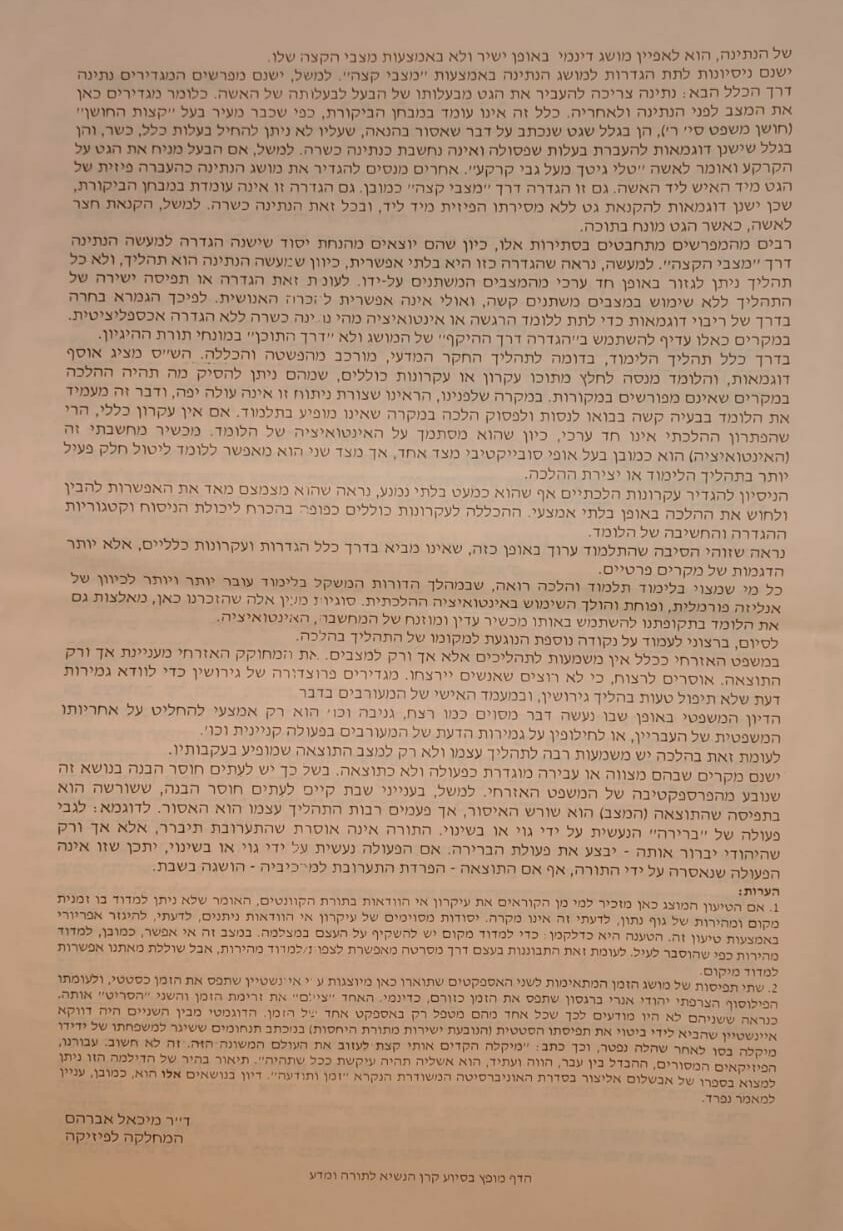
‘And he shall write her a bill of severance and place it in her hand’ (Deut. 24:1). The Torah describes the stages of which the act of divorce is composed. First, the husband must write a bill of severance, that is, a bill of divorce. At the next stage the bill of divorce must be delivered to the woman, and finally it must be in her hand. Each of these stages is explicated in the Oral Torah, chiefly in Tractate Gittin, chapters 2 and 8.
In these discussions there is an attempt to present and characterize what delivery is. This is done by adducing various examples of valid and invalid forms of delivery. Although the Talmud generally does not define rules but presents examples, in this discussion the matter is especially striking. On the one hand, there is no direct definition at all of the concept of delivery, and on the other hand there are very many examples that seek to characterize it.
We shall try to clarify why such a mode of presentation is required for the concept of delivery, which at first glance only burdens the student, and by doing so to shed light on several basic points in the conception of Jewish law.
In every dynamic process one may look at it in two different ways: one is to examine what the situation was before the delivery and what it is afterward. The second is a description of the dynamics, or of the act of delivery itself.
To illustrate this, let us take an example from physics. The motion of a body in mechanics is described by a graph that describes its position at every point in time. The function x(t), called the trajectory, gives the position x at every time t.
From the fact that the body is at different points at different times one can infer that it moves. By contrast, one can describe the motion directly, not through a change of positional states (static states), but by means of the concept of velocity. v(t) is a function that gives the body’s velocity v at every given moment t.
Velocity describes the process of change of place itself, whereas the first description gives only an indirect indication that motion is taking place.
Ordinarily, following Newton, we calculate the velocity of a body by dividing the distance it traveled by the time in which it did so. If the body was at position x1 at time t1, and at a later time t2 it was at position x2, then we may infer that between these two times it moved, and its (average) velocity was v = (x2 – x1) /
t2 – t1
That is, velocity is computed from differences in position and time. Despite this mode of calculation, I would like to argue that the concept of velocity is essentially different from the concept of position, insofar as it describes a process (a dynamic concept), whereas position describes a state (a static concept). The concept of position is regarded as more basic, such that the concept of velocity is derived from it, because human cognition is so constituted that it more easily grasps static concepts, and therefore man also constructs dynamic concepts as derivatives of static states. This is essentially the idea that underlies infinitesimal calculus, which today serves to describe processes in a very wide variety of fields. The process is always described by means of differences between states.
If we continue developing the example from mechanics a little further, we may uncover an interesting understanding of Zeno of Elea’s paradox known as the paradox of the flying arrow. Let us observe an arrow in flight. At every given moment the arrow is in a different place, and therefore at every moment the arrow is stationary, except that at different times it is stationary in different places. Zeno’s question was: when is the arrow flying?
Put differently: suppose we had an ideal camera (with an exposure time of 0). Then at every moment we photographed the arrow we would observe a stationary arrow. There would be no moment at which we would photograph a moving arrow. If so, at what moment does it pass from point to point? Zeno’s conclusion, as is well known, was that the concept of motion is in fact an illusion. This is an extreme formulation of the claim made above concerning man’s difficulty in discerning a process other than through states.
The accepted solutions to this paradox of Zeno, as far as I know, are based on the concept of the infinitesimal as the basic building block of the line instead of the point.
I shall not enter here into these solutions, since in my opinion they are semantic circumventions of the problem, and not a genuine solution to it.
From Zeno’s argument there is no need to reach the extreme conclusion that he himself reached. The necessary conclusion is that an ideal camera cannot capture motion or velocity, but only place. This does not mean that there is no such concept as velocity at all; it means only that a different instrument is required in order to apprehend it. Let us call this instrument an ideal movie camera. The movie cameras of today are in fact built on successive photographs taken at high frequency, that is, they reconstruct the process from states. The ideal movie camera would film the motion itself, and observe the process itself not through the changing states produced by it. An observer using such a camera would see the body’s velocity even though the exposure time is 0. That is, he would not require a time interval in order to define the concept of velocity, as ordinary perception does. For him, velocity is a quantity that exists at a point in time. Incidentally, we may note that even in the ordinary method of calculating a body’s velocity, the result is v(t); that is, there is a different velocity at every point in time, and not only over different intervals of time.
This is evidence for our claim that the need for a time interval is only a computational need, in order to extract velocity from position, but not a real need; the concept of velocity itself characterizes the body at a point in time, and not only over an interval of time.
The conclusion from all this is that a moving body has two characteristics at every point in time: position and velocity. Human cognition, in its simple mode, operates like a camera and apprehends static states, and in this case positions, from which it infers indirectly that there is a process in the background, and in this case velocity. To discern the process directly, one must observe it through another ‘instrument’ or another kind of cognition.
Let us now return to the subject of delivering the bill of divorce. In my opinion, what the Talmud is trying to do by providing the many examples of the correct manner
of delivery is to characterize a dynamic concept directly, and not by means of its terminal states.
There have been attempts to define the concept of delivery by means of ‘terminal states.’ For example, some commentators define delivery by the following rule: delivery must transfer the bill of divorce from the husband’s ownership to the woman’s ownership. That is, the state before delivery and the state after it are defined here. This rule does not withstand critical scrutiny, as the author of Ketzot HaChoshen already notes (Choshen Mishpat, sec. 200), both because a bill of divorce written on something from which benefit is forbidden, to which ownership cannot apply at all, is valid, and because there are examples of transfer of ownership that are invalid and are not regarded as valid delivery. For example, if the husband places the bill of divorce on the ground and says to the woman, ‘Take your bill of divorce from the ground.’ Others try to define the concept of delivery as a physical transfer of the bill of divorce from the husband’s hand to the woman’s hand. This too, of course, is a definition by way of ‘terminal states.’ This definition as well does not withstand critical scrutiny, for there are examples of conveying a bill of divorce without physically handing it from hand to hand, and nevertheless the delivery is valid. For example, by transferring ownership of a courtyard to the woman when the bill of divorce lies within it.
Many commentators wrestle with these contradictions, because they proceed from the basic assumption that there is a definition of the act of delivery through the ‘terminal states.’ In fact, it appears that such a definition is impossible, since the act of delivery is a process, and not every process can be derived in a uniquely determined way from the states changed by it. By contrast, a direct definition or apprehension of the process without using changing states is difficult, and perhaps beyond human ability. Therefore the Talmud chose the path of multiplying examples in order to give the student a feeling or intuition of what valid delivery is, without an explicit definition.
In such cases it is preferable to use an ‘extensional definition’ of the concept rather than an ‘intensional definition,’ in the terminology of logic. Usually the process of study, like the process of scientific inquiry, is composed of abstraction and generalization. The Talmud presents a collection of examples, and the student tries to extract from it a principle or general principles from which one may infer what the law will be in cases not explicitly discussed in the sources. In the case before us, we have shown that this mode of analysis is unsuccessful, and this places the student in a difficult position when trying to rule on a case that does not appear in the Talmud. If there is no general principle, then the legal resolution is not uniquely determined, since it relies on the student’s intuition. This intellectual instrument (intuition) is, of course, subjective on the one hand, but on the other hand it enables the student to take a more active role in the process of study or in the creation of Jewish law.
The attempt to define legal principles, though almost unavoidable, seems to greatly narrow the possibility of understanding and sensing Jewish law in an immediate way. Generalization into comprehensive principles is necessarily subject to the student’s capacity for formulation and to the categories of definition and thought available to him.
This seems to be the reason the Talmud is arranged in such a way that it generally does not present definitions and general principles, but rather demonstrations of particular cases.
Anyone well versed in the study of Talmud and Jewish law sees that over the generations the emphasis in study has shifted more and more in the direction of formal analysis, and the use of legal intuition has steadily diminished. Discussions of the kind mentioned here compel even the student in our own era to use that delicate and neglected instrument of thought, intuition.
In conclusion, I would like to dwell on one additional point concerning the place of process in Jewish law.
In civil law, as a rule, processes have no significance, but only states do. The civil legislator is interested only in the result. Murder is prohibited because we do not want people to be murdered. A procedure of divorce is defined in order to ensure settled intent, so that no mistake will occur in the divorce process, or in the personal status of those involved in the matter.
Legal discussion of the way in which something was done, such as murder, theft, and so forth, is only a means of deciding the offender’s legal responsibility, or alternatively the settled intent of those involved in an act of acquisition, and so forth.
By contrast, in Jewish law the process itself has great significance, and not only the resulting state that appears in its wake.
There are cases in which a commandment or a transgression is defined as an act and not as a result. Because of this, there is sometimes misunderstanding on this issue that stems from the perspective of civil law. For example, in matters of the Sabbath there is sometimes a lack of understanding whose root lies in the conception that the result (the state) is the basis of the prohibition, whereas very often the process itself is what is prohibited. For example: with regard to the act of sorting performed by a non-Jew or in an unusual manner. The Torah does not prohibit that the mixture become sorted, but only that the Jew sort it, that is, perform the act of sorting. If the act is performed by a non-Jew or in an unusual manner, it may be that this is not the act forbidden by the Torah, even though the result, the separation of the mixture into its components, was achieved on the Sabbath.
Notes:
1. If the argument presented here reminds some readers of the uncertainty principle in quantum theory, which says that one cannot simultaneously measure the position and velocity of a given body, then in my opinion this is no accident. Certain elements of the uncertainty principle can, in my view, be derived a priori by means of this argument. The claim is as follows: to measure position one must observe the object with a camera. In that situation it is of course impossible to measure velocity, as explained above. By contrast, observing the object through a movie camera makes it possible to observe or measure velocity, but deprives us of the possibility of measuring position.
2. Two conceptions of the concept of time corresponding to the two aspects described here are represented by Einstein, who conceived of time as static, and, by contrast, the French Jewish philosopher Henri Bergson, who conceived of time as flowing, as dynamic. One ‘photographed’ the flow of time and the other ‘filmed’ it. Apparently neither of them was aware that each was dealing with only one aspect of time. The more dogmatic of the two was in fact Einstein, who gave expression to his static conception, which follows directly from the theory of relativity, in a letter of condolence that he sent to the family of his friend Michele Besso after the latter died, and thus he wrote: ‘Michele has gone a little ahead of me in leaving this strange world. This means nothing. For us believing physicists, the distinction between past, present, and future is only a stubbornly persistent illusion.’ A clear description of this dilemma can be found in Avshalom Elitzur’s book in the University Broadcast series, entitled Time and Consciousness. A discussion of these subjects is, of course, a matter for a separate article.
Dr. Michael Abraham
Department of Physics
This page was produced with the assistance of the President’s Fund for Torah and Science