

On Pesik Reisha (an inevitable consequence) in Rabbinic Prohibitions in the Talmudic Passage of a Lamp on a Table (Shabbat 120b)
Contents of the Article
105 Inevitable Consequence in a Rabbinic Prohibition
Rabbi Michael Abraham
Higher Torah Study Hall
Tiferet Netanya – Yad Moshe
On Inevitable Consequence in Rabbinic Prohibitions in the Sugya
of a Lamp on a Board (Shabbat 120b)
I.
The dispute between the Meiri and Terumat HaDeshen, on the one hand, and the Rashba, on the other, regarding inevitable consequence in rabbinic prohibitions
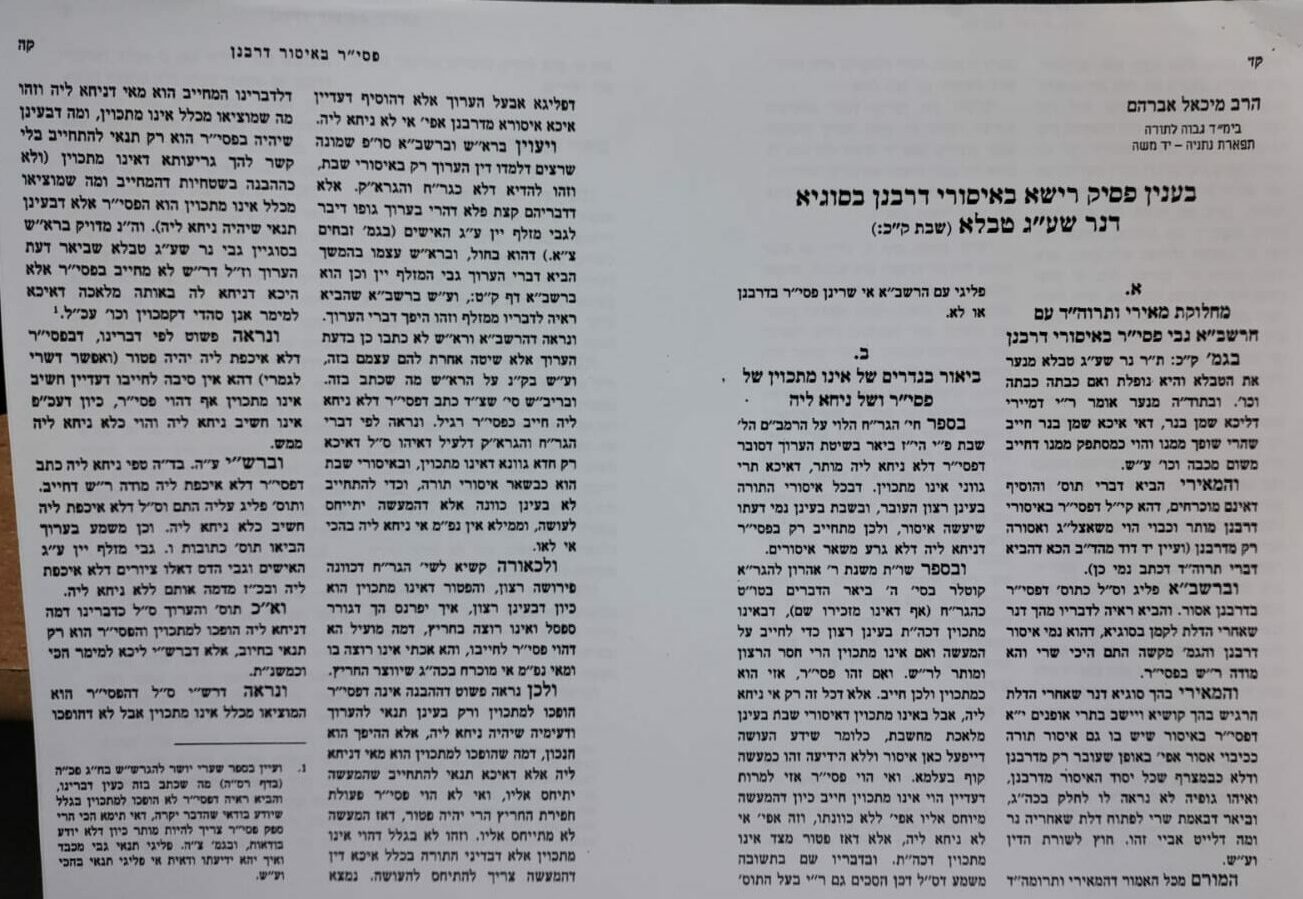
In the Gemara, Shabbat 120b: “The Sages taught: If a lamp is on a board, one may shake the board and it will fall, and if it goes out, it goes out,” etc. And in Tosafot, s.v. ‘one may shake,’ the Ri says that this speaks where there is no oil in the lamp, for if there is oil in the lamp he is liable, since he spills some of it, and that is like taking from it, for which one is liable on account of extinguishing, etc.; see there.
The Meiri cites Tosafot’s words and adds that they are not compelling, for we rule that inevitable consequence in rabbinic prohibitions is permitted, and extinguishing is a labor not needed for its own sake, which is prohibited only rabbinically (see Yad David, second edition, here, who cites Terumat HaDeshen as having written the same).
The Rashba disagrees and holds like Tosafot, that inevitable consequence in rabbinic prohibitions is forbidden. He brings proof for his view from the case of a lamp behind a door later in the sugya, which is likewise only a rabbinic prohibition, yet the Gemara there asks: how can this be permitted, when Rabbi Shimon admits in the case of an inevitable consequence?
The Meiri, in that sugya of the lamp behind the door, noticed this difficulty and resolved it in two ways. Some say that inevitable consequence in a prohibition that also has a Torah dimension, like extinguishing, is forbidden even in a case where one transgresses only on the rabbinic level, unlike tempering metal, where the entire basis of the prohibition is rabbinic. He himself did not find this distinction convincing, and explained that in truth it is permitted to open a door behind which there is a lamp, and Abaye’s denunciation there was beyond the strict letter of the law; see there.
The upshot of all this is that the Meiri and Terumat HaDeshen disagree with the Rashba over whether we permit inevitable consequence in rabbinic prohibitions.
II.
An explanation of the conceptual categories of unintentional action, of inevitable consequence, and of whether the result is beneficial to him
In Rabbi Hayyim HaLevi’s novellae on Maimonides, Laws of Shabbat 10:17, he explained the view of the Arukh, who holds that an inevitable consequence that is not beneficial to him is permitted, on the basis that there are two kinds of unintentional action. In all Torah prohibitions, the violator’s will is required; and on Shabbat we also require his awareness that he is performing a prohibited act. Therefore liability exists only in a case of inevitable consequence that is beneficial to him, for that is no worse than other prohibitions.
In the book Mishnat Rabbi Aharon by Rabbi Aharon Kotler, sec. 5, these matters are explained at length in accordance with Rabbi Hayyim’s approach (although he does not mention him there): with respect to unintentional action in Torah prohibitions generally, will is required in order to incur liability for the act, and if he did not intend it, the requisite will is lacking, and according to Rabbi Shimon it is permitted. If, however, it is an inevitable consequence, then it is as though intended, and therefore he is liable. But all this is only if it is beneficial to him. By contrast, with respect to unintentional action in the prohibitions of Shabbat, we require purposive labor, meaning that the actor know that a prohibited result will be effected here; without that awareness, it is merely like the act of a monkey. If it is an inevitable consequence, then although it still counts as unintentional, he is liable because the act is attributed to him even without his intention, and this is so even if it is not beneficial to him; however, then he is exempt on the separate ground of unintentional action in Torah prohibitions generally. And from his responsum there it appears that he held that the Ri of Tosafot agreed as well
and disagreed with the Arukh, but added that there still remains a rabbinic prohibition even if it is not beneficial to him.
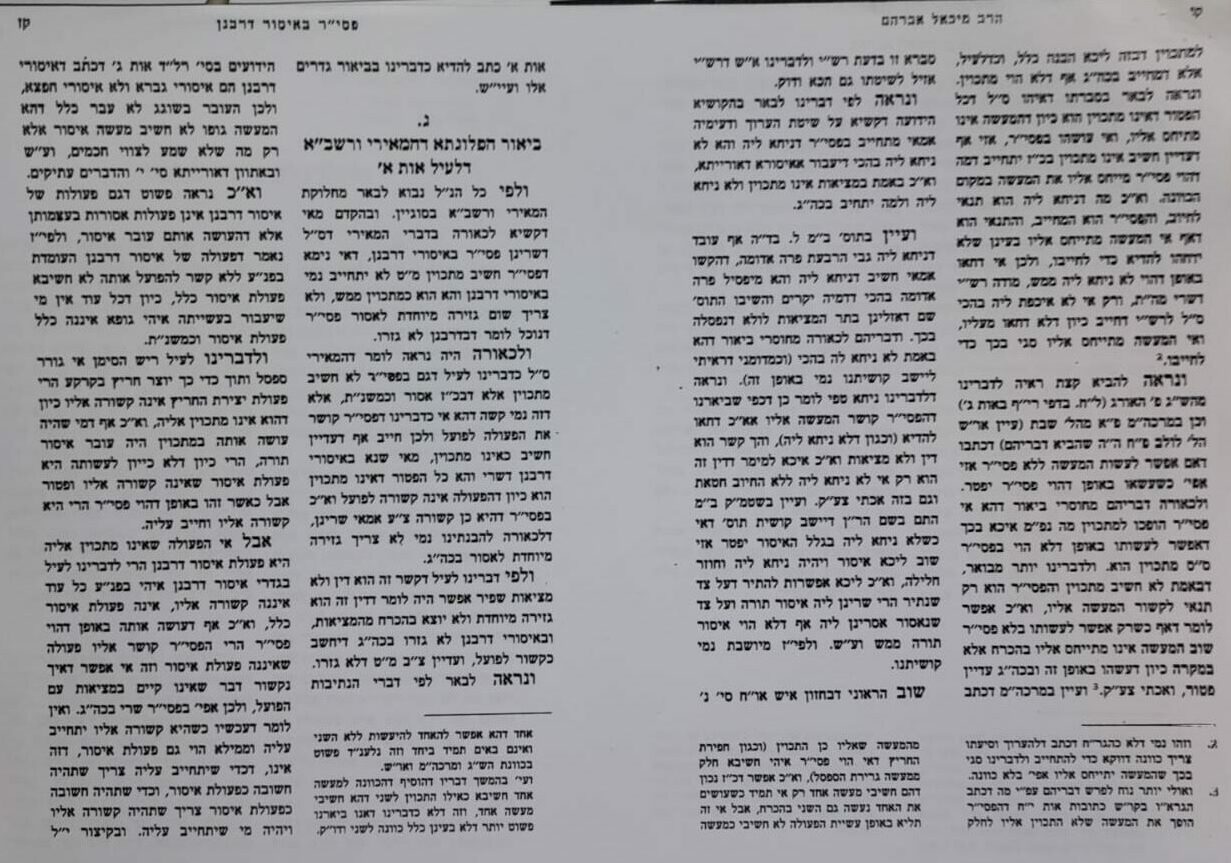
One should consult the Rosh and the Rashba at the end of the chapter “Eight Creeping Things,” who learned the rule of the Arukh only with respect to Shabbat prohibitions, and this is explicit evidence against Rabbi Hayyim and Rabbi Aharon Kotler. Their words are somewhat surprising, however, for the Arukh itself speaks about one who sprinkles wine on the fires of the altar (Zevahim 91b), which is a weekday case; and the Rosh himself later cites the Arukh’s words regarding one who sprinkles wine, and the same is true in the Rashba on 109b. See there in the Rashba, who brings proof for his own view from the sprinkling case, which is the opposite of the Arukh’s view. It seems that the Rashba and the Rosh did not write this as an interpretation of the Arukh, but rather as a different view of their own on the matter. See Korban Netanel on the Rosh for what he writes about this. And in Rivash, sec. 394, it is written that an inevitable consequence not beneficial to him is liable just like an ordinary inevitable consequence. According to the words of Rabbi Hayyim and Rabbi Aharon Kotler cited above, it would seem that he holds there is only one kind of unintentional action, and that with respect to the prohibitions of Shabbat it is like the other Torah prohibitions: in order to incur liability, intention is not required; rather, the act need only be attributable to the actor. Consequently, it makes no difference whether the result is beneficial to him or not.
At first glance, however, Rabbi Hayyim’s approach is difficult. If intention means will, and the exemption for unintentional action is because will is required, how will he explain the case of dragging a bench when one does not want a furrow? What does it help that it is an inevitable consequence so as to obligate him? He still does not want it. What difference does it make that in such a case the furrow must necessarily be formed?
Therefore it seems obvious that the correct understanding is not that inevitable consequence turns it into intended action, with the Arukh and those who follow him requiring, as an additional condition, that it be beneficial to him. Rather, the reverse is true: what turns it into intended action is the fact that it is beneficial to him; but there is also a condition for liability, namely, that the act be attributable to him. If the digging of the furrow were not an inevitable consequence, he would be exempt, because then the act would not be attributed to him. This is not because it is unintentional as such; rather, in Torah law generally there is a rule that the act must be attributable to the one who performs it. It follows that
according to our explanation, what creates liability is the fact that it is beneficial to him, and that is what removes it from the category of unintentional action. The requirement that it be an inevitable consequence is only a condition of liability, unrelated to this deficiency of unintentionality (and not as the superficial understanding would have it, namely, that the inevitable consequence is what creates liability and removes it from the category of unintentional action, while the requirement that it be beneficial to him is merely an added condition). This is also precisely the implication of the Rosh in our sugya regarding a lamp on a board, where he explained the view of the Arukh as follows: “Rabbi Shimon imposes liability for an inevitable consequence only where that labor is beneficial to him, for then we may say: we are witnesses that he intends it,” etc. 1
According to our explanation, it is obvious that in a case of inevitable consequence to which he is indifferent, he would be exempt (and perhaps it is even entirely permitted), for there is no reason to obligate him, since it still counts as unintentional even though it is an inevitable consequence, because in any event it is not considered beneficial to him, and is equivalent to a case genuinely not beneficial to him.
And Rashi on Shabbat 75a, s.v. ‘more beneficial to him,’ wrote that in a case of inevitable consequence to which he is indifferent, Rabbi Shimon agrees that he is liable. Tosafot there disagree and hold that indifference is treated like a case not beneficial to him. And this also appears from the Arukh, as cited by Tosafot in Ketubot 6a regarding one who sprinkles wine on the fires and regarding myrtle, for these are cases of indifference, and nevertheless he compares them to cases not beneficial to him.
Thus Tosafot and the Arukh agree with our explanation, that it is the fact that it is beneficial to him that turns it into intended action, while the inevitable consequence is only a condition in liability. But with respect to Rashi one cannot say this, as explained.
And it appears that Rashi holds that the inevitable consequence removes it from the category of unintentional action, but does not turn it into intended action
1. See Sha’arei Yosher by Rabbi Shimon Shkop, vol. 3, ch. 25 (p. 268), who writes something along the lines of our explanation, and he brought proof that inevitable consequence does not turn it into intended action merely because one knows with certainty that the thing will occur. For if you were to say so, then a doubtful inevitable consequence should be permitted, since one does not know with certainty. Yet on 95a the tannaim dispute the case of sweeping, and how can his knowledge be certain if the tannaim dispute the matter? See there.
107 Inevitable Consequence in a Rabbinic Prohibition — Rabbi Michael Abraham
In section I he explicitly wrote as we have written in explaining these conceptual categories; see there.
III. An explanation of the dispute between the Meiri and the Rashba discussed above in section I
In light of all the above, we can now explain the dispute between the Meiri and the Rashba in our sugya. By way of introduction, there is an apparent difficulty in the Meiri’s words, for he holds that we permit inevitable consequence in rabbinic prohibitions. If we say that inevitable consequence counts as intended action, why should he not incur liability in rabbinic prohibitions as well? After all, it is just like intentional action ממש, and no special decree is needed to forbid inevitable consequence, so one cannot simply say that with rabbinic prohibitions no such decree was enacted.
At first glance, it would seem possible to say that the Meiri agrees with our earlier explanation, that even in a case of inevitable consequence it is not considered intentional, although it is nevertheless forbidden, as explained. But this too is difficult, for if, as we said, inevitable consequence links the act to the actor and therefore obligates him even though it still counts as unintentional, what is different in the case of rabbinic prohibitions that it should be permitted? The entire exemption of unintentional action is because the act is not connected to the actor, and if so, where in a case of inevitable consequence it is connected to him, it requires explanation why we should permit it. On our understanding as well, it would seem that no special decree is needed to forbid such a case.
According to our earlier explanation that this connection is a legal rule and not a fact of reality, one could indeed say that this rule is a special decree and does not necessarily follow from the factual reality, and that with rabbinic prohibitions they did not decree in such a case that it be considered connected to the actor. But it still requires explanation why they did not decree this.
And it seems that this can be explained in light of the Netivot
since one can occur without the other and they do not always come together; and this, it seems to me, is plainly the intent of Shiltei HaGibborim, Merkhevet HaMishneh, and Or Sameaḥ. See further in his words, where he adds that intention for one act is considered as though he intended the second, since they are considered one act. This is unlike our explanation, for we explained it more simply: no intention for the second is required at all. Consider this carefully,
He brings this in Rashi’s view, and according to our explanation it is well understood, for Rashi follows his own approach here as well. It also seems, according to our explanation, that one can resolve the well-known difficulty raised against the view of the Arukh and those who follow him: why is one liable in a case of inevitable consequence that is beneficial to him, when it is in fact not beneficial to him insofar as he thereby transgresses a Torah prohibition? If so, in reality he does not intend it and it is not beneficial to him; so why should he be liable in such a case?
Afterward I was shown the Hazon Ish, Orah Hayyim, sec. 50
as part of the act that he did intend (for example, digging the furrow, which, if it is an inevitable consequence, is considered part of the act of dragging the bench). If so, perhaps all this is correct — that they are considered one act — only when whenever one performs the first, the second necessarily occurs as well. But if this depends on the manner in which the action is performed, they are not considered a single act.
his well-known statement in sec. 234, par. 3, that rabbinic prohibitions are prohibitions upon the person and not prohibitions upon the object, and therefore one who transgresses unwittingly has not transgressed at all, because the act itself is not considered a prohibited act; the only prohibition is that he did not heed the Sages’ command. See there, and in Atvan DeOraita, sec. 10; these matters are longstanding and well known.
If so, it is obvious that acts prohibited on the rabbinic level are likewise not intrinsically prohibited acts; rather, the person who performs them thereby transgresses. According to this, an act that is rabbinically prohibited, standing by itself without relation to the one who performs it, is not considered a prohibited act at all, because so long as there is no person who will transgress by doing it, it itself is not a prohibited act at all, as explained.
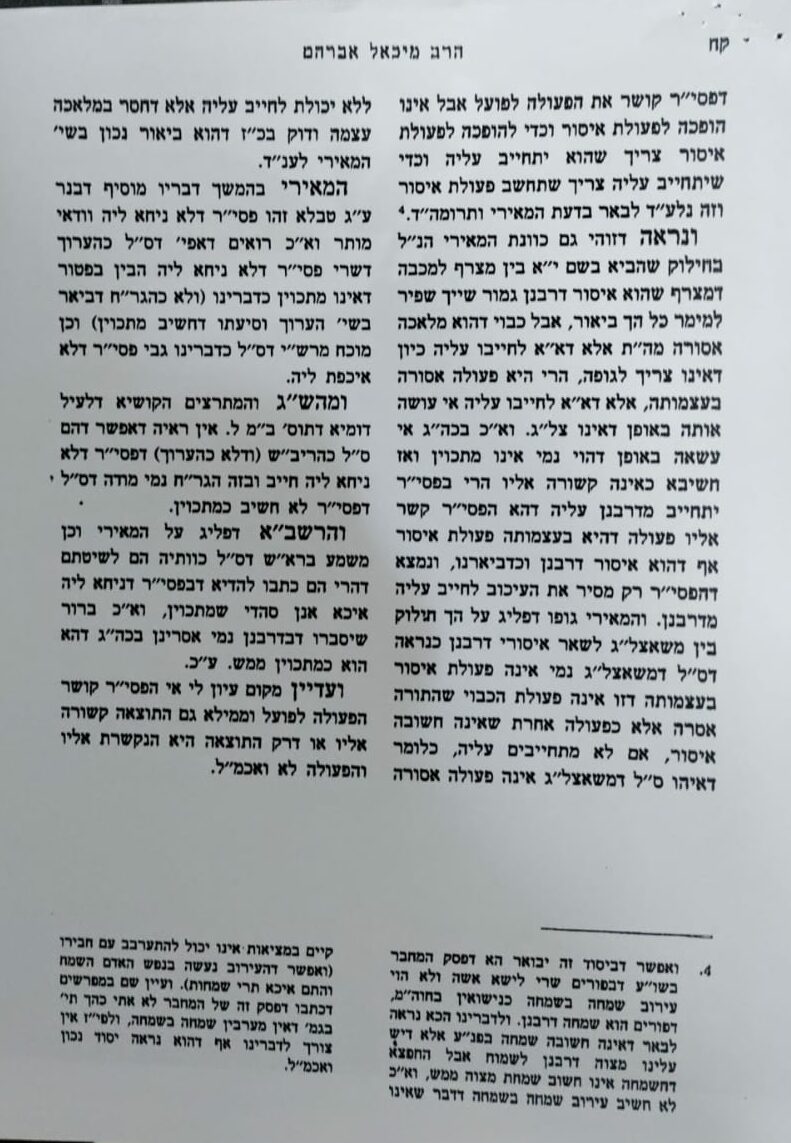
According to what we wrote above at the beginning of this section, if one drags a bench and in doing so creates a furrow in the ground, the act of creating the furrow is not connected to him, because he did not intend it. Therefore, although one who performed it intentionally would transgress a Torah prohibition, nevertheless since he did not intend to do it, it is a prohibited act that is not connected to him, and he is exempt. But when it is done in a way that constitutes an inevitable consequence, then it is connected to him, and he is liable for it.
But if the act he did not intend is one prohibited only rabbinically, then according to our explanation above concerning the nature of rabbinic prohibitions, that act, standing on its own so long as it is not connected to him, is not a prohibited act at all. Accordingly, even if he does it in a way that constitutes an inevitable consequence, the inevitable consequence links to him an act that is not a prohibited act, and that is impossible: how can we connect to the actor something that does not exist as a prohibited act in reality? Therefore even in a case of inevitable consequence it is permitted. And one cannot say that now that it is connected to him he will be liable for it, and it thereby also becomes a prohibited act, for that will not do: in order for him to be liable for it, it must first count as a prohibited act; and in order for it to count as a prohibited act, it must already be connected to him and there must be someone who would be liable for it. In short, one may say
108 Rabbi Michael Abraham
that inevitable consequence links the act to the actor, but does not turn it into a prohibited act. In order to turn it into a prohibited act, he would have to be liable for it; and in order for him to be liable for it, it must first count as a prohibited act. This, it seems to me, is the explanation of the view of the Meiri and Terumat HaDeshen. 4
It seems that this is also the Meiri’s intention in the distinction cited above in the name of “some say,” between tempering metal and extinguishing. In the case of tempering, which is a wholly rabbinic prohibition, this entire explanation can indeed be stated very well. But extinguishing is a labor prohibited by the Torah; it is only that one cannot incur liability for it because it is not needed for its own sake. Therefore it is intrinsically a prohibited act; one simply cannot incur liability for it if one does it as a labor not needed for its own sake. If so, when one performs it in a manner that is also unintentional, so that it is considered not connected to him, then in a case of inevitable consequence he would incur liability for it on the rabbinic level, since the inevitable consequence has connected to him an act that is intrinsically a prohibited act, even though the liability here is only rabbinic, as we explained. It follows that the inevitable consequence merely removes the obstacle to imposing rabbinic liability for it. The Meiri himself, who disagrees with this distinction between a labor not needed for its own sake and other rabbinic prohibitions, apparently holds that a labor not needed for its own sake is likewise not an intrinsically prohibited act, for this is not the act of extinguishing that the Torah forbade, but rather another kind of act that is not considered a prohibition if one is not liable for it. That is, he holds that a labor not needed for its own sake is not a prohibited act
for which one merely lacks the possibility of liability; rather, the deficiency lies in the labor itself. Consider all this carefully, for in my opinion this is the correct explanation of the Meiri’s position.
The Meiri later adds that in the case of a lamp on a board, this is an inevitable consequence not beneficial to him and is certainly permitted. Thus we see that although he agrees with the Arukh that an inevitable consequence not beneficial to him is permitted, he understood the exemption of unintentional action as we have explained (and not as Rabbi Hayyim explained the view of the Arukh and those who follow him, namely, that it is considered intentional). The same is proven from Rashi, who agrees with our explanation regarding an inevitable consequence to which he is indifferent.
And from Shiltei HaGibborim and those who answer the difficulty above in a manner similar to Tosafot in Bava Metzia 30a, there is no proof, for perhaps they agree with the Rivash (and not with the Arukh) that an inevitable consequence not beneficial to him is still liable; and in that case Rabbi Hayyim too would agree that inevitable consequence does not count as intentional.
And the Rashba, who disagrees with the Meiri, and so too it appears from the Rosh that he agrees with him, are consistent with their own approach. For they explicitly wrote that in a case of inevitable consequence beneficial to him, we may say, “we are witnesses” that he intends it. It is therefore clear that they would hold that even in rabbinic prohibitions we forbid such a case, since it is ממש like intentional action. This is the conclusion.
There still remains room for further consideration, in my view, whether inevitable consequence links the act to the actor and the result is thereby also linked to him, or whether only the result is what is linked to him while the act is not; but this is not the place to elaborate.
4. Perhaps on the basis of this principle one can explain why the author of the Shulchan Arukh ruled that on Purim it is permitted to marry, and this is not considered the mixing of one joy with another, unlike marriage on the intermediate days of the festival, because Purim joy is rabbinic. According to our explanation here, it would seem that this joy is not considered an independent joy in itself; rather, there is a rabbinic command upon us to rejoice, but the objective legal entity of that joy does not count as full commandment-joy. Accordingly, this is not considered the mixing of one joy with another, because something that does not
exist as a concrete legal reality cannot become mixed with its fellow (though it is possible that the mixing occurs in the soul of the rejoicing person, and there there are indeed two joys). And see the commentators there, who write that this ruling of the author of the Shulchan Arukh does not accord with that answer in the Gemara that one may not mix one joy with another. According to that, there is no need for our explanation, even though it still seems to be a correct principle, and this is not the place to elaborate.