

Torah with Derekh Eretz – A New Model for the Yeshiva High School


Article Contents
Torah with Worldly Engagement – A New Model for the Yeshiva High School
Dr. Michael Abraham
In these pages I would like to try to focus on several of the central problems from which the educational system in Israel suffers in general, and yeshiva high schools in particular, and to propose a principled direction, and perhaps a solution, to these problems. I should note that my discussion here concerns mainly problems connected to study and learning, and not purely educational problems, although there is a clear connection between the two realms.
This article does not purport to be a scientific paper, nor does it present the results of a systematic examination of the state of any particular educational system. What is presented here are impressions of problems whose existence is beyond doubt. At the same time, there is definitely an intention here to present a systematic analysis of the problems and of the possible solutions.
Here it is appropriate to say in advance that some of the things that will be presented in the curriculum and in the general conception appear, at first glance, unrealistic because of the characteristics of the average student and because of our social system’s demand for measurable achievements. In the course of my remarks I will argue that there are ways to realize such a program; some of these ways are being tested in an experimental program being carried out beginning this year (1995-96) in the tenth-grade classes at the Midrashiyah. In any case, there is good reason to discuss a program of this kind. Any curriculum or educational philosophy must define clearly its goals, its achievements, and its failures in the current situation, and in light of this try to build an alternative program if one is needed. To the best of my knowledge and understanding, even these initial stages toward shaping an educational program have still not been carried out in a serious and systematic manner. Many people and bodies feel that there is a problem with the current form of education and learning, but I do not know of any attempt to characterize and define the educational goals precisely, and as a result the problems as well. Only after such a characterization can one move forward toward formulating a concrete program. Such a characterization also assumes at its base a value system that should guide both the educator and the student. Setting out such a value system in clear lines is a difficult and delicate matter, since even within the religious sector, and even within the religious-Zionist sector, there are different shades
of opinion. Those who shape strategy, the students’ parents, the administration of the institutions, the educators, and the students themselves do not always reach agreement even on this deepest and most basic level. In my view, some of the problems the educational system encounters stem from precisely this confusion and lack of agreement among the various parties, accompanied by the transmission of contradictory messages to the students, and by an unwillingness to define precisely an educational-value strategy. I do not mean to argue against ideological pluralism, which is generally a blessing, but rather, on the contrary, against the attempts to suppress the differences. This article assumes at its base, though implicitly, a certain value system; it derives from it the desired educational goals, characterizes the problems existing in the current structure, and tries to outline a possible way of coping with them. The article concludes with a curriculum that is still rough and experimental, derived from the principles above. The reader’s response to these matters also depends on the reader’s own value system. In any case, the educational approach proposed here can be adopted as one solution to educational problems, even if the value system underlying it is not, in the reader’s eyes, the ideal model. For this reason, I have chosen to present these matters as a model that assists in solving existing educational problems on which there is a fairly broad consensus.
A. The Problems
Below I will try to present several of the central problems that, in my opinion, characterize the typical product of the educational system in Israel. The subject under discussion is the yeshiva high school, but its range of relevance includes the entire religious educational system and even the secular one.
The problems on which we will focus are four: lack of broad general education, lack of analytical ability and critical thinking, lack of ability for independent study, and lack of motivation for study. By these problems I mean both the realm of secular studies and the realm of sacred studies.
I can testify about myself and about other graduates of the educational system
152 Torah with Worldly Engagement – A New Model for the Yeshiva High School / Dr. Michael Abraham
that if any of us possesses something of those qualities whose absence was listed above, it is despite the educational system and not because of it. Every university lecturer can testify that assigning an independent task to students is perceived by them as a capricious and excessive demand on the lecturer’s part. Most study, both in high school and in university, is based on lecture-style cramming of given material and on an examination that does not require much thought from one who has prepared well. This is especially true of high-school studies. Throughout all his years of study, the student becomes accustomed to learning that is merely preparation for an examination, and the curriculum itself is built in that way.
For example, in the teaching of physics, which is certainly one of the more difficult subjects in high school, an overwhelming majority of the time in class, and certainly at home in the dormitory, is wasted on practicing all sorts of problems whose only value is that they may appear on the test. The principled understanding of the basic ideas receives no attention at all. Later on I will examine the roles of the high school in our time, and I will argue that such a form of study is a direct result of stagnation and of the failure to reassess the role of the school.
From a religious perspective, the matter is doubly problematic. If, in the teaching of secular subjects in general schools, there can be debate about the value of ability and motivation to study, then in sacred studies this is a religious problem that is beyond all dispute. Looking at the time and effort invested by adults in study in general, and in sacred studies in particular, teaches more than anything about the problem with which we must contend. Even those adults who are already willing to devote time to sacred studies do so within a framework that outwardly resembles an enrichment course, and it may be said with confidence that this is not one of the popular ones.
The failure in the yeshiva high school is far more painful. Within this framework, the time, effort, and resources invested in sacred studies are significantly greater than those in parallel frameworks, and yet almost no improvement is evident. The ratio of output to input is significantly lower. The research of Professor Moti Bar-Lev quantifies the facts known to all of us regarding the status of sacred studies, and especially Gemara, as compared with secular studies. This is a profound failure that casts doubt on the worthwhileness of the entire system.
In ‘Niv HaMidrashiyah,’ vols. 22-23 (1990), an attempt was made to deal with the results of that research by means of a survey among experts in pedagogy from academia and from the field. In my opinion, with all due respect to the participants in that discussion, they were looking for the coin under the lamp. Directing the questions to experts in pedagogy points to a basic assumption of the discussion, plainly mistaken in my view, namely that the roots of the problems belong to the realm of pedagogy; and indeed, the answers received in that survey were all on the pedagogical plane. The points that came up were how much weight should be given to partner study, how to improve the pedagogical ability of the Talmud teacher, and so forth. In all modesty, I permit myself to reject this basic assumption and to state that the problem is not pedagogical. Does anyone among those scholars imagine that teachers of mathematics, physics, or history have greater pedagogical ability than the Talmud teachers, or that they invest more time in preparing their lessons? In my humble opinion the answer is no, and in fact the opposite situation is, in my view, closer to reality on the ground. If so, the question remains in full force: why does Gemara receive the worst treatment, in inverse proportion to the quantity and quality of the resources invested in teaching it?
B. A Proposal for a Solution on the Principled Level
In my opinion, the root of all the problems raised above lies in seeing study as a means and not as an end. Study at all levels, in high school and in university, is perceived as an instrument for obtaining a certificate, a livelihood, social standing, getting along in life, and so forth. The curricula and the way they are conducted transmit this message to students, and very powerfully. The purpose of learning, and of teaching as well, is to pass the examination as smoothly and successfully as possible. Not long ago, one of my friends told me about an experiment conducted with monkeys. Monkeys have an instinct to spin wheels that are near them. During the experiment, several such wheels were placed in a cage of monkeys, and, as was their habit, they spun them incessantly. After a certain time, a banana was given as a reward to any monkey that spun one of those wheels. After some time, the giving of bananas was stopped, and the monkeys stopped spinning the wheels.
The implications of this experiment provoke gloomy reflections about the achievements possible under the existing educational method. Of course, one must examine the possibility of extrapolating from monkeys to human beings, but the experiment is certainly thought-provoking. Is the students’ lack of motivation genetic, or is it the educational system that reduces it? If a certain institution needs a means of screening those who seek admission, then that institution should conduct the examinations for that purpose. The examinations in the educational system are meant only to test the success of the learning, and perhaps to encourage it somewhat, but they are not the purpose of learning.
If we continue this line of thought, we will see the problematic nature of sacred studies emerge on its own. Sacred studies do not help one attain any goal in the foreseeable future. Their status is inferior a priori regardless of the level of teaching. There is certainly room to improve the level of teaching as well, but that is a problem that characterizes all fields of study equally.
153 Torah with Worldly Engagement – A New Model for the Yeshiva High School / Dr. Michael Abraham
The monkey parable above helps explain why this is the crux of the problem in instilling general values of study as well. One who grows accustomed to studying for the sake of a goal will, once he has attained what he seeks, or when there are parts of his studies that do not directly help him attain it, have no motivation to study at all. Throughout his studies, a student never encounters learning for the sake of enjoyment or for the production of purely intellectual benefit. Even students who study in the humanities and literature track, which ostensibly does not open a gate to the student’s economic future, usually do so out of laziness or lack of ability, and not out of interest. The form of teaching is also derived from the students’ attitude, and the principle of learning not for its own sake becomes self-reinforcing.
The conclusion of all this is that the proposed solution on the principled level is to try to create a system in which study is a value in itself, both in sacred studies and in secular studies. In my view, and this is a value judgment with which the reader is entitled to disagree, the very distinction between these two kinds is unnecessary and harmful. If we succeed in creating such a system, then it is clear that the status of the studies now called sacred studies, as against their secular competitors, will improve immeasurably, regardless of any improvement in the level of teaching and pedagogy. No study will be for the sake of attaining some material goal. The gap between ‘useful’ studies and those that are not will disappear. Clearly, all the parameters connected with learning ability and motivation will improve.
So much for the direction on the declarative level, which of course has importance in itself in sharpening the problem and, consequently, in the search for the concrete solution. Later on I will try to offer such a concrete formulation. Even one who disagrees with me regarding the nature or feasibility of the proposed model can agree with the analysis presented up to this point and suggest a different concrete formulation.
To conclude, I emphasize again that this principle, that of study for its own sake in all subjects, stems for me from a worldview that advocates from the outset an integration of Torah with worldly engagement. But even one who is willing to adopt such an outlook as an ex post facto means for solving educational problems is invited to continue reading the next chapter.
C. The Concrete Solution
In this chapter I will try to sketch the character of an ideal institution, and perhaps a utopian one, that operates according to the principle presented above, and afterward I will try to discuss its implementation within the constraints of the reality in which we live and act. The prevailing conception today regarding the instrumental value of study
causes a distorted method of evaluating schools. Today a good school is called one that bites off as large a portion as possible of post-secondary studies, chiefly academic ones. Even enrichment programs in schools are often directed toward these goals. The Harari Report, submitted not long ago to the Minister of Education, plainly reflects this mistaken conception. The report recommends deepening the students’ and teachers’ scientific and technological training, and accordingly, of course, the education budget as well. Here too, at the basis of assigning the task to a committee of this kind, lies a mistaken assumption that will become clear below.
It is completely clear that intensive high-school study in a central specialization subject yields, and even that only rarely, at most the credit for a single semester course at university, a benefit negligible to the student. Material studied במשך two years in high school can be learned at university in half a semester, and more deeply as well. This follows from various reasons, some connected with motivation to study, others with intellectual maturity, and so on. More than that, in an external preparatory school one can obtain a reasonable matriculation certificate within about two years of evening study, while during the day many of the students work, and many of them also have families.
In light of all this, it seems that there is no reason to define the goal of the high school as an institution that teaches the initial material in the future track of professional training. On the contrary. Simple logic says that the school should concentrate, beyond the basic information required for the adult to function in society, precisely on those fields that the student may or is likely not to encounter in the future. The issue of professional training should be left in the hands of post-secondary institutions, which carry it out better and faster in their specialized areas. The high school should concentrate on imparting knowledge and habits of learning and thinking that have general value, and not those that constitute a first step toward some specific track. Of course, this conception also accords with the general approach proposed in these pages, which sees study as a value in itself and not only as a means of attaining concrete future goals. The approach prevalent today has its basis in a past era, when the high school constituted the summit of the studies of most students, only a few of whom went on to academic study. Today, the situation has changed completely, and there is room to reexamine this approach. The Ministry of Education generally does respond to this change in situation, but the response is to lower the level of demands on students. My claim here is in favor of a change in the direction of the demands, not a lowering of their level.
I should note here that I do not intend to deny the legitimacy of acquiring a profession, of course, but only to argue that today this is not the primary role
154 Torah with Worldly Engagement – A New Model for the Yeshiva High School / Dr. Michael Abraham
of the high school.
Let us examine, for example, the concept of the specialization track. This concept is so deeply rooted in the life of the school that it is difficult even to try to examine it from a broader perspective. It is in fact an educational chain leading the student in a narrow and clearly defined direction. This concept is a direct product of viewing the school as opening the future training track. There is an illusion that the tracks open different avenues for students of different inclinations, in the sense of ‘train a child according to his way’ (Prov. 22:6), but this is not so. The average student in tenth grade, and his parents as well, generally has no real understanding of his natural inclinations. Still less does he know the various forms of study, not to mention his degree of familiarity with the academic studies that continue this track. Usually even by the end of twelfth grade the student is unable to recognize and assess the three parameters mentioned above. Indeed, anyone familiar with the way tracks are chosen today knows that there is no connection whatsoever between a student’s choice and any substantive consideration. This determination, incidentally, is based on surveys conducted in grades 9-12 at the Midrashiyah. A student chooses a track according to vague rumors about the prestige of a subject, the expected future income of those who engage in it, social pressures, and parental ones as well, and above all the ease of the studies and of passing the various examinations. A simple indication of everything argued above would be to examine the correlation between the track in which a student studies and his future field of occupation. Today, a student who wants to study law or medicine needs to study in a physics track or something similar in order to pass the careful screening conducted by these faculties. Very few of the graduates of the physics tracks go on to study physics at university.
The conclusion of this brief discussion is that in the school today there is no need for tracks in their current format. A student should learn the principled layer and the foundations of thinking in all fields, and under no circumstances spend significant time practicing and acquiring specific skills. When the studies are at a foundational level, the different inclinations of the students also need not be expressed, and there will be no need for tracks. That is, if there is no need to solve specific exercises in mathematics or physics, but only to understand the principles, then a student will not be able to claim that such a subject is beyond his ability. Of course, there may be cases in which the student is not interested in one subject or another, but acquiring a basic education is necessary for every student in every subject. This is far more important preparation for the graduate’s functioning in life and in society than the acquisition of skills in solving problems in one of the sciences or branches of technology that the student studies in the current format. Studies
in a format such as the one proposed here will enable the graduate to choose his path in the future in a more balanced way and מתוך broader acquaintance with all the possibilities open before him.
Within the curriculum, great emphasis should be placed on the teaching of subjects important for the development of thinking ability, such as logic, geometry, research methods in the social sciences, foundations of literature, philosophy, historical analysis, and of course strong emphasis on English, which is an indispensable tool for any study whatsoever. At present, in the experimental tenth grade at the Midrashiyah, the subject of logic and its implications for mathematics, philosophy, computer science, and digital electronics is also being taught.
Everything said above applies to sacred studies as well. The approach proposed for secular studies will strengthen the status of sacred studies, contrary to the concern that usually accompanies the strengthening of secular studies in yeshiva high schools, lest sacred studies be harmed. In Gemara study there is a principled problem, beyond the fact that it does not lead to any visible goal. At the beginning of the road, the student must contend with problems of language and text decoding, and only afterward can he begin to enjoy his studies. Usually, a student in a yeshiva high school does not get beyond the stage of decoding the text even by the end of twelfth grade. This leaves him with the feeling that the essence of Gemara study lies in cracking the linguistic difficulties. This situation will worsen if secular studies become more attractive and more intellectually developing, and the competition will become impossible. The solution usually adopted in such cases is to turn secular studies into stone as well, in order to prevent such competition. This is an outrageous solution, one that has no place in an educational system. My proposal on this matter is as follows. Each pair of students in ninth grade will sit with a Talmud teacher or instructor for about an hour every day. The teacher will read roughly a page of Gemara with Rashi at a quick pace, while only clarifying questions are asked. The pair will be given about two hours for review and preparation, and on the following day an oral examination will be held for one or both of them, including reading and explanation of the page studied the previous day. In this way, after a few months, the stage of decoding the text will be behind all the students. Today, when the teaching is lecture-based, the rabbi teaches about ten percent of the students, and the rest will not close the gap by the end of their studies. Thus, in far fewer hours, for the student, not for the class, good achievements can be reached at the stage of decoding the text. In the following years it will already be possible to teach the students in lecture format or in partner study that includes more in-depth analysis and greater independence in student activity. In this way sacred studies will be able to withstand competition with secular studies. I note here that I know of a yeshiva for newly observant students that uses such a method, and the students’ achievements within a few months are impressive. The additional resources required for a program of this kind are negligible in relation to the increase in the efficiency of the investment. Considering that these studies are the crown jewel of the yeshiva high school, and considering the depth of the problem in the existing approach, this is an elementary requirement.
155 Torah with Worldly Engagement – A New Model for the Yeshiva High School / Dr. Michael Abraham
I would further note that there is room to consider such a method for English studies as well. So much for the outline of the general lines of the proposed program. I now turn to discuss the problems that may arise when one approaches its implementation in real reality. Two principal points arise here: a. Institutions of higher education are not prepared to screen on such a basis, and as a result they also begin study with the assumption of a certain prior knowledge.
b. Students need from the outset to possess learning motivation, and if so, studies in the style proposed here will not improve the learning parameters among those most in need of such improvement.
As for the second point, it seems that at the initial stage there is no choice but to begin with a group possessing basic motivation, one that has not yet been worn down in the gears of the system, and to try to create with it a model that will serve as a benchmark for the entire system. This is an experimental stage carried out in the expectation that the enjoyment and challenge in study will attract and challenge additional students as well. In any case, at least this group will be spared the erosion that would have been expected had it continued studying in the regular track. If we succeed in creating such a model, motivation may develop among a much broader public. In the current situation, when the entire system is searching for better solutions, similar models, and perhaps even better ones, will, in my estimation, immediately arise in additional places. An attempt to change a general atmosphere can never begin from above, but only from below.
The selection of the students for the experimental group should not be made on the basis of ability but on the basis of motivation, though I do not ignore the correlation between these two traits. The program is not intended specifically for especially strong students, and its goal is chiefly to improve motivation and learning skills, each only in accordance with the ability of that particular student.
The first point raised above requires the program also to include standard specialization subjects, so as to finish with a matriculation certificate that allows the student to be admitted to and to succeed in post-secondary studies. Of course, the approach is that the studies are what is important educationally, whereas the enrichment courses are the studies toward the specialization subjects and the matriculation examinations. Part of the problem can be solved by integrating subjects of educational and intellectual value as specialization subjects. In the experimental tenth grade at the Midrashiyah, the subject of logic and the theory of reasoning is now being taught as a matriculation option at a scope of at least 5 units. This subject is of enormous importance for imparting habits and capacities of thought, the foundations of philosophy, while at the same time it has implications for applied fields such as mathematics, computers, and digital electronics. In this way, of course, time that would be wasted on tracks is saved in favor of content of general value. This requires added teaching time and teaching resources because of the special structure of the curriculum. Discipline problems in this class, if there are any, will not be able to be handled as in the regular track. A student who is problematic in terms of motivation will be forced to leave, not as a punishment but as a matter of reality, and the time wasted on discipline problems and lack of motivation, which is very significant, as every teacher can testify, will be saved. Clearly, the goal is that in the permanent stage of the program, after the experiment is completed, it will be possible to handle such problems by educational means. Additional flexibility in time is achieved by conducting a large part of the studies, mainly in subjects that do not require intensive lecture-style teaching, by way of self-study with periodic examinations. Such an experiment has already been conducted in history studies according to a course of the Open University in the tenth grades at the Midrashiyah. Such a form of teaching is of course also of important educational value in itself, and not only as a method of saving time. It is also possible to teach during part of the excessively long vacation periods. Teaching can take the form of concentrated workshops, which allow flexibility in making up gaps in the study material.
At first glance, a program of this kind seems intended only for especially talented students, but that is not so. In my view, every average student can quite easily fit into such a program, provided that his motivation and self-discipline suit it. It should be remembered that in any case this is the experimental stage of the program, and therefore it is also subject to the many limitations to which it is bound. If the model created really affects a broader public, there will be attempts at imitation and improvement in additional places, in the spirit of the maxim that scholarly rivalry increases wisdom (Bava Batra 21a). This can create a change in the motivation and learning ability of a broad public. In that case it will be possible to build a program more suited to the theoretical model, and to bring about recognition by academic and other institutions of such a program as equivalent in value to the existing alternatives. In any case, if a reasonable learning ability is created among the students, then they will also be able to complete their studies toward the specialization subjects in a relatively independent way. It should be remembered that the purpose of study in such a track is the studies themselves; the possibility of completing a matriculation certificate in a given specialization is only a side matter, although the institution must, of course, assist in that as well. The feasibility of a program of this kind is examined by formulating a program
156 Torah with Worldly Engagement – A New Model for the Yeshiva High School / Dr. Michael Abraham
in practice that will cover all the goals above, in addition to studies toward a matriculation certificate. Such a program is presented schematically in the next chapter.
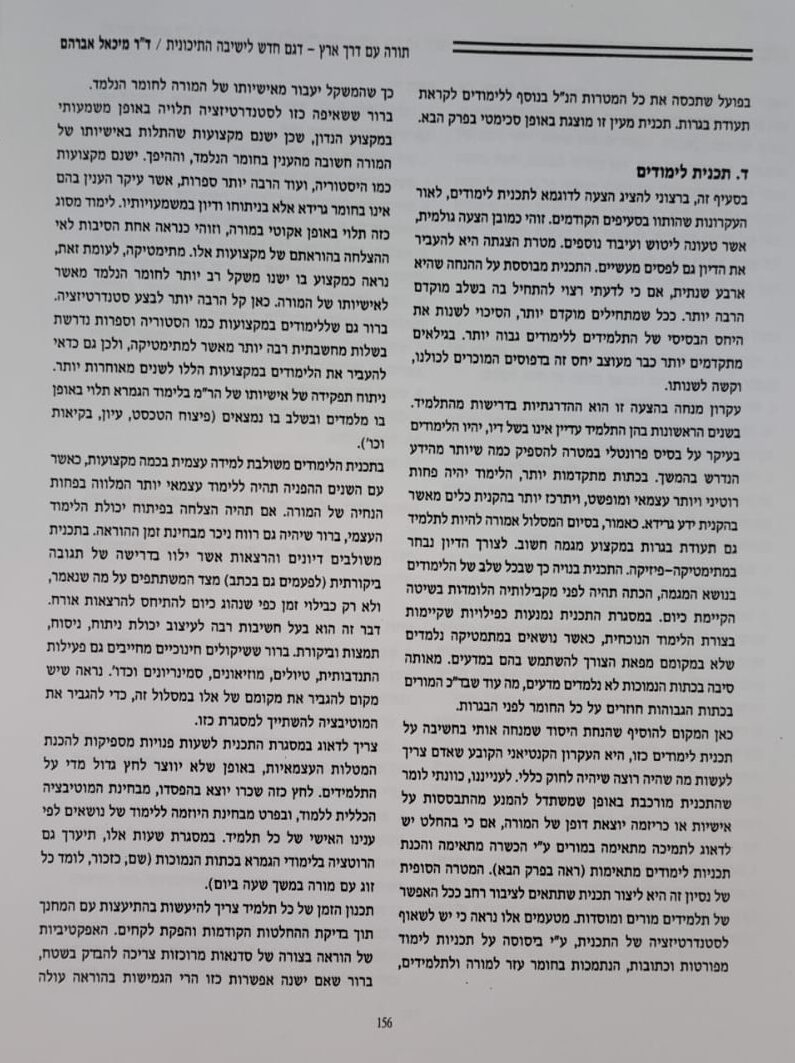
D. Curriculum
In this section, I would like to present a sample proposal for a curriculum in light of the principles outlined in the previous sections. This is, of course, a rough proposal that requires further polishing and development. The purpose of presenting it is to move the discussion onto practical tracks as well. The program is based on the assumption that it spans four years, although in my opinion it would be preferable to begin it at a much earlier stage. The earlier one begins, the greater the chance of changing the students’ basic attitude toward study. At more advanced ages, this attitude is already shaped in patterns familiar to us all, and it is difficult to change it.
A guiding principle in this proposal is gradualness in the demands placed on the student. In the first years, when the student is still not sufficiently mature, the studies will be mainly lecture-based, with the aim of covering as much as possible of the knowledge required later on. In more advanced grades, the study will be less routine and more independent and abstract, and will focus more on imparting tools than on imparting mere knowledge. As stated, at the end of the track the student is also supposed to have a matriculation certificate in an important specialization subject. For the purpose of the discussion, we will choose mathematics-physics. The program is built in such a way that at every stage of the studies in the specialization subject, the class will be ahead of its parallel classes that study according to the method current today. Within the program, duplications that exist in the current form of study are avoided, when topics in mathematics are taught out of place because of the need to use them in the sciences. For the same reason, in the lower grades the sciences are not studied, especially since the teachers in the upper grades usually go back over all the material before the matriculation examination.
Here it is appropriate to add that the basic assumption guiding me in thinking about such a curriculum is the Kantian principle that a person should do what he would want to become a universal law. For our purposes, I mean that the program is composed in a way that tries to avoid relying on an unusual personality or charisma on the part of the teacher, although appropriate support for teachers should certainly be provided through suitable training and the preparation of suitable curricula, as will be discussed in the next chapter. The ultimate aim of this experiment is to create a program that will suit as broad a public as possible of students, teachers, and institutions. For these reasons, it seems that one should strive for standardization of the program through detailed written curricula, supported by auxiliary material for the teacher and for the students,
so that the weight will shift from the teacher’s personality to the material being studied.
Clearly, such an aspiration to standardization depends significantly on the subject under discussion, since there are subjects in which dependence on the teacher’s personality is more important than the interest in the material being studied, and vice versa. There are subjects such as history, and even more so literature, in which the main point is not the material itself but its analysis and discussion of its meanings. Study of this kind depends acutely on the teacher, and this is probably one of the reasons for the lack of success in teaching such subjects. Mathematics, by contrast, appears to be a subject in which greater weight lies in the material being studied than in the teacher’s personality. Here it is much easier to carry out standardization. It is also clear that studies in subjects such as history and literature require much greater intellectual maturity than mathematics, and therefore it is also preferable to move the study of those subjects to later years.
Analysis of the role of the Talmud teacher’s personality in Gemara study depends on the way in which it is taught and on the stage at which one stands, whether text decoding, in-depth analysis, or broad coverage.
The curriculum integrates self-study in several subjects, and with the passing years the direction will be toward more independent study accompanied by less teacher guidance. If there is success in developing the ability for self-study, then clearly there will also be considerable gain in teaching time. The program includes discussions and lectures that will be accompanied by a demand for a critical response, sometimes also in writing, on the part of the participants to what was said, and not merely as a way of passing time, as guest lectures are commonly regarded today. This is of great importance for shaping the abilities of analysis, formulation, summarizing, and criticism. Clearly, educational considerations also require volunteer activity, trips, museums, seminars, and the like. It seems that there is room to increase their place in this track, in order to increase the motivation to belong to such a framework.
Within the framework of the program, care must be taken to provide enough free hours for preparing the independent assignments, so that excessive pressure is not created on the students. Such pressure is counterproductive in terms of the general motivation to study, and especially in terms of the initiative to study topics according to the personal interests of each student. Within these hours, the rotation in Gemara studies in the lower grades will also take place, where, as noted, each pair studies with a teacher for an hour a day.
The planning of each student’s time should be carried out in consultation with the homeroom teacher, while reviewing previous decisions and drawing conclusions. The effectiveness of teaching in the form of concentrated workshops must be tested in practice. Clearly, if such a possibility exists, flexibility in teaching increases by very significant factors.
157 Torah with Worldly Engagement – A New Model for the Yeshiva High School / Dr. Michael Abraham
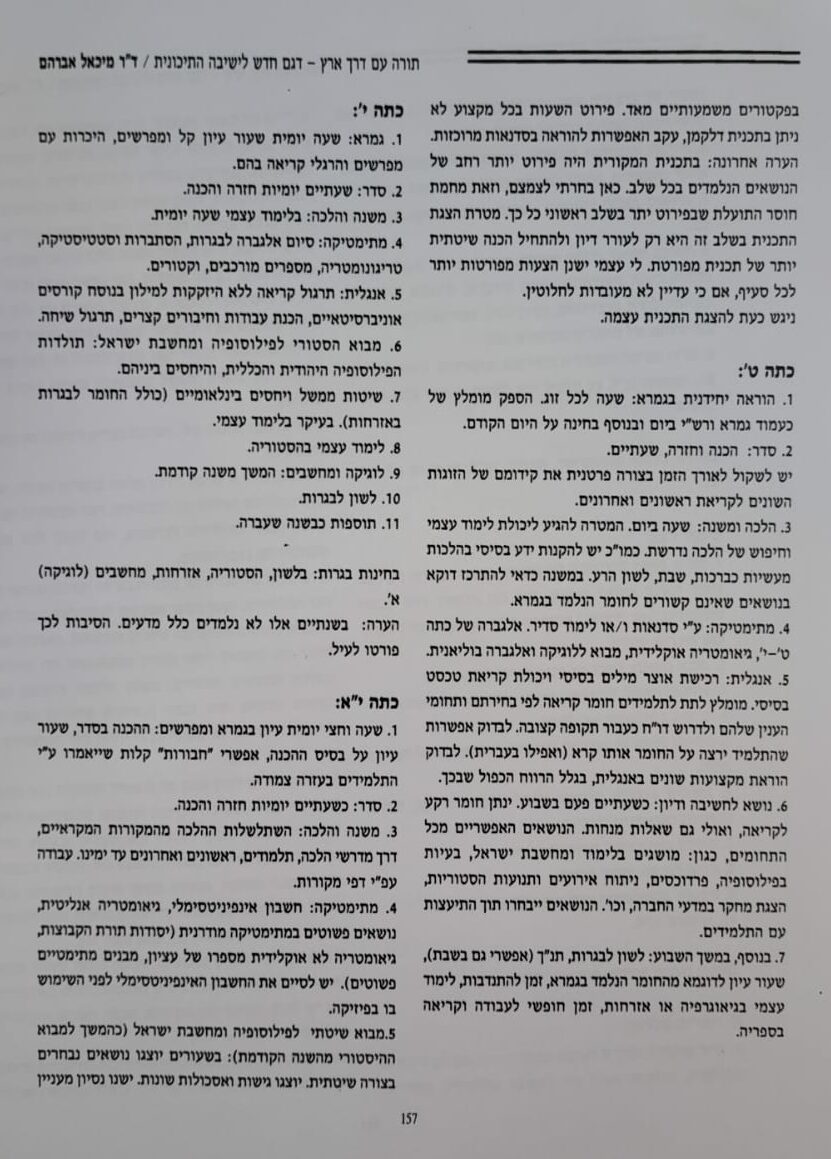
A breakdown of the hours in each subject is not given in the program below because of the possibility of teaching in concentrated workshops.
One final note: in the original program there was broader detail of the topics studied at each stage. Here I chose to reduce that, because of the lack of usefulness of over-detailing at so early a stage. The purpose of presenting the program at this stage is only to stimulate discussion and to begin a more systematic preparation of a detailed program. I myself have more detailed proposals for each section, although they are still not fully worked out.
I now turn to the presentation of the program itself.
Grade 9:
1. Individual instruction in Gemara: one hour for each pair. A recommended pace of about a page of Gemara and Rashi per day, plus an examination on the previous day.
2. Study period: preparation and review, two hours.
Over time, the advancement of the different pairs toward the early and later commentators should be considered individually.
3. Jewish law and Mishnah: one hour a day. The aim is to reach the ability for independent study and for locating the required legal ruling. Likewise, basic knowledge should be imparted in practical laws such as blessings, Sabbath, and harmful speech. In Mishnah it is preferable to focus specifically on topics not connected to the material studied in Gemara.
4. Mathematics: by means of workshops and/or regular study. Algebra of grades 9-10, Euclidean geometry, introduction to logic and Boolean algebra.
5. English: acquisition of a basic vocabulary and the ability to read a basic text. It is recommended to give students reading material according to their choice and areas of interest, and to require a report after a set period. The possibility should be examined that the student present the material he read, even in Hebrew. The possibility of teaching various subjects in English should also be examined, because of the double gain involved.
6. Topic for thought and discussion: about two hours once a week. Background material for reading will be given, and perhaps guiding questions as well. The possible topics may come from all fields, such as concepts in study and Jewish thought, problems in philosophy, paradoxes, analysis of historical events and movements, presentation of research in the social sciences, and so forth. The topics will be chosen in consultation with the students.
7. In addition, during the week: Hebrew language for the matriculation exam, Bible, possibly also on Sabbath, a sample in-depth lesson from the material studied in Gemara, time for volunteer work, self-study in geography or civics, and free time for work and reading in the library.
Grade 10:
1. Gemara: one daily hour of a light in-depth lesson and commentators, acquaintance with commentators and habits of reading them.
2. Study period: two daily hours of review and preparation.
3. Mishnah and Jewish law: one daily hour of self-study.
4. Mathematics: completion of algebra for matriculation, probability and statistics, trigonometry, complex numbers, and vectors.
5. English: practice in reading without recourse to a dictionary in the style of university courses, preparation of papers and short essays, and conversation practice.
6. Historical introduction to philosophy and Jewish thought: the history of Jewish and general philosophy, and the relations between them.
7. Systems of government and international relations, including the material for the matriculation exam in civics. Mainly through self-study.
8. Self-study in history.
9. Logic and computers: continuation from the previous year.
10. Hebrew language for the matriculation exam.
11. Additions as in the previous year.
Part A.
Note: During these two years, the sciences are not studied at all. The reasons for this were detailed above.
Grade 11:
1. One and a half daily hours of in-depth study in Gemara and commentators: the preparation is done in the study period, an in-depth lesson is given on the basis of the preparation, and short presentations may be delivered by the students with close assistance.
2. Study period: about two daily hours of review and preparation.
3. Mishnah and Jewish law: the development of Jewish law from the biblical sources, through legal midrashim, the Talmuds, early and later authorities, up to our own day. Work according to source sheets.
4. Mathematics: infinitesimal calculus, analytic geometry, elementary topics in modern mathematics, foundations of set theory, non-Euclidean geometry from Etzion’s book, and simple mathematical structures. The infinitesimal calculus should be completed before its use in physics.
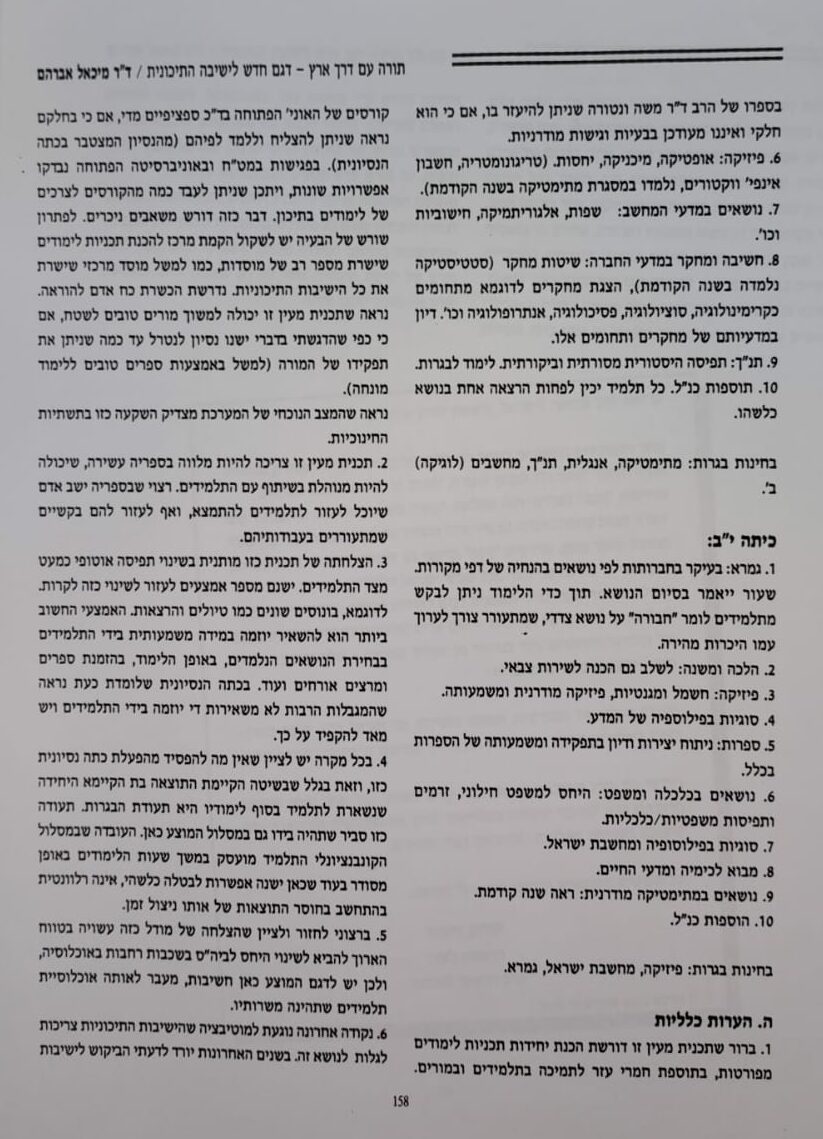
5. Systematic introduction to philosophy and Jewish thought, as a continuation of the historical introduction from the previous year: in the lessons, selected topics will be presented systematically. Different approaches and schools will be presented. There is an interesting attempt
158 Torah with Worldly Engagement – A New Model for the Yeshiva High School / Dr. Michael Abraham
in the book of Rabbi Dr. Moshe Ventura, which can be used for assistance, although it is partial and not up to date regarding modern problems and approaches.
6. Physics: optics, mechanics, and relativity. Trigonometry, calculus, and vectors were studied במסגרת mathematics in the previous year.
7. Topics in computer science: languages, algorithmics, computability, and so forth.
8. Thought and research in the social sciences: research methods, since statistics was studied in the previous year, presentation of sample studies from fields such as criminology, sociology, psychology, anthropology, and so forth. Discussion of the scientific status of these studies and fields.
9. Bible: traditional and critical historical perspectives. Study for the matriculation exam.
10. Additions as above. Every student will prepare at least one presentation on some topic.
Matriculation examinations: mathematics, English, Bible, computer science, logic. Part B.
Grade 12:
1. Gemara: mainly in partner study by topics, under the guidance of source sheets. A lesson will be delivered at the end of the topic. During the study, students may be asked to give a presentation on a side topic that arises when there is a need for quick acquaintance with it.
2. Jewish law and Mishnah: preparation for military service should also be integrated.
3. Physics: electricity and magnetism, modern physics, and its significance.
4. Issues in the philosophy of science.
5. Literature: analysis of works and of the role and significance of literature in general.
6. Topics in economics and law: the attitude toward secular law, legal and economic schools and conceptions.
7. Issues in philosophy and Jewish thought.
8. Introduction to chemistry and the life sciences.
9. Topics in modern mathematics: see previous year.
10. Additions as above.
Matriculation examinations: physics, Jewish thought, Gemara.
E. General Remarks
1. It is clear that a program of this kind requires the preparation of detailed curriculum units, together with auxiliary materials to support students and teachers.
Courses of the Open University are generally too specific, although in some cases it appears that it is possible to teach successfully on their basis, according to the accumulated experience in the experimental class. In meetings at the Center for Educational Technology and at the Open University, various possibilities were examined, and it may be possible to adapt some of the courses to the needs of high-school study. Such a thing requires considerable resources. For a root solution of the problem, one should consider establishing a center for preparing curricula that will serve a large number of institutions, for example a central institution that will serve all the yeshiva high schools. Training of teaching personnel is required. It seems that a program of this kind can attract good teachers to the field, although, as I emphasized in my remarks, there is an attempt to neutralize as much as possible the role of the teacher, for example by means of good books for guided study.
It seems that the current state of the system justifies such an investment in educational infrastructure.
2. A program of this kind should be accompanied by a rich library, which can be managed in cooperation with the students. It is desirable that someone sit in the library who can help the students find their way, and even help them with difficulties that arise in their work.
3. The success of such a program is contingent on an almost utopian change of outlook on the part of the students. There are several means to help bring about such a change. For example, various bonuses such as trips and lectures. The most important means is to leave a significant measure of initiative in the hands of the students in the choice of the subjects studied, the manner of study, the ordering of books and guest lecturers, and more. In the experimental class that is now studying, it appears that the many limitations do not leave enough initiative in the hands of the students, and this point must be guarded very carefully.
4. In any case, it should be noted that there is nothing to lose from operating such an experimental class, because in the existing method the only lasting result left to the student at the end of his studies is the matriculation certificate. He will likely have such a certificate in the track proposed here as well. The fact that in the conventional track the student is occupied in an orderly way during school hours, whereas here there is some possibility of idleness, is not relevant in light of the lack of results from that use of time.
5. I would like to repeat that the success of such a model may, in the long run, bring about a change in the attitude toward the school among broad strata of the population, and therefore the model proposed here has importance beyond the population of students who will be its direct beneficiaries.
6. One final point concerns the motivation that yeshiva high schools ought to show toward this subject. In recent years, in my view, the demand for yeshiva high schools
159 Torah with Worldly Engagement – A New Model for the Yeshiva High School / Dr. Michael Abraham
especially boarding-school ones, has been declining, and is expected to decline further. This stems in part from the fact that city schools have offerings such as enrichment programs, academic studies within the framework of the school, and more, things that the yeshiva high school has difficulty offering because of lack of time. In almost every good yeshiva high school, a hopeless competition is being conducted against the spirit of the times. In the recent past it was the issue of the various specialization tracks, which today are perceived as self-evident, and today proposals concerning academic studies in school are arising. If the struggle against the city schools continues, the yeshiva high schools will lose it because of their a priori inferior status in these areas. In the proposal presented in this article there is an opening for taking
the initiative into our own hands by opening an alternative direction, as against directions aimed at career. Adopting such a program means moving the struggle from the home field of the ordinary religious high school, where defeat is almost certain, to a new field that presents an independent alternative.
The yeshiva high school must begin to offer paths of its own, instead of trying to prove that it is no less good than the regular schools in programs designed according to their measure. It seems that the time has come for a new model of yeshiva high school that not only suits the spirit of the age but even tries to shape it.
The Appeal of the Chief Rabbi of Israel, the Rishon LeTzion, may he live and be well
One of the most important tasks incumbent upon us is to establish and sustain institutions of Torah and education for youth in order to bring them close to Torah, to plant faith within them, and to educate them to the commandments. Midrashiyat ‘Noam’ in Pardes Hanna fulfills an important role in this mission, and during the sixteen years of its existence it has served as a great and blessed instrument in receiving youth who are given faithful education within the walls of the institution. Midrashiyat ‘Noam’ has also made an important contribution to the ingathering of the exiles, for young people from all the tribes of Israel are found within it, studying together. The administration of the institution constantly makes many efforts to expand the boundaries of the institution in order to prepare it for the reception of greater numbers of young people, and we have recently witnessed how great is the importance of institutions that receive youth, especially from the latest wave of immigration, but naturally this requires increased financial means.
Its devoted and diligent general director, Mr. Israel Sadan, will travel abroad on behalf of the institution in order to interest our generous brethren and join them to the commandment of building it.
Knowing the great importance of the institution, I hereby call upon our brethren everywhere to give generously, so that he may succeed in his mission to strengthen the Midrashiyah and expand it, in order that it may fulfill its mission completely and be blessed with praiseworthy fruit.
And all who act and inspire others to act shall be blessed with every good thing.
Yitzhak Nissim, the Rishon LeTzion, Chief Rabbi of Israel
* Published in ‘Niv HaMidrashiyah,’ 1962