

On Translating Moral Ideas into Ontic Terms (Column 168)
From ash and demons to seeing the person as an individual or as part of a whole
The column opens with Rav Kook’s passage in Ein Ayah on the Talmudic procedure for detecting demons: ash symbolizes separation, because it is “not kneadable” and remains a collection of grains, so it exposes the impulsive and destructive forces. Dust or earth, which coheres into one lump, symbolizes connection and positivity. On that symbolic basis Rav Kook argues that egoism grows out of an individualistic self-conception, whereas altruism grows out of seeing the person as an organ within a wider collective.
“No particulars in the intellect and no universals in the senses”: from Maimonides through Russell
The column explains that the intellect always works through universals: describing an object is done in terms of general properties, and explanation—especially scientific explanation—rests on a general law from which the particular case is derived. Sense perception, by contrast, encounters only this person, this table, or this event. Hence “there are no particulars in the intellect and no universals in the senses.” To sharpen the point, the column draws on Russell: a description such as “the first prime minister of the State of Israel” points by means of a combination of meaningful general features, whereas a proper name such as “David Ben-Gurion” merely points to the individual without describing him.
From the epistemic distinction to the dispute between rationalism and empiricism
From here the column shows how Rav Kook moves to the metaphysical plane: the collective, like theoretical entities in science, is not grasped by the senses but only by the intellect. A rationalist is therefore willing to treat it as something real, whereas a radical empiricist will see it at most as a useful fiction. According to Rav Kook, this is also the moral difference: the intellect “forces” us to see human beings as organs of humanity, while sticking to the senses yields isolated individuals.
The case of targeted killings: sometimes a moral dispute really does reduce to an ontic question
The column cites an earlier essay to show that this kind of reduction is sometimes plausible. On targeted killings, right and left may agree on the norms—one may not harm an uninvolved person, and one may harm a pursuer—while disagreeing only about the ontic status of the uninvolved Palestinian: is he a third party, or part of a pursuing collective? In such a case, the moral dispute does rest on a metaphysical picture of the world.
But you cannot turn all morality into a matter of metaphysics
At this point the column sharply parts company with Rav Kook. It stresses that this is not a contrast between the wise and the foolish but between two worldviews, and it even grants that an empirical objection is not enough: the fact that some empiricists and metaphysical individualists behave morally could be explained by saying that they are simply inconsistent or “covert collectivists.” But that is exactly why the real objection is principled. If every bad act stems only from mistaken metaphysics, the wicked person ceases to be wicked and becomes merely mistaken. And if every good act is ultimately just concern for a wider “self,” then the righteous person too ceases to be righteous and becomes a collective egoist, like an ant or a bee acting for the swarm. The second problem is even sharper than the first.
The naturalistic fallacy and the denial of altruism
The column’s conclusion is that this move commits the naturalistic fallacy: it tries to derive normative categories from facts about the structure of reality, even though morality requires a value principle beyond the facts. More than that, it also pulls the ground out from under the possibility of genuinely moral action. Here the column recalls its earlier claim that a moral act is an act done for a chosen value-laden end, not an act forced by a motive or an interest. If every instance of altruism is explained as the interest of an expanded self, then no room remains for an act done truly for the sake of another person.
With God’s help
Dedicated to the commenter with the nickname Y.D., in his comment here
On one of the recent Sabbaths we studied in class the passage in Ein Ayah by Rabbi Kook that deals with the algorithm for detecting demons in Berakhot 6a in the Talmud. The Talmud says there that in order to see the traces of their footsteps one should scatter ash before the threshold of the door and inspect in the morning. And on this Rabbi Kook writes in section 46:
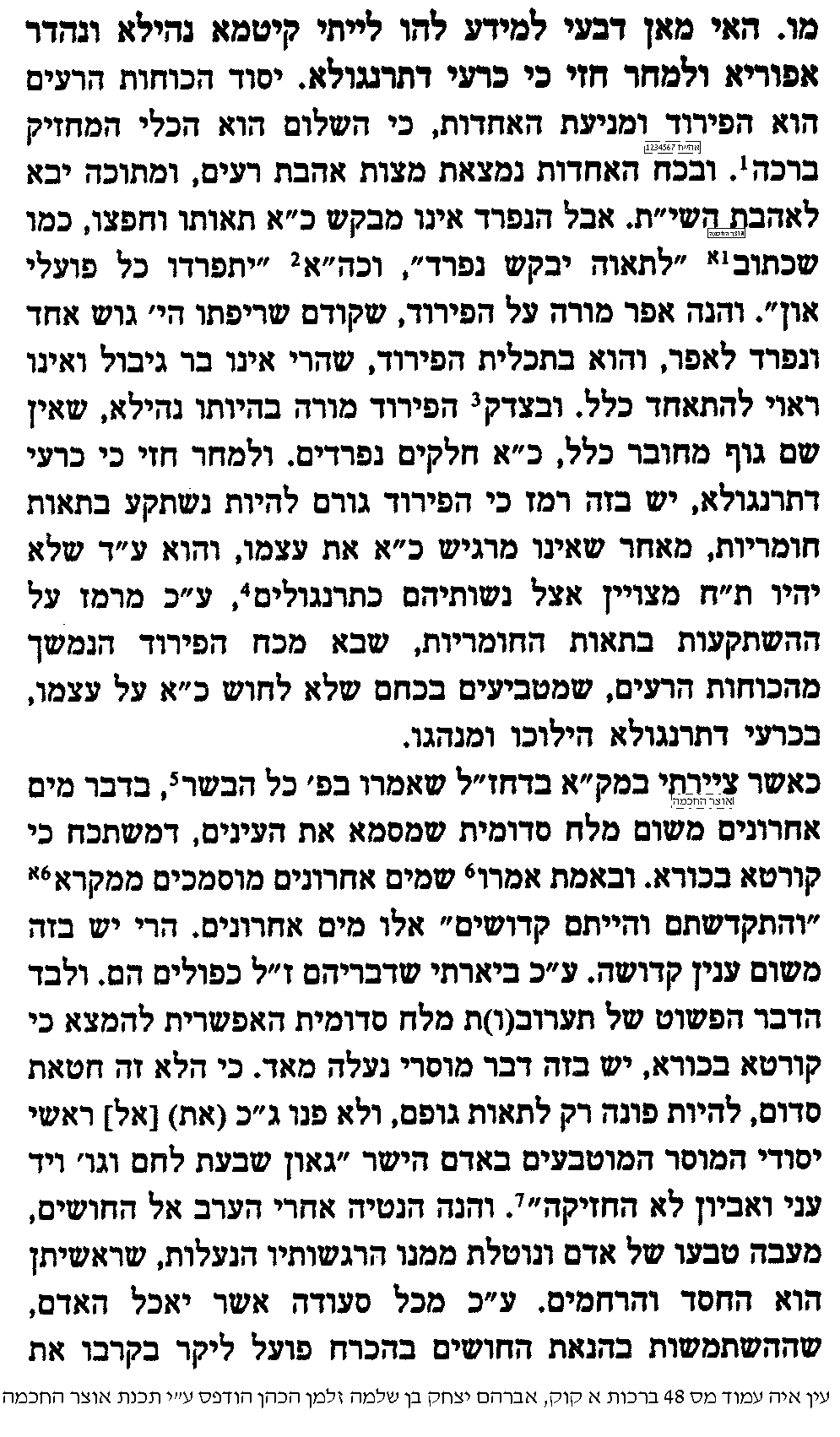 |
 |
One of his claims here is that altruistic behavior is rooted in seeing oneself as an organ within a broader collective, whereas egoistic behavior is rooted in an individualistic self-conception. He also cites the Guide of the Perplexed , which argues that "there is no particular in the intellect and no universal in sense perception" ("there is no particular in the intellect and no universal in sense perception"). Someone who follows the senses sees every object as an isolated entity, that is, through an individualistic perspective. Intellectual contemplation, on the other hand, enables one to grasp collections of objects as a collective entity. Therefore, in order to discern the demons and harmful forces that cause impulsive behavior, one uses ash, which symbolizes separation. Ash does not cohere (that is, if you soak it in water, no lump of mud is formed, only a collection of wet granules). Earth, by contrast, which is the fertile and positive element, is an intellectual element, since it does cohere (soaking it in water turns it into a lump of mud).
"There is no particular in the intellect and no universal in sense perception"
Rabbi Kook relies here on a statement by Maimonides in the Guide of the Perplexed. Maimonides there draws a very important and very profound distinction between the intellect and the senses. Intellectual treatment of concepts or ideas is always in general terms. When we describe an object or a concept, we always do so in terms of its properties. But a property is always a general concept. When we say that the table is long, low, has four legs, brown, useful, and the like, we have characterized it in terms of general concepts that concern groups of objects: the group of brown things, of long things, of things with four legs, and so on. The table belongs to each of these groups. A full description of the object will include enough group-characteristics such that their intersection yields only one object (otherwise the description does not uniquely identify the object before us). The same is true when we explain some phenomenon: the explanation is always given in terms of general principles. According to Carl Hempel, a scientific explanation of a phenomenon is always deductive-nomological in character, that is, one explains a phenomenon by means of a general law (= nomos), from which the phenomenon can be deduced as a particular case. For example, this body fell to the ground because of the gravitational force that exists between any two bodies with mass. If one adopts this general law, the specific phenomenon under discussion can be derived from it as a particular case. If the explanation is not given in terms of general principles, it is not an explanation.
By contrast, observation of an object or even of an idea (or an idea presented before our consciousness) is always individual. I see Reuven, Shimon, the specific table before me, or one specific event or another. The senses apprehend concrete reality, and only the intellect ties it to general ideas or to the characteristics of groups of specific particulars.
In the second section of my book Two Carts I explained that this distinction is related to Bertrand Russell’s well-known analytic distinction between two modes of referring to objects: by description and by name. Referring to an object by description means giving a collection of features that can identify it sharply and clearly. Each of those features links our object to an entire group of objects (that resemble it with respect to that particular feature). Referring by name, on the other hand, points to the specific object without any connection to other objects. Therefore a person’s or object’s name has no meaning. It does not describe; it points. An arbitrary name is attached to an object or person so that we can point to it in a particular and individual way.
From this it follows that, unlike a name, a description has meaning. When I say "the first prime minister of the State of Israel," I have referred to David Ben-Gurion by means of a uniquely identifying description (there is no other person who fits that description). Each detail in this description is a property or predicate, and as such it does not single out one object but a group of such objects. Head — that is a term for the heads of various groups or bodies. And the same is true of the concepts government and state. (By contrast, the State of Israel is already a name and not a description. In fact, it is more accurate to say that it is a nominal description: the state whose name is Israel.) If I had used only some of those properties — that is, if I had described him as a prime minister, or even as a prime minister of the State of Israel — I would have described him correctly, but not uniquely (there are other figures who fit those descriptions). But the totality of the features creates a uniquely identifying description. Each of those features has its own meaning, and the combination of the meanings (the intersection of the groups) uniquely identifies the object we have described.
This is one form of reference. But one can refer to that very same person in another way, simply by saying his name: David Ben-Gurion. Reference by name does not concern the descriptions and predicates that apply to him jointly with other objects. A name is a specific reference to the individual himself, isolated from those who resemble him.[1]
This is what Maimonides means when he says that there is no particular in the intellect and no universal in sense perception. The sense sees the specific person or object, and the linguistic reference to what is perceived by sense is the name. This is "there is no universal in sense perception." By contrast, the intellect sees the person, object, or event in a more general context, and classifies it through general characteristics. Therefore, "there is no particular in the intellect."
The Meaning of This
Rabbi Kook’s claim is that the morality of our behavior is rooted in the use of the intellect as opposed to the use of the senses. We have seen that a simple use of the senses sees separate human beings and relates to them as individuals. That is the picture in its plain sense, as the senses see it. By contrast, as we saw above, the use of the intellect enables us to see them as organs within a collective organism (the human being is an organ within the collective called humanity), and in fact compels us to see them that way.
From another angle, I would put it this way. The collective is an entity that cannot be grasped by the senses, and therefore radical empiricists deny its existence. At most, they see it as a useful fiction. What collectivists and Rabbi Kook call the use of the intellect is regarded by empiricists as nothing but the operation of imagination. This is essentially a dispute between radical empiricism and rationalism. The rationalist is willing to see the conclusions of his intellect as claims about the world, whereas the empiricist sees them as subjective imaginings. In his view, only sensory observation is a basis for claims about the world.
For this reason, radical empiricists see the general laws of science as claims about us rather than about the world, since no one has ever seen gravitational force, frustration, or an electromagnetic field. We see concrete phenomena that are derived from these theoretical entities (for after all, there is no universal in sense perception), and from them infer their existence (because there is no particular in the intellect). The rationalist thinks they do in fact exist, because in his view the intellect that reached these conclusions is a tool for knowing the world, whereas the empiricist claims that this is only our subjective processing of sense data, and not a claim about the world itself. This is again an expression of the Maimonidean principle that there is no particular in the intellect and no universal in the senses. The empiricist, who privileges the senses, sees individuals, whereas the rationalist tends toward a collective perspective, because he sees the individual as an organ within a collective, that is, within a broader group (which shares his characteristics, or at least some of them).
Targeted Killings
In column 5 I used a similar argument to explain why there are disputes between people on the right and people on the left over questions that seemingly are unrelated to policy and politics, such as the question of targeted killings, which is a moral-security question. I explained there that underlying these moral positions is an ontic conception: the Right sees the Israeli-Palestinian conflict as collectives fighting one another, and is therefore prepared in certain cases to accept harm to individual persons who are not guilty (uninvolved parties) in order to win the war (I explained there that, given its ontic conception, the legal category of a pursuer applies to them). The Left sees the world through "empiricist" lenses, and therefore from its perspective this is harm to an uninvolved party, which is of course morally forbidden (for on its ontic view this is saving oneself at the cost of another’s life, which is of course forbidden).
This was an example of translating a moral claim into an ontic claim: what at first appears to be a moral dispute turns out to be a dispute over a metaphysical worldview. Everyone agrees that one must not harm an uninvolved party, and everyone agrees that there is justification for harming a pursuer. The question under dispute is the status of the individual uninvolved Palestinian: is he indeed a third party, uninvolved, or is he a pursuer? But that is no longer a moral dispute, but an ontic-metaphysical one.
Back to Our Topic
At first glance, Rabbi Kook in the words cited here broadens the scope and grounds all morality in an ontic-metaphysical picture. For him, someone who performs an altruistic act for the sake of another is in fact proceeding from a collectivist-intellectual worldview. And someone who does not behave this way is simply not an intellectual person but a sensuous one — or, in my terms here, an empiricist rather than a rationalist.
It is important to understand that these are not synonymous distinctions. The distinction between a sensuous person and an intellectual person sounds like the distinction between a fool and a wise person. But the second distinction is between two worldviews held by intelligent people. The question is whether you cling to the senses or are prepared to accept the intellect as an instrument for knowing the world. That is a question of philosophy and worldview, not of wisdom or stupidity. It seems to me that Rabbi Kook mainly intends the second distinction.
The Problem with Rabbi Kook’s Approach
As stated, this is apparently only an expansion of my remarks about targeted killings. If I suggested there that an ontic dispute lies at the basis of the moral dispute, Rabbi Kook argues that this is so regarding morality in general. Every moral action is driven by a collectivist ontic conception. But with this expansion I do not agree at all, and I would even say that it is highly objectionable.
One could attack his remarks empirically, and say that there are many people who espouse metaphysical individualism and empiricism yet behave morally. The link between metaphysical individualism and morality does not withstand the test of the facts. But that is not necessarily an objection to him. It may be that those people are really covert collectivists. They themselves are not aware that they do in fact believe in collectivism.
I make a similar claim in the fourth notebook regarding morality. I explained there that a consistent moral outlook is impossible for materialist atheists, but factually it is clear that quite a few people who espouse such views do behave morally. I explained there that, in my opinion, they are simply inconsistent. They are covert believers; that is, even they themselves are not aware of their belief in God, but their actions reflect such a belief (or simply inconsistency).
Two Problems
In my opinion there are two serious problems in Rabbi Kook’s analysis, both in his conception of wickedness and in his conception of righteousness:
- On his view, the wicked person is not wicked at all but merely mistaken. He holds an incorrect worldview or metaphysics, but what does that have to do with wickedness? He simply acts in accordance with his metaphysical view (albeit a mistaken one). Why should a person who holds an incorrect metaphysics be considered wicked? This is exactly like the dispute over targeted killings, regarding which my own remarks really imply that we are dealing not with a righteous person and a wicked person, but with two different metaphysical conceptions held by righteous people. It is a moral dispute, not a dispute between righteous and wicked people. The problem is that for Rabbi Kook this applies to every moral dispute, and therefore on his view it turns out that there are no wicked or righteous people in the world at all. There are only those who are mistaken and those who are correct in their metaphysical conception.
- On his view, the righteous person is not righteous either. For on his view the righteous person is an egoist exactly like the wicked person; the difference between them lies only in the question of which entity your egoism is directed toward. If you see yourself as an organ within a collective, then your egoism is directed toward the good of the collective, just like an ant or a bee in a colony. And if you are an individualist, then your egoism is naturally directed only toward yourself. Once again we find that the righteous person and the wicked person are both egoists, and the difference between them lies only in the metaphysical picture they hold. It is implausible that this is what defines righteousness or wickedness.
These two problems in Rabbi Kook’s picture can be summed up by saying that he falls into the naturalistic fallacy. He grounds the moral norm in facts. But morality is a category different from the factual category. Beyond the facts there is always a normative principle that defines us as righteous or wicked. The facts themselves cannot by themselves be responsible for those definitions.
And yet, one must understand that the two problems I have presented here are not symmetrical. In the first problem, he seems mistakenly to focus on facts instead of ethics, that is, he falls into the naturalistic fallacy. That problem exists with respect to righteous and wicked alike. But from the second problem something more extreme emerges, which concerns mainly the righteous: not only is it impossible to characterize the two types morally, but it also seems from here that both are in fact wicked. After all, both act in a clearly egoistic manner, and the difference between them lies only in the question of who the "I" is whose welfare the egoist seeks.
In Rabbi Kook’s remarks here there is both a naturalistic fallacy and a pessimistic view (as though all people are egoists, that is, as though there are no righteous people in Sodom). In the next section I will sharpen further the meaning of the second difficulty.
Altruistic Acts
In column 120 I addressed the question of whether there are altruistic acts. I argued there that anyone who accepts the existence of a moral category must assume that a person can sometimes act without a motive. A moral act is done for the sake of an end and not out of a cause. An action done out of a cause is not moral, because the person did not decide to perform it. An action for the sake of an end is one that a person decides upon in striving for the end that appears proper in his eyes (that fits his values).
The second difficulty I raised above in effect denies the existence of altruistic acts. We are all presented there as egoists who act out of self-interest and self-concern. So not only is there a confusion here between facts and values and norms, but there is also a general pulling of the ground out from under the very possibility of moral action, which by its essence is supposed to be altruistic — that is, done for the sake of the other and not for my own sake (or for some interest of my own).
See in this regard Y.D.’s remarks in his comment here on my article that dealt with the full and empty cart of liberalism, and also my response immediately afterward. This article is an expansion of my answer there.
[1] Of course there are people with a similar or identical name (in Talmudic terminology: "two Joseph sons of Simon in one city" ("two Joseph sons of Simon in one city")), but then as far as I am concerned the name has to include more of the lineage (Joseph son of Simon son of Israel son of David) until a uniquely identifying description is obtained. A name, by its essence, is particular reference.
Discussion
Can one not make the following argument:
Human beings, as social creatures, feel good (= a secretion of dopamine or some hormone) when they do good to others. That is a fact that can be explained by evolutionary psychology.
In addition, as emerges from game theory, in repeated games there is an advantage to behavior that benefits others, since (empirically) the other person will return the favor.
That is, there are selfish mechanisms that concretely exist (and can also be mapped and measured) that lead people to behavior that benefits others (= moral behavior).
You can also see from the use of the word “good” that people perceive “good” not only as moral, but also as pleasurable or efficient (good ice cream, a good drill, a good movie). That is, “good” is naturally perceived as something selfish. The only times we reject selfishness are when it creates disproportionate harm to another’s pleasure/joy.
People are sometimes tempted to do something that harms another for the sake of immediate gain, but they know (at least subconsciously) that by acting this way, in the long run, they are making the world a less good place. They try to ignore this knowledge, but it bothers them (= guilt).
Of course, one may choose not to rely on rational considerations, or to wait for slow moral development based on learning and selection mechanisms, and instead add mythological entities that punish sins, and that is what was done in all ancient cultures.
But that too has costs, especially nowadays, when there are already more effective mechanisms.
In short, rational explanations for morality exist in abundance. In particular, with the flourishing of evolutionary psychology, which provides explanations of development over time without any need for spiritual entities that people supposedly sense with a “sixth sense.” Altruistic behaviors have been observed among monkeys and other animals. (And also among gentiles.) We are not talking there about an ontological perception of morality, right?
Likewise, behavior without causality is a claim about reality in the human brain that may turn out to be completely refuted as our understanding of brain mechanics advances. But even now this claim seems patently unreasonable.
And thank you, and more power to you, for the effort to communicate with us, the anonymous commenters!
Roni, so where does the “evil root in one’s character” come from? Are people born that way? If so, there is no justice. Does it come from a choice to have bad character traits? If so, what causes the bad choice? A mistake (blindness)? Then we are back to the original difficulty…
I understood you as saying the following:
A rationalist sees universal concepts as objective entities, whereas an empiricist sees them as imaginary creations of the mind and not objective.
This is understandable with universals like laws of nature such as gravity, which the rationalist sees as something that exists outside the mind.
But a universal like the concept of a “people” is a concept that depends on definition. If the definition is that all individuals with such-and-such characteristics (racial and cultural, etc.) belong to one people, then the empiricist too will agree that there is an objective people, because there is a group of people that meets the definition. In what more objective sense does the rationalist recognize a people?
What is there in a people, even according to the rationalist, beyond a group of individuals with such-and-such characteristics?
The overwhelming majority (if not all) of the wicked think that their actions are fine, so I do not understand the first argument against Rav Kook. Hitler had a moral view according to which the Jews had to be gotten rid of. He was wrong about that, and for that we condemn him.
I also do not see in Rav Kook’s words some ontological fact that one must know, but only a way of relating to reality.
Chazon Ish, Moed 56:4, s.v. “u-mi-makom” (it is accepted that the Chazon Ish wrote this to reject refraining from milking by means of a non-Jew)
“And it is the way of the Torah to maintain peace with every person and to forgo strictness… and just as it is not fitting for a wise man to become angry and take revenge on one who harms him out of sickness of spirit, so too it is not fitting to take revenge upon and hate one who does harm out of the sickness of the intellectual soul and the lack of balance in character traits; and there is essentially no difference at all between a base man and one deranged in mind. And all punishments exist only because the wisdom of the wise is very limited and insufficient to give prudence to the simple, and there is a necessity to use punishments to uphold the fences of the world so that the world not be prey to the teeth of the physically strong and the weak-minded. But punishment must be carried out in sorrow, clean of any feeling of envy toward others. And since man is not complete in ultimate perfection and is agitated by the evil inclination, he will not refrain from being compassionate and from becoming lax at the time of the commandment to execute justice, and so he is permitted to use also the stirring of a vengeful nature under the supervision of the mind, for its stirring here is only to spur the execution of justice, and this is ‘with all your heart’—with both your inclinations.”
This is an old argument of mine with the Rabbi. There is no problem at all with Rav Kook. And unfortunately I am compelled once again to say (really, to declare this—and indeed, as the Rabbi says, one cannot argue with declarations, but nevertheless perhaps the Rabbi can take it into consideration that maybe, maybe there is justice in my words) this. It is hard to justify, because this is a matter of contemplating reality, but indeed there is no such thing as pure righteousness in reality. There is no righteousness without wisdom, and wickedness always stems from stupidity. Indeed, it is impossible to persuade a person who does not believe in the existence of morality that it exists, but he will still be wicked (this is an observation. Or perhaps we should say a fool, which is worse than wicked. That is, a fool is like an animal, while a wicked person is someone who can still repent), and only reward and punishment can bring him out of his wickedness. And if they do not exist because of lack of providence, then morality is empty. That is, righteousness and morality in that case are mere self-righteousness and moralizing (mere posturing). That is, they are evil. There truly is no morality without fear of God (a mechanism of reward and punishment; crime must not pay). It is like a magnetic monopole, which exists in theoretical reality but not in actual reality (one could say there is proof of its nonexistence from the very confirmation of all four Maxwell equations together by means of electromagnetic waves. If Gauss’s law were not correct, then either there would be no such waves, or their form would be different from what we observe). The Rabbi does not see this and, please forgive me greatly—simply suffers from a lack of self-awareness.
Indeed, Amichai is right. You are only pushing the problem one step back.
Amichai, one can argue anything.
What you call rational explanations for morality are perhaps rational explanations, but certainly not explanations of morality (rather, of good behavior). In other words, you are claiming that there is no morality, only a form of behavior that is ingrained in us.
If you think there is no morality in the world, only interests, then of course you will not agree with my remarks. I am speaking to one who thinks (as I do) that morality exists. See the fourth notebook, vol. 3 (and also the introduction to the notebook on the meaning of “theological” versus “philosophical” arguments).
I do not think a people is a matter of definition. Just as a body is not a collection of atoms but an organic entity, so too a collection of people can be integrated into a people. There is nothing particular there beyond the collection of people, but the whole is not merely a collection of particulars (just as a body is not a collection of atoms or even of cells).
It may be that you have a source of information that I do not, but I am really not sure that most people in the world think that what they are doing is the right thing. Has it never happened to you that you acted in a way you thought was wrong because of an impulse or an interest? That itself is what one repents for. Of course one can raise the problem of weakness of will, but this is not the place for it.
If Hitler truly and sincerely thought that it was proper to kill the Jews, and it was not that his impulse drove him to develop a theory that repeatedly justifies that impulse, then I really do not condemn him; I merely defend myself against him. One should not condemn people for mistakes. If they are harmful, then of course one must defend oneself against them. Condemnation is for a person who knows what is good and does not act accordingly.
I did not understand your last remark. Rav Kook describes two ways of relating to reality that determine moral conduct. It is against this identification that I objected. In my opinion, moral or immoral conduct is not assessed in terms of an epistemic/ontic error. Only if that very error is itself the action of the impulse that comes to justify itself (as above).
I did not understand the relevance of the argument to our issue.
Indeed, one cannot argue with declarations.
One does not always need to argue. Sometimes one can try to understand the other side on the assumption that it understood everything the Rabbi wrote and nevertheless disagrees with him. Rav Kook is deep, and presumably this issue of morality without God was before him, and in his teaching there is, implicitly, a response to the claims the Rabbi raised, even though Rav Kook presumably was never aware of the Rabbi’s explicit formulation of them (which, as far as I know—which does not say much—was never stated by anyone else. Leibowitz spoke about this, but he was not a moral person as intuition shows; he had, so it seems to me, an almost Nazi German mentality—one could smell misanthropy from him. Though in this I actually identify with him a bit). I could expand on this discussion, but I would argue that Rav Kook is not speaking about egoism but about what might be called “supra-egoism” (which is also supra-altruism at once). This is a state in which interest and value become one. It is an ontic phenomenon in which norm is united with fact. That is, the moment a person concerns himself with the collective out of wisdom, in practice he will be altruistic in his whole being. Just not in declaration. In practice, I observe that all the people who talk about ethics and morality are clearly not good people, whereas the people who really were good people (like Rav Kook himself, and it seems to me no one disputes that) always make claims in Rav Kook’s style. The Rabbi will say that this does not matter and that the discussion is pure. But I think that in practice he too would not dismiss these things without addressing them. Maybe I need to meet with the Rabbi again privately and elaborate on this.
The empiricist too will admit that a collection of cells that builds a body with a new function is not just a collection of cells; it is both a collection of cells and a new unit. Even complex concepts like the human body are open to experience.
But the concept of a people is something that cannot be experienced, only defined.
I agree that perhaps one can say that the concept of a people is similar to mathematical concepts, which have objective “existence” even without our mind, but the empiricist too admits the existence of mathematical concepts.
I did not understand the question.
The evil root in one’s character stems from the power of choice that every person has. Rav Kook did not deny free will.
Thank you very much indeed.
Even if I do not act for the benefit of the collective entity as a motive for action, as Rav Kook argues, some connection between me and others is still required—whether national toward members of my people, humanistic toward the whole human race, or simply empathy toward animal suffering. Otherwise I will not notice their suffering. From Rav Kook one can arrive at a kind of bear hug, as Rav Shagar describes it in Broken Vessels. On the other hand, absolute individualism can become lacking in empathy. There needs to be some kind of back-and-forth between the positions.
As is known, the human soul is one (Rambam, beginning of the Eight Chapters), and among the functions of the soul are the senses, the intellect, and the faculty of will.
A person who chooses (the faculty of will) to conduct himself only through the senses suffers from two deficiencies. 1. He will do only what is pleasant to his senses. 2. He is incapable of grasping the possibility that he should act for another / not harm him, because what has he to do with another? (That is, there is no way to grasp moral norms by means of the senses, nor even concepts such as a common denominator with the rest of humanity.)
Only if he chooses to use his intellect will he be able to understand that there are goals that are not pleasures and that there are norms governing conduct with other human beings, since they have something in common.
The choice not to use the intellect, but only the senses, is itself the sin.
What I meant, of course, was to interpret Rambam’s argument that “the human soul is one,” for at first glance what meaning is there in claiming that the soul is one? Surely his intention is that the totality of the soul’s functions are not separate things, for otherwise a person could exempt himself from judgment by saying that it was not the intellect that sinned but his senses (the soul and the body could exempt themselves from judgment / for now I am not Aristotle).
The totality of the functions is one unit called the soul, and the person/soul must decide in his actions and conduct when to use the intellect, when the senses, and when emotion, etc., etc.
You are again repeating the same thing, and I will again repeat what I wrote: the relation between a people and its individuals is like the relation between a body and its components, or even an atom and its particles.
True. But one should be careful not to take things too far. An empiricist does not really operate only with the senses.
I am repeating myself because I do not understand your position.
I believe I am not the only one for whom this point is difficult to understand. Are there places where you expanded on this point more, in response to lack of understanding like mine?
With God’s help, 25 Elul 5778
I do not see in the Rav’s words here a statement that morality depends on seeing everything as one collective. The intellect, freed from sensory pleasure, sees two conceptions that are valid as a “categorical imperative” for all individuals.
The first conception is that every individual has a right to exist in a fitting way, and what I want for myself—I must allow for my fellow as well. This general conception obligates “justice and integrity” toward every individual.
The second conception claims more than that: every individual is a vital limb in the organism of all existence, and therefore I am obligated to him not only in the fairness of justice and integrity, but also in love, because we are brother-individuals.
The basic intellectual conception leads to justice, to the basic morality of “What is hateful to you, do not do to your fellow,” while the deeper intellectual conception leads to a love of soul among all individuals, to “Love your fellow as yourself” as required by “I am the Lord” who loves all His works. And this is a level above and beyond basic morality.
Even after we have arrived at the conception of brotherhood, we must not give up basic fairness. Brotherhood brings a readiness to say “What is mine is yours,” whereas justice requires saying “What is yours is yours.” The loving brother gives to his brother without limit, but does not permit himself to demand of his brother that he give up what is his for his sake.
Regards, S.Z. Levinger
Only in a situation of war is there a reality in which one may demand of the individual that he even sacrifice his private existence and nullify himself before the collective, but that is an exceptional situation that exists only when “there is no alternative.”
Excellent. Thank you very much.
The idea linking an incorrect intellectual perception with wickedness is very common in Jewish thought; it is not an innovation of Rav Kook.
The Mussar movement dealt with this a great deal. Rav Dessler writes that our intellect does not examine the world objectively, but rather interprets it according to our character traits.
Only a person whose inclination toward truth is stronger than his other drives will also have correct intellectual conclusions.
As strange as it sounds, this has been proven in psychological studies. (Sorry for being brief and not quoting; I am not here to convince anyone.)
So of course there are people who strive for truth and nevertheless err, but a person who does not work on himself will probably also arrive at incorrect intellectual conclusions.
Rationalism and empiricism are already your interpretation of the text.
I understand that Rav Kook is arguing against one who chooses to conduct his life in relation to others solely in accordance with the senses, and from that it follows for him that he must care only about his own pleasures (he is certainly aware that the intellect dictates otherwise, but chooses the senses).
Against this it is argued that in all matters concerning one’s relation to others, one must obey the dictates of the intellect and not the senses. The very choice of the senses in this matter, and building one’s moral worldview in this way, is itself the sin,
and therefore I do not see any room for your objections.
The connection to our issue is that you attacked Rav Kook on the grounds that according to his view the wicked person is nothing but mistaken.
I do not understand what is unclear and what needs to be specified. You may disagree, and that is completely legitimate. But my remarks seem to me entirely clear and not in need of clarification.
My claim is that a people is not a detached definition but a kind of reality. Of course it is not an entity whose existence is like that of physical objects, which occupy space and have mass (those are the individuals that compose the people), but it is still some sort of reality. Just as a human body is not only a collection of cells, although about it too you can ask what there is in it beyond the collection of cells. Abstract entities fully exist, even if you do not see them.
And by the way, the typical empiricist does not at all admit the existence of mathematical entities. Unless you define Platonists as empiricists, which is a possible definition but not the accepted one.
Indeed, that is my interpretation, but it is the correct interpretation. The fact that something is an interpretation does not disqualify it from entering the congregation. Your own interpretation, however—despite also being an interpretation—apparently is not correct. For example, it is hard for me to see how you would explain the connection to Rambam’s words in the Guide of the Perplexed about the universal in the senses and the particular in the intellect. That is not explained by your interpretation.
(Sorry for the pestering, but to my mind this is important.)
So a people is not something that exists like a physical body.
It also does not exist like a spiritual entity, such as our soul (the spiritual component in a person)?
So what kind of existence does a people have?
I will try to spell out the kinds of existence I know.
1) Real existence that can be observed, like a physical object.
(The extreme empiricist will not even admit the existence of an object, because the senses only give us color, sound, taste, sensations of cold and heat…, etc.; we have no sensory access to even the most basic concepts without intellect, so with that kind of empiricist there is nothing to discuss.)
2) The existence of a spiritual entity like the human soul (according to the dualist), which seems to me to be available to each person through personal observation of his own soul.
3) The existence of a theoretical entity like gravity: it is only inferable; we have no direct sensory access to it, but if one accepts its existence, it exists in the same sense as a physical object. (It seems to me that at this point lies the main dispute between rationalism and empiricism.)
4) The existence of intellectual concepts such as logical and mathematical concepts, or concepts like cause, substance, … (Kant’s concepts of reason)
(I do not know whether this is connected to rationalism/empiricism; was Kant a rationalist or an empiricist?)
These are the things I know of as existing. Have I omitted another possibility?
(I am aware that I do not have a method for dividing types of existence, so it may be that I am missing something.)
Again, you are trying to fit things into the existing categories. By the same token, you could ask in what sense a soul exists. You too have not seen that in simple observation. And yet you assume that there is such a kind of existence. The same applies to a people. As it is written (Amir Gilboa): “Suddenly a man rises in the morning and feels that he is a people and begins to walk.” Just as you experience the existence of a soul, you experience the existence of a people. If you do not experience it—then you do not. There are also those who dispute the existence of souls, and such is the nature of non-empirical experience.
My reply:
The soul exists in the same sense that a physical body exists; the dispute is whether the soul really exists.
The discussion is exhausted. You see another type of existence that I do not see. Too bad.
Why is it not explained?
Sensory contemplation: a. will prefer to care only about sensory pleasures. b. is incapable of grasping moral norms that determine how one ought to relate to another, and beyond that is altogether incapable of grasping a common denominator for the human species, which morality presupposes at its foundation. (There is no universal in the sense.)
Intellectual contemplation, by contrast: a. grasps the value in morality. b. More than that, it is incapable of accepting the claim that a person should care only for his own good, because the intellect accepts only universal norms according to which every person, insofar as he is a person, must be related to appropriately. (There is no particular in the intellect.)
And as stated above, a person ought to govern his relation to others in light of intellectual contemplation and not in light of sensory contemplation.
What is incorrect about this interpretation?
Everything is fine, except that this is not what Rambam writes, nor is it the meaning of his words, nor the context in which this was brought in Ein Ayah. But it seems to me that we have exhausted the matter.
Well, that really is an unreasoned declaration that one cannot argue with, and it is a shame that this is the level…
By the way, as a rule I think it would be better if you invested energy and effort in understanding and reconciling the words of the great Jewish sages throughout the generations, instead of trying to disagree with them and present them in a foolish light…
Rav Kook and many other great figures whose words you tend to dismiss with a wave of the hand were not idiots, and it is worth making the effort and investing in understanding the depth of their words.
If there is an interpretation that presents their words in a ridiculous light, it is better to interpret them differently.
There is a difference between peace and unity, and between separation and aloofness. People can be united with one another while their hearts are divided from one another; separated from one another yet at peace with one another. In any case, Israel were in true unity only at Mount Sinai. That true unity, the quality of inner peace, was learned דווקא from the individual: “like one man with one heart.” And the Midrash says: In the normal way of the world, a burden that is hard for one is easy for two; hard for two, easy for four. But is a burden that is hard for six hundred thousand easy for one? All Israel stand before Mount Sinai and say, “If we continue to hear…” yet Moses hears the voice of the speech itself and lives. That is, Israel’s unity at Mount Sinai was by virtue of Moses.
More power to you! Very יפה. What is interesting is that Rav Kook agrees with you completely—the position he presents is not a moral position, but a position of the attribute of holiness. According to morality, a person should diminish self-love, and according to holiness [which is somehow supposed to come after morality] he should increase self-love, but as he writes in this passage:
“The ultimate tendency in life is holiness. Holiness is a supreme unity, in which there is nothing of the weakness found in morality. Holiness does not fight at all against self-love, which is deeply implanted in the depths of the soul of every living being; rather, it places a person in such an exalted form that the more he loves himself, the more the good within him will spread to everything—to all his surroundings, to the whole world, to all existence.” (Kovetz Aleph 132)
And it also seems to me that a person’s choice is not only between altruism and egoism, but also how to look at reality—from within which metaphysics, after all even Rambam expanded choice to matters of worldview and beliefs. Intellect and will are not disconnected. But
also the idea that evil is a small good that has been constricted is connected to the attribute of holiness, and as far as I know that too is not an innovation of Rav Kook.
A must-read on this matter (morality = intellect and universality) is Ahad Ha’am’s essay, and this also teaches us about the place in life of this way of thinking in Rav Kook’s time: “In one other matter, perhaps the most important, that same tendency revealed itself: in the matter of the moral basis. It has long been a common phrase on many lips that the morality of Judaism is founded on justice, and the morality of the Gospel on love. But it seems to me that not all who speak of this difference have descended to the depth of its meaning. Usually they see in it a difference of degree on one moral ladder standing on one basis: both teachings intend to fight egoism, except that in the Christians’ opinion their religion has achieved a higher degree in this, and the Jews deny it. Thus Christian commentators proudly point to the positive rule of the Gospel: ‘Whatever you would have men do to you, do also to them’ (Matthew 7:12; Luke 6:31), and contrast it with Judaism, which has only Hillel’s negative rule: ‘What is hateful to you, do not do to your fellow.’ And Mr. Montefiore hesitates on the matter and cannot decide whether the positive rule truly encompasses more in its intent than the negative, or whether Hillel and Jesus both intended the same thing. But this much is clear to him: if Hillel’s saying were suddenly discovered somewhere also in a positive form, Jews would rejoice over it and Christians would be saddened (550).
But a deeper look into the matter will bring us to recognize that the difference between the two teachings in this regard is not a difference of ‘less’ or ‘more,’ but a fundamental difference in the very view of the nature of the moral basis. It was not by chance that Hillel gave his rule a negative form, but because in truth the moral basis of Judaism does not tolerate the positive rule. And if such a rule were found somewhere in Hillel’s name, we could not rejoice over it, because we would cast doubt on the very ‘discovery,’ whether words contrary to the spirit of Judaism had really come from Hillel’s mouth.
As stated, the root of the difference here too lies in Judaism’s tendency toward abstract foundations. The moral teaching of the Gospel sees before it the individual person in his concrete image, with his natural relation to himself and to others, and it seeks to reverse this relation and turn personal life from the ‘I’ to the ‘other,’ from ‘egoism’ straight to ‘reversed egoism.’ For indeed Gospel ‘altruism’ is in essence nothing but ‘reversed egoism,’ since it too denies man objective moral value in himself and makes him a means to a subjective end—except that ‘egoism’ makes the ‘other’ a means for the benefit of the ‘I,’ while ‘altruism’ makes the ‘I’ a means for the benefit of the ‘other.’ Judaism, by contrast, removed the subjective relation from moral teaching and set it upon an objective abstract basis—absolute justice, which sees man as a self-standing moral value, without distinction between ‘I’ and ‘other.’ According to this view, the feeling of justice in the human heart is the supreme judge over one’s own deeds and the deeds of others alike. This feeling must be freed from personal relations, as though it were a creature unto itself, and all human beings, including ‘I,’ must be equal before it. All of them, including ‘I,’ are obligated to develop their lives and powers as far as their hand can reach, and all are likewise obligated to help one another in attaining this goal, according to their ability; and just as I have no right to destroy another’s life for the sake of my own, so too I have no right to destroy my own life for the sake of another’s. For we are both human beings, and both our lives have one and the same value before the throne of justice.
I know of no finer example of this view than the well-known baraita: ‘Two were walking on the road, and one of them had a flask of water. If both drink, both will die; if one drinks, he will reach an inhabited place. Ben Petora expounded: Better that both should drink and die, and let not one of them see the death of his fellow. Until Rabbi Akiva came and taught: “And your brother shall live with you” — your life takes precedence over your fellow’s life’ (Bava Metzia 62a). We do not know who Ben Petora was, but we know Rabbi Akiva, and we are certain of him that the spirit of Judaism speaks through his throat. Ben Petora the altruist does not value human life as such, and it is acceptable to him that two souls be lost where the Angel of Death demands only one, provided that the feeling of altruism triumphs. But the morality of Judaism looks at the matter from an objective perspective: every act involving the loss of a life is evil, even if it proceeds from a pure feeling of love and compassion, and even if that life is the life of the doer himself. And in the case before us, where it is possible to save one of the two lives, it is therefore a moral duty to overcome the feeling of compassion and save. Whom? Justice says: the one in whose power it lies must save himself, for every person has been entrusted into his own hand to preserve, and preserving the deposit in your hand takes precedence over preserving the deposit in your fellow’s hand.
But when a man came before Rava and asked him what he should do, for a certain ruler wanted to kill him unless he killed So-and-so, Rava answered him: ‘Let him kill you, and do not kill. What makes you think your blood is redder? Perhaps that man’s blood is redder’ (Pesachim 25b). Rashi, who usually penetrates to the depth of intent by the ‘Jewish sense’ within him, understood the matter here too in its truth, and explains: ‘You came to ask only because you know that no commandment stands in the way of saving a life, and you think that this too should be set aside for the sake of your life. This is not like other transgressions. For either way there is here the loss of a life… Who can say that your life is dearer before the Omnipresent than his? Perhaps his is dearer to Him.’ If a man had come with such a question before a Christian priest, he would surely have begun his words enthusiastically about a person’s duty to give up his life for the benefit of another, ‘to bear his cross’ in the footsteps of the ‘Messiah,’ so that he might merit the Kingdom of Heaven, etc., etc. But the teacher of Judaism weighs the question on the scales of objective justice: ‘Since either way there is here the loss of a life, and who can say which of the two lives is dearer before the Omnipresent, therefore your “saving of life” does not permit you to violate “You shall not murder.” Go and be killed, rather than kill!’ However, if the matter were the reverse—if a man came and asked: ‘So-and-so is going out to be killed, and I can save him by giving my life in his place; what should I do?’—Rava would answer: ‘Let So-and-so be killed, and do not destroy your life with your own hands. For either way there is here the loss of a life, and what makes you think that man’s blood is redder? Perhaps your blood is redder.’ For from the perspective of Judaism, every man’s blood is equally ‘red,’ and every soul is ‘dear before the Omnipresent,’ whether ‘I’ or ‘other.’ Therefore a person is not free to do with his life as he does with his own property, and is not permitted to say: ‘I am endangering only myself—what concern is that of others?’ (Rambam, Laws of Murderer 11:5). Jewish history does indeed know many cases of ‘self-sacrifice,’ whose memory is precious and holy for all generations, but this is not the sacrifice of one life for the sake of preserving another life like it; rather it is the sacrifice of a person’s life for the ‘sanctification of God’s name’ (the religious and moral ideal), or ‘for the good of the collective’ (the religious and moral goal).
And just as justice requires rising above feeling with regard to the distinction between ‘I’ and ‘the other,’ so too it requires us to do this regarding the distinction between one other and another. More than forty years ago R. Abraham Geiger—the very man whom the reformers now see as their spiritual father—remarked that Judaism’s commandment, ‘Neither shall you favor a poor man in his cause,’ is a moral vision with no equal[5]. All other teachings warn only against showing favoritism to the rich and the great, while the Gospel, as is known, itself favors the poor and exaggerates their praise and greatness ‘in the Kingdom of Heaven.’ All this is very well from the standpoint of the feelings of the heart, but the morality of justice overcomes feeling and says: compassion is indeed a good trait, and if it is in your power to help the poor, it is your duty to help—but do not let your compassion lead you to tilt the scales of justice, so that you favor the poor in his cause!” And see there the rest of this foundational essay. (It appears on the Ben Yehuda site, “Between Two Branches.”)
And to my mind this approach is not egoistic, because it looks from above and equally from the point of view of “justice” or God. A person thus does not do what is good for him (as an individual or as a society),
but rather what is good from the divine perspective, that “all my children are like lambs.” Best regards, and may you be successful.
There are things here with which I agree and others with which I do not. But I will only say that his words can also be read differently. If, because of the moral command, I work on myself and cause myself to live as though I perceive myself as a limb of the collective, that is morality mehadrin. But if collectivist metaphysics is my ordinary metaphysical perception, and by its force I act in an “altruistic” way, that is not morality. The question is whether collectivism is a cause or a result.
I did not understand. You are proposing a different thesis from that of Rav Kook (Ahad Ha’am). I was speaking about Rav Kook’s words, not Ahad Ha’am’s. Here itself you have demonstrated my comment on your previous message.
Thank you very much. You sharpened the matter for me considerably. Ahad Ha’am’s essay resonated for me as parallel to Rav Kook. I had not been aware of the distinction between cause and result within Rav Kook’s words. As someone noted earlier, it may be that at a certain stage a person acquires the collectivist perception and then it becomes a cause. However, what raised him to that level was years of working to force his nature because of the moral command. Except that in the end he becomes convinced of it. Something like your explanation of Rav Kook regarding the transition from suppressing to uprightness (on the Akedah, in the book Et Asher Yeshno, if I remember correctly). But one must still examine whether that is what Rav Kook is writing here.
With God’s help, 8 Tishrei 5779
To Gil—greetings,
Even when one arrives at seeing the world as a collective and is motivated not only by a conception of justice but by a unified vision of love—the perspective of justice must still be preserved.
And love can bring one to a perspective of “what is mine is yours, and what is yours is mine”; just as I am prepared to give you without limit “for we are brothers,” so I expect you to give me without limit.
But the Torah does not think so. “What is mine is yours and what is yours is mine—this is the trait of an ignoramus.” There is a basic measure of justice: “what is mine is mine and what is yours is yours,” which is the trait of every person; and there is a measure of love: “what is mine is yours and what is yours is yours”—the lover is prepared to give without limit, but does not demand such giving from the other. This is the trait of the pious person, who aspires to be one who gives and not one who receives.
With blessings for a good final sealing, S.Z. Levinger
It seems to me that according to Rav Kook, the individualistic and separating metaphysical perception is a product of blindness stemming from a lack of purity of soul and wallowing in smallness (in terms of character traits), whereas a desire to refine the soul and work on one’s character traits can open one’s eyes to the true reality. Therefore, according to his approach, it is not correct to say that the righteous person is not righteous and the wicked person is not wicked.
What we are really dealing with is an evil root in one’s character that brings about (psychologically) a mistaken and bad perception of reality, which then leads to bad actions and further bad traits.