

Is There an Act Without a Motive? (Column 120)
Ein Aya: the Torah as a gift with no loss and no return
The essay opens with the passage in Berakhot about the difference between a human seller, who is sad when he gives away his object, and God, who gave the Torah and rejoiced. Rav Kook offers two explanations. In the first, the comparison is between the goods: a physical object leaves the seller lacking, whereas Torah is spiritual abundance that is not diminished when given. In the second, which is closer to the plain sense, the comparison is between the givers: for a human being, both sale and gift always involve a two-way transfer of benefit. In a sale there is money, and in a gift there is a prior inner satisfaction that moved the giver to give, and afterward also gratitude. So a person is happy about what he receives and sad about what he gives. By contrast, God gave the Torah with no prior cause that moved Him and no return that came as a result of the giving, and therefore His joy is pure.
The book of Jonah challenges the divine-human contrast
From there the essay turns to the kal va-homer of the kikayon in Jonah. At first glance it seems flawed: Jonah is not pitying the plant but upset because he lost its shade, while God pities Nineveh even though He does not need it. But the essay argues that neither assumption is obvious. On the one hand, there are sources about a divine need, according to which God, as it were, needs the world and human service. On the other hand, even if Jonah had an interest in the kikayon, that does not prove his anger came only from that interest; a person can benefit from something and still genuinely pity it. If so, either God too acts out of need, or a human being too is capable of altruistic action. Either way, Rav Kook’s sharp contrast is weakened.
Without altruism there is no Kantian morality and no pure religious commitment
The essay then explains why this question is fundamental. Kant defines a moral act by its motive: what matters is not the outcome but acting from the moral command itself. Rav Michael applies this also to the religious act: service of God and accepting divine kingship have value only if they are done because the command binds, not because of reward, love, fear, satisfaction, or benefit. Anyone who claims that every human act stems from self-interest in effect denies the possibility of that kind of morality and that kind of religiosity, and replaces them with utilitarianism. Here the essay also links the issue to determinism: behind the rejection of free will often stands the same assumption that every act must have a pushing cause. He rejects both pictures together: if morality exists, free will exists, and there are also acts done for a value-laden end rather than from self-interest. That is why he was surprised to find in Rav Kook a formulation that sounds utilitarian.
Even halakhic discussions sometimes assume there is no act without a need
In his view, this is not only philosophical. He points to the Arukh HaShulchan, who struggles to understand the halakhah forbidding moving a utensil on Shabbat with no need at all: how can a person do something with no need whatever. He is therefore pushed to explain it as unintentional handling. The essay sees this as an expression of the same basic assumption that there is no action without a purpose. But here he sharpens the real disagreement: even someone who believes in altruism is not claiming there are purposeless actions, only that there are actions whose purpose is value-based rather than self-interested. So there is no contradiction between intentional action and the absence of personal gain.
Geneivat daat and gratitude: a gift may generate a return without being given for it
The essay then brings the sugya of geneivat daat in Hullin. According to Rashi, the prohibition on inviting or honoring someone only for show is rooted in stealing gratitude that one does not deserve. This shows that a gift is not entirely one-sided: it generates an obligation of gratitude in the recipient, and R. Yitzhak Hutner even describes that almost as a right of the giver and a lien on the recipient. This strengthens Rav Kook’s point that a gift, like a sale, involves something like a return. But the essay emphasizes that this still does not prove the giver acted in order to obtain that return. There is a difference between a return that accompanies the act and a motive for the act. The fact that giving produces satisfaction, prior inner satisfaction, or gratitude does not rule out the possibility that the giving itself was done out of value.
One can enjoy the act and still not act for the sake of the enjoyment
Here he offers two distinctions. First, altruism and return may coexist, but the return is not the cause of the act. His example comes from the introduction to Eglei Tal: learning Torah for its own sake may be accompanied by pleasure, and yet if one learns for the pleasure, that is already not for its own sake. In other words, enjoyment can accompany an act without defining its motive. Second, there may also be mixed motives: both value and self-interest. In that case one must ask what would have happened without the self-interest. If the person would still have acted, there is reason to see the act as altruistic, or at least to see the person as a moral person, even if the precise value of the act itself remains debatable. On that basis, the essay raises a milder reading of Rav Kook: perhaps he did not deny every altruistic motive, but only claimed that in human action some self-interest is almost always mixed in as well. But he finds even that version hard to accept: if a value-based motive is possible in principle, why assume it never appears on its own.
Organ donation and serving God: reward may come afterward without canceling purity
Toward the end, the essay applies this distinction to the debate over organ donation. Opponents and supporters of organ markets often assume as an axiom that every donation is given in exchange for some gain, and argue only over which gains are legitimate. The essay challenges the assumption itself: a person may donate simply because it is right, even if in practice he also receives satisfaction. And even if that satisfaction participates in the motive, one still has to ask whether the donation would have been made without it. He closes the whole discussion with Maimonides in Hilkhot Teshuvah: one should not serve God in order to receive benefit, but should do the truth because it is truth. Precisely Maimonides captures the essay’s central point: in the end benefit may come, but the return that follows an act does not have to be the reason the act was done.
With God’s help
Is There an Act Without a Motive?
On Sabbaths I give a lesson on the book Ein Ayah. Last Sabbath (Parashat Terumah) we dealt with the Talmudic passage in Berakhot 5a:
Rabbi Zeira said, and some say Rabbi Hanina bar Pappa said: Come and see that the measure of the Holy One, blessed be He, is unlike the measure of flesh and blood. With flesh and blood, when a person sells an item to another, the seller is sad and the buyer is happy. But the Holy One, blessed be He, is not so: He gave the Torah to Israel and rejoiced, as it is said, “For I have given you a good teaching; do not forsake My Torah.”
At first glance, it is unclear why the seller is sad. If he does not want to sell, let him not sell. It seems that we are speaking of someone who sells under pressure, and therefore he is sad to part with the item. But that itself would seemingly already weaken the comparison to God, for He gives us the Torah not under pressure (and indeed He gives it to us, rather than selling it).
The Interpretation of ‘Ein Ayah’
Rabbi Kook, in section 29 of his book, explains this passage in two ways. The first way relates to the comparison between the goods, not between the givers/sellers. The Torah is a spiritual good, and therefore giving it does not diminish God in any way (A lamp for one is a lamp for a hundred—a candle for one is a candle for a hundred), and so He is not sad (a person in such a case would not be sad either).[1] By contrast, a physical item that is given to someone will be lacking to the seller.
He then offers a second explanation, closer to the plain meaning of the Talmudic text (and also answering the difficulties raised above), according to which the comparison is between the sellers and not between the goods:


Here Rabbi Kook anticipates the view of the author of Hovot HaLevavot, who writes that whenever a person gives something, he also intends his own benefit. Only God gives the Torah in a pure way, solely for the good of the created beings.
Another premise he offers is that there is no real difference between a gift and a sale. A gift too is given in exchange for something (that he gave himself peace of mind—because it gave him peace of mind). This matter is discussed at length in the essay of the French philosopher Marcel Mauss, The Gift (published by Resling). However, Rabbi Kook explains, following the Talmud in Megillah, that in the case of a gift the return is given in advance (the peace of mind done for him caused him to give the gift).
From this it follows that both in a gift and in a sale there is a two-way transfer of benefit, from the giver/seller to the recipient and vice versa. Rabbi Kook therefore writes that in every act of giving or selling, the seller/giver is sad, since he is taking the item out from under his control. True, he receives money or some other return (peace of mind), and over that he is happy. Joy and sadness coexist within him: joy over what he receives, and sadness over what he gave. The same is true of the recipient.
But God, who gave the Torah to Israel, did something that was neither like a sale nor like a gift. It was not like a gift (I have given you), because there was no prior cause that led to the giving (the peace of mind), and not like a sale (a good teaching), because He received no return as a result of the giving. And yet God was happy and not sad, unlike a human seller/giver.
Jonah and the Kikayon: Between God’s Actions and Those of Flesh and Blood
Rabbi Kook’s view of human action here is somewhat pessimistic, and no doubt some would say realistic. He assumes that a flesh-and-blood human being always sells or gives because of some return he receives. His assumption is that a human being has no purely altruistic action, that is, no giving without a prior cause (such as peace of mind) or without some benefit that comes afterward as compensation. His second assumption is that God does have such acts; indeed, all His acts are of that type.
It seems to me that both of these assumptions are challenged by the well-known verses in Jonah (4:6-11):
And the Lord God appointed a kikayon plant, and it rose up above Jonah to provide shade over his head, to save him from his distress; and Jonah rejoiced over the kikayon with great joy. And God appointed a worm at dawn the next day, and it struck the kikayon so that it withered. And when the sun rose, God appointed a scorching east wind, and the sun beat down upon Jonah’s head so that he grew faint; and he asked that he might die, and said, “My death is better than my life.” And God said to Jonah, “Are you so greatly angered over the kikayon?” And he said, “I am greatly angered, even to death.” Then the Lord said, “You had pity on the kikayon, for which you did not labor and which you did not grow, which came into being in a night and perished in a night. And shall I not have pity on Nineveh, that great city, in which there are more than one hundred and twenty thousand people who do not know their right hand from their left, and many animals as well?”
After Jonah shelters under the shade of the kikayon and God sends a worm that destroys it, Jonah becomes angry and frustrated. God then rebukes him with a very strange a fortiori argument: if Jonah had pity on the kikayon, which he had not labored over and had not grown, how could God not have pity on Nineveh, a great city with many people and animals, all of whom God made?!
This is a strange a fortiori argument because the refutation is obvious. Jonah is not angry because he pities the kikayon, but because he is hot without the shade of the kikayon. He does not pity the kikayon; he is concerned for his own interest, since he needs the kikayon. What does that have to do with God, who pities Nineveh (which He obviously does not need)?
Once I told my students in Yeruham (after the sunrise prayer on the morning after Yom Kippur on Mount Avnon) that this refutation rests on two assumptions, both of which can be questioned:
- God does not need Nineveh.
Here there is room for doubt, since in several places it is explained that God created us because He needs us (in the sense that there is no king without a people). The Ari cites in this connection the verse Ascribe strength to God, meaning that we give power to God. This is what the medieval authorities call The secret of worship is a need on high, meaning that our worship serves a divine need, and therefore He created us.[2]
- Jonah did not pity the kikayon, only himself.
True, Jonah had an interest in the kikayon, but does that necessarily mean that he did not pity it? Our criminally minded heads automatically assume that the moment there is an interest, there is probably no altruistic action. But that is not necessary. It may be that Jonah did need the kikayon, and yet his anger stemmed from the injustice done to the kikayon, or from the kikayon’s suffering, and not from his own interest.
Either of these two questions can restore the a fortiori argument in Jonah to its proper footing. Question A leads to the conclusion that both God and Jonah need what they pity, and therefore the argument has force. Here the assumption is that both God and man act for interest and benefit, not altruistically. Question B leads to the conclusion that neither of them pities because of need, but rather as something altruistic. Either way, the distinction Rabbi Kook made between the acts of flesh and blood and the acts of God has collapsed: either God too is not altruistic, or flesh-and-blood humans can also perform altruistic acts.
The Significance of the Discussion: Altruism[3] and Determinism
Why is this discussion important at all? Kant, in his ethical discussions, when defining the moral act, writes that a moral act is not defined by its results but by the motivations for doing it. A moral act, according to Kant, is an act done in response to the moral command (the categorical imperative), that is, an act done solely out of the good will, and not for any interest of any kind whatsoever.[4]
In column 71 (and also in the fourth notebook there) I argued that the same applies to the religious act. There too it has religious value only if it is done out of commitment to the divine command (and see there for the proofs). In column 94 I briefly mentioned that this is the essence of crowning God on Rosh HaShanah: accepting Him over us as God, where ‘God’ means the being whose very command is itself a reason for obedience (not for the sake of any other goal—certainly not interest, and not even love and fear).
There are many who are unwilling to accept the existence of such human acts, that is, they oppose the altruistic conception (descriptive altruism, of course). They argue that a person always acts from some motive, which in effect means an interest. When a person does something, there must be some reason he does it. Either the satisfaction he gets from the act (which is also an interest), or some other benefit. Such an approach casts serious doubt on the possibility of a religious or moral act, as these were defined here (in the Kantian approach).[5] Accordingly, they define morality in utilitarian terms, and they deny the gap that Hume and Kant drew between facts and norms (the naturalistic fallacy). For them, utility (which is a fact) explains the moral value of the act (that is, the norm). In the religious context too, utilitarians are always looking for reasons why one should be religious, or why one should observe commandments. They are unwilling to acknowledge that observing commandments can stem from the view that fulfilling God’s command is a value in itself and does not come to serve anything outside itself (including satisfaction, creating a better world, reward in the world to come, and the like).
In the fourth notebook I argued that utilitarianism is not a moral conception, and the shared label between it and morality is confusing and unjustified. The altruistic conception of the human being says that he is capable of actions out of a pure value-based motive, without interest or any return whatsoever. The moral demand placed upon him is to act that way. There too I mentioned that the same holds with respect to religious and halakhic commitment. If it is driven by interest or return, there is no religious commitment here.
Similarly, many adopt a deterministic conception, because they reject the idea that human beings have free will (libertarianism). At the root of that rejection lies a similar picture, according to which every human action has a causal motive. Without a motive (such as a return), a person will not do what he does. Something must drive him to his act.
The connection between this determinism and the question of altruism is not absolute. A person can be a libertarian, that is, accept that human decisions are made for the sake of an end and not out of a cause, and yet still adopt a utilitarian view, meaning that the end is always benefit and interest rather than a pure value-based decision. A person can also be a determinist, and still accept that within our illusion of choosing there are also acts done out of value and not for the sake of interest. The sense of value is then the cause of the action. Still, the logic of these two pictures is fairly similar, and that is precisely why I disagree with both of them for similar reasons. As far as I am concerned, if there is morality then we necessarily have free will, meaning that there are human actions done for the sake of an end and not out of a cause. Moreover, in my view that end can be a value and not only an interest; in other words, I do believe in altruism.[6] And from that it follows that one can also define morality as altruistic action (someone who does not believe that such actions exist certainly cannot see morality that way).
I was quite surprised to find here, in Rabbi Kook, a utilitarian conception—that is, a conception according to which a human being cannot act out of pure altruism. In the passage we saw, Rabbi Kook assumes that a person always acts out of interest and for the sake of benefit, and thereby undercuts the foundation of Kantian morality and of a Kantian conception of religious commitment.[7] As stated, I most certainly do not agree with this.
A Clarifying Note: Acts Done with No Need at All
On the Sabbath there is a prohibition against moving muktzeh. Muktzeh is an object that has no use, that is, it is neither a utensil nor food. But at some stage an additional decree was added, which today is regarded as part of the laws of muktzeh: the decree concerning utensils (see Shabbat 123b: In the days of Nehemiah son of Hacaliah…).[8] In this decree, even utensils were forbidden to be moved, and Jewish law distinguishes for this purpose between different kinds of utensils.[9] A utensil whose primary function is for prohibited use may not be moved for its own protection, but it is permitted for use of the utensil itself (for a permitted use of it) and for its place (if one needs to clear the place where it is lying). By contrast, a utensil whose primary function is for permitted use was entirely permitted to be moved, even from sun to shade. However, the Ran (in his novellae there, s.v. and then they went back and permitted it) proves that it is forbidden to move it for no need at all. This is also the ruling of the Shulchan Arukh in O.H. sec. 308, paragraph 4.
The author of the Arukh HaShulchan there, sec. 15, struggles with the question how it is possible that a person should do an act for no need at all. If he has no need whatsoever, why is he moving that utensil? His assumption is that an act is not done without an end and without a goal. He explains there that this refers to moving it inadvertently (unintentional involvement). This is of course puzzling, for one who acts inadvertently is permitted, because he is not at all paying attention to what he is doing. Even if you forbid it to him, he will still do it, since he is acting without awareness (though, with some effort, one might perhaps say that he is warned to pay attention so as not to enter a state of inadvertent handling).[10]
The assumption of the Arukh HaShulchan is that a person does not act just like that, without any purpose. Those who oppose altruism are in fact claiming that when there is no interest or return, this is an act without purpose, and therefore such an act is impossible in principle. But that very point is disputed by those who hold the altruistic conception (like me). Not that, in their view, it is an act without cause or purpose; rather, in their view a value can also serve as motivation for action, even if there is no return or interest alongside it. Such an act is not an act without end and without goal, but one without an interested end or goal. There is, however, a value-based goal and motivation for doing it.
Geneivat Da’at and Gratitude
The passage in Hullin 94a discusses the matter of geneivat da’at. The Talmud there gives quite a few examples of actions forbidden on grounds of geneivat da’at, for example:
It was taught: Rabbi Meir would say, a person should not press his fellow to dine with him when he knows that he will not dine, nor should he increase gifts to him when he knows that he will not accept them, nor should he open barrels already sold to a shopkeeper unless he informs him, nor should he say to him, “Anoint yourself with oil,” when the flask is empty. But if it is for his honor, it is permitted.
I may not make a show to someone that I am investing effort or money in him because he is dear to me and honored in my eyes, if I am not really doing so. That is geneivat da’at, which according to most medieval authorities is prohibited by Torah law (see Ritva ad loc.). Thus, for example, it is forbidden to invite someone to a meal if I already know now that he will not be here on that day. By doing so, I display goodwill toward him while in fact knowing that I will not have to realize it.
Rashi there, consistently throughout the entire passage, explains that the issue is taking gratitude for free. Thus, for example, he writes on the cases brought here:
“He should not press him”—he should not urge him when he knows that he will not do so, because he is misleading him into crediting him with an undeserved favor, thinking that he is urging him sincerely.
“And one should not open for him,” etc.—all their barrels were sealed, and when an important person came to him, he would open a barrel for him in order to give him strong wine to drink. But if he had sold a whole barrel to a shopkeeper and it was still in his possession, he should not open it for a guest who comes to him, because he is misleading him into thinking he is doing him a free favor. The guest imagines that a great loss is being incurred on his account, since this barrel will now remain partially empty and its wine will spoil; but in fact the host will immediately hand it over to the shopkeeper, who will sell it.
According to Rashi, the person who gives something to his fellow receives gratitude in return for the favor he gives; and if he is not really doing him a favor, then he has received gratitude that he does not deserve, and that is geneivat da’at.[11]
It seems that the Talmud here (at least according to Rashi’s interpretation) assumes that every gift necessarily entails gratitude; that is, something passes back from the recipient to the giver in return. We learn from this that beyond what Rabbi Kook brings from the Talmud in Megillah—that there is a prior peace of mind motivating the giver to give the gift—there is also gratitude that comes back to him after he gives (like consideration in a commercial transaction).
Rabbi Yitzchak Hutner takes the matter one step further and proves that there is an obligation to show gratitude that is akin to a financial lien.[12] Whoever received something owes gratitude to the giver. His claim is that this is not a moral duty incumbent on the recipient (perhaps a derivative of He who hates gifts will live), but rather a right of the giver (he has a kind of claim on the recipient, who owes him gratitude). He proves this from a halakhic discussion of honoring one’s father and teacher. This already brings the act of giving very close to the commercial act of sale. Giving obligates the recipient to provide something in return.[13]
Altruism with an Interest
But these proofs do not show that human beings are incapable of altruistic action. At most they show that in response to the giving some return reaches the giver, and perhaps even must reach him. Does that mean that from the outset the giving was done in order to receive that return? That is a logically unnecessary leap. It may well be that the giver does receive a return, but that his giving was not done in order to receive that return.
This is precisely the second question we raised regarding Jonah’s a fortiori argument. Jonah may indeed have needed the kikayon and yet still pitied it altruistically. He derives benefit from the kikayon, but his attitude toward it was not caused by that benefit and was not for its sake. The same is true of someone who gives a gift and receives gratitude; he does not necessarily do so for the sake of the gratitude he receives.
A beautiful example of this distinction appears in the introduction to the book Eglei Tal, where he writes:
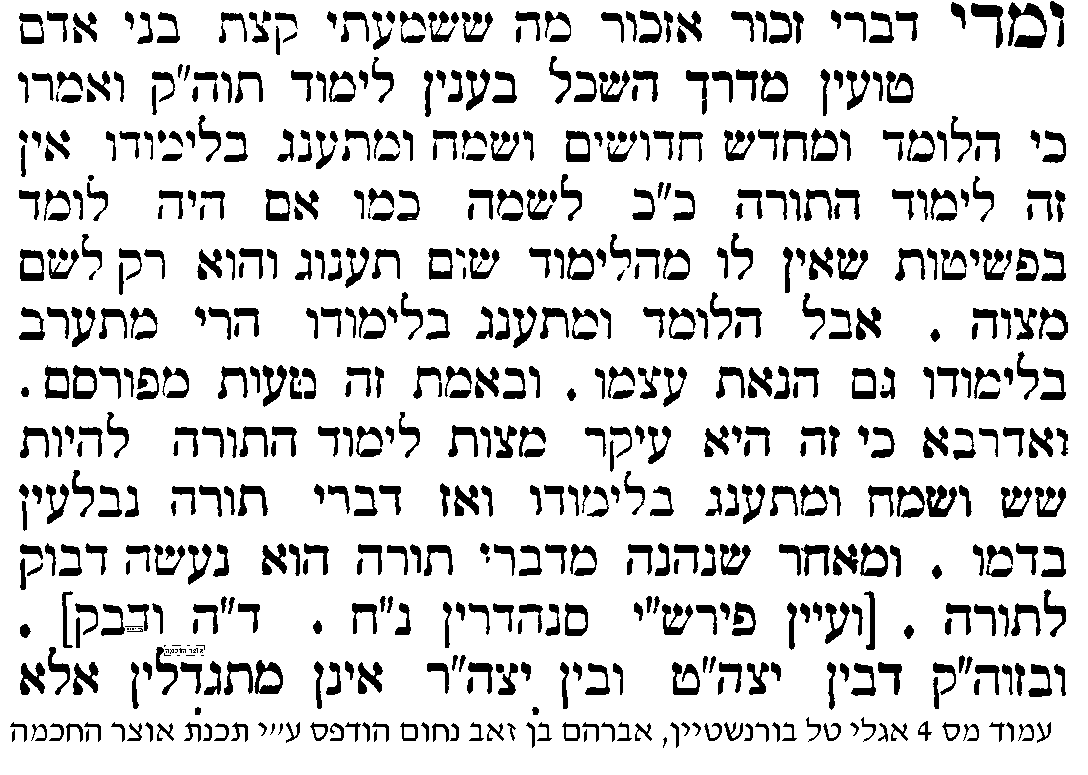
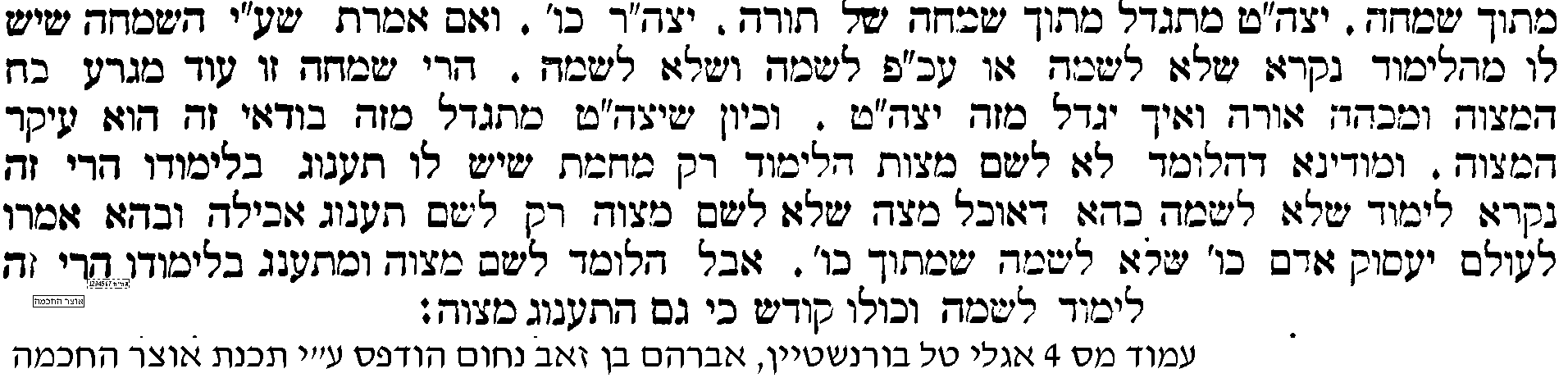
He writes that it is certainly permitted, and even desirable, to enjoy the study. But at the end of his remarks he adds that one who studies for the sake of pleasure is indeed studying not for its own sake. That is, Torah study for its own sake is study that includes pleasure, and yet is not done for the sake of pleasure.
Dual Motivations
One may raise another possibility, according to which the act is done from a double motivation: both for the sake of interest and altruistically.[14] The point is that both of these are motives for the act (and not that one is a motive and the other is a return that is not itself the motivation for the act, as in the previous proposal). In such a case, it seems that we should ask what would have happened without the interest: would the person still have done the act? If so, then altruism is in fact his primary motive and the interest is merely a secondary, nonessential addition. In such a case, this is an altruistic act.[15] However, if the act was done primarily because of the interest, then even if there was an altruistic dimension here, it is not a full act.
And what shall we say about a case in which each of the motivations by itself would have been sufficient to cause the person to do the act? At first glance, that too seems to point to altruism. This is a good person, after all, since he would have done the act even without the interest, and therefore there is no reason to think that the fact that an interest was also involved detracts from his worth. Still, one might distinguish between the evaluation of the person (is he a moral person?), where it really is enough for us that he is someone who would have done it even without the interest, and the evaluation of the act itself. Here, if another intention is also involved, that may perhaps reduce the value of the act. This obviously requires discussion.
Back to Rabbi Kook
Perhaps that is also the meaning of Rabbi Kook’s remarks cited above. He is speaking about the purity of the act’s intention, but perhaps he does not mean that an altruistic motive is impossible. Perhaps he means only that alongside it there is always some interest mixed in as well. Such a situation too explains why a person is always sad, for he is always giving something in exchange for what he receives. And yet he could still agree that, at the principled level, an altruistic motive for human action is possible.
By way of side note, I would say that such a claim, although more moderate, also sounds implausible to me. Fair enough if you assume that altruism is impossible because of the human psychological structure, that is, that a person always acts for some benefit. If that is your assumption (even though I do not agree with it), I can understand the claim. But if you accept that such a thing is possible in principle, then I do not understand why one should assume that some interest must always also be involved. It is obvious that in some cases this is indeed the situation. The question is why assume that this is necessarily the situation in all cases. If there is no mechanism here that is impossible in principle, why should it not be realized from time to time?!
A Concluding Note on Organ Donation
The law regarding organ donation prohibits a donation given in exchange for some form of consideration, or as a result of pressure. Many argue against the law that every donation is given in exchange for some return, whether it be satisfaction or any other return.[16] Even an altruistic donation receives some return (such as satisfaction), and therefore there is an ongoing debate over whether one can distinguish among the different kinds of return. It seems that in the background of the discussion everyone agrees that there is no such thing as giving a donation without return. But in light of what we have said here, that convention can be challenged: is it really true that a donation is always given for the sake of some benefit or return? Could there not be an altruistic donation, given only because of the value involved and not for the sake of any other return at all (including even the satisfaction that comes from the good deed)? One should note that, in light of what I wrote above, even if there is pleasure and satisfaction, that does not necessarily mean that they are the motives for the donation. Beyond that, even if they are motives for the donation, one must ask whether the donation would have been given even without them (solely because of the value-based motive). Both sides in the debate over the sale of organs assume a premise that seems to me highly doubtful.[17]
Altruism and Return in the Service of God
There is no better way to conclude than with the wonderful words of Maimonides at the beginning of chapter 10 of the Laws of Repentance:[18]
A.A person should not say: I will fulfill the commandments of the Torah and engage in its wisdom so that I may receive all the blessings written in it, or so that I may merit the life of the World to Come; and I will keep away from the transgressions against which the Torah warned so that I may be saved from the curses written in the Torah, or so that I will not be cut off from the life of the World to Come. It is not fitting to serve God in this way, for one who serves in this way serves out of fear, and this is not the level of the prophets nor the level of the sages. And God is served in this way only by the ignorant, by women, and by children, whom one trains to serve out of fear until their knowledge increases and they serve out of love.
B.One who serves out of love engages in Torah and commandments and walks in the paths of wisdom not because of anything in the world, nor out of fear of evil, nor in order to inherit good; rather, he does what is true because it is true, and in the end the good will come because of it. This level is a very great level, and not every sage attains it. It was the level of our patriarch Abraham, whom the Holy One, blessed be He, called His beloved, because he served only out of love. And this is the level concerning which the Holy One, blessed be He, commanded us through Moses, as it is said: “And you shall love the Lord your God.” And when a person loves God with the proper love, he will immediately fulfill all the commandments out of love.
He describes the service of God as altruistic service: to do the truth because it is truth. But that does not contradict the fact that in the end good comes as a result, that is, that there is also a return or benefit. But the return and benefit are not supposed to be the motive for our actions.
[1] However, in my article in Tehumin 25 on intellectual property and copyright, I explained that ownership of information involves uniqueness. That is, information has value only where it is unique. Therefore, once I took information from someone, he suffered a loss even though the information remained with him as well (A lamp for one is a lamp for a hundred), and this is an infringement of his intellectual property (I explained there that it is prohibited because of geneivat da’at).
[2] See hints of this in the Rashba’s responsa, vol. 5, nos. 50-51, and elsewhere.
[3] I should emphasize that the term altruism here does not describe a moral approach, but rather a description of the way human beings act. This is not a norm, but a factual description of a mode of human action. The altruist believes that sometimes human beings act from a value-based motive and without return or interest.
[4] See on this in the fourth notebook, part 3.
[5] See in my article on the price of tolerance, where I show this assumption in relation to tolerance. The self-interested motives usually offered as a basis for justifying tolerance do not hold water. Tolerance is defined only when its motive is a pure value-based one. I am tolerant toward the other because I have a value of tolerance, and not because I am afraid, or because I do not have enough power, or because I would pay some price or other. See there.
[6] It is important to sharpen the point that the use of the term altruism here is too narrow. For me, this means actions for the sake of values in general, and not only actions for the sake of other people. If a person has other values that are not matters of self-interest but are not intended to benefit others (and perhaps even to harm them), a person can act for their sake as well. My claim is principled: there need not be a cause, and not even a benefit, in the background of every one of our actions.
[7] The second part does not really surprise me, since his view that the pioneers who drained swamps fulfilled the commandment of settling the Land of Israel, and that their actions have religious value, also reflects a similar position. In my view (see here), such actions have no religious value whatsoever, since commandments require faith and commitment (even according to the view that commandments do not require intention). Rabbi Kook assumes that what determines religious value is the very doing of the correct act, and that motivation (faith and religious commitment) is not a necessary condition for that. This is a very non-Kantian conception of religious commitment and of the meaning of the religious act.
[8] This description follows the line of the Arukh HaShulchan, O.H. sec. 308 (see there at much greater length). It should be noted that this is not universally accepted. Some see all these prohibitions as one single decree.
[9] As for muktzeh on account of financial loss, the commentators disagree whether it is part of the decree of muktzeh or the more severe part of the decree concerning utensils, in which moving it was entirely forbidden, like ordinary muktzeh.
[10] R. Akiva Eiger’s view, however, is that even one who acts inadvertently is prohibited rabbinically. Apparently, he really understands this as a warning to pay attention and not enter a state of inadvertent action.
I once thought to resolve the difficulty raised by the Arukh HaShulchan: perhaps this refers to a person who moves a utensil whose primary function is for permitted use for the sake of some value-based purpose (for example, in order to violate the rabbinic prohibition of moving a utensil on the Sabbath). Perhaps that itself is what they prohibited.
But that cannot be, because before this handling was prohibited, there was no prohibition in it; and then the person would have had no reason to move the utensil (because he would not have been violating any prohibition). So what exactly did they prohibit? The decree itself created the motivation that it itself forbids.
[11] See a fuller explanation of this matter in my aforementioned article in Tehumin.
[12] Pahad Yitzhak Rosh HaShanah, essay 3 (and likewise in his letter 15).
[13] His remarks were cited and analyzed at the end of my article on gratitude from a philosophical perspective, and also in my book Enosh KeChatsir, Gate Six, chapter 2.
[14] There are several examples of this in the Talmud, mainly regarding the motivations involved in bringing sacrifices. For example, in the Mishnah Zevahim 13a (see also the Talmud there 2b): for the sake of the Passover offering and for the sake of peace offerings. Another discussion relevant to this issue is the question of coercion and will, that is, a person who was coerced into doing an action that he in any case wanted to do (for sources, see the Encyclopedia Talmudit entry ‘Ones,’ section yod).
One might also have brought here the dispute between R. Shimon and Rabbi Yehuda (Shabbat 33b) about gratitude to the Romans for building bridges and marketplaces. R. Shimon does not acknowledge gratitude to them because they acted for their own benefit, while Rabbi Yehuda says that there is still an obligation of gratitude toward them. But there it seems that this is not a matter of dual motivations, but of a single motivation (they acted only for their own benefit). The question in dispute there is whether the obligation of gratitude depends on the motivation or on the act itself.
[15] Like two people who performed it where one is capable and one is not. See Shabbat 92b.
[16] See on this in Yossi Green’s book, Organ Transplantation: Legislation, Rulings, and Practice. This is one of the reasons he gives in favor of permitting trade in organs. See also the article by Shmuel Yellinek, Organ Donation for Consideration—A Proposed Model, Medicine and Law 26, 86 (2002).
[17] One cannot ignore our difficulty in judging and diagnosing motives, especially when the act under discussion has a complex motive (a combination of several motives). My remarks here deal only on the principled plane: whether an altruistic donation is possible. The legal application can of course also be affected by the difficulty of diagnosing the motive.
[18] See in column 22 (the source of these remarks is in my article here) on the contradiction between what he writes here and what he writes in law 3.
Discussion
Well, nice to meet you. You are one of those whose position I referred to in the post as one with which I disagree.
Do you have an example of a purely altruistic action?
There is no such thing as a purely altruistic act, for the simple reason that the moment it is done, it is done for some reason. Even if you tell yourself Leibowitzian stories of that sort, in the end it is done so that you can sleep quietly at night knowing you did something right. There is no pure action in the world. By definition.
And of course all the righteous and pure people who tell themselves how they are sacrificing themselves for one value or another are really doing it for their own sake and for their conscience, which gives them no rest (and there is no free choice in the world, etc., but that is already another story).
I didn’t understand the question. How can one give an example of an altruistic action? Any action done from a purely value-based motive (and not for any other purpose, including satisfaction) is an altruistic action. It is not a type of actions but a type of motivations.
A really simple reason, just not a correct one. But declarations are hard to argue with.
Thank you.
And enlighten our eyes through Your Torah.
Is there an action that is done from a purely value-based motive? Do you have an example?
Why do you think that if you repeat a question I didn’t understand, suddenly I will understand it?
But to make things easier, let me ask you whether you can give an example of a non-altruistic action.
You said that “any action done from a purely value-based motive” is an altruistic action. If that is the case, you shouldn’t have any problem giving an example, right?
An example of a non-altruistic (pure) action: a person who gives charity in order to be saved from death or to attain the World to Come. In my opinion, it can be shown that every action a person does is ultimately for some end like satisfaction (or to avoid guilt feelings, etc.). If you have an example that shows me otherwise, I’d be glad.
With all due respect, this is really amusing to me.
Let’s now take your example, and on that basis I’ll give you mine: someone who gives charity not for the sake of the World to Come, rescue, or satisfaction, but only because he thinks it is right and proper to give charity—that is an example of an altruistic action.
You will of course say that necessarily he did it for satisfaction, because you assume (without justification) that there is no altruistic action. And I say that there is such an action.
Now think whether this example helped the discussion in any way. One could bring another thousand such examples, and our disagreement about all of them would be identical. That is exactly what I meant.
But by all means, if in your opinion it can be shown otherwise, I’d be happy to hear.
Your first sentence is an empirical claim that one can argue about. Your second sentence is completely mistaken, and also contradicts the first sentence – you would do well to try to explain to yourself what definition you are talking about from which the claim follows (the definition of an act? of altruism?).
(Your second paragraph merely repeats itself, apart from the parentheses.)
Regarding note 7, though it also bears on the whole article:
In the Kantian view (and yours), there is no religious value to commandments performed without commitment, or in your words “faith and religious commitment.”
And at the end of your remarks you cite the Rambam on serving out of love and fear as support for your position.
But I would be glad to hear where those who serve out of fear are, whom the Rambam mentions in the previous section.
Do their actions have religious value according to your approach, even if a lower one, as is commonly understood in the definition of “service out of fear”?
Because if you look at a child whose motivation, faith, and religious commitment come from his parents’ education,
then I do not understand why, according to the Kantian view, such actions would have moral value.
Yet one can set against this position a different line of thought: if a person is motivated by a motive that depends on things whose source is faith-based and religious commitment, such as parents educating their children,
then even if our evaluation of the person acting is lower – the actions still have religious value.
And this is also how I see Rav Kook’s view regarding the pioneers mentioned in the note, in the context of their motivations.
And this indeed clashes with the pure Kantian view, which requires a direct link between the motivation and the commitment,
but in my opinion the more common view does allow second-order and higher links.
(And in my opinion this is also connected to the motivation that drives many people, as opposed to what drives you.
And one must consider whether your definition does not itself express a naturalistic fallacy –
philosophers defining an intellectual norm because they themselves are like that.)
Hello Eitan.
I’ll start from the end. As for what drives me, you may be surprised, but I’m not such a radish that I don’t need motives. I too need to work in order to be a strictly observant radish. So this is the correct view in my opinion, but not because I am like that. By the way, in any case this is not a naturalistic fallacy, because I do not derive this view from what I am. You, as an outside observer, think it stems from what I am. But even if you are right, so long as my argument is not based on that, there is no naturalistic fallacy here. The fallacy concerns your logical inference, not your psychology.
As for your main point, I agree that this has diminished value (also with idolatry out of love and fear one is exempt from punishment, but it seems there is still a prohibition). But in a certain sense this is not really service of God at all, but service of oneself. Still, the commandments have some value even if they are not done as service of God.
I will only add that without faith, in my opinion they have no value at all.
To Michi,
It seems to me that neither side in this debate has any way to prove its position on this matter. It is a matter of taste. Isn’t that so? If so, can you explain what the point of such a discussion is?
It may be that through discussion and thought, each person can clarify his own position and come to know himself more deeply. That ‘depth’ is the ‘psychological makeup’ (as you called it, and rightly so in my view – and what others have called the ‘root of the soul’) that stands behind many positions on various issues. For example, the psychological makeup that causes me to think that there is no action except for attaining pleasure and escaping pain is what causes me to think, for instance, that religion and the commandments are not obligations in which we find no meaning. For the ultimate will is directed toward pleasure (and this requires elaboration, but this is not the place).
And conversely, it seems to me that your belief in the existence of altruistic action is compatible with (and perhaps even stems from) your belief in the existence of concepts as ‘entities.’ These two views reflect a tendency to grasp ‘existence’ as independent of human consciousness, and from that it follows that a ‘concept’ is ‘given’ to us from ‘somewhere out there’ (whereas my view is that a ‘concept’ is a ‘product’ of my consciousness, reflecting its state, and this is profound), and also that will is an ‘object’ found within us (rather than a mental ‘state’), which is not necessarily driven by considerations of pleasure and pain (I wrote this without the requisite depth of analysis).
This is an interpretation according to my own psychological makeup.
I would be glad to hear how you justify this discussion.
The point of this discussion is twofold:
1. To raise a possibility that many people never even consider. There are many who take it for granted that a person always has some self-interest at the base of every action. Here I wanted to raise the other side. In many cases, once people see that there is another side, they are also willing to adopt it (because originally there was an assumption that self-interest was self-evident).
2. The second point is the connection to moral theory. Without belief in the existence of altruistic acts, a moral act and moral judgment have no meaning. Many people are also unclear about this connection, whereas to me it is self-evident. This itself can also lead people to understand that they in fact do accept the existence of altruistic acts, since intuitively they do think there are moral acts and moral judgments, and that is what follows from this.
It seems to me that most of those who argue with me here and in general are not aware of (or do not agree with) these two claims.
From that point on, it really is a discussion between opposing basic assumptions, and there is not much point in it (see Sh’s repeated request for an example).
After reading the article and the comments, I finally decided to emerge from my expressive hibernation. As a continuation of previous discussions between us (about the purpose of existence), I think the rabbi does not really understand and see what Rav Kook is talking about (and indeed, agreement is of almost no importance—only understanding). It seems to me that beneath the surface there is here a discussion no less, and perhaps even more, about what we want reality to be than a discussion of what it is. One really has to discuss what that moral person is, or the one who acts without any self-interest. Historically, no such person is known, and it does not seem there is or will be such a person on the face of the earth. So the rabbi will say that this is an ideal, that one can only approach it, and that he was speaking only about specific acts and not about any particular person. But I think that is relevant, and the question is whether we even want to be such a person. As the rabbi noted, this is not a human being. It is a radish. So why should we want to do radish-like acts in the first place?
But the truth is that I do understand the rabbi (I see what he sees). The discussion here is whether one can act for the sake of goals (teleological, enabling and attractive, inspiring) and not by means of motives (deterministic causal compulsion). And on that it is fairly clear that Rav Kook did not disagree, otherwise this would simply undermine free choice (goals that compel, interests, are like causes). But again, there are three levels and stages here, like kindness, judgment, and mercy (right, left, middle).
The right is actions by motives that have form and structure. This is in fact a kind of determinism. The motives are causes and are described by physics (that is what I mean when I say they have form and structure; one can call them by names, say what the motives are). At this level people say there are no truly good people, everyone is corrupt, and everything is just interests. And the morality that society insists upon is simply a sacred lie. But in fact this is a sophisticated jungle.
The rabbi’s altruism (and Kant’s, and Leibowitz’s) is the left side: to do the truth because it is the truth, the right act because it is right, values as ends and not means, etc. And the truth is that this is indeed true. For example, take anyone engaged in mathematics: ask him what for he engages in it (what practically comes out of it for you?), and he will say (if he is a serious mathematician) that he engages in it for the sake of mathematics, studies it for its own sake. It is not a matter of merely enjoying proofs and riddles and problem-solving, and not even of the wisdom itself. It is about a sense of mission and importance. From his perspective, mathematics (and wisdom) does not serve external things (livelihood, science, physics, etc.); rather, they are lower than it. If anything, they are supposed to serve it. (Assuming physics is indeed lower than it. I don’t think so; I believe they are equal sisters: chokhmah and binah.) And he sees himself as serving it (a priest of mathematics). The same applies to science, art, and of course also morality and Torah study and fulfillment of commandments. The rabbi is now on the left side (a consummate “the opposite seems reasonable,” as I was in my childhood), so naturally he attacks anything that seems to him like the right side. But Rav Kook is not the right. He is the middle. And there is a middle.
Because the feeling is (and it is expressed here by many of the commenters, and underlies Rav Kook’s words) that the left side is also accompanied by unbearable self-righteousness and moralism. That is, it cannot be that the left side is the whole truth. There is no value to such a truth (and the statement that there is no such thing as the value of truth and that only truth matters is also part of the same left-wing sub-conception. To the rabbi this sounds as though truth serves goals—the values of truth—and he thinks that is the right side (pragmatism), but it isn’t. There is also a middle in the end.) And indeed, if we ask the mathematician why mathematics exists, he will not understand the question. From his point of view it is the purpose of existence (or there are several such purposes, as the rabbi said). But of course that does not feel objectively correct. He will simply turn it into idolatry. It is very strange that the world of causes has form and structure (the equations of physics), and even an aspiration to unify it into one cause (the unified field equation), but the world of goals, purposes, and meanings (the higher realm) has no form and structure whatsoever? Is there nothing that binds all values and goals to one value and one goal? Is there no reason (meaning, structure, form) why a certain value is a value? And if the rabbi answers that if you find such a reason then it will not be a value but a means, that is evasive. I am speaking of meaning, not cause. (Like reasons for the laws of nature—for example, the reason, more precisely the goal, for the existence of the electromagnetic interaction is the symmetry of the Lagrangian of a charged field (a complex field) under local internal rotations of the fields from which it is composed.) Is there no reason why truth is what it is? Why the right act is what it is? The truth is that there is, and in the end it is the purpose of existence, whatever it may be. About that we will no longer really be able to ask questions, but not only because otherwise it would turn from an end into a means, but because of an inner sense of tranquility with it. Then it will truly no longer arouse questions of why.
In any case, the middle position is indeed that a person acts for goals, but those goals have content and meaning. It is not simply doing the right act. There is a reason why it is right, and a reason for that reason, and so on until the purpose of existence. Such an interest is a true and pure interest. And only God can do that in perfection (pure giving). A human being can do it locally, in time, if God “clothed Himself” in him at that moment. The soul acted (the God within the person), and not the body or the psyche (self-directed receiving). A person as such cannot distance himself from the right side within him (the evil inclination), but he has a choice whether to allow the horse or the rider to act. But the rider’s action too has structure and content, just like the horse’s action, which is studied in biology and psychology. It is not simply the right act. Of course, all this was known to Rav Kook, and he wanted to say something additional connected to explaining the words of Aggadah against the background of these matters, and this is not the place to discuss it. In any case, the interest in doing the right act, or the pleasure from it (I am speaking of something higher than just the shallow pleasure of doing good deeds and helping people), constitutes necessary fuel for the action of human beings who act for goals. From observing the rabbi and human beings, I have never seen anyone perform any action without fuel. So the rabbi is simply speaking into thin air if we have never found any person or any act whatsoever that fit the pure left side. It is a kind of empty contingent truth.
And with that we will finish for today.
Hello Eilon.
First, I am glad to hear that I served as your David Hume (who awakened you from your dogmatic slumber).
As for your actual remarks, with all due respect I think your comments add nothing to the discussion. I presented the matter fairly sharply: is self-interest the reason for the action or not? At the moment it doesn’t matter to me that the fulfillment of the interest comes afterward, since that is almost always true anyway (except in the case of nayaḥ nafshah, where it comes first). Is the reason that caused the person to act the desire to fulfill a self-interest (the desire precedes the action, only the fulfillment of the interest comes afterward): yes or no?
I really do not agree that an altruistic action is an unrealistic abstraction. I defined it well, and in my opinion it is entirely realistic. I see no necessity that there must always be self-interest. But beyond that, even if we assume as a working hypothesis that there is always also self-interest, the question still remains whether the self-interest is the reason for the action or merely a factor that appears incidentally (a side effect) (that is, without it I would not act). But about that I have already argued with several of the commenters here.
In fact, these 3 lines parallel another triad of right, left, and middle: love and fear, or love and honor. On the right there is romantic love built on attraction (the person is acted upon). This is a love that depends on something. Then comes the left side of fear, that is, respect, and then once again the middle—true love, love that contains respect, love that does not depend on anything. This explains several phenomena. For example, on the one hand the Rambam explains that love of God precedes fear of Him (after his description of how one comes to love of God through contemplation of creation he writes, “And when he reflects on these very matters … he will recoil in fear and trembling”). He also lists them in this order in Sefer HaMitzvot and in the Mishneh Torah. And on the other hand we have accepted, for example, that repentance out of fear precedes repentance out of love, and that repentance out of love is greater than that of fear. This also explains the phenomenon that one begins with romantic love and then afterward life becomes difficult and people quarrel and belittle each other, yet on the other hand people say there is no love without respect. Because there are 3 stages. So too there are 3 stages in the love of God, and the Rambam described the first and second. (One would need to discuss, according to this, when exactly the commandment to love God is truly fulfilled—only after fear of Him?)
I’m glad that the rabbi is glad (though unfortunately I was not in dogmatic slumber—it would be fun to wake up. I have simply been too lazy to write this response ever since the post came out).
As for adding content to the discussion: I do not know how the rabbi can say what he said. Was all this verbiage of mine for nothing? In any case, my point was clear: the rabbi is right, but the value of his being right is questionable (right but not wise). I do not know what the rabbi means by the word “interest.” The meaning of the word is “concern.” There is no one in the world who does anything without concern. Action without concern (in something—even in the action itself and not in its results) is not human action. It is not action at all. It is the movement of particles in space, or an animal instinct, or a robotic algorithmic response. That is not altruism at all. It is clear to me that this is not what the rabbi meant. The rabbi means what is called narrow self-interest (and nayaḥ nafshah is included in this too). And my middle position is broad self-interest. My assumption is that simplistic altruism, meaning simply acting for the benefit of someone other than yourself, is self-righteous and not at all a good thing, and goes together with Christian wretchedness and a slaughtered-sheep mentality. These are the sources of the approach, consciously or unconsciously, of the circle of people to which the rabbi belongs (Kant). And it is built on the idea that other people are better than me simply because they are not me. I see no reason to discuss this at all or to claim that it is possible. What I claim is that true altruism is really expanded egoism. It is action for the good of the whole—the whole that includes me as well—at first shelo lishmah, out of the understanding that what is good for the whole will be better for me (in the narrow sense) than the narrow profit that comes from actions that transcend or work against the whole, and in the end simply identification with the whole itself.
And by way of a prophetic statement without explanation (because the margins of the notebook are too narrow to contain the explanation for it, though it is itself truly marvelous), I will add that at this level something else also happens: the end and the means also become one. He does not merely rejoice in the joy of the whole because it is his own joy (and again, not only because of personal gain, because the cake grows and then his own slice grows, but because of the growth of the cake itself). At this level, actions and results become one. The taste of the tree is like the taste of the fruit.
And as an aside, if I see a side effect that always appears together with something, I suspect that the thing and the side effect are inseparably connected.
What is clearly happening here is that the rabbi does not like something (which I too do not like), and not merely that something does not seem that way to him by virtue of his conception of reality. And therefore he is pushed (again, in my opinion) into abstract regions (which the rabbi claims are not abstract, and on that we remain in disagreement) that to me, and to many people, feel fake (and not only because in reality they can or cannot exist; it is fake from within). I also understand the repression. But there is a way out of it.
I lost you completely. I see not the slightest connection between what you wrote in explanation of my remarks and my actual remarks.
Hello Rabbi Michi. Thank you for the response.
My assumption was not that you are a radish who is driven only by pure reason.
My assumption was that you are less driven by social influences,
and therefore such a state of motivation (in order to resemble person A, for example) is absent from the map of the moral conception you drew.
And from this comes the criticism about the fallacy—you have no reference to this because your inference rests on assumptions that erased this option from the map, and those assumptions stemmed from you.
And from here let us continue to the second paragraph: what value do they have in your opinion?
Is this moral value, or is it utilitarian value (from which one can arrive at a moral conception, for example)?
And of course one cannot do without a comment on the closing sentence—
even if I agree, we would have to define in our discussion what level of faith we are talking about,
precisely because the discussion concerns the level of a child and the like.
1. There is still no naturalistic fallacy here.
2. They have the value of service not for its own sake. Belonging to the group that observes the commandments.
3. It doesn’t matter. Each person will define his faith and its level. But the things must be done out of what he regards as faith.
With God’s help, 12 Adar 5778
Kant’s view that an act is moral only if it is done purely for the sake of the moral imperative is very puzzling, because if so, you leave no life for any creature. Consider: a person does what is good and upright in complete fashion, yet still will not be considered ‘moral’ in Kant’s eyes because something is lacking in the lishmah?
Rav Kook certainly would not go this way. After all, he is a man of halakhah and a halakhic decisor for the many, and as a disciple of the school of the Vilna Gaon he is steeped in the Gaon’s guidance: “Let the book Mesillat Yesharim be your guide.” In Mesillat Yesharim, the Ramchal explains that the ‘categorical imperative’ demanded of every person is “watchfulness, zeal, cleanliness,” and if only we all reached these levels.
“Purity,” the directing of a person’s intention solely toward his Creator without personal ulterior motive, is already a very high level, the level of those who aspire to piety and holiness. Can one really malign someone who has not reached complete lishmah by saying that his actions have no moral value?
The Rambam too, in his comments on “The Holy One, blessed be He, wished to confer merit upon Israel; therefore He increased for them Torah and commandments” (Commentary on the Mishnah, end of Makkot), according to which one merits the World to Come only through an act done purely for the sake of Heaven, does not imagine that a person will reach a state where all his acts are lishmah; rather, from the abundance of good deeds, there will certainly be acts that are done with perfect intention and without ulterior motives, and these will merit the person the World to Come.
And who is more utilitarian for us than Harbonah, who only when the wheel turned against his guide Haman ‘repented,’ and yet we do not deprive him of his reward and mention him favorably. Surely, surely, a person who fulfills in his life his calling—“He has told you, O man, what is good, and what the Lord requires of you: only to do justice, and to love kindness, and to walk humbly with your God”—will be defined as a moral person in every respect.
And indeed, kindness without feeling is not enough; one needs “love of kindness.” When a person loves God and other people, and the religious and moral imperative has been internalized in his soul, then he enjoys and is filled with delight from every good deed, and does it not as a burden but with desire. Not only is it “good for him in the World to Come,” but he is “happy” also in this world!
With blessings, S.Z. Levinger
SZL, why do I once again have the feeling that you are not reading what you are responding to?…
The rabbi says that even if every act is accompanied by self-interest, it is still possible to do it for its own sake (because of the value in it), and he argues that otherwise the religious and moral command would lose their meaning. Let him correct me if I am mistaken.
To that I say 4 things:
1. I also call “for its own sake” an interest (a concern), and this is not mere semantics. The assumption is that things have value for some reason (there is indeed a reason not to murder, because life has value—it has a purpose—the purpose of existence. Likewise with the preservation of property for the sake of “you shall not steal,” and so on). There is a structure to the whole set of values in reality, and they are summed up in one value—the purpose of existence. The rabbi will then say that in my view these are not values but means, and there is only one value they serve, namely the purpose of existence. On that I will partially agree, because one can already experience in the means themselves, even before we know what the purpose of existence is, that they have value, and in that respect they are not only means but already somewhat part of the goal itself. (As in induction, where one can see the rule through the particulars, and it already resides within them.) I also claim that this is how the rabbi himself acts, without being aware of it, and that he could not act otherwise. If there is no concern, there is no fuel (fuel is not a motive; it is simply something without which one cannot act).
2. I claim that the previous claim is true precisely (I want it to be true and also believe it), because if, as the rabbi says, these must be values just like that, without any added context or explanation (a collection of values and commands with no relation between them, built only on the experience of their valueness), and this is so that morality and the religious command may have meaning, then I say that such morality and such a religious command have no value in my eyes (or in the eyes of many people). It is mere posturing. This is what is called moralism and self-righteousness (which in these weeks fill all the newspapers, right and left alike, regarding the Bibi affairs. Everyone is serving the molech of the holy and terrible law, and wearing a self-righteous facial expression and a severe countenance and abysmal seriousness, as though they themselves, in their own honor, are running the universe). I will serve God because He is great and awesome and wise, etc. (which among other things makes Him God), and meaningless commands that are intended only to be obeyed cannot come from Him. There is no value in obeying for the sake of obeying some entity. The assumption is that God is meaningful (in our terms of meaning), and therefore His commands necessarily have meaning and are not merely meant to make puppets of us. Indeed, I too think that serving God is an end in itself (and the highest end), but that is because it has an external meaning beyond being arbitrary words that came from God’s mouth (God, by virtue of being God, cannot command arbitrary commands, such as slaughtering from the neck and not from the nape).
3. I also personally experience that these values are not the end of the story. That is, they are not merely values. They serve one value, and that is the purpose of existence, whatever it may be.
4. If indeed every act must be accompanied by an external interest, then there is a connection between the lishmah (which for me too is an interest) and the interest (perhaps as soul to body). This is indeed another claim of mine: that morality without reward and punishment (like the religious command as well) lacks something essential, and is like a soul without a body. But that is not the place to elaborate.
Perhaps now I am clearer.
With God’s help, 12 Adar 5778
To RMDA – greetings,
I began by criticizing the Kantian point of departure, which sees the altruistic motive as a necessary foundation for the moral definition. Does the fact that something is done shelo lishmah detract from the moral value of a good deed? Purity of intention is an “added value” on the path to piety and holiness, which are reached by exceptional individuals who go beyond the letter of the law, as the Ramchal explained in Mesillat Yesharim, beginning of chapter 13: “And you see that all that we have explained until now is what a person needs in order to be righteous, and from here onward it is for him to be pious.”
On the other hand, I brought the Rambam’s words (in his Commentary on the Mishnah, end of Makkot), that service of God without ulterior motive is a necessary condition for attaining the World to Come, and in this there is support for the view that ‘altruistic’ intention is a necessary foundation for every person. But in the Rambam’s words it is made clear that he does not expect a person to persist on this high level; rather, through persistence in doing good, a person will reach moments in which he succeeds in climbing to the summit of pure lishmah, which will merit him the World to Come.
And in the end I brought the possibility that personal delight and action “for the sake of Heaven” converge, somewhat like what you brought in the name of the Aglei Tal in his introduction regarding Torah study for its own sake—that it is impossible to study Torah without taking delight in it. So it is with every true love. A person who loves his wife and children delights in their closeness and rejoices in their good, which is also his go
And the same is true of love of God and love of other people. The lover sees no dichotomy between ‘I’ and ‘he.’ The ‘I’ becomes ‘we,’ and what is good for one is good for all, and the bond contains within it mutual love and mutual beneficence, in the sense of ‘1+1=1’
With blessings, S.Z. Levinger
Something of this sort I heard from the rabbi of Kochav HaShachar, Rabbi Ehud Krakover, may he live long, that “those who exchange their meals” is not merely a legal workaround, the ‘default option’ of the poor, but rather the very essence of “sending portions one to another”: the insight that the two of us are ‘one soul in divided bodies’; your portion is my portion and my portion is your portion.
In contrast to Kant, who sees pure altruism as the foundation of all foundations, Rav Kook says in the essay “Pleasure and Joy” in his book Ikvei HaTzon (ed. Rabbi Hagai Lundin, p. 85
“Pleasure and joy must necessarily accompany every spiritual occupation. Only when a person delights in and rejoices in the good and upright deed will he be diligent to do them in the utmost perfection and to add to them day by day. Only then will the spirit of the Shekhinah and the radiance of its glory rest upon him… and help him to be adorned with grace and kindness, so that his deeds and actions too will find favor in the eyes of others, and they too will go in his ways, and blessing and goodness will increase in the world.
Only when there is inner pleasure and joy in the heart joined to the good and just deed—only then are they established in a person, so that he becomes fixed in the ways of the good God, blessed be He, and from the source of his soul he will find living waters flowing to enlighten him and guide him in the paths of life. All actions, feelings, and thoughts that are done under compulsion and distress, whether the distress be material or spiritual, are not in their utmost perfection, and they come only in order to set a person upon the proper moral state, in which he is joyful and delights in doing good, and when he abstains from evil and ugliness his soul rejoices and his glory is glad.”
In short:
the pleasure and joy that accompany a person in the service of God and in doing what is good and upright spur him on to persist and increase his good deeds, and even exert a positive motivating influence on those who see him. Joy in doing good establishes the aspiration to good within the person himself and brings him to self-motivation for good. In essence, this is “the proper moral state”: delighting in the good and recoiling from evil.
Drink, beloved friends, of the perfumer’s wine, and rejoice in good teaching; let both giver and recipient of the bargain be glad, and may the eager and discerning together increase!
With Purim blessings, S.Z. Levinger
With God’s help, 13 Adar 5778
To Eilon – greetings,
Your words are very understandable, and your previous words were also very understandable. There is no need to be ashamed and no need to apologize. Say your instructive words, clear and understandable to every reader open to hear. If so-and-so or such-and-such responds dismissively—don’t take it to heart. Opposite him there are dozens of readers who understand and appreciate your words! Be strong and courageous!
With blessings, S.Z. Levinger
Hello Eilon.
Who spoke about doing things just like that? I spoke about doing them without self-interest. I too think that service of God and the commandments have purposes. Where did I write otherwise? But I serve because He commanded and because there is value in fulfilling His commands, not because I gain something from it. All the rest, in my opinion, is indeed semantics.
SZL,
You write against the Kantian view and then repeat it. I too, little as I am, wrote that purity of intention is the fundamental value, but I added that there is also value to actions done not for their own sake (though in my eyes it is minimal and instrumental value).
The claim that together with the lishmah there can be self-interest or pleasure, and that sometimes it improves one’s ability to perform, is quite correct in my opinion as well. More than that: I myself wrote this (following the Aglei Tal). So what? What does this have to do with my basic thesis? My claim is that the motivation for the action should be the lishmah and not the self-interest, as the Aglei Tal writes there.
The linking of personal pleasure and acting for the sake of Heaven is mere empty rhetoric. I too can write that self-interest and purity come together and create marvelous harmony. Or that murder and rescue from death unite into one hyperbolic unity of opposites. Paper suffers everything.
With God’s help, 13 Adar 5778
To RMDA – greetings,
A clear example of the built-in combination of pleasure and benefiting another can be found by anyone in the love between husband and wife and in parental love for their children. The lover invests above and beyond his strength in his beloved, yet he also enjoys and delights in their closeness and their wellbeing.
The same combination of investment and enjoyment, each intensifying the other, also exists between a rabbi and his students and between close friends. A person who is aware of the magnitude of the good bestowed upon him by his Creator will delight in His closeness and rejoice in bringing pleasure to his Father in Heaven.
With blessings for release from emotional rigidity, S.Z. Levinger
To SZL, I never said that both things do not exist. For the fifth time I repeat: there are many situations in which both things exist. And still, the moral motive is the beneficence and not the pleasure.
With blessings for release from intellectual rigidity and lack of listening.
I came across an issue that connects nicely to this column, the sugya of taluhu vezavin. The halakhic authorities (Rashbam, Hagahot Maimoniyot, Tur, and others) wrote that specifically in taluhu vezavin, “his sale is a sale,” but in taluhu veyahiv, no. And the Rambam wrote in Hilkhot Mechirah: “With a gift we follow only the expressed intent of the giver—for if he does not wish with all his heart to transfer ownership, the recipient of the gift does not acquire it.” The Tur wrote that one who is coerced and sells for less than the real value, his sale is not a valid sale, just as with a gift. That is, there is a similarity between a gift and a sale below real value. From here one can learn that even if there is some compensation in a gift, the compensation never reflects proper compensation as in a sale, but only something partial. Therefore, in every gift there is a part that is altruistic (for example, if I gave a gift worth 100 shekels and in return received contentment, and let us say the value of that contentment is 20 shekels, then the remaining 80 shekels were given in a completely altruistic way).
But the Tur writes that because of this the acquisition does not take effect. That is, the giving was not genuine. Is that not a refutation rather than a proof?
When physical pressure is applied to you, the giving is not genuine. But when you do it out of your own free decision, the giving is genuine. That is what the Rambam wrote: “for if he does not wish with all his heart to transfer ownership, the recipient of the gift does not acquire it.”
But that is the very question: when no pressure is applied to you, will you give a gift without full compensation? I of course think so, but I do not see any proof from here.
For sources in the writings of Rav Kook and Rabbi Aharon Lichtenstein on the question of the relation between commitment and acceptance of the yoke, on the one hand, and enjoyment in the service of God, on the other—I referred to them in my comments on Irit Halevi’s article, “Stop with the Rearguard Battles,” on the “Mussaf Shabbat – Makor Rishon” website. The ideal state is that a person has built and shaped his soul such that his will is identical with the will of his Creator.
With blessings, S.Z. Levinger
Non-binding reflections:
– A person himself cannot judge his own actions as to what they really stem from, or whether he would do them without the pure/interested motive. So the whole matter has no practical significance at all.
And see the illuminating words of Nehama Leibowitz, of blessed memory, in response to Rabbi Rafael Posen, who asked her whether to send one of his female students to a youth movement even though her motives might not be idealistic but rather to meet boys:
“I did not quite agree with your answer to the sincere and painful question of a girl who is going on vacation and wants to continue serving as a counselor in Bnei Akiva. You did indeed permit it, but with a heavy heart and reservations. – But there is nothing better than this, and one should encourage such a thing with all one’s might. After all, the society outside the movement there is not good at all in our sense, neither for girls nor for boys. And if someone joins Bnei Akiva, or Ezra, this is a great miracle and one should strengthen his hands!
And now one more thing: you wrote that she should examine herself to see whether she is doing this for the sake of ‘to magnify Torah and glorify it’ or for the sake of meeting boys. And according to that it should be permitted or forbidden. My good friend, is this really the way? If I myself were to begin examining myself, in what percentage was I driven to teach, to travel to all corners of the הארץ to give classes, to answer thousands of people’s questions for the study sheets—because I wanted to increase Torah in Israel, and in what percentage was the drive because I wanted to earn money, and in what percentage is there self-love here, to hear words of praise—and one does hear them, from friends, from students—when the lesson succeeds, and in what percentage (perhaps?) since my husband passed away is there here a desire to flee from loneliness, from the empty house… Better not to examine. And can this matter even be examined? Let us leave this examination to Him who tests kidneys and heart, and He will judge.
And how can this girl examine herself in such a matter? And this is not desirable at all!! Better that she think she is doing something great here, saving children from the street, from abandonment, and bringing them near to their Father in Heaven, while a psychoanalyst, and even an ordinary psychologist, would discover that the desire to meet boys is a very strong factor. But it is very good that she not know this and not think about it. Under no circumstances would I say to a girl fired up (‘burning’) for the movement, who gives of her time to ‘activities’ and to the wall newspaper and to ‘organization Shabbat’ (instead of sitting at home in front of the television), ‘You know, all this you are doing because you want to be in the company of Yaakov and David and Moshe, and want to find favor in the eyes of the boys.’ Under no circumstances!”
– It may be that Jonah saw himself as a perfectly truthful man, and from this came his opposition to the repentance of the people of Nineveh, since it was clear to him that it would not be entirely genuine and would contain elements of falseness and externality, of putting on sackcloth and so forth. In the story of the kikayon, the Holy One, blessed be He, proves to him that he should not deceive himself—“You had pity on the kikayon” is a sarcastic statement—after all, I know that you had pity (also) on yourself, because no person is free of interests, so please go and prophesy to Nineveh.
I did not mean that we should examine others, or even ourselves. But this does have several implications (most of them unrelated to the question of diagnosis):
1. A fundamental implication: does a person have free choice, or are his actions forced upon him? This is an important question regarding how we relate to him and judge him. Is he like an animal?
2. There are presumptions. When a person does a good deed, the presumption is that he also does it from good motives (perhaps not only. And that is the give-and-take in the Nehama Leibowitz passage you brought). Therefore we do not make a diagnosis not because the evaluation is unimportant, but because we already have an evaluation by force of presumption.
3. When it is clear to us that a person is doing it only for side reasons, then there is definitely room to judge him.
4. We must work on our character so that we do our deeds out of altruism. This does not mean we will always know whether we succeeded, or to what percentage it was altruism, but that is the goal of spiritual work.
And regarding Jonah, the verse compares this to God’s compassion for Nineveh. What you present is not the kal va-ḥomer of the verse, and in fact is not a kal va-ḥomer at all.
I arrived at this post בעקבות a reference of yours from the first book in the trilogy that I am busy with during the days of the coronavirus (if not for your books, I would be busy with nonsense).
1. I am writing from my own reflections: it seems to me that this is a very elusive matter even for a person regarding himself—whether when he does something he is completely free of interests, and even if he has two motivations, how to assign the proper weight to each. Here even the owner of two wagons and a balloon would agree to assign most of us to the church of the skeptics. The most I can do is tell myself before the act that I am hereby activating a pure intention of lishmah, while knowing that only after 120 years will I be able to verify, through the Tester of kidneys and heart, that I hit the mark exactly.
2. Is this whole discussion not connected to the mishnah in Avot, “Do not be like servants who serve the master on condition of receiving a reward”? And likewise to the well-known Rambam, which I do not remember where it is (I’m using my own words), that the reward of the World to Come comes by virtue of the fact that in the course of our many days of life perhaps once it will come out that we perform one true perfect act without ulterior motives.
3. If the above mishnah in Avot is to be taken literally, which from it seems like your view here in the post, it is possible that the debate here between you and the commenters stems from the fact that you have already reached such a lofty and exalted level, and they, who are unable to understand the possibility of such a thing, simply have never reached those heights at all (this is the first time I have encountered the phenomenon of humility where the humble person truly does not know that he is such).
1. It is entirely clear that self-diagnosis is always doubtful. Still, there is room for the principled discussion whether altruistic actions exist at all. Even if they do, it is still obvious that it is difficult to determine about a given action whether it is such or not.
2. The relevant Rambam is, in my opinion, at the beginning of chapter 10 of Hilkhot Teshuvah:
Halakhah 1:
A person should not say: behold I am performing the commandments of the Torah and engaging in its wisdom in order that I receive all the blessings written in it or in order that I merit the life of the World to Come, and I will separate from the transgressions against which the Torah warned in order that I be saved from the curses written in the Torah or in order that I not be cut off from the life of the World to Come. It is not fitting to serve the Lord in this way, for one who serves in this way serves out of fear, and this is not the level of the prophets nor the level of the sages, and only the ignorant, women, and children are made to serve the Lord in this way, until their knowledge increases and they serve out of love.
Halakhah 2
One who serves out of love engages in Torah and commandments and walks in the paths of wisdom not because of anything in the world, nor because of fear of evil, nor in order to inherit good, but rather does the truth because it is truth, and in the end the good comes because of it. This level is a very great level, and not every sage attains it. It is the level of Abraham our father, whom the Holy One, blessed be He, called “My beloved,” for he served only out of love. And this is the level concerning which the Holy One, blessed be He, commanded us through Moses, as it is said: “And you shall love the Lord your God.” And when a person loves the Lord with the proper love, he will immediately perform all the commandments out of love.
3. I do not think the basis is the mishnah or the Rambam. The main basis is reasoning. My level is so exalted that I am not even aware of that (= of the lack of awareness). Thank you for a level like that you never even dreamed of. 🙂
I actually meant a different Rambam. All morning until now I searched Rabbi Google without success, until I tried to remember in connection with what I had heard the preachers cite this Rambam, and I recalled that it was on the well-known mishnah “Rabbi Hananiah ben Akashya says…” And finally I found it: it is the Rambam in his Commentary on the Mishnah to tractate Makkot, chapter 3, mishnah 16.
The Rambam’s commentary
and this is its language:
“Rabbi Hananiah ben Akashya says: The Holy One, blessed be He, wished to confer merit upon Israel; therefore He increased for them Torah, etc.—Among the fundamental principles of faith in the Torah is that when a person fulfills one commandment of the 613 commandments properly and fittingly, and does not associate with it in any way any intention directed toward worldly aims, but rather does it for its own sake out of love, as I have explained to you, behold he thereby merits the life of the World to Come. And on this Rabbi Hananiah said that since the commandments are many, it is impossible that in the course of his life a person should not perform one of them in its proper manner and perfection; and by performing that commandment, his soul will live through that act. And what indicates this principle is what Rabbi Hananiah ben Teradyon asked: ‘What am I to the life of the World to Come?’ And the responder answered him: ‘Did any deed ever come to your hand?’—that is, did it happen to you to perform a commandment properly? He replied that the commandment of charity had happened to him in a way of perfection as much as possible, and he merited the life of the World to Come. And the meaning of the verse ‘The Lord desired for the sake of His righteousness’ is: He wished to justify Israel; therefore He made the Torah great and glorious.”
This is a well-known Rambam, but slightly different. He says that one can merit the World to Come with one commandment just as with all 613 commandments. The novelty is not the absence of ulterior motives required, but that one commandment does all the work.
I read column 120 on altruism.
The underlying assumption, as I understood it, is that an act done because it has value is altruistic. And as the Rambam writes, it is done because it is true.
The question I am asking is: does a person have an interest in doing an act of value? In my opinion, certainly he has some motive or purpose for doing it.
Perhaps what the Rambam sets out is a high bar that cannot be realized and is not really possible.
One can say that a person does something because it has value and because it is true—but why did he choose to do דווקא something of value? Perhaps the motive for doing something of value is reward and punishment from Heaven, only it is in a person’s subconscious?
And another comment: regarding kidney donation—it is interesting to see that the donors are mostly religious people. And the question is why. Are secular people not people of values? I think perhaps the reason is that it is easier to manipulate a religious person: we convince him that donating a kidney is very valuable and he will do it because he sees value in it, but in any case he also expects to receive reward in the World to Come for this action, even if he will not admit it or it is only in his subconscious. By contrast, a person who does not believe is harder to manipulate if reward and punishment from Heaven concern him less.
It bothers me very much that the religious public is becoming the organ bank of the secular public. There is something wrong here, in my opinion, in the way Israeli society is functioning.
I would be glad to hear your opinion.
Hello.
You ask why a person does something of value, and therefore conclude that he must have some self-interest (the World to Come, etc.). I deny that very point. If an act has value, that in itself can be the reason one does it. I do not need the World to Come or any other reward. It is like the following question, which cannot be asked: I know that act X is moral, but why do it? That is a meaningless question, because the very definition of an act as a moral act means that it should be done.
Notice that secular people do good deeds (even if, in your opinion, they do so less). They do not expect reward in the World to Come. Sometimes they do so secretly when they will not even get recognition for their actions. One can of course say that they do it for the sake of feeling good, but I deny that. They do it because that is the proper thing to do, period.
In short, you assume that at the basis of every human action lies self-interest, and I deny that very assumption. Your claims are not arguments but an assumption. And I deny it as such. One may agree or disagree, but your words do not present an argument against it.
As for kidney donation, are you suggesting that religious people should not donate because secular people do not donate? That seems to me very bad policy. One should try to get others to join in. Notice that secular people contribute in areas where religious people do not contribute (for example, in the economic sphere. There are almost no start-ups founded by religious people).
A. I think there is some reason that drives a person to do something of value, and the question is what that reason is.
Perhaps among religious people it is sometimes the World to Come. Among secular people, I am really interested to know why.
B. 1. Regarding kidney donation, I am in favor of broad outreach to the secular public. And by the way, I once read an interview with Rabbi Heber, of blessed memory, in which he said he regretted that he had not gone to do outreach to the secular public.
2. One must be careful of manipulations in persuading the religious public on this matter. In my opinion, these manipulations are not done consciously, but they are done. And therefore it is much easier to persuade religious people to donate, and that is where the outreach of the Matnat Chaim organization was focused.
I am not at all sure that I am right in what I say, but these things provoke a great deal of thought in me.
Notice that there is evidence against your position, and yet you cling to it and remain with the matter unresolved (why secular people do good deeds). The simple and obvious conclusion is that you are mistaken: people do not always act out of self-interest. Therefore there is also room for appreciation of people who act morally. According to your view, there is no room for that.
I am quoting a previous response of yours, about which I want to ask a question:
Someone who gives charity not for the sake of the World to Come, rescue, or satisfaction, but only because he thinks it is right and proper to give charity—that is an example of an altruistic action.
You will of course say that necessarily he did it for satisfaction, because you assume (without justification) that there is no altruistic action. And I say that there is such an action.
If I understand correctly, the motive for that charitable act is that the person thinks this is the proper thing to do. And it may be that already here I am not understanding you correctly, so correct me if I am wrong.
And my question is: what is the motive of that motive? Or is the claim that there is no motive for the motive, and that the above motive is the first motive?
And if a person claims or feels that this is the first motive (a moral motive, that this is what is proper), can it be proven that it is the first motive? Or in other words, can it be proven that the act was altruistic? Or in other words, can it be proven that altruism might exist?
Because I accept the possibility that altruism may exist, and I do not see any absolute way to refute that possibility. Even though I do tend to refute it, because it seems to me that when an act is done because it is proper, the average person does it in a way that is not detached from emotional motivation; that is, he does the proper act because it causes him to feel good about himself, that he is a proper person who does proper acts. Is there a way to detach from that emotional motive? Or a way to know that one is doing the act not because of that emotional motive, but rather that the good feeling comes as a side effect and not as the motive.
A strange question. How do you want to prove altruism? It is impossible to prove anything in the realm of a person’s motives.
The question we are dealing with is whether altruism is possible. My claim was that it is possible, and I described what it means. That is, you cannot claim that it is an empty concept or something contradictory. As far as I am concerned, once the thing is possible, the burden of proof that there is no such thing is on you.
Of course, one indication that all of us, including you, think it exists is the appreciation we give to such actions. If this is a deterministic result of my mental state, there is no place at all for moral appreciation of such an action, neither for good nor for bad.
I’m one of those people whose psychological makeup does not allow them to act except out of self-interest. I’m not speaking only about giving; rather, as I understand it, every action whatsoever is based on seeking pleasure or fleeing pain (not necessarily physical). I find a lot of meaning in one sentence from Sefer Yetzirah: “There is no good above pleasure, and there is no evil above affliction.” In fact, the very concept of ‘will’ (which underlies all our actions) requires the concepts of pleasure and pain.
To act for the sake of a value because “the sense of value is the reason for the action” (in your words) is completely unintelligible to me. In my view, this is a meaningless sentence (unless we interpret that ‘sense’ you are speaking of as itself also being a kind of personal pleasure and pain). How and in what way does a value cause me to act? So what if it is something important? And in general, what is ‘importance’ if not the fact that the ‘important’ thing makes some difference to me, for better or worse?
I would complete the Rambam’s phrase, “he does the truth because it is truth,” with an important addition: “because truth is his self-interest.” That is, he derives pleasure from being truthful. This is the highest level of one who serves out of love: he has managed to rise above every other interest and finds pleasure only in the truth.