

The Halakhic Meaning of Multiplying Probabilities: B. Safek Sefeka (Double Doubt) (Column 613)
From an ordinary doubt to a sfeik sfeika tree: not every two doubts create multiplication
The essay begins with a general picture of halakhic doubt: halakha attaches a norm to a reality, and when there is uncertainty about the facts or the law, the laws of doubt arise. In an ordinary doubt between two equally weighted options, we get 50%-50%, and therefore in Torah law we are stringent while in rabbinic law we may be lenient. In a sfeik sfeika there is a two-stage possibility tree: for example, is the piece meat of forbidden fat or permitted fat, and if it is permitted fat—is it from a cow or a pig? In such a structure, the probabilities at the endpoints come from multiplying the transitions at the nodes. But the essay stresses that not every tree that looks “double” is a sfeik sfeika: if the two doubts run parallel rather than being multiplied into one another, this remains one doubt, just like the distinction in the previous essay between “two majorities” and a “majority of a majority.” So a genuine sfeik sfeika requires a branching structure, not merely two sources of uncertainty.
Why sfeik sfeika is relevant only in negative doubt and not in positive doubt
To understand the mechanism, the rabbi returns to the distinction between positive doubt and negative doubt. Positive doubt is equipossibility that comes from information; negative doubt is equipossibility that comes from ignorance. If we really know that each node is 50%, then in a lenient sfeik sfeika there is simply a probabilistic majority of 75% for permissibility, and there is no need for an independent concept of sfeik sfeika—the ordinary rule of majority is enough. Hence the conclusion: the laws of sfeik sfeika are needed only when the doubts are negative, meaning that the symmetry is not a factual datum but a halakhic assumption imposed because information is lacking. The leniency of sfeik sfeika is therefore not an extension of ordinary statistics, but a special halakhic rule for states of non-knowledge.
The leniency of sfeik sfeika is a “majority of sides” — but the sides themselves are defined halakhically
The essay formulates sfeik sfeika as a kind of following the majority, but not a majority of probabilities; rather, a majority of sides. In an ordinary doubt there is one side against one side; in a lenient sfeik sfeika there are three permissive sides against one prohibitive side, and therefore we permit. But here comes the central innovation: in a negative doubt there is no objective statistical basis for deciding what exactly counts as the “sides.” One can draw the problem as only two sides—forbidden or permitted; one can draw it as three sides; and one can also split it into more and more sub-options and tilt the outcome almost at will. Therefore counting sides does not arise from reality but from a halakhic decision about how to divide the doubt. The probabilistic calculation comes only after that division, not before it. This explains why the basic discussion in the laws of sfeik sfeika is not statistical but halakhic: the decisive question is which possibilities count as one “side” and which are split into two.
The rule of “one name of doubt”: we merge reasons of the same kind, not outcomes of the same law
From there the essay moves to the "petach patuach" sugya in Ketubot. The Gemara treats certain cases as a sfeik sfeika that would permit the woman, but Tosafot ask that in one particular setup there still seem to be two doubts: coercion or consent, and even if consent—perhaps she was still a minor, and seduction of a minor counts as coercion. Tosafot answer: “the name of coercion is one.” The essay explains that this is not a technical move but a basic rule: if several paths rest on the same halakhic-factual rationale, they count as one side. By contrast, one cannot merge several paths merely because they all lead at the end to the same ruling, for example “permitted”; otherwise every sfeik sfeika would collapse into “one name of permission.” So the merger takes place at the level of rationale and facts, not at the level of the normative result. This too continues the earlier claim: the division into sides is a halakhic decision, not neutral statistical mapping.
“One name of doubt” and “reversible sfeik sfeika” are two different rules
The essay then turns to another rule accepted by many decisors: a sfeik sfeika must be “reversible,” meaning that one can switch the order of the doubts. It presents the source in the old Tosafot to Ketubot and the familiar examples from a nicked slaughtering knife and from Ketubot, but insists that this rule must not be automatically identified with “one name of doubt.” It shows that there is a case where the doubt is reversible and yet we are stringent because the doubt has one name—as in Tosafot on Ketubot 9a—and, conversely, a case where the doubt is not reversible even though the permissive sides do not share one name—as in the old Tosafot on Ketubot 9b, where one side is that the husband is not expert in identifying an opened entrance at all, and the other is that the intercourse was coerced. So the two rules are independent: sometimes we are stringent because several paths are really one rationale, and sometimes we are stringent because the structure of the doubt itself does not allow reversal. This also grounds the criticism of the attempt by R. Akiva Eiger to read Tosafot as though “one name of doubt” were merely a case of non-reversibility.
Why not to accept the Shakh: lack of halakhic practical difference does not make a doubt “non-reversible”
Here the rabbi sharpens his practical disagreement with the Shakh—and with R. Akiva Eiger in a similar direction. On their view, even if one can raise the second doubt on the factual plane, but it no longer has a halakhic practical difference, that already counts as a non-reversible sfeik sfeika. The essay rejects this: as long as one can still be uncertain about the facts themselves, the structure is still reversible; the fact that several paths end with the same law belongs to the rule of “one name of doubt,” not to the rule of reversibility. Therefore, in the Ketubot case of the minor, and even in similar examples brought by the Shakh, one should not say that the doubt is “not reversible” merely because the second doubt would not change the ruling. True non-reversibility exists only when the second doubt cannot even be formulated once one has chosen the order of doubts—not when it is possible but halakhically redundant.
The first attempt to explain the requirement of reversibility — and why it fails
After separating the two rules, the essay asks what the independent logic of reversibility could be. It first suggests a variation on Rema of Fano’s explanation: perhaps when a sfeik sfeika is not reversible, we have two equally legitimate ways to describe the case—one that yields a sfeik sfeika tree and one that presents it as an ordinary doubt—and therefore, when counting all sides together, we no longer get the “strong” majority of 3/4 but a weaker majority. This could fit the essay’s overall picture, according to which in negative doubts halakha needs a significant majority of sides in order to treat it as something like a probabilistic majority. But the rabbi himself rejects the explanation: the “reversed” tree is not really a full alternative description of the case, because it hides real possibilities that exist in the story, so there is no reason to count it as a parallel tree. If so, the requirement of reversibility cannot be explained merely as a problem of “counting sides.”
The emerging explanation: non-reversibility may signal dependence between the events
The second explanation, which the essay is more inclined to treat as a possible direction, again uses probabilistic language, but now through the concept of statistical dependence. If the two stages of doubt are not independent, then one cannot calculate the total chance by simple multiplication; one needs conditional probability. So it may be that when a sfeik sfeika is not reversible, that signals that the second doubt depends on the first, and therefore the leniency built on multiplying two doubts becomes dangerous. On that basis one can understand why halakha removes the leniency in such structures: it is no longer guaranteed that the majority of sides even roughly represents a real majority. The essay points to the case of the slaughtering knife as a situation where non-reversibility really is connected to a timeline and to dependence between the events.
But this explanation too is limited: it requires factual non-reversibility, not merely halakhic non-reversibility
Still, the rabbi emphasizes that this explanation does not automatically fit every case that the decisors called “non-reversible.” In the old Tosafot’s "petach patuach" case, the mere fact that the question of coercion or consent is formulated only if one assumes that intercourse occurred does not mean that the chance of coercion or consent has changed; there the non-reversibility stems from the content of the question, not from real statistical dependence. Hence his practical conclusion: only when non-reversibility concerns the facts themselves—meaning that the second doubt cannot really be raised at all, or there is reason to see it as statistically dependent on the first—does it make sense to undermine the leniency of sfeik sfeika. But if the issue is only that the second doubt no longer has practical difference in the law, there is no justification for taking it out of the category of reversible sfeik sfeika. So the essay remains with only a partial explanation for the reversibility rule, and precisely through that it sharpens its restrictive stance against the Shakh: not every structure that looks one-directional in halakhic terms should be treated as a non-reversible sfeik sfeika.
In the previous column I discussed the leniency of “two majorities” (trei rubei) in cases of agunot, as an example of the halakhic meaning of multiplying probabilities. I opened that column with a decision tree that represents a situation of safek sefeka (double doubt), because this is the fundamental discussion of multiplying probabilities in halakhah. In this column I return to safek sefeka itself, and we will see that several of the ideas presented there are relevant here as well. By some providence, on the very day I posted the previous column I received a question that dealt with a “reversible” safek sefeka (mit’hapech), which is almost the essence of the multiplicative property in the laws of safek sefeka. As I wrote to the questioner, I will address that as well here, and along the way I will explain why I disagree with the Shach whom he cited (though, as I will note, R. Akiva Eiger agrees with him).
What Is a Safek (Doubt)?
Halakhah by its very nature assigns norms to factual states: in a given factual state X, we must do or refrain from doing Y. To act according to halakhah we must know the factual state precisely, and also the normative directive that pertains to it. We can represent this picture as follows:
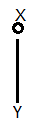
Diagram A: A regular ruling
The circle depicts the state before me, X, regarding which I am supposed to know what to do, and at the end of the branch appears the halakhic directive pertaining to it, Y. Halakhah is the line that leads from the factual state to the norm.
The problem of doubt arises in situations where we lack clear knowledge of the state X (a doubt in reality) or of the normative directive that pertains to such a state (we do not know what Y is; this is a sefeika de-dina, a doubt in law). These are states of uncertainty, and we must know how to act in them. Here the laws of doubts apply. In any case of doubt we have several possibilities and do not know which one is correct. For simplicity we will deal here only with doubts between two possibilities (which is the usual case). If the two possibilities before us have different weights, this is the law of majority (rov), discussed in the previous column. If their weights are equal—this is a state of (balanced) doubt and the laws of doubts apply. The main rule here is: a doubt in Torah law is treated stringently (safek de-oraita lechumra) and a doubt in rabbinic law is treated leniently (safek derabbanan lekula).
The decision tree of a state of doubt (I will not distinguish here between a sefeika de-dina and a doubt in reality) is as follows:
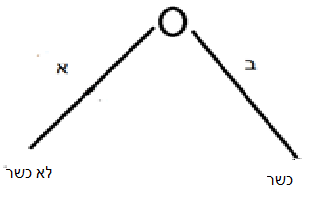
Diagram B: A regular doubt
The top circle represents the factual state about which I need to decide (the nature of the piece of meat before me). In a factual doubt I have two equally weighted possibilities: A – chelev (forbidden fat), B – shuman (permitted fat). To each I assign a probability of 0.5 (50%). As we saw above, the path from the question (the state) to the answer (the normative directive) is a route along the decision tree. Each branch is in fact a case like Diagram A, except here we have two possible branches. Note that even if the doubt were in law (in the directive), the diagram would be the same, only the top circle would be the state and the branches would depict a doubt between two rulings (and not between two factual states). But the analysis is identical, and therefore henceforth I will refer to a factual doubt.
When I know that it is chelev, I go from the top circle in Diagram B along branch A—at whose end there is an answer: not kosher. If I know it is shuman, I go along branch B—and at the end there is the opposite answer: kosher. Each of these is a simple tree like Diagram A. But if I do not know which of the two possibilities is correct, I assign each branch a probability of 0.5 (50%). Now there is a 50% chance the piece is kosher and a 50% chance it is not. Because of the laws of doubts, in a Torah law I must be stringent, while in a rabbinic law I may be lenient.
Important Reminder: Positive vs. Negative Doubt
In the previous column I noted that there can be two different types of doubt: a positive doubt and a negative doubt. A positive doubt is one that assigns equal weight to the two possibilities based on information I have about them. For example, with a fair coin there is equal chance of “heads” and “tails,” because I know the coin is fair. But there is also a negative doubt, a case where I assign equal weight to the two possibilities due to lack of information (ignorance). For example, a coin about which I have no information regarding its makeup (whether it is fair or not, and how it is biased). Here too, if I had to bet I would assign equal probabilities to the two possibilities (since I have no way to prefer one over the other), and therefore I also view this situation as a balanced doubt. But the balance here is the result of ignorance (and not of information). Therefore this is a negative doubt. In Shev Shema’tata 1:18 this distinction is explicitly made (in explaining the Rivash).
Recall that in the previous column I noted a similar situation regarding majorities. There too there are cases where I have a numerical measure of the majority (80%, 55%, 99%, etc.), and then usually this is a positive majority (based on information). But in most cases I do not have such a numerical measure. At most I can say that this is a large or small majority (in the previous column I defined three kinds of majority: overwhelming, absolute, and regular). This is a negative majority, since it is not based on clear information. I have general information that the odds lean to one of the possibilities, but nothing beyond that.
What Is Safek Sefeka (Double Doubt)?
What happens if I have a doubt about the animal from which this piece of meat was taken? If from a pig—then it is not kosher even if it is shuman; if from a cow—then it is kosher if it is shuman, but if it is chelev then not. This is a case of safek sefeka, and its decision tree is the following:
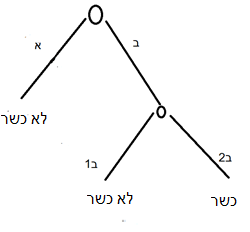
Diagram C: Safek Sefeka toward stringency
The top circle is the factual state before me, or the question: what is the piece of meat before me—chelev (A) or shuman (B)? The second circle is placed under the branch of shuman (B), at which point the second question arises (another node that also represents a doubtful factual state): is it cow fat (B2) or pig fat (B1)? As stated, if I have full information, I must traverse the decision tree according to my information. For example, if I know it is pig fat, the route is to the right at the upper node and to the left at the lower one. At the end of the route there is a clear outcome for such a case: not kosher. The same for cow fat (right, right: kosher). Chelev (left; and here it does not matter whether pig or cow—the result is not kosher).
What if I do not know the answers? Again I must do a probability calculation. There are three leaf nodes in our tree, but they do not all have the same probability. Every node along the route represents a balanced doubt (negative or positive).\[1] Therefore, as I proceed along a route, each passage through a node multiplies the result by 1/2. For example, a route that goes through two nodes (ending at B1 or B2) has probability 1/2 × 1/2 = 1/4. In contrast, a route that passes only one node (A) has probability 1/2. Thus there is a 1/4 chance it is cow fat, a 1/4 chance it is pig fat, and a 1/2 chance it is chelev (regardless of pig or cow). Therefore in such a case there is a 3/4 chance it is not kosher and a 1/4 chance it is. This is a safek sefeka toward stringency (most of the odds point to stringency, and one must be stringent).
It is important to understand that this is merely an example to illustrate the logic. Usually a safek sefeka is described by such a tree but toward leniency, i.e., a graph with three “kosher” outcomes at the bottom and one “not kosher” (where the chance is 3/4 to permit and 1/4 to forbid). Below we will discuss such an example from Ketubot. The reason safek sefeka is usually lenient is that if it were a safek sefeka toward stringency like ours, it would have no practical implications, since even a single doubt in de-oraita requires stringency; certainly when most of the odds point toward stringency one must be stringent.
One could present the same decision tree in Diagram C in a different, fuller way:
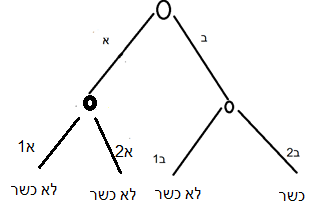
Diagram D: Safek Sefeka, full presentation
Here I presented the doubt of pig vs. cow also under the chelev possibility (A2 – cow, A1 – pig), even though there it makes no halakhic difference. The advantage of this presentation is that now each outcome has the same probability (because the path to each has two nodes). In this situation one need not calculate with multiplications; one can simply count the leaves and reach the result directly: there are three “not kosher” outcomes and one “kosher,” hence the chance is 3/4 toward stringency and one must be stringent.
Note that if the distribution of outcomes were 2–2, as in the following drawing, it would not be a safek sefeka:
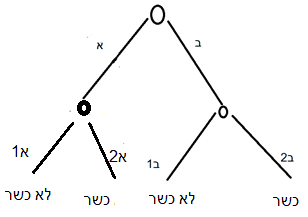
Diagram E: A safek-sefeka-like tree without multiplication, only parallels
For example, I have a doubt whether this is goat or cow, but in both there is a doubt whether it is chelev (forbidden) or shuman (permitted). Therefore here the chance it is not kosher is 1/2, and this is a single doubt rather than a double doubt. This is entirely parallel to the case of “two majorities” that is not a “majority of a majority” (ruba deruba) from the previous column. I explained there that here there is no multiplication, hence this is essentially a single majority. Likewise here there is no multiplication; thus this tree describes a single doubt, not a safek sefeka.
Safek Sefeka and Majority: A “Majority of Sides”
The commentators discuss why we allow ourselves to be lenient in a safek sefeka even in Torah prohibitions (see a survey, for example, here). Rambam’s view is that the rule “a doubt in Torah law is stringent” is itself rabbinic. According to him one could say that a safek sefeka is a rabbinic doubt and therefore we are lenient. But according to most Rishonim, who hold that “a doubt in Torah law is stringent” is itself de-oraita, the most reasonable explanation for leniency in safek sefeka is that it follows the rule of going after the majority. When we have a safek sefeka tree that favors leniency (three “kosher” possibilities), then most of the odds (0.75) are that it is kosher, and we follow the majority. This is indeed how the Rashba understands it (Torat HaBayit, Bayit 4, Sha’ar 1). The question is: why do other commentators not accept this? Seemingly there is a majority here, and the rule of majority could explain everything. One could press further: why do we even need the notion of safek sefeka if we already have the rule of majority? Consider a case of a positive doubt, i.e., where we have information that each doubt is truly 50%. In that case, in a safek sefeka there is a clear majority of odds toward leniency (75%), and then we would not need the law of safek sefeka at all; the regular rule of majority would suffice.
The conclusion that emerges is that the law of safek sefeka is relevant only to negative doubts. When the doubts are positive, there is only the rule of majority. In negative doubts there is a special novelty of the Torah that even though there is not necessarily a majority of probability, we may treat it as a majority. And indeed we saw in the previous column that in most cases of doubt (and of majority) we are dealing with negative doubts. In such a situation we do not know the probability of each of the two possibilities, and out of this ignorance we assume they are balanced. In such a doubt there is no necessity to say that there is truly a probability majority toward leniency, and therefore we need the laws of safek sefeka in addition to the laws of majority. In a safek sefeka there is one side versus three others, and we have no information about the true chance of each possibility (“side”), for it could be that the single side has a chance equal to or greater than the other three combined. But since we do not know each side’s probability, halakhah tells us to assume equal weight for each.
In a regular doubt we assume balance, and those are the laws of doubts: as if there is a 50% chance for each side. In a safek sefeka—which, as noted, applies only to negative doubts—we again count “sides.” Here there are three sides for leniency, and therefore we permit. In other words, we do indeed follow a “majority” here, but not the regular rule of majority of probabilities, since there is no such probability majority. Rather, it is a halakhic novelty that when there is no information we go by a majority of sides: in a regular doubt it is one side versus one, while in a safek sefeka it is one side versus three, and therefore we permit.
The Category of “Sides” Is Halakhic, Not Probabilistic
It is very important to grasp the logic (or illogic) underlying this picture. To that end we return to the example of chelev vs. shuman in pig vs. cow. The fact that in a regular doubt between cow and pig we assume there is a 50% chance for cow and 50% for pig is simply a rule. We have no indication that the doubt is balanced, but in the absence of other information that is our assumption. This is a negative doubt. Now we add another doubt—whether it is chelev or shuman—which is likewise a negative doubt. We have thus reached a safek sefeka (since we lack information about the distributions of both pig vs. cow and chelev vs. shuman), and as we have seen, we count sides and follow the majority of sides (which is not the regular rule of majority).
But in such a case there is no necessity to speak of four sides. The choice to split a safek sefeka and view it as four sides is somewhat arbitrary. We could just as well say there are only two sides: kosher or not kosher; that itself is a two-sided doubt, and in the absence of information we should assign equal chance to both—thus a stringent doubt. Likewise we could say there are three sides (as in Diagram C), and then the majority is 2/3 rather than 3/4. The assumption that branch A carries double the weight of the other two is based on a probabilistic perspective that lacks a true factual basis (this is a negative doubt). That is why I suggested the fuller presentation in Diagram D. There the safek sefeka has four sides, and then going by the majority toward leniency looks more natural without needing probabilistic assumptions about different weights of leaves. All paths—or their leaves—have equal weight.
Yet there are additional ways to define “sides.” Not only two or three as just seen; we could equally well split the decision tree into more sides (seven, ten, a hundred). For example, we could discuss whether it is a warted pig, a regular pig, or a giraffe; and on the permitted side, whether it is a Dutch or Australian cow, or perhaps a goat. We could debate whether it is the soft part of the chelev or the hard part, and so on. If we assign equal weight to every such side (absent information), we could reach any halakhic outcome one desires. Note this is not irrational statistically; it is no less reasonable than the choice to present a safek sefeka as a four-sided tree.
The conclusion is that splitting a negative safek sefeka into four sides is an arbitrary decision without factual or statistical basis. In positive doubts such a division does have a probabilistic basis, but as we saw, in a positive doubt there is no need to enter the laws of safek sefeka, since there we have the usual rule of majority. In a safek sefeka we are always dealing with a negative doubt. It may look like a probabilistic calculation, but it rests on a non-probabilistic foundation. The division into “sides” in the given problem is a rule—that is, a halakhic consideration—and it underlies the subsequent probabilistic calculation. Once we have the sides, we assign them equal weight and then count them as if they were probabilities. The conclusion is that the division into sides is the crux of the discussion in the laws of safek sefeka, and that is a halakhic question, not a probabilistic one. But from here on, for our purposes it is a probabilistic calculation (similar to what we saw in the previous column regarding majority and “two majorities” in agunot).
This leads us to two rules in the laws of safek sefeka that are tied to the picture described thus far.
“When the Label of the Doubt Is One”
The Gemara in Ketubot 9a discusses the husband’s claim “I found an open orifice” (petach patuach matzati):
R. Elazar said: One who says ‘I found an open orifice’ is believed to render her forbidden to him.
The husband claims she is not a virgin, and if she had intercourse during the marriage she becomes forbidden to him and to the adulterer. R. Elazar says the husband is believed and she is forbidden to him. The Gemara asks:
And why? It is a safek sefeka! Perhaps \[the intercourse was] with him, perhaps not with him; and if you say it was with him—perhaps by coercion (ones), perhaps willingly (ratzon).
The Gemara’s question shows that in the claim of “open orifice” there is a safek sefeka: a doubt whether it happened during the marriage or not (if not, she is not forbidden), and even if it did—another doubt whether coerced or willing (she is forbidden only if willing during the marriage). If so, the husband should not be able to forbid her, since in a safek sefeka we are lenient and rule she is permitted. This is difficult for R. Elazar.
The Gemara resolves this in two ways:
It is needed—in the case of a priest’s wife. And if you wish, say: in the case of an Israelite’s wife where her father accepted betrothal for her when she was less than three years and a day old.
If she is a priest’s wife there is no difference between coercion and willingness (in both cases she becomes forbidden to him), hence there is only one doubt. A second answer: her father accepted betrothal when she was under three years old; in such a case she could not have had intercourse before the betrothal because her hymen would regrow.
On Tosafot s.v. “ve’i ba’it eima” there, they ask:
If you say—there is still a safek sefeka: perhaps coerced, perhaps willing; and if willingly—perhaps when she was a minor, and the seduction of a minor counts as coercion, etc.
Tosafot challenge the second resolution (the father accepted betrothal before age three), that there is still a safek sefeka: perhaps coerced, perhaps willing; and even if willing—perhaps it was when she was still a minor, and the seduction of a minor counts as coercion (for she lacks full consent).\[2]
The tree in question is similar to Diagram C or D (which is a full presentation of the same safek sefeka as C), but this time toward leniency (there are three possibilities of permission):
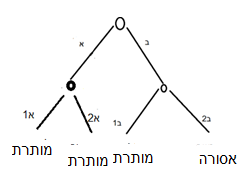
In our case the first doubt is coercion (A) vs. willingness (B); and if it was willingness, there is a further doubt whether she was a minor (B1) or an adult (B2). If we use the full presentation of Diagram D (where the second doubt appears also under option A), we get four leaves: coerced minor (A1), coerced adult (A2), willing minor (B1), and willing adult (B2). In three of them she is permitted, and in one she is forbidden.
Tosafot answer:
One can say: the category (‘name’) of coercion is one.
The case of willingness while a minor (B1) and the cases of coercion as an adult or minor (A1 and A2) are the same possibility. All these are cases of coercion, and “the label of coercion is one.” Therefore we actually have only a single doubt, like Diagram B above (option A represents the three coercion possibilities): coercion or willingness:

Hence we must forbid her as in an ordinary doubt.
The commentators take this Tosafot principle and turn it into a general foundation in the laws of safek sefeka: when the “label of the doubt is one” (shem safek echad), we view all such possibilities as a single possibility. This is, of course, based on what we saw above, that the division into possibilities (“sides”) is a halakhic matter rather than a probabilistic one. Tosafot’s halakhic consideration is that all possibilities that lead to coercion should be considered one possibility.
But if we merge all the lenient possibilities into one, does safek sefeka disappear from the world? Seemingly any safek sefeka could be collapsed into a single doubt. For example, in the original double doubt (coercion vs. willingness; during the marriage vs. not), one might say that the three lenient possibilities (coercion during marriage, not during marriage, willingness not during marriage) bear a single “name”: they all yield permission. “The label of permission is one.” But this is mistaken. Tosafot’s rule concerns the rationales, not the ruling. When the rationales are of one kind (=coercion), they are one “name.” But when the outcome is the same (=permitted), that does not unify them into a single side. When we speak of coercion, that is a rationale for why the woman is not forbidden, and different forms of coercion are the same rationale: coercion.
This is like what we saw above: one does not split the doubt into additional artificial sides (e.g., warted pig vs. regular pig). If we separated between seduction of a minor (counted as coercion) and coercion of an adult, we could equally split coercion into many different possibilities: coercion by holding hands, with or without tying, deception, etc. All these are types of coercion, and there is no reason to make them separate sides: “the label of coercion is one.” In contrast, when the norms at the end of several paths are similar (all “permitted,” or all “kosher,” etc.)—we obviously do not unify them. If we did, safek sefeka would not exist.
From this you can understand that Tosafot’s principle, “when the label of the doubt is one,” follows from the earlier description (similarly noted by R. Z.N. Goldberg in his article here). Obviously if the doubts are positive, none of this discussion is relevant. First, we saw that in such cases we do not enter safek sefeka at all; the law is determined statistically. Second, in positive doubts there is a natural division of sides and we do not need to weigh their labels: a “side” in a positive doubt is whatever has a 50% chance. If the sum of several sides adds up to 50%, they will be joined regardless of their “name.” If, say, I know that the chance that the woman was seduced as a minor or coerced is 50% and the chance that she did so willingly as an adult is 50%, then I have a balanced doubt, and I do not care that the first side is a combination of several sides. I have a balanced doubt because in fact there is 50% that she is permitted and 50% that she is forbidden. That is a statistical, not a halakhic, consideration. But, as stated, for our purposes we are dealing only with negative doubts, and there we need the rules of safek sefeka and the labels of the doubts determine the relevant sides.
Reversible Safek Sefeka
Several Rishonim and Acharonim wrote that in the rules of safek sefeka there is an additional principle: a safek sefeka must be “reversible” (mit’hapech). In their view, a safek sefeka that is not reversible is not a safek sefeka. I must note that this rule is not universally accepted (the Shach embraces it enthusiastically, but the Maharit and the Pri Ḥadash disagree), yet it is accepted by many. Here we will examine it according to those who require it.
One source is in Tosafot Yeshanim on Ketubot 9b. By way of preface: a woman who marries not as a virgin has a ketubah of a maneh (100), not 200. Therefore in the husband’s claim of “open orifice” there is a discussion both of the prohibition (whether she is forbidden to her husband) and of money (the ketubah amount). In Tosafot Yeshanim s.v. “i le-meitav,” they infer from the Gemara that regarding money the husband would be believed to reduce her ketubah. They immediately ask why the husband is believed to cause her a monetary loss—it is a safek sefeka: perhaps he is expert in diagnosing an open orifice, and even if yes—perhaps coercion, perhaps willingness. Essentially there is a doubt whether she is in fact be’ulah (since perhaps he is not expert and she is in fact a virgin), and if be’ulah there is a doubt whether coerced or willing. Tosafot and the commentators answer in various ways.
But Tosafot Yeshanim resolve as follows:
There are those who say that here it is not considered a safek sefeka, because one cannot reverse it and first say “perhaps coerced, perhaps willing,” and if willingly “perhaps …,” and therefore it is treated as a single doubt.
They argue that a safek sefeka must be such that one can switch the order of the nodes in Diagrams C and D. For example, in the earlier example one may first doubt whether during the marriage or not, and then, if during the marriage, doubt whether coerced or willing; and one can reverse the nodes—first doubt coercion vs. willingness, and then, if willingness, doubt whether during the marriage or not. Only when the nodes can be swapped is it a safek sefeka. If they cannot be swapped, it is treated as a single doubt and we are not lenient. In the case of Tosafot Yeshanim this is a non-reversible safek sefeka, for one cannot first doubt coercion vs. willingness and then doubt whether he is expert in diagnosing “open orifice”; if he is not expert, then she is a virgin and there is no room to doubt how she had intercourse (coercion or willingness). As noted, commentators and posekim broadened this to be a general principle in the laws of safek sefeka.
The logical explanation for this rule is unclear. The Rema mi-Pano suggests that since the sides of the doubt can be raised only in one order and not the other, we have a doubt about whether to present the doubts in the first order (and be lenient) or in the second (and be stringent). Since this itself is a de-oraita doubt, we must be stringent. But this explanation is not compelling for at least two reasons:
- That itself generates a safek sefeka: whether to present the doubts in this order or the reverse, and if we present them in the first order there still remains the single remaining doubt. Why not be lenient in such a safek sefeka? One can wonder similarly about those Rishonim who hold that “a de-oraita doubt is stringent” is de-oraita: why not be stringent also in a safek sefeka, since that itself is a de-oraita doubt (a doubt that perhaps we have a case requiring stringency)? Acharonim discuss this (see, e.g., Sha’arei Yosher, Sha’ar 1, chs. 3 and 19). It can be explained that if we have a doubt whether to raise a doubt, we are not obligated to raise it; the rule of stringency in de-oraita doubts does not obligate us in that meta-doubt.
- It should suffice that there is one order of doubts that creates a double doubt to be lenient. Why should it matter that there is another order where the ruling would be stringent?! It is like in a kal va-ḥomer argument: it suffices to formulate it one way to prove the ruling, even if the “vertical” formulation was refuted (see in column 537).
We will return to explaining this rule after discussing the relationship between the two rules.
The Relationship Between the Two Rules: Reversibility and “Single-Label Doubt”
The posekim cite another example of a non-reversible safek sefeka, regarding a nick (pegimah) in a shechitah knife (see the Shach in the rules of safek sefeka, no. 13, in the name of the Agur). From Chullin 10b it emerges that one who slaughtered an animal and later found the knife nicked—the slaughter is invalid and the animal is a nevelah. Some Rishonim ask why we do not permit the animal by a safek sefeka: perhaps the knife nicked during the slaughter, perhaps after (when it hit the spine); and even if it nicked during the slaughter—perhaps it was after most of the neck had already been cut (and then the slaughter is not invalidated). The answer: this is a non-reversible safek sefeka, since if we begin with the second doubt—whether the nick occurred before cutting most of the neck—we obviously cannot then continue and say that even if it nicked before most of the neck, perhaps it nicked after the slaughter.
In this example one can also argue it is a “single-label doubt.” Whether it nicked after the slaughter or after most of the slaughter—the single label is: it nicked after the stage at which the slaughter was already valid. Indeed, to the same extent we could add many more sides: perhaps it nicked after 51%, after 54%, after 80%, after 98%, and entirely after the slaughter. All these are the same side: the knife nicked at a stage where the slaughter remains valid.
This hints to the question of many scholars: why see these as two different rules at all? On the face of it, “single-label doubt” and “non-reversible safek sefeka” are one and the same rule. To strengthen this, see here that R. Akiva Eiger understood Tosafot’s answer on Ketubot 9a (“the label of coercion is one”) as meaning that it is a non-reversible safek sefeka. If we start with the doubt of coercion vs. willingness, we cannot continue and say: if willingly, perhaps as a minor—for the act of a minor is considered coercion, and thus that branch collapses back into coercion.
From these two examples one could infer that the two rules are identical. Many indeed tend to see them as two faces of the same rule. If so, there is no question why a safek sefeka must be reversible: the explanation would be the same as for “single-label doubt,” namely, reversibility is required so that we truly have distinct sides of doubt that create a majority of sides toward leniency (so argues R. Shlomo Levi at the opening of his article; he then rejects it). However, as we shall now see, this is apparently not correct.
Already in Tosafot’s Ketubot example we can see the two rules are not identical. Unlike R. Akiva Eiger’s assumption, one certainly can present the doubts in the reversed order: start with willingness vs. coercion, and on the willingness branch further doubt minor vs. adult. True, as far as the ruling goes, willing minor counts as coercion, so at the end of the paths both sides yield “permitted” (see above, Diagram D, where under branch A there is a split whose two sides have the same ruling). At most one could claim there is no point to raise the doubt because “the label is one” (both are effectively coercion).\[3] In other words, Tosafot’s Ketubot case is an example of a reversible safek sefeka—but the label of the doubt is one (all the rationales for leniency are the same rationale: coercion), and therefore we are stringent. This is not like the shechitah case, where one cannot raise the second doubt at all in reversed order—there it is both non-reversible and a single-label doubt. I will note here that also in the question I mentioned at the start of the column, the Shach’s example of a non-reversible safek sefeka in shechitah is cited, and he argues it is non-reversible because the second doubt makes no practical difference on the first branch. But as I have argued here, the lack of practical difference does not make it non-reversible. For a structure to count as non-reversible one must be unable to raise the second doubt at all (as in Tosafot Yeshanim’s Ketubot case).
Thus far we have seen that there can be a case where the label is one but the doubt is reversible (Tosafot Ketubot). Is there a case where the doubt is non-reversible but the label is not one? Shechitah is not such a case, because we saw there it is both non-reversible and a single-label doubt (the doubt is whether it nicked after the slaughter was already valid). But the Tosafot Yeshanim case in Ketubot 9b—the first case we saw of a non-reversible safek sefeka—there the label does not appear to be one. If the husband is not expert—the leniency stems from the fact that she was not intimate at all. But if he is expert and she nevertheless is leniently ruled because it was coercion—then the leniency stems from a different rationale: coercion. These are two distinct “names” of lenient sides that lead to the same norm. We saw above that “single-label doubt” applies to the rationale (the sides), not to the norm itself.
From what we have seen it clearly emerges that these two rules are not identical, and in fact they are independent: there is a safek sefeka where we are stringent because it is non-reversible even though the labels of the lenient sides are not one (Tosafot Yeshanim in Ketubot 9b), and there is a safek sefeka where we are stringent because the labels are one even though it is reversible (Tosafot on Ketubot 9a). So it follows also from the fact that there are positions which do not require reversibility, but do accept that when the label of the doubt is one it is not a safek sefeka.\[4]
I reiterate that the “single-label doubt” rule is logical and compelling as explained above. But if indeed we are right that these two rules are independent, we must still seek a separate explanation for the rule that requires reversibility. We have not yet found a satisfactory explanation.
Explaining the Rule of Reversible Safek Sefeka
We have seen in the previous and current columns that contrary to common assumptions, the rules of doubt and majority are rooted in a probabilistic perspective. The rules of safek sefeka are needed only when dealing with negative doubts (and these are the overwhelming majority of cases and examples in halakhah). In such cases we have no actual numbers describing the probabilities, and the decision to treat such a doubt as balanced is a halakhic decision, not a probabilistic one. But from that point on, for our purposes we view it as a probabilistic question described by a tree in which each node is a balanced (negative) doubt, and we must decide using probabilistic “glasses.” The chance of each outcome is the product of the probabilities at the nodes along the way. If so, we must examine a safek sefeka tree and ask what it means for it to be non-reversible. I can suggest two explanations.
First Explanation: Between Counting Sides and Probability
The first explanation follows the Rema mi-Pano mentioned above, but in a slightly different conceptual frame. Our starting point is that we are dealing with negative doubts. If so, we are essentially counting sides, not probabilities. The foundational rule that underlies leniency in safek sefeka is that a majority of sides is also a majority, even though it does not necessarily indicate a majority of probability. In a regular doubt there is one side each way, and although we have no way to examine whether there is really 50% each way, halakhah tells us to treat it as balanced and be stringent (in a de-oraita). In a safek sefeka we have three sides for leniency versus one for stringency, and therefore we go after the majority of sides and are lenient. What happens in a non-reversible safek sefeka?
The Rema mi-Pano suggested that in such a case we doubt whether to present the order of doubts in a way that yields a safek sefeka (and then one may be lenient), or in the reverse order that yields a single doubt (and then one must be stringent). He claimed this doubt itself is a de-oraita doubt and we must be stringent. But we saw above this is problematic. Here I propose a small variation. Let us view this as a doubt whether to draw a decision tree of a safek sefeka (i.e., three lenient sides vs. one stringent), or of a regular doubt (then there is one lenient and one stringent side), which for the sake of comparison we will depict as two leniencies vs. two stringencies (a more detailed presentation—akin to Diagram D above).
To illustrate, take the case of a non-reversible safek sefeka that is not a single-label doubt (this is the interesting case to explain)—namely Tosafot Yeshanim’s case in Ketubot 9b: doubt whether he is expert in diagnosing “open orifice” or not; and if expert—doubt coercion vs. willingness. In such a situation we have two ways to draw the structure. The first is to present it in the order described, yielding the following tree:
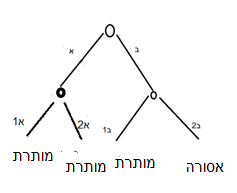
Here A represents the possibility that he is not expert (i.e., the orifice was not open), in which case the coercion/willingness question does not arise and she is permitted. B represents the possibility that he is expert (i.e., the orifice indeed was open), and then it depends on coercion (B1) or willingness (B2). There are three lenient sides and one stringent.
The second option is to reverse the order and begin with coercion vs. willingness. We saw that in such a case we cannot continue and raise the doubt of expertise (since the first doubt assumes the orifice indeed was open). Therefore here we get a single doubt (coercion vs. willingness). We will represent it too as a “double” tree, but the norms at the bottom are equally split between leniency and stringency:
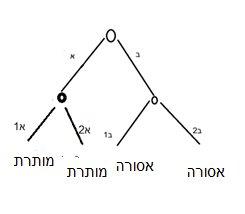
Here A represents coercion—in any case she is permitted; B represents willingness—in any case she is forbidden. There is no real possibility of “expert” (1) vs. “not expert” (2); I split each branch merely to keep the basis of comparison to the previous tree identical.
I now suggest, following the Rema mi-Pano, that we treat these two trees as two balanced options; therefore we must count all the leaves at the bottom of both. We then have eight possibilities, each of probability 1/8 (and not four of probability 1/4 as in a regular safek sefeka). We get a total of five lenient possibilities and three stringent ones. There is a majority of lenient sides, but smaller than in a regular safek sefeka (here 5/8 vs. 3/4). Now we must recall that we are comparing sides, not probabilities, for this is a negative majority (we cannot quantify the chance she was intimate before or after, or whether he is expert). But we saw that a majority of sides does not necessarily reflect a probabilistic majority, and only halakhah instructs us to treat it as an indicator of a probabilistic majority. My proposal is that, in order to accept a majority of sides as a probabilistic majority, halakhah requires a decisive majority of sides—at least 3/4 (or 6/8). If so, then a smaller majority of sides, e.g., 5/8, is insufficient, because there is a concern that there is no probabilistic majority, and therefore in a de-oraita prohibition we do not rely on it.
This is very similar to the explanation I proposed in the previous column for “two majorities.” There I explained that since this is a negative majority and we have no way to measure the probability numerically, we demand multiplication to ensure there is an absolute majority probability. The same, in essence, is the proposal described here for safek sefeka. This could be a possible explanation for why a non-reversible safek sefeka is treated as a single doubt—i.e., we cannot be lenient there.
But on further reflection this analysis is unconvincing. The reversed order ignores entirely the possibility that she was not intimate at all—i.e., that the husband simply erred because he is not expert. But clearly that is a possibility; it does not appear on that tree only due to the limitations of the description. It is therefore not reasonable to treat that tree as a balanced option alongside the regular safek sefeka tree that does present all possibilities. The tree that faithfully represents the case is only the regular one. The other is fictitious and there is no reason to account for it. Therefore there is no point in counting both trees’ leaves as if they were two possible descriptions.
The conclusion is that only the regular tree correctly depicts the case in such situations. The other tree is not genuine and we need not consider it. Still, such a tree has the property of being non-reversible, and apparently that is what prevents us from relying on it toward leniency. We must now seek an explanation for why non-reversibility weakens the case for leniency.
Second Explanation: Dependence Between Events
This explanation starts from the premise that although each node-doubt is not truly a balanced probabilistic doubt (that balance is a methodological assumption, since this is a negative doubt), from there on we view it as a probabilistic calculation. The crux of my proposal lies exactly here. In probabilistic calculations, if the order of occurrence matters, that indicates statistical dependence between the events.
Suppose we are discussing SIDS (Sudden Infant Death Syndrome). The chance that infant A will die of SIDS is P(A), roughly 1/8,000. What is the chance that two infants will die of SIDS? If the two events are independent, the chance is the product: P(A) × P(B). But if the two infants are from the same family, there may be a genetic factor affecting infant mortality; therefore, if we have seen that one infant died, the chance the second will die is higher. This is a situation of dependence between the two events (there is a factor affecting both). In such a case, the chance that both will die is not the product of each one’s probabilities (that holds only when there is no dependence), but P(B|A) × P(A), where P(B|A) is a conditional probability. If there is dependence between events A and B, it means the chance that B will occur, P(B), differs from the chance that B will occur given that A occurred—P(B|A). In our case, the conditional probability is larger than the absolute probability P(B); hence the product is larger as well. The conclusion is that if there is dependence between two events, the probability of the second changes (here—increases) if the first occurred.
Let us now return to a non-reversible safek sefeka. For the woman to become forbidden, two events must occur: (1) she is not a virgin (which is only if the husband is expert in “open orifice” and he diagnosed that she is indeed not a virgin); (2) that open orifice is the result of intercourse willingly, not by coercion. What is the chance that both will occur (that she is a be’ulah and that the act was willing)? Seemingly it is the product of the chances of each event: P(A) × P(B). But that is only when the safek sefeka is reversible, i.e., when there is no dependence between the events. If the order matters—i.e., event B can occur only if event A has occurred—this means there is dependence. In such a case, the chance that she is forbidden is P(B|A) × P(A). But, as noted, where there is dependence the conditional probability can be larger than the absolute probability P(B). It may also be smaller (there are such dependencies), but it may be larger.
The conclusion is that if the safek sefeka is non-reversible, there is dependence between the events (the nodes in the tree), and therefore the chance that the woman is forbidden could be larger than we thought. In such a case we lack certainty that the chance she is forbidden is small enough—or even that there is a majority chance she is permitted. Therefore, in such a safek sefeka we do not permit the woman. This is a possible probabilistic explanation for why a non-reversible safek sefeka does not yield leniency.
Two Reasons for Non-Reversibility: Substantive and Statistical
When we consider the example we have been using (doubt about the husband’s expertise and doubt about willingness vs. coercion), it seems this explanation does not hold water. The inability to reverse the sides of the doubt is not due to statistical dependence but to the substantive content of the events. In short, it does not appear that the chance of willingness is truly greater because of non-reversibility. Whether the husband is expert does not change the ratio of chances between willingness and coercion; it merely enables us to ask the question (if she was not intimate at all, there is no point discussing willingness vs. coercion). Therefore, in this particular case, it is implausible to say that non-reversibility changes the probabilities. The non-reversibility stems from a substantive, not statistical, matter.
This is also why I disagree with the Shach and R. Akiva Eiger, who understood that if the second doubt makes no practical difference, this counts as a non-reversible safek sefeka. I argued here that, contrary to their view, so long as one can raise the second doubt at all, it is considered reversible. A safek sefeka that is non-reversible is only when one cannot raise the second doubt at all. You can now understand why: non-reversibility has significance only if it indicates statistical dependence—that is, when the order of raising the doubts changes the probabilities of the factual possibilities (not the norms; I have emphasized several times that the doubts are about facts, not norms). In the Shach and R. Akiva Eiger’s cases, the probabilities of the facts do not change; only the norms change (their claim is that there is no halakhic practical difference between the different facts, but the facts themselves still differ). In light of the explanation proposed here, such a case is reversible.
The upshot is that only when the reason for non-reversibility is statistical does the leniency based on safek sefeka become more precarious. But regarding a safek sefeka that is non-reversible (in the facts, not in the law), even if the reason is not statistical dependence, it may be that because such a structure could exhibit dependence between events, halakhah sets a general rule: in such a safek sefeka we do not rule leniently. Thus, for non-reversible doubts, we nullify, in principle, the leniency of safek sefeka. From here on we do not inquire whether the non-reversibility points to statistical dependence or not—lo pelug.
Still, it is clear there must be cases where non-reversibility is due to statistical dependence; otherwise the entire approach has no meaning. If there indeed are such cases, we can say that we nullify the laws of safek sefeka when it is non-reversible, even if in the given case it does not stem from dependence. Are there truly such examples? Consider again the safek sefeka in Chullin regarding the shechitah knife. We saw it is non-reversible (and also single-label), and there non-reversibility indeed seems to arise from dependence between events. If I know the knife nicked before most of the slaughter, then it certainly did not nick afterward. As I move forward on the time axis, I leave behind everything that lies after the given time point. In such a case, non-reversibility appears to indicate statistical dependence. But, as noted, this is a non-reversible safek sefeka that is also a single-label doubt. The question is whether there is a case of a non-reversible safek sefeka that is not single-label and in which the non-reversibility stems from statistical dependence. For the proposed explanation to hold, it would be best to find such a case (otherwise the rule of reversibility is superfluous, for we already have an explanation for “single-label doubt,” and that certainly exists). At the moment I cannot think of an example, but I see no reason one should not exist.
\[1] It must be balanced; if it is not, the laws of majority apply. That was the subject of the previous column.
\[2] This assumes that the marital intercourse occurred after she reached bat mitzvah. That is, between the betrothal (before age three) and the marriage, more than nine years elapsed.
\[3] Indeed, R. Akiva Eiger ultimately rejects this explanation, for according to it even if she were betrothed under age twelve (not only under age three) we would have to forbid, since it would still not be a reversible double doubt by the same logic. This proves that the two rules are not identical.
\[4] So concludes R. Shlomo Levi in the cited article.
Discussion
A. Offhand, perhaps this is an artificial example of a non-reversible double doubt due to statistical dependence, and it is not “one category”: there is a mechanism that receives a piece of meat and may or may not inject it with non-kosher sauce, and only if it decided to inject non-kosher sauce does it then perhaps throw the piece into a small pot and perhaps not. In the pot there is a double doubt: perhaps no sauce was injected into the piece, and even if sauce was injected, perhaps it was not thrown into the pot. This does not look like one category. And it is not reversible, because if it was thrown into the pot then necessarily the mechanism injected sauce into it. And there is clear statistical dependence here.
B. According to your view, unlike the Shach, it may be that there is no practical difference and yet it is still reversible. If so, I do not understand why you accepted that in the case of the vertebra it is not reversible. There is a doubt whether it was nicked at the vertebra, in which case it is kosher, or not; and even if not at the vertebra, there is a doubt whether it was nicked in the latter minority, in which case it is kosher. This reverses nicely—there is a doubt whether it was nicked in the latter minority, in which case it is kosher, or not; and even if not in the latter minority, there is a doubt whether afterward at the vertebra, in which case it is kosher. And about this the Shach says that it is impossible, and once we have said “not in the latter minority,” we are forced to go backward to the former minority and not forward to the vertebra, because there is no practical difference between the latter minority and the vertebra. If so, it seems that your position is that this is in fact reversible, but only as one category.
A. At first glance you are right. But I think not. Your formulation is misleading. The doubt is whether any piece at all was injected (not necessarily the one before us) or not, and if one was injected, there is a doubt whether it was thrown into the pot or whether something else was thrown into it (and it does not matter that it was thrown somewhere else). Now let us reverse it: there is a doubt whether some kosher piece was thrown into the pot, or whether an injected piece was thrown into it. And if no kosher one was thrown in, there is a doubt whether there is an injected piece or whether no piece was injected at all. I think the formulations of the doubts here are too sloppy.
B. I did not understand. If it was not nicked in the latter minority but rather in the former one, then there is no possibility that it was nicked after the slaughter.
I did not understand part of what you wrote, and this is not the place to elaborate. But in my opinion you have no explanation for reversibility. After all, there is a side on which the doubt is doubled, so why is that not a double distance that permits? Why should I care that there is a formulation in which the doubt is not doubled?
A. I did not understand. I do not know what happened to the pot—whether a piece was thrown into it and whether that piece is non-kosher—but it is known that if the piece was thrown in, then it is certainly (or with high probability) non-kosher. Why does that not fit?
B. Why did you add “but rather in the former one”? It was not nicked in the latter minority but rather in one of two possibilities: the former minority or the vertebra.
This entire column assumes that double doubt is a kind of majority, essentially a weaker majority than an ordinary one. But the Rashba writes: “A double doubt is preferable to a majority, and perhaps its permissive force is stronger than a majority.” Do you have an explanation for that?
According to the approach taken by those many rabbis, that it is based on majority, one has to say that this is a breadth of possibilities and not a statistical majority, and in that sense one can say that it is preferable to a majority. Of course, according to Rav Shimon Shkop, whom I mentioned earlier in the comment, the understanding of the Rashba is different, and on that basis he explained his words.
A. I do not understand. It seems to me that you did not define the data well. Is there a case where there is no piece at all in the pot?
B. If it was nicked before the latter minority, then certainly it was not nicked after the vertebra.
That is not a question of stronger or weaker. It is a different kind of majority. Whether it is stronger or weaker is another question. It depends, of course, on what kind of majority we are discussing. If the majority in question is also negative, then it is really not clear. But even if it is positive, still in a majority of possibilities this way is possible and that way is possible. The decision whether this is stronger is a halakhic decision, not a statistical one.
I will only add that R. Shimon’s explanation is also mentioned in the column itself (at the end of the section on reversibility, in the first argument).
A. Yes, it is possible that there is no piece in the pot and that the piece is non-kosher or kosher, and it is possible that there is a piece in the pot and it is non-kosher. I now understand that you are probably saying that in such a case one should not have any doubt at all about the piece, but only a single doubt whether there is a non-kosher piece in the pot or not. You are right, and sorry that I did not understand you earlier. Okay, then another case. They cooked a piece in a pot, and now they are cooking a new dish in the pot. It is possible that the pot absorbs and possible that it does not, and it is possible that the piece was forbidden and possible that it was not. But it is known that if the piece was forbidden, then the pot certainly absorbs (the expert chef who cooked the piece yesterday cooks pork only in a pot made of a special material, and this special material absorbs). There is a doubt whether it absorbs or does not absorb, and even if it absorbs, there is a doubt whether what was cooked in it was kosher. But the reverse is impossible: there is a doubt whether they cooked kosher or forbidden, and even if they cooked forbidden, there is a doubt whether it absorbs or not—that is impossible, since if the piece is forbidden then it is known that the pot absorbs. Does this now seem to you like a valid case?
B. But explain to me why you add “it was nicked before the latter minority.” The first doubt is whether it was nicked in the latter minority itself, in which case the slaughter is kosher. And even if it was not nicked in the latter minority itself—that is, it may have been nicked either before it or after it—there is a doubt whether perhaps it was nicked after it at the vertebra. When one sets up the double doubt this way, it reverses nicely. There is a doubt whether it was at the vertebra or not, and even if not at the vertebra, there is a doubt whether before it in the latter minority; or the reverse: there is a doubt whether in the latter minority or not, and even if not in the latter minority, there is a doubt whether afterward at the vertebra. And about this the Shach says that to say, “even if not in the latter minority, there is a doubt whether afterward at the vertebra,” is unacceptable because there is no practical difference between the latter minority and the vertebra, and therefore the double doubt is not reversible. But according to your approach, that there is no practical difference in the fact that there is no practical difference, the double doubt is reversible after all.
I did not understand—so are you not comfortable with the Rashba’s wording, or do you have another explanation for his words?
The Rashba apparently held that it is preferable, but that says nothing about our discussion. He thinks so, and that is perfectly fine, of course.
A. I did not understand. Does the pot absorb only pork pieces and not other meat? Then there are not two doubts here. If it was pork, then it absorbed, and if it was kosher, then it did not absorb. So there is only one doubt about what was cooked.
B. In fact, this is not a double doubt but one doubt with three branches rather than two: the former minority, the latter minority, and the vertebra. Between the latter minority and the vertebra there is no difference, because in both cases the slaughter is not invalidated. The question is whether a 2/3 majority of the possibilities counts as double doubt or not. According to the Rashba, it is indeed a majority, because there is here a majority of possibilities. However, according to my suggestion in the column, perhaps one needs a significant majority (because a majority of possibilities is not necessarily a probabilistic majority).
I have already lost the thread of the discussion. What were you trying to show here?
A. You are probably right, although I still need to think about it more.
B. I am asking about the sentence you wrote: “Between the latter minority and the vertebra there is no difference, because in both cases the slaughter is not invalidated.” That sentence is a component in the Shach’s explanation for why this double doubt is not reversible (“and you cannot say perhaps it was nicked in the latter minority, and if you wish to say it was not nicked in the latter minority, perhaps it was nicked at the vertebra itself, for in both there is no concern of prohibition and it is all one”). Is this not contradicted by the sentence in the column, “The fact that there is no practical difference does not mean that the double doubt is not reversible”?
Hello Rabbi!
I enjoyed the article, thank you. I learned the entire sugya in a completely different way… I agree that the Peri Chadash, the Pnei Yehoshua, the Pri Megadim, and many others understood the law of double doubt as based on a majority of possibilities. But according to Rav Shimon Shkop, the whole sugya is explained very well and in a completely different way… I added a bit from sugyot that you did not mention.
Rav Shimon Shkop held that the Torah prohibited acting in a case of doubt only if one may encounter a definite prohibition, but in a case where there is doubt whether there is any doubt at all, it did not prohibit. If so, the issue here is not calculating the sides, but rather what reality stands before you: is the prohibition one touch away or two? And accordingly the sugyot are explained:
A reversible double doubt—one can understand the need for reversibility: if it is not reversible, the prohibition is one touch away and cannot be ignored. And the Shach’s novel point is understandable as well: where there is a rationale for where to begin, reversibility is unnecessary—because the questions are not themselves the cause of the leniency, but only a way to examine the distance. (And accordingly this answers your difficulty well, for the Shach really did not understand reversibility the way you explained it.) According to his view, many laws can be understood.
One category—the Sha’arei Yosher challenged the “majority” approach: why is one not lenient when it is all one category, if there is still a majority of cases? But according to his view this is clear—when there is only one factor causing the prohibition, it is only one touch away.
An uneven doubt—in Tosafot on Ketubot 9a, s.v. “ve-im tomar,” it is explained that if “most by will” were a full majority, there would be no double doubt but only one doubt, and she would be prohibited to an Israelite; and from here he proved that the doubts must be evenly balanced, and so too the Ritva. But the Pnei Yehoshua asked: let us combine one balanced doubt with a minority that is not balanced, and it should help on the basis of majority. But according to Rav Shimon Shkop’s approach this is clear, for one can understand why the doubts must be evenly balanced: one doubt may be decided by a majority or a presumption, and then there is no “doubt upon a doubt,” because the matter has already been decided. Therefore it must be balanced so that the prohibition still not stand before us.
A double doubt in the stringent direction—the Pnei Yehoshua asked against Tosafot: how does the woman’s presumption of permissibility help permit the wife of a kohen? There is a double doubt in the stringent direction: perhaps it happened under him, and if not under him perhaps she became disqualified? According to his view, that double doubt is based on majority; and similarly the Noda BiYehuda treated double doubt as close to certainty, and therefore one should be stringent, and so too the Mishneh LaMelekh.
The Sha’at HaMelekh permitted a double doubt in the stringent direction in a rabbinic matter—but what is his reasoning? According to Rav Shimon Shkop this is understandable, for double doubt only says that there is no need to be concerned, and therefore it is inapplicable to be stringent because of double doubt.
Double doubt against a presumption—the Rema, and likewise the Peri Chadash citing the Rashba, wrote that double doubt is stronger than a presumption because double doubt is stronger than majority and majority is stronger than presumption, and there is transitivity; and if it is based on majority, this is understandable. But the Issur VeHeter and the Taz disagreed, and according to them, when there is a contradiction between the presumption and the double doubt—such as a married woman with an established presumption, and a doubt arose whether perhaps he died or divorced her—she is prohibited; but if the presumption does not conflict, it is permitted. But if it is based on majority, why? Rav Shimon Shkop explained in the Rashba that its superiority to majority stems from the mode of operation: majority says to decide, whereas double doubt says that one should not treat it as doubtful, and therefore double doubt really is stronger than a presumption—since there is no doubt, we do not resort to the presumption, which comes into play only after there is doubt.
The Taz disagreed with the Peri Chadash and the Rema and held that even a thousand doubts do not help where prohibition has become established in the object itself, and this is now understandable, because double doubt does not make a positive statement about what happened, but only says not to regard it as doubtful—and in slaughtering one needs a positive statement that it was slaughtered properly.
Double doubt for extracting money—double doubt says that there is no doubt, and accordingly it is understandable that if there is a ketubah and there is a double doubt whether the husband is exempt, the obligation remains in place and we extract money.
Double doubt regarding something that will become permitted—in Beitzah 3b the Gemara says that something that will become permitted is forbidden even in a rabbinic doubt. The Rashba and the Shulchan Arukh held that in such a case it is permitted in a double doubt. But how can a rabbinic doubt be forbidden while a double doubt is permitted? According to Rav Shimon Shkop this is understandable: the stringency regarding something that will become permitted is because, since one can eat it permissibly later, they did not rely on doubts and nullifications. But double doubt is a mode of analysis that says there is no doubt, and therefore there is no need to be concerned with it, and so it is permitted even regarding something that will become permitted.