

A Look at Our Political-Legal Limbo: The Game of Chicken and Its Applications (Column 287)
Defying the Supreme Court crosses a red line even for someone suspicious of the Court
The column opens with the current event surrounding the convening of the Knesset and the election of the Knesset Speaker. Rav Michael notes that he usually sees left-wing talk about the end of democracy as exaggerated hysteria, even though he has no special trust in Netanyahu and even though there are precedents in the world of democratic decline. But ministers calling for disobedience to a Supreme Court ruling changes the picture in his eyes: even if the Court often leans left and sometimes rules problematically, disobeying a judgment is graver than a mistaken judgment. Here it also seems that the government is protecting mainly a sectoral and personal interest, whereas the damage in replacing the Speaker is negligible compared to the damage of turning the dispute into a power struggle between branches.
The sense of being exploited is shared by both camps and therefore drives escalation
After stating that, the column seriously presents the counterclaim: in the eyes of many, the Supreme Court exploits the fact that the government and the Knesset do not want to break the rules, and therefore allows itself to rule without sufficient basis. Rav Michael illustrates this logic through the conflict in Ponevezh, where each side is convinced that the other side is acting forcefully and that restraint would only reward it. The important point is that this feeling is symmetrical: each side sees itself as seeking peace and the other as exploiting that fact. When the picture looks like that, concession itself is perceived as legitimizing bullying, and so the road to collision is almost paved.
Halakha too recognizes situations in which the rules collapse when the other side exploits them
To show that this logic is not merely psychological, the column brings halakhic sources. In the context of the Shai Dromi law, Rav Michael wrote that when a person cynically exploits another's decency, halakha as it were freezes the protection it gives him: someone who threatens to kill unless he gets a shekel is treated as a pursuer, even though one could seemingly submit and avoid killing him; and in the words of Kli Chemdah it emerges that Zimri too could have harmed Pinchas, because Pinchas cannot hide behind the prohibition of murder in order to force surrender on him. The point is not to equate the cases, but to illustrate a principle: a normative system recognizes that sometimes the ordinary rules of fairness collapse when they themselves become instruments of exploitation.
Why the chicken game depends not only on formal structure but on the size of the loss
From there the column turns to game theory and the chicken game: two drivers race toward each other, and whoever swerves first loses. Rav Michael stresses that the standard abstraction is misleading if it treats collision as merely a low cost, whereas in reality it can be total loss, almost negative infinity. Therefore it is not enough to say that all chicken games have the same logical structure; the rational decision depends on the size of the gains and losses. The Cuban missile crisis and the nuclear balance show that at times an extreme threat is understandable because the loss in not threatening is also enormous, but if both sides present their situation as though any concession were an existential disaster, collision is almost guaranteed. In addition, players can deliberately present an inflated payoff table in order to justify a forceful policy.
The threat not to obey the Court is a small gain versus the danger of regime breakdown
Applying this to our case, Rav Michael argues that the gain the government seeks is at most political and partisan, whereas carrying out the threat could bring about the dismantling of the democratic decision mechanism. If the real table is one in which the price of collision is enormous and the harm one is trying to prevent is relatively small, one must not keep driving straight into collision. One can argue that the government is only threatening tactically and pretending that the loss from its perspective is enormous, while not really intending to carry it out; but such a threat works only if there is a real chance it will be carried out, and so even a tactical threat already draws all of us into a dangerous game. Conversely, Rav Michael's opponents can say exactly the same thing about the Supreme Court: once the threat is on the table, it too should retreat in order to prevent destruction. Therefore game theory by itself does not solve the problem, but Rav Michael's conclusion is that the threat itself is illegitimate, because it forces the Court and the state into an impossible dilemma.
Whoever keeps driving straight appears not to be weighing the good of the state properly
At the end, Rav Michael asks what one should think about a side that keeps charging ahead even when it is clear that the real table is one of destructive collision in exchange for a limited gain. In his eyes, all the possible interpretations are deeply unflattering: either it does not care enough about the state, or it gives its own interest excessive weight, or it is counting on the other side to be the responsible adult, or it is simply irrational. The prime minister's silence in the face of the ministers' threats seems to him proof that the threat was seriously placed on the table, and now the ball is in the Court's hands: if it rules against the government, we fully enter the chicken game, and if it retreats, the government profits from an illegitimate tactic. Because of the prime minister's personal and catastrophic conflict of interests, one cannot place trust in him in such a situation, and for Rav Michael this is a central reason why he must not be allowed to run the system. Therefore, despite his usual reservation about hysteria, in this case he too has a real fear for the fate of democracy.
With God’s help
In light of the many responses to the previous column, I decided to capitalize on success and ride the wave of popularity of columns that deal with logical and mathematical theory, and to address a question related to game theory that has come into sharper focus for me in light of today’s news. But have no fear, in the next column I plan to return to the discussion of the envelope paradox, which of course also belongs to the genre. So for those biting their nails, beyond the consolation that here too we will deal with theory (and critique), I would say that it is important to get used to delayed gratification.
Should one obey the ruling of the Supreme Court
For years, people on the Left have been speaking about the destruction of democracy, and about how Bibi and his associates are steadily, consistently, and systematically gnawing away at it. These fears are voiced with even greater force in days when Bibi is given very great power because of the state of emergency in which we find ourselves, and he uses far-reaching tools (such as lockdowns and surveillance of citizens, closing the courts, and the like), all this when he does not really have a public mandate (a minority caretaker government). Usually I recoil from this rhetoric, and see it as typical left-wing hysteria. At times it is innocent hysteria, and in other cases it seems to me tendentious and deliberate. It is not that I have, God forbid, even a drop of trust in that fellow (Bibi), but I do have trust in our democratic system. True, there are precedents in which a forceful takeover and the imposition of a totalitarian regime took place through a creeping democratic process (from Erdoğan and Putin to Hitler), but my firm feeling (though perhaps unjustified) is that it will not happen here. I feel that our democracy is stable and strong, and that it will not happen to us.
Today, however, it was reported that there are ministers calling not to obey the ruling of the Supreme Court regarding the convening of the Knesset and the election of its Speaker (there is already a non-identical precedent from a few months ago, and today’s events only illustrate why there may nevertheless be room for the left-wing fears mentioned above). Although this is a fairly marginal matter that does not directly harm any citizen (who cares who will be the Speaker of the Knesset?), I think a red line has been crossed here, and I must admit that I am suddenly beginning to see a danger to our democracy. The moment a government does not obey a ruling of the Supreme Court, what remains is a brute struggle for power between the branches of government, which could bring about the collapse of governance in our state. Bulldozers will be driven against the Supreme Court or the government (incidentally, in this case I would be among those going after the government).
I must say that I agree with the assessment that the Court acts, in not a few cases, in an unbalanced way in favor of the Left, but despite that, in this particular case I actually tend to its side. First, because the Court is certainly doing something legitimate, even if it is disputed. Disobeying the Court’s ruling is far more serious than an incorrect ruling on its part. But beyond that, one cannot ignore the fact that in this dispute Likud is defending its own sectoral interest and not anything public. Nothing will happen to our democracy even if they replace the Knesset Speaker contrary to the customary practice and procedure. The person who will be harmed is mainly Yuli Edelstein and Likud. By contrast, disobeying the High Court of Justice is a mortal blow to democracy. Beyond that, even if you do not agree with the substance of the High Court’s ruling in this matter, it is clear that it is not protecting a personal interest. I personally also tend to think that the High Court justices generally believe in the rulings they issue (even when I disagree with them) and do not take mistaken steps deliberately. But this is of course only my personal belief, and as I will argue, it is not important to our discussion.
To conclude the introduction, I can only anticipate the protests and accusations that will predictably be hurled at me in the comments here, about the High Court’s takeover, about how I am a bleeding-heart leftist, and of course that I would do better to deal with areas in which I am an expert and not speak utter nonsense about political matters. So there, I have saved you the trouble, and now you can keep reading and respond mainly to the substance of the matter.
The Feeling of Being Exploited: Is Esther Hayut a ‘Hater’ or a ‘Terrorist’?
Underlying all these accusations is the view that the High Court exploits all of our desire to preserve democracy, and therefore allows itself to issue baseless and irresponsible rulings. The High Court counts on the fact that the government and the Knesset will not smash the whole game (which indeed has not happened until now. The Knesset did not stand its ground even when it should and could have done so), and in this way it tries to achieve gains. According to this view, the High Court places the Knesset and the government in a situation in which there is no choice but to put the judges in their place and refuse to obey. The feeling is that it makes no sense to play fair on the one hand when the other side exploits the situation to its own advantage.
A similar phenomenon occurs at Ponevezh Yeshiva (or: yeshivot). Quite a few years ago I used to give a weekly lecture in Bnei Brak to married full-time students and yeshiva students from various yeshivot, among them boys from Ponevezh. After the lecture we spoke about the situation in Ponevezh, which had already then begun to deteriorate, and I asked them how they viewed a situation in which great Torah scholars could not reach common ground, especially since here the matter was mainly a struggle over power and money and not really over worldviews. The answer was: "Should he treat our sister like a whore?" ("Shall he treat our sister like a harlot?"). That is, everyone agrees that this is a struggle over power, but compromise or surrender to the wicked people on the other side (the Haters or the Terrorists, fill in the blank) amounts to giving a stamp of approval to coercive conduct. True, it is only about money, but why should we give in when they know that we give in for the sake of peace and exploit that in order to gain power? This is exactly the same situation as the one I described earlier. Needless to say, both sides see the situation this way. In the eyes of the Haters/Terrorists, the Terrorists/Haters are wicked people who act coercively and exploit our desire for peace (we, the Haters/Terrorists), and therefore one must not surrender. This is of course a proven recipe for a head-on collision with no way out.
Sources in Jewish law
One can even bring sources in Jewish law for this. In my article on the Shai Dromi law I noted that Jewish law freezes itself in situations in which someone uses it cynically to harm another. Thus, for example, if Reuven threatens Shimon that he should give him a shekel or else he will kill him, Shimon is permitted to kill Reuven under the law of a pursuer (rodef), even though he could give him a shekel and thereby save him (and as is well known, one is not permitted to kill a pursuer when he can be stopped by injuring one of his limbs). When the person making the threat exploits my decency, knowing I would prefer to give him a shekel in order to save both our lives, Jewish law suspends the legal protection it would otherwise give him and permits me to kill him. I noted there from the words of the Kli Chemdah at the end of the Torah portion Balak that Zimri was permitted to kill Pinchas, even though he could have stopped sinning and thereby save himself without needing to kill Pinchas. He explains that the permission for Zimri to kill Pinchas is because Zimri has a right to sin, and if Pinchas exploits the prohibition of murder in order to threaten him, he is permitted to harm Pinchas. If the right to sin justifies an otherwise unjustified killing, then the right to protect my property certainly does so all the more.
The game of chicken
The major problem arises in situations where there is no option of killing the other or harming him and thereby solving the problem. There are situations in which, if one does not yield to a threat and goes all the way, the result can be problematic for everyone. In game theory such situations are called "the game of chicken" (= chicken, coward), or "hawk and dove."
Think of two people holding the following contest. Each drives a car toward the other on a one-lane road. They are driving toward one another at speed, and the collision will cause devastating harm to both of them (say, death). Whoever swerves out of the lane last is the winner, and whoever blinks first is the loser. Each of them can ostensibly count on the other being a rational person and not allowing himself to crash and die (it is better to lose the contest than to die), and therefore he should continue driving without swerving all the way to the end, come what may. The problem, of course, is that his friend is making exactly the same calculation. If each of them is completely "rational," both will die. In this sense, this game can be seen as a dilemma, the chicken dilemma, which is very similar to the prisoner’s dilemma (see column 122).
The table that describes the outcomes for the chicken dilemma is as follows (see Wikipedia):
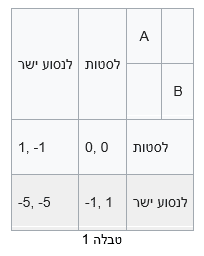
A table like this presents a game of gain and loss, and the considerations are those of maximizing payoff.
There is also a game in which the outcome table is wholly positive (the minimum is zero profit):
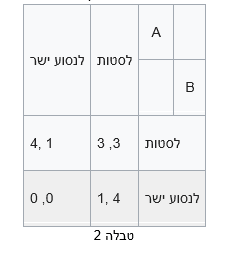
This is a game in which the maximum risk is simply not to gain. At least psychologically there may be differences between the games although the logic is ostensibly similar (behavioral game theory incorporates psychological considerations in addition to the logical considerations of maximizing gain and minimizing loss).
Back to our case
But it is clear to everyone that these tables do not correctly represent the game I described above. In the game I described, the lower-left cell expresses total loss and not merely a modest cost. What ought to be written there is -∞ for each of the participants:
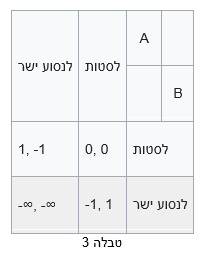
In such a situation it seems most reasonable to swerve, even at the price of risking that the other will continue straight and win. The risk in continuing straight is so great (relative to the expected gain if the other swerves) that it is unreasonable to take it.
Example: the nuclear balance
This situation appears more than once in political life and in life generally. One of the clearest examples brought in this context was the Cuban missile crisis. The American president Kennedy receives a report about the deployment of Soviet nuclear missiles in neighboring Cuba. This is a strategic threat to the United States, and the only response is to pose a nuclear threat of his own. But if he threatens to use nuclear force, a nuclear war may break out, causing devastating harm to both countries. Kennedy threatened to use nuclear force, and fortunately for him the Soviet Union backed down. This is not exactly a game of chicken, because Kennedy hesitates whether to threaten or not, and after he threatens there is a further hesitation whether to carry out the threat (without carrying it out, the threat is meaningless), and of course there are similar hesitations on the other side (how to respond to the threat). As usual, reality is more complex than the abstractions of game theory. A similar state of affairs prevailed in the nuclear balance of terror between the superpowers during the Cold War. There too, in the background, was the hesitation whether to use nuclear force or to threaten to use it (hence the policy known as mutually assured destruction).
In those cases, in issuing the threat you move onto a collision course on the assumption that the other will retreat (swerve); otherwise both of you are headed for doom. But in those cases the threat facing you is itself very great (the deployment of missiles that constitute an existential threat). Such a situation sometimes justifies taking a step (a counter-threat) that may bring about a war of mutual destruction, in the hope that we will not get there. This can be represented by the following table:
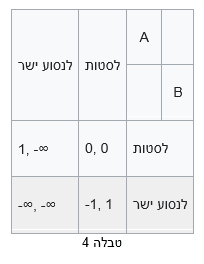
In such a situation one can understand why player B will choose the collision course, because the expected loss facing him in any event is terrible. Of course there is a risk that player A will see matters the same way, that is, that the table will be as follows:
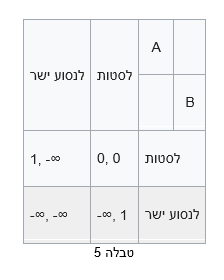
Here every reader surely understands that we are on a certain path to collision.
General conclusions
In any case where the expected gain (or the expected loss one seeks to prevent) is not so great, it is clear that one must not take such dramatic risks. This is Table 3. When, from the standpoint of one of the players, the ratio between the gains or losses changes (Table 4), the strategy he adopts will change as well.
In short, the chicken dilemma in all these cases ostensibly has the same logical structure (considerations of expected payoff, or of minimizing or maximizing damage/gain, are similar), and yet the sensible way to act in each such situation depends on the specific contents of the table (the gains and losses, and the comparisons between them). And in my view these are not merely considerations of psychology (behavioral economics), but pure logic.
However, one should note that the prices listed in the table are the players’ own assessments and not the pure truth. And sometimes the players can present, tendentiously, a table that justifies their policy decisions, even when they themselves know perfectly well that these are not the true costs. Player A may present, from his perspective, a table like 4 in which his expected loss is infinite, and thereby justify adopting a policy that leads to collision (in the hope that the other will behave like the responsible adult and will not, tactically, also present Table 4 from his own perspective, so that in practice we are in Table 5 and the result is obvious in advance).
Back to obeying the High Court
The question is how we should analyze the situation I described at the beginning of the column. The government threatens not to obey a ruling of the High Court of Justice. Its hope is for some political gain, namely the identity of the Knesset Speaker (and for the moment I ignore the fact that the gain is mainly self-interested), but the expected state of affairs if the threat is carried out is catastrophic (the dismantling of our democratic government). If the expected harm one seeks to prevent (the replacement of the Knesset Speaker) is not dramatic, and the expected result of continuing the collision is enormous (Table 3), one must not choose the path of continuing straight without swerving. But of course there is always the possibility that the government is presenting a false picture, as though in its table (Table 4) the expected harm from its perspective were enormous, and thereby justifying a policy that may lead to collision.
Assuming that the true expected harm is not really so great (and that this is posturing for bargaining and gaining advantage), it would seem that in such a situation one may threaten (in order to achieve a retreat by the High Court) but may not carry it out (because it will lead to ruin). A threat, for our purposes, is the presentation of Table 4 for the sake of achieving an advantage, while in fact it is clear to the threatener that the real table is 3. But here too there is a problem: if it is clear to all sides in advance that the threatener will not carry it out, then the threat too remains meaningless. The force of the threat derives from the fact that there is a real fear that the threatener will indeed carry it out as well (exactly as in the nuclear balance of terror and in the Cuba crisis). A tactical presentation of Table 4 may lead the player to act as if his table really were 4.
One can of course argue that the High Court, upon hearing such a threat, also cannot ignore it, and that it must not rule according to the best of its understanding and conscience, since otherwise it takes a risk of enormous damage. In this way one can justify adopting such a policy while blaming the High Court for the result. After all, the whole analysis I have offered thus far is also true of the High Court’s side. It seems to me that this is exactly what is happening here.
So once again we have returned to the same tangle. When both sides act on rational considerations—even if their tables are not really of type 4 but of type 3, and the presentation of Table 4 is done only for the sake of achieving gains—the collision is guaranteed. The question that remains is who will be the responsible adult and will not deploy the doomsday weapon (that is, who will act according to the real table and not present an imaginary table for the sake of achieving an advantage). I think that in such a situation the threat in and of itself is not legitimate. It places the High Court (and the state) in an impossible dilemma: whether not to rule according to the best of its judgment and conscience, or to take a risk of destroying our democratic regime. But needless to say, that is only my own opinion. My opponents will say, from the government’s side, the same thing about the High Court: that it should retreat in order to prevent a collision.
In short, this story does not end on the plane of pure game theory. Here we are in an impossible limbo.
Bottom line
Think now that you are in the midst of such a game of chicken (Table 3). Would any of you have conceived of not swerving? And if you saw someone who was not swerving, and who in the expected collision was going to take all of us down with him, what would you say? I assume you would oppose him and condemn him, right? And if he were to present the situation from his point of view as Table 4, would that persuade you? I assume not. It would be clear to you that this was a false presentation. That is the way I see our situation today.
For if one of the sides (the government or the High Court) sees the situation as it truly is, in the form of Table 3, there is no doubt that it must swerve and not continue on the collision course. If we see that it does not do this, and assuming it is clear that the true table is indeed 3 (and even if it claims Table 4, it is clear that this is a performance for the sake of achieving gains), then we have one of several interpretive possibilities: either, from its point of view, the expected damage from the collision is not infinite (it does not care about the state), or the true damage (from the government’s perspective—the loss of office, and for the High Court—a deviation from the law) genuinely appears in its eyes as colossal damage (crazy self-interest), or it is counting on the other (= the High Court) to be the responsible adult, and thus both harms will be avoided (contrary to its own claims, which vilify the High Court), or it is simply irrational. It seems to me that none of these interpretive possibilities reflects well on the side that continues on the collision course.
Our present situation is that the government has already raised the threat and placed it on the table. True, it did so indirectly, through certain ministers, with reservations voiced by others. But in my opinion the prime minister’s deafening silence says that there is a bullet in the chamber. The fact that he did not come out clearly against these statements undoubtedly means that they were made with his consent (at least implicitly). The ball is now in the High Court’s court. If it rules against the government, it will have put us into the game of chicken, and now we are in Table 3. If it yields and rules otherwise (assuming that in its view this would be yielding, and that this is not the correct ruling), the government will have succeeded in its outrageous policy. Now only one question remains: whether the government will carry out the threat and refuse to obey, or whether at the last moment it will come to its senses. When such interests (the fate of the government and the prime minister’s personal fate) are at stake, I would not count on a good outcome. Which should show you that one must not allow a person in a state of catastrophic conflict of personal interests to run things. Even if inwardly he is a perfectly righteous man and acts only for the sake of the state, in such a situation I cannot trust that this is indeed the case. This is the main reason why he must not serve in such a situation.
In any event, if you will forgive me for the "leftism," in this particular case I too have a real fear for the fate of our democracy.
Discussion
(It seems to me that the small number of responses to the previous column stemmed from complete agreement and from anticipation of the main column about the envelopes. When I reached the end of the previous column and saw that indeed, as promised, there was no discussion there of the envelopes, I wondered whether this might violate “Do not muzzle an ox,” etc.)
In the case of Reuven and the shekel, halakhah indeed must permit Shimon to kill, but Shimon is personally obligated to give the shekel, and more than that, so as not to stand idly by Reuven’s blood; and there is absolutely no difference between this case and a case where Reuven is dangerously ill and needs a shekel in order to be saved. Except that one can always pull out of the hat the categorical imperative that will spread as far as Damascus.
You already answered yourself 🙂
I understand that in your opinion, even in a case where Reuven put himself under duress on the last day—that is, he deliberately put himself into a situation of dangerous illness and lacks a shekel to buy medicine, and now he can no longer avoid it—Shimon is still permitted not to give him the shekel, right?
By the way, regarding delayed gratification, it seems there is a difference between postponing giving the candy until tomorrow or postponing the threshing until tomorrow, and giving part of the candy and postponing most of it until tomorrow.
Why does the rabbi call the householders in Ponovezh “great Torah scholars” ???
Okay… I indeed understood in the clearest possible way that Bibi cannot continue serving as prime minister.
Is replacing a government in the midst of a severe health crisis logical?
(Starting from the premise that Bibi is handling the crisis well)
A masterpiece of pseudo-academic demagoguery.
So many fallacies and half-truths (worse than lies) that it’s hard to choose where to begin. Perhaps the biggest problem of all is that you apparently believe what you wrote. (If not, then you’re a demagogue of the Abba Eban type, spouting nonsense in academic disguise for those in the know, and playing games that really have nothing to do with the issue.)
Democracy is not blind obedience to the rule of the High Court (even when it is right!). Democracy is also not “majority rule.” The only definition of democracy I know that holds water is Popper’s: “a regime that allows a change of government without bloodshed.” Can the rule of the High Court in Israel be changed without bloodshed? It seems to me that still yes, but I’m no longer so sure. A regime in which an unelected authority always—always and in every matter—has the final word is certainly not a democratic regime. “Everything is justiciable” is the slogan of judicial dictators.
The guarantee for the possibility of changing government without bloodshed (that is, the foundation of democracy) is a system of checks and balances and a careful delineation of the boundaries of each of the branches of government. Judicial imperialism down to ridiculous resolutions (whether to open or close the “Orient House” in Jerusalem, whether or not to demolish a row of terrorists’ houses under whose protection Tali Hatuel and her daughters were eventually murdered, ruling on what will and will not be included in the “health basket,” in the “gas framework,” and in many more matters on which the High Court has neither the knowledge, nor the tools, and above all not the authority to rule, while its judges bear no responsibility for their foolishness) erodes the principle of separation of powers. Add to that the corrupt method of selecting judges (unique to Israel), and there you have dictatorship in all its glory.
As for the game of chicken: violating a High Court ruling is not “the end of democracy,” nor is it even an early sign of it. Not in the slightest. A report by Yehudit Karp (formerly deputy attorney general) from the 1980s lists ten High Court rulings that Israeli governments over the generations simply decided to ignore, and the sky still did not fall. (The most famous of them is the ruling—repeated and tripled—to return the displaced people of Iqrit and Biram to their homes. The government decided not to, and that the High Court could go jump in a lake. That is more or less what it has been doing on this matter ever since.)
There is also a similar list of U.S. Supreme Court rulings that presidents openly ignored. The two that come to mind right now are (1) a ruling that canceled Lincoln’s order suspending the writ of habeas corpus (written by that same “enlightened” judge who wrote the majority opinion in Dred Scott…). Lincoln publicly announced that he was throwing that ruling into the trash. (2) A ruling that required the federal government to return vast tracts of land to the “Sioux Nation.” The president (I think Hoover) said, “The Supreme Court has decided; let the Supreme Court carry it out,” and did to that ruling what Lincoln did to his. To the best of my knowledge there are dozens more U.S. Supreme Court rulings that presidents ignored, and as far as I know the U.S. is still a democracy. In his monumental book (which I have already recommended to you), de Tocqueville explains why this is not a contradiction in terms (and it is rather strange that he bothers to explain the obvious).
In the paper I intended to present at conferences in June (one in Tel Aviv and one in Prague), I elaborate more on this issue, but the conferences will probably be canceled because of the coronavirus. In any case, to sum up: there is no connection whatsoever between obeying High Court rulings (especially on matters it should not have been ruling on in the first place) and democracy. It neither endangers democracy nor strengthens it. It is simply unrelated!
Oh, and one more thing. In the holy book The Little Prince, the “king” explains to the prince the secret of the stability of his kingdom (quoting from memory): “I never give an order unless I know my subjects will carry it out.” In the language of Hazal this is called: “One does not decree a decree upon the public unless most of the public can abide by it.” And it seems to me that the great rabbi Niccolò Machiavelli, of blessed saintly memory forever and ever and ever, gave similar advice to his own “prince.” In simple words: if the High Court is worried about its status, it should keep its nose out of matters that are not its own. Not everything is justiciable, and that is the whole Torah; the rest—go and learn.
Correct, so long as he did it deliberately in order to extort me. Negligence is not part of the issue.
Because that’s what they are. Surprising, but when I say something I mean what I say. That too is an interpretive option.
That is a separate question. This situation only shows that he should have stepped down from the outset. As I wrote even before the coronavirus, a prime minister to whom no credit can be given for any word or action of his, and who is always under suspicion of a conflict of interest, cannot serve. This situation illustrates that very well. Replacing him now is also not a disaster in my opinion, but as stated this is a separate discussion.
Mordechai, I didn’t mention you by name, but you surely understand that I meant you. And indeed, you did not disappoint. As I already wrote to you in a similar discussion that took place here earlier, despite my appreciation of you, especially in the area that is your expertise, I find no point in discussing demagogic, tendentious, and unreasoned claims (the comparisons you make to earlier examples are really absurd, and I hope that in the lectures you mentioned you present things in a more responsible and balanced way). Especially when it is clear to me that there is no listening. And the voter will choose.
I, for one, do not forgive the leftism. Democracy is not important. What matters is justice. And in any case this is not a democracy but a dictatorship of the High Court, which has already caused quite a few deaths because of moral principles it decided to impose on the government. And finally the ministers in the state have understood that where justice is, there is wickedness. In fact I wholly hope that the government (which at least is elected by the citizens and also bears responsibility for its actions) — in effect, the people — will rise above the court that imposes itself on the Jewish people and will appoint judges who represent the Jewish people and not some religion (the religion of democracy). It is time for this wickedness to be eradicated already.
Cautiously, I’ll say that regarding the categorical imperative, I toy with the thought that Heaven forbid you do not actually mean it, but are fulfilling your duty to publicize it in order to persuade the masses (likewise, the Holy One, blessed be He, also will not punish, Heaven forbid, in the World to Come, but is forced to promise that He will). And I am writing because in any case I have no influence (or in order to fulfill the duty of categorical protest. The rejected position was presented so well in the columns that no new arguments remain, only to voice protests in the manner of Cato the Elder). Granted, in ordinary cases it would not hurt to accept the imperative, but in Reuven’s case this is already an escalation and a danger to democracy, etc.
By the way, there is no need at all to rise up against the High Court. One simply has to ignore it. I always say that the best way to defeat the left is simply to ignore it. Not to exchange a word with it. It is simply bad company. The left is like a parasite that destroys and ruins the body that hosts it. It draws its strength from arguments with the other side. You have to ignore it and it will turn to destroying itself. The Jewish majority in this country simply needs to establish for itself (in principle, as a matter of justice; I don’t know how this is practically possible) a state of its own ((with no Arabs in it, or only those who recognize it as the state of the Jews and are decent people. And the relation to them will not be as equals but a commercial relationship. If their being part of us benefits both sides, great, and if not then they should not be part of us)) that will be the state of the Jews and of justice. Its courts will be Jewish and not an arm of the UN. It will be a poorer state and militarily weaker, but at least it will be independent, and the second state that remains (the state of the left and the Arabs that the rabbi may choose to live in) will then destroy itself on its own even without assistance from Arab states. Not a desirable situation in my eyes, but it seems there is no choice. It will be bad before it gets better.
By the way, this is true in a certain sense also regarding all the discussions here on the site with the rabbi about God’s providence. The rabbi’s approach on the subject feeds off those arguments, and on its own it has no lasting existence. I believe (actually know) that the moment all these discussions end and the whole subject becomes stale, one of two things will happen: either he will become secular (he is already on the way there now, sadly. His self-righteousness and leftism are alarming, and they are already part of the path there. I invite him to read a book called Two Wagons and a Hot-Air Balloon, which will explain this), or suddenly God will reveal Himself to him and he will see His involvement in the world, and consequently there is not much point in these arguments on the part of the other commenters here. The real question here is not whether God intervenes in the world but what we want to happen and what we will do so that God will be revealed in the world. I think the rabbi is among those who do not want God to be revealed because that draws attention away from him. He enjoys being the ipcha מסתברא—the counterintuitive contrarian (in a very childish way, it must be said. He is already a grandfather). But that is his choice and it has consequences. Whoever does want God to intervene and is prepared to act for that simply needs to distance himself from the rabbi, and that’s all.
Ailon, I’m totally in favor. So for now we’re canceling our meeting that was postponed because of the coronavirus. Excellent.
Indeed. But out of respect I did not want to do so explicitly. I really am sorry about it, but there is no choice but to part ways until this spirit of madness passes from the land. I wouldn’t even comment here on the site, but there are other readers here who might be impressed by the rabbi’s words if I don’t respond appropriately. But really, there is a limit. And the left in this country has already crossed every limit. And if the rabbi wants to be part of it (“concerned for our democracy”—what a joke. I thought that what matters is the essence: justice, not the instrument, the system of government). The current story is admittedly tiny and unimportant, but the High Court and the left crossed their boundaries a long time ago. They may not be aware of it, but they are truly on the verge of treason. I am willing to tolerate everything, but someone who does not believe in the state of the Jews and does not share with me in the common fate of the Jewish settlement in the Land of Israel (worships the idol of democracy and in its name allies himself with my enemies) — I truly have nothing in common with him. There is a limit to everything.
The rabbi needs to do some deep soul-searching. And I am convinced I am not the only one here who thinks so.
And do you really think your “appropriate responses” are so important? “The peasant women ceased in Israel, they ceased until I arose, Deborah…” and so on, Ailon?
I agree that in this specific case there is no great risk if the Speaker of the Knesset is replaced, and in my opinion the High Court’s decision here is even correct (though the whole process that Blue and White initiated to depose the Knesset Speaker at this time also seems foul to me).
Still, regarding concern for the fate of democracy, in my opinion one must at some point show the High Court that the Knesset will not obey rulings that are outside the High Court’s authority (there have already been several such cases, though this is not one of them). Precisely because of the High Court, democracy is in danger, and today we are effectively under a dictatorship of the High Court. Although disobeying the High Court is dangerous, I prefer complete rule by elected representatives over complete rule by those who are not elected. Refusal to carry out a High Court ruling is indeed necessary as a temporary emergency measure, but I agree that it is unfortunate if this tool is used precisely at the wrong time for political gain.
Mordechai,
You are mistaken. There is a difference between occasional court decisions against a stable government and a dispute over who is the sovereign authority. In the second case the dispute can deteriorate quite quickly, before people realize it, into civil war. Read a bit about England’s slide into civil war in 1640 and the United States in 1860.
With God’s help, 28 Adar 5780
“The rock-badgers are a people not mighty” (Proverbs 30). Yet “they are exceedingly wise.” And the rock-badger knows how meager its strength is, and therefore generally does not enter political conflicts, but rather “they make their home in the rock,” where they are far from the centers of influence but, on the other hand, protected from predators.
When does the little rock-badger’s great hour come? When it serves as the balance of power between evenly matched blocs, and then it dictates the “agenda.” That was Avigdor Lieberman’s power in the recent election campaigns. And most recently he “took a side” and decided to go with the left, even at the price of a coalition with Odeh, Tibi, Yazbak, etc.
But here a new balance of power has arisen: Tzvi Hauser and Yoaz Hendel, who contrary to the incorrect stereotype created by those who tell parables about the rock-badger – are small but very courageous; and your mnemonic is: Tzvi Hauser—oz, courage 🙂 From now on they determine the agenda, and on the face of it they will determine who forms the next government.
Hendel and Hauser are absolutely opposed to a minority government relying on Arabs who support terror, but their preferred option is that Benny Gantz should head the government, with Likud, Yamina, and the Haredim joining him. From their perspective there is no option at all of preferring Netanyahu. Gantz understood this, and that is what he is trying to realize.
And the beginning of his move was the takeover of the Knesset and its committees. Now he can pass a law that will forbid anyone under indictment from being a candidate to form a government, and thereby remove Netanyahu from the government (because he also cannot be a minister due to the Pinhasi ruling). Removing Edelstein from the position of Knesset Speaker could lead Edelstein to run for the leadership of the Likud, or in any event bring him to a senior leadership position in the Likud. Likud without Netanyahu could be a much more convenient partner for a coalition with Gantz.
Another effective means of pressure for breaking up the “right-wing bloc” is the left-wing bloc’s takeover of the committees. With Forer as head of the Finance Committee, Nitzan Horowitz as head of the Education Committee, and an Arab representative as head of the Labor and Welfare Committee, the situation of the religious and Haredi public and of their Torah and educational institutions could worsen to catastrophic levels, which would hasten their representatives to join a coalition headed by Gantz.
If the “right-wing bloc” stubbornly refuses to join a coalition headed by Gantz, over what the public will see as insistence on matters of “who’s on top,” it does not seem that this will add “merit points” for them, and it seems they will not dare cause a fourth election, and will be forced to go along with the outline dictated by Hendel and Hauser, who are the “balance of power.” (Unless deserters are found in “Blue and White” or “Yisrael Beiteinu” who change the picture.)
Regards, S.T.
An appropriately Zionist response 🙂
I think this is a genuine question and not mockery. I think you too agree that even someone who does not actually hold categorical imperatives must publicize that he does and persuade people of them if he has influence. It is not at all clear how a person can convince others that this is his true opinion. Therefore in cases like these the ad hominem evaporates completely and reveals nothing at all about the writer’s personal opinion. It’s just a pity that it does not seem correct to me.
In this case the High Court’s decision is not “manifestly unreasonable.” It did act contrary to the wording of the law, which allows the temporary speaker to postpone the vote until the establishment of the government, but on the other hand the High Court strengthened the right of the majority of Knesset members against the speaker, who does not currently hold his office by virtue of election.
After all, this is what opponents of “rule by the High Court” (myself among them) argue: that the High Court should be subject to the will of the elected representatives. So why should we complain about the High Court when here it did exactly what we always demand: it strengthened the power of the people’s elected representatives, by ruling that the speaker must heed the voice of the majority of the elected members and not cling to the authority granted him by law.
What can be done? A principle has to be maintained even in a case where the conclusion it leads to is inconvenient for us.
Regards, S.T.
What can indeed be argued is that the High Court is not acting “with clean hands,” for when the will of the majority runs contrary to their agenda, they will not impose the majority’s view.
Bottom line, all we can hope for is the “Big Court” [a pun on Bagatz / “the coming of the righteous redeemer”] 🙂
I couldn’t really manage to read the hateful remarks in the comments, but I have just one question:
Democracy is, by definition, rule by the people, and the judicial system is not elected, but only serves as “checks and balances.” Therefore, if there is a clash and one side has to “make room” (temporarily), priority belongs to the Knesset, which was elected by the people, not to judges chosen by a “friend brings friend” system.
I have just a comment. It is not true that a principle must be preserved even when the resulting conclusion is inconvenient to us. That is true in a general case where the other side also preserves the principle, but if I oppose theft and everyone steals from me, then certainly I too will steal. “Symmetry first,” for me, is the supreme principle, except in cases explained in previous columns where the first step is a necessary tool in order for all sides to agree to accept the shared principle. After all, you would not expect someone in favor of low taxes and low public services to pay high taxes and then use the public services only minimally.
With God’s help, ערב ראש חודש Nisan 5780
To Ailon – greetings,
In the first paragraph you determined that there is no point talking with the left, and therefore one should part from it. But in the second paragraph you concluded that even though with RMDA there is “nothing to talk about” and he is hopelessly fixed in his view, nevertheless there is still room to debate with him because of the readers who are not yet “locked in” to their position, and for their sake you should remain and participate in the discussion in order to give them an appropriate response.
And this reasoning is also correct in the argument between left and right and the like. Most of the people are neither a clear-cut left nor a clear-cut right, but something “along the spectrum.” There is almost no chance of persuading the distinctly left-wing people of the correctness of our position—but the “silent majority” in the middle can certainly be influenced. Sound reasoning can persuade many of the justice of our path, and many more, even if they are not convinced, will understand and appreciate our position.
“Rule by the High Court” stems from a situation in which there is no clear majority in the nation one way or the other. Broadly speaking there is an ongoing “tie,” with small shifts one way or the other. A real change in tendency that creates a clear decision one way or the other can come only in a long-term process spanning generations. Sometimes there is no avoiding “pounding on the table” and shaking public opinion, but a significant change in direction can come only over time, through slow influence. With patience we will win!
Regards, S.T.
And even on the left, the “anti” is not always as clear-cut as it seems in the heat of televised arguments.
I’ll take for example Meir Cohen from Yesh Atid, over whose prospective appointment as Speaker of the Knesset the country was in an uproar. I heard Meir Cohen speak three or four years ago as the guest of honor at the cornerstone-laying ceremony for the Dimona yeshiva, headed by Rabbi David Turgeman. It turned out that Meir Cohen, a resident of Dimona and formerly its mayor, is a good friend of the yeshiva head, and he spoke warmly about the yeshiva’s blessed work and social involvement, which contributes greatly to the city’s residents.
So we learn that even among those fighting “religionization” and delusional messianism—all that is out of fear of some monstrous “straw figure”—when Torah people act with gentleness and love, they know how to appreciate it. In general, a large part of the harsh and blunt expressions are said under the spotlights and to the ears of the media. When you meet them quietly “at the snack bar,” you find a completely different attitude, an attitude of esteem and respect.
And in short, as the poet said: “Our hope is not yet lost, to be one people in our land.”
Regards, S.T.
With God’s help, ערב ראש חודש Nisan 5780
Indeed, I too noted (in the postscript) in response to your comment that fidelity to the principle should also be demanded from the other side, but there is room to say that it is preferable that we remain faithful to the principle we believe in even when we are alone in this. True, “one who steals from a thief is exempt,” but on the other hand there is the reasoning of “after the thief has stolen, has he thereby tasted reason?”—and for this reason Rav Huna was required to divide fairly with his sharecropper even though the sharecropper had not acted honestly toward him.
And on the practical side:
You can fight the High Court when you have power, when “the people are with you.” But when you have only a narrow majority, let alone not even that, and when even on the right many call for respecting the High Court—then all the talk about “flexing muscles” against the High Court is empty. What cannot be changed at this stage—there is no choice but to grit our teeth and wait for better times. We are in any case in a far better situation than in exile. We live in freedom, can say what we think, and vote in elections. That is no small thing. Let us enjoy the cup that is half full 🙂
Regards, S.T.
a. Is the rabbi deriving halakhic rulings from the Kli Chemdah / stories from the Torah?
b. Simply speaking, there is an essential difference between saving oneself through one of the pursuer’s limbs and the shekel grant. Likewise stopping an act of sexual transgression. When the Torah permitted the blood of the pursuer, it is because the solution to the shedding of the victim’s blood comes at the pursuer’s expense. That is the definition. Therefore the victim does not need to defend himself or flee all his life. The solution need not come at his own expense. This has nothing to do with exploiting decency.
As far as I’m concerned, even from a rock. If he is right and his proofs are good, then the halakhah follows him. Why should I care where it is written?
Your explanation is problematic because according to it I do not have to spend a shekel to save someone drowning in a river (not at my expense).
In paragraph 2, line 4
…they are empty of substance. What cannot be changed at this stage…
I assume you noticed that I rarely comment on your columns, since I do not generally speak on subjects in which I am not an expert, especially not against someone who purports to be an expert. But when I read your demagoguery in fields that are my expertise, I wonder whether the credit I gave you in other fields was excessive?
You wrote a column consisting entirely of demagoguery; I responded with a very well-argued comment (did you read it?), and you replied that I don’t provide arguments…! Then, after several more comments, you brought as supporting evidence a first-rate Soviet-style column from Israel Hayom. Slava!
Perhaps I erred in disputing the relevance of the game-of-chicken parable (it is indeed really not relevant to the issue). So let me instead offer a parable that will clarify the absurdity of your claims.
A filibuster is a well-known and accepted maneuver in all democratic parliaments around the world. Suppose that instead of refusing to convene the Knesset, Edelstein had given free rein to a filibuster and allowed each MK to speak for a full 12 hours. Even if only the MKs of the right-wing bloc had used this, it would have completely nullified the possibility of replacing the Knesset Speaker before a new government was formed.
A filibuster is certainly a dirty and despicable trick. Even so, in no decent democracy in the world would any court (high, low, or middle) dare intervene and force parliament to stop it, despite the fact that it “disrupts the work of the legislative branch,” “thwarts the will of the majority,” and so forth, because it is legal. It stinks, but it is kosher. That’s all.
(Actually, I am beginning to wonder whether in one “democracy” in the world the Supreme Court really might intervene and allocate speaking time to each MK. Care to guess which one?)
Edelstein’s refusal to convene the Knesset before a new government was formed is legal and grounded both in Basic Law: The Knesset and in the Knesset regulations (which are themselves grounded in Basic Law: The Knesset). So perhaps this refusal is a dirty, tricky maneuver, but in the words of Menachem Begin, C’est la vie (that’s life). It is part of the political game, and the judicial branch must not have any say in this matter. Anyone who doesn’t understand that—well, I’ll spare the appropriate epithets.
And one more thing: your blind faith in Israel’s legal and law-enforcement institutions (and only Netanyahu is, in your eyes, the pathological liar…) reminds me for some reason of Bertrand Russell’s, George Bernard Shaw’s, and many others’ blind faith in the Stalinist regime. They were sure that Stalin was the sun of the peoples and the U.S. was the kingdom of darkness and terror. (Literally!). Some of them sobered up after Khrushchev’s “secret speech” in 1956, and some never did… The important point is that although Lenin called them “useful idiots,” they were not idiots at all. They were very smart people, in fact geniuses. Their problem was that they thought genius in one field proved they understood everything they thought they understood. But it does not.
And one more thing… the “judges” of the High Court openly admitted that their “ruling” (19 pages) had already been printed before they received Edelstein’s response… Even the anti-Semitic Hungarian judges who tried my great-grandfather in the Tiszaeszlár trial were more decent.
Clarification: when I wrote that perhaps I erred in disputing the game-of-chicken parable, what I meant was that the issue is complex and tangled, which allows you to parade your expertise before the masses, while it is hard for me to explain it before such an audience.
Hello Mordechai.
I wanted to continue my policy of not responding, because of the feeling that there is no chance here for an attentive conversation. You are very angrily biased, and therefore you fail (or do not want) to see very simple things. But since you continued, I thought it would in any case be better to explain why your words are nonsense.
Let me preface by saying that although I am not an expert in game theory, I do have some mathematical and logical understanding, and I think every reader understands that I make no pretension to professional expertise, and that he should read the arguments and form his own position. Unlike you, I did not ask anyone to rely on my expertise; I laid out my arguments. By contrast, you are guilty of the very thing you accuse me of, since it is you who parade knowledge and expertise as a substitute for presenting substantive arguments. The excuse is that this is not the place to lay out your full doctrine, broad as the sea, on the matter. So I leave it to the reader to judge which of us is really flaunting expertise without backing.
Your words remind me that there are foolish things so great that one can hear them only from intellectuals. Sometimes expertise itself causes a person to use the knowledge and examples he has collected in the wrong way. The tendency (commendable in itself) to formulate rules and bring historical evidence blinds the expert to seeing that this is a different situation.
I will therefore address your two messages here.
1.
Your definition of democracy is of course a bad joke. You chose a dubious quotation from Karl Popper and decided that this is law given to Moses at Sinai. Enjoy. What can one do if most of the public (and I as well) think differently from the pure truth you present. And by the way, democracy does not necessarily prevent bloodshed but reduces the likelihood of it. When people play games of chicken, they increase that likelihood even within a democratic framework. Alternatively, a change of government in a monarchy also does not necessarily lead to bloodshed; it’s just that the chance there is greater. In short, here too you are babbling tendentiously.
The separation-of-powers argument can go in both directions. In its ruling, the High Court argues that it ruled this way precisely for the sake of separation of powers. The legislative and judicial branches are also supposed to be separated, and Yuli Edelstein and his gang wanted to force something else on us. So the third branch (the judiciary) came and ensured separation between the first two. Contrary to the ridiculous declarations of Edelstein and yourself, who see this as intervention in the separation of powers, this is separation-of-powers democracy in the finest sense. This is exactly the role of the judicial branch. And if you don’t understand this simple thing, then truly you are simply unwilling to listen.
Violation of a High Court ruling is not the end of democracy, but a real danger to it. I wrote that I am concerned for our democracy; I did not write that it is certainly headed for doom. Don’t put into my mouth the hysterical left-wing rhetoric that I criticized. Even if you are biased and not listening, I expect you not to put words in my mouth.
As I wrote earlier, the examples you brought as precedents for noncompliance with High Court rulings are not even remotely comparable to the case at hand. There are several differences between those situations and the situation today. I will mention just a few by way of example (and there really are more): 1. Here it is being done for the sake of an interest, there it was done for the sake of an ideological conception. 2. Here it is being done against the will of the Knesset, and there it was done with the backing of a majority in the Knesset. That requires High Court intervention for the sake of preserving separation of powers, as I said above. 3. Here it was done in an explicit declaration in advance (“we will not obey”), and there it was done after the fact. Either they did not succeed, or they did not sufficiently want to carry out the ruling. There are sometimes constraints (obviously of varying degrees) that lead to noncompliance. That is not good, but somehow tolerable. Here there is a prior declaration that they will not obey. Do you really not see the difference? If so, hurry to an optometrist. 4. Here the public situation is tense, and the context may lead to serious harm to democracy and public cohesion. There it was a disputed matter, but such damage was not expected. Context also matters. As is known, the public today is split and the tension is very severe, and therefore the danger is much greater.
Regarding the American examples, the first, second, and fourth differences are relevant, even if not the third.
Your assumption that the High Court should not have intervened here at all is absurd. But you keep assuming it in order to explain why noncompliance here is reasonable (because one need not obey a ruling that should never have been issued). But that very point is what is disputed here. Your begging the question here is absurd.
2.
The credit you gave me is very flattering, but after reading your words I am beginning to wonder whether it is really such a great compliment.
The filibuster parable is not relevant. The question under dispute here is whether Edelstein did something within the rules. The High Court says no (and I agree with it). In their view, section 20(a), according to which the Knesset elects a Speaker, overrides such regulations or others. What does that have to do with filibusters? If a filibuster caused some law not to be carried out, they would strike that down too.
Beyond that, you ignore questions of reasonableness. True, this is a disputed doctrine, but in Israel today judicial review on grounds of unreasonableness is accepted. That is, even if the action taken is not in direct contradiction to a law or some rule, when there is extreme unreasonableness the High Court can invalidate it. One can argue about that. There is an excellent lecture by Noam Sohlberg on the subject, and I really recommend reading it. Especially since this is a conservative and probably right-wing judge (with whom, incidentally, my son is currently clerking):
https://www.gov.il/BlobFolder/news/judgespeech61219/he/%D7%A4%D7%A8%D7%A9%D7%A0%D7%95%D7%AA,%20%D7%A1%D7%91%D7%99%D7%A8%D7%95%D7%AA,%20%D7%9E%D7%99%D7%93%D7%AA%D7%99%D7%95%D7%AA%20-%20%D7%A2%D7%A8%D7%9B%D7%99%D7%9D%20%D7%A1%D7%95%D7%91%D7%99%D7%99%D7%A7%D7%98%D7%99%D7%91%D7%99%D7%99%D7%9D,%20%D7%A9%D7%95%D7%A4%D7%98%D7%99%D7%9D%20%D7%90%D7%95%D7%91%D7%99%D7%99%D7%A7%D7%98%D7%99%D7%91%D7%99%D7%99%D7%9D.pdf
This conception is an entirely legitimate legal conception, even if not universally agreed upon. And our court today tends to adopt it. If the Knesset wanted to express a position and prevent the court from invalidating actions on grounds of reasonableness, that too would be legitimate (though it would stink in my opinion), except that then it would have to legislate that in law. So long as no such law has been passed, the court is sovereign to formulate for itself a legal interpretation and position as it sees fit. I assume that beyond all the arguments, it was mainly considerations of reasonableness that led the High Court to decide as it did.
And once the ruling is legally sensible (because of 20(a), and also based on considerations of reasonableness, which is a legitimate doctrine not denied by the legislature), the court acted entirely legitimately, even if this is not necessary and not universally agreed upon (by you or in general). And once that is so, noncompliance with its ruling is a scandal that certainly endangers our democracy (see above).
I have no blind trust in any institution or person. Certainly not in the judicial system, which I have criticized extensively here as well. Even in the column here I wrote that I oppose some of their decisions and see them as tendentious actions. But of course that did not prevent you from again putting words in my mouth. Lack of listening, as we said?…
For some reason, the blind lack of trust you display toward the court (without exception and without any reservations, unlike me) and by contrast the wondrous trust in Bibi and his gang (again without reservations), apparently seem legitimate to you. I wonder why specifically my combination (limited and selective trust in the court and fairly sweeping distrust of politics) is Stalinist, whereas your dual combination (absolute sweeping distrust of the court and wondrous trust in politics) seems to you democratic, enlightened, balanced, and rational? And don’t tell me again that politics is made up of elected people and the court is not. I have had my fill of that demagoguery. That is how our system is built, and the Knesset can do as it wishes regarding the appointment of judges as well. Besides, in the present case, the politics of our elected representatives in the Knesset mostly stand with me, whereas you support a minority even within the elected political body. And I will remind you again of what, as an expert, you surely know: if there is anyone here who is highly suspect of interests and conflicts of interest, it is Bibi and his minority government, which is acting against the will of the majority of the public. And lo and behold, they are exactly the ones who win your wondrous trust (and perhaps blind trust?…). But I have blind Stalinist trust, and you have only pure reason and intellect, of course.
In general, your slide into Stalin the sun of the peoples reminds me of Godwin’s law. When substantive arguments run out, people move to demagoguery (Stalin or Hitler).
And finally, I did not read the judges’ admission, and I do not know what you meant. But even if there is such an admission, I can guess what is meant (and I am sure you can too, if only you would bother thinking a bit). For various reasons it is reasonable to prepare for cases that will come before you, if only because of the need for a quick response to a complex issue. Wouldn’t you prepare in advance? There is nothing surprising in preparing a ruling in advance, and even printing it. There would be something wrong only if, as a result of an unexpected response from Edelstein, some consideration they had not taken into account in advance had come to light (you understand that the chance of this is negligible), and yet they still would not have changed the ruling they had written in advance. Do you have the slightest shred of evidence that this is what happened here? So what is the problem with preparing a ruling in advance? How did you get from there to anti-Semitic show trials, if we set aside the tendentiousness that is really dizzying you and shutting down your common sense?
I will conclude by saying that I think that in light of my clarifications here, anyone can see that, exactly as I wrote, there is really no substantive argument in your words. There are absurdities that can be heard only from the mouths of experts and intellectuals.
And I’ll finish once more by saying that precisely because I appreciate your education and wisdom, such elementary failures and distortions as the ones you displayed here (there is not even one argument of yours that holds water, let alone one that is correct) are a clear indication that you are biased and unwilling to listen to other positions and weigh counterarguments. That is a proven recipe for absurd conclusions and for a discussion doomed to fail; that is why I thought not to take part in it.
But you managed to annoy me, and I also thought my words should be written for the benefit of the readers, who will see and judge. And pleasant will it be to the listener.
To Rabbi Michi, my words concern a pursuer. Since when is someone drowning in a river categorized as a pursuer?
Hello Rabbi, it seems to me that another consideration should be introduced into the example you gave. If this is a one-time clash, then correct, sometimes it is better to forgo the clash because of the loss that will be caused to the sides; but when it is a case that may reasonably recur dozens more times, then in that case the concession too will cause great cumulative damage, even though at the present moment the concession causes less damage, and that changes the picture (somewhat like the Ran’s remarks on whether it is preferable to eat non-kosher meat or to slaughter for a sick person).
One can argue whether this indeed will happen many more times or not; in any case it seems to me that most of the opponents think this is not a one-time injury, but something ongoing that is worth absorbing damage for.
Obviously, but according to your view there should not be any difference.
A correct point.
Wow, that was long, but certainly tendentious, full of distortions (at best), and wonderfully incoherent—fulfilling what was said, “whoever disqualifies others…”
Indeed, I clarified that I erred in getting into an argument over the game-of-chicken parable because the issues are too complicated for this forum. And still, I explained that there is no “game of chicken” here because no catastrophe will occur from the “clash of civilizations” between government/parliament and the court; for that I brought the historical precedents from Israel and the U.S. (meanwhile, a friend of mine, a lawyer by training, told me there are hundreds more such precedents from all the democracies in the world). Modeling the situation as a game of chicken is pure demagoguery.
You are certainly entitled to disagree with Popper, but while you protest that I put words in your mouth through no fault of my keyboard, don’t do to me what you hate. Neither he nor I claim that democracy prevents bloodshed. (What on earth?) What he proposed was a definition of democracy as a regime that permits a change of government without bloodshed. Whether or not such a regime exists is an empirical question. That has nothing to do with the definition. (Strange that one has to explain that to you.) True, democracies do apparently tend to fewer upheavals and civil wars, but that is not the point here. I did not “decide” that Popper’s definition is Torah from Sinai; I noted that it is acceptable to me (and of course I could not lay out his whole doctrine in a talkback). On the other hand, you, for some reason, decide that if the High Court claims it is acting for the sake of separation of powers (while in fact it is usurping from them more and more powers never granted it in any law), then that is Torah from Sinai. Nu, fine.
The differences you listed between violating High Court rulings here and there are simply incorrect. (Embarrassing.) The violation of the Iqrit and Biram ruling stemmed from the fact that kibbutzim and moshavim had meanwhile taken over their lands. That is, it was for the partisan interest of Mapai and Mapam, not because of “ideology.” Nor did it receive any backing in the Knesset, though perhaps it was done after the fact (I think not, but one should check). Lincoln’s violation of the U.S. Supreme Court ruling was declared in advance, was not done for any “ideology,” but in order to allow him to liquidate political rivals (many were executed without trial), and it received no backing in Congress (Lincoln simply did not ask it). The same applies to the ruling on the “Sioux Nation,” which Hoover violated (if indeed it was Hoover; I don’t remember). Your fourth argument, “the public situation is tense,” is, how shall I put it gently, utter nonsense. The public situation was “tense” in all the hundreds of precedents in which the government/parliament thumbed its nose at a Supreme Court ruling. That is exactly the point: when “the public situation is tense” (Rashi: when the matter under discussion is political rather than legal), the court must not intervene in it in the first place. Not everything is justiciable. For some reason you decide, like one prophesying in the name of Omnipotence (=Aharon Barak), that “everything is justiciable,” and therefore casually determine that my assumption that the High Court should not have intervened is “absurd” because I am “begging the question.” Be healthy and strong.
The High Court did not argue that Edelstein violated the law (because he did not), but that it was not “reasonable.” Indeed, I think the doctrine of reasonableness is illegal because it is not anchored in law and judges are not more “reasonable” than other mortals. I’ll read Sohlberg’s lecture another time, but I know Barak’s and others’ doctrine on this and doubt he will teach me anything new. The fact that he is “right-wing” is irrelevant. He is a member of a body that accumulates power and is therefore biased. (And best of luck to your son.) In any case, this conception is not legal and not legitimate at all, despite having been joyfully adopted by activist, power-drunk judges in Israel and abroad. Now will you again complain that I don’t justify everything in a talkback? Then I’ll refer you to the writings of Richard Posner, Antonin Scalia, and other great jurists of the world.
I am glad to discover that you do not have blind trust in the judicial system (sorry, but I haven’t read all the columns you posted on this site; I’m not even sure I’ve read most of them). I responded to what you wrote in this column, in which you displayed toward them a trust that reminds one of a battered woman. On the other hand, again you put words in my mouth as though I place blind trust in Netanyahu. I never voted for him, and I have sharp criticism of many aspects of his policy, both in the diplomatic sphere and in the economic sphere. What does that have to do with the judicial putsch the left concocted against him in collaboration with corrupt prosecutors and judges? And what is more ad hominem than to claim that I place blind trust in Bibi and therefore am biased and tendentious?
And more demagoguery, and even a gross lie. Bibi is not a minority prime minister—unless you count the irredentist fifth column as a legitimate integral part of the population of Israel and the party of terrorists and spies as a legitimate party in the Knesset of Israel, while ignoring the explicit commitments of Blue and White and Yisrael Beiteinu on the eve of the election not to rely on it. But if so, then truly there is no possibility of any dialogue between us. Happy holiday.
Well, as expected there is no point in discussion. The voter will choose.
Mordechai,
If Edelstein had not backed down and had remained in the position of unelected Speaker of the Knesset, who should have arrested whom for sedition—Edelstein arresting Hayut, or Hayut arresting Edelstein?
“And the voter will choose”? – Go again to elections? Oy oy oy 🙂
Regards, the grumbling voter
A general suggestion, R. Michi: before you express an opinion on a certain subject, at least read the bare minimum basics of the subject.
From between your lines it is glaringly obvious that you read neither the High Court ruling nor Mr. Edelstein’s letter rejecting the proposal.
Correct me if I’m wrong..
P.S.
I appreciate you very much and enjoy reading your words. I have one single central criticism of you, and it is that you express opinions on many subjects where your knowledge approaches zero and you do not investigate them thoroughly.
In everything else (critical thinking, analysis, logic, and much more), you are simply terrific, truly.
A good suggestion, but I don’t always have time for it. I read about them, not the texts themselves. If you have a specific claim—you are welcome to correct me.
With God’s help, Rosh Chodesh Nisan 5780
What should be asked about Lapid and his associates is this:
I understand that they were in a hurry to take over the Knesset, as I explained above that this would give them effective means of pressure to collapse the “right-wing bloc.” For that purpose they did something unprecedented: appointing committee chairs only from the left-wing bloc, with extra care taken to place at their heads the most extreme and bluntest of them. Of course I understand the president of the High Court, who was delighted at the opportunity to carry out the governmental upheaval quickly, something that accords well with the principles of Israel’s heritage, which state that “the zealous hasten to perform mitzvot” 🙂
What I do not understand is their “zeal” to humiliate the outgoing Speaker of the Knesset to the fullest. Edelstein found a solution that would preserve both the honor of the High Court and his own honor, and announced his resignation, which made it possible to convene the plenum on Sunday and elect a Speaker of the Knesset as they desired.
So why is it burning in them to petition the High Court demanding that it order the resigning Speaker of the Knesset to convene the plenum immediately? Can they not restrain themselves and wait a few days? Must they humiliate the defeated person to the fullest?
And why are the High Court judges so eager to hold an “urgent session” immediately to discuss the petty demand without any delay, Heaven forbid 🙂—at a time when all synagogues are closed and on the Seder night people will not be able to recline with grandparents for fear of the coronavirus—“your elders and your judges” 🙂 gather to stop the “terrible danger” to democracy that would be caused by postponing the vote until Sunday. A real matter of life and death 🙂
What is good about this ridiculous and absurd situation is that the left and its hangers-on are exposing more and more of their abysmal hatred, and making themselves more and more loathsome to the public. As they say: “In Nisan Israel became repulsed,” and from that, with God’s help, there will also be fulfilled “In Nisan they are destined to be redeemed.”
Regards, S.T.
With God’s help, 1 Nisan 5780
Since the law explicitly states that a judge’s term of office is conditioned on a declaration of loyalty “to the State of Israel and its laws,” it would seem that a judge who declares that a certain law enacted by the Knesset is invalid has thereby nullified his declaration of loyalty “to the State of Israel and its laws,” and thereby ceased to serve as a judge…
Regards, S.T.
Reuven, in light of your words I began to worry that perhaps I had missed something. I went and read the entire ruling. I found nothing there that contradicts what I wrote. On the contrary, what I wrote is an accurate description of Justice Amit’s words and also partly of the others’. I was definitely even more convinced of everything I wrote. The main point was that the ruling strengthens the separation of powers (executive and legislative), contrary to the claims of Edelstein and his interested friends. And in addition, that section 20(a) overrides the Knesset regulations—exactly my two claims here.
I am still waiting for your comments explaining where exactly I missed something.
For anyone interested, the ruling can be seen here:
It seems to me that the decision now made in the dead of night (just a reminder—how much criticism Ohana got for a decision he issued at 1 a.m.)
is the removal of all restraints in the war on the part of the High Court. Now it is already permissible to repay them doublefold.
How much tendentious nonsense can people pile onto them? There was an urgent petition because Edelstein violated a High Court order. So they issued an urgent decision. That’s all. Bias distorts people’s thinking, and because of it they are unable to think in a balanced way and rise a little above hatred and political biases. It really is frustrating.
Here the judges themselves explicitly write in last night’s ruling one of the distinctions I presented to Mordechai:
Last night the Supreme Court judges published their decision. “Indeed, in the past we have known cases in which government authorities ‘dragged their feet’ in carrying out court orders, as well as cases in which they did not comply with those orders because of claims about difficulty in implementation or enforcement, or because of the need for preparation. But never until today in the history of the state has it occurred that a governmental body openly and defiantly refused to comply with a judicial order, saying that its order of conscience does not allow it to carry out the judgment,” the judges wrote.
Well, they are of course liars and devoid of professional knowledge, which is found only with our own Mordechai. Wonders of tendentious reasoning.
Taken from here:
https://m.ynet.co.il/Articles/5701621
How does the rabbi see this as fitting my approach?? Where is Officer Doron when needed?
“My approach” is that the Torah of truth applied the law of pursuer to (and here comes the surprise) a pursuer only. Not to someone who is about to die. Even if he is in a river. On the contrary. One must spend from his own money for the sake of fulfilling a commandment. Shedding blood is an ideal solution only where there is intent to shed blood on the other side. Whence comes the rabbi’s distortion of my words?
Why, when the solution comes at the victim’s expense, did they permit killing? A scriptural decree? Where is that written? Why shouldn’t he give him a shekel and thereby save a life and avoid the prohibition of murder? And if not, that means life is not worth a shekel. So in rescue too I need not invest a shekel to save a life. By contrast, on my view, halakhah is suspended when there is malicious intent to exploit it.
That’s it, as far as I’m concerned we’ve exhausted this.
At first I didn’t understand how the rabbi can issue halakhic rulings “as far as I’m concerned, even from a rock,” in his words. Now I understand.
One quotation (out of many) from this delusional ruling: “But this hope—shared by all of us—cannot constitute a reason for the Knesset Speaker’s refusal to bring to a vote the election of a permanent Speaker of the Knesset, because by doing so he places at the heart of his refusal
a political consideration concerning the formation of a government—whatever its composition may be. Such a political consideration has
no place within the sphere of discretion entrusted to him on the question whether to include or not include agenda items in the deliberations
of the Knesset plenum, and all the more so when it concerns the election of the Speaker of the Knesset himself.”
What a heap of nonsense. The Speaker of the Knesset is a political figure elected in primaries and in general elections, and therefore one certainly expects him to weigh political considerations. He is the chairman of the political house of the state. This is unlike judges, who are supposed to be politically neutral yet twist and mutilate the law according to their political agenda.
In general, throughout this “ruling” the judges do not point to any contradiction at all between Edelstein’s actions and any section of any law. All they determine is that he is mixing in “political considerations” (which, in their opinion, for some reason are forbidden to him despite the fact that he was elected to the Knesset as a politician) and that this “deviates from the sphere of reasonableness.” They forgot only one thing to explain: who appointed them as the commissioners of reasonableness for the state? In what section of what law were they given this authority? (Hint: nowhere.) Moreover, Edelstein’s desire to leave a chance for a national unity government is certainly a legitimate political consideration (whether or not it is politically correct).
Their claim that a Knesset Speaker is usually elected at the first sitting after the swearing-in of the Knesset is, how shall I put it gently, a gross lie! As is the lie that the High Court judges are anxious about the “rule of the majority” of 61 MKs, while they themselves many years ago arrogated to themselves the authority (which was not granted to them in any law) to invalidate laws passed by any majority whatsoever on the basis of a distorted and false interpretation of the Basic Law: Human Dignity and Liberty, which was passed in the Knesset in a vote attended by… 34 MKs!
I could go on analyzing this delusional and deceitful “ruling” without leaving one stone standing upon another, but that would be long and burdensome. I will confine myself to responding to only two things:
(a) In response to the fact that the judges themselves admitted that they wrote the ruling before receiving the response of the subject of the petition, you wrote: “For various reasons it is reasonable to prepare for cases that will come before you, if only because of the need for a quick response to a complex issue,” etc. etc.
I refrained from responding to this yesterday because the words stunned me and I feared I had misunderstood. This is really a gem! A rabbi who serves as a judge justifies staging a show trial and writing a ruling before hearing the response of the subject of the petition. Unbelievable. Have you gone completely mad? Have you heard of “Hear your brothers”? Is this also how you conduct yourself in court? And if “the issue is complex,” doesn’t that imply that the response cannot be “quick” but requires study, moderation, and judgment? (“Be deliberate in judgment.”) What was so urgent and important about issuing a ruling that same evening? What will happen if the election of the Speaker is delayed by a day or two, a week or two, but real justice is done rather than a staged performance?
(b) Indeed, the judges are lying deliberately and brazenly. I mentioned Yehudit Karp’s report (formerly deputy attorney general), which listed ten High Court rulings that the government openly and defiantly ignored, the most famous of which is the ruling on Iqrit and Biram, to which the High Court was required to return three times (!!!) in the face of the government’s blatant and defiant refusal to carry it out. They don’t know this? I have just now recalled also the ruling against the Jerusalem Municipality requiring it to prevent gender separation in the streets of Meah Shearim on festival days, and the municipality simply openly ignores it. There are many other examples. Likewise, there are several precedents of public figures who resigned following a High Court decision so as not to do something contrary to their conscience, and this is accepted throughout the democratic world. (The example that comes to mind right now is Minister Yitzhak Peretz, who resigned after the High Court required him to register a Reform “convert” as Jewish.) It is not that I am wiser than the High-Courtists, but they are not very wise either (I knew some of them in the course of my previous work), and above all—they are great liars.
But when you are right, you are right. Wonders of tendentious reasoning…
Unbelievable. No words. (“Even he would withdraw and weep…”)
With God’s help, Rosh Chodesh Nisan 5780
To Mordechai – greetings,
What “set off” the High Court judges was that Edelstein said with his mouth that he was not willing to comply with their “ruling.” Thumbing one’s nose by way of silent disregard—they gave that their “seal of approval” 🙂
Edelstein’s refusal, expressed in a respectful and reasoned manner, while showing readiness to take responsibility and resign, and including entreaty and request that the judges take his feelings into account and not force him to do what was contrary to his conscience—gives the refuser “merit points” in public opinion, and that irritates them…
Even so, in the end the judges refrained from insisting that he himself, personally, convene the plenum in the time remaining before his resignation took effect, and they bypassed the problem by allowing the appointment of a temporary speaker even before the end of his term.
With blessings for a good new month, S.T.
Correction: I now saw that someone else also mentioned the ruling on the “Sioux Nation,” and according to him the president at the time was not Hoover but Andrew Jackson, and the precise quotation is “Marshall has decided; let Marshall enforce it.” (On another occasion I’ll check whose memory is more accurate…). Marshall was the Chief Justice of the U.S. Supreme Court, who suffered from severe urological problems (the channels of the yellow fluid were connected to his brain…). It seems to me this is the same Marshall whom, in another case, President Jefferson threatened with impeachment, and he immediately folded! And since then the U.S. has not been a democracy…
And while we’re at it, two warm reading recommendations:
1) Men in Black by Mark Levin, about the exploits of the U.S. Supreme Court.
2) The Purse and the Sword by Prof. Daniel Friedmann, about the exploits of the Supreme Court in Israel.
I deliberately did not add to the list The High Court Party by attorney Simcha Rothman, since I have not yet managed to examine it…
There is political refusal that is meant to frustrate the implementation of the decision of the competent authority, and that is much more problematic for the rule of law.
By contrast, “conscientious refusal” does not frustrate the implementation of the lawful instruction. The refuser says that he himself will not be the one to carry it out, but he does not cause the instruction’s implementation to be thwarted, since others can carry it out.
Edelstein’s words were not even “conscientious refusal,” since before the final deadline allotted to him he announced his resignation, while there was enough time for the “Arrangements Committee” to appoint an MK as temporary speaker (following the Knesset legal adviser’s view), and the substitute temporary speaker could have held the vote within the allotted time.
The impediment to carrying out the vote that very day was created by the hesitation of the legal advisers regarding appointing a replacement speaker within the 48 hours between the resignation and its taking effect— a delay not due to Edelstein.
Regards, S.T.
It seems that the urgency in replacing the speaker stemmed from Gantz’s negotiating considerations. Netanyahu insisted that the post of justice minister not be in the hands of “Blue and White” but be given to a neutral person such as Professor Ruth Gavison. Once Netanyahu saw that “the evil of the decree had come to completion” and that Likud was about to lose the speakership of the Knesset, he “folded” and agreed that Hili Tropper of “Blue and White” would be justice minister.
The mention that the decision was given in the dead of night was only as an anecdote.. (because of the mobbing Ohana took)
I meant the substance of the decision—to run the Knesset through the High Court… an escalation of pushing through a breach without law.
For that one must repay them doublefold. In your opinion, is there justification for their decision???
Israel is a relatively new state, many of whose inhabitants came from totalitarian countries or were born into a pseudo-democratic consciousness in which the party—whether Mapai or Likud—is the state, or even the head of the party is the state. Politicians who act only for the interests of their party and not for the good of the public as a whole are unworthy of holding positions of state responsibility.
What especially needs to be fixed is a separation between the executive and legislative branches: the legislature and the prime minister should be elected by the people, while the ministers of the executive branch should be chosen by the prime minister according to the professional requirements of each post. For example, a senior figure in the security system as minister of defense, a successful economist as minister of finance, an experienced diplomat as foreign minister, a physician and highly experienced administrator as minister of health, a man of kindness with a long record of accomplishment as minister of welfare, a rabbi with influence and broad public acceptance as minister of religion, a successful educator as minister of education, a retired judge as minister of justice, a man of letters as minister of culture, etc. In this way the legislature would enact laws in accordance with the public will and supervise the work of the government, while the government could work professionally and for the good of the public as a whole.
Then next time don’t present a side point as the center of the discussion. As for your actual claim, the High Court is obviously right. Very right indeed. The High Court is not fighting the Knesset but protecting it from takeover by the government. Its ruling preserves the separation of powers and does not harm it. I already wrote that. The Knesset is not being run by the High Court. That is just demagoguery. The Knesset is a collection of nonentities who know only how to whine. They can always legislate whatever they want and circumvent the High Court (an override clause and the like), and they don’t do it—they only whine. And why don’t they do it? Because there is no majority for it. The whining comes from a minority that wants to rule the majority. And that is exactly what the High Court is fighting, and very well too.
That does not mean that its other decisions have not been flawed. Of course they have, and I mentioned that in my remarks as well. But here they are one hundred percent right. And it is time that people stop thinking from the gut and start thinking with the head. And stop imposing their political-ideological outlook on every discussion. It distorts thinking and cripples the ability to conduct a discussion.
With God’s help, 1 Nisan 5780
It seems that out of the strong something sweet is going to come. Benny Gantz has freed himself from Lapid’s grip and set out on an independent path that will add brotherhood among the people in these difficult days. There are excellent people in Hosen LeYisrael, opinionated and capable of execution, who once freed from the path of hatred and extremism to which Lapid dragged them—have much to contribute and offer Israeli politics.
I also hope that the members of Telem will pull their leader Moshe Ya’alon back to the royal road of the moderate right. Lapid and Meretz will function vigorously as a tough opposition, which will be beneficial as “watchdogs” of democracy, but the mainstream will operate with greater respect and mutual understanding.
By his courage Benny Gantz has shown that he is worthy of stepping into the broad shoes of Yuli Edelstein as Speaker of the Knesset, and perhaps in the future, after “serving the sages” with the experienced Netanyahu, he will also be fit to contend for the premiership. May the son of Kfar Ahim help restore to the people of Israel the consciousness that they really are “brothers.”
Regards and with hope, S.T.
There are also important people from “our” side who agree with the High Court in this case
https://www.inn.co.il/News/News.aspx/431232
And as I suggested reformulating the “Anna Karenina principle”: those “who resemble one another,” who see their “common denominator” with others—connect easily with others, and are therefore happier. By contrast, those who emphasize the difference and distance between themselves and others—find it hard to connect with others and are therefore less happy.
May it be His will that we be among those who are connected and happy.
Regards, S.T.
Mordechai raised two claims that I didn’t understand how you answer.
1. In other democracies (and also in Israel) there were serious conflicts between the court and the house of representatives, and they did not end in the end of democracy, so it is reasonable to assume that now too democracy will survive (perhaps he argues that in charged matters these power struggles are normal).
2. The ruling is based only on a consideration of reasonableness, and the court should not be exercising that consideration, certainly not vis-à-vis the Knesset. (I assume this is an argument that stands on its own regardless of the question of the end of democracy.)
My questions are:
1. What is the dangerous scenario—where exactly would things deteriorate to? (This is really the basis for comparing different situations and for analyzing the situation itself.)
To the first claim you answered that the situation here and now is different because it is a private interest, because there is no backing of the Knesset, and because the public situation is tense.
2. Without getting into the question of reality (what happened in those cases), why does it matter what the interest is? Is noncompliance likely to lead to absolute rule by the Knesset somehow better if it is for ideological reasons? What is the reasoning regarding a tense public situation? Why, if there is no backing in the Knesset, is this a greater danger to democracy? On the contrary, if there is no backing in the Knesset, then in another week or two the Knesset will convene and put the court back in its place.
3. If we assume those distinctions did not exist—would you then accept those cases as evidence, or was there indeed then a danger to democracy and it overcame it?
To the second claim you answered that it is accepted to rule this way. Why is that an answer? That is the substance of the claim. And does the fact that they haven’t stopped the court until now justify ruling unlawfully? (Unless you think that this is in fact the law, in which case the answer should be a reason why the court has such authority.)
I have the impression that you did not read what I wrote, or that you too are entrenching yourself in your position and refusing to see what is in front of you. I explicitly answered those two questions.
1. When speaking about a threat to democracy, this does not mean that if the thing happens democracy necessarily collapses. By the way, I explained this in my remarks. My claim was that such a step is dangerous because it contributes to the undermining of democracy. I did not say that immediately afterwards we will no longer have a state. That is an infantile reading of what I wrote. Countries also went through the Holocaust and plagues and remained alive, so are the Holocaust and plagues not a threat?
2. I answered that as well. I explained that reasonableness is a legitimate doctrine of the court, even if not a necessary one. And if the Knesset objects, let it legislate a law against it.
In the rest of your questions I did not see anything new, or I did not understand them.
One of the explanations for Benny Gantz’s surprising change of position is that a poll was shown to him according to which support for “Blue and White” would shrink if there were a fourth election. See the article “The poll that deterred Benny Gantz” on the Arutz 7 site.
Regards, S.T.
With God’s help, ערב שבת קודש “wholeness—those who bring peace” 5780
To M80 – greetings,
Our problem is not one system of government or another. The problem is the great polarization resulting from existential disputes in which there is no clear decision—whether disputes between liberalism and tradition, or disputes over peace versus security and the wholeness of the land. Jews are a people of strong opinions, each believing in the justice of his own path and its necessity, and it is not easy for us to bend ourselves to a different decision, especially when it is made by a narrow majority.
The best thing would be to have a “mediating authority” that would reduce and soften the disagreements, emphasize and define the many points of agreement, and strive to reach agreed understandings as much as possible. It is no accident that we need not only “our judges” to decide disputes, but also “our counselors” who will strive to arrive at the “golden mean” that minimizes disagreements.
Regards, S.T.
And how terrible was it when the prime minister thumbed his nose at a final High Court ruling and did not evacuate Khan al-Ahmar? (True, about a year ago they accepted his petition to carry out the evacuation after a government was formed, but for a decade already this village should have been blown away—so what happened, or didn’t happen, until then?)
That really was not okay, but the distinction was explained well above. I hope you are not among those who, because of emotional biases, are unable even to notice that the subject has been discussed, let alone read and understand. There are a few such people here.
According to your logic, it was a real mistake by the United States government when they ignored Supreme Court rulings not to free slaves.
From Wikipedia
Many of the runaway slaves who were captured suffered harsh and cruel punishments such as amputation of limbs, floggings, branding with a heated iron, and other similar punishments.[5]
Citizens who aided runaway slaves were brought to trial and punished under the law. In a case that reached the U.S. Supreme Court in 1859, Sherman Booth was charged with helping Joshua Glover escape by preventing his capture by federal marshals in Wisconsin. The Wisconsin Supreme Court ruled that the Fugitive Slave Act of 1850 was unconstitutional because it required states to act contrary to their own laws, which allowed protection for slaves. An appeal to the Supreme Court upheld the constitutionality of the law.
With God’s help, 2 Nisan 5780
To Tuvia – greetings,
Interesting that the U.S. Supreme Court did not take into account the Bible law that forbids handing a slave over to his master—and after all, the Bible is sacred to them?
One of the derivatives of the Torah’s aversion to slavery is the halakhah that “a worker may withdraw even in the middle of the day.” Since the Foundations of Law Act obligates the courts to interpret the laws of the state according to “the principles of freedom, justice, equity, and peace of Israel’s heritage,” the court should have ruled that a speaker who has resigned cannot be compelled to continue managing sessions of the Knesset. The 48-hour delay before the resignation takes effect is intended to ease matters for the resigning worker and allow him to retract his resignation, so as to protect him from a hasty step; but so long as he has not retracted it, one must not compel a worker to do labor that he has come to loathe. Office is servitude, and there is no basis to compel one who has resigned to continue his servitude.
Regards, S.T.
Tuvia,
Absolutely. That was wrong. What they should have done was change the law, not impair the authority of the U.S. Supreme Court. But in any case there it is similar to the refusal of Rabbi Peretz mentioned above—a conscientious refusal or a manifestly illegal order. Here that is not the case. The refusal stemmed from political interest, not from a worldview, and therefore there is no conscientious refusal here. And certainly this was not a manifestly illegal order.
The question of private individuals who helped runaway slaves is entirely different. They are not the legislative or executive institution, and as such they have no possibility of legislating a different law. Therefore they retain the right to protest and act against the law, and of course to bear the punishment if this is a matter of conscientious refusal; or, if it is a manifestly illegal order, then there is not even punishment on them, as above.
I do not know why you came to the treatment of slaves in the U.S. and not to claims about obeying Nazi law in the Nuremberg trials.
To S.T.,
With your pardon, that is nonsense. The Speaker of the Knesset is not a private person (see my reply to Tuvia above). So long as he is Speaker of the Knesset, he must carry out the court’s instructions. And if he is not willing to do that, he should not enter the position. In general, he is not an employee but an elected official. Perhaps a prime minister too, when he doesn’t like something, will resign because one cannot force him to do something against his conscience.
It did not always end well. There were also civil wars, like the English Civil War (1640), the American Civil War (1860), the Dutch Disaster Year (1678), the Irish Civil War (1921), and others.
Y.D.,
Were all of those caused as a result of tension between the house of representatives and the court? I don’t think so.
With God’s help, ערב שבת קודש Vayikra 5780
To RMDA – greetings,
Indeed, even a prime minister who has resigned cannot be required to continue in his work against his will, and that goes all the more so. If a worker whose work hours are fixed cannot be forced to work, then certainly a prime minister, who has neither day nor night. Would it enter one’s mind to wake someone who resigned at three in the morning against his will and without necessity? Every officeholder should have a substitute to fill his place when needed, and therefore there is no reason to force a functionary who has resigned to continue even for one more moment. Let the deputy come and carry out the urgent task.
Indeed, the High Court did well in defining what was not explicit in the language of the law: that in a situation where the Speaker of the Knesset ceases to perform his duty, the most senior MK who is not a minister fills his place. So why force a worker who has resigned to work against his will when he has a replacement? The Speaker of the Knesset informed the court already in the morning of his departure, and if it was indeed so urgent to elect the Speaker that very day, this could have been done without any delay.
Regards, S.T.
And in fact it is also quite clear from the outset that there was no urgency whatsoever to vote specifically on Wednesday rather than two days later. The court allotted time for the Speaker of the Knesset to convene the session so that there would not be a situation of “dragging feet,” where each time he would find a new reason to delay another day and another two days; that is why a deadline is set. But once he announced his resignation, there was no possibility that he would continue delaying, and the purpose of the ruling had been fulfilled.
The insistence that Edelstein himself personally run the session that would bring about his replacement—he and no one else—seems petty and humiliating. They want to replace the speaker and they are in a hurry—let the deputy do it or let them wait 48 hours. What life-and-death issue was there in this, besides the need to humiliate Likud to the very end?
The lust to trample the defeated to the very end. It was not enough that they appointed the most extreme people on the left as committee heads; not enough that they forced Edelstein to resign—they had to have him personally conduct the ceremony of his own removal. For what purpose? In their pride they stretched the rope further and further and further until it snapped, and Mr. Lapid and his hangers-on are going to find themselves in the opposition, the proper place for those who drag the state into petty political intrigues while the prime minister works day and night to deal with the epidemic; the proper place for those eager to forge an “unholy alliance” with supporters of terror and haters of Israel..
Quote: “Absolutely. That was wrong. What they should have done was change the law and not impair the authority of the U.S. Supreme Court.”
You wrote similar things also in your column and in your comments above, and these are precisely the things that endanger democracy more than anything else. Democracy depends on checks and balances and on maintaining an equilibrium between them (a fairly delicate and fragile one). Placing one branch in a position where one must always, always, always always always obey it—even when it errs, even when we do not have “blind trust” in it, even when even you criticize it in columns on this site (yasher koach) in the sense that “the High Court even when in error, the High Court even when mistaken, the High Court even when deliberate”—turns it into a dictatorial authority par excellence. One can argue about Popper’s definition of democracy (and to paraphrase Bertrand Russell on another matter, that is much harder than mocking him…), but if what you say is not High-Court dictatorship, then teach us, master, what dictatorship is.
(Even the Sanhedrin did not claim such a status for itself, as we learned in Horayot and throughout the Talmud.)
You will surely answer me that the legislature can change the law but so long as it has not changed the law, etc. etc. That may perhaps work in the U.S. (and in my opinion it does not), but not in Israel, where there is no constitution and the High Court does whatever comes into its head without review and without accountability. The High Court rules contrary to explicit laws while draining them of content and giving distorted and false interpretations, invalidates laws passed even by huge majorities without having been authorized by law to do so, and if all that is not enough—it also invents laws out of its fevered mind. (“Judicial legislation,” as Aharon Barak called it; not for nothing did Richard Posner call him a “legal pirate.”) When the Knesset tries to overturn a High Court ruling, the left’s scribblers and other useful idiots cry out about a “law circumventing the High Court,” as if this were an international crime and not the most basic authority of the legislative branch. But even that does not help, since the High Court struck down the infiltrators law three times after the Knesset had legislated it again after it was struck down.
If there is truly a danger to democracy in Israel, it is not from ministers and officials who resign so as not to do something contrary to their conscience, and not even from a government that from time to time “thumbs its nose” at the High Court (even in cases where it is right), but from the growth of an oligarchic supreme branch which, paraphrasing Louis XIV’s words L’Etat, c’est moi (The state—it is I), believes that La loi, c’est moi (The law—it is I), and therefore its word is the last word in every matter and every issue, whether by legal authority or by authority it invented for itself. Rabbis whose public influence stands in inverse proportion to their understanding of the subject and who speak ignorantly in praise of such a dictatorship are no less dangerous to democracy. (Incidentally, I fear we are already beyond the stage of danger, that is, at the stage of its actual realization.)
Another warm reading recommendation: Civil Disobedience and Democracy, a collection of essays edited by Yoram Hazony, published by the Shalem Center.
I assume the concern for harm to democracy is some scenario that might ultimately lead to real harm to the ability of citizens to influence decision-making (assuming there is no problem in the mere fact that some principle or other was violated), and then in order to compare one matter to another we need to understand that scenario.
The examples Mordechai brought, of course, prove nothing, but if we look at democracies and see that democracy was never harmed by similar possible scenarios, that is an indication that these are not dangerous power struggles.
With an epidemic there are two different things: first of all, the epidemic itself is harm even if afterward everything returns to what it was before (aside from the dead), and also throughout history epidemics changed states and policies (it seems to me that part of the liberation of serfs is attributed to the Black Death); catastrophes certainly changed states and systems of government.
In short, I am trying to understand what the possible scenario is that would ultimately cause some real damage.
A note: I have no problem with your conclusion as such, and I do not have the knowledge that would allow me to infer whether such an event is indeed dangerous; that is what I am trying to understand.
In my opinion you are mistaken. There certainly are precedents for harm to democracy as a result of lack of balance between the branches. For example, the Nazis’ rise to power within a democratic framework. Putin in the Soviet Union. Erdoğan in Turkey. All these were democracies and, because of a lack of balance between the branches, became totalitarian (in varying degrees, of course).
In every system of government there are men of thought and men of action, and it is right that the men of action consult the men of thought and try to heed them. But in politics it is the way of the world that men of action think they also have opinions, and therefore most politicians throughout history, even if they have useful talents, are usually far from using them properly.
Within the limits of democracy, it is preferable that the Knesset be a place of ideological arguments (then perhaps there will be more worthy people there, as there used to be), and that the government be a place of action without ulterior motives (then they will be able to plan, execute, and complete needed infrastructure).
First and foremost, let public servants, whether in the Knesset or in the government, be humble and upright, whatever their opinions may be on issues of existential dispute.
Hello Rabbi Michael,
I haven’t gone deeply into the thick of the issue (and I don’t know whether I still will),
but beyond the arguments raised here, there is the interview with Yuli Edelstein:
https://www.makorrishon.co.il/news/215437/
and this opinion article as well (also from Makor Rishon):
https://www.makorrishon.co.il/opinion/215973/
These sit well with me, and I would be glad if you could enlighten me as to where you disagree and where you agree with their main points?
Many thanks.
The first one is too long; didn’t read. The second does not convince me at all. First, because the author is under the illusion that it is possible to establish a system of rigid rules that will manage the matter. That is childish positivism. Today it is clear to everyone that there is no way to do that. One cannot bypass common sense and cling to formal rules. There are even philosophical claims against that possibility (Wittgenstein—following a rule). This is essentially the foundation of the doctrine of reasonableness I mentioned in my remarks.
That addresses the principled argument. But even his second assumption—that the rules support Edelstein—is, in my opinion, incorrect. The rules say that the Knesset is run democratically according to the will of the majority of MKs. Edelstein tried to run it by force contrary to the will of the majority, and therefore he acted against the rules as well. If Edelstein had locked the session because he felt like sleeping for two days, should that also have been accepted? And let us assume for the sake of the discussion that there is no rule contradicting this (I didn’t check).
The claim that in the end it turned out there was no majority against him is, of course, demagogic nonsense. There was a majority against him at that time, and that is what matters. No one has to crawl into the kidneys of MKs and ask himself what they will do or think in another two days. That is not relevant. The fact that later the situation changed (if it really changed, I’m not sure) is another opera entirely.
Not the whole list. But still, the English Revolution, or the English Civil War, broke out following a struggle over authority between parliament and the king, in which parliament first executed the king’s chief minister by legislative act. After that the king tried to arrest the heads of parliament and they fled, and after the war parliament hanged the king after a trial. The American Civil War broke out following a struggle over authority between the federal government and the southern states.
A struggle over authority in a deadlock situation is definitely a dangerous matter that can easily slide into civil war, and therefore I agree with the rabbi in his column.
With God’s help, ערב שבת קודש Vayikra 5780
To Y.D. – greetings,
Civil revolutions and wars break out when part of the public feels oppressed, without the ability for representation and influence in the institutions of government. This was prevented by the working procedures formed in the Knesset over seventy years. The committees were determined by general agreement, and their composition gave representation also to the opposition, both in the composition of the committees and in the distribution of the chairmanships, so that the opposition too was given fitting representation in the management of the committees. And this was not merely honorific. Committee chairs have significant power in setting the agenda both in the plenum and in the committees.
What the men of the left did here was unprecedented. For the first time in seventy years, an Arrangements Committee was set up unilaterally without broad agreement. And for the first time, the chairmanships of all the committees were given to the most extreme of the extreme from only one bloc. Obviously, if a right-wing majority had done this to the left-wing minority, the High Court would have “stood on its hind legs”—and rightly so—against pushing the minority into a corner. Is justice only for one side?
Regards, S.T.
On chicken:
The idea you brought at the beginning (exploiting the goodwill of the rival) can be applied in chicken. For example, in table 1, a player who intends to play many times can reach collisions several times, and that way his opponents will know he doesn’t break and will minimize the damage by swerving first.
Also in table 3, the player can create for himself a reputation as someone who doesn’t break, for example by playing against players he knows will swerve first (or on a day of such a game). In any case, so long as the opponent is rational, he will know that the player opposite him does not intend to swerve and therefore will swerve himself.
Do you have an idea how to break such a strategy?
Just to remind you that the equilibrium in infinitely repeated games (where the end is not known) is not identical to the equilibrium in a finite game.
Indeed נכון. Someone already noted that above and I agreed. I have no solution for this within the framework of game theory. Here there is only goodwill. Perhaps one can define the long-term game as one in which there is a prisoner’s dilemma or chicken in the long term, and persuade people that for optimal long-term profit it is worthwhile for everyone to compromise already now.
Thank you for the reply.
There is something here that seems to me deserves more attention: the combination of the principle of separation of powers together with attention to the logic of rules that were created with thought, without reference to a narrow current political reality (John Rawls’s “veil of ignorance”). The establishment of the regulation to vote on the Speaker of the Knesset after the formation of the government is not accidental.
Here is another opinion piece describing the matter (and again, I invite you to address only the easier principles in it):
*the principled points in it
In the interview with Yuli Edelstein that I linked in the first message, there are important nuances that clarify things beyond the general principles.
You are mistaken. The law does not postpone it until after the formation of the government; on the contrary: at most until the formation of the government. And that itself proves that you are mistaken about the principle itself as well.
For example, one of the things he points out is that just as his legal background is weak compared to that of the Supreme Court judges, so too the judges’ parliamentary background is nonexistent (their concepts are like those of a beginner parliamentary adviser). The regulations were created on the basis of an understanding of the complexity of Israeli parliamentary reality (and the arrangements for electing the Speaker of the Knesset are not accidental), and the judges are intervening in a patch of ground they do not know. That is one small point out of the principle of separation of powers.
You’re right, correction of an error, so I’ll amend my words:
It was not by chance that they limited the speaker until this date, and not before.
And in this connection the opinion of the Knesset’s legal adviser, Eyal Yinon, in the petition is interesting.
That at most pertains to the question whether the ruling is correct. But it has not the slightest connection to the question whether there is an obligation to obey it. And that is the main question.
And the claim itself is very dubious in my eyes. First, anyone can make such a claim against the court. Law always deals with areas in which judges are not experts. Second, for some reason all those not in coalition with him understand the parliamentary rules and conduct differently. So they don’t understand either? Is his deep understanding the exclusive possession of Likud? I’m not buying it.
The humility of Hendel and Hauser will destroy our democracy. The current crisis has a very simple solution – establishing a government of either Gantz or Bibi with a majority of 61. Neither side is interested in unity. Hendel and Hauser should decide what smells less bad, and vote accordingly. You can’t get stuck in the position of Zechariah ben Avkulas and bring about the destruction of the state.