

Mitzvot as Segulot (Column 392)
From an innocent question to a mass cult of segulot
The essay opens with a question about separating challah for the success of friends’ matches, and from there the rabbi attacks a much broader phenomenon: organized, festive, uplifting ceremonies in which women attribute to challah separation a direct power to produce a match, healing, or salvation. He sharpens that he is not attacking the mitzvah of challah separation itself, but its transformation into an almost pagan cult of segulah that is spreading even in educated circles.
Two planes of critique: does it work and is it permitted
The essay separates two discussions. On the factual plane, the question is whether there is any indication at all that these rituals are effective. On the halakhic plane, the question is whether one may use a mitzvah in this way. For Maimonides, and the rabbi adopts this, the two planes are connected: the very fact that this is baseless nonsense is part of what makes it prohibited.
There is no factual basis for challah’s supposed power, only source compilations and miracle stories
The rabbi argues that there is no research, reliable information, or accumulated experience showing that challah separation helps with matchmaking or any other concrete result. At most, the only binding source for such a claim would be the Torah or a prophet; later rabbis, commentators, or kabbalists have no way of knowing such facts merely by authority. Even when people compile sources about challah segulot, the sources themselves are usually dubious, open to interpretation, or sound more like encouragement to perform a mitzvah than like an empirical claim. Personal miracle stories are not evidence: at most they express the law of small numbers, not proof of a causal connection.
Challah separation is a regular mitzvah, not a mechanism for targeted salvation
The essay stresses that there absolutely is a Torah mitzvah to separate challah, with clear halakhic parameters and a defined halakhic purpose. It is an important mitzvah like the rest of the mitzvot, and no more than that. One can discuss reasons for the mitzvah, but there is a large gap between reasons for mitzvot and inventing concrete magical powers. This also raises a possible counterclaim: if women thereby do one more mitzvah, maybe it does no good but also no harm. The essay argues that it is not only ineffective; halakhically there may be a real problem here.
Maimonides forbids turning Torah and mitzvot into bodily remedies or amulets
The main anchor for the halakhic discussion is Maimonides in the laws of idolatry and the laws of mezuzah. Maimonides forbids whispering verses over a wound, using tefillin or a Torah scroll as a sleep aid or medical device, and writing names and amulets inside a mezuzah for protection and benefit. In his view, one who does this both enters the category of divination and incantation, and also displays denial of the Torah’s true meaning: words of Torah are meant for healing the soul, not to become a magical tool for pursuing interests. The rabbi clarifies that he is not accepting Maimonides as an authority for determining facts; he independently agrees with him on the facts. He cites Maimonides as a halakhic source that if this is indeed empty superstition, there is also a prohibition involved.
Two layers of prohibition: divination in general, and a special degradation when the tool is a mitzvah
According to this reading of Maimonides, there are two layers here. The first is a general prohibition of divination: using a technique that has no real basis just because people believe in it. The second applies when this is done specifically through Torah and mitzvot: then there is also a degrading and improper use of words of Torah, as though they were an amulet or a utilitarian mechanism. The sugya in Shevuot about the prohibition against healing through words of Torah, and its codification by the Rif, strengthen the view that this is not merely an example of divination, but a special prohibition against turning Torah into a tool for healing or salvation.
The distinction between the merit of a mitzvah and a magical power in the act itself
Here the essay presents its main nuance. One might say that people are not attributing power to the mitzvah itself, but are hoping that God will help in the merit of the mitzvah. Some decisors allow this, and perhaps even Maimonides does not reject every such hope so long as the basic intention in performing the mitzvah is to fulfill one’s obligation. But even if one accepts that distinction, it does not justify assigning a specific benefit דווקא to challah separation: if this is only the merit of a mitzvah, one can increase any mitzvah. Choosing דווקא challah for matchmaking, or a particular mitzvah for a particular salvation, looks to the rabbi like a clear sign that people are attributing a segulah-power to the act itself, and that is the serious problem.
Psalms illustrate the difference between legitimate prayer and a forbidden segulah
The discussion of reciting Psalms sharpens the distinctions further. If a person uses the language of Psalms as a prayer to God, that is a legitimate request. But when people attribute to a particular chapter an automatic power for healing, matchmaking, or protection, they enter both the prohibition of divination and the degradation of words of Torah. Maimonides himself permits a healthy person to recite verses and Psalms so that the merit of the recitation will protect him from general future troubles, but regarding someone already sick, his language implies that this is prohibited even if one formulates it as the merit of the mitzvah. Because of the severity of the prohibition, especially when dealing with a broad public that does not master these nuances, the essay recommends staying away even from borderline cases.
Even when a mitzvah really brings reward, one may not turn it into an instrument for gain
The essay does not ignore sources in which certain mitzvot are linked to certain results: tithing and wealth, honoring parents or sending away the mother bird and long life, and charity so that my son may live. But it distinguishes between a possible result of a mitzvah and the proper motivation for performing it. The fact that a mitzvah may bring blessing does not mean that one should perform it for the sake of the blessing; usually that is, at most, a mitzvah performed not for its own sake. In the case of baseless segulot, besides the motivational problem there is also divination. Even the sugya about charity can be read as meaning that the person performs the mitzvah for the mitzvah’s sake, and only hopes that its merit will help him; or that this is a special rule in charity, or an educational statement meant to motivate the unlearned.
Practical conclusion: stay away from segulah rituals and seek help in the right places
The conclusion is that challah separations done in order to achieve matchmaking, healing, or some other salvation are at the very least cases of performing a mitzvah not for its own sake, and in many cases also a real concern of a Torah prohibition of divination and degradation of mitzvot, perhaps even something adjacent to idolatry. Even after all attempts to judge favorably, there is no real basis for the factual claim that these rituals help. Therefore the essay recommends not seeking salvation in such ceremonies: someone looking for a match should go to a matchmaker or suitable counseling, someone seeking healing should go to a doctor, and at most one can pray directly to God instead of turning mitzvot into a magical technique.
Mitzvot as Segulot
A few days ago I received in the Q&A the following question regarding separating challah for the success of the questioner’s friends in finding a match. I especially enjoyed the question whether one fulfills the obligation with a separation overseen by an unlicensed but righteous rebbetzin, who in her sins did not merit to be affiliated with nationwide organizations specializing in challah separations (having received certification from the Gender Studies Faculty of Hogwarts University, in the Chair for Separations, Loaves, and Matchmaking). The next stage will be regulation by the Chief Rabbinate of challah separations, of the academic institutions that specialize in it and license the righteous rebbetzins engaged in this work. They will apparently be examined on the deep mutterings that must be muttered during the separation in order to ensure that the matches rise nicely; together with them they will memorize the fees charged for such a ceremony, while ensuring that no one dares check whether in any instance the match did not work out despite the considerable effort. Beware and guard your souls exceedingly, for our lives are at stake.
At first I thought it was a troll. Still, I had some suspicion that this was a question asked innocently, because I am familiar with this amusing phenomenon which has taken root even among more educated and intelligent populations whom I would not suspect of such nonsense. Today there are many groups of women who take part in these pagan ceremonies, and for some reason they feel there a deep religious elevation and a wonderful closeness to the Master of the Universe—just like at the Boombamela festival. How fortunate we are; how good is our portion. This phenomenon has been expanding in recent years exponentially. It is no longer inferior to the finest grave-worship rituals and the salvations promised to all who participate in them, which were the preferred pastime of those yearning for a match until a few years ago. This column is dedicated to an attempt (foolish and hopeless) to prick a hole in this pagan balloon and the like.
Two Planes of Discussion
As I replied to the questioner above, my claims against these ceremonies belong to two different planes: (1) the factual (does it work); (2) the halakhic (is it permitted). On the factual plane I argue that there is no indication known to me (and I presume to anyone else) that such a ceremony works. Therefore, first and foremost, it is foolishness. On the halakhic plane I argue that such a ceremony is in fact bound up with a non-trivial halakhic prohibition. Incidentally, we shall see below that according to Maimonides there is a connection between the planes, since the prohibition here is rooted in the foolishness of the matter. I will now proceed to discuss these two planes, one after the other.
The Factual Plane
As stated, I know of no study or factual information indicating in any way that such ceremonies help with matchmaking or with any other outcome (apart from the bank accounts of the nationwide organizations and a few placebo effects). What we have here is a folk superstition (or triviality) that such a ceremony is capable of all sorts of things. An authoritative source for such a claim could only be the words of a prophet or the Torah itself. To the best of my judgment, other people—decisors, commentators, or kabbalists, however wise they may be, from any era whatsoever—have no way to know that such a ceremony can help with anything under the sun.
However, here you can find an article by a rebbetzin (apparently licensed for challah separations by the above-mentioned faculty and perhaps even a member of a nationwide organization) that collects all the blessings and segulot from their sources (to her credit, she really did a fairly comprehensive job). Some are from Scripture or the Talmud, and others are “from the mouths of scribes and books.” Tried and tested. Not for nothing does she note: “This is no figure of speech. This is a fact!”
You will see that each such source is either dubious, or can be interpreted in different ways (such as a desire to encourage people to perform a mitzvah, rather than a factual claim about expected outcomes), or consists of declarations by people from whom I do not understand whence they derived this information. Beyond all that, similar statements can be found in the Talmuds and Midrashim and in post-Talmudic literature about almost every mitzvah in the Torah. To extract from this that separating challah is capable of securing a match or any other specific result (beyond a general blessing that perhaps can be learned from biblical sources) is an invention for which those nationwide organizations bear responsibility. I am not addressing here the claim that the merit of the mitzvah may assist and save them (regardless of my view on God’s involvement in the world). I will address that later.
Beyond the impressive compilation of sources, one thing I failed to find there even with a microscope: an experiment or practical data that would provide any indication that there is substance to these declarations. There are, of course, a few miracle stories, as is customary in the genre (the patient whose doctors had despaired, and he merely muttered Psalm 586 and was immediately healed). Because I trust this site’s readers, I see no need or point in repeating here the law of small numbers—that is, the meaninglessness of such tall tales (even under the optimistic and far-fetched assumption, not to say baseless, that they are true). I discussed this in column 38 and in many other places; see there and you will behold wonders. Here I will only say that the law of small numbers can confirm the claim that standing on one leg helps with terminal cancer, crawling on all fours helps with matchmaking (even more than a pagan ceremony at Amuka), and that eating a chicken drumstick helps against the evil eye or sprouts eagle’s wings. So is it really too much for it to “confirm” the success of ceremonial challah separation in hopeless matchmaking cases?! (Cases over which all the professors of conventional matchmaking had already despaired, and only the doctors certified in alternative matchmaking, holding an N.D. from Baba Yaga College, saved them.)
We have indeed grown accustomed that if such or such sources are brought, reality is not supposed to confuse us. This is true of several fascinating religious phenomena.[1] But here even the sources do not really say this, so we have a double deficiency.
What Is Challah Separation?
Well, I hope there is no need to explain that I am not opposing challah separation per se. There is a biblical commandment to separate challah from the dough (see a halakhic summary here). It is explicit in Scripture, taught in the Talmuds, and codified by all enumerators of the commandments and decisors without dispute. My claim here is merely that this is a mitzvah like any other, whose purpose is the rectification of tevel and a gift to the priests (like terumah; on the difference between them see my article here), and there are defined halakhic conditions as to when one is obligated to do it. One who (masculine form intended for both genders) makes a dough of a certain size must (masculine likewise) separate from it a piece of dough in the quantity determined by halakhah and give it to a priest (today it is burned). As with every other mitzvah, the Sages instituted a blessing that must be recited before it. That’s all.
It is an important mitzvah, exactly like all the other 613 mitzvot. There is indeed an obligation to perform it in the relevant circumstances. The reason for the mitzvah is of course open to various interpretations, as is customary in the genre of “reasons for the commandments” (which I do not much appreciate due to its speculative and fruitless nature), but one can certainly “play” with it as our finest sages have done through the generations. From here to the inventions of segulot, salvations, and consolations—especially concrete salvations—supposedly produced by this mitzvah, the distance is very great (though as we see, one can also “play” quite a bit with that).
One can still argue that there is nothing wrong with performing such a mitzvah, if only so that its merit will protect us and our matchmaking. Like a horseshoe: if it does no good, it will do no harm. Moreover, if hope for the expected results brings righteous women to perform this mitzvah, then there is nothing to lose in these beliefs even if there is nothing to them. One could even argue that this is precisely the reason some sources spoke about benefits expected from challah separation (simply to motivate people to do it). But as we shall now see, this is not at all simple. Here I come to the discussion of the prohibition involved.
The Halakhic Plane: “Do Not Practice Divination”
In column 387 I wrote the following:
People prefer to separate challah with devotion and to believe that this will bring healing to someone, rather than understand that challah is a mitzvah like any other that should be fulfilled because we were so commanded, and that doing it for such purposes borders on a biblical prohibition.
The next day, someone in the “Beit Midrash” WhatsApp group wondered what “biblical prohibition” I had in mind, and a discussion developed around my claim. During the discussion I was asked to devote a column presenting an orderly treatment of the matter. Here I will try to fulfill their request.
Maimonides, in Laws of Idolatry 11:12, deals with the prohibition of divination (nichush), and there he writes:
“One who whispers over a wound and recites a verse from the Torah, and likewise one who recites over a child so that he not be frightened, and one who places a Torah scroll or tefillin on a child so that he sleep—not only are they included among diviners and charmers, but they are included among those who deny the Torah, for they make words of Torah a medicine for the body, whereas they are only a medicine for the soul, as it is said, ‘and they shall be life to your soul.’ But a healthy person who recites verses or a psalm from Psalms so that the merit of their recitation protect him and he be saved from troubles and harms—this is permitted.”
Maimonides rules that one who uses nonsense for healing and salvation violates the biblical prohibition of diviner and charmer. Incidentally, the placement of this prohibition indicates that he views it as among the ancillary matters of idolatry (and according to several early authorities, it has the status of “be killed and do not transgress”).
Also in Laws of Tefillin and Torah Scroll, 5:4, he writes:
“It is a simple custom to write on the mezuzah, on the outside opposite the space between the two paragraphs, the word Shaddai, and there is no harm in this since it is on the outside. But those who write on the inside the names of angels or sacred names or a verse or seals—they are among those who have no share in the World to Come. For these fools not only have nullified the mitzvah, but they have made a great mitzvah—which is the unification of the Name of the Holy One, blessed be He, and His love and His service—like an amulet for their own benefit, as their foolish heart imagines, that this is something that benefits in the vanities of the world.”
Incidentally, in Laws of Idolatry 11:16 Maimonides writes:
“All these things are falsehood and lies, and it was with them that the early idolaters deceived the peoples of the lands so that they would follow after them. It is not fitting for Israel, who are wise and discerning, to be drawn after these vanities nor to imagine in their heart that there is any benefit in them, as it is said, ‘For there is no divination in Jacob and no soothsaying in Israel’ (Num. 23:23), and it is said, ‘For these nations which you are dispossessing listen to soothsayers and diviners, but as for you, the Lord your God has not given you [such things]’ (Deut. 18:14). Whoever believes in these things and the like, and thinks in his heart that they are true and wise matters but the Torah forbade them, is but among the fools and deficient in knowledge, and among the women and children whose minds are not complete. But those who are wise and of perfect knowledge know by clear proofs that all these things that the Torah forbade are not matters of wisdom, but chaos and emptiness that those deficient in knowledge followed, abandoning all ways of truth because of them. Therefore the Torah said, when it warned against all these vanities: ‘Be wholehearted with the Lord your God.’”
As I already noted, in his view there is a connection between the factual failure and the halakhic failure: the prohibition lies in the fact that it is nonsense. In his view there is a prohibition against being a fool.
In passing I will note that I am not using Maimonides as an authority to establish that all these things do not work factually. As is known, I have shown in several places that one cannot define authority regarding facts; moreover, I do not regard Maimonides as a professional expert in this matter. I cite these words only because I too, small as I am, agree with them (from observing the world around me and because of the lack of any basis for these beliefs, as detailed above). After we agree on the lack of factual basis, it is worth taking Maimonides’ ruling into account on the halakhic plane (he determines that there is a prohibition here).
Two Planes of Discussion
Note that in these two laws Maimonides builds the prohibition from two tiers: a general prohibition of divination—namely, using techniques that do not work merely because of superstitions. This is the prohibition against being foolish, which I mentioned. Upon that general prohibition there is an additional prohibition of doing this with words of Torah and mitzvot. The second tier is not only divination but also disparagement of words of Torah, an improper use of them (as a means to something external to them), which of course expresses a lack of understanding of their meaning.
What is the source for the second prohibition? Its foundation is in the Babylonian Talmud, Shevuot 15b, where we find:
“Rabbi Yehoshua ben Levi said to those who would recite verses and sleep [with them], how could he do so? But did not Rabbi Yehoshua ben Levi say: It is forbidden to be healed by words of Torah?—To protect is different. And if so, when he said ‘forbidden,’ that is where there is a wound; and if there is a wound it is forbidden and nothing more? But we learned: One who whispers over a wound has no share in the World to Come. On this it was said in the name of Rabbi Yohanan: They taught it regarding [spitting], because one does not mention the Name of Heaven over spittle.”
Here there is a prohibition to be healed by words of Torah. One could understand that this is simply an example of the general prohibition of divination, but the formulation focuses on words of Torah. One could have understood that words of Torah here serve merely as an example to explain that they are not an exception (that is, that the prohibition of divination applies even to them). But Maimonides did not understand it this way. He understands that there is an additional prohibition here beyond divination. I will note that this prohibition is brought as law in two places in the Rif (see Berakhot 3a and Sanhedrin 20a). This appears to be Maimonides’ source, who, as noted, sees a special prohibition in divination that uses Torah and mitzvot: there is a prohibition to be healed by words of Torah.
And What About the Merit of the Mitzvah?
The claim raised in this context is that it is permitted if one intends that the merit of the mitzvot protect or help me. There is a difference between a conception that sees the mitzvah itself as protecting and one who understands that, by the merit of the mitzvah, God will protect me (thus writes the Torat Chayim on Shevuot there, and many other decisors). In Maimonides himself it does not read this way, for he says that the mitzvah should be done for the sake of the mitzvah and to discharge one’s obligation, not for protection. This is doing a mitzvah not for its own sake and a misunderstanding of the mitzvah. But this is not necessary, for it is possible that his intention is to say that the required intention is to discharge one’s obligation, but one may do so with the goal of being healed (below we will see a distinction like this regarding doing mitzvot for personal benefit).
We must discuss whether Maimonides’ words at the end of the law in Laws of Idolatry speak specifically of reciting Psalms or of any performance of a mitzvah. But even without Maimonides, there are certainly opinions among the decisors that permit this. One might perhaps understand it even in the Talmudic language in Shevuot: “To protect is different” (though this is not the simple meaning, for in both senses it is about protection; below we will see how Maimonides himself interpreted it). In any case, this distinction is irrelevant to our matter, for according to that conception one can simply increase one’s mitzvot and there is no reason to resort specifically to challah separation. Those who perform challah separation in particular and ascribe to it special segulot—beyond the lack of factual basis—demonstrate thereby that they conceive the challah itself as protective, and not the merit of the mitzvah. This is certainly true for many of the uneducated women who participate in these ceremonies (apart from the licensed rebbetzins, of course; after all, this is the first lesson at Hogwarts).
From Maimonides’ words it would seem that reciting Psalms for healing is forbidden, which looks odd in light of common practice (though, as noted, common practice is not much of a proof in these domains). But this conclusion is not necessary. If the person ascribes the benefit to the merit of their recitation and not to the recitation itself, it is apparently permitted. Still, if that is his conception, I would expect him simply to study Torah or perform another mitzvah, rather than waste higher-quality Torah on reciting Psalms. If he chooses Psalms specifically, it appears his intention is that the recitation itself protects and saves (as they say: “Torah protects and rescues”). However, regarding Psalms one can raise another important distinction: reciting relevant chapters of Psalms (such as “A Song of Ascents: Out of the depths I have called You, O Lord”) can be considered a prayer to God, namely a plea that He save me. If I am merely using King David’s language to beseech, there should be no problem. This is no different from any other petitionary prayer. In this context, it is worth mentioning the ubiquitous Psalms booklets (for example, the blue one by the “Sea of Tears” at the Kotel), which state before each chapter what it is “effective” for. Here the publisher, the believer in this, and the user of it most certainly violate the biblical prohibition of “do not practice divination,” as well as the second tier of Maimonides’ prohibition (disparaging and misunderstanding words of Torah and their meaning).
In any event, from our discussion it follows that performing a mitzvah so that the merit of the mitzvah protect and help is permitted. In this context, note Maimonides’ language there:
“But a healthy person who recites verses and a psalm from Psalms so that the merit of their recitation protect him and he be saved from troubles and harms—this is permitted.”
Seemingly, this distinction is written explicitly in Maimonides. But if you pay attention you will see that he speaks specifically of a healthy person. That is, a sick person for whom Psalms are recited for his healing—even if the hope is that by the merit of the mitzvah God will heal him—this is entirely forbidden. The only permission according to Maimonides is for a healthy person who wishes to protect himself.
What is the basis of the distinction? It may be that for a sick person for whom Psalms are recited for healing, this reflects a conception that the mitzvah itself will save him, or at least there is a heavy concern that it stems from such a conception. In contrast, in reciting Psalms for a healthy person, it is about protecting from general, future harms (not specific ones). Therefore there is no conception that a particular chapter helps with a particular harm. This is apparently how Maimonides understood the Talmudic distinction: “To protect is different,” and as I noted above, this seems to me indeed the simple reading of the Talmud. The conclusion is that reciting Psalms or studying for the healing of someone already sick is forbidden—at least according to Maimonides.
As a marginal note, one could discuss a person who says Psalms or studies for the healing of someone already ill, if he drills into himself and internalizes well that his intention is only protection by the merit of the mitzvah and not using the mitzvah itself as a remedy. This might be permitted, though Maimonides does not distinguish and implies that for one already sick it is forbidden in any case. I think that since this is a severe prohibition (ancillary to idolatry), it is proper to set a fence and to act stringently even in such a case (and perhaps this is precisely why Maimonides does not distinguish). We are accustomed to distancing ourselves and being stringent regarding prohibitions far lighter than matters ancillary to idolatry. One can petition God in your own words, and that is certainly preferable. And if, despite all, you decide to perform mitzvot for the merit of some sick person, it is at any rate worth trying to perform mitzvot that are not commonly treated as segulot (not challah separation), in order to distance oneself from ugliness and from transgressing the prohibition. All the more so when it is done by a large group of women who are not necessarily versed in halakhah (and not necessarily committed to it), and some of whom certainly do not understand these halakhic nuances. There the failure is almost guaranteed, and distancing is called for.
In the above WhatsApp discussion, the claim was raised that even if one relies on the merit of the mitzvah to protect and help (and not on the mitzvah itself), there is still room to distinguish between mitzvot. There is room to argue that the merit of the mitzvah of challah helps for matchmaking, and the merit of the mitzvah of redeeming a firstborn donkey helps for health, and so on. Using a specific mitzvah does not prove that it is faith in the segulah power of the mitzvah itself; it could also express a desire to accumulate merits before God (which in any case is also doing a mitzvah not for its own sake). This seems to me a very forced argument, especially since this thesis (that mitzvah X helps for outcome Y) has no source and no empirical basis. The lack of basis strengthens the distinction that this is not really a salvation due to the merit of the mitzvah, but a segulah belief—which, as noted, amounts to divination. I am convinced that many of the women who participate in these ceremonies, when asked, will say that in their opinion the thing itself helps with salvation. Even the aforementioned licensed expert in challah separations, despite her license, does not bother in her survey to note this important halakhic condition so as to prevent the masses from stumbling.
A Difference Between Motivation and Outcome
We cannot ignore the fact that there are sources that explicitly state that certain mitzvot are segulot for something. For example, tithes are a segulah for wealth (“tithe so that you may become rich”). And in the Torah itself, sending away the mother bird and honoring parents are segulot for long life. In my opinion, in the rabbinic dictum the intention is not that you separate tithes in order to become rich, but a claim that wealth will come as a result of tithing (and one can even test God on this; see Ta’anit 9a—though I strongly do not recommend that for the faint of heart and those with intellectual integrity). I still contend that it is not proper to give tithes with the goal of becoming rich (though there, apparently, the prohibition would not be “being foolish,” but rather a mitzvah not for its own sake).
Maimonides writes a similar distinction in Laws of Repentance, ch. 10. He explains there that one should not do a mitzvah in order to merit reward, such as the World to Come, even though indeed the World to Come is promised to us as a reward for the mitzvah. The fact that the mitzvah brings us some benefit does not mean it is proper to do it for that benefit. Doing a mitzvah for the benefit is a mitzvah not for its own sake.[2] And if the “benefit” is a baseless invention, then there is also here divination and the second tier of Maimonides’ prohibition. The same applies to sending away the mother bird and honoring parents for the sake of lengthening one’s days. This is an explicit promise in the Torah. And still, even there it is not proper to do it in order to lengthen one’s days. One must do it because it is a mitzvah (to discharge one’s obligation, for mitzvot require intention according to all opinions, even if not all agree it is strictly indispensable).
Yet in Rosh Hashanah 4a we find an example that seemingly contradicts my words:
“One who does so—this is not praiseworthy? But it was taught: One who says, ‘This coin is for charity so that my sons may live and that I may merit the World to Come,’ behold, he is a completely righteous person.”
Regarding the World to Come there is no question at all, for factually mitzvot are supposed to bring us the World to Come. The only question is one of motivation in performing the mitzvah; there is no factual failure as in our case. Regarding the life of his son, the situation is more similar to our case (for who can know that charity truly prolongs life?!).
But even regarding health (note that here too it is not about curing one already ill, but about praying for the life of one who is healthy—as we saw in the Talmud and in Maimonides above), I think the Talmud does not mean that the giving of charity should be done with the motivation to obtain health and life from the charity itself, but that I give so that the merit of the mitzvah will bring health to my son, or that I merit the World to Come.
Moreover, the fundamental intention should be to discharge one’s obligation (if only by the rule that mitzvot require intention), but I may have the hope that if I performed the mitzvah, then the merit of the mitzvah will also help with my son’s life, and so forth. We must remember that doing the mitzvah of charity with this motivation—beyond the question of divination—is a mitzvah performed not for its own sake (by Maimonides’ definition in Laws of Repentance, ch. 10). It is therefore reasonable that the Talmud is not speaking here about the intention within the performance of the mitzvah, but at most about the motivation that brings me to do it in order to discharge my obligation. I do the mitzvah for the sake of the mitzvah and because of the command, but the motivation to engage in it is concern for my son’s health or for my World to Come. Maimonides himself, in his Introduction to Perek Chelek, brings this Talmudic passage and explains that it was said for the unlearned to spur them to perform mitzvot. Beyond all this, some commentators claimed that this is a special rule in the mitzvah of charity and not a general statement about all mitzvot. See at the beginning of this lesson on performing commandments not for their own sake, for a summary of the early authorities on the sugya. See also the fascinating article by Ariel Finkelstein on intention in interpersonal commandments (you can also view the file here).[3]
Summary
In conclusion, the various forms of challah separation done in order to gain some benefit are mitzvot performed not for their own sake. Beyond this, we saw that at least in certain cases (especially when there is no factual basis for hoping for benefit from the mitzvah) there is also an element of divination. And when this is done regarding a mitzvah, we saw that there is an additional element of improper use of and disparagement toward Torah and mitzvot. Accordingly, such challah separations are bound up with a serious concern of a biblical prohibition that is ancillary to idolatry. As we saw, one can perhaps distinguish—at least according to certain opinions—between different intentions in performing the mitzvah and in attaining the benefit, thereby perhaps finding some defense for those who nonetheless behave thus. But regarding a prohibition ancillary to idolatry, it is certainly proper to be stringent and to distance oneself from it, especially when this is done in a broad public that is not necessarily versed in the rules of halakhah.
In any case, after all the extenuations—and even were there no prohibition at all—we saw at the beginning of the column that there is no factual or other basis for the very claim that challah separation brings any benefit. If so, the righteous would do well to look for a different pasture in which to graze. And what should those who want a match do? Let them turn to a matchmaker. And if they have particular difficulties, perhaps it is worth going for counseling with a psychologist. And what of those who want to be healed? Let them go to a doctor. At most, all of them can pray to God to be saved (though even about this, in my view, there is room to discuss—and this is not the place), but it is not really recommended to participate in challah-separation ceremonies, however festive and elevating they may be. It does not help and is probably also bordering on prohibition.
We must remember that I write all this in my poverty, as a certified ignoramus, boor and not a man, without being a licensed Hogwarts expert in challah separations, and even without belonging to a nationwide organization specializing in it. Let the public be informed and beware.
To conclude, I will bring here an amusing illustration that arose in the above WhatsApp discussion. Ironically, it is taken from that lesson page, whose title, as you may recall, is “Is there a flaw in doing a mitzvah out of self-interest?” And here it is before you:
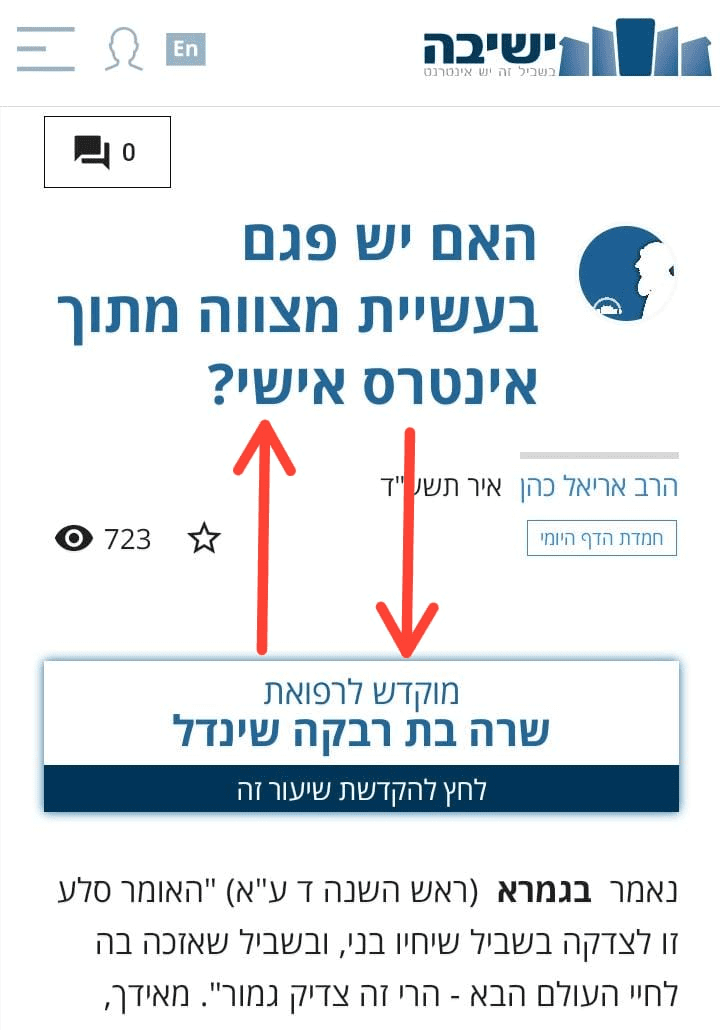
[1] See the sixth talk in my book Ein Adam Shalit Baruach, where I discussed several phenomena and beliefs that have no real source and certainly no basis in reason or reality, and yet have taken wide root in the religious public, as if there were here a solid fact or at least a principle of faith from a direct divine source. I surmise that challah separation is already on its way to becoming such a principle of faith.
[2] Similarly in the preface to the Eglei Tal: indeed it is proper and good to enjoy Torah study, but one should not study for the sake of enjoyment.
[3] In the Talmud’s conclusion there in Rosh Hashanah, they distinguish between a Jew—who may give charity in this way—and a gentile—who may not. The early authorities differ on how to explain this distinction. From several of them it emerges that for a Jew there is no concern that he will do the mitzvah not for its own sake even if he does it for the life of his son. We see that the benefit is not his fundamental goal in performing the mitzvah. Rashi there writes that for a Jew, even if the hoped-for result does not arrive, he will attribute the afflictions to his sins. Again we see that the performance is for the sake of the mitzvah, and the benefit is incidental.