

A Look at Transgenderism and the Giv’at Shmuel Affair (Column 504)
Why the public debate over Givat Shmuel became demagoguery
The column opens by describing the affair as a case in which each side uses the girl or the boy to prove that the other side is wicked: on one side people speak of abusing a small child for the sake of a struggle, and on the other side of using a girl to advance a progressive agenda in secret. The rabbi stresses that this is a complex case, with costs to every decision, and therefore a debate that sees only the considerations of its own camp is flawed and harmful. Already here he wants to replace emotional rhetoric with the practical question: what considerations are really at stake, and what is the price of each alternative.
Why esoteric halakhic rulings undermine trust even if they are not necessarily dishonest
In the context of Rabbi Yaakov Ariel's involvement, the column pauses for a principled discussion of 'esoteric halakhic ruling'. There may well be no contradiction between quiet support for a local and secret solution and public opposition once the case has become a public precedent, so one need not automatically impute personal dishonesty. And yet, the rabbi argues that a policy of one ruling in private and the opposite in public carries a heavy price: it will be exposed, it will erode trust, it will prevent substantive criticism of the ruling, and it will create the sense that one can never know what any posek really thinks. He distinguishes between hiding facts in order to protect the child, which may be legitimate, and hiding a halakhic position, which is far more problematic.
The critical distinction between radical queer theory and moderate queer theory
In order to clear the fog, the column distinguishes between radical queer theory and moderate queer theory. The radical version claims that the terms 'man' and 'woman' have no essential meaning, and that a person's declaration is what constitutes that identity; the concepts therefore become empty. Matt Walsh's criticism is aimed mainly there. By contrast, moderate queer theory assumes that gender has some objective content: a cluster of tendencies, feelings, and traits that are usually associated with masculinity or femininity, even if there is no sharp definition. On this view, self-declaration does not create gender; it serves as evidence of a person's inner experience. The map is in any case made up of at least three distinct components: sex, gender, and sexual orientation.
Why the existence of gender dysphoria is a plausible factual claim
On the basis of that distinction, the column argues that the very existence of gender dysphoria is a highly plausible factual claim. One may debate whether its source is genetic, physiological, cultural, environmental, or some mixture of all of these, and one may also debate how much present-day social legitimacy influences it, but it is hard to deny that the phenomenon itself exists. For someone who is not a materialist, there is not even any special reason to be surprised by a gap between physical dimensions and mental ones. That is why denying the phenomenon in the name of fighting 'progressivism' looks, in his view, like burying one's head in the sand.
Why fighting progressivism does not require rejecting moderate queer theory
From there the column moves to the value dimension. The rabbi sees himself as part of the struggle against relativistic progressivism that empties facts and values, but he argues that moderate queer theory does not have to belong there. It does not say that every act of self-definition creates reality; it asks us to recognize a factual state of affairs. If we all agree that someone is, for example, male in terms of sex and female in terms of gender, then the question whether to address that person in masculine or feminine language is mostly a social convention, not a culture war. A large part of the public controversy is therefore a semantic dispute loaded with heavy ideological charge by both sides.
The question 'is this a disease?' as a debate that hides a stance rather than establishes a fact
In the debate over whether transness is a 'disease', the rabbi argues that the expression has almost no objective content. In practice, a 'disease' is whatever the person, or the reasonable person, would want treated, so the term mainly reflects a stance about the need for treatment. In that sense, the suffering of some trans people makes dysphoria a disease for them, but the fight over the label settles nothing normative and mainly serves as a weapon. Here too, the language hides more than it clarifies.
The halakhic plane: transgenderism raises questions, but not the same questions as homosexuality
After narrowing the value dimension, the column arrives at halakha. Unlike homosexuality, which has a clear halakhic prohibition, transgenderism does not necessarily generate such a prohibition in and of itself. The real halakhic questions concern cross-dressing, the division of mitzvot between men and women, the definition of male and female for halakhic purposes, and shared life in a religious setting. One can argue that halakha defines by biological sex, and one can at least in principle argue that gender is decisive and that Hazal relied on physical signs because that was the conceptual system available to them, or because the signs are only a סימן and not a cause. The rabbi does not decide the matter here, but he stresses that this is a legitimate halakhic dispute, not a principled revolt against halakha. Even if one rejects that argument, a trans person can still fulfill obligations according to biological sex, and therefore not every such discussion is a 'war on Torah'.
Sex-reassignment surgery and halakhic sources: real complexity versus recruited readings
The column refuses to oversimplify even when it comes to sex-reassignment surgery. On the one hand, this seemingly raises problems of sterilization and canceling the possibility of procreation, at least if the person is halakhically defined as male. On the other hand, if this is a severe and ongoing mental anguish, the rabbi thinks there is room to compare it to a real medical need and to consider leniency, just as fertility may at times be compromised for some other treatment. This is not a simple conclusion but an insistence on complexity. He then attacks tendentious use of sources: the attempt to attribute to the Tzitz Eliezer a recognition of trans identity on the basis of 'self-definition' is simply unfaithful to what he wrote. At most, he spoke about trusting a person's statement about who he is when the external signs support it, not about severing gender from sex.
How the column reads the Givat Shmuel case itself
When the column returns to the Givat Shmuel case, it proposes beginning with two reasonable assumptions: that the phenomenon the child reports is real from the child's perspective, and that the religious parents did not enter this adventure in order to advance an agenda but in order to cope with distress. Of course one must take into account the child's young age, the possibility of temporary confusion, and the risk of irreversible decisions; but here we are not dealing with surgery, only with allowing the child to appear and function as a boy at school. It is therefore reasonable to assume that a process of deliberation took place with professionals, the school administration, and the religious school system, and even if one disagrees with the outcome there is no automatic reason to portray it as a cynical progressive move.
The central mistake was secrecy, not the very attempt to help the child
In the rabbi's view, the truly difficult practical point was not the attempt to help the child itself but the fact that this was done without coordination with the other parents. Here he is willing to concede that the paternalism of the school and the Education Ministry was problematic. Surprising the surrounding community contributed to the rupture, and it might have been better to share the matter in advance, at least with the parents, and explain that this was a special distress and the chosen way of dealing with it. Even so, once one acknowledges that mistake, he still estimates that the harm to the other children, certainly at such a young age, is very limited, and can be explained just as one explains the inclusion of a child with some other difficulty. A protest against the secrecy itself can therefore be understandable, but turning it into a loud anti-progressive campaign seems to him grossly disproportionate.
The practical lesson: less concealment and less war, more coordination and judgment
At the end of the column he adds that the liberal side too is not free of demagoguery: the mere fact that a child is hurt does not cancel every ideological or educational consideration, and sometimes individuals really do pay a price for broader struggles. But in this case, precisely because the value-based and halakhic costs are not all that heavy, there was no need for such a war. One could also have discussed intermediate solutions, for example allowing the child to live this way without forcing all the other children to adopt every piece of terminology. The conclusion the column wants to draw is not a closed 'recipe' but a mode of thinking: distinguish between facts, values, halakha, semantics, and practice; act with as much transparency as possible; and handle such cases without emotionalism, without silencing, and without vilification. In his view, that is the lesson the public owes the child, the parents, and the cases still to come.
In recent years the phenomenon of transgender people has swelled and become a burning political issue. In general society a growing consensus is forming that they should be treated according to the way they define themselves. In response, the religious community (and also some strands of feminism, parts of which oppose recognizing trans people) sometimes radicalizes the discourse, as it senses an ideological and social threat posed by this phenomenon and by the legitimacy it is receiving (that dreadful “progressivism”).
In recent weeks the case of a girl[1] at a religious school in Giv’at Shmuel was publicized. She feels within herself the identity of a boy, and from the age of seven received permission from her parents and from the school to dress as a boy (kippah and tzitzit, etc.) and to conduct herself at school fully as a boy. For understandable reasons, the other parents and the children in the class and in general were not informed, and therefore it is no wonder that when this came to light an uproar ensued: demonstrations by parents and children, a boycott of the school, and a demand to remove the girl or to transfer the other children whose parents so wished. Tempers around the country have been running hot for quite a few days and have still not cooled (the customary time span for such affairs is usually about one day). Only yesterday I read that indeed they had returned to routine, but the girl wanders alone in the schoolyard (boycotted). On the other hand, informed sources told me that life truly has returned to normal. The opposing parents did what they did, but now life has returned to routine for the girl as well.
The State-Religious Education Administration (חמ"ד) in the Ministry of Education is very embarrassed by this affair, since it was closely involved and the decisions were made at its guidance and with its consent. Moreover, in recent days a letter by rabbis was publicized demanding that the phenomenon not be recognized and that the girl be forced to return to identifying and functioning as a girl. Public discourse is heating up, and of course demagoguery is in full swing. The media and various politicians are meddling in the affair and see in it an expression of religious rigidity and intolerance and their price. Many speak of demonstrations held on the back of a small (!) child without consideration for his feelings and distress.[2] I already mentioned heartbreaking descriptions that the child walks alone in the schoolyard while all his friends boycott him. On the other hand, the parents and those who share their view argue that a small (!) girl and her distress have been exploited here to advance progressive agendas covertly and without informing the parents, and afterwards everyone is required to capitulate so as not to hurt the girl. Needless to say, the use of the words “boy” or “girl” usually depends on the platform in which the piece is written. Each side in this debate presents the other in a very emotional way as wicked with problematic agendas (hidden or not), while completely ignoring the considerations in favor of the opposing position. Someone already said that the difference between an argument and a quarrel is that an argument revolves around ideas whereas a quarrel revolves around people.
As noted, this is a complex situation with nontrivial considerations on both sides, and conducting a simplistic debate in which each side sees only the considerations that lead to its own position is flawed and harmful. It is possible and appropriate to formulate a stance on complex issues when one sees the full range of considerations and takes into account the costs of every decision. In the end each of us arrives at a single bottom line—and that’s perfectly fine—but this is how better and more correct decisions are made, and the discourse also becomes more rational and sane. Well, this is indeed a halakhah for the messianic era, but that’s exactly why we’re here. Before I get into the thick of it, I’ll add a note about the halakhic policy of decisors (poskim).
A brief look at esoteric halakhic policy
Among the signatories to the aforementioned letter is Rabbi Yaakov Ariel. And yet, according to the Ministry of Education he was the rabbinic authority consulted, and the previous decisions were made with his knowledge and under his guidance. Parenthetically I wonder, irrespective of my stance on this issue itself, who appointed him to be the rabbi of the State-Religious system? Why did they consult specifically with him? Remember that he is among the “senior rabbis of Religious Zionism,” who for some reason take upon themselves the crown of leadership of the entire non-Haredi public (see Column 500 and more).
In any case, for the sake of fairness it is important to note that there is not necessarily a frontal contradiction between the rabbi’s views before and after. It is possible that as long as he thought it could be kept secret and that it was a one-off case, he was willing to permit such conduct and even recommend it; but after it came into the public domain and could serve as a precedent, he holds that it is forbidden to continue to grant it legitimacy. So there is not necessarily a contradiction in his positions, and it is not necessarily dishonest. Still, the publication is rather embarrassing.
Here I only wished to comment on the policy of esoteric rulings—that is, situations in which certain instructions are given only in private and to individuals, while in public the same decisor gives the opposite instructions to the community. Sometimes this is done out of fear and lack of integrity (an unwillingness to stand behind an innovative ruling),[3] and then it is certainly reprehensible. But beyond that there is a problem here. One can perhaps accept the logic of such a policy in itself, but at the end of the day its costs are heavy and therefore in my opinion one should not adopt it. In the end everything is revealed, especially in the internet age and the flood of information, and therefore it is preferable to act transparently despite the opposite costs. One should also distinguish between hiding facts (as in this case) and hiding halakhic positions (which apparently also happened here). Concealing facts can be legitimate, since the girl need not suffer from our halakhic policy. But concealing halakhic positions is problematic—both because it will be revealed, and because if a person has a halakhic position he should stand behind it. Moreover, concealment does not allow such a position to be discussed and argued for and against. Furthermore, if one adopts a policy of concealment, a situation is created in which nothing can be trusted. One cannot know, regarding any ruling by any decisor, whether he is practicing an esoteric policy or whether this is truly his opinion.
An analogy is the well-known ruling of the Magen Avraham, which I have cited here more than once (see for example Columns 21, 63, 304, 362, 386 and others), to say things in the name of a great person so that people will accept them from him. I explained there well the logic of this permission, but it is important to note that practically, this permission carries a heavy price and should not be used (indeed, it should not have been granted at all, because even if one does not use the permission, its very existence undermines trust). If indeed such a policy is accepted, one cannot believe any testimony about any halakhic ruling by any decisor. This is a heavy price—and in my view it precludes using this permission. Incidentally, it may be that the Talmud and the Magen Avraham themselves did not intend to instruct us to actually do this in practice but only ruled that, in principle, such an action is not forbidden.
In the previous column I presented a dispute between Rav and Shmuel about whether it is permissible to cause someone to stumble in a matter that the one causing the stumbling believes is permitted while the one being caused to stumble believes is forbidden, without telling the latter that this is the situation. In note 5 there, I pointed out that such a policy is very problematic even if it is permitted, since if the one being caused to stumble thinks it is forbidden to cause another to stumble in such a case (and that was the situation there), then by its nature he is not supposed to suspect that this is an act of entrapment and will not be sufficiently cautious; in such a case the entrapment is deeper and more severe. This is similar to what I am describing here.
Moderate queerness: the factual plane
In recent years the term “progressivism” has enjoyed a renaissance. It was conjured up from the dusty basements of the communist discourse of a century ago, and in the religious and conservative society it is of course a pejorative. The discourse around the trans phenomenon—and the Giv’at Shmuel case is no exception—is always accompanied by a debate about progressivism. Conservatives attribute support for this phenomenon to a (negative) progressive approach. Here I wish to explain why this attribution is somewhat hasty.
In Column 497 I explained that the basis for all this discourse is the distinction between sex and gender. A person’s sex is determined objectively by physiological and genetic criteria, but gender is something else that does not depend on sex. So on what does it depend? In that column I brought Matt Walsh’s brilliant critique of queerness. But it is important to understand that the queer conception he criticizes there is radical. It is a view that holds that there is no essential definition of “man” or “woman,” and therefore we must accept what a person says about themself without any possibility of critique. In this view, a person’s definition as a man, a woman, or whatever else is completely arbitrary, and the person’s declaration has a constitutive status with respect to it. If he perceives himself as a man, that is what determines that he is one, and similarly for a woman. This is not a matter of politeness or not wanting to hurt him; rather, because if he declares it, then he truly is a man. No wonder Walsh goes around the world in a red dress with two braids and seeks a definition for the term “woman”—that is, when a person says he feels like a woman, what exactly should he feel in order to say that? Needless to say, he does not find an answer. I explained that the crux of his claim is that in this radical conception, concepts like “man” or “woman” are empty—words that say nothing.
But this is not the only conception. There is a more moderate (old-fashioned) view, according to which these terms (sex and gender) do have objective meaning, yet they are different. According to moderate queerness, someone who belongs to the female gender is a person who possesses certain tendencies and abilities (those commonly attributed to women), and likewise for a man. Here the concepts “man” and “woman” are indeed defined and distinct, even if not sharply and precisely. One might perhaps propose definitions (or diagnoses) based on fulfilling several characteristics out of a given set, as is common in medical and psychiatric diagnostics. If a person possesses four out of the following set of traits: tends from childhood to play with dolls; does not like soccer and does not idolize athletes; is gentle; likes to wear dresses and put on makeup; is weak in the exact sciences; does not know how to back up a car, and the like—then he is probably a girl. And vice versa for a boy. This is a certain definition of male or female gender and, in this sense, it is different from the radical view that grants the person’s declaration a constitutive status. Moderate queers preserve the definitions of the concepts and do not regard them as empty. They simply claim that gender does not always align with sex. There is a dissonance now termed “gender dysphoria,” in which a person’s gender does not identify with their sex. This is a person whose sex is male but who feels as a woman gender-wise, or the reverse.
Some transgender people undergo sex-reassignment surgery to align sex with gender (apparently the ways to align gender to sex are more difficult, if they exist at all; here we are already in the realms of psychology or psychiatry), thus resolving their dysphoria. After surgery, ostensibly we have a match between sex and gender, but even that is not so simple, since the person’s chromosomal composition does not actually change. The question that arises in such a case is whether external signs determine sex or genetics does, and that question can remain. In any case, at least psychologically, such surgery is presumably supposed to do the job—that is, to resolve the person’s distress (though even about this there are claims that in many cases it does not really succeed)—but philosophically the discussion can remain as is.
To complete the LGBTQ picture, I note that beyond sex and gender there is also sexual orientation. The claim is that it too is independent of the first two (at least not absolutely; correlations certainly exist). That is, the gender map consists of at least three components: sex, gender, and sexual orientation. One might have physiological male sex, a gender identity as a woman, and an orientation either to men or to women. Thus, fascinating phenomena arise of men who became lesbian women and therefore prefer sexual partnership with women. In essence, originally they are straight men, and the equation here becomes more complex: a transgender lesbian is, in a certain sense, equivalent to a straight man. The difference between them is only in sex (at least if he has not had surgery), but they are identical in gender and sexual orientation. This is practically a model for group theory, and one could formulate various theorems about symmetry and permutations among the elements of the group. You can think through all the possible variations and you will discover that all of them exist. Reality surpasses all imagination.
What matters for our purposes is that, at the factual level, it is hard to deny the very existence of the phenomenon. One can argue whether its source is genetic or environmental (I think there is still no scientific conclusion on the matter), and it is very plausible that there are cultural influences and influences from the legitimacy granted to this dysphoria nowadays. But one cannot deny that, factually, the phenomenon surely exists. I note that ostensibly materialists should have greater difficulty accepting this fact, since for them physiology determines everything. But even with respect to the body’s physical data there is not always a correlation between the theoretical definition and its actual manifestations (the idea and its instantiations). Sometimes people are born with three arms, without half a leg, with six fingers, with a crooked ear, and so forth. The fact that we are all human does not mean there cannot be people who are born different in certain respects, physical or mental. So why should gender identity be rigid and necessarily match sex in all people?! From the point of view of one who is not a materialist (and religious people are usually not), such claims ought to be accepted more easily. There is no obstacle to tensions between our genetics and physiology and our mental dimensions (feelings, traits, and the like). Physiology and genetics do not necessarily determine everything, and it is certainly not true that genetics determines our mental dimension unequivocally. So why should gender identity be rigid in all people?!
The conclusion is that, factually, dissonances can certainly exist between a person’s gendered sense and their sex—and it is even likely that such dissonances exist. Their source may itself be genetic or physiological, and may also be cultural-environmental, or the result of choice, and more likely a combination of all these. In any case, denying the very existence of the phenomenon seems unreasonable.
On moderate queerness and progressivism: the value dimension
Those who fight against progressivism often do so because of the conceptual vacuum it expresses, induces, and promotes. Denial of facts and of values (postmodern narrativism) can lead to very problematic results—and of course is also untrue. No wonder such radical conceptions provoke antibodies, and many see them as a threat to our civilization (I too am an active participant in this struggle, though I would not define it in such apocalyptic terms).
But even someone who fights vigorously against the relativist progressivism I described need not necessarily fight against moderate queerness. As stated, it does not deny the existence of facts and values; it also does not deny the differences between men and women and the psychological and physiological facts. On the contrary, it proposes that we recognize the facts and not impose on them our desires and preconceptions. Moderate queerness points to an existing factual situation, which I described above, and merely proposes that we recognize it. In its view, a person’s testimony about themself does not have a constitutive status as in the radical conception. In its view, a person who declares that he is a man is worthy of such treatment not because the declaration constitutes his manhood. He is a man because those are his feelings, and that reflects his gender. The declaration has evidentiary status, not constitutive status. I believe his declaration that these are indeed his feelings, and of course one must also assume that feelings are the determining factor. But the very definition of gender as opposed to sex is a cluster of feminine or masculine tendencies and feelings. For moderate queerness, we are engaged in rules of evidence, not in a detached discourse about constitutive definitions and not even in a discourse about rights. A woman who declares herself to be a man (assuming I know that the declaration does not reflect her feelings) is still a woman. But a woman who has a man’s feelings is truly a man in terms of gender, even if not in terms of sex.
To allow a balanced and rational discussion, it is very important to understand that this is a different position from the extreme progressive stance (which one may of course also call “progressive”—see below) that Matt Walsh addressed and ridiculed.
As noted, at the factual level the moderate queer claim is very plausible. Denying the facts and the studies that point to it is burying one’s head in the sand. In fact, this is not just about studies but also about direct encounters with people who report their experiences. Even without in-depth investigation, and although I am well aware of the severe bias in the discourse and in the facts presented by research in these fields (on both sides), it is still clear to me that factually this is true. There is such a phenomenon, and I see no reason to think otherwise.
However, this is still not the full picture. Facts themselves are not the main focus of the discussion (though they tend to be presented as such). Moderate queerness has social-value implications, and these require their own discussion. I will touch on these shortly.
Is it an illness?
In debates around these phenomena, the question of whether such dysphoria (as well as any LGBTQ phenomenon) should be defined as an illness crops up from time to time. Conservatives, especially religious ones, tend to say yes, while liberals tend to protest and claim that this is stigmatizing.
More than once I have pointed out that this debate is semantics devoid of substantive content (see for example Column 146 and the columns cited there). If one defines illness as deviation from the norm, then of course it is an illness. But by that definition, height above or below average is also an illness. If one defines illness as a phenomenon with an organic source, then again unusual height would also be defined as such (height depends on genes). If one defines illness as something life-threatening, then many illnesses are not an illness. And if we define illness as a phenomenon that requires treatment, then transness is an illness only for someone who wants treatment (e.g., whoever goes to surgery or to a psychologist). In those columns I explained that the only way, as I understand it, to define this concept in a non-empty or non-arbitrary way is: something in the body or mind that bothers me and requires treatment (even if not always treatable; it could be an incurable illness).
This is of course a subjective definition, since the answer to whether some phenomenon requires treatment depends on whom you ask. Some people are unhappy being overweight and others live with it at peace. Likewise, some people live at peace with transness and some do not. Ultimately, an illness is something that bothers me and I would like to treat and eliminate. By this definition, for someone who wants to die—cancer is not an illness. Foucault, who argued this with respect to psychiatric symptoms, was right (even a stopped clock is right twice a day. Actually, only a stopped clock). I go a step further and argue that this is also true for organic illnesses. Cancer is an illness only for a person who does not want to suffer or die. There is no other non-arbitrary way to define even organic phenomena as illness.
One can broaden the definition and make it a little more objective, and say that an illness is something a reasonable person would want to treat (and then cancer is indeed an illness; most of us do not want to die). But then the question remains: who is the reasonable person? Religious people think homosexuality should be treated, but liberals think not (unless it bothers someone—and even then most think treatment is impossible).[4] Needless to say, regarding transness the matter depends on worldviews. The very fact that such people are in distress and some require surgery means that at least for them this is an illness by every accepted definition (unlike homosexuality—a dysphoria of sexual orientation—which is not, if only because there is as yet no relevant surgery). Conservatives think it should be treated and changed and therefore, in their view, it is an illness. Liberals think not—and therefore, in their view, it is not an illness. People think that if some phenomenon is an illness then it must be treated, but the truth is the reverse: if it needs treatment then, and only then, is it defined as an illness.
In short, the question of whether this is an illness or not reflects at most the speaker’s stance regarding the phenomenon in question. It contains nothing beyond that, and therefore there is no point wasting words on it. These debates are mainly a means of mutual bludgeoning.
Between semantics and values
In any case, let us now assume that the phenomenon of dysphoria does indeed exist factually. What does that mean? Moderate queerness argues that we must recognize this, and if we encounter a male who feels like a woman we should treat him as a woman. Again, not only to respect him or not hurt him, but because he really is a woman. The definition of him as a woman is based on the feminine features in his personality.
This is ostensibly a demand from the realm of manners and consideration for another’s feelings. But is that all? The moderate queer approach also assumes that gendered feelings are indeed what should define our social status. That is, they assume that addressing a person as a woman or as a man is determined by their gender (i.e., their feelings) and not by their sex (or sexual orientation). In principle, one could argue about this as well. One could claim that even if I accept the factual claim of moderate queerness, still in my view a male (in sex) with feminine feelings (indicating his gender) is a man. This view holds that a person’s characterization is not determined by gender but by sex, regardless of his gendered feelings (although I believe him that he feels so).
Yet here too it seems that this debate is superfluous, since it is mere semantics. If we all agree that this person is male in sex and female in gender, then the question of how to address the person (according to sex or gender) is just a social convention. So if it is very important to him that we address him thus, why should that bother anyone? Again, this is not a question of truth and falsehood but a normative determination. It is not even a matter of good and bad, but a norm that is a mere social convention.
A conservative can claim in response that it is important to him to relate to people according to their sex, exactly as it is important to them that we relate according to their gender. So why should we consider them and not him? That is a good claim—if I am truly convinced that it really matters to him. But if it is a claim raised only for the sake of argument, then it is indeed unworthy. I estimate that in most cases conservatives are not actually hurt by the demand to address a trans person according to their gender, especially if they internalize the factual agreement that underlies matters. If this does not reflect problematic values (and we have seen that it does not), why should I care? Why quarrel about it? Of course one can direct the same question to trans people (and their supporters). My sense is that in many—and perhaps most—cases, people entrench themselves in these claims because of their ideology (or what they believe is ideology, because they do not understand that it is mere convention), and their sense of hurt arises because of that. It is not the hurt that determines the attitude, but the attitude that determines the hurt.
It emerges that it is not the ideological dispute that creates the debate; rather, the debate is what turns this issue from semantics into ideology. Hence, we could have simply not argued (just flip a coin and thus decide on the relevant lexicon), and then the problem would not have arisen.
My main claim is that the fight is waged against progressivism—that is, the discourse that empties concepts of meaning—and people do not notice that moderate queerness is essentially an agreed factual claim, and that the debate is nothing but semantics. The fervor accompanying the entire debate is drawn from radical queerness, and if we are wise enough to distinguish between the phenomena, it will neutralize all the hostility and fervor, the extremism and mutual slanders, and it will return this foolish issue to its true proportions.
In our present situation, all sides already carry heavy baggage burdening them, and history has already created its residues within all of us. Therefore both sides feel hurt by these demands. Trans people (indeed the entire LGBTQ community) feel hurt by long years of discrimination against them—and they are of course right about that. But the violent and silencing discourse that they themselves have conducted in recent years, in particular the extremism toward radical queerness, arouses justifiably harsh feelings on the other side (=the sitra achra), which identifies the entire LGBTQ phenomenon with a value vacuum and which leads to feelings of threat and to waging war against the phenomena and against the people—and in particular against their rights. Thus a social limbo without an exit is created. If we were all healthy-minded Aspies (see Column 218) who do not fall for fantasies and emotions born of arbitrary conventions, then we could easily leave the progressives in their bizarre corner to talk to themselves, return to the starting point, and reopen a rational discussion (which almost never happens, certainly not on these topics). I think it would be quite easy to reach semantic agreement, and thus this debate would evaporate. As long as the facts are clear to all, why wrestle over mere terminology? Well, that is unlikely to happen soon, but at least we have reached the point where it is clear to us that this is psychology and agenda, not a truly value-laden debate.
As I explained, in my view there is no real value dispute here. It is only a matter of shifting the cheese. Everyone ought to agree about the facts, except that conservatives feel discomfort from changing the terminology and liberals demand to change it because of that same discomfort. This is simply infantile skirmishing on both sides: one wants to move the cheese and the other is bothered by the cheese being moved. In this sense we have returned to progressivism. If indeed there is nothing important here except semantics, is this not precisely the fight against progressive emptying? True—and therefore there is no point in fighting.
The connotations that have accumulated around these debates cause the feeling that this is a struggle over the society’s value character. In my opinion, absolutely not (so long as we are not dealing with radical queerness).
Moderate queerness: the halakhic plane
After I have dismissed the value dimension, what remains is the halakhic level. Homosexuality is halakhically forbidden, and this is a fact that is hard to dispute or change. But the trans phenomenon does not present such a difficulty. Think of a person whose sex is male and is straight, but whose gender is female. Suppose he behaves as a woman and has a partnership with another woman. In the conservative conception, there should be no prohibition of lesbian relations here, since this is a relationship between a man and a woman (though LGBTQ folk prefer to treat this as a relationship between a woman and a woman. But that is mere semantics). If it is a situation that reaches same-sex relations, that can indeed raise issues of arayot (forbidden relations), but that is not connected to transness but to homosexuality.
We still have the prohibition of a woman wearing a man’s clothing (and vice versa), or the performance or non-performance of commandments imposed on men or on women, and the like. Here the situation is more complex. Indeed, there is room for a halakhic claim that one whose gender is female is a woman also at the halakhic level, and therefore all the laws that apply to women apply to such a person. If we do not accept that, then the person must observe the laws of their sex and not of their gender—but even this need not arouse special problems. So let them observe those laws.
Of course, in the Talmud and halakhic literature it is standard to hang the definitions of male and female on sex and not on gender (as in the sugyot of signs of maturity, and of a tumtum and androgynos), but one might argue that this is only because Hazal did not yet have the conceptual framework and knowledge we have today. Therefore there is room to argue that the definition in our day could change and be based on gender and not on sex (this of course touches on the question of changes in halakhah, which I will not enter here). Add to this the question of whether Hazal viewed the physiological signs as indicators or as causes (at least regarding the latter signs of maturity this is explicitly discussed).[5] If they are only indicators, then it is possible that gender is the essential definer and the physical signs were only indicators of it, and now this could change.
In short, one can agree on all the halakhic rules, and the question that remains is the application. Everyone agrees that it is forbidden for a man to wear women’s clothing; the debate is over who is a man. But this is a debate like any other. I do not see why people treat this as a war against halakhah. It is a halakhic position with which not everyone agrees. In this sense, the halakhic status of a trans person is certainly easier than homosexuality, which of course is not reflected in public discourse. I presume that a gay child would not have aroused a demand to expel him from school—simply because we are used to that already. I do not see a difference between that and a trans child, and if there is a difference it is clearly in favor of the trans child.
I do not intend to claim that recognizing gender as the basis for the halakhic definition of man and woman is simple. Clearly it is not agreed upon and there will be a (sane and legitimate) debate about it, but in my eyes it is at least a claim that can be made, and the debate over it is no different from any other halakhic debate (again, if we manage to ignore the sediment that has accumulated here due to the public struggles). There is also sensitivity regarding joint activities. What will those do who think the definition is based on genitalia when alongside them there is a transgender person who thinks the definition is based on gender? It will be hard for them to function together. Still, this is not altogether different from other halakhic disputes that we must learn to live with (though I agree that practically there is a nontrivial difficulty here). In any case, it is clear that the fundamental problem is human and emotional rather than halakhic. We live in peace and proximity with Sabbath desecrators and with those who sleep with a niddah, and it does not seem to me that the halakhic aspects of the trans phenomenon are more severe than those. As for psychological and social sensitivities, these are things that one can and should overcome. These are certainly not values or ideology worth fighting over.
Sex-reassignment surgery
Even regarding sex-reassignment surgery, it is not clear whether there is a prohibition. One can regard the outcome of the surgery as male or as female, but either conception is a legitimate halakhic claim. The surgery itself could be forbidden, since for a male, for example, it involves castration, which is forbidden by halakhah. It also prevents him from fulfilling the commandment of procreation. But that assumes we are indeed dealing with a male. If this is a woman, then there is room to claim that there is no prohibition.
Think, for example, of someone who undergoes surgery due to some medical problem and as a result loses the ability to have children. We will treat that far more leniently. Likewise, if we see a person suffering from unremitting (physical) pain, would we not permit them to have such surgery to treat their pain? By logic it seems to me that persistent and unremitting mental pain is no different in this regard, and therefore there is room to compromise the ability to procreate in order to resolve the trans person’s distress (dysphoria). One who does not find a suitable partner and thus decrees upon himself not to have children and to fulfill the commandment of procreation—there too we do not see a major prohibition. Note that a person suffering from dysphoria might not find a partner for this reason, and therefore in any case he will not fulfill procreation.
Well, I will not expand here because this is not the place. In any case, regarding these surgeries, see Tzitz Eliezer vol. 10 §25 ch. 26 (note that he deals only with physical changes—that is, it is clear to him that the definition depends on sexual organs, and he does not deal with gender. So too in vol. 11 §8 and §78 and vol. 22 §2).[6] To conclude, I will only note that in the heat of argument people can interpret sources and bend them in their direction freely out of complete misunderstanding. For example, some time ago I was sent a post by a man named Ariel Horowitz, who brings a story in which Rabbi Waldenberg, author of Tzitz Eliezer, seemingly recognizes a trans identity:
In the 1950s, Rabbi Eliezer Yehuda Waldenberg, author of the responsa “Tzitz Eliezer,” was the rabbi of Shaare Zedek Hospital in Jerusalem. One day Rabbi Waldenberg was asked about a person who entered the men’s section of the synagogue and wanted to join the quorum, but the other worshipers suspected that he was a woman. Rabbi Waldenberg—who did not need videos from the Liba Center, incitement from Bezalel Smotrich, or other rabbis to preach to him about the healthy institution of the family—ruled explicitly that one should follow the person’s self-definition and external indicators. In other words: a person’s gender status can change according to surgery or external changes.
He brings this story in the context of the case of the trans girl in Giv’at Shmuel. What does he learn from this? That a person’s gender status can change according to self-definition? Whether his intention is the radical approach (that a person constitutes their gender) or the more moderate approach (that a person is credible in testifying about their gender), this is nonsense that does not approach Rabbi Waldenberg’s words. All he wrote there was that a person is credible in saying he is a man (in particular if his external signs match his description), and there is no need to check his “fringes.” On the contrary, it follows from his words that if the external signs do not match, his declaration that he is a man will not help. In any case, there is not even a hint here of relating to gender identity detached from sex; on the contrary, as we saw above, Rabbi Waldenberg explicitly writes in several places in his responsa the exact opposite. Sadly, even if you are a liberal, the arguments and sources you bring must hold water.
Back to the Giv’at Shmuel case
In the discourse around the Giv’at Shmuel case, the common assumption among conservatives is that this is a progressive event. See, for example, the announcement of the conference to be held in Giv’at Shmuel (the crime scene) on the evening after the Fast of Gedaliah, where the public will be presented with objective information by world-renowned experts (including a city council member, a yeshiva head, a forum chairwoman, and a newspaper editor), in which diverse positions from different angles on the issue of children with worrying progressive tendencies will be presented, and thus everyone will be able to understand their roots and receive tools with which to cook up all the tough questions:
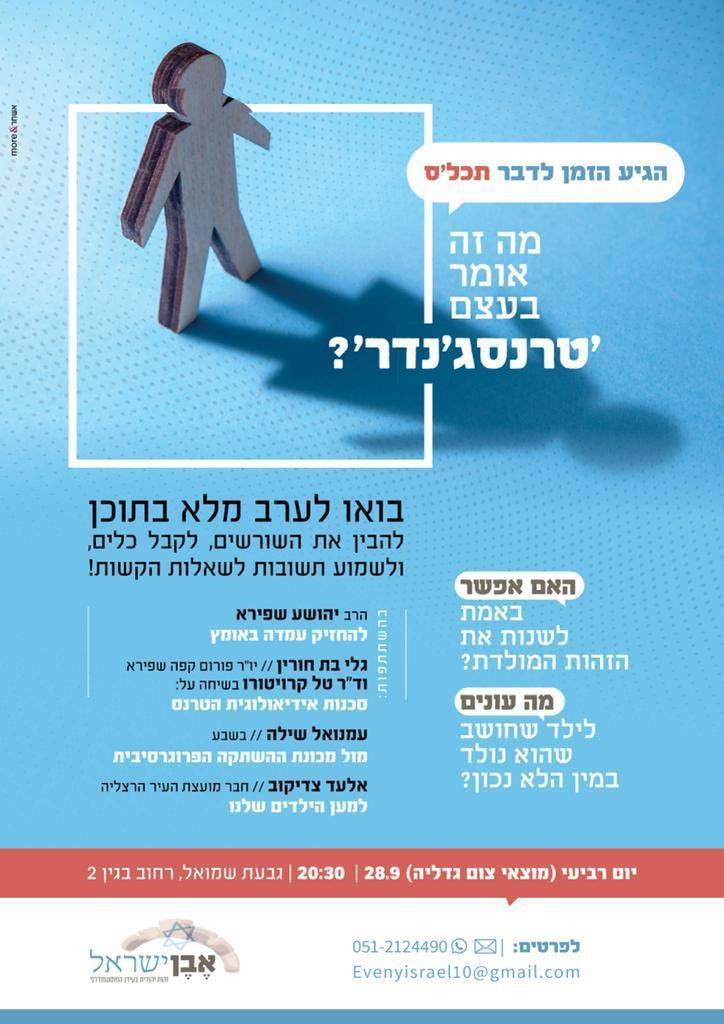
Before you run to the conference, note that in this announcement there is an identification—as if self-evident—between the issue under discussion here and progressivism (attendees are expected to arrive with the appropriate feelings and connotations).
If we look a bit more closely at our case, we should first remember the basic groundwork of the discussion: moderate queerness is a very reasonable position, at least at the factual level, and the debate over terminology is primarily semantics. The phenomenon exists and cannot be denied. I add here the assumption that the parents likely hold the moderate view. It is reasonable that they are not demanding a principled right for the girl to define herself just because she feels like it, but are making a factual claim: her feelings and tendencies seem male, even though at the sexual level she is a girl. It is very unlikely, in my opinion, that without significant reasons reasonable religious parents (from Giv’at Shmuel) would embark on such an adventure merely to advance a progressive agenda (unless they received a fat grant from the New Israel Fund and the European Union). If we accept these two plausible assumptions, then at the first stage we must recognize that the story begins with a real problem with which the girl and her parents grappled. Now we must ask ourselves what they ought to have done under these circumstances—or rather, what we ourselves would have done (the conference will surely provide all the answers, but in the meantime I shall try to guess).
As noted, I fully agree that the source of the girl’s feelings could certainly be influenced by the liberal environment and by LGBTQ discourse. Still, these are her feelings, and she came with them to her parents. I assume they did not find a reasonable way to cope with this difficulty and distress, and surely turned to a psychologist and afterwards to the school administration, and through it to the State-Religious Education Administration (which, as noted, consulted with Rabbi Yaakov Ariel), and this is the solution they found.
We must remember that we are dealing here with a minor, and therefore it is reasonable to expect the parents and the therapist to take into account that this may be an adolescent caprice, gender confusion (it is known that there is sexual confusion among teenagers, but here it is gender and not sexual orientation). They should have examined whether there is information about the reliability of these feelings—that is, what will remain of them in adulthood. To what extent do the feelings of a seven-year-old girl reflect real dysphoria or temporary confusion? With regard to surgery (which did not occur here), it is clear that such concerns are much weightier, since it carries risks and irreversible outcomes. But here no surgery was done; rather, it was decided to allow her to “dress up” as a boy and function as such at school. I allow myself to surmise that this was done after consideration in which they took into account and examined all that I noted above and more, and in the end saw no other way out. In any case, it is plausible that even the conservative critics have no information different from what I have regarding the process and the decision-making. If so, let us adopt these plausible assumptions, all at the factual level. So far there are still no values. In that case, everything seems fine, and one can understand this family’s decision-making according to their own lights.
I must reiterate what I explained above: that the value aspects do not truly exist in such a case, and the halakhic aspects also carry limited weight—and for a girl of seven or nine (long before bat mitzvah) the weight is even lower. Yet another question arises: these actions were not done in a vacuum. There are other children in the school, and this may cause them problems. Such a step can have ramifications for the environment, and therefore it seems it cannot be decided in a closed forum without informing the other stakeholders. The paternalism of the school and the Ministry of Education is problematic. Indeed, we should remember that in a sense this paternalism is embedded in the very fact that our education is centrally managed by the Ministry of Education. Still, there is room to argue that in such an exceptional matter they ought to have included the parents.
Now we must ask ourselves two final questions, which of course are related:
- What could the girl’s parents have done in the face of their daughter’s distress? Revealing to everyone that this is the situation could have confused the children even more, and it is doubtful they would have agreed to cooperate (we see what happened in the end). Perhaps they could have included only the parents without the children—but it is doubtful how much such a thing can be kept secret (we see it was not kept even when no one was told).
- What harm was caused to the other children? I assume the teachers are not truly harmed, and therefore their claims do not seem serious to me. I am referring here only to the claims of the other children and their parents.
I think the expected harm to the other children in this case is very limited—at least at such a young age. What could really happen? The sexual aspects do not yet exist. Perhaps the surprise of the discovery itself could create problems. But apart from that, the fact that there was a girl in costume who participated in activities as if she were a boy—whom does that harm and why should it bother anyone? There may be aspects I have not considered, and in practice some harms may occur, but it seems to me that in principle these harms are not truly significant. This is a decent reason why the parents are not necessarily required to involve the entire environment in this matter.
But even after this came to light and the children were surprised, one can explain to them that this is a girl with a special distress, like the many distresses of other children (today they are called “children with disabilities”), and this is the way chosen to treat it. I think children can accept such a thing, and the younger they are the easier it is, because for them it becomes part of the world they know—period. In fact, if I understand correctly, that is exactly the situation right now. Everyone knows that this is actually a girl in costume, and at present she is there in the school and things are more or less proceeding as they should. Many children with disabilities participate in regular classes and the children must learn to live with them.
It is true that for these same reasons it seems it could have been done from the outset—that is, to include and coordinate everything with the children and their parents at the time of the decision, and to preempt matters. They could have explained the problem and then everyone would have understood the distress and participated in the effort to solve it. Things could have been allowed to proceed openly, as is now happening in practice after the disclosure. The surprise created part of the rupture and the anger, and that could have been avoided. I think that if there is any lesson I would draw from this case, it is the reverse of what the rabbis who signed the letter above concluded. One can do what is necessary (if there is no other way to cope with the distress), but do so in coordination with the environment.
After accruing experience in dealing with new challenges, in the future we will know how to do this better. In practice, the parents and the administration did not do so in this case because they did not yet have experience. This was probably also a mistake, and in this sense the parents’ protest may be understandable (not about the very step the girl’s parents took, but about the fact that the environment was not included). So what? Everyone there made mistakes. Does that justify demonstrations and anti-progressive noise? In my opinion—absolutely not. Again, progressives do deserve condemnation and struggle against them, but what do moderate queers and those who truly suffer from this dysphoria have to do with it? This is a fact, not a value. Facts must be confronted. Denying them does not help. On the contrary, if there is another way to cope, it is worth discussing it openly and deciding accordingly. All through substantive discussion. The baggage that this issue has absorbed causes the whole matter to grow far beyond reasonable proportions and prevents substantive discussion.
I must nevertheless add a note to the other side. The righteous liberal claims that protest the abuse of a child and the raucous demonstrations of adults that ignore a child’s suffering are disingenuous. If there is indeed an ideological problem here—and that is apparently what some parents thought (though I personally do not see it that way)—then this may justify demonstrations even facing a suffering child. When an ideological struggle is underway, whether justified or not, this child is caught up in it. I do not think people must abandon their conceptions and pay any educational and value price merely out of fear of hurting a child. It is indeed painful when a child suffers, but the question is the broader price of capitulation in this struggle. Sometimes an individual, even a child, must pay a price for struggles occurring in the background. If they had not acceded to the girl’s request and had left her as a girl, she would have suffered because of the educational agenda. Now she has become a boy (or a girl in costume), and she is again suffering. By acceding to her request, perhaps the other children are also suffering. Therefore there is no schoolbook answer; but considerations of a child’s distress are not everything. They are one component among a wider set of considerations, and focusing on them alone is demagoguery.
And still, after noting this, I return to what I wrote above. Since in my opinion the costs here are not very significant (if at all), there was no need to spark such a high-intensity struggle. An inquiry could have been conducted and a decision reached. Moreover, the question of whether to allow the girl to dress up is separate from the question of what we demand of the other children. It may be possible to tell the other children to address her as a girl, and to tell her that the way they perceive her is different (for she is a girl by sex, even if not by gender), and that she too should consider them. Just as the other children are supposed to accept unusual conduct and get used to it, so could this girl accept such an arrangement and get used to it for their sake. She will be a boy who is addressed in the feminine because that is how the other children think of her, and they too deserve consideration.
In conclusion
I am not sure this is the optimal course of conduct, and I did not intend here to offer a prescription for a solution but only to illustrate a way of thinking. I am sure there are other problems I have not considered, and perhaps there are better and more effective solutions. What is more important to me is that the picture I presented here suffices to dissipate the artificial and harmful tension that envelops this issue and thus can lead to reasonable understandings that both sides can accept sensibly.
I think we at least owe this to all the parties who suffered in this case, and no less to the children and to the next cases in line. We must learn how to conduct ourselves henceforth rationally, coolly, and soberly—without emotions and without unnecessary outbursts. It is also more pleasant, also less harmful, and also leads to better results. I think that all sides there paid the tuition, especially the girl and her parents. If we draw the lesson, then we can say that at least it was not in vain.
[1] I use the feminine for her because that is her sex. Below I will address the relation between sex and gender.
[2] The masculine here is because I am describing the stance sympathetic to the phenomenon, of course.
[3] A blatant example is R. Z. N. Goldberg, who came out against the heter (permit) of get delivery in absentia in the Safed rabbinical court, while the judges there claimed they had received his consent for their ruling (see for example here). It seems plausible to me that this was not deceit by the judges but fear on R. Goldberg’s part of the criticism that arose there.
[4] It turns out that even by their view we apparently have rigid characteristics that cannot be changed.
[5] See for example here and here. With regard to signs of maturity, however, the discussion is whether they are signs of mental maturity, for halakhic adulthood concerns legal responsibility and obligation in commandments. Therefore there it is reasonable to see them as a sign of mental maturity rather than a cause.
[6] See also the comprehensive article by Shmuel Shimoni, “Legal Recognition of Sex Change,” Mekhkarai Mishpat 28 (2013), p. 311.
Discussion
With God’s help, 27 Elul, the day of the creation of combination and growth
If on the second day a separation was created between water and water, which gave rise to an intense longing for renewed union between water and water—then on the third day the possibility was created for a fruitful integration between them. The upper waters descend to the earth and make it grow. Their remainder flows to the sea, and some evaporates upward and returns and falls again as rain, and so the cycle repeats.
So too, man and woman were created united and then separated. In this, a lack was created in each of them. The man lacks the feminine component in his identity, and the woman lacks the masculine component in her identity; therefore the desire to fill in the missing component is understandable. But here the Torah teaches us that the union will not be by the man becoming a woman or the woman becoming a man, but rather by each one developing his or her unique identity and at the same time connecting with the complementary identity, in order to create, through love and longing, a strong and stable unity.
With blessings, Chasdai Betzalel Dovdavani Kirshen-Kvas
Hello Rabbi.
You use physiological height twice to illustrate cases in which surely we would all agree that this is not a disease.
I didn’t understand why—don’t you think dwarfism is a disease? Or the opposite—people above 2.60 meters (arbitrary), is that not a biological deformity?
As you always say—just because the boundary is gray, winding, and broad doesn’t mean there is no boundary, but the ends of the distribution really are disease.
Whether they interfere is another matter.
This whole distinction between sex and gender is a bluff (invented by people with no sense). Not every made-up concept from the ridiculous academy (“gender studies”) should be adopted. A man can have a feminine psyche, but he is a man (mentally ill). The whole meaning of feminine behavior is derived from the character and behavior of female human beings. Someone who says he is a woman is like saying he is a cat. It is simply meaningless. Or a mental illness. Like someone saying he is Napoleon. The girl should not be in this class not because of halakhic issues but because she is mentally ill and has no place in a regular school. And I have no reason to accept, or even argue with, moderate queers. Whoever does not understand this lacks judgment. There is a strong intuition about when something is an illness (biologically or mentally abnormal, that is, bad), and certainly this has nothing to do with deviation from some norm. Even if 99% of the population had cancer, it would still be a disease.
The way Rabbi Michi is trying to sell us transgenderism as something normal (or that its normality is a legitimate matter of dispute) is ridiculous and incomprehensible to me. And certainly sex-change surgery, which is simply mutilation. Even in a liberal state I would use coercion to prevent such surgeries (just as people are prevented from harming themselves or taking their own lives), and certainly I would not fund them.
“If we were all mentally healthy Aspergers who do not get swept captive after fantasies and emotions arising from arbitrary conventions, then it would be easy to leave the progressives in their delusional corner to talk among themselves, return to square one, and reopen a rational discussion.” End quote.
Well then, since I am less of an admirer of Asperger-ness, I nevertheless suggest trying to decipher what this thing is that causes people to go berserk and lose their minds when it comes to matters of sexual identity. True, when someone desecrates Shabbat or eats חמץ on Passover, no essential chaos is caused by it: there is a commandment, there is a transgression, such is the way of the world, and there is nothing new under the sun. The world will not be shaken. By contrast, gender and sexual confusion is a frightening thing. It pulls the ground out from under one’s feet. One can identify here a fear of identity and moral tohu va-vohu, of the mother of all licentiousness, of losing one’s basic bearings. (In a book I once read, human beings are tortured by a simulation of emptiness: existence without senses, which confuses their whole world and shatters them psychologically.) Therefore, precisely in order to deal with them—I would not dismiss these feelings too quickly.
“A halakha for the messianic era—and that is why we are here.”
Has the Messiah arrived and nobody told us?
In my opinion, no height is a disease unless it bothers you. It’s not a question of a gray boundary, but also if it is completely black and white. Perhaps the grayness of the concept of disease is only in the question of how much it has to bother you, but even there I proposed a criterion: does it require treatment?
So it’s a good thing this is a normal country where they don’t let you and people like you make decisions here.
Chayota, I certainly don’t need to tell you that in my opinion, if people are confused and suffering, they should take a pill. That doesn’t turn anything into a value or a right.
If you do not dismiss the feelings that cause trans people to cling to their identity, then do not dismiss the feelings that cause conservatives to oppose and recoil from it. Everyone has psychologies. The way to deal with psychological malfunctions is to take a pill and return to philosophy.
To be continued shortly.
Perhaps a day will come when I manage to explain that in the range of human states there are things besides “intellect” (right) or “emotion” (superfluous).
Try appealing with this to my intellect (not to my emotion). Maybe it will work. 🙂
The state is indeed not normal
And in an abnormal state I have no interest whatsoever in making decisions for lunatics and the mentally ill. May the Merciful One save me from them, and that’s that
One can therefore understand the feeling of lack in the man who lacks the feminine dimension and in the woman who feels the lack of masculine traits. I mentioned the repair found in the union of man and woman, which brings mutual completion, as Rabbi Yehuda HaNasi said regarding the father who teaches his son Torah, which is balanced by the mother who persuades him with words—that there is a need to combine masculine authority with feminine lovingkindness, awe with love.
Rabbi Berekhiah (Yoma 70) teaches us that Torah scholars combine the good traits of masculinity and femininity, “for they are like women” (Rashi: humble and physically weak) “and show valor like men”—a combination of firmness and gentleness, strength and humility.
With blessings, Simcha Fish”l HaLevi Plankton
Thank you for the balanced and interesting analysis that is so lacking in the discourse.
Two points that I feel are missed in your analysis:
1. You put in parentheses a claim that is super important to the argument—specifically with moderate queerness: “Apparently the ways of adapting the gender to the sex are more difficult, if they exist at all.” This is a claim that at the very least needs to be grounded in research, which I think does not exist today, and it obviously touches on the question of the relative weight of genetics and environment in explaining the phenomenon, certainly at a young age when gender is still being formed and there is confusion, as you mentioned. “Go to a psychologist” is not always a solution if one does not know whether the psychologist takes the approach that the solution lies in adapting the gender or in adapting the sex (if it is even legitimate for him to hold one of these positions a priori). In the homosexual case, the psychological discussion has been decided—at least publicly—that the only legitimate approach is to accept sexual orientation as a given and as unchangeable, and therefore the challenge is to adapt behavior to it and come to terms with the new sexual identity. The implications of this view in the transgender parallel are much more far-reaching because of surgeries and sometimes harm to fertility or to the ability to establish a family; but even for homosexuals the implication is far-reaching in building the family unit, which now depends on two external women, at least one of whom sacrifices her body, at great financial cost, and brings a child into the world who will not know his mother. (Of course, co-parenting solves part of the problem, but one must not say that it is socially preferable, and it too is not free of complexities.) In any case, if it turned out that in a reality in which adapting the sex is simply not an accepted option, adapting the gender is something that at least in some cases succeeds, with intervention or without it—or that most confused children find their place in the world within the framework of their sex, even if through psychological suffering, and even if only partially, in a way that requires coping—would such an understanding not affect the argument with moderate queerness? It seems to me that a substantial part of the labeling even of this approach as progressive stems from the feeling that it takes personal feeling at a given moment too deathly seriously, as though what a person feels is the only objective thing to hold on to, whereas it may be, as said, confusion, temporary or permanent, perhaps heavily influenced by the discourse and agendas in the environment. This approach may become a catalyst for the expansion of the phenomenon in an era without anchors, when the “norm” is shrinking. When there is a larger array of identity products on the shelf, the “objective” feelings may change, and there is quite a bit of testimony about the spread of the phenomenon where it exists and receives greater legitimacy (I know of no scientific backing for the claim). Progressives will always claim that this is the discovery of what already exists, not the expansion of the phenomenon, and once again we return to the basic point of dispute, which in my opinion carries greater weight than you described, and on which there is no research-based decision, nor even a sincere attempt to study the subject scientifically.
2. You treat rather indifferently the implications of expecting the other children to recognize the dysphoria and adapt the way they address the child, as though this were inclusion of a disability like any other disability. The form of address itself is indeed a semantic matter, and it really is not all that important, as you noted. But address is not a semantic matter; it is an entire relationship system, and we as adults relate differently to women and to men whether we want to or not, and with children whose sexual identity has not yet been formed, things are far more complex, because the dichotomy between boys and girls is much stronger and it serves the formation of each child. The concealment and the surprise that follows surely have confusing implications at such an age—not because of the practice of address, but because of a whole relationship that was based on a mistake (forgive the bluntness—think of a boy who spent a whole year urinating beside another child and then discovered that it was a girl; but one need not go as far as that very realistic situation—enough to think about the kind of friendly physical contact that exists between boys, which they are incapable at this stage of imagining with girls, who mostly repel them at this stage in a perfectly normal way). But even without the element of surprise, the very expectation that children address someone in a way different from his or her sex is an excessive expectation and very far from being semantic (it is difficult and confusing even for me as an adult). It may also have developmental implications for the other children, whose picture of the world will be disrupted at too early an age.
Hello Rabbi,
Regarding the facts you raised, as far as I understand they are not accurate.
I spoke about the matter with the mother of a student in that grade at the school, with whom I am closely acquainted.
According to her, the child has been dressing up already from age 3! She has been presenting herself as a boy for years, not from age 7 as seems implied by your words.
It is very difficult to understand that a child at age 3 feels an opposite gender identity, and therefore, in the perception of the environment, the ones who “turned” the girl into a boy are the parents, who preferred that she be a boy. They are the ones who turned her into a boy from the time she was a toddler.
So even if we accept the child’s needs in a situation where she is mature and developed enough to understand what gender change is, it is harder to accept a situation in which the parents are the initiators of the gender change. They confused her from a young age, and now it is unclear what is in the child’s best interest. The initiative for the change came from outside; without the ongoing parental influence, would she also have wanted the change? Who knows?
The question that arises in such a situation is whether such a child is suited to the framework, because of the education she receives at home, which does not match the religious education at the school.
For comparison, at that same school a child cannot bring a cake baked at home because of kashrut concerns. At every event (birthday, party), one may bring only packaged products with a kosher certification stamp. So if non-kosher food may not be brought in, why is education toward transgenderism allowed to be brought from home? Again, the child is not bringing a problem or personal need of her own, but parental influence. Is there room for such parental influence in a religious school?
According to that mother, parents of classmates asked to transfer their sons to another framework, in order to spare them the confusion the incident creates. At first the authorities agreed, but when they saw that the requests were multiplying and there was concern that the child would remain alone, they reversed course and did not permit the transfer.
I would be glad if you would address the specific question I am raising, in keeping with the description of the case as I learned it from looking into the matter. Should parents in a religious school agree to such behavior, when in their understanding it is the result of non-religious education and not a personal problem of the child?
Chaim Zeilig Berger
1. I do not see why this is such an important claim for the analysis. In my view it is marginal for two reasons. I suspect there is no serious information about it, and even if there is—it is not very important.
Suppose there are ways to do this, and suppose they even have scientific validity (they were tested, including the consequences, whether this works for all types of trans people, etc.), still this is one of two possibilities facing such a girl. You assume that if both paths exist, then the first is preferable, but there may be those who would prefer the second. The question is whether this is problematic and what should be done about it. I argued that it is not particularly problematic. This is beyond the question of whether such a path really exists (I did not see evidence of that in your words). But if there is evidence for it, one can certainly discuss it.
2. Regarding this comment, let me tell you a story. When I lived in Haredi society, people kept telling me that I needed to switch my clothing to Haredi clothing, because when my children reached bar mitzvah age the situation would greatly confuse them. I didn’t do so, and it turned out that children live peacefully with all kinds of irregularities. This fear of confusing the children is greatly exaggerated. If you explain to the children that this is a boy and that is a girl and that this and that should be the attitude—and together with that explain that there is an exceptional girl whom one must take into consideration and treat differently—in my opinion nothing will happen. A child with attention problems does not do homework. Is that supposed to disturb the other children, who are educated to do it? Not necessarily. If there is a boy who had a nocturnal emission and is forbidden to put on tefillin, but of course the condition is not disclosed to others—is that supposed to confuse everyone? They are told that he has a special problem and therefore conducts himself differently. In my opinion nothing will happen. Children, precisely because of their young age and mental flexibility, can contain almost anything.
I wrote that there may be problems I did not think of, and it is even very likely that there are. Addressing the girl in the masculine form is an example of this. It may be problematic (though I am not sure). So what? The question is not what the solution is, but what kind of solution we are looking for, and whether we are willing to think about it in a balanced way and not hysterically. Is there a problem with using the same restroom facilities? I am not at all sure. But even if there is, one can find a local solution for that too. And likewise regarding the form of address. My goal is a change of paradigm and basic direction, not a proposal for a concrete solution.
Hello.
1. I will begin with a story. When I was in basic training in the army, one of our guys shot himself at the entrance to my tent and committed suicide. Afterward journalists came, and all the guys told them that we were being abused because we were yeshiva boys, and they told hair-raising stories about what was happening to us. It reached the press, truly “from the horse’s mouth.” The soldiers who had undergone the abuse were witnesses. But I knew that it was all fabrications, from aleph to tav. People were convinced that this was the situation, not that they were lying. But this was a picture painted retroactively after the event had happened. There was abuse as in every basic training, and nothing connected to our being yeshiva boys.
What I mean to say is that after something happens that stirs an uproar and shakes us, people have a tendency to paint the past in colors that suit their agenda. Therefore I cast great doubt on the story of that mother. It may be that she saw that the girl once dressed up as a boy, and that is legitimate. And even if not legitimate—then it was a mistake by the parents. But from there to the conclusion that the parents wanted a boy and therefore turned her into one with their own hands—this borders on science fiction. Because I know such human dynamics, and I know how myths are created that people are convinced about as supposedly personal and direct information, I am not inclined to believe it.
2. But even if so, you assume that there is a problematic situation here and that the parents are to blame. But if the situation is not all that problematic, as I explained, then one can also accept that the parents did this. Moreover, even if the parents did this, there is now a child with a problem. Should we ignore it? If there are heavy costs—then certainly yes. But if the costs are not heavy, as I claim, then one should take the problem into account even if the parents are to blame for it.
3. You are making assumptions about a three-year-old girl. Neither you nor I know her, and both of us probably have not researched the phenomenon. How do you know that with a three-year-old girl this is only confusion? It may perhaps be confusion, but it may also not be. Suppose the case was examined and it became clear to the psychologist and the parents that this is not just confusion, or that it is confusion for which there is no good way to cope. What should they do?
4. The comparison to a cake with a different level of kashrut is foolish. It is obvious to everyone that there are standards of kashrut that must be met. I am not against rules. I am against a lack of consideration for exceptional situations, even if they conflict with the rules, especially when distress and suffering are involved. If there were a child who would suffer if we ate strict-mehadrin kashrut, I think the school really should allow in his case a lower level of kashrut. Indeed.
5. Regarding the question of transfers, my opinion is that regardless of this case, restricting transfers is a scandal. It is part of the centralism of the Ministry of Education, and in my opinion it is problematic in itself. Quite apart from this case.
With God’s help, 27 Elul 5782
I have no direct knowledge of what is happening at the school, but from what was published in the media it emerges that the parents of the children in the class, who were horrified by their children’s exposure to transgenderism, were offered that they send their children to supportive psychological treatment. And here I truly understand what “sets them off.”
To be sure, it must be said that in any case children are exposed to situations in which one of their friends behaves differently from his surroundings, and often this causes them to reject him or mock him. It would be good if part of the religious education that parents wish to instill in their children were that one must not shame one’s fellow in public even if he behaves strangely, and even if he violates Torah prohibitions.
If the school is called “Moreshet Neriah,” one can tell the children about Rabbi Neriah, who entered activity in Bnei Akiva when at the time there were mixed dances there, Heaven have mercy, and with patience he improved the religious situation there beyond recognition and inspired the boys and girls of Bnei Akiva to love the Torah. Whereas before the founding of Bnei Akiva the situation was that most graduates of Mizrachi education left religion— the religious youth movement, for all its flaws, changed the situation and brought about the creation of a generation of Torah lovers proud of their faith and observance of the commandments.
One can explain to the children that the girl’s parents are mistaken and are drawn after distorted views, but that it is forbidden to hurt the girl herself and shame her. And at the same time continue to struggle in the school and in the education system, and firmly demand that the girl dress in girls’ clothing, as the Torah requires. It seems to me that one does not need a psychologist for this. When parents explain—children understand.
With blessings, Ofer Badan Melavev-Muskaroner
Hello, and thank you for the analysis. Though in my opinion the problem with “moderate queerness” is that it contradicts feminism (at least radical feminism), which holds that there is no significant difference between a man and a woman, and a girl does not need to play with dolls, be gentle, wear dresses, and put on makeup, and can love soccer and admire athletes, be strong in the exact sciences, and reverse a car. According to feminism, there is no reason at all for such a girl to declare that she is a boy, and such a declaration is truly completely empty. There is only sex, and there is no such thing as gender.
Such feminism admittedly seems delusional to me, but it is quite common today, and it fits only with extreme queerness and not with moderate queerness.
I return again to the facts.
You tend to think that the gender change happened only at age 7, and you question the story because of your familiarity with human dynamics.
But from reading the articles you linked to, it appears that the events took place at an earlier age. In the third paragraph of the article on Arutz 7 it says that the child’s sexuality was already known from first grade only to a limited number of staff members at the school. On a straightforward reading, it emerges that the parents registered the girl as a boy already from the time of registration, at least from age 5.5, and that the girl cooperated and presented herself as a boy (spoke about herself in the masculine) from the time she entered school. This is from a simple reading, not “from the horse’s mouth.”
If the girl lived in the neighborhood (and did not move there from elsewhere), then presumably the presentation began even at a younger age. After all, it is impossible to send her as a girl to compulsory kindergarten and pre-kindergarten in the neighborhood, and then immediately register her as a boy in a school in the same place, because the matter would be discovered, and the whole thing was kept secret. So assuming they did not move precisely at the point of entering school (or that they live even today in a distant place), simple arithmetic says that the presentation is from infancy. I am astonished that you understood otherwise (I would be glad for an explanation).
As for what you wrote that there is room to consider waiving “mehadrin” kashrut so as not to hurt a person—the comparison is exaggerated. I do not know the religious-Zionist public well and the level of religiosity at that school, but the school does not require the cake to be mehadrin, only basically kosher. For comparison, many of the mothers wear pants and do not cover their heads (like the one I spoke with), and there are also some who live in lesbian relationships, and nobody has a problem with it, no one rushes to “Haredize” the families.
The claim here, as said, is that the girl’s parents initiated the matter, and in doing so they are bringing into the school a religious challenge that is not simple, without any need or preexisting problem on the part of the girl.
I did not understand the claim. Suppose it does not fit with some shade of feminism. So what? Did this feminist shade come down from Sinai such that everything has to fit it? By the way, as I noted, less radical feminism also opposes trans people precisely because they undermine the definition of femininity. There are fifty shades of feminism, and this whole issue is rather exhausting and does not interest me.
Where did I write that I understood otherwise? I do not understand your claim, and in any case I answered all the claims in your words.
Again you insist unnecessarily. I gave an example from mehadrin kashrut not because that is the situation in the school. But in a school where that was the norm, it would have been proper to waive it. I illustrated a point, that is all. And by the way, the daughter of two lesbians interferes no less with the school’s education, except that apparently you have already gotten used to that.
To Rabbi Michael Abraham—greetings,
There is a difference between the daughter of two lesbians and a girl who behaves as a boy, since the former does not behave within the school framework contrary to the Torah, whereas the latter violates the laws of the Torah within the school itself, and her parents demand that the religious school recognize their demands, allow her to dress as a boy, and address her in the masculine.
They can send their daughter to the religious school, but instruct her to behave within the school framework according to the code of conduct required there by the Torah.
With blessings, Ofer Badan Melavev-Muskaroner
In paragraph 1, line 3-4
…demand that the religious school recognize their demands…
In paragraph 1, line 3-4
…demand that the religious school acknowledge their demands…
The feeling when reading the post is that you are not up to date at all on what the argument is about.
You portray Matt Walsh as though he is dealing with an extreme phenomenon and ignoring the moderate and accepted view, but the view you present as extreme is indeed bizarre, yet not extreme at all.
All of Hollywood is immersed in this delusional conception, together with most of the media in the U.S., not to mention Western Europe.
The moderate view that you present here—they would burn at the stake over there. Look at J. K. Rowling, who is progressive herself, by the way, and agrees with them on 99% of the delusions; over that one percent they completely burned her—she is untouchable, beyond the pale, and no one thinks of working with her.
In addition, you use many words to argue that the phenomenon exists. I don’t know a conservative who fights the phenomenon and doesn’t admit that there are men who feel they are women. What is the question here? Obviously they exist—that is a fact. Nobody argues about that. Matt Walsh certainly admits this, as do Ben Shapiro and Jordan Peterson. There is no argument about that.
Regarding your claim about disease, even according to your formulation, both sides, the progressive and the conservative, ought to admit that this is a disease. The progressives in most cases turn to surgery; the conservatives would refer to mental treatment. That is, everyone agrees it requires treatment; that is, it is a disease. Here too, you will not find a single person in the progressive camp willing to say that, but never mind not saying it—in their opinion I am also not allowed to say it. That is the point, that is the battle.
Accounts are blocked today on social networks because people say that a man is a man—literally a violent statement.
You present conservatives as though this is not about ideology. I don’t understand that claim. People are fighting for the truth.
Even the approach you present as moderate, in my opinion is not moderate at all. Why should I change my way of speaking because a person decided this morning that he is a woman? And if he feels canine? And if he feels like a demon? I’m not just taking things to an extreme—this exists. There are many people who want others to relate to them as dogs, demons, elves, Your Majesty, and other creepy things. Should we take them at their word?
And if we are taking it to an extreme—if LeBron James said tomorrow that he is a woman, would you also take him at his word? Because there is no shortage of bullies claiming they are women.
There are also many who think they have the right to change their gender every day according to how they feel that morning, and of course whoever addresses them incorrectly is harming them. I hope you stay updated every morning so God forbid you do not offend them, for clearly their gender really changes every day—good thing they update us with this absolute truth.
In addition, you rather accept here that surgery can help the condition but psychological treatment cannot help, which is a strange assumption unsupported by any study.
Another point you give no thought to (apparently because you do not understand the size of the phenomenon) is how much this approach itself creates these distortions and mental illnesses. Many girls go through a tomboy phase in childhood; once they would have let it pass, today they entrench it and confuse them, giving them the feeling that this is their identity, that it is part of them, that this is what they are. Thus a temporary curiosity becomes fixed and creates suffering years down the line because of the confusion and inner contradiction.
At the end of the day, the battle more than anything else is over freedom of speech, which the side somehow called progressive strongly opposes. They will not decide for me what to say and what not to say, and certainly not what is true and what is false.
Hello Rani. This is the most demagogic and most bizarre message I have seen in quite a long time, and I am really not exaggerating. I am rather shocked, and especially it is surprising coming from you. You repeat things I wrote in the column itself and explain that I did not notice them and am not aware of them. You miss my main point, and then attack a different point with which I agreed. You keep repeating the important battle against the extremists when I am talking about the attitude toward the moderates. This message of yours is the clearest illustration of why this column is needed (and why it is probably not helping, unfortunately). It may be that here too, as in your previous message, anger has driven you out of your mind?! So I suggest you take a breath and calm down (really, this is not a put-down at your expense), and now read the details calmly:
1. Not only do I know what the battle is about, it is even written in my column. I really do not understand what you wrote. That extreme view is indeed worthy of struggle and it is indeed harmful, and that is what I wrote. But it is incorrect to attack those who hold the more moderate position because of the struggle against the extremists. Up to this point I think we both agree, and that is the only thing I wrote. So what are you commenting on? Do you think that in Givat Shmuel they are dealing with the extreme position? How do you know that? All the evidence shows that absolutely not. The girl did not simply want to be considered a boy, but rather because of her gender feelings. That is precisely the moderate position.
2. It is obvious to me that Matt Walsh does not deny the factual phenomenon. Where did I write that he does? On the contrary, I said that every reasonable person accepts it.
3. The question of how many extremists there are and how many moderates is not important at all to the principled discussion. Fight the extremists and leave the moderates aside. If there are many of them, then fight the few against the many and we will write a sweeping epic in your memory and also recite Hallel.
4. Beyond that, I think you are also factually mistaken. The fact that various radicals roam around the media and academia does not mean that this is the majority. Absolutely not. These are the loudmouths and the annoying ones, and by the way that is why they get great volume in the media and in your consciousness. This is definitely not the majority view. But as stated, this discussion is not important to our matter at all.
5. Beyond all this, because people do not make this distinction, many of those who want to support the moderate version find themselves supporting the extreme one. And so too with opponents who want to oppose the extremists and oppose everyone (like you). The war against everyone, as you suggest, only encourages this confusion. Exactly for this reason I used many words, because people really do not distinguish, even though it is a simple distinction. I am astonished that you do not understand that this is exactly the problem this column was meant to address. So on this I shouldn’t elaborate?! Your words are the best proof of why the column is important and why I am completely right.
6. The question of what disease is also creates enormous confusion, even though it is completely simple and should be agreed upon by all sides. It is exactly from here that all the insults and stupid feelings of offense that you mentioned arise. That is precisely why it is important to clarify this.
7. On changing one’s way of speaking, I wrote about it myself. The demand really is problematic on both sides, but on the other hand it is not really important either (unless one is talking about a struggle against the extreme position). Here again your demagoguery returns and hangs it on someone who woke up in the morning and simply decided he is a man, or who changes his gender every day. Again you smuggled the extreme position in here, even though we are talking about the moderate one. And after that I should still say one should not elaborate on this?!
8. The fact that treatment (I am speaking about conversion therapy) cannot help, and in many cases also causes serious harm, is supported by a great many studies. As for trans people, it is clear that this helps in many cases, though I do not know whether in all (probably not). So again this is your demagoguery. True, I too suspect that such studies are biased, at least some of them, but suspicion is not equivalent to an opposite scientific conclusion. I certainly do not think it is right to dismiss all of them without basis. By contrast, I do not know of facts regarding gender conversion. I would be glad if you enlightened me, and if it exists I am entirely in favor. As a reminder, this is one of the options I raised.
9. The question of temporary childhood confusions—I am aware of it exactly as you are, and for some reason I even wrote about it in the column. Again you raise a claim and explain to me that I am not aware of it when I myself raised it here in this very column and addressed it. You, of course, ignore my discussions of it. Well, as usual.
10. There is no connection whatsoever to the battle over freedom of speech. This is once again the same demagoguery that drags the extreme position into this. By the way, the indiscriminate wars you suggest waging will only increase the frustration that leads to LGBT violence. It stems from frustration at indiscriminate attitudes like yours.
The claim is that “moderate queerness” will not really help solve this conflict, because it does not fit with the progressive view common nowadays. If so, it is better to remain with the simple definition of gender, which is completely identical with sex. In short, inventing a new definition for gender contributes nothing.
In reality there is gender dysphoria. This has nothing to do with one feminist ideology or another. We are dealing with reality, not ideas. Now, one can bury one’s head in the sand and shut one’s eyes (one can also do both), or one can look reality in the eye and propose tools of coping. Moderate queerness is a code name for containing the difficult cases and coping with them, as distinct from the abolition of sexual and gender distinctions in extreme progressivism.
What does it mean that the distinction between sex and gender is a bluff? Don’t you see differences in human beings between biology and behavior, language, and mentality? For example, in most societies there is an overwhelming majority linking femininity to dresses and long hair (though of course this is not categorical or necessary). If you say there is no difference between sex and gender, your intention is presumably to abolish the latter category (gender), and then it follows that in your view growing long hair or wearing a dress is a biological reality…
I’m not sure there is a real disagreement between us. I too am in favor of containing the difficult cases and coping with them. There are certainly men (by sex) who have traits found more often among women, and vice versa, and one should be sympathetic toward them (not patronizingly). But that does not mean one needs to invent new definitions of man and woman (or give up on definitions altogether), and in my opinion such inventions contribute nothing.
It is better simply to find a way to tell a man that he can do almost anything he wants to do, even as a man (and likewise for a woman as a woman). Of course, in cases where there are halakhic problems with this, one will need to think of an appropriate solution, and there will not always be a perfect solution, but “cis-genders” also have such problems.
A general comment:
In my opinion, your presentation of the materialist position is often unfair, or at least does not pass an ideological Turing test—as a materialist, I do not identify with the conclusions supposedly implied by my position, and therefore not with the tensions they generate either. In this case, you put into the materialist’s mouth a general denial of psychology, and from there the conclusion that physiology determines everything. But of course, according to his view (my view), psychology is a very real thing, realized by the physiology of the brain—which is an organ of the body no less than any other organ. All I need in order to reconcile transgenderism with my worldview is a few neurons that connected to the right instead of to the left—whether because of a certain combination of genes, because of a certain combination of environmental stimuli, or because of a combination of both.
A very strange message. You repeat what I wrote and say that I present materialism in a biased way. In addition, I did not write anywhere that psychology is not real in a materialist picture. In short, you probably intended to respond to someone else. Try to locate him and post your response there.
Demagoguery… demagoguery… ah, I remember—demagoguery is, for example, saying in a discussion: “No wonder you’re talking such nonsense; we already know that anger drives you out of your mind”? Or is that a logical fallacy? I’m getting confused.
In any case, in my opinion, admitting a mistake should add points, certainly not take points away. (In addition, even in the post you refer to, anger did not “drive me out of my mind”; all I did was admit that I got carried away in my wording.)
As for the substance, I will only note that in the column itself you write, “Up to this point on the value plane,” and move on to the halakhic plane. The halakhic discussion did not interest me, so I skipped it, and indeed missed that you returned to the value plane afterward. So some of your claims that I ignore your words are for that reason.
In general, you attack me for ignoring your words in the column. I do not agree with this. My claim is not that you did not mention something, but that you did not address it properly; in my opinion you simply frame everything incorrectly.
You treat the progressives as an extreme opinion that can be ignored, when in fact this is the ruling approach in the Western world. I truly think you do not understand to what extent, and therefore continue to call it extreme even in your response. It is a delusional opinion, but not an extreme one; it is held by most heads of state in the Western world, including the U.S. (Biden admittedly is already senile, but his vice president and most of the Democratic Party), and including our learned prime minister. In addition, all five of the largest corporations in the world hold this view, as do all the major social networks.
In addition, you push aside the conservative view as though it is simply addressing this little phenomenon called progressivism. The very fact that you think a conference on the subject should not address progressivism, in my opinion, shows that you do not understand the size of the phenomenon. On the contrary—not to talk about progressivism at such a conference is absurd.
I will address two points:
1. Even if the moderate view you present were correct (and in my opinion it is wrong), in my opinion it is very problematic to accept it because there is a battle here over our freedom of speech. There is a side that sees silencing as a legitimate tool. If they had read Animal Farm they would have been happy that the animals won and seen no further problem with it.
In addition, you speak as though one can accept the moderate approach and fight the progressive one. That is simply not true. The damage already done today to many children because of the progressive view will only increase if suddenly everyone (= the conservatives, because the progressives will not moderate; they do not know at all what discussion is) accepts the moderate view you present.
2. Regarding the moderate view, where does it stop? Wherever it feels moderate enough to stop, because it is moderate? What about people who feel they are demons, elves, dogs, Your Highness? All these things are defined things with characteristics; in addition, for all these things there are factually people in the world who feel that this is what they are. So can we take them at their word that this is what they are?
In addition, even if there were a reason to stop at male and female, if indeed there is truth and we remain here with a problem of decision, why should we take the word of any random person in order to answer questions about the world? When has that proven itself as a good method for answering questions about the world? In my opinion, if I make decisions based on sight alone I will arrive at a higher success rate. And likewise in expectation across the whole population, deciding by appearances will be better.
In general, I don’t understand why you treat this as though there is a separation between people of the moderate view and people from the progressive camp. In the end what I encounter is a person who says he is a woman. Perhaps he decided it this morning, perhaps he changes every day, and perhaps it is a process of many years—how am I supposed to know? That is precisely why I claim that taking the word of a random person is laughable; after all, by default it is more likely that we are dealing with a person confused by Hollywood and social networks.
Just a note in closing: I very much disagree with your view of “my indiscriminate war.” All I ask is the freedom to say reality as I see it: a man is a man, a woman is a woman. To call this an indiscriminate war is the demagoguery. And yes, every surrender to the progressives until now has only strengthened them; it certainly has not reduced frustration or cooled the battle. See how much they have received, and it will never satisfy them until everyone agrees with them 100%; different opinions are illegal in their eyes.
P.S. I am not addressing Givat Shmuel at all because neither of us knows what the true story there is.
Emanuel responded correctly. The rabbi answered him in a cynical and evasive way
That is exactly what I am saying. This whole invention of gender is a bluff. There is biological sex, period. If it were something real, why would there even need to be feminine and masculine gender? And why does mismatch exist according to them? It is like saying there needs to be a match between political right and left and male or female. And if there is a mismatch, that means there is a problem (that is a disease. That is what “mismatch” means—it is a negative judgment). If there is feminine or masculine behavior, that means masculine behavior should belong to the biological sex of a man, and feminine behavior to a woman, but “man” or “woman” is the biological part. And even if there is no mental treatment for dysphoria, that does not mean one should mutilate. After all, that surgery (sex-change surgery) really solves nothing. It does not truly change the biological sex of the person and the dysphoria remains. It is not clear why Rabbi Michi is trying to adapt himself to the spirit of the times in this pseudo-science.
There is feminine and masculine behavior, and there is the biological sex of male and female (or man and woman in the human species). If a biological man behaves like a woman, then he is still a man (not a very successful one), even if he says until tomorrow that he is a woman. He is not a male with a feminine gender. He is not a woman. That is what I am saying.
Rani,
Regarding the first part of your words, I can only repeat what I already wrote, because you ignore it.
As I wrote, I very much disagree even with your factual assessment that the extremists are the majority. But I also wrote that it does not matter. You put into my mouth a claim I did not make, namely that one can ignore the extremists. Where did I write that? I said that it is proper to fight the extremists, but not to drag the moderates into that fight. You repeat this again and again despite my corrections.
I did not even write that the extremists are a small phenomenon. Again you put words in my mouth. I only distinguished between the two phenomena. I have not heard of any head of state who holds that view, and in my opinion you are again confusing the extremists with the moderates.
I also wrote that the indiscriminate war (like yours), which makes no distinction between the extremists and the moderates, only contributes to people’s confusion, and because of this even those who intend to support the moderate view join the extreme one. That is what I call an indiscriminate war, and that is exactly what one sees in you.
In the second part of your words you raised a new claim:
1. Because of the battle over freedom of speech, one must also persecute those who do not threaten our freedom of speech, and because of the battle against the extremists one must not yield even to the moderates.
I do not agree with this tactic. On the contrary, in my opinion an indiscriminate war will not help; it will only radicalize the opposing views and contribute to confusion, as I wrote. Beyond the question whether it is proper to harm innocent people in the course of a justified battle. Simply put, it is forbidden.
In addition, my aim is not to cause progressives to accept the moderate view. Again you put words in my mouth. My intention is to cause moderates not to move into supporting the extremists (the progressives), and to dispel the confusion that causes this, and in which you too share and in fact generate.
2. The moderate view does not stop anywhere. The question is whether the feelings are real or not. If they are real, they are entitled to appropriate treatment. Each thing according to its own case. Therefore the apocalyptic demagoguery you employ here really does not impress me. I have had my fill of slippery-slope arguments. By the way, some of those who oppose you probably think like you. They are moderate, yes, but if they yield to you there will be a slippery slope, and therefore they join the extremists.
The argument from diagnosis can also go very far. Why treat a person who says he is in pain? You don’t know whether it is real or he is just talking nonsense. That level of argument is rather disappointing.
As for the freedom to say whatever you want, I am entirely in favor. For everyone. That is not what the discussion is about, despite the fact that you keep returning to it.
Emanuel did not respond; he merely declared nonsense emphatically. As is always his way, he assumes that dogmatism is a substitute for arguments. When I see arguments, I always address them. He had none.
Whoever sees this as a substantive and correct response needs to go back to first grade.
You keep presenting my words as persecution and harming innocents.
Whom am I persecuting and which innocents am I harming? A bunch of delusional people asked me to change my way of speaking, which had existed forever. I said, thank you, but I am not interested. Then Rabbi Michi came and said, but there are moderates—respect them, don’t hurt their feelings. To that I answered, no thank you, I have already decided for my own reasons not to change. I’m sorry they are offended; they should learn not to be offended by every stupidity.
Let me understand: I am persecutory, hurtful, and unrestrained because I continue to speak as people have always spoken, referring to a human female as a woman and to a human male as a man? If so, then I’m sorry, you can present your opinion as moderate, but it is not moderate at all.
By the way, this approach of relating to everyone who is offended is not typical of you. I’m pretty sure that a few hundred columns ago you wrote with less respect for serially offended people.
Regarding the point that the moderate approach stops nowhere, I truly no longer understand your arguments:
The progressive approach: if a person says he is a woman / demon / dog / elf, respect him and relate to him as he asks so that he will not be offended.
The moderate approach: if a person says he is a woman / demon / dog / elf, relate to him that way, apparently that is the absolute truth in the world.
Yes, I see the moderation. How did I fail to see it before?
In my opinion, of all the views presented, the conservative view is the most moderate and the most true.
By the way, your argument that we trust patients doesn’t hold water. Would you say the same about the mentally ill? That is mainly what we are dealing with here. That is what I claimed: that most people who make such claims are confused by Hollywood and company, and therefore their testimony is meaningless in my eyes. And even in physical illness, no doctor would rush into serious treatment based on the patient’s testimony alone, certainly if he thinks the patient is not 100% for one reason or another—which is the situation here, as I explained.
I am truly at a loss. I wrote explicitly that the form of address is a problematic demand (or not problematic for both sides), and I did not express any position about it throughout the column and the comments. And you decided to put in my mouth the demand that you address them in the form they want. I only wrote that there is logic to it, because one can argue that the form of address should follow gender and not sex; but by the same token there is logic in saying that the form of address should follow sex. Therefore it is a tie.
As a reminder, the discussion was about whether to allow the girl to dress up as a boy, and regarding how to address her I wrote explicitly that I have no position and that one must reach an agreement on the matter. Not allowing the girl to dress up is indeed harming her, because it should not disturb anyone. The form of address is the business of the one speaking as much as of the addressee.
Therefore one should not infer from my words that if a person feels like a dog, I will address him as a dog. What I wrote is that I would take his illness into account (if his feeling seems sincere to me), just as I take dysphoria into account. I want to believe that you too would act this way; otherwise you have a problem of character.
As for moderation, you are confusing things again. I am the world champion of immoderation, and I never claimed otherwise. The question is: immoderate toward what? I show immoderation toward problematic opinions and problematic behaviors (in my opinion). But I definitely try to show moderation toward people who are suffering. This is not about moderation but about reasonable character. I also do not murder or steal, although I am not a moderate person. Does that seem contradictory to you?
I have to tell you again that the logic of the arguments you keep raising is so problematic, and the gap between them and the talent of yours that I know very well is so great, that I again recommend you check yourself on this issue (I know this is not stupidity, so it is clear there are serious biases here). This discussion is really bizarre. There is not a single word of yours that holds water, and every sentence you put in my mouth is a distortion.
I partially agree with your last response, but that means that contrary to your previous declaration, even according to your view there is a distinction between sex and gender. A man who behaves like a woman remains, admittedly, a man in the sexual-biological sense, but at the same time has adopted feminine gender elements (even if only partially). You surely understand that if we insist on claiming there is no distinction between sex and gender, we will be playing into the hands of the radical queers, since they too deny this distinction.
I think it is time to sum up. I completely agree with you that one should take into account people with gender dysphoria, like any person with a mental problem.
I have no doubt that the treatment, certainly for confused children, should not be to dress them up as girls or vice versa and send them into a life of falsehood and fear of exposure from a young age; all the more so surgery, which in my opinion is as effective as stomach-reduction surgery for treating anorexia.
Here, for example, is a review by the Swedish Medical Board (not suspected of conservatism), which turns the preferred treatment for young people into psychological/psychiatric treatment.
https://segm.org/segm-summary-sweden-prioritizes-therapy-curbs-hormones-for-gender-dysphoric-youth
They also raise there the puzzling question of why the number of children with gender dysphoria has risen so much in recent years. Truly a mystery; if only I had an idea.
On this occasion I wish you and your family a good and sweet year, and thank you for your columns throughout the year.
If so, all that remains is to examine the effectiveness of treatment. That is already a scientific dispute and not a value-based one, and on that I said nothing. I will only note that I do not see how you apply a general statistical claim to each individual case. After all, neither of us knows the girl in Givat Shmuel and can recommend to her a course of treatment/coping. They were in contact with professionals and reached the conclusion that this was the way for her. Are you sure they were wrong? Does every child or person with dysphoria have effective “conversion therapy,” and are all cross-dressing or trans cases a clinical mistake? That is a very far-reaching claim, and I doubt (understatement) whether you have a solid basis for making it.
A good year to you too, gladly.
I am not trying to play or not play into the hands of some sociological group or other. I am simply saying things as I see them. And what you call radical queers are people with no judgment, and one must not relate to them or come into contact with them. As for what you additionally wrote, that is only semantics. I have no interest in giving masculine or feminine behavior the label of gender. It seems to me an unnecessary definition that contributes nothing to understanding anything. This invention of the concept of gender (giving another name to masculine or feminine behavior) is meant to blur and obscure simple truths. A man who behaves like a woman is a problem. It does not fit. In principle he could do one of two things: either recover from the mental illness, or undergo a real sex change (become a real fertile biological female with a womb, ovaries, eggs, appropriate sex chromosomes, etc.), which does not exist today. What exists today is simply mutilation. And as long as he has not undergone a real sex change, he is a man with a mental problem. To call him a man with feminine gender characteristics is intended precisely to blur the fact that this is a disease by means of scholarly conceptualization (which turns it into something normal, healthy). For example they say that “there can be all kinds of combinations of sex and gender,” etc.
I indeed did not come to argue with the rabbi. But my response is very substantive (I don’t know what “not substantive” means to him. It was not a response on physics, say). As for correctness, that is precisely what I leave to the objective reader to judge. The purpose of my response is to deny the basic assumption that Rabbi Michi is trying to sell here under the table (or above it). He adopts this invented concept of “gender” in order to reach the conclusion (and sell it) that transgenderism is not a disease (and sex-change surgery is not simply mutilation). And since it seems to me that most readers here are very influenced by his subtext (“you are allowed to think such-and-such, but you are not allowed to think otherwise, or you will be declared by me delusional and crazy,” as all sorts of pseudo-intellectual leftists tend to do—and he is actually not one of those), and he is making quite an effort to throw his weight around with such declarations, I saw a need publicly to deny this and say that the “king” is naked and they are trying to sell us an engineered reality. In his view, there is no such thing as disease anymore. Dwarfism is no longer a disease if the height does not bother someone. What is he saying? But in practice it bothers 99.9999999999% of humanity. And even if cancer does not bother someone, then in his view it is not a disease. Obviously disease implies that there is something bad here. Only my claim is that this badness is objective (exists in reality itself; otherwise why does 99% of humanity think so?) and he simply claims that bad and good of this sort (not the moral kind, the “aesthetic” kind, in his language) are not objective. This is part of that progressive reality-engineering. Soon ugliness and beauty will also become empty concepts (like anything that is not objective), and I indeed declare that it is a bluff so that the objective reader may judge between us fearlessly. I have a feeling many think like I do, and I do not want them to be afraid to express it here because of fear that they will not find favor in the eyes of the rabbi and the herd of his believers.
Note that he even tries to belittle you, saying that if you think my words may be correct then you are at the level of first grade. That is exactly what I am trying to do in my response: that people not be impressed by his attempts to belittle them in order that they adopt his very assumptions.
Correction of an error:
In the fifth line: “in order to reach the conclusion (and sell it) that transgenderism is not a disease (and sex-change surgery is not simply mutilation)”
You may not be “trying,” but that is what in fact comes out of your words, according to which there is no distinction between sex and gender. This distinction itself is objective (even if the concept of gender itself is not objective in the strict sense). In other words: you are a partner to anti-binary radical transgenderism. If there is a heaven for transgenders and their supporters, your place there is assured.
If the root of the problem lies with the parents, then the welfare authorities should intervene and remove the girl from the parents’ custody on charges of abuse.
A girl cannot become a boy even if they castrate her and give her boy decorations (including plastic testicles and a penis). All we would get is a sterilized girl, but we would not get a boy. Therefore your halakhic argument is simply strange. If I define myself as a woman, would it then be permitted for me to destroy my beard with a razor or remove my peyot? And if she defines herself as a boy, will she be obligated in the commandment “be fruitful and multiply” (with the sexual organs she does not have)?? What a bizarre claim this is. If I received a boy’s body, then the commandments that apply to boys apply to me. If the girl received a girl’s body, then the commandments of girls apply to her and she is exempt from the commandments of boys. Castration or sterilization changes nothing (and in my youth I innocently thought that phenomena such as castration and sterilization belonged to the Middle Ages and had disappeared in the modern era; oh sacred innocence).
All that can be learned from the story of the girl in Givat Shmuel is not “I do not desire to wear boys’ clothes,” but rather “I do desire and desire, but the Master of the Universe has forbidden it.” The Torah recognizes moderate queerness and forbids it.
The only way to accept your argument is only if you assume that the girl is insane and therefore exempt from all the commandments. The gap between her mental state and the actual state is so great that one cannot assume sanity, and therefore she is exempt from all the commandments, including the prohibition on wearing a man’s garb. This is comparable to a person walking on a cliff and saying he is walking on level ground. The bodily damage from crashing is no greater than the bodily damage from sex-change surgeries. But the weakness of this argument is built into it. If the girl is insane, there is no reason for a school to accept her. Let her go to special frameworks. This claim is true of this entire reality. Trans men should not use women’s restrooms but disabled restrooms and disabled showers. Such a crooked reality should be recognized as a cliff and not as a plain.
One can accept the claim of gender dysphoria, but as I wrote, the weakness of the claim is built into it. These people should be recognized as insane, and the social treatment should be accordingly.
(And I am not entering here into the cultural aspect that is encouraging the phenomenon in recent years.)
I don’t understand you. If tomorrow someone gets up and adopts cat behavior—walks on all fours and meows, etc. (and in the end demands that you address him as a cat)—would you define him as having a cat gender? Would you say that biologically he is human (Homo sapiens) but has a feline gender (belonging to the Felidae gender family)?
No. You would call him crazy, period. It is the same thing here. What does this have to do with radicals and so on?
And this is essentially what Rabbi Michi wants us to do. He thinks that defining womanhood biologically or by gender is a tie. Not a disease. So no. It is not a tie. It is madness.
Declarations are a fine thing, but it is proper to give reasons for them as well. The moderate queer claim is that the definition of girl or boy is not only a matter of sex but also of gender. You may agree or disagree, but that is the claim you are supposed to grapple with. For my own part it seems quite reasonable to me (that is, no less acceptable than its opposite), and I find it hard to see good reasons against it. You decide that this is a crooked reality without giving reasons (I said I have no problem defining it as a disease, because that is an empty expression), but others think that this is a different reality, and it is no more crooked than the usual one (like height different from the average). Note that their claim is that there is at least freedom to define, and they do not rule out anyone who wants to define girl or boy through physiology. In that sense, the burden of proof is on you. Dogmatism is not a substitute for reasons.
I think there is a difference between whether gender is a cause or a sign. If it is a sign of a person’s sex, then one should treat it as one treats any sign. It is true statistically, but every rule has exceptions. One may ask why they are exceptions. Is there some physiological issue here, or another factor (cultural?). And still, being an exception does not automatically move you to the other side. Good reasons are needed to decide that the ends of one bell curve really belong to another bell curve. If it is a cause, then you are exposed to the progressive attack. If gender is not anchored in sex and in the bodily interests of the body, then it is essentially a social construct and becomes relativistic.
In my opinion, gender is a sign. In general it reflects interests of sex and of the body. Girls play with dolls to practice being mothers. Boys prefer soccer in order to practice being hunters. And still, if a boy plays with dolls, that does not make him a girl. He just enjoys playing with dolls. From an evolutionary standpoint there is no single correct strategy. There is a spectrum of strategies, and a male can be a very successful male in terms of fertility and passing on genes even by adopting strategies perceived as feminine. So now we will castrate him because he does not fit the usual strategies? What kind of Procrustean bed is this into which children are being forced?
For my own part, I think the whole story stems from mixing boys and girls too early and from the intra-sexual competition that imposes a heavy burden on children at early stages when they still cannot cope with it. In this competition boys must adopt extreme boy strategies in order to be identified as boys (and thus win female partners), and girls must adopt extreme girl strategies in order to be identified as girls and thus attract mates. And of course both sexes must adopt burden-signaling strategies such as drinking alcohol and piercings in order to mark themselves as high-quality individuals. And what about those who ripen slowly? Who do not work on strength but on mind? Who think that, with all due respect to soccer, in the long term a programmer will be a much more successful and attractive partner? What kind of stupid stereotypical world is American culture creating? And I am supposed to adopt this madness?
Here is a link to Gil Greengross’s blog on the handicap principle:
https://greengross.wordpress.com/category/%d7%a2%d7%99%d7%a7%d7%a8%d7%95%d7%9f-%d7%94%d7%94%d7%9b%d7%91%d7%93%d7%94/
As I wrote here to someone else in the comments:
If tomorrow someone gets up and adopts the behavior of a cat—walks on all fours and meows, etc. (and in the end demands that you address him as a cat)—would you define him as having a cat gender? Would you say that biologically he is a human being (Homo sapiens) but with a feline gender (belonging to the cat family gender—scientific name: Felidae)? Where does the boundary pass?
To Emanuel—greetings,
Whoever defines himself as a cat creates a problem for whoever defines himself as a rooster or as a mouse, who fear that the cat will prey on them. And whoever defines himself as a dog may find himself pushed to bite the cat, especially when in the cat he sees his self-definition as “the thing itself,” as it were 🙂
Therefore, public peace requires refraining from self-definition as a cat! There are more than enough non-predatory objects for definition!
With blessings, Martin Hehindik, the “Who Is That” Institute for Auto-Taxonomy
Emanuel, I’m onto you! You’re a foreign agent of the progressives who has come to sow confusion in the conservative camp. At first you helped blur the objective distinction between gender (in its conservative sense!) and biological sex. Now you see that it’s working for you, and you want to blur the distinction between cats (and animals in general) and human beings as well. A reminder: there is no gender for creatures that are not part of human culture. Not gender in the conservative sense, and certainly not in the delirious interpretation of the concept as practiced by the extreme queers. A person can, if he tries very hard, adopt a tiny part of the behaviors of cats, but never their gender. Simply because they don’t have one.
I think I will convene tonight the last conservative militias remaining here and we will raid your house.
Rabbi, thank you very much for the post. It brought order for me and very much completed the previous post on what a woman is. Thank you for that!
And another reason to forbid a person to define himself as a cat is that cats customarily dig a pit in order to cover their excrement, and one must fear that one who defines himself as a cat will dig a pit on Shabbat as well. Therefore one should forbid a Jew to choose the feline gender, משום “to fence off the matter” 🙂
With blessings, Shunra HaLevi Katzlinger
Isn’t the meaning of the prohibition “a man’s gear upon a woman” a prohibition on transgenderism?
I don’t see how else they could have formulated it in the biblical period, when there were no surgeries or hormones and turning a man into a woman (or vice versa) was done through clothing alone.
With God’s help, on the eve of holy Shabbat, “Assemble the people” 5783
However, although one should not exchange one’s identity for a feline identity, there is room to learn fine things from them, such as being careful about cleanliness.
The cats also practice a lovely custom with those they love: when someone whom the cat loves enters the house, it runs to the door to greet him immediately upon his entry.
It would be lovely if couples adopted this nice custom, and when the spouse enters the house, they would leave everything for a moment and hurry to greet him or her affectionately immediately upon his or her arrival. How much strengthening this contains for a relationship.
With blessings, ShaKa”L
Correct. Now you need to discuss whether it is a sign or a cause. That is precisely the dispute. I understand that in your opinion it is a sign, but the question is what you argue against someone who thinks otherwise, and why does it bother you that he thinks otherwise? Whom does it disturb? (I am speaking about moderate queerness.)
You have time to read posts now? I’ll tell Hodaya. 🙂
I addressed this in the column. In simple terms, yes, although there is room to interpret that the prohibition applies to one whose gender is male or female, and not to one whose sex is such.
I claim that if it is a cause, then it is hard to explain why there are only two genders and not infinitely many genders as the progressives claim. That is, if the reason for the existence of boys and girls stems from gender and not from sex, then why do we stop at only two genders and not infinitely many? And if there is no connection between sex and gender except accidental proximity created as a result of social construction, then why should we obey this social construction instead of smashing it, as we have done to infinitely many previous social constructions?
In my opinion, progressivism springs from the internal difficulties of the moderate queer position. Those internal difficulties lead either to adopting a progressive position that claims there is no such thing as gender at all, or to retreating from the queer position in favor of a traditional one. One cannot truly adopt the original queer position because it contains internal difficulties. And if the rabbi nevertheless succeeds in solving the internal difficulties of the moderate queer position, he will deserve honor for the achievement even if not agreement. For now, in my opinion, one cannot adopt the moderate queer position in light of its internal difficulties.
There is no problem at all with there being infinitely many, so long as there are people who really feel that way. This has nothing to do with progressivism, since the progressive does not claim there are infinitely many genders, but rather that there is no such thing as gender and that a person’s declaration has constitutive status.
I did not understand what difficulties you see in the moderate queer position. I see no difficulty in it.
Seemingly there is some tangle here that must involve “argument” and “dispute” (according to your distinction), and I will present it—suppose I, according to “the conservative approach” (or whatever), hold that a person is a man or a woman solely according to sex, even if his or her gender (in the sense of feeling and all of the above) differs from that sex. And my friend, according to “the moderate queer approach,” holds otherwise. What will happen when I indeed feel in my gender unlike my sex? From my perspective it is reasonable that it would hurt me if people related to me according to my gender inclination (though from your words it sounds like it is a bit harder to believe in this business than in the opposite. Who knows—maybe queers are more vulnerable), but according to his view he is indeed obligated to address me according only to my gender inclination and not my sex. A somewhat complicated case; I hope it is clear. In any case, beyond the argument over definitions there is also a dispute between people at the level of ongoing conduct, if each person sticks to his definition. (Therefore in any event this will probably drag along a sharpening of the moderate queer definition, for example.)
In addition, I suggest that it be possible to comment directly after the article and not have to scroll to the end of all the comments. Thanks.
I did not understand the pilpul. First, I did not establish a position regarding the proper form of address or regarding proper treatment of other approaches on the matter. Second, in the case you described, he is not obligated to address you that way, but at most wants to do so. And in general, how is this tangle different from all the usual tangles on the subject?
What is the difference between “people who really feel” and “a person’s declaration”? Seemingly it is the same thing. And if infinitely many genders are possible, then the concept of gender is not well-defined, which is the crux of the progressives’ claim.
From what I understood from you in the article, you do not claim there are infinitely many genders but only 2 genders, with the division between them being made by all sorts of characteristics that appear arbitrary (playing with dolls, gentleness). You admit it is arbitrary, but you claim that if it exists, we should accept it. By the same token, 200 years ago in Europe there were people who saw themselves as open and enlightened and claimed this: we agree that the feudal division between nobles and commoners is arbitrary, but it exists and therefore should be accepted. The list of noble characteristics is physical courage, honor, etc. The list of commoner characteristics is utilitarianism, physical cowardice, etc. Then the revolutions came and it became clear that it was all hot air. If a division is arbitrary, it is in any case discriminatory and oppressive, and its end is to fall.
By contrast, I claim that the division is not arbitrary, but expresses essential interests of the different sexes, and just as the communist revolution collapsed because it did not correctly appreciate the importance of the interests expressed by the market, so too this revolution will collapse in its time.
The difference is very great. A large part of the column is devoted to this difference. Is a person defining himself arbitrarily just because he feels like it, or is he reporting to us feelings and inclinations that he really has (for we have no way of knowing what is in a person’s heart)?
I was not talking about the question of how many genders there are, but about the question of how and whether they are defined.
And the claim of moderate queerness is precisely that the division is not arbitrary. I feel that I am repeating what I wrote in the column, and I do not understand where the disagreement is. Whether this will collapse or not is a question for futurists, and it does not really interest me. The question is how I should relate to this today and what the truth is. That is the important question for the discussion.
Forgive me; indeed I did not formulate myself properly. What I meant is that because of cases like these there is slippage between “argument” and “dispute,” and I am not sure the argument can continue to exist only in the theoretical sense. In the end we must arrive at “you are setting one person against another,” since each side thinks a person’s identity is determined by different things. Still, in order to clarify the truth, I would ask the rabbi for a column on a halakhic discussion according to Torah and rabbinic sources, in which supports and difficulties and the like would be presented, until we would need to decide whether the Torah has a conception on this subject. A practical difference would of course be whether the prohibition of “a man shall not wear…” applies to a person whose sex is male even if he feels otherwise, or whether in such a case the prohibition indeed does not apply to him. (Possible sources to draw on might be androgynos and tumtum—this is not “it is enough for what is derived from an inference to be like the case from which it is derived,” right?) I am simply interested whether moderate queerness is halakhically legitimate or not. Thanks! Shabbat shalom.
First, a “dispute” is a polemic between people that is already detached from its evaluative root, that is, from the positions themselves. Not every polemic between people is a “dispute” in my definition there.
I do not think I have anything to write about this. It is an interpretive question: can man and woman be defined in a queer way and not through physiological signs? It is unlikely that proofs can be brought one way or the other. It is clear that for Hazal what determined things was the physical signs, but one can say that this was only according to their perception in their period, when they were not aware of queer phenomena.
As for androgynos and tumtum, I do not recall a source that speaks about their gender inclinations. We are talking about physical signs, nothing more.
Well, I don’t see a difference. But as you wrote, it seems the discussion is exhausted.22
Hello,
Why do you believe Mrs. Nagar that they consulted Rabbi Ariel on this question, rather than Rabbi Ariel, who claims there is no place in halakha for such a thing? Though it must be admitted that in the publications of both of them there is no explicit claim regarding what happened in this specific case.
What I miss in the halakhic and factual discussion here (or anywhere else) is reference to the fact that in light of the very high suicide rate among transgenders, there may perhaps be here an aspect of life-and-death law that should affect the manner of response.
I would be glad to hear your opinion both in this specific context and in the broader contexts of using the argument of life-and-death law.
With God’s help, 8 Tishrei 5783
To A.—greetings,
That is precisely the point. The high suicide rates among transgenders are what obligate us not to channel children in this dangerous direction, which leads to destructive mental chaos.
With blessings, Yaron Fish”l Ordner
Why shouldn’t I believe her? As I explained, Rabbi Ariel did not deny it, and his words do not contradict the matter. Besides, we have already heard of retroactive denials of this sort.
I do not have data, but my impression is that the data circulated publicly do not have much significance (and it is no wonder that, as usual, everyone makes of them whatever suits him). In order to reach a factual conclusion (even before the evaluative implications), one has to compare the suicide rate with the rate among people with such tendencies who did not change their sex. Beyond that, one must take into account the effect of the environment’s attitude toward the person, because if the suicides are due to the surrounding attitude, then the solution is not not to make the change but to change the attitude.
But even if you were factually right, that still does not mean that such a change should not be allowed. If a person wants to do something that may harm him, that is his right, and whatever will be will be. So too with smoking cigarettes, unhealthy eating, and more. At most, one should present him with the full factual picture when he comes to make decisions. I assume that usually this too is taken into account.
What this basically means is that if you hold, like most rabbis probably do, that this is a choice or channeling by the parents and the girl, then the consideration of life-and-death law will only make you intensify the protest against the school and the concealment of the matter, etc. And if you hold like Rabbi Michi that this is a given state that the girl is not choosing, you will probably prefer to accept the girl and her choices as they are. Each river follows its course…
With God’s help, 8 Tishrei 5783
To A.—greetings,
Seemingly, one who sees gender dysphoria as a phenomenon with no possibility of change should support full publication of the fact, both so that parents of children suffering from the problem of “gender dysphoria”—which is presumably also an incurable illness—can choose whether to integrate their children with children who are not sufferers of “di-dimag,” or perhaps prefer to send their children to special-education frameworks whose method is supportive treatment for the “dis-dis-phoric” child 🙂
By contrast, one who sees “gender dysphoria” as a problem that can be treated may prefer to encourage the child’s emergence from the “dysphoria” דווקא by means of discreet treatment, as is customary with mental problems whose public exposure can also be harmful.
Sometimes even a temporary “going along” with the “dysphoria” can be a way of releasing someone from it. Thus, for example, the physician in Rabbi Nachman’s famous story of the prince who thought he was a turkey adopted the doctor’s method: he went along with the prince and accepted his “identity,” but little by little brought him to develop behaviors suited to society’s expectations.
The problem is when this takes place in a “state religious” school, where creating a precedent of recognition—even temporary and even hidden—of “gender dysphoria” may lead to the imposition of the values of “regressive progressivism” on the religious education system, and hence the outcry of parents and public figures.
The position of the rabbis in the letters that were published after the affair was revealed sounds less alarmed. They did not say that the girl should be removed from the framework, but rather that she should be required to wear girls’ clothing and be in a girls’ class. Perhaps that is like Rabbi Nachman’s advice: to work on developing appropriate behavior before openly fighting the consciousness itself.
With blessings, Martin Hehindik
This issue is being pushed by the extremist leftist media. They hate religion.
Because they push this issue on television and in the movies, we have been encountering this phenomenon lately, and a lot.
By the way, an interesting point from Judaism is about Amalek—the cruel nation from the Bible.
A rabbi said that Amalek in gematria is “doubt.” And these are the postmodernists and pushers of the agenda in our day, who want to cast doubt on absolute truth and on God’s Torah.
That’s it, all the media garbage is just inventing issues out of thin air, whereas we in the study hall—which is of course free of any agenda—have long known (within the framework of the absolute truth that exists only with us straight from Sinai) that there is no such thing at all. What extreme leftists they are. Burn them all.
Ah, and a rabbi also said that “left” is an acronym for “not there,” which proves that Amalek with the kolel is false, and doubt without the kolel is also false. QED.
Hello Rabbi,
I can generally accept your position regarding the approach to transgenderism, and still in this specific case it seems to me that you set out assumptions about reality with no basis at all.
This is what you wrote: “I will add here the assumption that the parents there probably hold the moderate approach. It is likely that they are not demanding a principled right for the girl to define herself just because she feels like it, but rather making a factual claim: her feelings and inclinations seem male despite the fact that on the sexual plane she is female. It seems highly unlikely to me that, without significant reasons, reasonable religious parents (from Givat Shmuel) would enter into such an adventure just in order to promote a progressive agenda.”
I do not rule out that possibility, but I suggest another possibility, and I would like to know why the second possibility seems less likely to you.
Perhaps the story is different: perhaps the daughter does not really identify with the male gender. After all, this is a very young girl who changed her external markers before entering school, at kindergarten age. Perhaps as a toddler she blurted out some sentence or played some game from which her parents inferred that she was not settled about her gender. The parents, influenced by liberal education and sanctifying freedom, were alarmed by her words and gave her freedom of action and even encouragement to lay the cards on the table and “choose her gender as she wishes.”
The educational staff who were in on the secret also believe in those values, or simply fear and are afraid that they will pay a heavy price (publicly and personally) if it is discovered that they did not support the child’s free will, and therefore they supported the parents’ choice. In such a situation, things snowballed until a joint decision was reached that the girl would become a boy.
I do not understand why the first possibility is preferable. You wrote that these are “reasonable religious parents from Givat Shmuel,” but you did not say that you know them personally. That is of course no guarantee that their conduct is balanced and logical in every situation.
I am not saying that the second possibility I suggested is necessary, but it is possible.
Given that there is such a possibility, the opposition of the other parents is very understandable. They think that such decisions are made by the parents without proper judgment, and are supported by the educational staff because of fear and intimidation by the carriers of the values of the liberal elite (as you yourself noted that both sides are full of emotions and baggage). This leads to a feeling of an ethical vacuum, which you pointed to. They fear that the progressive atmosphere leads to mistaken decision-making and defective education.
Why does my description sound less plausible to you?
I would appreciate a response!!!
It could also be that these were not the parents but two demons impersonating them. Indeed, it is possible that the whole thing is journalistic fake news. I am astonished at you—there are many more possibilities you did not raise.
Beyond all the sarcasm, the Givat Shmuel case is not the topic. The question is what one does and how one relates to such cases.
By the way, even if the parents acted irrationally, most of my arguments still stand.
If the parents acted irrationally, the arguments still stand? Why? How so?
It creates a precedent that every time a similar case occurs, the system will go crazy and act irrationally!!!
Rabbeinu, I do not understand why students or friends who loved you, and even your opinions, let their hearts join the celebration of their arguments whenever this contradicts their outlooks, as though you had personally offended them. I call heaven and earth to witness (well, not heaven with 100% confidence) that even when you wrote very harsh things about Haredim, among whom I count myself among the more extreme (a Lithuanian of the Rav Chaim Kanievsky zt”l variety), there was never anything in my heart at all—at most I tried to write my opinion with a bit of sarcasm, and that was it.
And to the matter itself: as an introduction I will open with a story (possibly true) told about a secular woman from the simple folk who asked two lecturers at different times why it is forbidden to use a hot plate on Shabbat—after all, that is not lighting a fire. The first lecturer was Rabbi Mordechai Neugroschel, who laid out for her the halakhic and scientific issue with the best of his talent and in bombastic pseudo-technical Hebrew, every word in its proper place, a true halakhic answer, reasoned, as they say, the absolute truth of Torah. The problem was that the woman did not understand. By contrast, when she asked Rabbi Amnon Yitzhak, the rabbi answered her: “Wait—a hot plate, that’s not fire? So sit on it.” Everyone laughed, but the main thing is that the woman understood, and thus a redeemer came to Zion. And now back to our matter: in the past, when there was a whole polemic around Rabbi Firer’s modest request to hold a fundraising performance for Ezra LaMarpeh without women, and the whole country raged about it this way and that, I did not understand what all these emotions were. I simply took my mobile phone and called Rabbi Firer’s assistants and naively proposed a compromise that would be acceptable to both sides: namely, to bring Dana International there, who according to the Haredim is male and according to the secular people is female, and everything would then come peacefully into its place. I still do not understand to this day why they did not act on my proposal, and Rabbi Firer, in his noble way as always, gave up the performance for the sake of peace, and thus avoided pouring fuel that would have served his lofty goals of helping the general public (including, of course, that same liberal public that opposes the exclusion of women). Perhaps the rabbi has solutions as to why my proposal was not accepted? (And perhaps there is a connection between the two parts of my response here—they are two sides of the same coin, and it may even be that I am one of the simple folk, like the woman above, beyond whose grasp the understanding of such complex concepts lies.)
Perhaps the rabbi will not agree, but I think there are things regarding which one should let the anger and the lack of dialogue run wild—and precisely them. There is a reason they exist in us; a person is not a robot, and there is room for that too. And if not with things as delusional and contrary to human nature as these, then I do not know with what.
Rabbi, a battle is going on here, whether you want it or not, and in battle the side that tries to understand the other side will lose in the end.
I do not understand how the rabbi can stand indifferent in the face of such things, and I do not need to explain how WRONG this is.
This requires a long and complex response. Some of it is answered in the Wikipedia entries “Transgender” and “Human embryonic development,” to both of which I contributed extensively.
Throughout history the definition of people on the question of what “a woman” is has changed, just as that film asks. At first people said—it’s simple—anyone born with female sex organs. But already in ancient times they reached the conclusion that this is not so simple, because there are rare cases in which people are born without sex organs, or with dual sex organs, etc. In the modern period, people began relating to things like XX or XY chromosomes, but even this does not constitute a binary division because of cases of XXY or XYY and more.
There may be several explanations for transness, but it seems that the first explanations proposed—such as that this is a sinful person, one into whom a demon entered, or someone who simply went mad—are not correct at all. In the past most psychologists and physicians believed in the explanation of a psychological disorder. As more findings were discovered, this idea declined—among other things because of the lack of success in “treating” this “disorder”—and indeed the opposite: failure to recognize the person’s “claim” usually led to psychological problems of depression, emotional distress, suicide, etc.
The most logical explanation for transness is that most women we meet actually have a number of characteristics—they have XX chromosomes; while they are fetuses in their mother’s womb they develop sex organs, gonads, and a brain accordingly, while men develop differently during pregnancy and grow gonads, sex organs, and changes in the brain as well. Usually there is full correspondence among all these characteristics—between the brain, the sex organs, the gonads, the genetic makeup—and this is because usually the instructions written in the genetic code are implemented by the body of the fetus and the body of the mother giving birth in order to create a new creature—similar to the way construction workers implement the instructions given them by the architect.
But sometimes this is not so—not all building instructions are implemented by the builders exactly as given. A common example is defects in children because of teratogenic substances. Another example is cases of abnormal development of sex organs. The most logical explanation for trans people is that the development of the male / female brain is determined in accordance with the development of the other organs of the body, but not always. Sometimes a female brain organ is formed while the other organs of the body are male, or vice versa.
The brain is a complex organ, and therefore one cannot always speak of a fully binary division between males and females. The plausible thing is that there is a kind of continuum in which there are, say, 300 different traits, and in these one would expect to find that most women have one characteristic and most men the opposite characteristic. Usually we would expect a woman to have, say, 290 clearly feminine traits and perhaps 10 that are closer to men, while among men the opposite is true. Not all the differences are psychological and functional; there are also differences in average brain size and in substructures within the brain between men and women.
The findings of several studies found that trans people are not merely imagining that they are women; a survey of the physiological structure of their brains showed that they possess a “female” brain. There is no possibility of changing the physiological structure of the brain, and there is no evidence that psychological or consciousness-based training, or any mental trauma whatsoever, is capable of changing the brain’s physiological structure.
The fact that there is not necessarily a binary division also explains why there are differences among trans people—there are trans people who are “a woman born in a man’s body,” that is, more precisely, their brain is a “female” body organ while the rest of their body organs are “male”; while among other trans people there is fluidity (sometimes feeling like a man and sometimes like a woman), or a kind of mix of femininity and masculinity without necessarily wanting or being able to identify with man or woman.
This explanation (changes during pregnancy) explains, for example, why no social explanation has been found (such as abusive parents, progressive parents, the child’s education, media, etc.) or genetic explanation for transness—it is neither this nor that—although there may perhaps be genetic states that allow a greater possibility of development of a fetus that will later be trans. Likewise, this explanation intersects with another issue that is ignored by most camps—the problem of many teratogenic factors in our environment—even if we did not take medications—whose source is persistent organic pollutants due to exposure to flame retardants, PCB, and other substances that reach us through water, food, air pollution, and can accumulate in the human body or in the bodies of animals people eat (bioaccumulation).
Today there is greater awareness of trans people; their percentage is estimated at 0.3% to 0.6% in society—it is hard to know, because many of them are “in the closet.” It is hard to know the number precisely because even today there are cases of people, especially from conservative backgrounds, who will reach depression and suicide or addiction to hard substances—anything in order not to come out of the closet. The rise in the rate of trans people observed in society may be because society accepts them more. If there is a rise in the rate of trans people—which is not at all clear—it may be due to increased exposure to teratogenic substances or to other aspects (for example, giving birth at an older age).
I will not go into all the refutations of the claims about “education” causing transness, but I will mention cases in which trans people “discovered” their identity at age 3 (the age at which cisgender people too—most of the population—express their gender identity), cases of trans people in closed Haredi society and among closed Christian sects (that is, they never knew such a thing existed), and trans people who grow up in conservative Christian families, etc.—that is, without anyone “encouraging” them to be trans.
The term sex-change surgery is not accurate. According to one definition, we do not change the person’s sex; if we stick to the terms of genetics, we are still talking about a person with XY. In another sense the definition is also inaccurate, because they defined that the person was “male” on the basis that at birth we saw he had male sex organs—while nobody performs such a test regarding his brain. Therefore “gender-affirming treatment” is a more accepted and more logical term. We adapt the rest of the body’s organs—or at least some of them or their appearance (not all trans people undergo all the surgeries)—to the identity felt by the brain, because opposite attempts—to adapt the structure of the brain organ to the structure of the sex organs—have brought very bad results.
Trans people are persecuted for no fault of their own. There are places where they are in danger of being ostracized by family or society, experience violence (even today, even in Israel), and because of ostracism by the family and discrimination by employers and many in society, they have trouble finding work, and many are pushed to the margins, for example to prostitution. This recalls phenomena such as the ostracizing of people with mental problems centuries ago, or phenomena of persecution, at times to death, of albinos in Africa. We do not blame albinos because they were born with white skin, but many in our society blame trans people as though they are crazy or wicked or part of a hidden agenda to undermine conservative theses.
Two closing remarks.
The progressive movement is a very interesting movement; its roots are in the early 20th century in the United States, and then it changed both parties there. The basic claim of this movement is that science can and should serve humanity in order to reach better lives. And it enacted many social reforms, most of which are still with us today—such as mandatory labeling of food products, the Food and Drug Administration, the antitrust commissioner, and more. This was because another idea of the progressive movement grew against the background of a reaction to the age of the “robber barons,” and this idea was that the state should intervene from time to time in the market in order to preserve economic freedom and competition. Certainly there is no identity between the basic idea of the progressive movement and postmodernism. They are almost opposite movements, at least in their origins. Today there are all sorts of “progressives” who have taken it to all sorts of districts, but the core of the movement is not there, just as there is no point discussing Judaism on the basis of a Haredi religious Jew who murdered a girl at a pride parade.
The second remark is that this whole discussion shows how science can indeed be relevant to moral questions. People who say “a man cannot become a woman” are simply not being precise—they have assumed from the outset that anyone who appears to us at birth as a man is necessarily someone with complete correspondence between brain and sex organs. And that there is necessarily a binary division between men and women.
For further expansion—see also “teratogenic material” in EcoWiki, the book Our Stolen Future, and entries on substances such as PCB. There is also an entry there on “the progressive movement.”
Heating can occur because of fire (which is a chemical process involving oxygen), or because of other processes such as friction, microwave radiation, sunlight radiation, or the resistance of a material to electrical flow (as in a bulb, electric hot plate). The fact that something is hot (its molecules are moving faster) does not mean that it is fire. So Amnon Yitzhak’s explanation is not correct; it only appears so because it is intuitive.
In the Wikipedia entry on trans people I brought data from a number of studies about suicide rates and other aspects such as depression among trans people, and what affects it. There are also recommendations from psychological organizations in the United States. The sweeping recommendation is that if this is a consistent feeling, one should support the child and not the “sex assigned to them at birth” (that is, according to the gender, or according to the “sex” of the brain and not of the sex organs). The bad feeling is due to a number of things—both the attitude of the environment and the feeling of “being stuck in the wrong body”—similar to each of us waking up in the morning and discovering we have characteristics of the other gender. Even if everyone tells you that this is great, you would still likely feel discomfort.
This is the opposite of smoking or unhealthy eating—at least in most cases. It is precisely the insistence on determining sex by the sex organs and not by the brain that creates damage to the person. Even when there are only good intentions. One simply has to approach this without prejudice and without emotion, while taking into account that not every boy or girl who thinks they are trans necessarily is, and therefore one should also consult professionals.
Gender dysphoria is not currently defined as a disease. It is a feeling of distress against the background of a feeling of gender incongruence. Not everyone who has a gender feeling that does not match the definition according to sex assigned at birth (trans) will necessarily feel distress. They left this distinction in order to allow people to receive assistance from insurance companies and health providers—it is not a mental problem.
Someone who feels he is a turkey suffers from a mental problem; he imagines a different state.
A person cannot be a turkey; the genetic distance between us is too great. By contrast, there are people born with gills or with six fingers or as albinos, etc.—that is, a deviation from the normal with regard to one of their organs. There are people born sterile or without a hand or without a womb. That is not a disease.
All these states are also not in the realm of the impossible (unlike a person born with the brain of a turkey), and albinos, for example, are not imagining that they lack pigment. Similarly, most trans people are not imagining their condition. It is certainly physically possible that during fetal development the brain undergoes male differentiation while the sex organs undergo female differentiation.
Citizen Dror, two questions.
First question: if I understood correctly, and if what you say here is accepted by the research mainstream (and I am not at all sure of that), then even so we are talking about a bit more than half a percent of the population. And in fact much less, because within that 0.6 one can play with the definition according to the scientist’s agenda and methodology.
Have I done justice to what you are saying?
Second question: I am not sure what moral value your innovation has, assuming it is accurate.
Can you give me an example of a policy change that could be made in society and would do more justice with trans people? I mean a change that is not at the expense of those who are not trans.
The figures in different surveys are between 0.3 and 0.6 percent. I have not seen other surveys. What is “the scientist’s agenda and methodology”? What does the scientist have “to prove” by there being 0.3 or 0.6? What difference does it make if there are 0.003% trans people? Or 0.3%? How many albinos are there in Africa? How many Jews are there in China? Does this change anything in the way we would expect people to treat them?
This is not “my” innovation. I am simply trying to dispel common prejudices, like the claim “it’s a man who imagines he is a woman”—when the speakers imagine that they certainly know how to define who was born a man. Nor is there much innovation here in the moral sphere.
What is the moral value? Not to assume that this is imagination / madness / sin. To relate with tolerance and humility regarding your biological knowledge (since what seems to people “natural” and “obvious” is not so in many cases)—according to the simple rule: “Love your neighbor as yourself,” and “derekh eretz precedes Torah.”
Examples of a change that would do justice to trans people:
– not forcing someone to dress / use a name / use pronouns according to their sex organs. Identity is not determined by sex organs but in the brain.
– to listen to trans people exactly as you would listen to another person, to speak with them rather than about them.
– not to mock someone because of their gender difference.
– to help trans people integrate into society (not to discriminate in hiring, transactions, and any other social interaction, just as we do not think it right to discriminate against a disabled person or an albino, say).
– to help them if they need emotional assistance / gender-affirming treatment (even without any cruelty from society, being trans can be a difficult experience; one need not make it harder, on the contrary).
“A change that is not at the expense of those who are not trans.”—I do not think that is a sensible demand across the board. For example, when I behave politely toward someone else, clearly I pay a price—I am forced, say, not to pick my nose in front of other people. When I drive on the road, I am forced to drive more slowly near pedestrians, etc. Clearly I pay a price for that. Society pays a price when it installs Braille buttons for the blind or makes crosswalks accessible for the disabled. We stand up for the elderly on the bus—there is always a price to moral behavior. The question is not whether we pay a price but whether the price is proportionate. For example, is it proportionate to insult someone so that you can preserve prejudices, even at the risk of their life? In my opinion, no.
On the other hand, perhaps the “high” price we will have to pay for integrating trans people—that is, behaving according to the rule “love your neighbor as yourself” also toward them—may end up benefiting us. For example, one day we will be old, and perhaps we too will be glad that people do not pick their noses in front of us. Perhaps your child or your sister’s son will be born trans, and then you will be glad society is not cruel to him. Another way in which we can gain is by having a more tolerant society with more points of view—a more diverse and therefore more interesting society.
First of all I’ll note, though in my view it isn’t all that relevant to the discussion, that I am a teacher and educator in special education, and this year I have 3 trans students. So I also have a practical, though minor, stake in this discussion.
The second point is the importance of the data. You yourself took the trouble to bring them, so I thought you understood their relevance. I’m no longer sure of that. In addition, you insisted that science is indeed relevant to morality. Science, as you know, is based on data. If these are not important to you, perhaps you should reconsider whether you want to drag it into morality. If so, my own opinion is that the data are relevant in certain contexts, even though I am a moral deontologist (placing emphasis on intentions rather than acts or results). Still, a deontologist need not be naïve, and the facts and the hoped-for benefit from relying on them have great moral value. Therefore, if a certain group is a tiny minority relative to others (Jews, Arabs, redheads, or trans people), one has to take that into account with respect to every social and moral decision, and weigh each matter on its own whether a certain concession to that group is not too large. For example, the demand of radical transgenderism to allow someone born male to compete against women in professional sports is outrageous in my opinion. This demand is often raised by that same radical trans wing, and among their arguments appears your argument—that although they are a minority among the “women,” and despite their innate bodily advantages, “they deserve to define themselves” according to that, and therefore to compete with women by birth, to compete with what some call real women.
Third, I actually have no problem with what you called “examples of change that would do justice to trans people.” As I said, I implement this (or at least try to) in my everyday life. These are obvious norms to me, even if they are implemented far too little.
Fourth, I asked a clinical criminologist who deals with sexuality about the theory you raised here concerning “sex areas” in the brain in the context of trans identity. He had never heard of such a thing. Interesting.
Fifth, you conclude by saying that you want a more “diverse and interesting” society. That is even more interesting. For my own part, I think life is already too interesting, and I would happily reduce the dosage. As for diversity… well, I would prefer a more just society and would compromise in favor of a bit more homogeneity. But that’s me.
The data matter—but only in context, meaning: what question are we trying to answer.
One of the questions is, for example, whether this is a phenomenon that does not exist, or how rare it is. For those questions it is important. One of the problems in measurement is that in the past people related to trans people only as something binary (a woman born with a female brain and the rest of the organs male), but today the definitions also relate to a spectrum. Another problem is conservatism, being in the closet, etc., so it will take time until there are sufficiently reliable measurements of the percentage in the population. In any case, another measure is how many people say they know trans people personally. And that rose from 17% to 35%, so I assume this is an increase in willingness to acknowledge the identity and also in willingness of families to acknowledge it.
In my opinion, the demand of trans women to participate in women’s sports competitions also seems unfair to me, for obvious reasons—apart from the brain, their muscles and height are usually better adapted to male sex organs. I think a framework like the Paralympics is more suitable.
Thank you. Unfortunately this is actually rare. For example, even secular society still does not understand trans people and discriminates against them, not to mention more conservative societies such as religious Jews or Muslims. There are also quite a few politicians and organizations who are happy to say that trans people are because of liberals / progressives / cartoons, or any other strange reason. And there is a tendency to blame them (as though they choose this) or to justify cruel behavior toward them.
An example of an explanation
https://www.scientificamerican.com/article/why-are-some-people-transgender/
An example of a study
https://ceres-prod.literatumonline.com/doi/abs/10.4158/EP14351.RA
The main thing in my eyes is preserving the proper value of “love your neighbor as yourself” also with respect to “different” people, just as we apply it toward the disabled / albinos / or pregnant women (who are not ill, but are in a different health condition and therefore one takes their needs into account). At the same time, together with another aspect important in my view, namely that justice is usually connected to truth.
I’ll just note that the impression that arises from your words—correct me if I’m wrong—is that the transgender identity people choose for themselves is not influenced by their social and cultural environment. If that is your claim, it does not accord with the rate of trans people coming out of the closet in recent decades in light of our period’s sexual permissiveness. The claim that transgender identity is a “natural” or innate datum distorts reality, because it is obvious that the growing legitimacy of the phenomenon can influence (albeit in different directions) its gender expression. If that is the case, the moral argument should take place around this, not around the deranged agendas of the benighted conservatives and the benighted progressives in equal measure. Personally, I do not have enough experience with the trans kids I work with in order to present a relevant impression, especially since these are young people. But the gut feeling I get from the way they and their friends (most of them straight) talk at school is that there is too much very confused and radical “anti-judgmental” ideology. In the philosophy classes I teach, for example, every “critical” statement against trans identity gets the stupid label of “racism.”
https://rotter.net/forum/scoops1/773071.shtml
It is worth reading everything through to the end.
Even someone who seeks to accommodate moderate queerness needs to understand that in the end, as a social phenomenon, it rolls into this.
The situation in the U.S. is catastrophic even among Jewish populations—children, youth, young adults, students… and within Jewish institutions.
Very quickly we will get there in Israel too.
We are living in one of the most vile and deceitful periods in history.
In our stupidity and helplessness we are amplifying terrible suffering.
With God’s help, on the day of the separation between water and water, 26 Elul 5782
The matter is not all that complicated. Since this is a religious school that educates its female and male students to observe the commandments of the Torah, the girl must fulfill the Torah’s commandment, “A woman shall not wear that which pertains to a man.” And since in fourth grade they begin there to separate boys and girls, she will have to study in the girls’ class.
Even if fulfilling the commandment “A woman shall not wear that which pertains to a man” is difficult for the girl or for her parents—this is the Lord’s commandment, and a commandment that comes to a person with difficulty has great reward, for “according to the pain is the reward.” And usually, when one shoulders the task of doing God’s will, only the beginning is hard; afterward one finds great meaning and immense satisfaction in overcoming the inclination. And it is good for a lady to bear a yoke in her youth. This will toughen her to stand up to the challenges of life, which are not easy.
Does a person always love the burden laid upon him? Beginning with the burden of studies, continuing with the agonies of adolescence and the period of searching for a match, and continuing with the difficulties of making a living and the sorrow of raising children until they stand on their own—and then come the difficulties and sufferings of old age. Life is not only a “bed of roses,” but one must cope with the hardships, and what is better than the explicit guidance of the Creator of the world in His Torah?
With the blessing of accepting the divine mission willingly and joyfully, Ammi’uz Yaron Shnitzel”r
P.S. What do “Ariel Shmuel David” and “Shmuel Lorber” have to do with this post? It would have been better to note as a “related article” the column on “What Is a Woman?” and the like.