

On Lighting the Hanukkah Candle and Watching the World Cup Final (Column 527)
Reversing the rabbis' ruling: not 16:55 but after extra time and penalties
The column lays out the three options the rabbis offered: after the match, during the match, or five minutes before it; they chose the last option. The rabbi reverses that ruling and argues, half-pilpul and half-joke, that one should wait until the match is truly over — including extra time and penalties if there are any — and only then light.
The practical concern: you cannot count on calm candle-lighting when everyone's eyes are on Messi and Mbappé
The first argument is practical: it is not reasonable to expect people to turn off screens, stop their preparations, and sing calmly moments before kickoff. Therefore, although there is value in zerizin makdimin, the quality of the mitzvah's performance will suffer; this is a form of hiddur that touches the act itself. As an analogy, he cites the custom to postpone Kiddush Levana after a fast so that it not be recited hastily.
Even on the merits of the law, pirsumei nisa is better after the match
The column adds that not only bedi'avad but even lechatchila, the proper lighting time here is after the match: at nightfall there is almost no one to see the candles, and before the match everyone is at home and will not go out for another two hours or so. If "until the foot disappears from the marketplace" refers to Jewish passersby, then in this situation a candle lit before the match will go out before people return to the streets; after the match, by contrast, masses will come out — some to cry and some to celebrate — and then the publicity of the miracle will be optimal.
The play on "feet in the marketplace" as an extension of the satire on "Greek culture"
From there the column deliberately slides into a satirical pilpul about the "feet of Israel," Messi, African players, FIFA, and Israeli politicians. This move is not mere ornament: it mocks the religious panic over soccer and "television," points to the hypocrisy surrounding "Greek culture," and ends with a parody-prayer that ties together candle-lighting, the World Cup, and compassion even for the "gentiles" harmed by the power structures of the sport.
Dedicated to Rabbi Ariel shlit"a, who forbade the boys of the Yeruham cheider from playing soccer, because it is “the culture of Yo–van (Greece).” Rabbi, here is the proof: how did those wicked ones not consider the timing of the final match?! In these very days, the words of our Sages are fulfilled in us: “to make them transgress the statutes of Your will.” Blessed is He who chose them and their teachings, and who did not make us like the nations of the lands…
Yesterday I was sent a sacred call by two rabbis regarding delaying the lighting of the Hanukkah candle because of watching the World Cup final (today at 17:00, for anyone living on the moon):
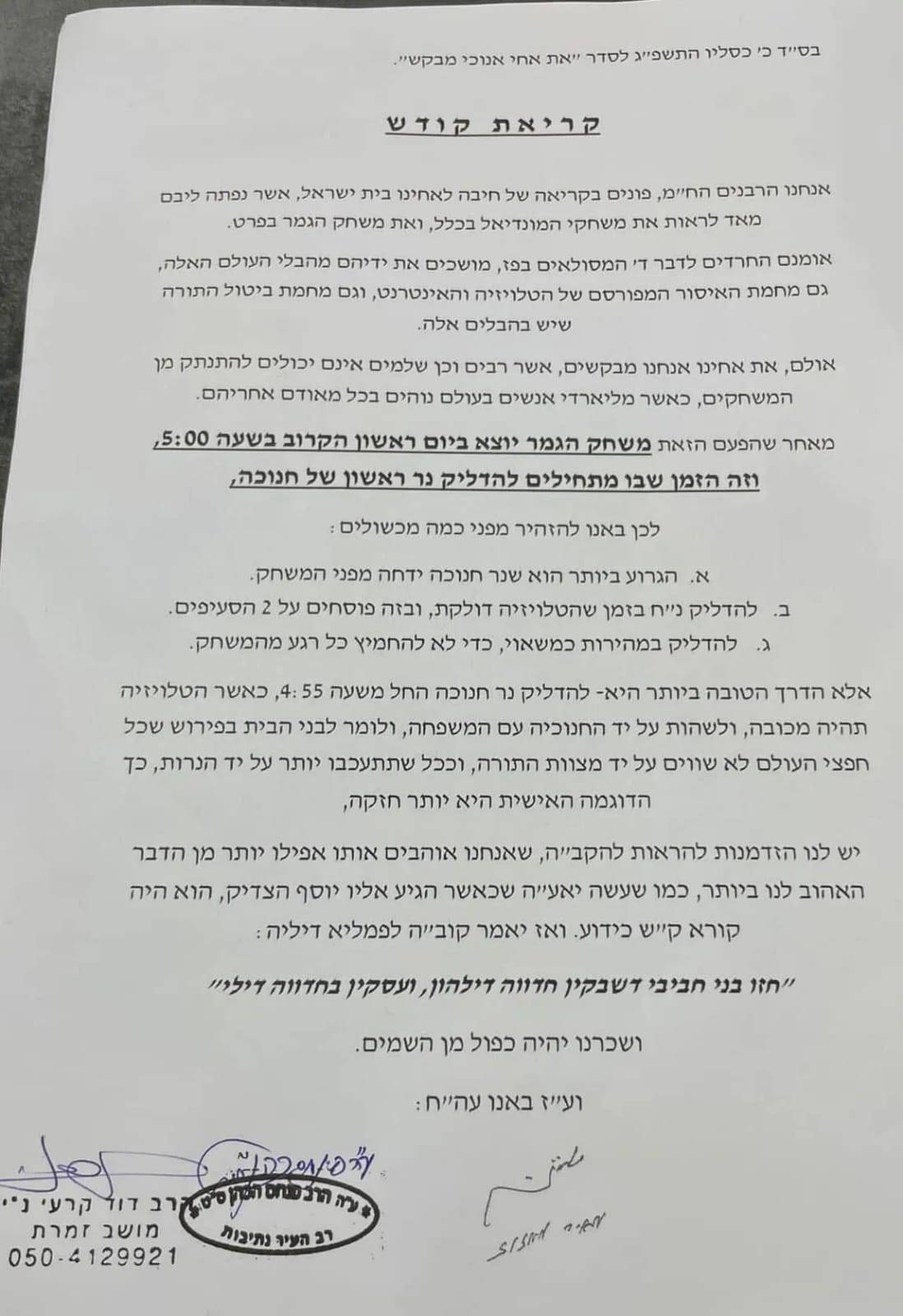
At first I was sure it was a joke, but in the end I realized it was completely serious (see for example here). And then of course I immediately thought to myself: actually, they’re right, aren’t they?
Since this is a practical halakhic question for this very day, I decided to gird my loins like a man and offer my opinion from afar on this weighty matter. Naturally, in this column—written on this very holy day—I will try to combine my response to the ruling with the humor that is called for, and beg forgiveness from the aggrieved. And this is my beginning, with the help of the One who gives strength to the wrathful and increases might to the powerless.
The Halakhic Ruling
Let me preface that this concerns those who light at nightfall (tzeit hakochavim), since those who light at sunset can light even on this holy day in their usual manner.
The esteemed authors shlit"a presented three options:
- Light after the match. This is the worst option.
- Light during the match while the television is on (for to turn it off in the middle of the game is beyond the sages’ enactment).
- Light in haste, as if it were a burden, so as not to miss a single moment.
Their conclusion: light five minutes before the match (16:55) with the television off, with all household members present, and only then turn on the television and watch (but only for one who cannot avoid these grave transgressions of telebiziya and internet, of course. Allah yerhamo).
However, for several weighty reasons, in my slender opinion—“a worm and not a man,” a servant to a holy people upon the holy land—it is preferable specifically to light after the match, calmly (their Option A). I will add that one should be careful to light after extra time and penalties, if there are any (may the Lord hear our prayer). Therefore I have not fixed a time for this directive, and may it be pleasant to the listener. I will only add my view—da’at Torah—that most likely we are talking about around 19:30 at the earliest, when the legs of Messi and Mbappé will have ceased from the marketplace.
My main arguments are divided in two: a practical consideration regarding the manner of lighting, and a consideration from the letter of the law.
The Practical Consideration
I, humble as I am, have not been endowed with love of Israel and the attribute of finding merit like our rabbinic letter-writers shlit"a. In my slender opinion, fortunate is he who believes that our brethren, the people of Israel, will turn off the television during the preparations, shut the microwave with the popcorn, and set the table for the festive meal (or the convalescence meal—each according to his taste), and then will placidly light the Hanukkah candle without constantly checking whether the internet has, Heaven forfend, gone down; that they will sing at leisure about the barking foe and the victory of the Maccabees over the culture of Yo–van, and tell their modest and pure sons and daughters of the Lord’s miracles, for His compassions have not ceased upon us.
I am not among those who believe this (even regarding myself—don’t tell anyone). For people are preparing for the holy day (and “a mitzvah is best performed by the person himself rather than by a proxy,” as in “Rav Yosef singed the head and Rabba salted the shibuta fish”—see Kiddushin 41a), and it is highly doubtful that the masses of the House of Israel, holy flock, will be able to withstand the optimistic challenge set before them by these rabbanim. Therefore it is more reasonable, in my opinion, to recommend lighting after the match (even though it is a pesik reisha that part of the audience will be mourners exempt from mitzvot, yet at most this is placing oneself in a situation of duress. See Eruvin 67b, “that child whose hot water spilled,” and the commentaries there and much more).
We must remember that the time to light is “until foot traffic ceases from the marketplace,” and in our times and places this certainly applies even at 19:30. True, there is the principle that the zealous act early; but against that stands the manner of lighting, which would be poorer, and in my view this consideration outweighs, since it is a matter of enhancement that touches on the performance of the law itself. If not a proof, there is at least a hint from the fact that our rabbis instructed not to recite Kiddush Levanah immediately at the end of the fast (on Yom Kippur and Tisha B’Av). Indeed, many reasons and opinions are offered, but the simple understanding is concern that, due to hunger, people will say it hastily in order to get to the meal (see the question discussed here). Still, they did not instruct to say it immediately at the fast’s conclusion but postponed it to a later time. The same applies to our case.
From the Letter of the Law
Until now I assumed that there is indeed value in lighting earlier but that the manner-of-lighting consideration overrides. Yet we should recall that one who lights the Hanukkah candle this evening at nightfall will be publicizing the miracle to lizards, at best. It seems to me that only a pedestrian will be in the marketplace at that time (in any case, these feet of mine will not tread the market). If we want the people of the marketplace to see the lights and the miracle to be publicized, it seems one should lechatchilah light after the match. Even if we light five minutes before kickoff, people will then be at home—lighting the candle and preparing for the game—and afterwards they will not go out to the market but will gaze upon the noble faces of Messi and Mbappé for two hours and more. So who is it that will join the lizards in publicizing the miracle?! Therefore, it appears that even from the letter of the law, not only bedi’avad, it is preferable to light after the match, when the people’s feet arrive from the pitch to the marketplace (for as is known, in soccer the feet are not in the marketplace but on the pitch).
While writing this I wondered how the Sages tie the time of lighting to the ceasing of people’s feet from the market, for among Jews everyone’s feet are at home, since they are lighting Hanukkah candles. So whose feet are in the market for whom the miracle is publicized? One must remember that since the semi-finals even the feet of the Africans (broad ones; see Shabbat 31a) and the Tarmodians (see Shabbat 21b) are no longer in the market. If you say that this law was stated for Jews living among gentiles, and the publicizing of the miracle is intended for gentiles—that itself is strained, especially as this law was instituted by Tannaim in the Land of Israel (in my view, not by the Hasmoneans), and there, plainly, at least some settlements were entirely Jewish.
In any case, if the intent is that the lighting serve as pirsumei nisa for Jews who go out to the marketplace after the lighting (which also explains why at least half an hour’s worth of oil is required), then certainly in our case one should light after the match: one who lights before the match—his candle will be extinguished already in the first half, Heaven spare us. But if one lights after the match, the masses will pour into the streets—some to weep, some to dance in the fountain at City Hall Square—and thus all will see his tiny candles and the miracle will be publicized in the most select and elevated way.
Closing Words
I have now seen what Rava expounded in Chagigah 3a:
“Rava expounded: What is the meaning of ‘How lovely are your steps in sandals, O noble daughter’ (Song 7:2)? How lovely are the feet of Israel when they go up for the pilgrimage festival. ‘Noble daughter’—the daughter of Abraham our father, who is called ‘noble,’ as it is said: ‘The nobles of the peoples assemble, the people of the God of Abraham’—the God of Abraham, and not the God of Isaac and Jacob? Rather, the God of Abraham, who was first of the proselytes…”
And as is known, any Amora mentioned in the Gemara could revive the dead. The holy Rava already foresaw that the delicate and lovely feet of Israel may be in the marketplace—but certainly not at the World Cup (to which one “goes up to be seen by foot”). For these Israelites are compassionate, the children of the compassionate, but not really players, the children of players. And though their steps are lovely in the sandals of the noble daughter, they are somewhat less lovely in soccer boots. In our sins, in this matter the beauty of Japheth does not quite dwell in the tents of Shem. It is good that our father Abraham, peace be upon him, in his holy spirit, already brought us converts (“for he was first of the proselytes”), and from here—to those Africans with the broad feet who play for us everywhere; and as is known, the Maccabees of our day are none other than these men of renown, the Africans.
Only now we must amend FIFA’s rules and allow a national team to use “acquired players” (ger toshav), and then perhaps we will reach the final of the financial World Cup. And perhaps when their coach is Jewish, there will be in it an element of amira le-nokhri (instructing a gentile) or “throwing a splinter onto the fire” by a Jew—a sanctification of the Name unparalleled, as it is said: “and a little child shall lead them.”
And since we have come to this, I can only recommend from the depths of my heart that in the next FIFA elections the winners be Deri, Bibi, Ben Gvir, and Goldknopf. Their platform suits very well the management of this important organization, whose exploits in this World Cup you can see a little of here (not funny at all), and here regarding its corruption in general. Thus Ben Gvir will surely excel in killing multitudes of gentiles (Arabs and others) during the construction of stadiums. If they killed their enemies and lost six or seven thousand people, Ben Gvir will excel far more. Deri and Bibi, of course, will corrupt the system far better than its current and former heads. If those embezzle funds and are ousted, these of ours have already sat or will sit in prison, and their hand is great in all matters of corruption, cigars, champagne, and settling the Land of Israel in various homes as the law—without coercion. And Goldknopf, completing our five-a-side for the next World Cup, will ensure there is no “culture of Yo–van,” and that the final’s time will not again coincide with candle-lighting. And when they reveal to him that there is a housing crisis and stadiums are lacking, he can always organize a construction project like in Qatar (at the reasonable price of some ten thousand dead, by way of instructing a gentile—or a secular Jew). Then that righteous, pious, and abstinent one will say to them, in his pure tongue: “Have you tithed? Have you made eruvim? Light the candle.”
Nothing remains for me but to conclude with a prayer to the One enthroned on high, which I corrected to recite after candle-lighting this evening, just before Messi’s foot ceases from the marketplace (this is likely his last match):
May it be Your will, Lord our God and God of our fathers, that by virtue of lighting the candle according to its law this year, You grant us to see many fine finals before You (for the woman: “Place our tears in Your bottle to be,” and save us from the fate of agunot whose husbands drowned in the endless waters of Qatar). And may it be Your will that we merit to do so only by way of instructing a gentile, yet have compassion on the gentiles, for they too are Your creatures; grant them to defeat the Greeks—Joseph smiting Joseph—and may a redeemer come to Zion, and peace upon Israel.
“Behold, are not My words like fire?”—declares the Lord.
Discussion
I liked it very much.
Praying that Mbappé’s feet will leave the marketplace. Happy Hanukkah, Rabbi.
You? Praying against Mbappé? Well, if it were me…
You call someone who doesn’t know the exact time of the game—and let us recall that some of the fans are killed (not to mention the injured and the cursing) as a matter of routine (without even mentioning the thousands who died this year in preparations for the event in host country Qatar)—“living on the moon,” but you don’t know that Qatar itself bought its players?
-As for the main halakhic discussion: those rabbis, as is well known, think it is a major problem to light at a late hour, and therefore ruled this way.
I wrote that this is directed at those who customarily light from nightfall, as stated in the Shulchan Arukh: the end of sunset.
Mistake. Messi’s feet,* of course. 😅
As I wrote, in any case they will leave the marketplace at the end of the game. Begging your pardon, but in this case I’m actually with him.
It seems to me that the gentleman mixed up the two rabbinic holidays.
In any case, in my holy neighborhood one can light comfortably at the proper time and there will still be plenty of feet in the marketplace.
And as this master of the discussion concludes: https://www.facebook.com/people/%D7%94%D7%99%D7%94%D7%95%D7%93%D7%99%D7%9D-%D7%90%D7%95%D7%94%D7%93%D7%99%D7%9D/100063611022089/
Fortunate are you, Israel
😱 A fit of kordiakos has seized you
And I heard that in one of the communities this Shabbat, the synagogue rabbi noted that some have the custom of saying on Hanukkah, “A good final sealing,” and “the wise at that time shall keep silent.”
That’s surely better grounded than wishing it on Hoshana Rabbah (actually also on Rosh Hashanah, but don’t tell anyone).
Wasn’t it agreed that “the wise at that time shall keep silent”? 🙂
A talkback—and yet one does not rule that way
Looks like Hanukkah got mixed up with Purim this year hahaha
More power to you for all of the above.
Hahahahaha
A supporting teaching:
Having a television in your home is like having a jew in your living room
Father Leonard Feeney
Published in “The Point” magazine in 1957
From all this humor, I didn’t understand: what is the rabbi actually suggesting one should do in practice? Light after the game? Don’t you see any kind of value failure in that?
Yes. And no.
More power to the rabbi!
You gave us genuine holiday joy.
I laughed through the whole column until the death of the foreign workers.
Insane! That in an enlightened world like ours no one gives a damn about this needless death.
If until now I doubted whether reincarnation exists, now I’m sure the rabbi is the reincarnation of an especially successful stand-up comedian.
What about the viewing itself? (Not from the standpoint of Greek culture, but because of the many workers who died through negligence in preparations for the event.)
I truly don’t know what to say. It’s hard to see this as a real problem, because my viewing makes no difference one way or the other. Though perhaps the categorical imperative would forbid it. In any case, it really is accompanied by a very bitter taste.
At Meron too some of the fans were killed—that’s how it is in crowded conditions
A. There was an enactment—to light when people returned to their homes. As for the question you asked—presumably the time of return from the fields was around those hours, a span of about an hour from sunset until everyone got home. One could say there is less significance to the precise time of day, but it doesn’t sound like there is any particular value in lighting דווקא at the end of a temporary one-time event and attributing importance to that.
B. Given that there is a general madness in the world, one that legitimizes corruption and idolatry and the loss of human life for the sake of pleasure and culture, one could say there is room for a counter-message. One can educate people to light, to take part in that, and only then to watch if they want. That is education for health, for proper priorities; I don’t understand making a joke of such a thing. That’s what I did with my son: we lit candles, sat for an hour asking riddles, rejoiced, and ate. Then we went to watch together. If not people of Torah will chart such a path, then who will?
What’s essential is missing from the text, namely reciting Hallel with a blessing after Messi’s victory, which is no less important than Herzl
To Shmuel, upon reading his name—
It seems to me there is no place to recite Hallel over Messi’s victory, for the verse explicitly says: ‘The dead do not praise…’
With blessings, Shraga Kadmon-Tiaharnski
With God’s help, 27 Kislev 5783
It is worth noting that the Sephardic rabbis, like the writers of the letter, follow their own approach: that the Torah was not given only to people who immerse themselves in the world of Torah, but also to those found in a “place of marketplaces”; and even those drawn after the “World Cup” should be given guidance on how to enjoy interesting viewing without giving up the mitzvah of the Hanukkah candle in accordance with halakhah.
With blessings, quiet and secure.
Besides the point of lighting the Hanukkah candle at the preferred time lechatchilah—there is also the point of not doing an action involving delay and excitement before fulfilling the mitzvah of the day. Apart from the concern that in all the excitement of watching the game the day’s mitzvah may be forgotten—there is also importance in raising eternal values to “the head of our joy”…
With God’s help, 27 Kislev 5783
The common denominator between Messi and Mbappé is that they are descendants of “strangers in the land” who integrated into the country that absorbed their forefathers and brought glory to their land. Messi descends from Angelo Messi the Italian, who emigrated to Argentina and was absorbed there. Mbappé is the son of immigrants—his father from Cameroon and his mother from Algeria—who were successfully absorbed in their new homeland and climbed to the top.
The victory of the Hasmoneans too was not only a shutting-in against Hellenistic globalization, but also the standing tall of the Jews, which brought them honor on the international level. From that point on, the people of Israel became an influence on general culture; converts joined them, and “those who fear God” attached themselves to them, until just two or three generations after the Hasmonean victory, the sons of converts—Shemaya and Avtalyon—rose to the rank of leaders of the Jewish people.
The candles that every Jewish family lights at the entrance to its home signal to whoever is “outside”: “Come and join. You are invited to receive light and to give light.” The candles bear the stamp of Yose ben Yo’ezer of Tzeredah and Yose ben Yochanan of Jerusalem, and signal that the Jewish home is a “meeting place for sages” yet “open wide” to every seeker, who is invited to receive light and to give light.
With blessings, Shraga Kadmon-Tiharansky
I think it is contemptuous of the House of Israel to say that they are incapable of restraining themselves and fulfilling a rabbinic mitzvah that they merit to fulfill only seven days a year (all the more so on the first day of Hanukkah—at the height of enthusiasm) at the expense of watching a group of gentiles (or perhaps animals) chasing a ball. (In particular, my words are directed at the Haredi public, because regarding the Religious Zionist public (at any rate the more “lite” element), sadly it is very plausible that they really do prefer the option of watching gentiles chase the ball… By the way, I heard this distinction between the sectors from a Religious Zionist rabbi himself. Even they are aware of their compromising attitude… what a generation we have reached. And this compromising attitude has already been turned into an actual ideology, to our sorrow, as the Maharal writes in Netivot Olam that people have a tendency to create an ideology in order to permit themselves their desires. And just as in Bnei Akiva they turned mixed activities into an ideology, saying that it is a blessed thing and helps youths know how to form connections also with girls, even though Rav Tzvi Yehuda, who was the leading sage of the generation in Religious Zionism, strongly opposed it (see Sichot HaRatzia), these are people who are not exactly interested in what the great Torah sages think, even if they are sages from their own public… and He, being merciful, will atone for iniquity…)
With God’s help, 28 Kislev 83
To Moshe—greetings,
The Sephardic rabbis who wrote the letter recommending lighting before the game are also addressing the traditional public, for whom the mitzvah of candle-lighting is important, but for whom the concern lest they miss the World Cup broadcast is likewise not foreign.
The concern is not that they will deliberately cancel the candle-lighting, but that they will postpone it until after the game, and meanwhile, in all the excitement of the game and the storm of discussion about what happened and what was or was not done—they will simply forget the mitzvah of the day.
Therefore the rabbis advised lighting the Hanukkah candles a few minutes before the game broadcast, and only after lighting the candles should they turn on the television and watch the game.
This is always the way of the Sephardic sages: to care also for simple Jews, and to draw them close with great patience to Torah and its commandments. And in the manner of Aaron, who loved people, even when they were in a certain state of distance, through his love and patience he would bring them close to Torah.
With blessings, Hillel Feiner-Gluskinos,
Paragraph 4, line 2
… even when they are in a state of distance…
Moshe, I suggest you look through job listings. If there’s a yeshiva looking for a mashgiach, it seems to me you’re an ideal candidate. Preaching without arguments, talking nonsense, tossing out slogans with certainty, etc.—those are exactly the parameters required for the job. Good luck.
Besides the real concern about forgetting, there is also the value aspect: to show that God’s commandments are dear to us and take precedence in value—and therefore also in timing—over the pleasure of the World Cup, that we do not set aside “eternal life” for the sake of “temporary life.”
With blessings, H.P.G.
From here there is also an answer to the claim that nowadays most people come home at a later hour and not close to sunset. Even so, there is reason to say that since there are still people in the public domain near sunset—there is nevertheless a value in advancing the lighting, in that it expresses alacrity and love of the mitzvah.
I did not mean to challenge what the rabbis who wrote the letter wrote. On the contrary, I meant to challenge the words of Rabbi Michael Abraham, who wrote—and I quote: “I, the least of all, am not among those who believe in this (even regarding myself. Don’t tell anyone)… and it is very doubtful whether the masses of the House of Israel, holy flock, will be able to meet the optimistic challenge that these great rabbis have set before them”… It was to that that I was directing my words.
With God’s help, 3 Tevet 5783
It is mentioned in books of Hasidism that “This is Hanukkah” is the final completion of the sealing of judgment of the High Holy Days, in which a “last chance for improvement” is given. See the Wikipedia entry “Zot Hanukkah” and the sources cited there, and the article “Zot Hanukkah: The special power of the day in Hasidic books.”
And in this year, on the first day of Hanukkah there was the “world final,” and on “This is Hanukkah,” parallel to Shemini Atzeret, the special stature of Israel is revealed, as God says to them, “Your departure is difficult for Me,” and the lights of the festival continue into the coming weekdays, especially as the long nights of Tevet are coming, which are conducive to increasing Torah study.
With blessings, Yaron Fish”l Ordner
Thank you for your incisive words. Every time anew I am impressed by them
Regarding the rabbis’ letters, these and those—wouldn’t it be simpler to light the Hanukkah candle at sunset, as the primary law requires?
After all, its mitzvah begins “from when the sun sets.” In the Diaspora, where many followed Rabbenu Tam’s view, they would in any case light at the “second sunset,” which is at full darkness. But for us, according to the basic law, the time is the one and only sunset, and that is before 16:40, so why wait until 16:55, or even later?