

A Constitutional Moment, or: How Public Discourse Operates (Column 552)
The hardball tactics of both sides are part of the discourse — and are also what created it
The column opens with the claim that Israel usually does not have real public discourse, only positions, shouting, and lack of listening. דווקא now, alongside an especially sharp escalation — demonstrations, economic pressure, media pressure, threats of refusal, and what he calls a game of chicken — a real discussion is also beginning: people are reading, comparing outlines, and hearing arguments about Basic Laws, judicial appointments, legal advisers, and the limits of judicial intervention. He stresses that this change was born not despite the hardball tactics but largely because of them: without the determination of Levin and Rothman, sudden admissions that reform is needed would not have been heard, and without the pressure applied by the protesters, willingness to compromise would not have emerged. So even if the motives are partial and the mutual suspicions are partly justified, this opening should not be missed.
This is not a correction to Barak's revolution but a belated founding of the rules of the game
Following Micah Goodman, the column proposes seeing the situation differently: not as a counter-revolution that merely tries to balance Barak's 'constitutional revolution,' but as a very late attempt to complete what Israel failed to do at its founding. Most ordinary public disputes take place within a given framework; here, for the first time, the argument is over the framework itself. Israel was established without the constituent assembly completing a constitution, that is, without properly defining the relations among the Knesset, the government, and the court. That vacuum let the system function partially, and later also allowed the court to fill some of the missing pieces on its own. Now that the elected branches are finally trying to set the rules, the move is experienced as a dramatic change — even though, at a deeper level, it is mainly the setting of rules that were never actually settled.
When the rules of the game are under dispute, a simple majority is not the only source of authority
From this he concludes that in the current debate one cannot simply say that the coalition is the majority and therefore may decide. Majority rule is itself one of the framework rules that has not yet been fully agreed upon, and so other forms of power also enter the arena: economic, media, social, cultural, and even military power. That is why protests by business leaders and high-tech figures, and even military refusal — problematic as it may be — are not, in his view, plainly illegitimate departures from the game, but signs that the argument is about the very existence of the game, its rules, and the prices each side can exact if ignored. This is a mass, forceful, messy discourse, but the column sees it דווקא as a sign of a living society arguing over its own foundations.
The path to a constitutional moment requires clear rules and broad agreement
The column adopts from Goodman three conditions for giving birth to a constitutional moment rather than a constitutional crisis: public awareness that this is a founding moment, clarity about the rules that will be set, and broad agreement on those rules. The first two conditions seem attainable to him; the large question is whether agreement exists. Here he distinguishes between two components of a constitution: its value-laden content — its basic values and the relation between the state's 'Jewish' and 'democratic' character — and the mechanisms of regulation, meaning the rules of the game. In his view, the fierce dispute of these days concerns mainly the regulatory side: a Basic Law on legislation, a Basic Law on adjudication, the way Basic Laws are enacted, their status, judicial review of laws, the override mechanism, and the composition of bodies such as the committee for selecting judges. Precisely if the focus is first placed on those questions, and not on all the value disputes, there is a real chance of progress.
Beneath the noise there is already broad agreement: reform is needed, but not in the current version
The column's main claim is that there is already broader public and professional agreement than it seems. He reads the petitions of supporters and opponents and argues that the media presents them as two extremes, although in practice they say almost the same thing: there are real problems in the balance among the branches, and reform is needed, but Levin and Rothman's current version is too fast, too forceful, and too extreme. So the disagreement is not over the need for reform itself, but mainly over wording, balance, and details. Even the remaining disputes — whether legislation should be paused during talks, in what forum the talks should take place, what majority should be required for an override clause or for striking down a law — are, in his view, mostly technical nuances for experts, not a principled abyss over the future of democracy or governability. The broader public, and most politicians as well, do not actually hold a worked-out constitutional position; they mostly express opposing sentiments.
Even a good compromise may be experienced as defeat, and rules alone will not repair the lack of trust
This leads to the column's double-edged ending. On the one hand, he estimates that a reasonable solution, not far from common sense, will eventually take shape דווקא through these power struggles. On the other hand, he worries that even if the agreed content is good, both camps will experience it psychologically as defeat: one side will see it as the end of democracy, the other as the end of governability. In that case, a deep social crisis would continue even without an actual constitutional crisis. Beyond that, there is an even deeper problem: democracy rests not only on balanced rules but also on trust, good intentions, and the integrity of the players. The constitutional vacuum may perhaps be filled; the mutual lack of trust, in his view, cannot be solved by law and constitution alone. That would require a new social covenant, and here the column ends on a cautious pessimism.
In recent days, Micha Goodman has been speaking again about the significance of these times, pointing out that we are on the verge of a constitutional crisis, but that this moment also carries a very positive—even formative—potential because we are in what is called a “constitutional moment.” This phrase has taken hold in the last few days, and I have heard it in other contexts as well. I highly recommend listening to his talk on the matter. Truly enlightening, in my view, and what I write here follows from listening to him. I will refer quite a bit to my remarks in Column 548, and whenever I point to that column, this is what I mean.
How does public discourse operate?
I have written here before that in Israel there is no public discourse about anything. There are tribal shouting matches and yelling without listening, and people don’t really understand what is at stake—but that doesn’t stop them from holding firm views on the issues of the day. Positions dominate every discussion, and the opinions expressed are generally entirely predictable.
These days, I suddenly have the feeling that the situation is a little different. Most people are still not versed in the details of the reform and its ramifications, and that still doesn’t stop them from holding well-formed views—but without our noticing, a real conversation about it has begun.
One must understand that public discourse, when it does occur, unfolds in a very complex manner. The skirmishing in the streets, demonstrations, and the application of economic power (moving money and businesses abroad), media power, or other forms (including refusals by military personnel) are an integral part of the game. One can argue about the legitimacy of these dimensions—and typically you will hear formulaic, predictable positions here too—but note that until now this was the whole game, even if it played out at relatively low intensity (we didn’t see such threats and refusals in earlier cases). None of that is true these days. In parallel to the usual invective and inattention—and despite the rising intensity of power struggles—suddenly people are beginning to read up, to get a bit oriented, to exchange views and proposals (new “frameworks” are being published every day and brought into discussion). Suddenly you hear people expressing opinions about what Basic Laws are, how they are enacted, whether and how they permit invalidating statutes, what ought to be and what is, judicial appointments, the status of legal advisers, comparisons to other countries (usually not worth much, from all sides), and the like. What had been the domain of a handful of legal experts and elite journals has suddenly become present in the street and reached the “ordinary person.” Alongside all this, more systematic work is being done, and people are starting to offer reasoned views and even to argue on substance. In many cases this is not done directly, but even indirect debate and discussion are something. And of course, along with this, the tussling is beginning to escalate, and steps on both sides are becoming more extreme—up to fears for our continued existence. Thus the game of chicken I described in that column emerges. Yet in recent days there has been a change of direction. The application of force by both sides is making itself felt.
Suddenly you hear legal figures expressing a willingness to compromise—a partial reform, recognition of the need, motivations, and frustrations that led Levin and Rothman to take steps, and so forth (with criticism only about the speed and the details). These are tunes we had not heard until now. I have no doubt this would not be happening without the forcefulness and resolve of Levin and Rothman, even if that forcefulness is not justified in itself. And of course their openness would not have been possible without the power exerted by the various protesters (economic protests, refusals, and more). In my view, if Levin and Rothman, who set this process in motion, thereby made it possible for us to begin truly debating, they deserve a place of honor in the annals of history. Supporters of the reform ask these newly conciliatory voices: Where have you been until now?! Why have we not heard admissions that there are problems and that a reform is needed? And of course the inevitable comparisons (partly apt) to the Disengagement keep surfacing. Supporters of the reform suspect—and with some justice—that their opponents voice compromise only because they fear their side’s hand may now be the weaker. I think there is something to that; but “from not for its own sake comes for its own sake,” and if a genuine conversation has been created, for whatever reason, it is wrong not to join it.
For my part, I am quite convinced that the reform in its current form will not pass. The pressures—mainly economic, media-related, social (the unraveling of the army), and diplomatic—will ultimately defeat it, unless the present coalition is truly irresponsible and utterly tone-deaf. But in any case, it would be wrong to miss this moment, and it is important to make the most of the conversation now unfolding. In the column cited above I explained that this game of chicken can have several possible outcomes: one side wins, the other side wins, or both crash. At present, it seems the third result is likely to occur (the crash can be of varying degrees, of course: the state could be ruined, cease to be democratic, turn into a banana republic economically and/or morally, and so on). But I wrote there that there is another possibility: both sides come to their senses and realize this has no future, and reach a mutual agreement that is better for both (I compared this to the Prisoner’s Dilemma). That is also what Micha Goodman says in the remarks cited above: we are a moment before a constitutional crisis—or in a “constitutional moment,” a moment with the potential for rehabilitation and momentum.
Progress toward the “constitutional moment”
Micha Goodman argues that we are looking at the situation incorrectly. People commonly assume that there was a revolution in recent decades carried out by the Supreme Court, which took into its own hands too much power without having truly received it from the Knesset (which did not legislate the basis for its activity) or from the public (it is unelected), and that now Yariv Levin and Rothman are carrying out a reverse revolution intended to restore balance. The problem with their approach is that they are taking it to the opposite extreme and will bring us to a situation in which there are no real constraints on the executive branch’s power. In any case, the prevalent view is that there is an attempt to balance and correct what Aharon Barak and his cohort did in the past, and the debate is whether we are returning to the middle path or moving to an opposite extreme. Many claim that the attempt to reach the opposite extreme (the forcefulness of Levin and Rothman) is what will bring us to the middle path, in the well-known approach of Aristotle and Maimonides.
Goodman contends that this is not the right way to look at it. To explain, he prefaces with the distinction between a conversation within the framework of the game and a conversation about the framework itself. Almost all debates—in Israel and elsewhere—deal with policy, security, religion and state, economics, ideology, morality, etc. All these discussions take place within a given framework that is not itself being discussed. To what may this be compared? To a debate among basketball fans about the proper tactics: whether to attack from here or there, inside the paint or outside, how many bigs and how many guards to use, and so forth. Fans do not usually argue about questions such as the basket’s height or the ball’s weight, whether a foul should mean two free throws or three or perhaps one, and so on. Those are the rules that set the framework, and the ordinary debates happen within them. So too in politics. Until now, there were stormy debates on ideological, moral, and various political and security questions, and they took place as though we had a fixed and known framework within which this discourse could be conducted. What is new these days is that, for the first time, Israel is having a debate about the rules of the game themselves. When the game of basketball runs into a crisis and it turns out that the framework is problematic, then too debates can begin about the rules themselves. This is what leads us to the “constitutional moment.”
Logic dictates that before we enter questions of what the court ought to do and the extent of its intervention, and how the government ought to act (in policy, religion, security, values), we must first settle the framework rules: what the government or the court are authorized to do, and how relations between them should operate. Only after that is settled can we conduct the more substantive debates about content, policy, and values.
Goodman’s claim is that in most democratic countries, when they arose, their first step was to establish a constituent body tasked with drafting a constitution. That is the setting of the rules of the game. Afterward—once the framework exists and is defined—this body is supposed to disperse and hold elections to the legislature and other institutions, and now that the framework exists, the democratic game can begin. In Israel, as is well known, after the War of Independence there were elections to a Constituent Assembly that was supposed to draft a constitution and then disperse and hold elections to the legislative and executive branches. But the constituent body failed to reach agreements and did not create a constitution, and in the end decided to skip that stage and turn itself into a legislative body. The upshot is that they—and we—began to play the game without setting its rules.
On the face of it, this is an absurd situation that should not be workable. Think about a group of people discussing how to define a game and deciding to start playing it without defining its rules. Odd, no? Amazingly, it sort of worked. With a bit of dictatorship and Ben-Gurion’s dominance, followed by the Histadrut and the Labor movement in its variations, but overall it worked. Institutions were established, debates were held, there was even some legal and political review, and the proof is that after almost thirty years of absolute dominance, Mapai’s rule changed hands. In other words, a kind of democracy did emerge.
Yet throughout this entire period, breathing down our necks was the vacuum at the foundation of this whole game. Its rules were not settled. From time to time the issue surfaced, usually at rather low intensity, but it was never truly addressed. At some point the court saw that there was a vacuum in terms of the rules of the game and had to make decisions—and in doing so allowed itself to set some of these rules on its own. This should not surprise us, since the game must be played, and when there are no rules someone has to jump in and fill the void. Otherwise—how shall we play?! The Knesset insisted on not advancing a constitution and on not creating a framework, and repeatedly evaded the challenges the court set before it. Amazingly, that too worked for a while. From time to time there were protests and calls to fix and balance the situation, but overall they did not ripen into genuine civil disobedience. True, a great deal of frustration accumulated, mainly on the religious-right side, but that did not lead it to heed the calls—usually from the left—to establish a constitution. That situation suited it; it preferred to dance at two weddings: keep things as they are while crying foul at the court. Note that even during the right’s long years in power, the rules were not shattered and no one tried to carry out a counter-revolution or clip the court’s wings. Compliance with Supreme Court decisions was almost total.
An exceptional case occurred exactly three years ago, when Knesset Speaker Yuli Edelstein, a rather statesmanlike figure, came almost to the brink and announced that his conscience would not allow him to carry out the High Court of Justice’s ruling. The sense of a game of chicken then took on flesh and bone. Ayelet Shaked and Gideon Sa’ar—two conservative justice ministers opposed to Supreme Court activism—made rather cosmetic changes, accompanied by considerable frustration among their supporters that they were not truly changing the situation. All along, the rules of the game (those created de facto by the court) remained roughly as they were.
In recent months this situation changed at a stroke. In the last term, the members of the executive and legislative branches (the latter not truly existing here) decided to take the initiative into their own hands and put an end to this strange state of affairs. They want to set, at long last, the rules of the game. The problem is that for much of the public their determinations are seen as too extreme and too hasty, and the dialogue that such a step requires is lacking. Beyond that, tentative rules have already arisen that vested power in various institutions and actors, so setting rules of the game is now perceived as changing existing rules (which is not quite accurate; in essence, this is now more a setting of rules than a change to them). No wonder this arouses protests, turmoil, and disagreement. Collisions are now beginning, escalating rather quickly, but alongside them a conversation is also stirring, as I described above.
Goodman argues that these days we are in fact re-establishing the constituent authority and the constitution; that is, setting the rules of the game that were missing from our play until now. This is the completion of the state’s founding (and not necessarily the beginning of its end). Of course, that is only if we are wise enough to reach agreement in the game of chicken we are in; otherwise we are on the road to ruin. The question is whether we will reach a constitutional crisis, or recognize that a constitutional moment has arisen and should be seized. In short, his claim is that this is not a “counter-revolution” trying to correct Barak’s revolution, but a belated establishment of the rules of the game—filling the vacuum that Aharon Barak and his colleagues tried to fill in problematic ways—so that the debate and conversation that were missing before Barak made his decisions are being held now. It is not a reversal, but a late framing of the rules of the game.
As I explained, the mutual battering and pounding we are witnessing these days are how a mass, healthy public discourse unfolds. There is no other way to conduct a conversation about the rules of the game themselves—certainly not when we are no longer truly at the beginning of the road. It has now become clear to all of us that we must decide whether we are interested in a shared game or in breaking up the team. It follows that this conversation cannot be conducted only by representatives or through existing political institutions. What is at issue is the role and meaning of those institutions, and fundamentally the people themselves must speak. Representation itself is under discussion, and it is no wonder we have returned to decisions in the town square, as in Athenian democracy.
The character of the debate
Note that in this conversation there is no significance to majority and minority, for as I explained in the column cited (and as I will elaborate in the next column), there is no validity to majority decisions and no obligation on the minority to accept them so long as we all have not agreed to play a shared game. For the same reason, what determines in the present discussion is not merely the majority of voters’ raised hands, since majority rule is itself one of the framework rules we have not truly created. Entering this primordial, foundational debate are also economic, media, and cultural power, various value disputes—and it has no very clear rules. All sides deviate from the rules, since this dispute itself reflects the fact that we do not really have rules.
Above I explained: that is how public discourse operates. Such discourse is not decided by a Knesset vote, since voting is a method grounded in the rules of the game. We are now debating whether there is a game at all, whether it is viable, what its rules will be, and who is prepared to participate in it under those rules. Therefore, businesspeople and high-tech companies moving their money as political protest are taking a perfectly legitimate step. Even soldiers’ refusals—problematic as they are—are not utterly illegitimate in such a situation. This is part of the power struggle accompanying the substantive discourse. Each side clarifies for the others what the costs will be if their views are disregarded. The opposition tells the coalition: True, you are the majority, but note the economic price you will pay for using that majority in a non-consensual way. So too do soldiers and commanders in the army tell us.
It is worth recalling that even in halakhah there is a dispute whether we follow a majority of wisdom or a majority of people, and we have a similar dispute here: is majority rule the majority of citizens, or must we also consider the majority of economic, military, and social power? It is no accident that the United States has a veto in the Security Council and we do not. When a crisis erupts in the world, the entity sending money or an army to resolve it is not the State of Israel but the United States. Economic actors and high-tech professionals bear most of the country’s economic burden, and it is no wonder their voice has significant weight. Claims about equality among voters and votes can be raised after the game and its rules have crystallized, but not while we are discussing its viability and rules. Power has justified significance in a debate about the rules of the game, and biases in its favor are not an injustice.
No wonder the arguments in this debate are accompanied by the application of force by both sides: on the coalition’s side, political power; on the opposition’s side, economic, media, and social power. There are very few inhibitions in this struggle, but that does not mean it is not proceeding properly. This is a debate about our very foundation here—about the framework of discussion—and as such it is bound to be forceful and tough. It only means we have a healthy society (at least as long as it still exists). The question is whether in the end a golden calf will be born—only to be smashed—or a shared democratic game will be reborn and refounded now (in place of what the Constituent Assembly should have done at the state’s dawn). In my view, the odds are that the state will not be destroyed (though that is possible), and there is also a decent chance that it will not only survive but even advance. That brings us to what Goodman calls a “constitutional moment.”
How to arrive at a proper birth: the “constitutional moment”
In the game of chicken we are in, two outcomes are possible: a constitutional crisis or a constitutional moment. I described the constitutional crisis in the column above: the Knesset legislates, the court annuls, and now police, soldiers, and citizens are bewildered whom to obey. The important question now is: how can something positive emerge from this? How can this moment be turned into a “constitutional moment”?
Goodman argues that three main conditions must be met: 1) public awareness and sensitivity to the formative nature of this moment—and that certainly exists today; 2) the constitution that emerges must be clear (otherwise anarchy and inter-branch conflict will continue); 3) there must be broad agreement regarding its principles (the rules of the game). The main problem is, of course, item 3: agreement. Seemingly, we lack agreement about the rules of the game, and thus there appears to be no horizon for the current discussion.
You will likely be surprised by what I write here, but in my view we have more or less already reached such an agreement. Agreement about the rules of the game very much exists—despite the turmoil, and perhaps because of it. To understand this, we must distinguish between two parts of the constitutional structure: arrangements and content.
Where is the dispute?
What prevented the drafting of a constitution at the state’s outset was disagreement on the value plane (mainly religious). I am not sure whether the situation today is worse or better (surprisingly, I think it is better), but some Basic Laws were created then that deal mainly with arrangements (Basic Law: The Government, the Knesset, The Judiciary, The President, etc.). In the 1990s, two more Basic Laws were created—this time touching on content (Freedom of Occupation and Human Dignity and Liberty). This reflects the fact that a state’s constitution has two foundations: fundamental values and the rules of the game (the constitutional arrangements). The two latter Basic Laws were adopted with broad agreement in the Knesset and in society (religious parties feared possible harm, but they fully agreed with the values expressed in these laws and therefore ultimately supported them).
Regarding the constitution’s value-content part, the situation is not as bad as it seems. The main debates to this day have focused on the relationship between the “Jewish” and the “democratic,” and perhaps even more on the content of “Jewish” in that pairing. In my estimation, regarding the meaning of the “democratic” in that pairing, almost everyone agrees that this is the proper and fitting framework. There are no significant disputes there (including among Haredim and hardline religious-Zionists). The religious fear is of the “democratic” injuring the “Jewish” (particularly via the court, which is why the court’s composition matters so much to them).
Note that the current struggle’s focus is not value content (which, as noted, has crystallized and is more consensual than in the past), but the parts dealing with constitutional arrangements. If we now focus on filling these gaps—that is, completing the constitutional arrangements while ignoring content disputes—we can escape the present conflict and move forward. That is also what the President proposed. At the first stage we must agree on Basic Law: Legislation and Basic Law: The Judiciary, and only afterward discuss the reform’s details. We cannot discuss the court’s relationship to Basic Laws before defining what a Basic Law is and turning it into a law with a distinct status (through a different, much more stable legislative process). The initial arrangement requires formulating laws that will determine how a Basic Law is enacted, what it does (whether it invalidates statutes and by whom and how), and how the legislature may respond (override) to such invalidation.
My claim is that even regarding the constitutional-arrangement rules—those now at the center of contention—there is, in my estimation, quite broad agreement both in the public and among experts. Incidentally, this has happened largely thanks to the ongoing skirmish that has succeeded in sparking substantive discussion and the presentation of arguments from all sides. I will now try to persuade you that despite the noise and commotion, today the disputes about constitutional arrangements (the “reform”) are really marginal.
The agreement
To see why I perceive broad public agreement, consider for example the ad signed by the 120 professors who support the reform, as published a few days ago:
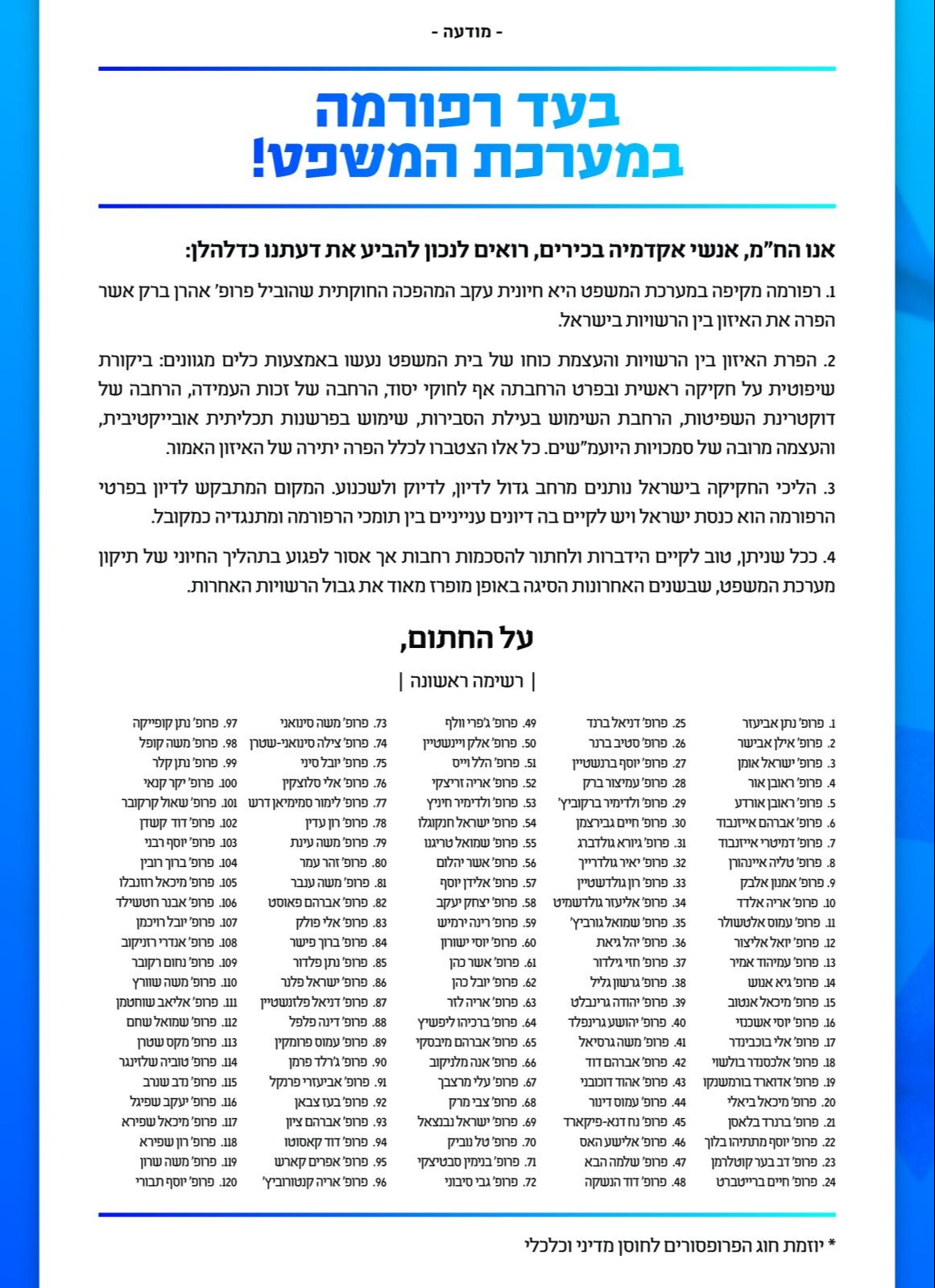
When you examine this ad you will see that they are not supporting the reform (as a fixed package), but a reform (as a general idea). They call for dialogue and a mutually agreed text. Some even gave interviews, and with my own ears I heard several signatories say they have reservations about Levin and Rothman’s formulations (such as Ron Shapira, Israel Aumann, and others), but they support the need for reform. Today I was sent quotes from my friend Prof. Moshe Koppel, founder and president of the Kohelet Policy Forum, who himself says he does not want the entire reform as it is currently sketched. I too would sign such a petition.
By contrast, take petitions and ads from those opposing the reform (a survey is here, and see also here and here) and try to assess what they say. You will find that most claim that in its current formulation the reform will bring ruin and disastrous results. That is, there too most do not reject the need for reform or deny the existing problems in the balance among branches (the lack of agreed rules of the game), but say that in the details Levin and Rothman go too far. [I will add parenthetically that in my impression a significant portion of Likud members themselves agree that the reform must be moderated, and without coalition discipline there is no chance the reform could pass. The extreme formulations are the result of Levin and Rothman’s obstinacy, and those two are leading the entire move—to the chagrin of many of their colleagues (as has begun to spill into the open in recent days). It is not reasonable to frame agreed rules of the game by virtue of the power wielded by two Knesset members.]
If we return to the petitions on both sides, the media present them as two extreme poles: these are “for the judicial reform” and those “against the regime coup.” The feeling is that there is no way to bridge such a deep chasm—a true game of chicken. But if you read carefully and note my comments, you will see that while the dispute may be heated, it actually lacks real substance. It turns out that even among the petition signatories—supposedly belonging to the debate’s poles—there is very broad (if not complete) agreement that a reform is needed, and conversely there is also very broad (if not complete) agreement that the present draft is extreme. So what is the dispute really about? Nuances—how to phrase this clause or that.
When you hear media interviews with someone supporting the reform, he always explains why it is necessary. He points to the flaws and problems requiring correction—but you will hardly hear from him about the dangers in the proposed solutions. In interviews with those opposing the reform, you will hear about the dangers in the proposed solutions—but never about the problems that led to it. This is a dialogue of the deaf, since it shows that the two sides are not actually arguing: one focuses on the problems and the need for reform, the other on the problems in the solutions and the dangers of the proposed reform. The conclusion is that everyone agrees a reform is needed and the current draft is dangerous and problematic. All that remains are disputes over details.
I do not belittle the details, but they do not reflect a dispute over the reform as such—or even over the need for it. Moreover, in a dispute over details, there can be shouting on both sides. Someone who supports reform can be more extreme in his demands to moderate it and in pointing out its problems—at least in some respects—than someone who opposes it. In short, the entire map presented to us is distorted. Be that as it may, we can see that this is no longer necessarily a war for home or democracy but about nuances concerning proper balances. Those at the extremes—the absolute supporter and the total opponent—are a negligible minority in the public and even among experts. Furthermore, I have written here more than once that one cannot argue about a single item from the reform in isolation. We must examine the entire structure, because every part affects all the others. Beyond that, there can indeed be several different constitutional designs that achieve the proper balances among the branches.
It is no wonder, then, that if you pay attention you will see that more than the content, the arguments now deal mainly with the form of discourse: whether to stop the legislation during talks; whether the talks should be held in the Constitution Committee or in some other format. These are technical rather than substantive matters, and at the moment they seem to be what is blocking the conversation, even though everyone has already admitted it is necessary. This too indicates that there is fairly broad agreement on the structure and framework as such. Even if someone thinks the override clause should require 61 or 70, and another thinks 75 MKs are needed, this is essentially a nuance. So too with the dispute about the majority required in the court to strike down a law: should it be 12 out of 15, 80% of any panel, or even a simple majority—these too are technical debates, not highly substantive, and certainly not the ruin of democracy or the state. In each such item there are extreme formulations that really do pose a risk, but in my impression most actors on both sides already understand this well—and they are not there. This is certainly the state of the public. Time and again it becomes clear to me that there is fairly broad agreement here that the matter requires arrangements, and even what the problematic points are that require arranging, and in what directions. The rest is a matter for negotiation, as in any other political issue. There is no deep dispute about essence; the matter is simply stuck. Incidentally, for this reason I estimate that this issue will, in the end, be resolved.
Note that a debate over details can only be conducted among experts—and even there, only among those who have delved into the issues at hand. Ordinary citizens—or experts who have not gone deep—do not truly have a formed position on what majority is required for an override clause, or the composition of the Judicial Appointments Committee for lower courts or the Supreme Court, or the majority required in the court to invalidate a law. The overwhelming majority have not examined these matters in depth and certainly have not formed a comprehensive constitutional picture. As noted, the arguments reflect opposing sentiments rather than formed positions. In the column cited I pointed out that this is also the case among opposition politicians. Unlike Levin and Rothman, the opposition’s leaders have been careful, for a long time, not to present any formed position about the reform—neither about the problems nor about the solutions. In my view, that is because they don’t have one. This is one reason it is so difficult to engage them in dialogue and discussion.
Thus, the disputes among politicians and in the wider public (as distinct from a very small minority that has done and is doing systematic work) mainly express opposing sentiments rather than truly different positions. This is evident in the petitions cited above, which reflect primarily a difference in sentiment, not a substantive disagreement—except for technical debates over details. The third condition for a “constitutional moment”—public agreement—also exists, in my view. Therefore, I think there is a good chance that ultimately the process will reach some reasonable solution acceptable to the sides.
Seemingly, this is a rather optimistic picture. I will conclude nonetheless with two not-unrelated aspects that somewhat dampen our optimism.
A. Between practice and sentiment/consciousness
I explained that the condition of agreement exists today—at least regarding constitutional arrangements (and to a not insignificant extent also regarding the constitution’s substantive content). There is thus no bar to turning this very moment from a constitutional crisis into a “constitutional moment.” If we do not do so, we will all smash into the wall at the end of this game of chicken. That will be the result of folly and irresponsibility, and chiefly of misunderstanding—not of substantive disagreements. It will happen if sentiment (which reflects polarized differences) eclipses substance (where there are no significant differences). Such a thing can indeed occur. Disputes grounded in sentiments without real substantive basis can indeed carry us to the abyss.
I have already written that I am an optimist. In my estimation, what will ultimately happen is that we will reach a more or less agreed compromise, and in my view it will not be far from what common sense dictates. In the end, substance will overcome sentiment, and slogans will lose to truth. This will not happen despite the power struggles in all the arenas I described—social, diplomatic, economic, military, and political—but because of them. So too it should be.
But here a new problem may arise—somewhat the reverse. If and when we reach that desired result, both sides may ask whether the compromise reached at the end of the process is a victory or a defeat. I fear that because of the opposing sentiments that drive us to extremes, both sides will see the result as a loss and a disaster for them (either the ruin of democracy or the ruin of governability), even though in practice neither will occur. In such a case, the outcome we achieved may be good and proper in itself, but it will not stop or prevent the social rupture and the clash already occurring. There will be a virtual smash-up in a game of chicken that is not taking place in the real world at all but in people’s and groups’ consciousness. If sentiment prevails over substance, then the victory achieved on the substantive plane will sink on the plane of consciousness. Our society may be deeply cracked by the sense on both sides that they lost (these will think there is no governability; those will think there is no democracy), even if this occurs only in the realm of perception.
B. Back again to integrity
In the column cited, I noted that beyond the rules of the game there is a no less important—and perhaps more important—foundation of democracy: the players’ quality and their good intentions. I showed there that without integrity and proper conduct by all players on the field, no system of rules, however perfect, will help. If so, the conclusion from what I have written here is less optimistic than it seems. Perhaps the problems about the rules of the game will be resolved by some agreement, but that will not necessarily solve the real problem, rooted in the lack of trust between the sides regarding their intentions and integrity. At present, there is no trust between the sides that they can even play a fair game according to the rules set, and in light of what has happened so far this distrust is quite justified. If democracy requires a balanced, rational system of rules and integrity, then solving the framework and constitutional-arrangement issues will not necessarily save our democracy.
I do not know how to solve this problem. I noted there that real-life problems cannot be solved by changing rules. A genuine solution requires a new social covenant, not merely setting the rules of the game. We must attain trust among the players and a fairer way for them to play—and here there is already a deep crisis of distrust. Sadly, this is a matter for a psychologist, not for a philosopher or a jurist. Which brings me to the somewhat pessimistic ending of this ostensibly optimistic column.
The most famous sentence in Wittgenstein’s Tractatus Logico-Philosophicus is its concluding one: “Whereof one cannot speak, thereof one must be silent.” I wanted to end here with the book’s second-most famous sentence, which appears at the end of its preface:
It seems to me that the truth of the thoughts here presented is unassailable and definitive. Accordingly, I believe I have, in essentials, solved the problems finally. And if this is so, then the value of this work consists in showing how little is accomplished when these problems are solved.
Setting aside the hubris, the feeling he describes often washes over me too. While I am not entirely convinced that I always solve every problem completely—and certainly not absolutely—my sense is that I often have a not-bad solution for them. But at the same time, human beings (not me—the others) repeatedly reveal themselves to be irritating creatures full of frailties, and these prevent them from behaving intelligently and rationally, even in cases where the right course is clear (see Column 218 and 236). Who will grant me, in the wilderness, an Asperger’s inn…
Discussion
“Equality exists only after agreement on rules.” And before that there is no substantive equality? Meaning, he who has the money has the say (in a substantive sense)? Fine. Free market. But what does the man with the money want to do? What power does he want to keep for himself? What god does he worship? The god of equality, of course. Equality for Arabs in rights even though they have no duties, and for Haredim, for some reason, not so much (the differences in funding are almost equal, according to a report I saw, and the Arabs also contribute crime, meaning they anti-contribute). After all, that really is the heart of the matter (Haredim or Arabs; the state of the Jews versus the state of all its citizens). So the whole story about equality is really one big manipulation. If there is inequality and greater value is given to the rich and educated, then I demand that there also be such a corresponding difference between Jews and Arabs (who, generally speaking, are more developed than Arabs). For some reason, affirmative action is only against right-wing and religious Jews and not against leftists (there it’s called political appointments, which are justified even without “affirmative action”). There, for some reason, suddenly there is hierarchy. This duplicity is unbearable. But for some reason you didn’t notice it. So either the man with the money is a great fool or he’s a fraud. So what is the other side supposed to do? I truly don’t know. I have no solution. The left, broadly speaking, is obtuse and manipulative, as you yourself have seen. (Apparently without being aware of it. Like Aharon Barak.) You deal with obtuseness by counter-obtuseness and counter-manipulations (like the Haredim), or by separation. Both options will be hard because the right still hasn’t achieved economic and political independence (the left also contributed quite a bit to this by constantly advancing its people into public positions, in the army, etc.). But what is the price of independence? The left simply wants to enslave us to this god of equality. The number of contradictions, paradoxes, and injustices that accompany this religion of that god could fill a new series of books by Ephraim Kishon. Will the left be willing to accept that we are allowed to think that it is permissible to prefer Jews over Arabs? That really is the depth of the issue. My problem with the high-tech people is not taking their money out, but their desire to threaten us. The desire that we will need them in any case. But that is subjugation. How long can we remain subjugated? Forever? Will we never mature?
In my humble opinion, I think we need to separate, but slowly and safely. Not all at once. As a first step, dismantle the IDF and establish a collection of militias (as in the underground period), each one to defend the settlements that enlist for it, and each one should respect every other one. Then too, none of them will fight the other (like the Saison and the Altalena). That’s the first step. This already existed in the past. That would be security independence. Slowly, the right (the people who are not ashamed to be nationalist) will achieve economic independence, and then we can separate with dignity (that used to be my plan with the Haredim, except that then I realized I hadn’t grasped the reality the left lives in. That changed the rules of the game).
Many thanks.
Two comments –
1 – Did I understand correctly that you wrote that the two Basic Laws from the 1990s passed with broad agreement? It seems to me that one passed with thirty-two Knesset members voting for it and the other with fewer than that. Did you mean that most of those who refrained from voting nevertheless supported it?
2 – The American Ashkenazi in me can’t help noting that there should be a kamatz under the bet, not a pataḥ. 😀
There are two not-large groups, but they have quite a bit of political power, that cannot live with compromises that preserve the democratic character.
The Haredim are not interested in equality. They do not want to enlist, and they are interested in money without equal contribution to the public purse.
The second group is the extreme settlers, who are interested in ruling over the Palestinians and giving them second-class citizenship.
With the first group, we have learned to live while gritting our teeth.
As for the second group, I can’t see how anyone who is truly democratic can live with the reality of apartheid. Any compromise that does not give Smotrich the ability to do whatever comes into his head in the territories will be a loss for him.
I very much hope the sane majority will win, but it’s hard for me to see how that works out politically
Where can one read a readable summary of the discussion in Hazal about majority of wisdom versus majority of people?
The professors who signed the petition supporting the judicial reform did well to present one hundred and twenty names in their petition. How fitting is this typological number, for it contains the blessing of long life, and more than that, it hints at the people’s choice of their representatives in the Knesset of Israel. The distinguished signatories are therefore no less than the true chosen representatives of the chosen people.
The subject of the judicial reform is the correction of the relations among the three branches of government in Israel’s regime. The very idea of separation of powers comes from the school of the French gentile Montesquieu in the eighteenth century. On its face, then, the discussion of the reform appears to be rooted entirely in the political thought of the modern age. Yet a look at the list of names, some of them very well known in Israeli public life, shows a high correlation between the list and religiosity. The obvious question therefore arises: what does a political-state discussion whose roots are three hundred years old have to do with the true religion of thousands of years?
Perhaps we will find the answer if we sketch the figure of the most important person on the distinguished list: Nobel laureate in economics, Prof. Yisrael Aumann. In 2008 Aumann joined the AHI party (Land, Society, Judaism) headed by Effi Eitam. Aumann also gave many interviews regarding the new party and recommended that the public support it. He presumably knew what Effi Eitam’s views were on various issues, and it may be assumed that he identified with those views.
Here is a taste of Eitam’s views as he presented them in an interview he gave to Ben Caspit (Maariv, 15.9.2006.)
(Eitam) “In order to decide a state and exact a price from it so that it will do everything to stop the fire or surrender, one has to strike its three components: the government, the physical infrastructure—water, electricity, and fuel—and its people, that is, the civilians.”
(Caspit) Simply kill civilians?
“(Eitam) Yes. That must be the equation and none other. It is cruel, it is cold, but that is what there is.
(Caspit) What does harming the civilian population mean—killing tens of thousands of civilians?
“(Eitam) It could be yes.”
Interesting proposals, though less murderous, were expressed by Eitam with respect to removing Arabs from the Knesset and expelling Arabs from the occupied territories. Justice Mazuz ruled that these statements by Eitam constitute a criminal offense. It was this criminal offender, proposing to act in ways that are crimes against humanity, whom Prof. Aumann vigorously supported. He also explained on several occasions that in war between peoples the distinction between soldiers and civilians is blurred. The civilians are the enemy and therefore are not worthy of special protection.
Prof. Aumann often presents his views as conclusions derived from game theory, which is his field of expertise. Laymen, who cannot understand even the titles of Aumann’s articles, may be deeply impressed by the views of a man of science. But private interviews with several of his research colleagues indicate that presenting his views—which are sometimes murderous, like those of Eitam—as a conclusion from the theoretical analyses of game theory is deception and misrepresentation.
Is there a connection between Aumann’s religiosity and support for politicians who propose crimes against humanity as a desirable course of action? It appears so. Aumann has great interest in the Bible, the foundation of the Jewish religion. His faith in the Bible is apparently the faith of a craftsman, characteristic of the German Orthodoxy from which his family came. Since that is so, it is worth recalling the following simple fact. The solution proposed by the Bible to demographic problems strikingly similar to those facing the State of Israel is simple: genocide. That term was indeed coined by a Jewish jurist, Lemkin, toward the end of the Second World War, but the idea that one may destroy peoples or large human groups—and not only may, but ought to and morally should do so—is biblical. This is the Bible’s modest contribution, the most widespread of books, to the cultures influenced by it. Nowadays there is an understandable difficulty in expressing such ideas in public. But as we have seen, Effi Eitam fully understands the need to be cruel, or in his words, “that is what there is.” It is no surprise that Prof. Aumann recommends him to the religious voter.
One of the barriers standing in the way of this sacred murderousness in the State of Israel is the Supreme Court. True, it tends to acquiesce in the theft of land and the ongoing oppression of Arabs while using a legal doublespeak and baseless security arguments. But even in these matters the Court from time to time displays some intellectual decency that is unacceptable to those parts of Religious Zionism who hold a divine title deed to the land. It is reasonable to assume that such a court would not permit crimes against humanity—say, the wiping out of villages in Smotrich style. Hence the urgent need to appoint to the court judges who also believe that the land between the sea and the Jordan is ours, or in the language of the first sentence in the current government’s statement of guiding principles:
The Jewish people have an exclusive and inalienable right to all parts of the Land of Israel. The government will promote and develop settlement in all parts of the Land of Israel—in the Galilee, the Negev, the Golan, Judea, and Samaria. (Guiding Principles of the 37th Government).
And not only that, but once suitable judges are chosen, they will concern themselves solely with human rights—that is to say, the rights of those who possess the right to vote. The wiping out of villages is, after all, a matter of policy and not of human rights, and therefore the court worthy of the people will refrain from intervening in it.
Indeed, the judicial reform is eminently fitting for its God-fearing supporters, and they are fitting for it as well.
- Indeed. There was also a later ratification that showed this.
- I probably need to go back to studying grammar.
“Thus did the clear-minded men of Jerusalem act: they would not sign a document unless they knew who was signing with them.” Michi, would you attach your name alongside someone who supports killing civilians?
Sorry, but this is nonsense. There is no murderousness here. This is an entire people that wants to wipe you out. So if necessary, we’ll wipe it out. What do you think, that “genocide” is some magic word that is supposed to make our eyes flutter in submission? You’ll threaten that you won’t give intellectual approval, and then people will think differently? In the meantime, the only murderousness I see is on the part of the Arabs (who also murder each other; apparently the only thing that unites them is murderousness toward Jews).
I simply don’t understand you. What Effi Eitam says is the simple and straightforward common sense of every person on the face of the earth, and every state would act that way. This is not biblical, it is human. The Bible reflected a reality that existed even without it. And still exists. The British killed 70,000 Germans in the bombing of Dresden at the end of World War II. Did they too commit crimes against humanity? Should they be put on trial? What nonsense. And the confidence with which it is said. If an entire people threatened the existence of another people, then it has permission to wipe that people out if necessary (and morally speaking even if not necessary). Are we supposed to be impressed by masses of human beings? Are we supposed to bend the knee and prostrate ourselves?
And in this suddenly the Jews are different? And what crime against humanity is there here exactly? You probably don’t understand what the concept of crime means. Humanity is not a society organized under one law. If tomorrow Russia decides to end the war, they’ll stop boycotting it. The main thing is that it stop. It won’t stand any trial. If Germany did not stand trial (and they even helped rehabilitate it after the war), then certainly Russia won’t stand trial.
The morality you present, sorry, is a sanctimonious bluff. Religious people have no need of feathers (or a peacock’s tail) of that kind. They already have other feathers
I laughed at the name you gave yourself in the title before your musings. Thank you; I had just finished a few hours of a coding marathon and went onto the site for a short rest, and I saw your comments together with the name and laughed. Purim is over, but thank you, much appreciated.
What does the rabbi think about the framework published at the President’s residence? There they talked explicitly about legislation of additional constitutional rights (such as equality), but at the price of the Haredim’s draft evasion from the IDF becoming constitutional…
Without an override clause, leaving the legal advisers as they are today, softening reasonableness a bit only in everything related to political minorities and the like, and striking down a law by a majority of 9 out of 15.
By the way, I understand that even the Kohelet Forum agreed to drop the idea of the override clause (the Forum’s CEO claims there’s no need for it).
Here is the framework that was published:
https://m.calcalist.co.il/Article.aspx?guid=ryaa4bn1h
The argument is over how much power the pigs in the Knesset will get, and how much power the pigs in the courts.
There is no discussion at all about the very swinishness itself. So enough with throwing dust in our eyes as though they’re talking about the substance of the matter.
When you throw pigs into a wrestling match, the result is predictable.
There is nothing special about a swinish moment.
The lack of trust, at least of reform opponents just like supporters, will be resolved if it passes. They will see that even when the right is in power and has tools of governance, democracy continues and nobody really intends to exclude women, nationalize funds, or imprison homosexuals. So perhaps, paradoxically, there is an opportunity here to renew trust and stop the demonization.
The 120 I don’t know.
But I do know a few of them personally.
Some of them quite well, and one of them in depth, with cooperation, touring, and long involvement with him in his area of expertise.
If those I know personally reflect all the signatories,
then their opinion carries no special weight.
They do have a degree in hand, true, they invested effort. But they are not really impressive in breadth of mind.
Thank you for your response, B.
It illustrates my argument very well. Religious people—not all of them, but many of them—have feathers of their own. And not only that, they are proud of their feathers. And what do those feathers say? We are the best in the world, because we hold the true religion. And what does that religion say? That one must destroy those whose land we come to inherit. Plain and simple. All those threats to our existence that you mention are idle talk that only someone ignorant of history and brainwashed could believe. In the end, “You shall save alive nothing that breathes” does not stem from a threat to our destruction. You embody sacred murderousness superbly.
Well, this is sheer ignorance. “You shall save alive nothing that breathes” refers to the seven Canaanite nations, who honestly earned that commandment. And not because of an existential threat. And even they were given the option of fleeing before the entry into the land.
And “he who is merciful to the cruel will in the end be cruel to the merciful” (I remind you that they sacrificed their sons and daughters to their gods). So I really recommend you think again, because according to what you say, you are apparently a candidate to murder a Jew someday
Besides, if you think there is no threat to our existence, then you need a referral to a psychiatrist (that’s not an insult. Really)
Today it is impossible to write a constitution while being blind to the demographic reality in which the Haredim are growing and growing. This is a reality that did not exist at the founding of the state. No non-Haredi person can live under Haredi rule. Therefore it must be ensured that there is a federal democracy based on cantons, in which the cantons have veto authority and nothing on the federal plane happens without broad agreement.
I was already asked about it, and I answered that it contains some good details and some less good ones. There is no point in discussing those details, because this is an egg that has not yet been laid. In any case, any proposal worth considering has to contain a complete framework and not an argument over this or that detail.
This is theoretical, because it is quite clear that the reform in its current form will not pass.
You could write such a comment about any group, opponents or supporters of the reform (especially since, as I explained, there is no difference between the groups).
My dear B,
I am impressed by every one of your replies. Indeed, Hazal did not like what they read in the book of Deuteronomy and did much to neutralize biblical murderousness. Since you are apparently a serious Torah scholar, you do not need my references to Hazal’s sources. I am not sure you are capable of understanding the complexity of Jewish history and the relationship between the Bible and Hazal. In any case, those biblical ideas seeped into the entire culture based on the Bible, without the filters of Hazal’s blessed interpretation.
I will certainly think again when such a proposal comes from the mouth of someone who is a potential murderer by his own admission—and perhaps not only potential.
There is of course no need to involve Rabbi Abraham in the exchange between us, which really is not so fair because, as they say, “it’s not a fair match.” But you can ask him privately. From my acquaintance with him, he is much closer to my view than to yours in everything connected with understanding Judaism. Though I do not know you, and perhaps in your opinion Rabbi Abraham too is an ignoramus.
What are you basing that on? On your acquaintance with the sector of reform opponents?
The current coalition already tried in the past to disqualify Arab parties, to put cameras in Arab polling stations, and in general to reduce turnout in the Arab sector. Without judicial review, there would be no problem getting that through, and then they more or less guarantee themselves victory in the next elections. And what about pride parades? Suddenly they’ll ban the pride parade in Jerusalem (or in Tel Aviv, or Beersheba), and that will be normal, because the majority won and deal with it; and separate sidewalks for women in Bnei Brak or Beit Shemesh—why not? One has to be considerate. Likewise separate seating on buses. And separating women in academia will suddenly look completely natural (how did Haredim and religious people study until now?), along with the discrimination against women (both lecturers and female students) that comes with it.
So no – apparently they won’t stone gays.
No, this has nothing to do with Hazal: it is written explicitly in the book of Deuteronomy: “Only in the cities of these peoples that the Lord your God gives you for an inheritance, you shall save alive nothing that breathes.” The “only” stands in contrast to “Thus shall you do to all the cities that are very far from you, which are not of the cities of these nations,”
which speaks of the laws of going out to war there in places far from the land (an optional war).
On the matter of feathers, I claim that you don’t really believe (but you don’t know this) in the nonsense you’re spouting. They serve you for appearance, to feel enlightened and so on. If you had something else to adorn yourself with, you’d use that. You’re not moral. You simply have no self-awareness (not as an insult; you simply haven’t bothered to look within yourself and see why you do every single thing you do).
You can also call anything by any name according to your method. Self-defense is called murder. Democracy (rule of the Jewish people and their choosing their judges) is called dictatorship. Dictatorship of unelected bureaucrats is called democracy. Black is called white. Day is called night. Anything goes. We’ll shout loudly and that’s what it will be called.
The Palestinians are cruel and evil. He who is merciful to the cruel will in the end be cruel to the merciful.
Well, what can you do—the Arabs belong to a people that is an enemy, and their parties don’t really bother to hide it—especially Balad and the terror supporters in its midst. And that is the reason why they really aren’t drafted (whether because they don’t want to cause them to fight against their own people, or because they fear that those weapons will be turned against us). For some reason, racism is considered a graver sin than support for terror. It turns out that in your view the left is willing to do anything in order to rule—even give citizenship to Hamas……
Nobody cares about the gays; let them do whatever they want in Tel Aviv and anywhere else, so long as they don’t go through religious neighborhoods, and their displays of nudity (and other things we won’t describe here) in those parades (which is why Smotrich called them beast parades) are not forced on those who live there and do not want to see them. That is actually very democratic.
Why do you care about separate sidewalks in Bnei Brak, in their neighborhoods, if that’s what they want? Do you have some principle of specifically forcing integration on them? Is that a commandment in your religion? Will something happen to you if you walk on the men’s sidewalk if you need to pass there? Besides, it won’t happen because the overwhelming majority of Haredim are not interested in it, and in any case the ones who decide are their gedolim, whom they are willing to obey.
The majority only wants not to have the progressive religion and its commandments forced on it, and not to have imposed on it how to fight its enemies outside the state and sacrifice soldiers’ lives for the sake of civilians of an enemy collective, who themselves openly are hostile to the Jewish people and if they could would themselves become soldiers and would support their own army (the terrorists). The majority opposes “affirmative” discrimination for Arabs (in academia) who belong to an enemy people. The majority actually wants discrimination in favor of Jews because of Jewish solidarity (and the desire to advance members of their own people), especially since there is almost no tax income from the Arab public but a great deal of crime comes from them. But despite that it is prepared to put up with equality in admission to institutions.
Meanwhile, all the bizarre things you mentioned are the antics of the unelected judicial arm, which cannot be fired and has no responsibility and gives no account to the public. And you can’t really call it “review.”
There will be no separation on buses or in academia, because what can you do—the Religious Zionists and Likud oppose it. There will be no discrimination against women because even now there are women lecturers and women students in religious colleges, and as for Likud voters there’s nothing to talk about at all. If you really think that, then you’re delusional (or hoping that this is what will happen). That is part of the left’s consciousness engineering. The Haredim are mainly focused on themselves and are not interested in the outside world, but they know their limits. They mainly want to be the balance of power, and what they cannot achieve with the other side (and would in any case get much less because of the progressive leftist religion), they will not achieve in a right-wing government.
I disagree with everything you said, but I’ll focus only on separation.
Every few years there is a demand to open segregated study tracks in academia, and every time one has to fight this again, and sometimes one also loses. See here:
https://tinyurl.com/mryvv39h
As for separation on buses, it happens and has happened in the past, and the Haredim definitely want it in “their” cities or on buses traveling to “their” cities. I do not see Likud or Religious Zionism stopping this without judicial review.
Based on my acquaintance with that sector – definitely. Of course, this is an assessment, and what I say about the other side’s thinking is also an assessment (I didn’t conduct surveys). But I’ve had quite a few conversations with reform opponents and they indeed sincerely fear this. By contrast, I don’t know even one supporter who wants to turn us into a dictatorship. It’s really a joke.
I don’t know. I feel I know quite a lot of such people and follow others on social networks. It doesn’t look like they would simply accept it if it passes. It seems to me quite the opposite.
No one will admit that he wants to turn Israel into a dictatorship, obviously. And what is a dictatorship anyway? According to reform supporters, we are already in a dictatorship today. Earlier I gave a good example regarding suppressing voting in the Arab sector, something they tried to do in the past. There are more examples that could be given.
What interests me regarding reform supporters is: don’t you see that implementing it will lead to increased corruption? To me this is so obvious that it hardly even needs explaining. We have elected officials whose whole occupation is themselves. Personal laws that take care of them and only them. Without any judicial review, isn’t it obvious that this will only grow and worsen?
The only answer I’ve heard to this is that the answer will come in elections. But in elections people don’t vote on this issue, or at least historically this has not been the issue of elections. It’s always something security-related or religion and state or Bibi. And we know that the masses can be manipulated with some last-minute spin or with lies repeated often enough.
One more thing that interests me regarding reform supporters is the question of reality: there is a large minority that vehemently opposes this reform, but the fact is that it has tremendous power in the country. Let us assume for a moment that the reform really is important and essential and will only help everything. That is irrelevant to anything. I hear talk around me about leaving, or staying abroad, from young and talented people who wanted to return from work in high tech or from an academic position abroad. Do they not understand that we need those people here if we want to preserve the state as it is today, or do they not care if they pass the reform and lose the state on the way? We are not the United States or even England, where one can make such mistakes (Trump, Brexit) and survive.
You’re confused. When saying “there will be no separation,” the meaning is that there will be no separation for those who do not want it. If there is demand for separate study tracks, they should of course be opened. The fact that they are not opened despite the demand is precisely the attempt at re-educating the public that should not be allowed.
A few points:
1. I don’t see any connection between the reform and corruption. The press will remain the press and the police will remain the police. I don’t think elected officials are occupied with themselves, but that among them there are people who came to work. There are also some who didn’t, but that is true in every sector. There are also lazy and biased judges, but they are the minority, and so too among elected officials.
I’ll say what I said during the disengagement: if the state determines its conduct in matters like these because of a pressure group, we might as well close up shop here. Such a consideration must not count at all. Besides that, as I wrote, once the smoke clears everyone will understand that the world goes on as usual and the fears will disappear. Don’t forget either that no side remains strong forever: the right too can reach the limit, and then we will remain with pilots but without a backbone of battalion commanders and brigade commanders. If neither side learns to compromise, we have no future.
That is also true. But I hope it passes in some form that will still contribute to governability.
I think it’s a bit naive to think that way.
A. Even in the “ideal” situation where there is separation in academia only for those who want it, there is still a serious problem of discrimination. Can a woman lecturer lecture in a men’s class? No. But men can lecture in a women’s class. That of course will be a consideration in hiring a lecturer, and therefore male lecturers will be preferred. I don’t know whether you think that’s bad, but to me it’s obvious.
B. In practice, the moment you allow separation only for those who want it, it already becomes mandatory. Once one can be more stringent in commandments, one is more stringent. This is not something new. The fear is that it will normalize a demand for separation also among those who “do not want it.”
You apparently don’t read the news, or maybe live in a cave (with internet!): elected officials first and foremost take care of themselves. Look at the heap of laws they are passing right now: Deri 2 (obviously it’s terribly important that Deri be a double minister, and apparently they’re prepared to die on that hill, but what are we talking about in the end? A job arrangement), the Donations Law (because truly, what a poor politician who can’t receive donations to deal with his trial?). Even the National Library Law is ultimately a way of getting back at Shai Nitzan (that is, legislating a law in order to settle personal scores). In fact, I can’t think of anything the current government has done or wants to do that is for the benefit of all citizens.
The press will remain the press? You know that newspapers can also be manipulated—for example by preventing government advertising in a newspaper (as the communications minister recently threatened to do to “Haaretz”), and I don’t want to imagine what else.
The police will remain the police? When the Police Internal Investigations Department is under the authority of the justice minister (another law being advanced today, and I think it already passed first or preliminary reading)? Why would police investigate politicians? Why would prosecutors prosecute them if they know that afterward they themselves will be investigated?
I’m simply describing reality. That is just the situation. Your answer is not relevant to what I wrote. It’s not only about pressure groups. Those people who won’t return, those minds that will leave—that is simply sad.
Both sides need to compromise, that’s true. There is one side that in practice is controlled by a small group of people (the coalition heads + Levin and Rothman) who can, with one small decision, extinguish this fire (say, by announcing a postponement of the legislation subject to serious discussions, etc.), and another group that is not controlled by anyone (it amuses me when people think Lapid is somehow connected to the protest), and in fact has no representative body one can talk to. So it seems to me that from a practical standpoint, it is quite clear what should be done.
I think you are underestimating the psychological aspect here. After all, even you agree that there is no disagreement about the need for reform, and yet there is no dialogue. On the face of it, I would expect immediate dialogue (when I neutralize the psychological aspect). I think the feeling of a politician that a certain move will bury him politically/image-wise does not allow him to carry out that move, and that is behavior that is entirely psychological and devoid of substance.
(By the way, in my view that is a significant part of the traits of leadership that are so lacking. A trait that I think Bennett had, for example, and that was expressed דווקא in his more controversial moves.) I think the solution should come from the direction of creating the impression among politicians lacking leadership that dialogue will not lead to their political burial but on the contrary. Such a thing can arise only if public opinion among their base supports dialogue. The problem is that the protest is led by extremists, and therefore I’m rather pessimistic.
Apparently we see things differently. For every embarrassing “Deri Law,” there are many hours of work for the public that are barely covered. Besides, maybe what you say is already happening now regarding judges and prosecutors? In any case, this is a long discussion that will not be decided.
For some reason I can’t manage to reply there regarding the study programs. In any case, in a capitalist economy there is no such thing as “deserves” and “doesn’t deserve” regarding salary. If there is such an effect on demand, then there will be. A ban on supplying a certain product in order to manipulate demand in the labor market is such a bad act in so many respects (morally, economically, socially, legally) that the canvas is really too short.
As an aside, I really don’t think this will happen. The demand for such tracks will remain small, because it doesn’t fit the Religious Zionist way of life, and that’s a good thing.
Gentlemen, you’re killing me with the procedures. Substance, substance… My test is this: if Deri comes back, that’s a sign something is flawed in the compromise.
https://archive.is/2023.03.08-203035/https://www.haaretz.co.il/magazine/2023-03-08/ty-article-magazine/.highlight/00000186-c123-db36-a5ff-f5fb71080000
2 – And the Yemeni in me can’t help noting in addition that there should be a hiriq under the bet in the second possibility, not a sheva, and the resh should have a silent sheva. 😀
Rabbi Michi, the essence of the claim is that there is a “quiet agreement,” and the details are only “nuances.” I see it differently: each side has the opposite goal. Both sides ostensibly understand one another and agree there is a problem, but both want to place the boundary in a way that advances what they seek to achieve and prevents what the other side wants. One wants to strengthen the “democratic,” and the other side the “Jewish” and the right.
Take, for example, the argument over an override clause at 61 or 70. I don’t see here an argument over “nuances,” but an expression of something very substantive: these want precisely the number that will allow them in practice to “override” and advance “right-wing” policy, and those want precisely the number that will not allow it, because the override threshold is greater than the right’s mandates (and if possible even more, because of “demography”), and will allow overriding only in very exceptional cases with very, very broad agreement that goes beyond the right-wing bloc.
For this reason, unfortunately, I do not see a way to agree on any framework whatsoever (as can be seen regarding the Friedman-Elbashan framework), because the line between “in favor of reform with balances” and “against the reform in its extreme format” is indeed thin, but very clear.
In my opinion, the mistake of the column is much more fundamental—your honor assumes that because some professors or politicians half-mouthed in the middle of an interview that indeed a reform is needed “but not like this,” that is a sign they recognize that some reform is needed, and all that remains is to discuss the details. In my opinion, the more reasonable and obvious assumption is that they said it only in order to gain more points in public opinion and show that the other side is the one that is really extreme—not only does it want reform, it wants such an extreme reform that even I, who recognize the need for reform, still oppose the one being proposed.
And as proof—have you ever heard anyone say in the plainest possible terms what change he does agree to? The maximum I’ve heard is agreement to an override clause by a majority of 65–70. A change which in itself almost does not change the existing situation, but will give legitimacy to striking down laws, which will lead to a significant worsening of the relations between the branches.
Moreover—if the goal of the opposition and the protesters were to pass a softened reform, why is none of them putting his own proposal on the table (with a few bargaining chips for the sake of negotiations, of course)? Don’t you think that would make the protest far more effective?
Assuming they are not idiots, the only reason for this is that from their point of view the goal is to thwart every change, even the tiniest one, exactly as they have behaved in recent decades.
Anyone who claims they have changed now will need stronger evidence than what was presented in the column.
[Shachar, because you think reform is vocalized with the resh in sheva, and then like “let there be lights in the firmament of the heavens.” But reform would presumably be vocalized with the resh in tzere, and then like “In the beginning God created”]
I really do not agree. Nobody here is introducing the “Jewish.” The current discussion is about the constitutional framework (the arrangement), and that is what the arguments are about. Nobody is proposing to insert ‘Jewish’ amendments into the Basic Law: Legislation.
It is true that there are those who do not want a constitution because of the “Jewish,” and I commented on that. That concerns only the substantive part of the constitution, not the arrangement.
Here you are mistaken about the facts. There certainly are people who agreed to the need for reform; see for example Neta Barak-Corren’s article that was linked in the column and in the comments to that earlier column. And there are many others.
Of course you can always posit hidden agendas, but that won’t get you very far. In that way you fortify your theory against any refutation, since every contrary fact you will explain as a conspiracy.
The opposition people are not putting a proposal on the table because they are lazy and do not do their homework. I have written this more than once. Yair Lapid never does his homework. But on their side there are experts who certainly have put such proposals on the table. And after all, it is clear that Sa’ar and Elkin and ליברמן, all from the opposition, agree that reform is needed.
Of course you are right. That is already a specification of what I meant. I was speaking in general. In short: in favor of liberalism, against progressivism.
Regarding everyone who wrote in the comments that the fear of a “dictatorship” is exaggerated, and that it is a joke—here are 2 examples from today:
1. Politicization of the police: the Minister of National Security is moving the Tel Aviv District commander from his position because in his opinion he was not violent enough in his handling of today’s demonstrations.
2. The government interferes in the media: Ayala Hasson moved from Channel 13 to Kan 11 and everybody knows why—to serve as body armor against shutting down the public broadcaster—and she is doing the job. https://tinyurl.com/5n7szrdw
Itai
B. That is exactly progressivism. In the eyes of one who wants it, this is indeed normal. When such a demand arises, then cry out. Not now. Right now you are trying to force your opinion about the abnormality of it on someone who does want it. That is exactly progressive anti-religious coercion. In the name of fear one can always prevent freedom from people. Whoever wants to be more stringent can be, and whoever doesn’t—won’t. You can’t force someone not to be more stringent with himself. When he tries to force it on you, then go to war. Interesting that with the Palestinians you are not in favor of preventive actions.
A. So? Then what? This is justified discrimination (relevant discrimination). Women too are allowed not to want a male lecturer. The problem with discrimination is when it is unjustified, which means that in general the problem is not discrimination but simply injustice (which is a tautology). People are allowed to study with whom they are interested in and not with whom they are not interested in (and also within a framework supported by the state, if they already decided to support higher education). Just as a lecturer is allowed to decide where he teaches and where he doesn’t. That is called freedom. We do not think equality is a value. It may be a reality but not a goal. The goal is academic education. Why is that bad? (And by the way, presumably in the separate tracks there will only be women lecturers.) Since when is the lecturer’s gender relevant to academic education? This is simply emptiness. Maybe you should simply abolish university entrance tests and just hold a lottery if you want equality.
What is subsidized by the public is not theirs. According to your approach, basically the Haredim will demand everything and Likud and Religious Zionism will give in. So you have no trust. You’re allowed. I don’t think so. You are making decrees even stricter than Hazal did. And on the left too there are lunatics like the Haredi activists (who initiate these separations) with coercive initiatives a thousand times worse. Likud voters are not suckers. And even now you can see that until now Likud has not allowed them full funding for their schools (which in my opinion is actually completely legitimate. The schools are one big waste of time. One can complete all high-school studies, including English, in a hundredth of the time).
Meanwhile the left too was willing to give in to Haredi demands in order to harm the settlers, whom it hates most of all (both in Oslo and in the disengagement). This time they went one step too far and decided to hate the Sephardi public as well, and also moved in an anti-religious progressive direction. So now they are eating what they cooked.
So you want an enlightened dictatorship. So do I. And I think left-wing people are lacking in judgment. Really. Autistic people living in an imaginary reality they created for themselves and unable to get out of it. I think the left is not worthy to rule me and that it is as corrupt as the politicians it complains about, only it is not aware of it (which actually is not corruption but something worse than that). And the judges belong to that crowd.
As for those talented people: the people of Israel will survive and emerge stronger (as in all the crises of the Jewish community before the establishment of the state). And those people will get antisemitism in the face just as happened after emancipation before the establishment of the state around the world. Only this week I read that Steven Spielberg says antisemitism is reaching new highs in the U.S. Imagine all those opinionated Jews, lacking loyalty, who will arrive there. Do you think they’ll be received with love (especially by the Hispanics and blacks, who already hate them even more than the white rednecks do)? Germany back then was today’s America. They learned nothing from history. The world is not waiting for you. Get out of the movie. Otherwise you will have to come back here in shame with your tail between your legs. There is no democracy of the type you imagine anywhere. It is an empty governing procedure. To connect human beings together, you need something a bit more substantive to bind them together (even family, or ethnic blood kinship). America is in fact much closer to civil war than we are
You’re mistaken; he’s moving him because he failed to prevent the blocking of the main artery (Ayalon).
They’re spitting on you and you think it’s rain…
What arrogance—all the truth is with you, left-wing people lack judgment, nice.
You are also arguing with reality. I’m not threatening (and I also can’t threaten); I’m simply saying what is happening now. I’m glad you’re pleased with that (the people of Israel will emerge stronger). I’m not.
What does that have to do with arrogance? Many people think like me that this is really a mental illness. It is a kind of extreme obtuseness accompanied by fanaticism, but most problematic of all, full of internal contradictions (the legacy of the communist mentality). I’m not talking about returning territories or about the economy but about progressivism—the religion of equality (emptiness). Why am I arguing with reality? And of course you’re threatening—gently, but threatening. Why are you (not necessarily you) telling me this? To explain to me what the consequences are? They are known in advance. But the other option is not logical. This is not democracy; it is the rule of those with the money, which may be legitimate, but in that case I expect a preference for Jews over Arabs and not this babble about equality. In the end the poor too go to the army and die in wars, and their blood is no less red, and therefore their voice is worth no less. And if you challenge me from the Haredim, I will answer you from the Arabs.
And I’m not pleased. I said that in the end it will emerge stronger. But in the middle it will be bad. Except that in this case one cannot give up on justice. And that would not be wise either. Otherwise there is no point to elections. De facto, the Supreme Court currently rules, and it’s getting worse. And it has no responsibility and was not elected. This is a dictatorship. Everyone in the world would agree with me, and even you admit it. So what are we supposed to do? Agree to an enlightened dictatorship in its own eyes? You tell me. If you were in my place, what would you do?
With state media funded by the government, it makes no sense to say there is interference. If that media incites against part of the people, then it has lost its right to exist. And note that they didn’t try to fire left-wing journalists and put right-wing journalists in their place. The conclusion is that it would be better not to have public media that is state-run, and therefore there is no point in its existence.
There is no such thing as a non-political governmental body. The police is already political. It is not left-wing by itself (unlike the army), but it does know which side its bread is buttered on, and I remember with what violence they dispersed settler demonstrations during the disengagement. Besides, it currently sets policy on its own. Politics is statecraft, and setting policy is the job of elected officials, not professionals. There is no point in a police minister if he has no authority and the police can’t decide on its own to run things. That is rule by bureaucrats. The role of professionals is to advise and execute, and anyone who cannot because he doesn’t believe in the policy that was set should resign. Otherwise how will we learn what the correct policy is? The one who set it did not stand for election by the public
I can’t reply to what you wrote below for technical reasons, so I’m writing here.
You wrote that I admit something. I do not admit it. You wrote that everyone in the world would agree with you—that is simply complete nonsense, by the way, and also arrogance.
Speaking of arrogance: all you wrote is that many people are arrogant. That doesn’t make you right.
I’m not threatening. How can I threaten? I have no power over you or anyone else.
In the middle it will be bad and at the end stronger. I don’t know about the end and neither do you; we both agree that in the middle it will be bad. Maybe it’s better to avoid the bad—that’s my logic, though maybe I’m wrong.
In the end you asked what I would do in your place. I would begin by assuming that not all the truth is with me, and I would go talk honestly with people from the other side of the barricade—not from the thought that they lack judgment or are mistaken, but truly to listen and try to challenge yourself. That is what I am doing in this forum, for example.
I disagree. There is definitely a point to public media. It is media detached from economic interests, and the only place where one can put something high-quality without taking an economic risk. Specifically, Kan 11 has quite a lot of very high-quality and very popular original productions, and its news division is also very high-quality (not including the new hire).
It is very good that the police is not political. The police is supposed to serve and protect all citizens, including those who did not vote for this government. I don’t know whether you are serious.
What would prevent the minister from ordering the police to arrest opposition members? According to your logic, the police must obey.
In any case, let’s take your logic to its extreme. In your view there must not be independent governmental bodies. Politicians should run everything. So the governor of the Bank of Israel too can only advise? And the chief rabbi too can only advise? And if the minister who appoints him tells him that meat and milk together are kosher, and the rabbi disagrees, should the rabbi be fired and one appointed who will agree?
I agree this is an interesting approach. Interesting whether there is such a country, without independent governmental bodies, where there are still elections every few years. Ah, there is: Russia.
You may be surprised, but many of my relatives are left-wing people. Even my father, who is dear to my heart. And it pains me to say that he too is obtuse. I really had to force an admission out of him that he believes in an enlightened dictatorship. And that’s what you admitted. This is what you wrote: “And we know that the masses can be manipulated with some last-minute spin or with lies repeated often enough.” So you’re saying the masses are stupid, and I agree, but from my point of view you are not much smarter than they are. From my point of view, you are a ten-year-old child condescending to an eight-year-old child (in this parable, I’m an eighteen-year-old youth, in case you were wondering). At least put that on the table and don’t babble about democracy. That’s really manipulation.
And all the things you said—I’ve long been behind all that. That is the conclusion I reached after trying to talk honestly: there is no one to talk to. At most they’ll tell you one thing and afterward do something else. See Rabbi Medan and the Gavison-Medan Covenant—what became of it. Any claim of yours that you raise before me, I will address. And if I don’t have an answer, I’ll say I need to think about it, and that’s it.
Clearly, what is really happening here is the Haredim, so why not put that on the table?
Besides, how can the government make significant policy decisions—mistaken or correct, but the main thing is that we learn from them—if there is a Supreme Court trying to educate them? If the politicians are corrupt, that means the people are corrupt (after all, they grew out of the people and were elected by them), then all the law-enforcement systems and the judges are corrupt too, so your argument about increasing corruption has no value. It gets us nowhere. And if politicians are corrupt, they can ignore the courts anyway.
What connection is there between what you quoted from me and an enlightened dictatorship? What I meant was that in Israel people do not go to elections over corruption. I do not support a dictatorship, enlightened or otherwise.
I also don’t think the masses are stupid (and by the way, the age analogy is the mother of all arrogance—do you notice that?). I only said that they can be manipulated. That doesn’t make them stupid. Not everyone has the time and inclination to go into every detail of everything; that’s what representatives are elected for, people one generally trusts.
Politicians are not born corrupt. Power corrupts, and politicians have a lot of power and access to interested parties, so they need to be limited. This is really trivial and also empirically proven. Judges also have access to power, but much less. Corruption is possible there too, but at least in Israel there is no comparison.
As for the Haredim, finally we agree. This whole reform and all the Bibi/not-Bibi business is all nonsense compared to that. That is Israel’s number one problem, and almost no one talks about it.
Oh, how transparent people are. From reading the article and the commenters, I can, on almost any political issue you raise, say almost atomically exactly what the opinion of each person here will be. But let’s set that aside. I have an idea, a very simple one, that in my opinion would get everyone down from the trees. I’m curious what Michi thinks of it. (It is so simple that I am amazed I haven’t heard anyone mention it till now. So one of two things: either it is a naive idea bordering on the idiotic, or it is what is called thinking outside the box. In the past I had such ideas in bitter public disputes in the country, one of which was actually accepted; the first one, by the way, was not accepted. Here it is: in the bitter dispute that arose around the musical fundraising event for Rabbi Firer’s organization, where he asked that women not perform—known, of course, as a storm that shook the הארץ over whether one should comply, or whether this was exclusion of women—I called his assistant, and also the opposing side, and suggested a real but cynical idea: bring Dana International, and that way both sides would fulfill their obligations. For the Haredim, he is a man whose voice is not only not ervah, but one may even shake his hand; and for the secular, Dana is a woman, and thus the redeemer comes to Zion. But as is known, Rabbi Firer’s gentleness prevailed over the other side’s purism, and he canceled the event. And now let us move to the place where my idea was accepted, which I define as a real but provocative idea: the bitter dispute that has been going on since the establishment of the state regarding drafting Haredim and equality in bearing the burden. I proposed that they legislate a Basic Law: Torah Study, whose purpose would be to clarify to all the ignorant and unlearned on the secular side, and to all the heretics on the religious side, or those of independent philosophical thought (forgive me for being sharp, but the Gemara gave this definition: “Who is an apikoros? One who says: What benefit do the rabbis bring us? For themselves they studied, for themselves they learned”), that Torah study is not merely an important value, etc. etc. etc., but is the principal thing that protects the inhabitants of our land—as I always define it, “the best to the Air Force,” and the ultra-best to the Torah corps, which is the most secret unit in the army, to such an extent that even the Chief of Staff is excluded from recognizing and understanding their immense contribution to the defense of the inhabitants of the land. That, as stated, was accepted and is waiting in the pipeline until after the judicial revolution. And now let us return to our matter. My idea is to stop all the legislation, even for an unlimited period determined in advance, during which the sides will discuss everything under the sun in order to reach agreements. But immediately and at the same time, right now, they should add (even on a temporary basis for the time being) 15 judges, exclusively from the camp supporting Levin and Rothman’s reform. Together we would have 30. (Unlike Torah law, where there needs to be an odd number, here an even number is preferable because neither side trusts the other; and if indeed there is, in a rare case, a tie, we will arrange a temporary solution—either sit and do nothing until Elijah comes, or decide by lot, or by the Vilna Gaon’s lot, or whatever you want.) They should be from all backgrounds: religious, Haredi, and Mizrahi—did I forget anyone? Oh, sorry, Ethiopians (except Arabs; I apologize in advance, I simply hate Arabs and racists). I am sure that for the time being Levin’s side could trust such a composition, which would be free of all the ills that now exist in the Supreme Court (whose judges are sometimes selected by lowering the lower one), and who knows—perhaps in the end it will turn out there is no further need for an override clause, nor for the rest of the reform, because of the maturation
What you’re saying is funny. Politicians too are supposed to serve all citizens, not only those who voted for them. The assumption is that those who voted for them think the policy they believe in will be good for everyone. Meanwhile, the right is actually interested in what is good for the people of Israel, whereas for the left “the people of Israel” is something set aside as loathsome, and it does not really count the majority of the Jewish people here at all.
What will prevent the minister from arresting opposition members is that, in this case, he simply does not hate the people of Israel and wants their good. Yes, including that of opposition members. There is no point in living in a society when you do not believe in its people. The thought that a collection of rules will prevent such a thing is childish. If the minister wants to arrest opposition members, he can do it directly. By the way, this fear is found for some reason all the time among left-wing people. Like the Arabs who fled from here in ’48 because they thought we would do to them what they intended to do to us, and in doing so revealed what was in their hearts. The left too apparently fears what the right will do to it because it itself would do it (and has already done it). If someone on the right had spoken the way Lapid has spoken several times, he would already have been in jail long ago for incitement. Rabin was prepared to kill settlers for the sake of the Oslo agreements and almost succeeded in preventing Netanyahu from being elected (even though he is innocent until proven guilty. Ah no, that’s actually only for Arabs). Ben-Gurion was prepared to kill Jews for the sake of control. He saw nothing else (he quite hated the Etzel people. He wasn’t even willing to call Begin by name). Shulamit Aloni said the people need to be replaced. I could write here for a whole hour.
Russia is like that not because of independent bodies but because of the mentality of its people, like the other countries of Eastern Europe. It is quite clear that Germany too would continue to be a productive country even if it had no independent governmental bodies. In addition, I refer you to this post by Nadav Shnerb:
“Is politicization of the legal system a bad thing? Like any question of this kind, the answer depends on another question: what are the alternatives.
Think of the Governor of the Bank of Israel. Stability of the currency and the monetary market is important to the government, and on the other hand politicians always have an incentive to harm that stability and print money without restraint in order to respond to local pressures. In order to achieve the public good, politicians (throughout the Western world) perform a kind of trick against themselves. They take a person one can rely on, appoint him governor of the bank, pay his salary, but willingly relinquish authority to supervise him. This method has many advantages: it frees the politician from public pressure (he can complain about the governor who raised interest rates and wash his hands clean), it signals to the world and to foreign investors that there are serious people here who will preserve the value of the currency—wonderful.
Not only central banks. Around the world, over the years, many such ‘positions of trust’ have been created: judges, academics, artists, the state comptroller—people who receive a salary or stipend in order to fulfill a mission, but are given complete or almost complete freedom to choose the way they will fulfill that mission within a very broad definition of general goals.
So what do we do if the Governor of the Bank of Israel starts playing with interest rates for his personal needs, or for the needs of his friends? What would we say if he informed the government that interest rates in the economy are rising to 20% unless they build a bridge from Safed to Tiberias? When you give the governor the keys, you assume he is a sufficiently loyal person, sufficiently decent, someone you can rely on. If no such person can be found, then with all the sorrow and pain and disadvantages involved, the decisions about interest rates would have to be returned to the finance minister or the prime minister. That would be a major change for the worse relative to the current state, but still preferable to depositing a position of trust in the hands of an untrustworthy person.
This is, in my opinion, the direction our world is heading. The elites of the Western world are ceasing to be loyal. The idea of a public servant who, although he has freedom of action, adheres to the role defined for him, is evaporating, dying away. This is not corruption in the classical sense of acting for self-interest or taking bribes, but a political prostitution of the profession and a free interpretation of the ‘mission’ of the profession, an interpretation that takes no account of the intent of the one who created the position and funds your salary.
The judges and the law faculties set the tone for this process. Since the 1960s they have been increasingly shrugging off the role for which they are paid—to judge between people according to the language of the law—and also something even more basic: the commitment to the rules of language and to good-faith interpretation. All the talk about ‘purposive interpretation,’ ‘expansive definition,’ and the like has become code words meaning: we will do with the words of the law as we wish, without regard to their simple meaning and without good faith, in order to move society from point A, where it is today, to point B, where we want it to be. Legal systems are turning themselves into systems of rule engaged in social engineering, and the law faculties cheer them on, because who and what is ‘just a judge,’ just a loyal person doing the job for which he is paid?
Pay attention to one of the main arguments in the debate now taking place: ‘Israel has no constitution.’ There needs to be a constitution, as it turns out. Interesting. Why does no one speak about the question of what will be written in that constitution? Today Ben-Gvir and Smotrich are in power—aren’t you afraid? Doesn’t it scare you that theological, nationalist, Judeocentric ideas will enter the constitution and bind the State of Israel for generations? Of course not. The jurists do not care about the content of the constitution, so long as they retain the possibility of interpreting its words however they feel like. The politicians have no chance: like a bad chess player facing a grandmaster, the other side will use even their own moves on the way to victory. The jurists need a principle that will permit them to strike down any governmental decision on the basis of their interpretation of a document. They don’t care at all what is written in it, because they have lost their commitment to good-faith interpretation of words. They will interpret the document as they wish.
The general trend seems very problematic. In the fullness of time, I fear the whole concept of positions of trust will disappear from the world. That is sad, because society succeeds much better with an independent central bank governor, independent judges, and so on, but the level of personal morality required of a person in such a role is becoming increasingly rare, while the media and the relevant parts of academia regard it with almost nothing but contempt. At the end of the process—and this is a global process, not specifically Israeli, and I assume the trend will come to us from outside—there will be no escape from boring the ears of these arrogant elites to the doorpost of public trust, from subjecting judges and governors to elections or close political supervision. Politicization is bad; tyranny or anarchy are worse.”
Hello Rabbi Michael Abraham,
What you say is very correct, but it does not manage to break out of the framework of technocratic discussion at a time when the story here goes far beyond that. The story here is a social and cultural struggle between different groups in the population, and this cannot be solved by technical means, even if agreement is reached on them.
The historian Polybius, who studied the causes of wars, made a distinction between a cause and a pretext. The pretext is nothing but an excuse or trigger for an eruption that truly stems from deeper causes that do not appear in the official manifestos.
Here too, the argument is not really about the independence of the court. After all, it is obvious to everyone that if the court were populated by judges in the style of Yosef Elron and Noam Solberg, or clearly conservative people, or religious and Haredi people, would there also be a demand to grant the court independence? Try to think what would happen if the Knesset decided to recognize same-sex marriage and the court annulled the law as extremely unreasonable.
The story here is an argument about values, about freedoms, about the character of the state, about the nature of the public sphere. Half the people—people born into a state of a certain character, people who contribute to security and to the economy—feel the ground is slipping out from under their feet, and fear, not without basis, that the character of the state will become more and more extreme in directions in which they will no longer be able to live in it. That is a terrible feeling.
So one must listen not to the cries of “democracy” or “dictatorship,” because they are only the pretext. The reason for the demonstrations is different, and therefore a solution to the constitutional crisis will not answer the problem. At most, perhaps, it will postpone the explosion by a few years.
What is the solution? Good question. But I’ve already gone on too long here.
You write that Lapid ought to be in jail for sedition (and you are not the only one; there was also a coalition MK who said the same thing) and you say that the fear that a minister will imprison opposition leaders is just a projection of the left. Nice.
Everything you wrote is correct: theoretically there is enormous risk in independent bodies. Practically, they prove themselves wherever they exist. The fact is that people generally tend to try to do the best job they can wherever they are. The same is true of politicians, but their incentive structure distorts this (the desire to be elected again, and immediately after being elected, to be elected again), together with their great power and access to corruption. That is why, all in all, the system still works.
I support a system in which any politician can be elected to office only twice (to allow him to learn from mistakes the first time). Thus in parliament about half would be people for whom this is the first time (and they would have an incentive to topple the government if it is not functioning because they want to be elected again), and half would be people for whom this is the last time (so they would not need to do populist things in order to be elected again and could do what they think is right for the public good and not only what their base thinks is right).
The example of Russia is not good because of the mentality (I don’t agree, but let’s say so), so take Turkey. Another country where the central bank is controlled by an elected official. A country where opposition leaders are accused of terrorism and people who organize demonstrations go to prison. How are they functioning? Great – right?
I completely agree. The reform is a platform, and what is mainly worrying is the content that will fill it (what it will make possible).
Still, the discussion now is around it, and what you described is the deeper background that there is no deliberate way to deal with (only reality may perhaps do something here).
I wrote about this, even in this very column (the argument over the “Jewish”).
The problem is that a norm has been created whereby blocking roads is a legitimate thing. If it were known that this is not the case, and it were enforced by (reasonable) force at every demonstration whatsoever without exception, then there would be no problem with dismissal. When you change a norm specifically in a demonstration against the government, that is problematic. On the other hand, almost every demonstration is against the government. Therefore one must change the norm by means of specific legislation, and then everything will be clean and transparent.
The point is actually simpler.
In every country in the world the parliament appoints judges. Throughout the West the parliament appoints judges.
Only in Israel do they choose themselves (a committee with an automatic majority. A rubber stamp).
The reform is one of the most minimal reforms that have existed for a long time in every Western country.
In the U.S., Canada, the European Union, etc., parliament and only parliament appoint judges. (That is, they went further than this reform.)
Obama himself appointed judges.
Biden appointed judges.
You are mistaken and misleading. The solution is for the Knesset to appoint judges.
Just as in all Western countries the parliament appoints judges.
Just as Biden himself appointed judges.
Note that the left’s demonstrations are also funded by foreign governments, the Wexner Foundation, the New Israel Fund, and the like.
That is what foreign governments pay for—to protect the terror-supporting Supreme Court.
The constitutional framework has a direct effect on the laws, and that is exactly the dispute: whether to permit free legislation according to the will of the majority, which is not always “enlightened and democratic” (at least in their eyes), or whether from the outset to limit it and place enlightened foundations above every possibility of legislation, so that if they come and legislate, there will be someone standing at the gate to prevent them.
In the final analysis, the argument is simple, and all the frameworks lead to the sea—what will bring about (or not) the desired result: whether there will be public transportation and open stores on Shabbat, whether people will continue to be forced to marry through the rabbinate, whether Haredim will continue to be allowed not to enlist and not to bear the burden, whether they will allow chametz into hospitals or not, whether they will allow harm to minority rights in the name of right-wing policy or not.
Though both sides use similar “words,” the goals are opposite. Each fears precisely what the other side is trying to achieve.
This is a partial presentation of the issue. It seems there is a threefold argument here: over substance, over the arrangement, and over minority rights.
1. In terms of substance, they certainly aspire to a somewhat different utopia (liberal versus religious/national). Even here, however, in my opinion there is some agreement on the democratic component, and the argument is over the “Jewish” and not over the democratic. The problem in dispute is what happens when they clash.
2. In terms of the arrangement, it seems they use similar words and also mean the same thing. Their claim is that there needs to be a democracy that expresses the will of the people. The question under dispute is what the will of the people is, and how it is expressed and preserved (only through the Knesset/government, or also through the court). Each side thinks its own view is the people’s view.
3. Beyond that, there is also the issue of protecting minority rights. Even if the utopia the majority wants is A and they succeeded in realizing it, there still remains the question of what to do with a minority that wants B.
You wrote: “But in elections people don’t vote on this issue, or at least historically this has not been the issue of elections. It’s always something security-related or religion and state or Bibi. And we know that the masses can be manipulated with some last-minute spin or with lies repeated often enough.” Meaning, you want to appoint a supervisor over elected officials, and not one on behalf of the public itself. That is exactly an “enlightened dictatorship.” And this too is an example of the obtuseness I’m talking about. I have no problem with an enlightened dictatorship. But the left is not enlightened in my eyes. That is also the reason for my “arrogance.” Why do I need to tell you something so obvious? Why don’t you think of it yourself?
Power does not corrupt. It only reveals what was inside all along. The thought that one can solve a substantive problem with methods is childish. One must develop above the narrow ego, and that is a matter for each individual privately; then truly great people will be chosen to lead. And if, in your view, power corrupts, then the more power you give the court, it too will be corrupt, and then you’ll simply have more corrupt people according to your view. And once the left is in power, then judicial review will disappear completely (as happened in the disengagement, etc., and with the legal adviser who vanished during the Bennett-Lapid government), so there will be one even more corrupt big regime without any judicial review over it. Therefore the separation of powers really solves nothing real. If the people are righteous, then even a king is possible, and it will be better than what exists now.
As for the Haredim, the problem is in democracy itself. Aren’t the Arabs exploiting the state? For some reason that doesn’t bother the left. Haredim and, correspondingly, Arabs should not have the right to vote (or citizenship)—for exactly the same reasons. I would be very happy. God forbid, I do not want to harm the Haredim, but this situation is impossible. The rest of the public, foolish as it may be, is not their slave. But the left would never agree to adopt that framework. The moment that happens, the right would become the absolute majority here forever. And that too runs against their progressive religion (whose commandments for some reason do not apply with regard to the Haredim, though they are less primitive than the Arabs). This is another example of the left’s obtuseness
I am saying that Lapid ought to be in jail according to his own method and according to how he behaved in the past (those who supported him, Olmert’s government). We, by contrast, believe in freedom of expression
Here is another example of obtuseness. How did you miss the main point in everything that was written? The judges and legal advisers are not loyal, and little by little now the other institutions and their officials aren’t either. So this already does not prove itself. On the contrary. Theoretically it’s good, and practically it is becoming bad. It is simply the ego of the bureaucrats, which is why even the “conservative” judges chosen under right-wing governments are also activists. Therefore there is no choice, and the power of these people has to be returned to the people. Originally a king (an enlightened dictator in principle) was an independent institution, until he lost loyalty and that power returned to the people.
Again you are trying to take choice away from people and are in effect creating, according to your method, more and more corrupt people (within 8 years they’ll already be corrupt). Maybe we should have elections every year.
I can’t believe you said that. Apparently you didn’t understand what I said about mentality, because Turkey’s mentality is far worse than Russia’s (they are even more primitive than the Russians). As the verse says, “Gentlemen, sing and tell of the truth and justice of the emir’s rule” about the rule of the Turks here. This is simply another example of obtuseness (of a leftist mentality), because I assume you have enough talent to see this without me.
Countries of this kind really need a dictator (a strong leader), because otherwise there will be anarchy (might makes right, each person does what is right in his own eyes), which, believe me, is much worse for them. Democracy does not suit them (they are not developed enough for it; they do not have enough integrity, in Rabbi Michi’s words), and therefore all these things happen to them. As we see in the Arab society here in Israel with their internal crime (murder and robbery among themselves).
And therefore in Israel too democracy does not suit the Haredim and the Arabs. But from what I see today, apparently it doesn’t suit the left either…….
B, nice that you managed to return and also change your style of wording. It seems to be working for you. “Take counsel together, and it shall be brought to nought; speak the word, and it shall not stand.”
If the Palestinians are cruel and evil, why do far fewer terror attacks come from among the Palestinians who are citizens of the State of Israel?
To B.
Factually you are mistaken. In separate tracks, male lecturers can lecture before women, and the reverse is not true.
There are several problems with this, beyond the point of equality (I understand that you do not think equality is an important value).
Let us assume for a moment that the goal of academia is scientific research and the dissemination of current scientific knowledge everywhere. I think that is a fairly reasonable assumption.
Let us further assume that men and women are equal in their cognitive abilities and in their potential contribution to science.
Another important assumption: when female students or girls see a female professor, they may think that this is an option for them too, and they may go in the direction of scientific research (remember that according to my first assumption, this is something positive from the perspective of academia). This contrasts with a situation in which girls or female students are exposed only to male professors, and therefore many of them will think that this field is closed to them.
So far this seems pretty clear to me.
Now, when a university considers whether to appoint someone as lecturer and researcher, there are various considerations, and yes: the gender consideration is also a consideration for the reasons I explained above (note that the value of equality or “affirmative action” does not appear as a consideration, only the advancement of scientific research). If segregated studies cause male lecturers to be hired at the expense of female lecturers, this will cause regression in that goal, and regression in the general goals of academia.
Hope this is clearer.
I’m curious—why, according to his own method, should Lapid be in jail? Which law did he break?
Not that this is super relevant, because the main point is that you think he should be in jail, and in the same paragraph you think putting opposition leaders in jail is just left-wing scaremongering.
What is meant by “not loyal”? I didn’t understand what is meant by “practically it’s getting bad.” What is so terrible that we need to destroy the state over it? All in all, the state has functioned pretty well until now. That is: it could have functioned better, of course, and there are many serious problems, but all in all people live, work, create, contribute…
Well, I liked the thing about the king being independent and returning to the people. I don’t know which king you are talking about, but the word “returned” is not very clear to me. Which king belonged to the people?
But that’s just an aside; in any case all the talk about a king as sole ruler is irrelevant to the discussion.
You know, in many countries there are term limits. For example, in the U.S. the president can be elected to only 2 terms. I think that is also the case in France. So they are not democracies according to your method? It sounds like you haven’t really thought seriously about these things. Corruption develops over time, not immediately. 8 years is a lot but not enough. Olmert was an elected official for quite a long time and then mayor before he began to become corrupt, and I think he is a fairly clear example. In any case, statistically it would reduce corruption. It may be that the system I suggested is full of other problems—I haven’t thought through all its drawbacks and advantages—but after I wrote to you I thought of another advantage. It would increase the Knesset’s stability because MKs would have much less motivation to break up the Knesset.
As for the mentality of Russians and Turks: I don’t know how many Turks or Russians you know. I know some. The Turks I know are people exactly like you and me (well, maybe not like you). And one can find Israelis and Turks of all kinds of mentalities. Turkey was a relatively democratic country until a few years ago (still problematic, because the army held the power, and Erdoğan changed that to a large extent), and if you remember there was much talk (maybe 10 years ago) about Turkey joining the European Union, something that was being seriously considered at the time. And no, I don’t agree that any country needs a dictator.
I also don’t agree that democracy doesn’t suit Arabs. There are serious cultural problems, which I do not belittle at all, but in Tunisia, for example, there was a functioning democracy that won broad agreement from the Arab Spring until about a year ago or something, when there was a crisis that threatened to return the country to dictatorship, and apparently things there have deteriorated since then. I would not be surprised if the situation there returns and improves in the coming years.
Question: is there a single country in the world that is democratic according to your method? After all, according to your method the very existence of independent governmental institutions is already not democratic. I’m interested whether there is any country where your democratic dream is realized.
To B:
I don’t see how you understood from my words that I want a “supervisor over elected officials” and “not on behalf of the public.”
The current situation is that judges and legal advisers are indeed chosen by the public indirectly, but once chosen, they are independent. The attorney general is chosen by the government (that is, by the public), and the government has veto power over the appointment of judges, and the judges on the committee too were at some stage chosen by the public through that same committee (back to the first judges…). After all, even under the current system, the judges appointed by Shaked will eventually be the presidents and will decide on appointing future judges. I don’t understand the problem.
What I said was with regard to the fact that governments do not rise and fall over corruption, and therefore corruption is something that needs to be supervised all the time, and the voter does not have the ability to do that (in any case—only once every 4 years). From what I understood from you, if a minister breaks the law, that’s fine because he is an elected official, and the public will make him pay for it in elections. Do you see how quickly this reaches absurdity? Do you know of a single country run that way? I’d be glad to hear.
As for the question whether power corrupts: indeed this is much discussed, and it may be that power does not corrupt but rather that people with psychopathic tendencies are drawn to power. If so, all the more reason they should be limited as much as possible.
The thought that substantive problems can be solved by methods is at the basis of the whole democratic system, of choosing the precise electoral system and the precise method of appointments, etc. These are serious problems that very serious people discuss exactly because the method matters a great deal.
No offense, but it seems like you read one too many Ayn Rand books…
In any case, human beings with too much power tend to become corrupt. Giving power to the court is not the same as giving power to a specific judge. I already wrote earlier that judges have much less power than politicians (and perhaps from the outset people drawn to become judges are also less drawn to corruption, I don’t know), but indeed there is a limit on judges anyway: for a judge to reach the Supreme Court he has to prove himself professionally for many years (for example as a judge in lower courts), and if there is the slightest shadow of suspicion of corruption over him, there is no chance he will be appointed or promoted, and therefore the chance that he will be corrupt is small (I’m not saying it’s zero). One cannot say the same about politicians.
For some reason I don’t think one should revoke the right to vote from Arabs or Haredim (are you sure you believe in democracy?), or from any citizen for that matter, and I don’t think the Haredim “exploit the state,” and certainly the Arabs do not.
The problem with the Haredi sector, unlike the Arab sector, is that it is a sector that educates for ignorance, is not interested in participating in the workforce, and moreover receives privileged rights (such as money for Torah study over many years for people who can work) and is growing very, very much. This really is the number one problem of the state in my opinion, but I doubt there will still be a state here to solve it…
“If we now focus on filling in these gaps, that is, complete the constitutional arrangement and ignore the disputes over content, we may be able to extricate ourselves from the current conflict and move forward” –
Do you not think that in practice the problems are bound up with one another despite the logical distinction?
For example, the inability to agree on the powers of each body out of a clear understanding of its expected composition (court = liberal/left, Knesset = more and more conservative/fundamentalist right) – from the outset prevents the possibility of agreeing on the rules (because after 75 years of play, given any proposed rule, one can already estimate who will win and who will lose, and therefore who will oppose the rule)?
I am not sure, but that is a political question. In practice, in my opinion there is a very broad agreement regarding the arrangement.
Right now the ones spitting on me are demonstrators blocking intersections, bureaucrats who took power into their own hands, and judges who think the surrounding light emanates from them in every ruling.
Bureaucrats who “take the law into their own hands” and judges who “think the surrounding light emanates from them” have always existed in Israel according to your view (and demonstrators blocking intersections is not new either). A political police force still hasn’t, at least not to the best of my knowledge. So maybe after the reform the first kind of spitting will stop, but there will be new kinds of spitting, and the question is which spitting you prefer: the sort you know and can deal with, or something new that may be much worse.
To Itai
I simply remember how the left threatened with sedition during the disengagement. So Yair Lapid wrote in the newspaper and was among the supporters. If he were judged by the standards of the left of that time, he would be in jail by their lights. The right does not believe in those standards because it is not dictatorial (for example, it would allow the Haganah to exist in parallel to the IDF if the Etzel had continued)
People are murdered here every year by Arabs; it’s just that Jewish blood does not count in the world, and apparently not in the eyes of the left either, which sees the world through Gentile eyes. In fact the main risk is in future wars against Hamas and Hezbollah. After all, the normal response to rocket fire is reciprocal rocket fire. For some reason, on the other side the civilians are always innocent (and ours are not…) even though Hezbollah sits in the Lebanese parliament and there is no difference between Hamas and the Communist Party and every other police state. The main fighters in this type of warfare are the jurists of all kinds (see the murder of the Hatuel family, the Supreme Court ruling regarding the demolition of the house from which they were shot). Therefore this is very bad
“The king returned to the people” means that originally the creation of a people always precedes the crowning of a king. And the people hand over the rule to him (this happens without saying it, implicitly). And if the king uses his power to exploit the people, at some point the people will take that rule back into itself.
I’m not interested in what is democratic but in what is just. Yes. In countries where there are term limits, there is harm to the people’s freedom of choice. That is less democratic.
Well, you insist on not seeing what everyone sees. There is a Turkish collective and it is more primitive than the Russian one, and that one itself more than the Israeli one (on a weighted average over all parts of Jewish society). Turkey never had a mentality suited to democracy, and therefore it reached the state it is in today. It doesn’t matter whether you agree or not. But yes, democracy is not Torah from Sinai and not a sacred thing; it is a method of government, no more. There are peoples who are like children and they need a responsible adult, otherwise every man will do what is right in his own eyes and murder and robbery will increase. Look at what is happening in South Africa after the abolition of apartheid (regardless of the evil that existed in it). Today it is really a crime state (but for them freedom is preferable to personal security, and that is legitimate). And I heard there were also ordinary Chinese who said democracy is nice for the West but doesn’t belong with them. They have no cultural problem. They are simply not developed. They are like children. Being a child is not a problem; the point is that a child’s freedom is limited for his own good.
There is no country in the world that is truly democratic. It is an illusion. Indeed, throughout the world those who rule are the bureaucrats (and the rich and well-connected tied to them). That is the truth. There is an illusion that the elected officials are the ones who decide, but the bureaucrats tell them what to decide. And there is no democratic dream either. There are dreams about the redemption of the world and of man, but no dreams about methods. Methods are a means and not an end.
To B
I’m sorry; apparently our worldviews really are too different. You, for example, are a racist, and I am not. Not racist in the sense that there are races inferior to others, but only in the sense that there are peoples inferior to others, peoples that are not developed, that are like children. I think maybe you should open your mind a bit, maybe even travel abroad and live in another country for a year (without speaking Hebrew and not in an environment with Jews).
Glad to hear there are no democracies in the world at all. At least you’re consistent. I agree with you that a system of government is only a means, not an end, but we both want different ends.
I, for example, want to live in a sane state that more or less functions, takes care of the citizens, and gives them the conditions to be happy, work, invent things, research things, not interfere in their private lives, etc.
What a load of nonsense in one comment.
Sounds like just another paid commenter of the New Israel Fund.
They flood the comments with funding from foreign governments.
These are recycled slogans of the left.
This is a political legal system that sews up cases.
On the contrary—the Supreme Court is the judicial coup.
Precisely the reform protects democracy.
It returns to parliament some of the power the Supreme Court stole from it.
Meaning: leave the judicial dictatorship more or less in its current format.
By the way, in all the other democratic countries – parliament appoints judges.
Biden, who criticized the reform in Israel, appointed judges himself through Congress.
Only when they want to do that in Israel it’s “oy vey.”
For your information—“Itai” is a lobbyist for the New Israel Fund.
They flood the comments with funding from foreign governments.
That’s what they get paid for—to defend the terror-supporting Supreme Court.
And for your information—what he wrote is a lie.
The legal system appoints itself. The public has nothing to do with it.
There is no such thing in any other democratic country.
In all democratic countries parliament appoints judges.
In the U.S. parliament (= Congress) appoints judges.
Even legal advisers and attorneys general are elected there.
The judicial dictatorship of the Supreme Court / attorney general etc. exists only here in Israel
Itai = paid commenter of the New Israel Fund.
We are on the verge of a judicial dictatorship.
The Supreme Court itself issued gag orders on the corruptions in the legal system.
Where indeed is the money the New Israel Fund owes me? Maybe you know whom to contact there in order to get the payment?
P.S. Look to what imaginary realms you need to go in order to deny the fact that there are real people with a worldview different from yours
$0.25 has been deposited into your account by the New Israel Fund.
The far-left that rules the legal system is anti-liberal.
To call the left liberal is like saying North Korea is liberal.
I’m about to pass along my bank details here too. I’m not connected to the New Israel Fund, but I very much like the idea of getting free money like that.
Despite the good intention, there is a certain lightheadedness in the concept of a “constitutional moment.” A constitution is not legislated in a moment, but is supposed to be the product of a long and deep general thought process in which the entire public participates.
Examples:
1. The first constitution of the U.S. was enacted in 13 articles in 1777 after discussions that lasted about two years. Ten years later, delegates from 12 American states composed a new constitution over the course of 5 months at the convention in Philadelphia, in accordance with what is called the “Connecticut Compromise.” Eighty-five articles called “The Federalist Papers” were published in newspapers so that people would discuss whether to accept it. Some of the states agreed to accept it only if the new government enacted a bill of rights. In 1788 Congress approved the constitution. Since then the constitution has been amended 27 times. In 1791 the Bill of Rights, the first ten amendments, was approved, guaranteeing individual rights. In 1865 the 13th Amendment abolishing slavery was approved. In 1920 the 19th Amendment guaranteeing women the right to vote. In 1951 the 22nd Amendment limiting the president to two terms. And so on and so forth.
The British constitution is not a single written constitution, but is based on the Magna Carta of 1215, the Bill of Rights and Claim of Right Act of 1689, the Act of Union of 1707, the Representation of the People Act of 1928, and more, and on principles recognized by the British Supreme Court as having constitutional status, such as parliamentary supremacy, the rule of law, democracy, and respect for international law.
In Israel, in the Constituent Assembly, Mapai and the religious parties opposed enacting a constitution, while the opposition parties demanded a constitution. In 1950 they decided not to enact a constitution, but agreed to the Harari compromise: to enact Basic Laws that would later be assembled into a constitution. Thus over the years Basic Laws were legislated.
After the enactment of Basic Law: Freedom of Occupation and Basic Law: Human Dignity and Liberty in 1992, Justice Shamgar referred to these laws as laws with constitutional status. Following him, Justice Barak interpreted the Basic Laws and the Declaration of Independence in a way that came to be called “the constitutional revolution.” By contrast, Justice Cheshin held that Basic Laws are not a constitution, and that the Knesset has no authority to enact a constitution, though it does have authority to bind itself even without a constitution.
In conclusion, the State of Israel is young, and its public as a whole has never agreed on a constitution, although its delegates have taken steps toward one. From the history of other countries one learns that every constitutional step, whether in enacting a comprehensive constitutional document or in shaping laws with future constitutional status, is only such when done with active participation and broad agreement of the public as a whole.
The moment is not supposed to be the time of enactment, but a moment that enables and begins the process. As I wrote, there is quite broad agreement on most of the constitution. The only discussion under real dispute is what a Jewish state is and the relation between Jewish and democratic.
The moment that enabled and began the process was the establishment of the state. Since then, they have discussed a constitution many times. “The only discussion under real dispute is what a Jewish state is and the relation between Jewish and democratic” – that is the heart of the book, and the rest is supposed to derive from it. Therefore, since there is no general agreement on the main point, in order not to bind future generations in constitutional matters, one should beware of hasty constitutional legislation in either direction.
After you said the magic word “racist,” that’s it. The discussion is over. There is no truth, no reality, nothing. Well then, reality will not change because of the “feathers” of your “enlightenment.” Everyone sees what I’m talking about, including you. There are more developed peoples and less developed peoples. That’s a fact. And in any case, it is either true or it isn’t. There is no sense in accusing someone because of it. Racism is an empty concept. One can talk about unjustified discrimination, but it has no connection to the basis on which the discrimination occurs. And in general the problem is injustice, which as stated is a tautology.
It’s nice that you want what you want. But you need good people for that, not all sorts of systems of government. It’s only education.
.
But the fact is that you really are a racist. That too is reality. There was someone smart who said: everyone sees what I’m talking about, including you.
And I wrote what I want; I didn’t say I know how to get there (I do know a few ways not to get there). The context was that I said we both want different goals. I said what goal I think a state should serve. I think you prefer another goal.
In your opinion, what is the best system for running a state? I’m guessing that ideally, for you, it’s an enlightened king, and we just need to wait and raise the right leader whom we can finally crown over ourselves. Am I guessing right?
But I’m right (and you too see what I see, only you don’t say it, so by your method you’re also a “racist”), so why should I care what you call me. And “racist” is not an accusation of anything anyway. It’s like accusing me of being a hatter.
According to my view, the method doesn’t matter. What matters is the substance. If the people are good, there is no need for anyone to run anything at all. It will run itself excellently.
An enlightened king by itself is not enough; he also needs fear of God, and he also needs to be chosen by God (through a true prophet)
You’re not right, and I don’t agree with you.
And as for God – good luck with that.
The gush of text that was written here has been deleted, together with a warning for the future. Any opinion may be raised, however disgusting and ugly it may be, but with arguments and not with Goebbels-style texts. Michi
The gush of text that was written here has been deleted, together with a warning for the future. Any opinion may be raised, however disgusting and ugly it may be, but with arguments and not with Goebbels-style texts. Michi
One should always be optimistic, and in these days it is a mitzvah to encourage the frightened and the despairing, so I have taken this mission upon myself: to point out a new angle that people don’t pay much attention to. There is a perspective I have been thinking about these days, actually in a positive direction, one that even makes me smile every time they bombard us with more and more letters and warnings from all kinds of professionals and senior officeholders in the economy. Imagine that the reform keeps moving, and a year passes, then two, three, and four, and the economy does not collapse but on the contrary strengthens in all parameters, objectively (if there remains even one person on whom one can rely in analyzing and presenting dry data, especially since I have no ability to know and analyze whether this is a direct result of the reform, or of the global situation, the cost of living, and inflation around the world—not to mention adding fuel to the fire through deliberate damage that could be created by irresponsible schemers, whose hearts only the Tester of hearts and kidneys knows: people with one degree or two, who created a general panic and sowed fake fear that creates a psychological effect, especially for investors from abroad who do not know the active figures behind all these orchestrated choruses up close and are not expert in the fine nuances as we are, and do not wish, as it were, to take risks—as our eyes already see today even before anything has passed, and whatever does pass is not what they thought at the beginning; there are those who withdrew or refrained from bringing money in out of baseless fear)—what a blow that would be to all the prestige that academics, professors, and economists of almost every type and variety, in Israel and abroad, built around themselves—including Nobel laureates and prizewinners from all kinds of academies, from the governor of the bank to the professionals in the Finance Ministry, not to mention jurists—if it turns out to all of us that we have lived with them till now in an illusory world, that we thought they were something, and in the end it turns out there were neither bears nor flies, and everything came from position, like the prophets of Baal in Elijah’s time, and all their aura would evaporate as if it had never been, a balloon exploding in the faces of those who thought they were something. I am sure that if I had been raised from childhood to accord prestige to scientists, professors, and these title-bearing professionals, I would have had a severe crisis regarding all the credibility and honor I mistakenly gave them all my life. I do not envy those who, unlike me, see them as role models—what a fracture will befall them when the lie is exposed for all to see, as happened to groups in the past that believed in false messiahs. Fortunately, from childhood I was accustomed to admire spiritual men and Torah scholars such as Maran Rabbi Kanievsky, Maran Rabbi Elyashiv, and the Steipler, of blessed memory, and all the great sages of the generations, giants of the generations, whose stature gives off sunlight. Whereas toward the title-holders mentioned above we were educated, at best, to a minimal respect, like toward any householders—from the village doctor to the water drawer, woodchopper, and wagon owner—for making an honest living, but not beyond that, and certainly not admiration or any model to emulate or desire to become like. For that there are the gentiles; we have a completely different role. Thus I look at this side of the matter, as stated, positively, and indeed the more they increase the scares, the better. And the higher the rank of the person, the more, when the lie becomes clear, the “golden calf” will shatter along with him
(“The majority’s decisions have no validity whatsoever, and the minority has no duty whatsoever to accept them, so long as there is no agreement by all of us to conduct a shared game.” I’d note in this context https://mikyab.net/posts/66635 and the discussion there.)