

A Look at Haredi Ideology (Column 533)
The editorial presents Haredim as subject not to the state but only to ‘Da’at Torah’
The column opens by presenting an editorial from Yated Ne’eman, according to which asking whether Haredim belong to the right or the left misses the point: Haredim do not see themselves as citizens subject to the sovereignty of the state, but as ‘citizens of the Land of Israel’ whose ruler is God, via ‘Da’at Torah.’ From this, the editorial derives opposition to serving as ministers and to accepting collective responsibility for government decisions not made according to halakhah, and certainly for decisions of war and matters of life and death.
Behind the religious language lies a simple demand: to take without bearing responsibility
The column rejects the spiritual aura draped over this position. It argues that the practical meaning of ‘saving from the lion and the bear’ is permission to care only for budgets and sectoral interests, without commitment to the good of the state and without responsibility for the consequences. In his view, the attempt to portray the Haredi system as free of interests, honor, money, and corruption is transparent propaganda, especially when Haredi society itself contains mechanisms of concealment, denial, and persecution of criticism.
Litzman, the High Court, and Basic Law: The Government clarify why there can be no authority without responsibility
The column recalls Litzman’s attempt to serve as deputy health minister without a minister above him, so as to enjoy executive power without the legal and moral responsibility imposed on a minister. The High Court struck this down, and in the rabbi’s view this was not anti-Haredi persecution but the application of a basic constitutional principle: one cannot receive authority without bearing responsibility. When the Hasidic camp later found a temporary dispensation to serve as ministers and the Lithuanian camp refused, the contradiction was exposed again between the desire to influence from within and the refusal to carry the burden that comes with it.
Yated Ne’eman does not merely reflect Haredi ideology; it also helps produce it
The column stresses that Yated Ne’eman should not be read as just another media outlet reporting the views of leading rabbis. In his view, it is a propaganda organ that in practice shapes Haredi ideology and even pressures rabbinic leaders who deviate from it; in a certain sense it also ‘appoints’ them. That is why such an editorial matters not because it is factually precise, but because it expresses and in fact inculcates the Haredi public’s internal worldview.
Haredi pragmatism allows living with contradictions, and that is both a virtue and a vice
Here the rabbi adds a qualification: practical Haredism is not a pure ideological movement but a highly pragmatic one, and in practice it knows how to depart from its declarations when reality requires it. He is willing to see a positive side to that pragmatism, but stresses that it comes together with doubleness, self-deception, and an unwillingness to give an account. So the fact that the ideology is not implemented fully does not reassure him; on the contrary, what troubles him is that this is the declared ideology of parties that are now treated as part of the ‘national camp.’
The question of war exposes what he sees as a childish flight from reality
At the center of the criticism stands a simple question: if there are wars and existential dangers, who is supposed to manage them? Here the column also relies on Eliyahu Levi, who formulates the difficulty well, and brings the discussion attributed to the Brisker Rav and the Hazon Ish: do Haredim have any ability or authority at all to run a state and conduct war. The rabbi doubts that these statements were really made as quoted, and he especially struggles to believe the attribution to the Brisker Rav; but if one takes this wording seriously, he sees in it a childish escape from responsibility, as though one could hide from reality instead of defending oneself and doing the best one can.
Eliyahu Levi sharpens the point: you cannot be both Brisk and Hazon Ish
The column ends by presenting Levi’s conclusion: the older conceptions of the Hazon Ish and the Brisker Rav were formed in a reality in which Haredi rule was a distant fantasy, whereas today Haredim already hold power and in practice shape security, the economy, and domestic policy — even when they refuse to admit it. One therefore cannot keep recycling old slogans in order to enjoy state budgets, avoid military service, and dictate policy, while at the same time claiming to bear no responsibility. The conclusion Levi proposes, and which the rabbi adopts with respect to Yated, is that a choice has to be made: if one follows the Hazon Ish, one must begin to bear responsibility; if one follows the Brisker Rav, one must stop taking the state’s budgets.
In the previous column I discussed the new coalition and, among other things, argued that it is not as right-wing and national as it portrays itself. Thus, for example, I argued that it is hard to treat the Haredi components as national components (though in Column 500 I noted that this doesn’t have many practical ramifications today). To illustrate this, I pointed there to an article by Eliyahu Levy, titled “Why Did You Sit Among the Sheepfolds,” in the online journal ‘Tzrich Iyun’ (“Needs Examination”), which addresses Haredi ideology’s attitude toward participation in government and the responsibility that entails, in light of an editorial in Yated Ne’eman.
A few days ago someone sent me that article on WhatsApp and asked for a column addressing it. I replied that the views discussed there are so outlandish, unfounded, and childish that it seems a bit superfluous and even insulting to parse and debate them as Levy does. But on second thought, I realized it is still worthwhile to address this, if only because on the ideological plane there are quite a few people who truly believe this nonsense—among them intelligent people and Torah scholars (that’s what fixations can do to people). Moreover, there is seemingly a practical implication here of the ideological difference between Religious-Zionism and Haredi-ism (non-Zionist or anti-Zionist). Therefore I decided to devote a column to look at these matters a bit more deeply. In the last part of the column I simply quote a considerable portion of Levy’s article, since he formulates the points excellently.
The article in ‘Yated Ne’eman’
The discussion revolves around the editorial in Yated Ne’eman, the house organ of the Degel HaTorah party, from Friday, the 29th of Kislev of that year. For your convenience, I scanned the article here:
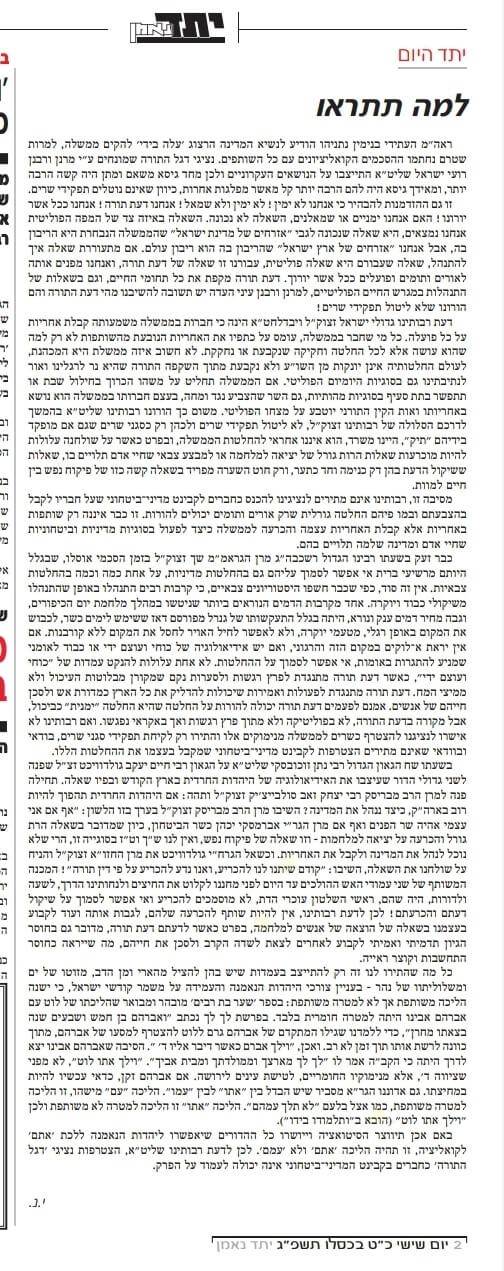
Granted, we are dealing with a Haredi-Lithuanian propaganda pamphlet that, naturally, is replete with slogans and grandiose proclamations that do not really reflect reality; hence it is not very reasonable to parse them and look for well-defined meanings. Still, I think it certainly reflects Haredi ideological discourse (regarding practice, see below).
The editorial staff argues that the question of whether their party is right or left is based on a misunderstanding. Such a question is relevant only for someone driven by one ideology or another, and who is a citizen of the State of Israel and subject to its authorities (the Knesset, the courts, and the government). But the Haredim are citizens of the Land of Israel, and their sovereign is the Holy One, blessed be He, Himself (no less). They act solely according to the “Da’at Torah” of our great rabbis, the shepherds of the Haredi flock (that is, the “Urim and Thummim,” no less).
It turns out that those Urim and Thummim long ago instructed them not to take ministerial positions, because by law the government’s responsibility for its decisions and actions is collective. Since government decisions are made not according to the Shulchan Aruch but according to politics (Heaven forfend), and therefore include actions that do not align with Halacha, it is impossible for a Haredi representative to serve as a minister and be responsible for those decisions and actions. In addition, at times the government must decide on going to war and on matters of life and death, which depend on subtle, delicate, and fateful considerations; therefore there is an additional, special prohibition for a Haredi minister to enter the political-security cabinet that makes such decisions.
Naturally they do not spare us colorful descriptions of how decisions are made by our military and political establishment, claiming they are driven mainly by considerations of honor and prestige—something that prevents G-d-fearing Haredim from sharing responsibility for them. It is hard to deny that, unfortunately, at times authorities make decisions based on extraneous considerations, but that happens in every human society. In a democracy there is at least an attempt to grapple with this, to expose and criticize it, and at times even address it. By contrast, the Haredim try to create a false impression that their decisions are made differently. They can do so thanks to their renowned insistence on freedom of information and expression and on denying all the ills of Haredi society while persecuting anyone who dares point them out. As we all know, the municipalities of Bnei Brak, Modi’in Illit, or Beitar Illit—not to mention the Haredi parties—are run in perfect purity of outlook; you won’t find, even under a microscope, considerations of prestige and honor, or interests and money. Anything you hear to the contrary is merely antisemitic propaganda by secular leftist antisemites (actually, if you listen to them internally as well, then not only leftists—rather all secular people). The fact that MKs go to prison, lie, act against fundamental values—all of that is secular nonsense. “Among our own” such things do not exist. In the Haredi world it’s all pure Torah and nothing else, conducted by ministering angels. Straight from Sinai to the Bnei Brak municipality and to the battles of the Mitla Pass. Well, as for their exemplary management of wars, it’s a bit hard for me to judge for obvious reasons (though their political wars, which are plentiful, are not bad examples of their purely “Torah-true” conduct). Fine—let me not wade further into this propaganda garbage and instead touch on what there passes for arguments.
In any case, the conclusion there is that the only roles permitted to them by the sages and shepherds of the flock are positions that allow them “to snatch from the lion and the bear,” or, in plain Hebrew: to look after their narrow sectarian interests at the public’s expense, and let everything else burn (I’ve written about this ideology in Column 507 and elsewhere). Haredi ideology—at least in the internal discourse, which they don’t even bother to hide (in outward discourse you won’t find even one true word)—is essentially to take as much of everyone’s money as they can with no responsibility for anything else. That way they can point to the faults of those who actually do something, distance themselves from their corruption, and continue exploiting them shamelessly. The shamelessness does not only accompany their actions; it turns out they even write this in black and white in the paper with not a gram of shame and without blinking. In fact, you can sense the wondrous pride in their “pure” conduct. Well, to their credit it must be said they have never run a war corruptly. Unbelievable.
A bit of history
It has always been the norm that Haredim do not participate in the government. They only siphon funds, look after their interests, and bear no responsibility for anything—per the guidance of the shepherds of the flock, the Urim and Thummim. But in 2015 something happened in Israel. Litzman wanted, as usual, to have his cake and eat it too. He decided to serve as Deputy Health Minister with no minister above him. Thus one can not only siphon resources from the public but also take part in the executive branch with no responsibility whatsoever. Admit it—this is a truly ingenious invention, and in my estimation, without shepherds of the flock and Urim and Thummim, no one would have come up with this brilliant trick.
Except that our Urim and Thummim failed to notice that behind the Basic Law: The Government, which imposes responsibility on those who run things here, there is some rationale. Their “lamdanut” (casuistry) disappointed this time. The rationale is simple, and I’m sure the “eyes of the congregation” could see it from miles away: you cannot receive authority without responsibility. Responsibility is imposed on the government because granting authority without responsibility is a tried-and-true prescription for Haredi-style conduct, i.e., acting based on interests without being accountable to the public. It is no wonder that this of course contradicts the basic principles of our system of government (I don’t know whether they leaned there on the reasonableness doctrine or directly on the Basic Law: The Government, but for me it’s the same). So the antisemitic High Court, purely out of persecution of Haredim of course, announced to the whole world that such a thing is impossible (don’t worry, the reasonableness doctrine will soon be abolished—shortly after reasonableness itself). No wonder the Haredim rose up against this antisemitism. Those leftists on the Court are interfering with their ability to rob us illegally and without bearing responsibility for their actions. Tfu.
What happened after the Court’s decision? You’ll surely be surprised, but it turns out that part of the “eyes of the congregation” decided that there is no choice: if they cannot rob us without responsibility, then they will rob us with responsibility. And presto, as if by magic, a special dispensation was found for Litzman to serve as a minister (don’t worry—the reasonableness doctrine will soon be abolished and all will be well). But it turns out that this dispensation is acceptable only to one “eye” of the congregation. The other “eye” of the congregation—that is, the Lithuanian leadership—did not accept the evil decree and did not permit its representatives to serve as ministers. Well, that’s what the Finance Committee and other positions are for, and of course various agreements with the criminals (the secular, the religious, the Hasidim, and the Mizrahim) who do serve. Not to worry.
And so to our days. We are left only to ponder their current takeover of positions of power, and their systematic siphoning of state resources with no accountability and no concern for anyone else—done openly and brazenly. Now even the Hasidim are unwilling to enter the government and the cabinet; something has changed among the “eyes of the congregation,” apparently, and they have decided to return to the good old method of robbery without responsibility. It is strange to me how, despite this, there are still broad segments of the public who are angry and unwilling to make peace with the “election results” and accept the will of the majority. Truly inconsiderate of them.
The meaning of all this
We must understand that Yated Ne’eman, exactly like Pravda or Al-Ahram, is not a newspaper in any relevant sense. It is a house organ, because it does not present the personal positions of any given individual, it is not obligated to journalistic ethics—not even as a fig leaf—and of course truth is the last thing that interests it. It is a propaganda mouthpiece of Haredi ideology. To be sure, anyone with a runny nose who is familiar with the inner workings of Haredi society knows that the pretense as if their “Gedolei HaDor” set the principles and the organ merely disseminates them is a lie—one of the many among them. This shoddy house organ has a significant part in shaping the ideology, and it even wages fierce battles against any “Gadol” who deviates from it (see R. Aharon Leib Shteinman, a bit before he was appointed “Gadol HaDor” and toed the line). To a large extent, the house organ is the one that appoints the “Gedolim.” Thus there is a wonderful symbiosis between its function in producing the ideology and the false impression it tries to create as if it is merely the mouthpiece of those who determine it—“It wasn’t me, it was him.” And if you ask the “luminaries” for their opinion on this corrupt and depraved ideology—well, first of all you won’t succeed because they don’t give interviews. And even if you do succeed, they will explain that they personally are not really in favor, but not everything is in their hands.
In any event, from this you can understand that precisely when this house organ publishes an editorial dealing with the foundations of Haredi ideology, it indeed reflects—and actually shapes—the public’s ideological conception, rather than the position of one person or group. There, usually, there are no lies (the lies are when speaking to outsiders, not internally). That is also how the pamphlet above should be read.
That’s regarding ideology. To the credit of our Haredi cousins it should be said that, as I described in Column 507, in practice it does not actually operate entirely this way, for several reasons. After all there is reality, and one must take it into account. Sometimes they even feel a twinge of conscience and realize that they cannot actually function that way. So they make do with grandiose ideological declarations about being citizens of the Land rather than of the State, with the Holy One—via the shepherds of the flock, not an angel—constituting the three branches of government; while in practice the conduct is somewhat different. What can cause confusion is the mistaken feeling that Haredi-ism is an ideological movement. I have written more than once that Haredi-ism of course has an ideology, but it is a very non-ideological movement. Unlike the Hardalim (national-Haredim), they are very pragmatic and possess an almost endless readiness to live with dissonance. They can proclaim something with devout fervor and act in practice in a wholly different manner, and there is indeed room to interpret that to their credit (pragmatism is a sound approach to life) and also to their discredit (lying and conservative ossification are somewhat less recommended)—“these and those are the words of the living God.” When someone nevertheless points out some contradiction, there is no need to be alarmed. It is simply a product of the vastness of the minds of the “torch-bearers of the exile” and the shepherds of the flock—and as is known, Urim and Thummim are not subject to the government of logic and are not expected to be consistent or reasoned, nor moral, and certainly not accountable to anyone. How convenient.
And still, although in practice they are not entirely a gang of bandits (only partially), I nevertheless find it very disturbing to hear that this is their declared ideology. To hold, without shame and openly, an ideology of a gang of bandits—even if not implemented fully—is an expression of ethical and human baseness. Where this ideology is indeed implemented (as in these very days, when you can practically feel it with your fingers), it is certainly disturbing. And what is most bizarre and troubling to me is that we have all gotten used to including these anti-Zionist, anti-national, and anti-ethical groups within what is currently called “the national camp.” If these parties are “national,” I don’t know what a “non-national” stance is. It seems to me that even Ahmad Tibi is more committed to the good of the state than they are. As for Mansour Abbas, I have no doubt of it.
Critique
What exactly is the problem with this ideology? Beyond the bandits’ morality and shamelessness I already noted, there is also rather infantile thinking here. There are wars being fought here, and they threaten the Haredim as well (even though R. Chaim Kanievsky promised that no harm will befall any Haredi), and in them people fall for all of us. So who exactly is supposed to run them? As Eliyahu Levy notes, the question is not whether the secular can run wars, but why shouldn’t the Haredim run them—and can they? He cites there a question by Rabbi Goldvicht posed to the Haredi leadership of the time (early 1950s), and in response a dispute arose between the Brisker Rav (the Griz), who claimed that we have neither the authority nor the ability to conduct wars even if the Haredim would control the state (may God protect us), and the Chazon Ish, who claimed that when we are given authority we will discover the abilities as well. I’m not at all sure that these statements were indeed said as quoted, since I esteem these two figures too much to believe they said that. This seems to me downright slander against them—especially regarding the Griz’s words. Perhaps he uttered it as a witticism or sharp remark, but in the Haredi public one must be careful, for every such witticism becomes “Da’at Torah” and turns into an ideological principle that is cited with reverence and blind devotion to this very day and forever (though, as noted, its implementation is more flexible).
What is the problem with such statements? If you have criticism of the way the war is being conducted (especially when this comes from expertise and rich experience in the field, accumulated through yeshiva casuistry throughout history), why don’t you do something to improve it? Please tell us how, in your opinion, it ought to be conducted. Is the proper way to send others to die—or even yourself to die—because of improper decisions made by the authorities? Where did the vaunted “snatching from the lion and the bear” disappear to? A small child faced with a threat may sometimes bury his head in the sand and declare that there are no wars and there is no need to deal with them, neither to participate nor to manage them. As if, by hiding, the war will vanish. But from someone older than five—certainly if he is a shepherd of the flock, a “light of the congregation,” “Urim and Thummim,” and other modest and realistic epithets of this sort—I would expect a slightly more mature approach. It turns out that I’m apparently unrealistic—apparently because there is no word about this in the Ketzot.
It seems that, according to their view, if someone comes at you pointing a rifle, you will say you have no authority to defend yourself and will accept the decree submissively. What is this nonsense? It recalls the dilemma of “until it is subdued” regarding waging war on Shabbat. Does defense and saving our lives require special authority and expertise? You do what you can. Moreover, does anyone seriously think that in the past Jews had higher abilities in conducting (modern) wars? Is there a “decline of the generations” in strategy as well? Or perhaps someone thinks we should conduct war based on midrashic hermeneutics, and that skill has been lost to us—so we are orphans with no father?
I marvel at how anyone older than two is willing to buy the bundle of nonsense about being citizens of the Land of Israel but not of the State of Israel, and about our being under the sovereignty of the Holy One and not of the governmental authorities (which, by the way, are now under their control—sometimes it seems that includes the Holy One as well). Are you sure this isn’t a leaflet from Tzili’s kindergarten but words uttered or written by an adult? Can anyone imagine that these are the words of the living God delivered to us straight from on high? If so, then it is time the Holy One grew up already. A bunch of people, some with high intelligence, who spend most of their days on scholarly analysis of complex sugyot, spout childish nonsense that would insult little Rivki in Tzili’s kindergarten, call it “Da’at Torah,” view it as a coherent and systematic ideological doctrine, believe that even the Holy One Himself believes in this childish and malicious drivel—and the public follows them like the blind in a chimney. I have written more than once about the phenomenon of excellent scholars who can deliver a highly impressive “general lecture” and, at the same time, speak childish nonsense and issue shocking moral directives in other domains (see, for example, my remarks on the constructive role of “balabatim” in Column 62). It is not only the content that is inconceivable here, but no less the reverence it receives.
To conclude, I will bring verbatim the final part of Eliyahu Levy’s article:
It is hard to level claims against the ‘Yated Ne’eman’ editorial board. The situation is indeed very confusing. The outlook in which we were raised was shaped and formulated under conditions entirely different from today’s. The debates between the Chazon Ish and the Brisker Rav took place at a time when even the wildest imagination did not conceive that the Haredim would be a majority here. Rabbi Goldvicht’s question was indeed a kind of “halacha for the messianic era.” The current state of affairs, in which Haredim are being offered to join the political-security cabinet, catches us unprepared.
We know very well how to conduct ourselves when we are persecuted. We are superbly trained for emergencies. Even before the siren begins to sound, we are already marching in column toward the shelters. And from there, from the shelter, from behind the trenches, we know how to make excellent use of our elaborate defensive arrays, which we cultivated over many generations. The present situation—where not only are we not persecuted, but the power is in our hands—is truly dreamlike. We were like dreamers. We wander about like somnambulists, unsure whether this is a trick meant to trip us up or a real promise. And above all, we do not know what to do with this new power.
Therefore we go back to the old and try to cling to the familiar. We reopen the Chazon Ish, but the Chazon Ish’s words do not fit the situation. So we close the Chazon Ish and turn to the Brisker Rav. Well, the Griz’s words do not quite fit either. So we try to mix the Chazon Ish with the Brisker Rav, and what comes out is “Lot’s shepherds.” And “Please separate from me”…
Is this serious? Is it what those great leaders intended—to make us “Lot’s shepherds”? What sort of negligence is this? In that same column it was written that questions “on which human life depends, life-and-death questions” are questions that cannot be decided offhand; rather, great Torah scholars must address them and issue judgment according to Halacha. Are we not now in precisely such a situation, where life-and-death questions lie at our doorstep? The time to answer this question is now.
‘Yated Ne’eman’ evades, in a not-very-elegant fashion, the question of what we will do on the day we become a majority. It prefers to blame “the heads of the anti-religious regime” instead of admitting that it has no answer to that question. Who are those “heads of the anti-religious regime” by whose hand ‘Yated Ne’eman’ exempts itself from responsibility? Are the Likud members “anti-religious”? The members of the Religious-Zionist party? Or is it referring specifically to the members of Shas? The great enemies of religion, Meretz, did not pass the threshold, and the rest of the anti-religious camp is licking its wounds in the opposition. Which “anti-religious” people exactly is it talking about?
There is no escaping the admission that ‘Yated Ne’eman’ recycles old arguments to avoid responsibility. It refuses to look reality in the eye and deal with the hard questions: What is our principled stance on security? What is our principled stance on the economy? What is our principled stance on domestic affairs? These are life-and-death questions, and our decisions on them have weighty consequences. We are making decisions on these matters. We do not enlist in the army—this is a decision on security. We do not direct our children to employment—this is a decision on the economy. We take budgets from the state as though they were “a lion and a bear”—this is a decision on domestic affairs. These are difficult choices, and it is hard to say they are a choice of life. We roll our eyes in self-righteousness and hang on the words of great leaders that were said in a wholly different context; we pretend that we are in the same situation as in the days of the Chazon Ish and the Brisker Rav, and deny the fact that, willy-nilly, we are making life-and-death decisions—not according to Da’at Torah.
But even if ‘Yated Ne’eman’ continues to ignore reality, reality will not ignore it. The idea of “please separate from me” is impossible. The idea of “Lot’s shepherds” is not viable either. ‘Yated Ne’eman’ seeks to rescue “from the sea’s spillage and the river’s puddle,” and that is indeed a wonderful image, because according to the conduct it recommends, the public coffers will indeed become a whirling vortex that quickly swallows anything entering it. If we continue to behave as ‘Yated Ne’eman’ recommends, we will discover very quickly that nothing remains in the lion’s and the bear’s den. They will have departed and gone, and we will be left with the coffers entirely—only, sadly, there will be nothing left to rescue from them.
Who will fill the coffers when there are no more lion and bear? ‘Yated Ne’eman’ refuses to answer. Who will defend the state when there are no more lion and bear? ‘Yated Ne’eman’ refuses to answer.
No, ‘Yated Ne’eman’, the question is not “Why do you show yourselves?” The question we must ask ourselves now is, “How long will you keep hopping between two opinions?” We cannot simultaneously hold both the Brisker Rav’s position and the Chazon Ish’s position. If we are loyal to the Chazon Ish’s path, we must begin to bear responsibility. If we are loyal to the Brisker Rav’s path, we must stop taking state budgets. You cannot have it both ways.
Levy is careful to preserve the honor of the Chazon Ish and the Brisker Rav, and directs his protest only at Yated Ne’eman, which continues to cite them and write as if their words are applicable to this day. For my part, I cannot believe that this is what they said even then. These were two extraordinary Torah figures and, of course, very wise men, and therefore I am very doubtful that they truly said what is quoted in their names (the words brought in the name of the Chazon Ish somehow seem a bit closer to plausible, but the words brought in the name of the Griz are sheer drivel). In any case, the content itself—and those who treat it seriously—have certainly earned this criticism.
Discussion
Today right and left (in Israel, but also in other countries, only there it is less substantive) revolve around the question of belief in the people of Israel: that is, are we a family that prefers its own members over strangers, or is a peoplehood altogether a fiction, in which case (and for some reason) the state and its citizens become the important thing (though these are merely instruments and formalities; in a left-wing world, form is more important than content and essence, because there is no such thing as content—objectively). On the left, the concept of a people and nation in its original sense—that is, the ethnic people—is an abhorrent taboo concept. It is racism. (Soon the classic concept of family will be as well. Or they will empty that concept of content too: any arbitrary group of things is a family—for example: a man, a cat, and a cloud.)
So by this measure the government is actually very right-wing and nationalist. Beyond that, there is nothing national about the left at all (and the soft right is dragged along after them). The Haredim are actually very much in favor of Israel. True, they still live with an exilic communal mentality (anshei shlomeinu, “our people”) and have no idea what national responsibility is (and that is what causes their intolerable behavior). But they are definitely right-wing: the Land of Israel or not, handing over territory for peace or not. Indeed, the people of Israel come before the Land of Israel. And whoever is for the people of Israel (the halakhic one, which is the real people, not the collection of citizens of a contentless state)…
By the way, in recent years I have come to understand that all newspapers are Pravda. If they were not, they would not sell. Most of them are simply a sophisticated, elegant, and refined Pravda under the guise of objectivity and truth (like a wicked man dressed in a suit). Maybe this is even done without self-awareness. Yated Ne’eman is simply made crudely, so its Pravda is obvious. I do not really know which is worse.
This is an interesting discussion, and there is clearly a measure of truth in it. Indeed, this dissonance exists in every society (not necessarily only conservative ones). And yet the feeling is that among the Haredim it is different, stronger. There is a difference between a situation in which people fail to realize their principles because it is hard for them, and an entire group that lives in duplicity; and even when their attention is drawn to it, they cling to da’at Torah and/or empty pilpulim. Beyond that, the unrealized values of the other groups are worthy ones (in my opinion), whereas here we are dealing with foolish and malicious approaches that are inherently unrealizable. But this is definitely a correct remark, and the matter requires clarification.
Regarding the words of the GRIZ:
I really think he meant what he said, and he is somewhat similar to Satmar. Very intelligent people are also very fearful people (because they see the consequences of their actions that less intelligent people do not see). Presumably they would not fight for their lives in a case where a rifle was aimed at them, but would flee, as the Jews did throughout the days of the exile. And since they are moral people, they certainly would not send other people to fight when they themselves would not do so. They would, however, instruct people to flee, just as they themselves would do. In a situation in which the Haredim are the majority in the state and are therefore in power, according to the ideology those who are supposed to rule are the great Haredi Torah sages, even though in themselves they do not want leadership at all; even today they lead because people come to them with questions and requests for instruction, not because they impose themselves on the public (I am speaking about people like the GRIZ or Rabbi Steinman). In any case, the conclusion is that when the Haredim become a majority, either they will invite the Arabs to rule over them or they will emigrate abroad. This is of course very impractical, and therefore they would face a situation they have never been in.
And even though they have fear of Heaven, such that they truly are not afraid of anything else (or do not let such fear manage them), there are still levels to this, and they too have sins that cause them to doubt whether they are worthy of God’s help. And without God’s help they are in fact very afraid to fight, and the logical conclusion in such a case is flight, not fight. In such a case they really would have neither authority nor responsibility, and they would not participate in government at all, nor in the army, nor in receiving budgets. It seems to me that this is the intention of the GRIZ. Indeed, this is Satmar’s view, and it seems that the Brisk community, from the students of the GRIZ, does indeed belong to the Edah Haredit, which does not take budgets from the state.
Don’t you know the story that the GRIZ said regarding demonstrations over the Sabbath in the early days of the state, that whoever goes there in fact agrees with the Zionists, because one who opposes them and knows how bad they are knows that they can murder whoever demonstrates against them (and here Brisker logic enters the picture), and “by the law of preservation of life” it is forbidden to go demonstrate.
I actually know the story; I just did not remember which rabbi said it. By the way, today I understand this approach much better. They are called Zionists, but really (probably unconsciously) in their hearts they were socialist cosmopolitans, and their successors today are the anti-Israeli Jewish progressives in the U.S. and in Israel. The left is truly capable of murdering anyone who gets in its way, like the communists in Russia and China. And the Altalena and the Saison prove it, though ostensibly they were done in the name of statism, but in truth they stemmed from hatred of Jews. Even in America, in the Seattle riots, they killed police officers in the name of progress.
“Rabbi Judah says: Anyone who does not teach his son a trade teaches him banditry, banditry.”
The “da’at Torah” that blocked core studies and entry into the workforce created a society of robbers.
Of course, we should blame the socialists of Mapai, who handed out health insurance free of charge, funded Talmud Torah schools for us, and distributed child allowances to a population that consciously chose not to work.
That way the Haredim could be a group of robbers without having to learn warfare like the Vikings or the Bedouin—everything under the patronage of the bleeding-heart socialists who brought destruction upon themselves.
The only good thing that came out of this whole process is that socialists around the world will internalize the error of their ways, and the monstrous idea of “universal basic income” will be thrown into the dustbin of history without being given the chance to destroy additional cultures (besides that of the Jews).
The socialists will internalize nothing. They never change their minds. They have no opinion. For them there is no truth at all. The rest of the public may internalize it, but the leaders of that public will not.
As my predecessors noted, the Briskers (like the whole Brisk dynasty, except for R. Yehoshua Ber and his descendants) were closer to Satmar in their outlook on Zionism, and the GRIZ rejected participation in elections and taking budgets from the state. So he was quite consistent.
As for “da’at Torah,” the stories in “Yated Ne’eman” remind me of a story once told by the Lubavitcher Rebbe (of blessed memory, may he live long, and the chooser may choose…). The Rebbe’s father managed to obtain for him and a group of rabbis with him a meeting with Stalin, at which they requested a government allocation of flour for baking matzot for Passover. (An utterly extraordinary act of courage. In those days, the days of the “Great Famine,” it was almost like asking Stalin to convert to Islam.) The rabbis explained that for religious Jews, hametz on Passover is not “food,” and if a supply of matzot were not made possible, they would be left without basic nourishment for a week. Stalin listened patiently and replied: “I will bring the matter to the decision of the president (Kalinin); I am only the general secretary”… (For the curious: President Kalinin approved it…)
The belief that the Arabs care more about the state than the Haredim do is ridiculous and stupid. The state is not important at all. What matters is the Jewish people. And the Arabs (including Abbas himself—he will change his skin when that comes from his voters; that is human nature in general and among Arabs in particular) certainly do care about eliminating the Jewish people.
At the moment the Arabs still do not really believe that they have been allowed to be in power. The moment they become the deciding swing vote, they will suck the blood a million times more than the Haredim. And they will still fight the Jews. See the riots in 5781, in which a substantial portion of Abbas’s voters participated, namely the Bedouins, who are a society of crime and wickedness.
I do not know how naive and infantile one can be. The problem here is the Haredim. They are not stealing or robbing anything. They sell their votes in exchange for budgets. The problem is not with them but with those who give them voting rights (and the Arabs too), regardless of their underdeveloped mentality. Democracy is not suitable for everyone. Even the structure of a state is not suitable for every group of people—like the states of sub-Saharan Africa, where there are no ethnic peoples but rather collections of tribes.
Essence (content) comes before form. State and democracy are means for natural human groups with the appropriate mentality—that is, for sufficiently developed peoples who already possess enough natural solidarity, not because of some law legislated in parliament. The system of government and the institutions are supposed to serve that people (not the other way around). They are not ends in themselves. Otherwise this is a kind of ridiculous fascism. In short, support (genuine support, not lip service) for a state that is not the state of the Jews is not a characteristic of the Jewish right but of the left (universalist; there is no such thing as a Jewish or national left of any kind, not today in the West at least).
Instead of giving credit to the leaders of the Haredi public, who care, for example, about reducing Sabbath desecration among the Jewish people as a whole, we get a column full of demagoguery (especially cheap) that mostly cries “robbery, robbery, robbery.”
There is a legitimate struggle here over budgets for different sectors, and right now the Haredi public has the upper hand. Completely legitimate.
Of course, where the Haredi public should be criticized, that can be done—but not through demagoguery.
I agree that Michi’s columns about the Haredi public are saturated with hostility (although he denies it, I believe him that he is unaware of feeling it…). But the claim is fundamentally correct. There is a big difference between someone poor by misfortune and someone poor by choice. There is a moral duty to help one who helps himself (as it is said, “you shall surely help along with him”). One who tracks his children into inability to earn a living, while at the same time demanding that “the state” (that is, the taxpaying public) support him through allowances and benefits—is nothing but a robber. For this purpose, he is a robber even if he is in the opposition, but exploits welfare laws intended to help the unfortunate and not those who choose their fate*.
And yes, I know the worn-out claims about Haredi charity organizations etc. etc. Don’t be Robin Hood. Don’t steal on the one hand and help others on the other.
What comes to mind by association is Donald Trump’s crushing response to Hillary Clinton’s claim that for nearly two decades he had paid no taxes—“I merely took advantage of the stupid laws you and your friends in the Senate enacted”… The point is that Trump built a huge business empire that contributed greatly to the American GDP despite his tax schemes (with the kind assistance of Senator Clinton and company).
Just to note: I absolutely do not deny the hostility toward Haredism, its mode of thought and conduct. What I do deny is hostility toward Haredim as people and toward the Haredi environment (I love Bnei Brak and its whole atmosphere). Some of my best friends are…
Come on. The truth is that I really have no complaint against the Haredim. They are a public that is not sufficiently developed for independent political-economic existence. They are exploiting the laws that the left legislated and sanctifies. That is no different from anyone who manages the tax laws so as to pay as little tax as possible. You simply should not give them the right to vote, or should revoke their citizenship altogether. This of course also allows—and indeed requires—revoking citizenship and voting rights from the Arabs, who are much worse than the Haredim in this respect as well. I wish this would be done, and for years I believed that this was the right thing.
The problem is that the left in Israel (and in the world) is so stupid and infantile and ignorant and foolish (bordering on wickedness) that it sanctifies empty democracy over simple justice and truth. So at this point I no longer care. Anyone who works here and pays taxes is also a great fool (unless he loves his work and is good at it—that is, in that case he is not working for the money, and then he contributes to the world as a whole).
And likewise regarding military service. In this matter the Haredim actually have much more justice in their claims about the IDF command. I was in the IDF, and I witnessed the frivolity of the commanders. In fact, there is nothing to be done: a person without genuine fear of Heaven (which also includes most people who wear kippot) always acts for himself, and all IDF commanders without exception are there for self-advancement (they are like Dreyfus, only the gentiles did not let them advance), and not for the Jewish people (the organism to which they belong). The soldiers under their command are intended mainly for that purpose. Only they are not aware of it. And the truth is that the moment their personal good no longer overlaps with the good of the whole, they will probably unconsciously choose their own good. And so considerations of honor led to unnecessary spilling of soldiers’ blood. This is true with respect to the Haredim as well, of course, except that the great leaders of the Haredi public apparently have self-awareness, and therefore they are not even willing to have a Haredi state and army according to the strictest standards. The rest of the operatives are also devoid of real conviction, and they too act for their own benefit without self-awareness. In that respect Moshe Friedman of Neturei Karta, formerly, is also a prime example. The same applies to Religious Zionism.
It is not that I have a solution to this situation. I do not think (and am not willing) that one should go like sheep to the slaughter before the gentiles. But can I serve under such children? And I cannot demand that someone else serve in such a situation. I think now the behavior of the great Haredi leaders is more understandable.
By the way, there is currently a governing institution in Israel that has authority without responsibility: namely the High Court of Justice. And that High Court, in its lack of self-awareness, is what decided (quite rightly, and fortunately so) to require Litzman to be appointed as a minister (to take responsibility).
There is a world of difference between a person who seeks role x in the game (even if, in your view, it is less productive), and a person who declares that he is not part of the game and never will be willing to take responsibility in it, but does want to take as much as possible and spread such an ideology.
I am awestruck—truly—by Rabbi Michael’s power of expression and analysis, and by that of the commenters, but to me, a simple average person, this all looks like cries of “Wolf, wolf,” and after I lick my lips over the wonderful formulations, I am left with a very bitter taste, because it seems to me that even you do not truly believe in the ability to influence, to change. Am I mistaken?
Shavua tov!
The rabbi wrote that ‘Rabbi Steinman fell into line.’ And that is simply a blatant mistake!! The story is exactly the opposite—Yated wrote against Rabbi Steinman’s policy regarding the Haredi battalions, and then the rabbi, in a brilliant maneuver, made sure to turn the newspaper into his own, and as a result they opened HaPeles, etc. That is, what we see here is exactly the opposite—not only did the rabbi not ‘fall into line,’ he went down to the field and turned it upside down!!!
Dear Ehud. I’m uncomfortable that again and again you recount my praises and thank me. Especially since you said that you are now going through a difficult period following hospitalization and are not taking your medication. I urge you to make sure to take it.
In any case, thank you for your warm words, and a complete recovery.
I was reminded of this column when I saw this morning excerpts from a letter by Rabbi Dov Lando, who is now considered the leader of the Haredi-Lithuanian Degel HaTorah party. https://www.bhol.co.il/news/957415
And here they are before you:
“The foundations of public leadership since the establishment of the state of heresy and apostasy… At the root of this leadership lies the recognition that here in the Land of Israel we are in exile, and one must conduct oneself with the exilic mode of leadership handed down to us through all the generations, as our holy Rabbi [Judah the Prince], compiler of the Mishnah, acted: before going before the rulers he studied the section of Jacob and his conduct with Esau (see Midrash Rabbah, Vayishlah, parashah 78, sec. 15)… And all those who demand to conduct themselves with heads held high, and who shout and rage against the authorities of the state—our master the GRIZ, of blessed memory, already compared them to a certain extent to the ‘Zionists,’ who conduct themselves and demonstrate with ‘strength’ and ‘might,’ ‘power’ and ‘heroism…’”
I also recall that I heard (though I did not see it with my own eyes) of a pamphlet written by Rabbi Lando in which he permits tax evasion and not paying the state for various services. In this matter he certainly charts a proper path for the current coalition (do not suspect the worthy: taking from the state was not forbidden, Heaven forfend). In Bnei Brak I heard this from many people, and it was clear that the matter was well known there.
And thus it is said: the national camp, the Zionism Law, full-on right wing, etc. 🙂
By way of the topic of mental duplicity from the last few columns, do you think that here too the Haredim live in mental duplicity, in that at the declarative level they oppose the state, but in practice they support it?
Very many of them certainly do.
I discussed this in column 507.
Dear Rabbi Michi.
First of all, thank you for this column and the previous one. In my opinion there is an interesting analysis here of the political situation.
I would like to point to a certain point that, in my view, is reflected in this case, and ask what you think:
This pragmatism, in which there is a certain dissonance between the huge ideological declaration and what sometimes actually happens in practice—quite apart from issues of corruption, hypocrisy, and injustice that exist in some of the conduct that follows from this, since I do not know whether all these phenomena are a result of that gap or something added to it—is it not in fact present in every standard conservative religious Jewish community in particular, and in every conservative society in general?
I would like to bring a somewhat opposite example, from the completely other pole: the dominant and aggressive Israeli left (setting aside its most shrill fringe, which in practice aspires to a state with an Arab majority), but rather its more standard form—the Meretz and Labor type, and the center, of Lapid and Gantz. These are the people who, on every social, religious, and moral issue, will usually voice a certain mantra, with absolute confidence that they are right in what they say: in favor of higher education and against coercion and religious ignorance! Love of every human being! Service for all citizens! And similar mantras and slogans heard from this camp.
Defectors from that camp have often pointed to the cognitive dissonance in which these people live, as follows:
In favor of education, acquaintance, openness, and against ignorance.
In practice: absolute rejection of any religious belief, without opening a page of Gemara or Tanakh even once in their lives, without meeting or speaking with a single religious thinker, while rejecting it on the basis of childish stereotypes.
Very low general education, expressed in unfamiliarity with conservative arguments, or with any other arguments at all that are unrelated to their cultural world.
In favor of love for every person.
In practice: most of them are unwilling, in a theoretical situation, to accept an Arab partner for their daughter or son, for purely cultural reasons, even if he or she were to undergo Israelization or a secular or Reform conversion in their view—whereas a partner with one Jewish side in the family, or a European partner, is completely acceptable to them even without Israelization or conversion in their view.
A declaration of enlightenment and belief that there are principles shared by every person.
While in practice there is behavior indicating that, in their eyes, only people like themselves are capable of arriving at the right values and the right opinions, something reflected in a lack of desire to work with youth or with the large general population at all and to come into contact with it.
And so on and so forth.
In Religious Zionism too there is often a dissonance between the declaration and the actual conduct, despite the harsh ideological atmosphere.
For entirely pragmatic reasons, it was decided on quite a number of occasions to give a platform to members of our people who are married to non-Jews and define themselves as complete atheists, and to describe them as ba’alei teshuvah and as part of the traditional-religious public. (Gali Bat-Horin was described as a ba’alat teshuvah beside whom we cannot stand, while she declares from every platform that she is in fact an atheist—and even more, declares that she will never be able to accept belief in God, and that after she helps the black-hats destroy the crazy progressives, she will move on to fight to preserve the old secular identity she held.) Likewise Sheffi Paz, who defines herself as a complete atheist, desecrates the Sabbath, keeps a pride flag in her home, and is in a same-sex relationship with a woman, gets a platform from the conservative religious right just because she decided, from purely national considerations, to move to love of her own people and abandon universal and cosmopolitan concerns, whose main expression is simply fighting illegal infiltrators and nothing more.
And this is the same Religious Zionism that declares from every platform that our right to the land derives from God’s promise, that the people of Israel are not a nation like all other nations but rather their purpose is to cause the Divine Presence of the Holy One, blessed be He, to dwell in the whole world. This is the same Religious Zionism in which the struggle against assimilation and for separation between Israel and the nations—and even more so the separation between Jewish nationalism and ordinary nationalism—was defined as one of its supreme goals.
But let us also not forget that this same Religious Zionism holds another dissonance: while it often declares that faith is not a simple religious experience based on emotion, and that observance of the commandments stems from deep intellectual and intuitive conviction and not from traditional feeling or mere ancestral loyalty, its rabbis attack, with that same declaration and in the same breath, any attempt to hold an objective discussion about matters of faith—about certain principles, not about God’s existence or commandment observance—within itself and among its own commandment-observant public, as dreadful heresy and unbelief.
And this is without even speaking about the dissonance in the declarations of many members of Religious Zionism—and to tell the truth I am speaking mainly about ideologically minded Torah scholars and rabbis, and less about the average knitted-kippah wearer—about love for each and every Jew because of his inner divinity, and in the same breath often expressing strong revulsion toward the individual Israeli person and endless criticism of every component of his personality. (And of course the very simple answer—really simple on paper but hard to swallow logically—is that this is no contradiction at all, because that love is directed toward the true and pure core that exists in that real self beneath all the masks, and not toward all the falseness in his visible personality…)
And what about gentiles? And the attitude toward Western culture and its values in general? After all, it is a shared genre of both Religious Zionism and the Haredim: to loathe the average concrete, realistic, historical, and contemporary gentile to the marrow of one’s bones—quite justifiably, it must be said, in most cases if one relates to the collective that persecuted, murdered, and abused Jews; and unjustifiably when it comes to the private democratic American, Canadian, or Norwegian gentile who did not really persecute the people of Israel—because all his deeds are like a pig stretching out its hooves, and so on, and all his democratic and egalitarian culture is nothing but a false covering. And in the same breath to speak about an abstract, utopian, future-oriented love for “the whole world”!!—which is destined to remain and be renewed by holy sparks of righteous converts and resident aliens; for we are the only true universalists who really love every human being, and they in fact invented the impure invention called democracy, human rights, equality, and the like…
What I mean to say is:
It seems to me that cognitive dissonances and gaps that nobody notices in daily life are shared by every conservative society as such. Even our Arab cousins, it seems to me, truly believe that they are not supporters of terror and do not want to murder civilians and soldiers, and that they want peace—while on the other hand they also cooperate with extremist Islamist organizations that want an Islamic dictatorial state in the Land of Israel according to the peace vision of the Prophet Muhammad. I think they really declare this without noticing the contradiction. When I see the outraged look of Ahmad Tibi, whom you mentioned here in the column, I think the guy genuinely believes his own lies. And likewise regarding Mansour: it seems to me that he too is trapped in very deep self-deception.