

Between the Zomet Institute and the Weizmann Institute, or: The Importance of the Sexton (Column 121)
Finding "Great Figures of Judaism" as the trigger for a principled question
The column opens with a personal, playful story: after decades of searching, Rav Michael finally finds, with Nadav Shenrav's help, the song "Great Figures of Judaism" from the show "The History of the Jewish People — Additions and Corrections." The excitement and the Purim-style dedication to Nadav are not just a nostalgic opening; they bring to center stage a song that is treated here as brilliant parody, because it mocks not only particular figures but the very notions of religious greatness themselves.
Why choose דווקא an "egg laid on Shushan Purim"
From there, Rav Michael deliberately turns to a "Purim Torah" on a pseudo-halakhic question: what is the law of an egg laid on Shushan Purim. He stresses that he chose precisely this kind of question, rather than semi-current ones like hitchhiking, sushi, or Shabbat on base, in order to clarify what exactly makes such pilpulim funny to us. The comic format of Purim Torah serves as a tool for examining our attitude toward halakhic learning itself.
Purim Torah mocks not only the error but pilpul itself
At first glance, the joke is that the discussion is contrived and unreal. But Rav Michael suggests a deeper suspicion: often we are laughing not only at the imitation, but at the real thing itself. Even a fully "authentic" learned discussion about an egg laid on a festival that follows Shabbat is experienced by many as endless engagement with trivia whose importance is hard to understand. From this comes an unsettling claim: if we truly trusted the method of pilpul, perhaps we would also apply it to real-life questions, rather than confining it to a narrow domain of issues detached from lived existence.
From the egg to the Zomet Institute: what counts as a contribution to Judaism
Here the column returns to the song "Great Figures of Judaism" and draws out its sting: it presents the absurdity, in many people's eyes, that someone who invents a grama switch or an automatic chametz detector, or even a synagogue shamash, is considered to contribute more to Judaism than Einstein, Spinoza, or Mendelssohn. The question "the Zomet Institute or the Weizmann Institute" is not just a Gashash-style joke, but a sharp formulation of a deep dispute: is a Jewish contribution measured דווקא by direct service to the world of halakha and mitzvot, or are scientific, philosophical, and artistic achievements an equally — or even more — important realization of Jewish capacities.
The Feynman story sharpens the outsider's view of religious learning
The anecdote about Richard Feynman sharpens the outside perspective: yeshiva students come to him with what sounds like a scientific question, but in fact they want to determine whether electricity is fire in order to rule about Shabbat. From Feynman's point of view, this is a double disappointment: not only is science not being studied here as truth and as an autonomous field of knowledge, it is being recruited into the service of a halakhic discussion through analogies that seem scientifically absurd to him. It thus becomes clear that the mockery is directed not only at odd details, but at the very subordination of broad fields of knowledge to the needs of halakhic pilpul.
There is something to the critique, but only as a partial truth
The column does not rule that the Weizmann Institute is more important than the Zomet Institute, nor does it simply adopt the contempt for pilpul and religious greatness. On the contrary, Rav Michael says explicitly that there is something in these claims, but only something: they expose a real discomfort about our hierarchy of values, but they are not the whole truth. So the conclusion here is not a verdict but the posing of a problem: we should take the satire seriously, because it asks what we count as greatness, what the right relation is between halakha, learning, science, and culture, and whether our religious hierarchies are convincing even from within.
With God’s help
"You send your son to the Weizmann Institute and I’ll send mine to the Samson Institute, and we’ll see who gets there first!" (the immortal son of Salim and Razeh to the teacher, in the Gashashim’s basketball sketch)[1].
This post is being written with great excitement. Many years ago (it now turns out that it was in the mid-1980s) I fell in love with a certain song that offered a parody of the great men of the nation, which was really a parody of religious notions of greatness, and did so with great charm. Many years ago I happened to hear it on the radio, but I didn’t catch the name of the song, who performed it, and so on. Since then I have been searching for it in vain, despite all my efforts. I corresponded with the giants of the field, from Dan Almagor—directly—to Eliyahu HaKohen—indirectly; I also turned to the Nostalgia Online website (which proved to be an irreversible mistake. Since then I have been receiving countless emails from them, but not an answer to my question). None of them knew and none could help me. I posted the question on various online forums, ran all sorts of searches (based on whatever keywords I remembered: Spinoza, Einstein, the synagogue sexton, the Theater Club, etc. etc.), and found nothing. Once it became clear to me that none of these people knew, after years of searching I began to think it had been nothing but a dream.
And then yesterday (Tuesday, 12 Adar 5777) I find in my email inbox a message from my good friend Nadav Shnerb containing a link, whose subject line read, in these very words: "Wow, I’ve been looking for this for twenty years already… starting at 14:10." I click at the indicated minute and get exactly what I was looking for. Miracles do not occur every day. Therefore I established it that very day and made it a day of feasting and joy for the Jews, from mourning to festival (a day of feasting and joy for the Jews, from mourning to festival), namely the day known ever since as Purim of Lod. I do not remember whether we ever shared this search with one another, but in any case, in place of praise and thanksgiving (its very recitation is the Hallel—its very recitation is the Hallel) and the blessing over the song, I said to myself: well, great minds think alike.
It turns out that the song is called "Great Figures of Judaism," from the play History of the People of Israel—Additions and Corrections (1986), and it was sung by the cast of the production: Hani Nahmias, Avi Dor, Osnat Vishinsky, Tuvia Tzafir, and Dubi Gal. After I learned the song’s name, I found it separately in a video on the Baba Mail site (thus saving Oren the trouble of clipping it out of Rivka Michaeli’s YouTube video). It is very much worth listening to (and of course also, and perhaps especially, to the lyrics):
You must admit that this is truly a masterpiece (or is it only me, captive to the nostalgia I have constructed for myself?…).
On the occasion of this lost object being restored to its lawful owner (= me), I am writing this post and dedicating it to Nadav (although, thank God, he is still very much alive—may he live to 120) in endless gratitude. Nadav, you have discharged your obligation of food-gifts and gifts to the poor for both Purim and Shushan Purim alike (for anyone pursuing his lost property is poor in relation to it—source omitted). And even though you caused me to violate the prohibition of adding and to rejoice before Purim (and according to our Lithuanian cousins this is, as is well known, a double offense, like someone who is sad on the Ninth of Av—but that is an old story).
Still, since it is the eve of Purim, I thought it inappropriate to discuss this with the customary gravity of our region. Therefore I shall attach it to a piece of Purim Torah (a humorous Purim parody in the style of Torah learning) that I had been thinking of writing for these days, and here, with God’s help, I begin.
On the law of an egg laid on Shushan Purim
Not long ago there reached me a flying scroll, recovered from hidden archives, containing a question that shakes every hearing and understanding heart: the law of an egg laid on Shushan Purim. I examined the books, and even their margins and the spaces between their lines; I sought it, yet I did not find the one my soul loves. The watchmen who go about the city found me and asked me whether my fair beloved had gone among the thorns and where his voice might be, and I answered and said: Hark, my beloved, here he comes; he has gone down to his garden, wandering about with the wind and gathering roses from whatever comes to hand. And since where there are no men, even penitents do not stand, and we have received that it is not upon you to finish the work, yet you are not free to desist from it (as it is said, among the dead one is free), therefore I assembled all the Jews—the court of this city, complete with ten idlers; and although we did not fast nor fulfill upon ourselves fast for me, we weighed and debated this great and small law. And I pray to Him who sits on high that, just as on the Fast of the Firstborn the holy (and hungry) people of Israel study instead of fasting, so may my colleagues and I be counted as having fasted likewise. And this is what our feeble hand has produced, the hand that we raised over it and thereby desecrated it.
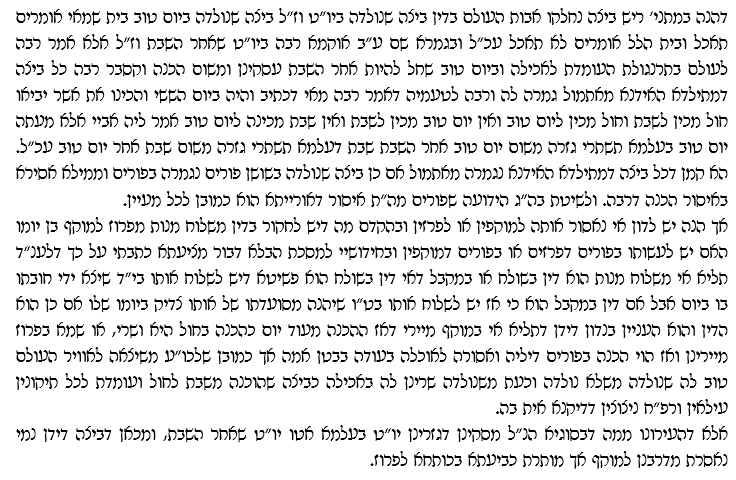

I deliberately wrote this piece of Purim Torah on a pseudo-halakhic question and not on current affairs, as is customary (the law of picking up hitchhikers, going home from the base for Sabbath, eating sushi, and the like). Now any reader may ask himself, about such Purim mockery, why these words of Purim Torah are written and spoken in every land, and their memory does not depart from their descendants (their memory does not depart from their descendants). On the face of it, this is only amusing casuistry for Purim’s sake; that is, we laugh only because this line of reasoning is wrong (see Column 52 on the difference between a homily and casuistry). But I suspect that in many cases there is something deeper here. What is at stake is mockery of halakhic casuistry itself. Deep in our hearts we feel that even a genuine discussion, in the truest Torah sense, of the law of an egg laid on a festival after the Sabbath is itself a kind of Purim Torah, because it deals with trifles and nobody understands why they matter at all. How can one spend days and weeks spinning out the differing views of the medieval authorities (Rishonim) about the legal status of an egg laid on a festival that falls after the Sabbath? Who cares, after all, whether one may or may not eat it, and whether the problem lies in the day that prepares or the day for which it is prepared? And all this when a festival follows the Sabbath only once every few years.
All our Purim discussions about the law of picking up hitchhikers, the law of eating sushi, or doing a medical residency in a hospital (the Purim Torah of Zev Frimer, of blessed memory), which are conducted through various responsum-like halakhic dialectics, are in fact mocking the method itself. If we trusted the method, wouldn’t we really use it for real-life questions too? Somehow, in life we think with plain common sense (at best), but in the realm of scholarship and Jewish law we have intricate methods and insignificant questions to which we devote all our energy and which we regard as the salvation of the world. After all, it is upon us—the dialecticians of the egg laid on a festival after the Sabbath—that the world stands, is it not?
And here we return straight to the song "Great Figures of Judaism" mentioned above. Those folks are mocking the conception of Jewish greatness, as though the synagogue sexton, or someone who invents grama switches (indirect-activation devices) or an automatic leaven detector, contributes to Judaism, whereas Einstein, Spinoza, and Mendelssohn are, at best, idlers and, at worst, traitors. Instead of engaging in essays, philosophy, or music, they could have invented a Sabbath grama switch or an automatic leaven detector, devoted themselves to fundraising for yeshivot (Talmudic academies), or composed Hasidic songs. What a waste…
This reminds me of the legendary story about Richard Feynman, the Jewish Nobel Prize laureate in physics, who was also no small joker. In his cult classic Surely You’re Joking, Mr. Feynman!, he tells of several yeshiva students who came to him and said they wanted to ask him a scientific question. Feynman was delighted that at last yeshiva students were beginning to deal with the subjects that really mattered instead of their usual dialectics, and he invited them in. In the elevator he asked them what it was about, and they told him that they wanted to ask whether electricity is fire. Feynman did not understand the question: fire is chemistry and electricity is physics, so what possible connection could there be between them? They explained that what interested them was whether it is permitted to use electricity on the Sabbath, and if electricity has the legal status of fire then there would be a prohibition of kindling here (a category formulated in the Talmud, the canonical Jewish text, several thousand years ago). Feynman was stunned and disappointed. He thought they were interested in science, but it turned out that, for them, science was merely a means to the lofty intellectual and spiritual goal of clarifying the law of flipping an electrical switch on the Sabbath. For that purpose they brought up claims that were scientifically absurd, in effect exporting their dialectical hairsplitting outward into the realm of science as well.
The question that arises here is actually what is more important: the Zomet Institute or the Weizmann Institute? Or, in the Gashashim’s golden phrasing: you send your son to the Zomet Institute and I’ll send mine to the Weizmann Institute, and we’ll see who gets there first. Is it more important to develop the theory of relativity or an automatic leaven detector? Who is more faithful to Judaism, and who contributes more to it: Einstein or the synagogue sexton? What do you say to that? I definitely think these are questions worth pondering. There is something to these claims, except that this is only a partial truth. But as noted, this is not the place for too weighty a discussion, and we will leave it for another time.
A happy and amusing Purim
[1] I couldn’t find it online, so I brought a pale substitute made as a tribute.