

The Importance of Studying the Gemara (Column 745)
The two difficulties and the paradox: a disorderly book about legal minutiae that stands at the center of Torah
The column opens with two difficulties. On the level of structure, the Talmud looks associative, unsystematic, full of unresolved disputes and wild transitions between topics; that is why a learner often finishes a sugya without a coherent sense of mastery over the material. On the level of content, it seems to deal with technical and esoteric details, precisely where one would expect the center of serving God to be Scripture, faith, thought, or Kabbalah. The difficulty is sharpened by the fact that Hazal themselves and the Rambam call “the discussions of Abaye and Rava” a “small matter” compared to the Account of the Chariot. And yet, in practice, most of the Torah world across the generations has placed talmudic analysis at the center—from the Talmud itself to the Rambam and the Rishonim.
The casuistic form of the sugya reflects a reality that does not submit to rigid rules
To explain this, the rabbi returns to one of his basic claims: reality, especially human, legal, and social reality, is not truly systematic. Coherent logical rules are our processing of it, and they always have exceptions. That is why a casuistic description built from cases, analogies, objections, resolutions, and contextual readings captures reality more deeply than an abstract and closed system of rules. Even unresolved disputes are not a defect, but a way of preserving the full complexity; a sugya that leaves multiple sides on the table gives a fuller understanding because it recognizes that each side contains a logic that should not be erased. The rules the learner formulates at the end are important, but they are only a late and partial summary of a richer process.
One studies not only material, but the very process of creating Torah and transmitting tradition
From here the mode of study follows. The rabbi argues that one does not “study Talmud” in the ordinary sense, but becomes a partner in its ongoing creation. In real analytic study, there are almost never two learners who will formulate the same distinction in exactly the same way, and therefore study with a partner and collective clarification around a table are not accidental tools but the mode that fits the content itself. This is also the meaning of the statement that “serving sages is greater than merely learning from them”: what is transmitted through tradition is not only information, but a mode of work that passes through friction with the sages, with the cases, and with forms of argument. Like an apprenticeship with a scientist or a craftsman, a frontal lecture is not enough. In every generation new formulations and conceptualizations are added, the dose of logic increases, but sharp eyes can see that the later developments were already latent as potential within the earlier material.
From the sugya to life: homo talmudicus as a mode of complex judgment
The value of the study is not limited to knowing halakha. The Talmud implants a form of relating to reality, and the rabbi describes this as the figure of the “homo talmudicus”: someone who breaks reality into aspects, moves between concrete examples and abstract conceptualizations, balances logic and intuition, morality and halakha, facts and norms, and makes decisions without mechanical deduction. But he stresses that this is not a simple application of rules to the world. One must first understand reality from within itself, and only then apply the analytic tools to it. Here he also criticizes rabbis who skip that first stage and think that reality as a whole is “written in Rashi script.” For him, this is a mistake born דווקא out of a correct view of Torah as an all-encompassing mode of orientation.
Not a museum but a workshop: the living bond with the sages of all generations
Beyond thought, talmudic study also creates an experience of partnership. Following Rav Soloveitchik’s description, the rabbi portrays the learner as someone sitting around one table with all the sages of the generations, arguing with them, getting angry at them, learning from them, and deciding for himself. This is not the stance of a museum visitor toward sacred exhibits, but of a participant in a family workshop. That is why one can “fight” with the בעלי התלמוד and the commentators without disrespect: this is involvement, not contempt. In precisely this sense the Talmud has an advantage that Tanakh does not; with Tanakh we stand before the word of God that was given to us, whereas in the Talmud we are partners in the ongoing interpretive process.
Why דווקא halakhic details are the deeper encounter with the divine will
This also yields the answer to the second difficulty. In the rabbi’s view, from a Torah perspective God is found precisely in the details. Thought, ethics, Kabbalah, and elevated interpretation sound “greater,” but to a large extent they are human constructions built in changing conceptual languages. By contrast, halakha is the continuation of interpreting the word of God that was given at Sinai, and therefore it has a stronger dimension of “Torah in the object” and not only “Torah in the person.” Following the Tanya and R. Hayyim of Volozhin, he explains that the details of halakha are the “garments of the King”: through an ox that gored a cow, nat bar nat, or the melakha of gathering, we touch the divine will itself, because without anchoring in particulars we have no real access to it. Clarifying what to do in practice is only one layer, an instrumental one. The intrinsic value of study lies in clarifying the divine will, internalizing it, and extending the mode of perception acquired from the sugya to all areas of life.
Between Steinsaltz and the survival of Torah: the Talmud as a flexible canon that holds together a people and a shared discourse
At the end, the rabbi connects his account to Rav Steinsaltz’s, but also distinguishes them. Steinsaltz emphasizes the importance of the form of discourse the Talmud creates between people and groups; the rabbi emphasizes first of all the benefit to each learner’s own mode of thinking. And yet on the historical-national plane the two points converge: if the canonical Torah had been a closed and rigid book in the style of a concise code, it could not have carried the multiplicity of times, places, and outlooks of the Jewish people; and if it had been completely open, we too would have disintegrated. The Talmud is precisely the canon that, on the one hand, creates a shared framework, and on the other hand, contains shades, disputes, and different languages of thought. That is why it is not only a textbook, but the skeleton on which both Torah and the Jewish people have rested across the generations.
Following my repeated remarks, I have been asked several times to explain why I regard the Talmud as such an exemplary and unique text, and what makes the study of it so important—both on the Torah plane and in divine service, and also in the general sphere. I therefore decided to devote a separate column to the matter. Almost all of the points have already been explained by me in many places, so here I will present only the broad picture and refer to the places where I elaborated. My sense is that there is value in seeing the full picture beyond the details.
The Question
A few days ago I received the following question on WhatsApp:
By the way, if I may, on several occasions—both in posts and in answers on the site—you expanded on the importance of studying the Gemara as an intrinsic value, not as a means but as an end. And these points are well known. However, at the same time, from time to time you mentioned that the Talmud is an exemplary book, and in the trilogy you especially emphasized its unique redaction, which enables debate within a framework, and in this way preserved the culture and the people, and so on.
From this, I dare to suggest: perhaps it would be worthwhile to devote an entire column to the importance of studying the Talmud not necessarily from its religious value, but precisely from its essence as a unique text—its style, its structure, the way it develops thought—and to present through it the importance of argument; these matters are very relevant. In short, to formulate the above “refinement” articulated by Steinsaltz.
At the end of his words he mentions things written by Yoel Spitz, in his second book about his meetings with Rabbi Adin Steinsaltz, Fire Cannot Rest. I will bring them below. But first I must sharpen the difficulty he raises, which actually hints at two kinds of difficulties.
The first difficulty: the book’s structure and character
The Talmud is constructed in an associative manner that appears, on its face, primitive and unsystematic. The arguments there do not look logically tight; it is filled with unresolved disputes. The transitions from topic to topic and the analogies made there look very freewheeling and unconvincing. The order of matters is jumbled and not divided by topic. Even the ordering that Rabbi (Judah the Prince) gave the tractates of the Mishnah is only a framework within which varied and sundry contents accumulate that do not always relate to the compartment ostensibly under discussion. Tractate Megillah contains many laws and statements not connected to the Megillah, and in the Gemara the discussions develop in highly varied directions, some of which are not related at all to Purim and the Megillah. So it is with the other tractates as well. It is no wonder that when a person finishes learning a sugya, he usually feels he is not holding the material. It is hard for him to say he “knows” the material discussed in the sugya. He knows how to resolve this or that difficulty; he recognizes several approaches of commentators at various points; but he lacks a coherent structure that contains all the relevant material in the sugya.
The second difficulty: the book’s content
Many struggle with the question of why it is customary to give the study of the Talmud such a central place in divine service. Seemingly these are trifles—details of halakhah and its fine points—compared to philosophy and reflection on the foundations of faith, to the study of Scripture as the direct word of God, to the secrets of Kabbalah, and the like. One can also add that the vast majority of these halakhic details are a human creation, produced over the generations and not given to us at Sinai. Why is it so important to engage with things created by human beings, more than with the word of God? Already in the Talmud we find (Bava Batra 134a; Sukkah 28a):
Our Rabbis taught: Hillel the Elder had eighty students: thirty of them were worthy that the Divine Presence should rest upon them as upon Moses our teacher; thirty of them were worthy that the sun should stand still for them as for Joshua son of Nun; twenty were average. The greatest of them all was Jonathan ben Uzziel; the least of them all was Rabban Yohanan ben Zakkai. They said about Rabban Yohanan ben Zakkai that he neglected not Scripture and Mishnah, Talmud, laws and legends, fine points of Torah and fine points of the Sages, the lighter and the weightier, verbal analogies, astronomy and geometry, parables of launderers and parables of foxes, the conversation of demons, the conversation of palm trees, and the conversation of ministering angels; and the great matter and the small matter—the great matter being the Work of the Chariot, and the small matter being the discussions of Abaye and Rava—to fulfill what is said: “That I may cause those that love Me to inherit substance, and I will fill their treasuries.” And if such was said of the least of them, how much more of the greatest of them! They said about Jonathan ben Uzziel that when he sat and engaged in Torah, any bird that flew above him would be burned.
That is, the discussions of Abaye and Rava are a “small matter” compared to all those lofty secrets that bring down the Divine Presence. It is not plausible that when one is immersed in miggo to extract, or nat bar nat of one day, a bird flying overhead would be scorched. That sounds like something that can happen when dealing with foundational ideas and secrets, not with the parameters of the labor of me’amer or the laws of tearing toilet paper on Shabbat.
So too the Rambam writes in Hilchot Yesodei HaTorah 4:13:
The subjects of these four chapters, within these five commandments, are what the early Sages called “the orchard (pardes),” as they said: “Four entered the orchard.” And although they were great among Israel and great sages, not all of them had the strength to know and grasp all these matters in their truth. And I say that one should not stroll in the orchard except one whose belly is filled with bread and meat; and “bread and meat” means to know the prohibited and the permitted and the like among the other commandments. And although these matters the Sages called a “small matter,” for they said: “A great matter—the Work of the Chariot; a small matter—the discussions of Abaye and Rava,” nevertheless they are worthy to be given precedence, for they settle a person’s mind first. Moreover, they are the great good that the Holy One, blessed be He, bestowed for the settlement of this world, in order to inherit the life of the world to come. And it is possible for everyone to know them—small and great, male and female, one with a wide heart and one with a narrow heart.
That is, the discussions of Abaye and Rava are a small matter that should be preceded to the deeper, truer study, since they settle our minds before we enter the inner sanctum. This is apparently the reason that they also earn a fine reward in the World to Come (people need motivation to engage in things so “unnecessary,” lowly, and boring).
Of course, against these sources and intuitions stands reality. In practice, in yeshivot it is customary to devote the bulk of time to analytic halakhic study. This is not a new invention; so it was in the past as well. The Rambam himself devoted a significant portion of his life to halakhic questions and halakhic compositions. Most of the Rishonim dealt primarily with these questions. Most of the Talmud is devoted to halakhic analysis, and philosophical points—inasmuch as they appear—are hinted, marginal, said in passing, and not precisely or fully developed.
The meaning and character of the Talmud
I have often stood on the casuistic conception underlying the character of the Talmud and on its importance (see, for example, in columns 482, 550, 662, and more). My claim there was that reality has an anarchic character—unsystematic and not subject to sweeping rules and tightly logical thinking. The attempt to describe it in terms of coherent logical theories is the product of our thinking. Therefore, the rules we find always have exceptions. For this reason, a description of reality (perhaps also physical, but primarily human and legal) by a casuistic path of cases and analogies (rather than rules and deductions) captures it more essentially. Presenting the various sides of a dispute, attempting to clarify it in light of conflicting and supporting sources, questions and answers, limiting interpretations, readings and explanations—and all this without deciding in the bottom line for one side—leaves us with a deeper, more comprehensive and complete grasp of the topic, since we have not negated any of the sides. The assumption is that in each side there is logic that cannot be entirely dismissed, and the full description of reality is a combination of all these sides (see, for example, in column 248 about “elu ve-elu,” and in my article here on halakhic pluralism).
The form of a Talmudic sugya enables us to be partners in the discussion taking place within it. We are not learning finished material; we are partners in the process of creating it. The Talmud continues to be created to this day, with the written Talmud serving as the base upon which the next stories are constructed by each of us. Those experienced in analytic Talmud study know that there are almost no two learners who will formulate the same distinction in exactly the same way. Therefore, sitting around a round table and jointly clarifying the sugya is the right way to understand it fully and reach its roots.
Immersing oneself inside a topic—instead of learning it summarized and orderly frontally—allows for a kind of understanding that cannot exist in the conventional frontal mode. It is no wonder that the Sages said that serving the wise is greater than learning from them. There is something that passes only through rubbing shoulders with the sages and their ideas, and not through a systematic, orderly study of the subject. It passes through analyzing cases and entering into them, not through general positivistic formulations. The learner’s task is to try to arrange the sugya for himself and formulate rules after he has entered it casuistically. That is a summary that concludes the entry into the sugya, but it certainly does not exhaust all that we derived there (see, for example, in columns 662 and 707).
When we speak about the transmission of tradition (see in columns 622 – 626 on the dynamism of tradition), there is no escaping transmitting it in this way. Learning physics in a classroom is not the transmission of tradition. Until you have done a kind of apprenticeship—pouring water on the hands of a seasoned researcher—you do not truly understand how this enterprise works. The study of the Talmud is more an apprenticeship than study in the conventional sense.
In the Talmud there is an exemplary combination of logic and intuition, more than in any other text I know. The proportion of logic rises as the generations pass. The Rishonim produce initial abstractions; the Acharonim continue this further and further. Each generation develops what was done until it; and the keen-eyed see that what happens in this generation was already latent in some potential form in all the earlier material (see, for example, in column 625). We are constantly engaged in exposing similar lines across entirely different contexts, in general abstractions and immediately returning to specific examples, in understanding different aspects of each topic and its relations to similar and distant topics (similarity and distinction, analysis and synthesis).
The meaning of the study
As noted, we are not learning Talmud so much as partnering in its creation. Beyond that, the Talmud does not teach us “material” so much as it grants and instills within us a mode of relating. That is what passes from generation to generation—not some defined body of content. And in the course of transmission it naturally undergoes incubation, refinement, and ramification; it moves from language to language, from one conceptual system to another; and they all relate to the same ideas and the same concepts, and all of them manage to speak with one another, to argue, to disagree, to deliberate, and even to decide. And when there is no decision—then to make decisions in a state where there is no decision, and to learn to live with reality that contains different opinions even on acute matters. This mode of relating should be applied also to the world around us, to more general contexts outside halakhah and Torah. The Talmudic person—the homo talmudicus—relates to the surrounding reality with Talmudic tools of analysis and decision. He breaks reality into shades, facets, and faces; he makes abstract generalizations; he moves to philosophical categories; and finally he returns to the ground of reality and makes decisions in a complex, non-deductive manner. I have often noted that rules are recommendations only: they come to guide us, not to dictate to us.
It is no wonder that there are not a few Torah scholars who do not understand this (see, for example, in column 733, and many more). They think they are studying halakhah and do not understand that they are partners in its creation. They also do not understand that the way to relate to the surrounding reality is not a simple application of what we have learned, nor a simple application of the methods we have accumulated. It is a very delicate combination: first, understanding the external reality from within itself; then, applying the tools we have acquired. There are those who think reality is written in Rashi script. This is a mistaken application of a correct conception of Torah. Indeed, the Torah is meant to guide us in understanding the surrounding reality. But that does not mean that all of reality is written in the Torah, and that understanding it is a simplistic application of what we found in the Torah. There is importance to a deep grasp of reality, and only then to applying the scholarly tools and the Talmudic mode of relating. In many cases Haredi rabbis skip the first stage; and this stems from a correct perception of Torah as a binding mode of relating in all contexts, coupled with a mistake in how we ought to implement that.
Personally, I feel in every fiber of my being that I am a homo talmudicus—that is, one whose Talmudic analysis accompanies him in every thought and every decision on any subject. The ability to analyze, to separate different aspects, to put emotion in its proper place and engage the intellect in shaping a stance and making a decision; to balance moral considerations with halakhic considerations; logic with intuition and common sense; facts with norms—all this is a direct result of engagement with the Talmud. There is great contribution from other fields of knowledge, and all of them join into my “Talmudicity,” drawing from it and enriching it. The Talmud is what gives meaning to all the other fields and integrates them into a single, vast, complex, and wondrous whole.
The Talmud is a marvelous combination of psychology, legal reasoning, philosophy, understanding society and the human being, grasping situations, simplicity and the use of theoretical concepts—and the fusion of all these into a consolidated (non-systematic) structure by which and through which it is possible and proper to relate to everything in reality. The perspective one acquires there helps us understand various fields of knowledge, make distinctions within them, and understand the connections and differences between them. Moving between aspects and between Talmudic sugyot turns all this into a natural approach that flows in our veins.
A sense of connection
Beyond all this, in column 63 I used Rabbi Soloveitchik’s wonderful description of his childhood experience seeing his father sitting at the table with all the greats of the generations and debating with them. He waits in suspense to see who will “win.” He feels part of this process that has never ended. I described there at length how each of us who engages in Talmudic analysis sits at the table with all the sages of the generations and debates with them. I described how I argue with them, call them out when they speak nonsense, feel their pain, share in their deliberations, and ultimately shape an independent position that takes all I have seen into account. Decision-making is independent and autonomous—at least with respect to the reality in which I myself stand. Everything I have learned takes part in it; but the move from what I have learned to a decision is not a mechanical deduction. My whole self is invested in it. It is no wonder that my decision is not like my study-partner’s or anyone else’s. This is not a situation in which I learn what some thinker or some sage said in some area as a finished datum. I am there with him; I argue with him, learn from him, call him out, and internalize the product that is formed in this complex, self-driven process.
In conventional frontal learning, one transmits material, and the lecturer determines what the material is and its content, and transmits it to me. Such learning is akin to visiting a museum, where you are distant, maintain the dignity of the exhibits and their creators. Analytic Talmud study is participation in creating the exhibits. It is a workshop, in which you are one of the group, and therefore you naturally feel free to participate in the discussion, to argue with the participants, to call them out. It is a family quarrel that does not indicate disrespect, but engagement and a sense of partnership. I would not do this toward Abraham our father or Moses our teacher. They are part of the museum and transmit to me the word of God. I am not a partner in what transpires with them. In the Talmud, it is a workshop and not a lecture, and there I am fully a partner. This is yet another advantage of Talmud study over Bible study.
Back to the difficulties above
The topics the Talmud treats are, ostensibly, technical, esoteric halakhic details—not important. But from a Torah perspective, God is in the details. We are clarifying what He wants from us. Precisely the grand ideas in thought, in Kabbalah, in ethics, in biblical interpretation, and so on—those are the small things. These are products of human reflection, and each thinker builds them according to his understanding and conceptual scheme. This is not interpretation of Torah that was given to us at Sinai, but a collection of reflections that are not essentially different from any other philosophical thought. By contrast, halakhah and halakhic analysis are an ongoing interpretive process that interprets and refines what was given to us at Sinai, drawing out from it more and more insights, abstractions, generalizations—and also halakhic conclusions. In this sense, precisely the study of halakhah is the deeper connection to the Holy One, blessed be He, and not to human beings. I have often distinguished between Torah in the subject (Torah be-gavra) and Torah in the object (Torah be-chefza) (this is where it began), and I have even written that there is not necessarily a clear ranking of importance between them. It is a difference in kind, not necessarily in importance. Torah in the object is Torah in the objective sense: when you touch it, you are touching the word of God, and the human additions accumulated over the generations are nothing but interpretation of the divine word given at Sinai. That cannot be said of Torah in the subject. Its ideas and contents are, ostensibly, more foundational, but their connection to the Holy One, blessed be He, is far weaker.
In columns 379 – 381 I explained, on that basis, the meaning of the topics studied in the Talmud. We saw there that the author of the Tanya and R. Hayyim of Volozhin describe this very similarly. In their view, Torah study is connection to the divine will that finds expression in the details of halakhah. From their perspective, the subjects we study are not really the point. We are not coming to clarify the law of an ox or a donkey, a thief, or this or that food. All of reality is a medium through which the abstract divine will reaches us. Every generalization we make draws us from the earthly medium up to the Platonic layer of ideas in themselves. But without rooting this in earthly details, we have no way to truly touch it and understand it. Rubbing up against an ox that gores a cow, nat bar nat, the labor of me’amer, and the like—this is the only way for us to truly touch the divine will. It is expressed in them and through them. Abstract formulations of that will, not planted in earthly particulars, will be disconnected and meaningless. Therefore we embrace the King through His garments (in the language of the Tanya’s opening chapters) and not the King Himself. But there is no difference, for the garments are what enable us to embrace the King Himself.
Hence the importance of engaging in halakhic details is multilayered. First, to clarify what is incumbent upon us. But that is study as a means—an instrument of a mitzvah—not an end with intrinsic value (see column 479). Study, as an activity of intrinsic value, is about clarifying the divine will embodied in these details—connecting to it and instilling it within us. And subsequently, applying (yes, not simplistically) this instilled perspective across all areas of life. The Torah is not the laws of nat bar nat, but the mode of relating we acquired through engaging with the sugya of nat bar nat.
Rabbi Steinsaltz’s words
To conclude, I will copy here what Yoel Spitz wrote in the name of Rabbi Steinsaltz about the importance of studying the Talmud (as against the Bible).
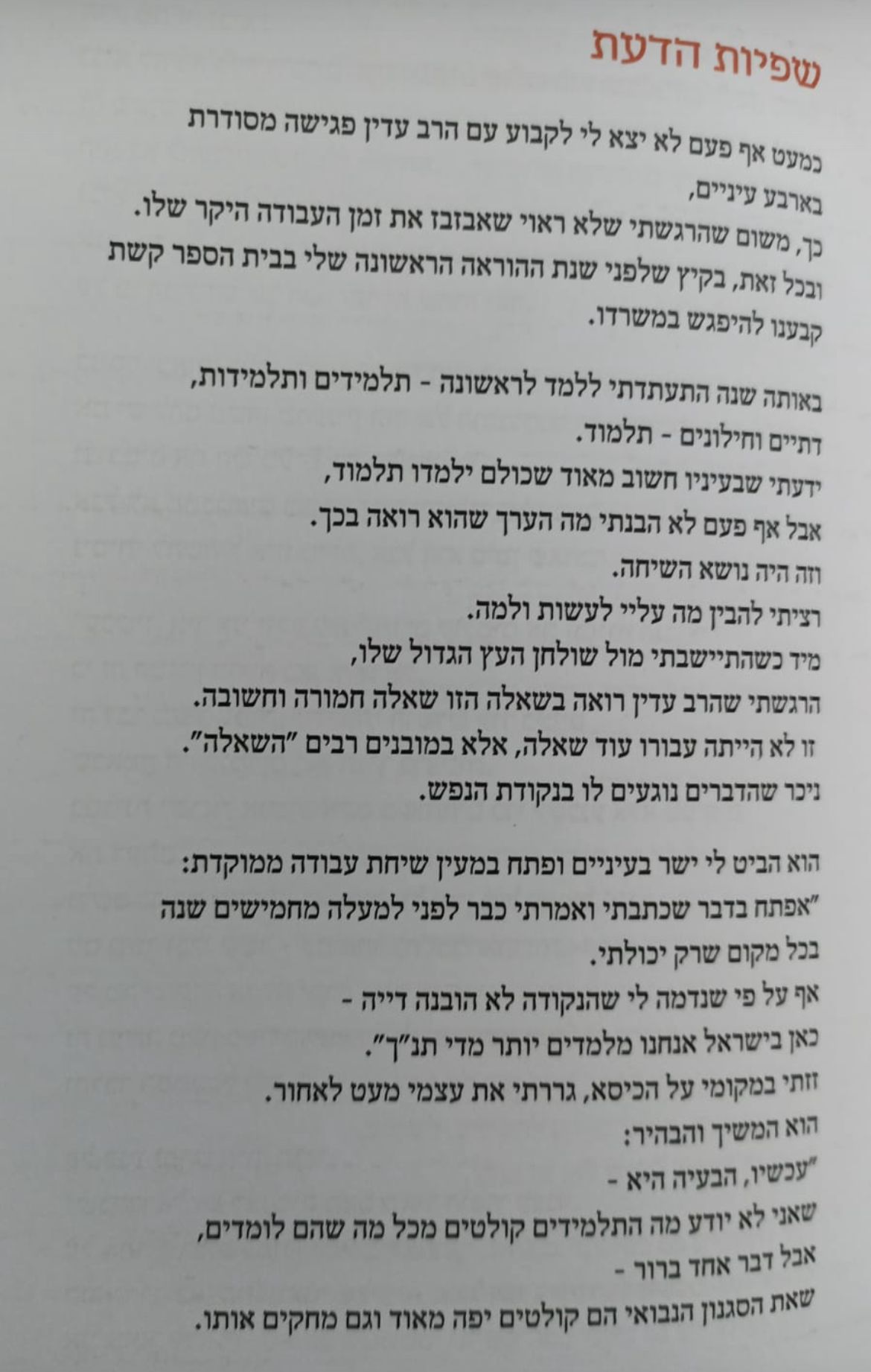
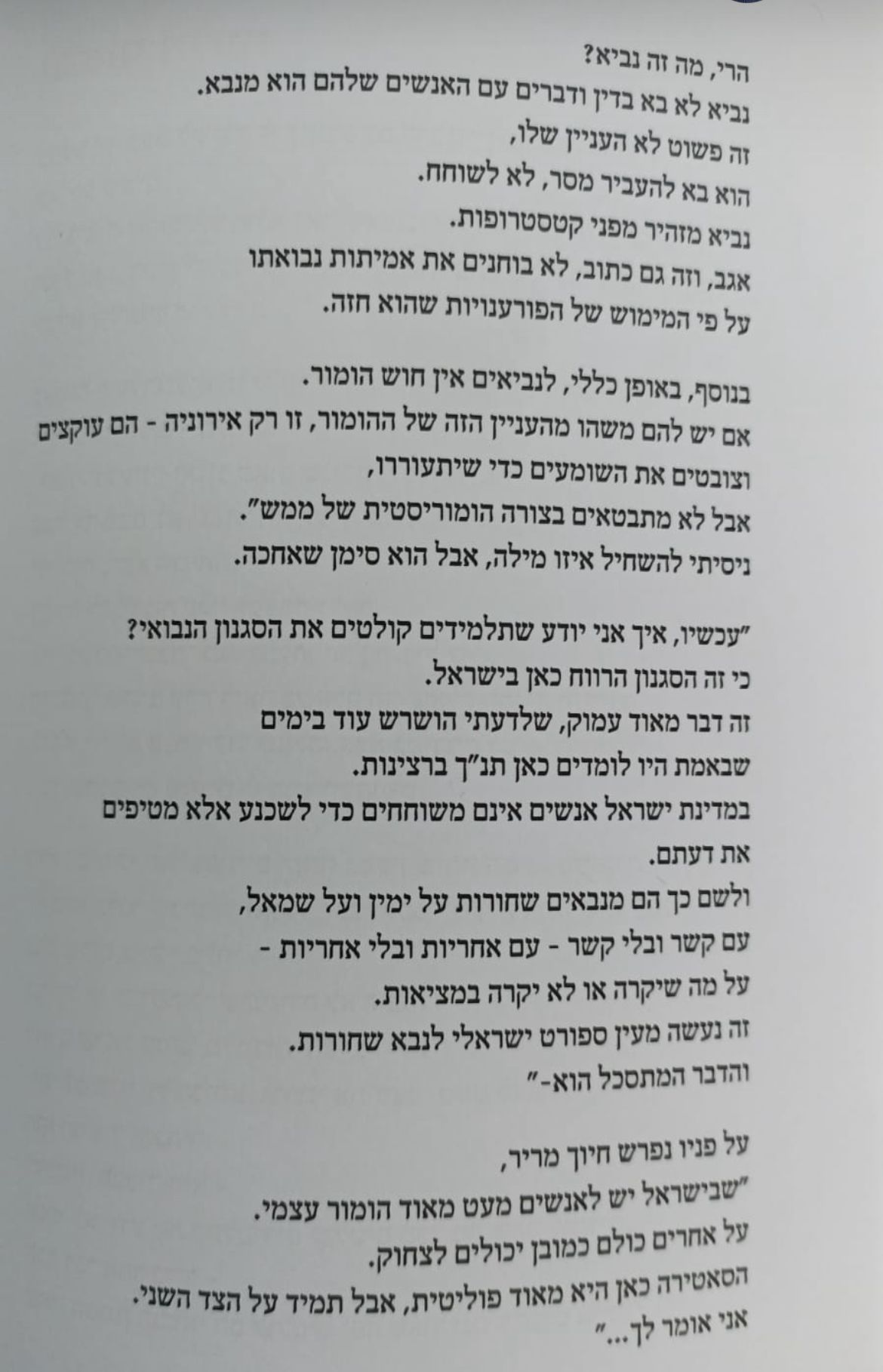
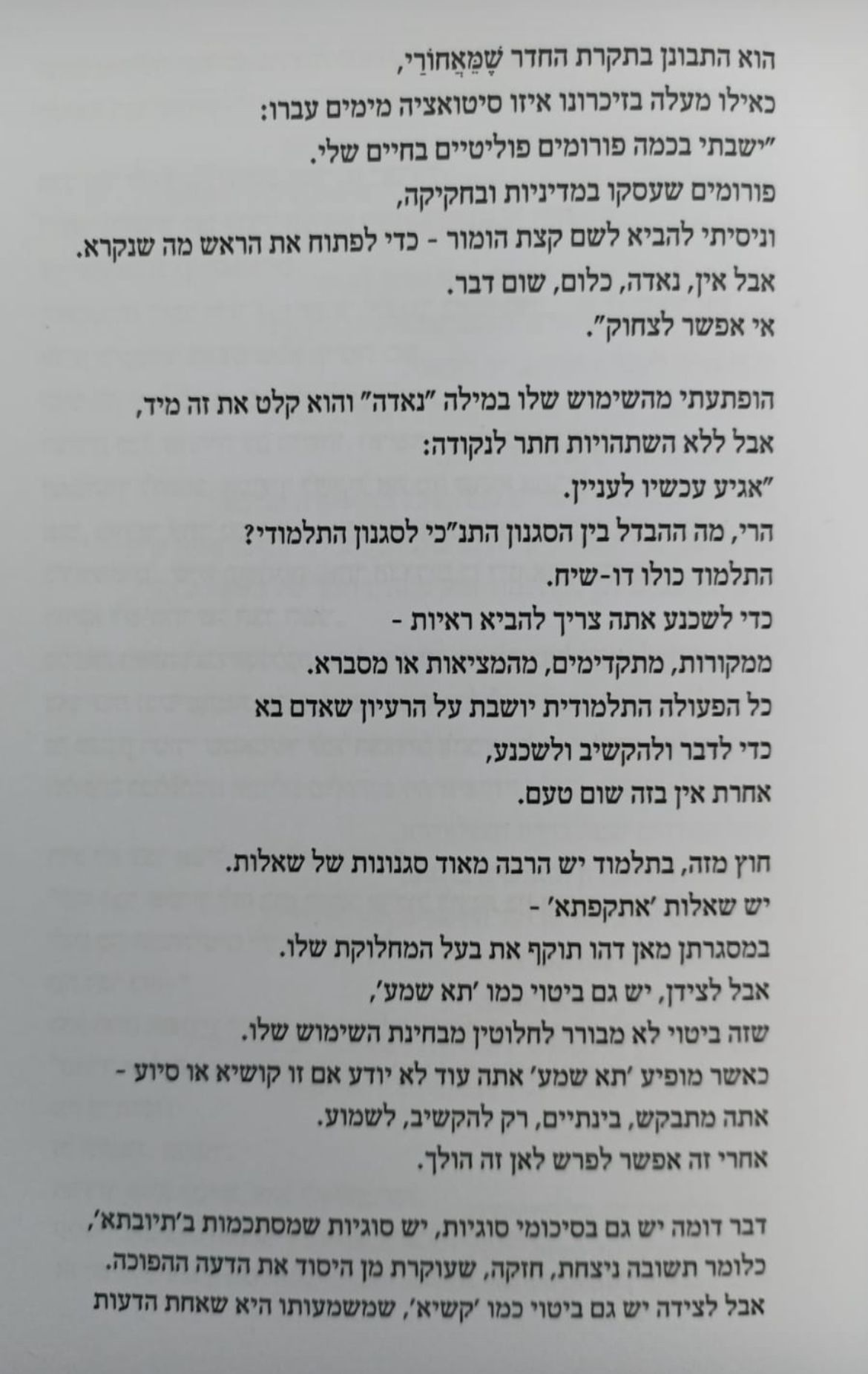
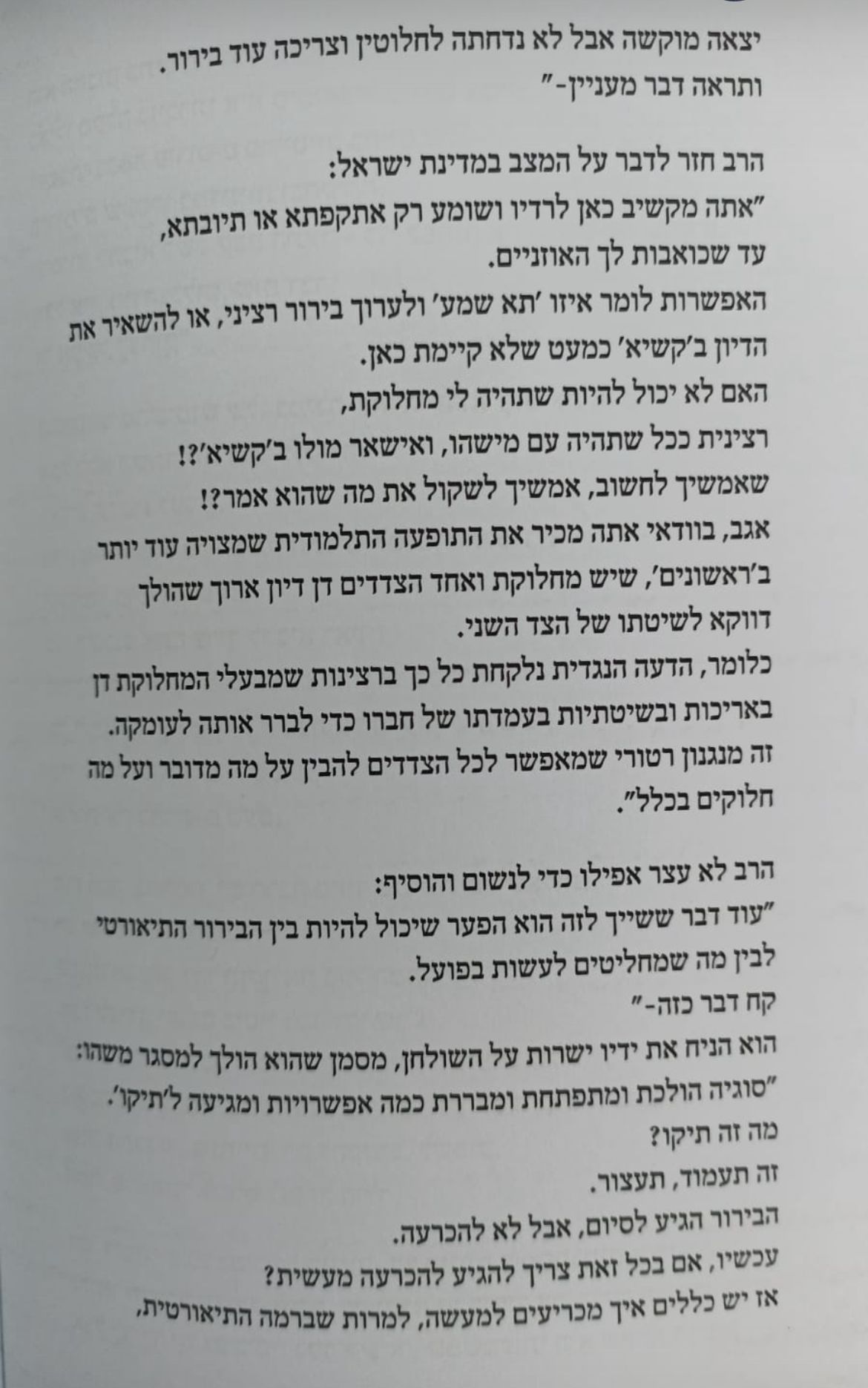
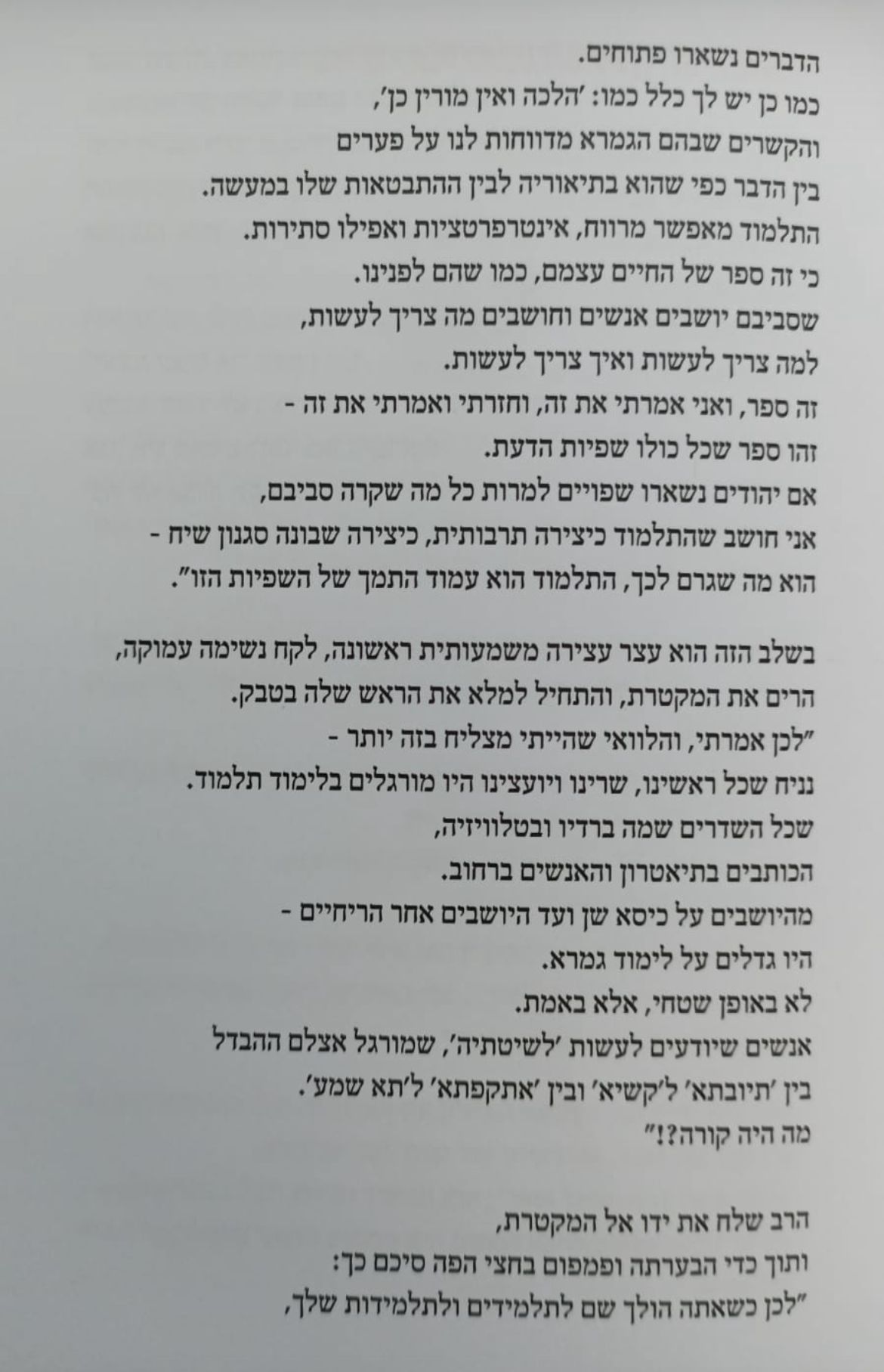
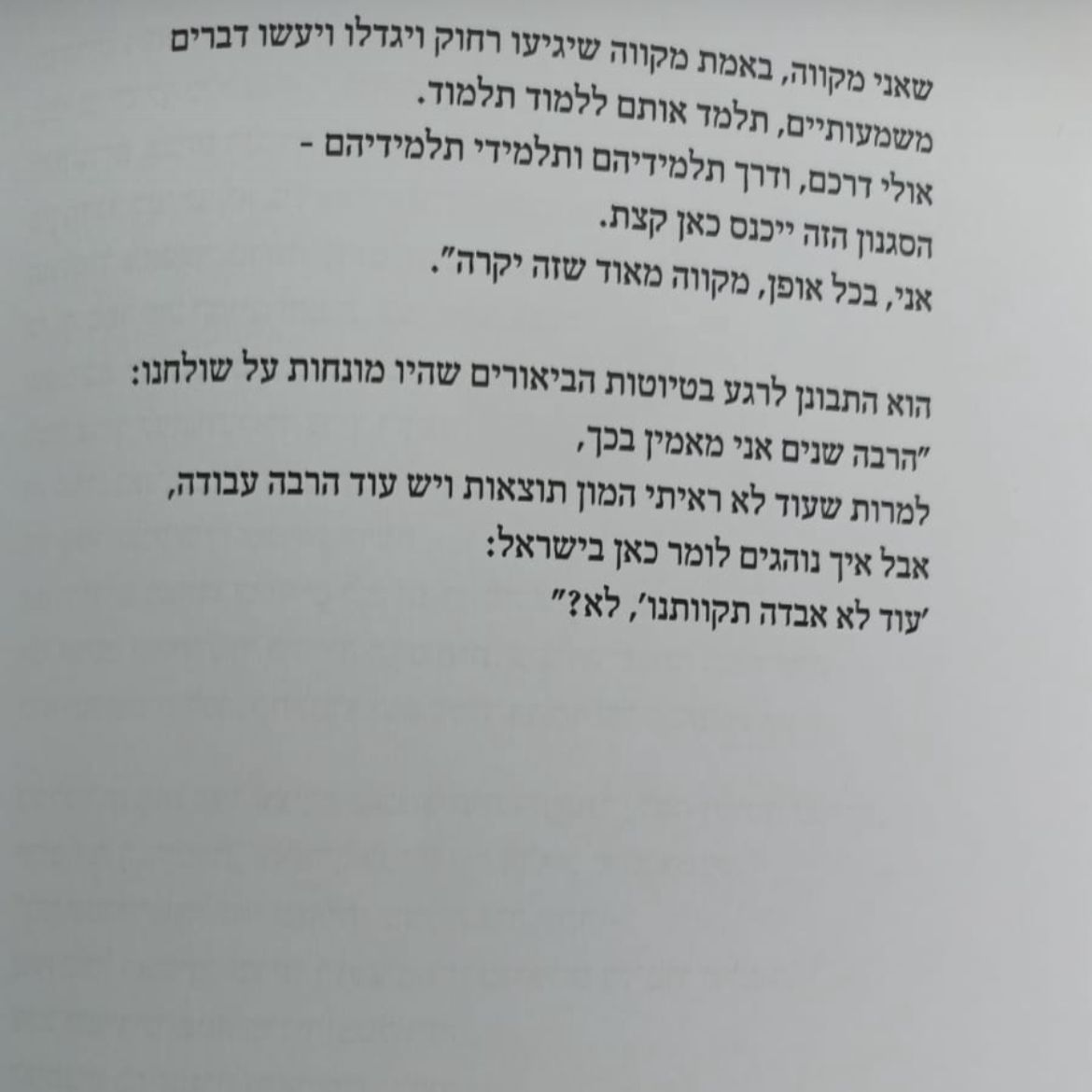
He focuses on the form of discourse and the stance with which we approach that discourse, and on the face of it this is very similar to what I have written here. But on a second look you will see that although there is some affinity, we are dealing with something entirely different. I am not speaking about streamlining and enriching discourse between different people, but about the benefit to each of our thinking in and of itself.
Several times in the past (see, for example, at the end of column 482) I emphasized the importance and uniqueness of the Talmud and of its structure for the survival of the Torah and of the people of Israel. Had a canonical work been fixed that looked like the Kitzur Shulchan Aruch or Shemirat Shabbat Ke-hilchatah, the Torah would have shattered into fragments. The variety of situations, times, places, generations, and modes of thought that the people of Israel has contained throughout history could not have contained such a rigid text; it would have lost its meaning and disintegrated into shards of Torah that would take entirely different hues in different places, and shared discourse could not be maintained. Had it been a completely open text, or had there been no canonical text at all, again we would have fallen apart. Only a canon like the Talmud, which succeeds in containing and making room for all the shades and modes of thought, can provide a flexible framework that still stands and manages to contain all opinions, communities, and outlooks and to preserve the possibility of discourse and debate among them. This is the skeleton upon which the people of Israel is built, and consequently also the Torah that it bears across the generations. Here my words return and connect to Rabbi Steinsaltz’s words brought above.
Discussion
The basic description you present here is not new to me. Although I never studied Gemara, I have read dozens of sources that present a picture similar to yours regarding the Gemara. The question that has always troubled me was the price of the (real) vitality that such a scholarly way of life may generate. And I think that many of the ills in Jewish history, at least in the symbolic context—that is, in terms of worldview, moral and aesthetic values, intellectual narrowness, mentality, and the like—feed to a large extent on that very excess vitality to which the Gemara “binds” us. The example (which I took from you) is the present-day degenerate Haredi world, most of whose horizons are anchored precisely in the Gemara-world you describe. Or in other words: there is no problem with the Gemara as such (quite the contrary, in fact), but there is a problem with the meta-halakhic (or meta-scholarly) assumptions on which it is founded. Or in more provocative language, as you like: the Gemara indeed triumphed and even perpetuated itself, and thus the Jewish people were decided by it.
Surprisingly, I completely agree. But not regarding all learners
You’re too much in love with the Gemara to criticize it. Unfortunately, the Gemara itself was written by people who didn’t have a tenth of your IQ, nor your intellectual integrity. To what is this comparable? To Yitzhak Amit writing a column about how important and pure Aharon Barak’s revolution is. In the end, all the Tosafot on the Gemara exist because it was written by people with low IQs and studied by people who didn’t dare see that the emperor has no clothes.
I also want to join Eitan and ask: many times the rabbi says that in Tanakh everyone inserts his own views, and it seems to me that the Amoraim were not at such a high IQ level as to do what the Brisk beit midrash does with it, and also the rabbi himself (and the proof is to see how the Rishonim studied Gemara; also the difficulties from one Rishon to another are not “lomdish” but substantive—except that the Brisk beit midrash turned the Rishonim too into world-class geniuses…). In short, I think there is a convention regarding the Gemara, and therefore it is our worktable for lack of an alternative (and perhaps that is what the rabbi really meant).
If I understand the rabbi correctly, the greatness of the Gemara lies in its open structure more than in whatever genius the Amoraim themselves did or did not have. The open structure allows inquiry, criticism, and a survey of the issue from different sides until its final clarification. After that the analysts come and clarify the initial intuitions found in the Gemara and the Rishonim. The open structure parallels Popper’s description of the structure of scientific research as an open body of knowledge subject to the constant testing and criticism of the scientific community, which transcends the genius or lack thereof of its individual members (which certainly exists).
As a side note, I would add that the accumulation of the discussion explains why it is preferable for yeshiva students to learn Gemara with Rashi rather than with Schottenstein, since Rashi opens a discussion that continues for 1,000 years, whereas Schottenstein summarizes it—without disparaging Steinsaltz and Schottenstein for those who need them.
1. I did not write that the Amoraim were geniuses, and the greatness of the text does not depend on their genius, as Y.D. wrote. Its greatness lies in its structure and its contexts. No less in the editing than in the content.
2. Independently of that, the fact that the Amoraim did not think and act like Brisker lomdim does not mean they were not geniuses. It is a different mode of thought and a different conceptual system.
3. My impression is that the Amoraim had very good intuition, and lomdus is a conceptualization of their intuitions. I have written more than once that lomdus and analytic tools are compensation for someone endowed with weaker intuition, or someone less willing to make use of it.
“Leaving us with a deeper, more comprehensive, and more complete conception of the issue”
The period should be replaced with a comma.
“In theoretical terms.” It should be “theoretical.”
“(This is where it began),.and even.” There is a missing space, and the period should be deleted (or the comma).
“Therefore we engage in embracing the king through his garment (in the language of the Baal HaTanya in the opening chapters) and not the king himself. But there is no difference, since the garments are what enable us to embrace the king himself.”
The fact that the garments enable us to embrace the king himself does not mean that they themselves are an embrace of the king himself.
Nonsense. Study a sugya in depth sometime, even without commentators, and you will see that the Gemara has wonderful depth, based on an “IQ” far higher than what you describe.
“As a side note, I would add that the accumulation of the discussion explains why it is preferable for yeshiva students to learn Gemara with Rashi rather than with Schottenstein, since Rashi opens a discussion that continues for 1,000 years, whereas Schottenstein summarizes it.”
On the one hand, you are right, but on the other—what is wrong with a good summary?
Indeed, for an in-depth study session there is no doubt that Rashi (even though Rashi is usually the basis in such a session) is preferable, as stated. But for a broad-coverage session—in which in any case one does not go into too much depth—in my humble opinion Schottenstein is definitely preferable.
Only, people are not willing to admit the truth that one can cover and understand more with Schottenstein, and therefore they prefer to continue learning one daf with Rashi over the course of an entire session and remain with bundles of questions, rather than learn three dapim with Schottenstein, remain with a few isolated questions (if any), and gain a clear understanding of the sugya—as long as one does not go too deeply into it.
Apparently the elucidated Gemaras have not entered the yeshiva world. That is, they entered the bookcase (the oytser), but not the students themselves, most of whom will not study from them systematically in broad-coverage study, mainly because of embarrassment before their peers (and perhaps also before themselves?) and all the rest.
Your qualification (“not regarding all learners”) is of course correct, but it does not address the principled intellectual and evaluative question that occupies me, and in my opinion many others—why choose a system whose hard core is the Gemara? What is the philosophical and theological benefit of such a system? And I claim there is no such benefit; therefore, if someone truly chooses it, it is only on the basis of more basic a priori conditions that do not accord with what the Gemara allows us to think. Perhaps he is not aware of this, but that is what he is actually doing. My proposal stands—take Paul a bit more seriously.
Correct. And still both claims are true.
I explained this. The Tanakh, aggadot, Jewish thought, ethics, and so forth are not a basis. The only way to cleave to the Torah is through Talmudic halakhic analysis. That medium allows you to encounter God’s will.
Thanks for the comments. Corrected.
I disagree. The labor of understanding the sugya when you are not being spoon-fed is part of Torah-building. And this is true also for broad-coverage study. No one obligates you to stick to Rashi. If while learning a question arises for me, and then I see that Tosafot, or the Ritva, or one of the later authorities on the page also raises it, then I get good feedback that I am learning correctly—that the learning did not remain at the level of recitation but actually understood the sugya properly.
Schottenstein probably answers a certain existing need, but it cannot replace people’s need to grapple directly with the difficulties in the sugyot.
There is no principled philosophical or theological interest for any person in “cleaving to the Torah.” There is no such thing. There is an interest in cleaving to the Absolute (God, for the sake of discussion). Now, ostensibly, we could begin arguing about what the preferred mediating channels are that the Absolute granted us so that we might cleave to Him. The Gemara was supposed to be one of those central channels. But all this is only ostensibly. Once we agreed on the “binding” character of this channel, it is no longer possible to justify personally choosing it by means of “self-awareness”—that is, to say something like: I am aware of its limitations and dangers, therefore I can make qualified use of it. The Gemara does not permit us any such space for qualified use with respect to itself (all of its “open,” flexible, and qualified thinking is directed toward the contents of its discussions, not toward its own existence).
The only way I see to resolve the contradiction (for someone for whom the Gemara is important as a way of life and who still wants to commit to it wholeheartedly) is to reinterpret it, and thereby reinterpret the Torah and all of Judaism. God may have given the Torah, and maybe, maybe He also wants us to study it (also through the Gemara). But I really cannot understand why anyone thinks God wants us to see it as such a central channel.
The criticism about the lack of a philosophical foundation reminds me a bit of Hegel’s criticism of Newton’s proposal to send a satellite around the earth, which was realized in the middle of the twentieth century. Hegel claimed that the proposal was not philosophical enough. Well, that quite persuaded Arthur Clarke and his friends, who since the 1960s have been busily realizing Newton’s proposal. The same is true of infinitesimal calculus, which also had a shaky philosophical basis, but then Cauchy came, introduced the idea of the limit, and removed the philosophical difficulties that so troubled Berkeley, Hume, and Kant. The fact that you do not understand what the philosophical basis is throws the difficulty back onto you, not onto someone who manages to do something that works—and works well.
I don’t understand. Are you proposing to abolish philosophical discussion in this specific matter? In Judaism in general? Philosophy as such? If that is your proposal, why not abolish rational discussion altogether?
If that is not your proposal, you are welcome to address my argument ***concretely***—that is, philosophically—and try to show me its weaknesses.
By the way, to the best of my understanding, Cauchy never solved the philosophical problem underlying infinitesimal calculus. But I admit that here I am on less certain ground.
If Cauchy did not really solve the philosophical difficulty underlying infinitesimal calculus, then my situation is good.
I think Rabbi Michi addressed what you are asking for. Cleaving to the Absolute is a slogan. As flesh-and-blood finite beings, we have no contact with the Absolute unless you assume that by virtue of our being created in the image of God, something in each and every one of us makes the Absolute present (a claim I can definitely accept).
If we have no direct way to touch the Absolute, and given that there is no longer prophecy for people, whatever prophecy may be, then there are two options—
— either to create a material representation of Him (a dead idol, or a living idol such as the Christians see Jesus),
— or to cleave to His will as revealed in the giving of the Torah.
As I recall, you prefer the first option and deny the second. But for someone who assumes the second option is possible, engaging with God’s will as revealed in the Torah is completely logical. He disagrees with you that God has no will, and therefore clarifying the will as revealed in the Torah is, in his view, the way to cleave to God. The form the Gemara chose for doing this is already the second stage, which can also be challenged, but without the first stage there is really no agreement and therefore no conclusion.
Do you agree with what I have described here?
I don’t accept that.
You are not presenting all the options. I begin my theology/philosophy with metaphysical naturalism, and only afterward posit upon it a personal God who may even have revealed Himself at Sinai.
Neither the Torah, and certainly not the Gemara, accepts these assumptions of mine, so either the problem is with me or with them.
I explained why I think the problem is with them: this is not about a “mistake.” It is about paradoxical philosophy and theology, namely such that their “vitality” (as Michi nicely described it) does not allow us to hold minimal structures of meaning and truth, and therefore also does not allow us to hold any body of religious knowledge whatsoever (such as the Gemara itself)…
Now either you understood my argument or you didn’t. If not, we cannot move forward; if you did, you need to show what is problematic about it (if that is what you think).
I remind you that you began with a skeptical remark regarding the relevance of philosophy to this discussion. Now you are no longer there.
I am talking about a yeshiva student who has already read and reviewed, spent many years of his life in junior and senior yeshiva, and knows how to learn in depth well, and now his time is limited (until marriage) and he wants to cover a lot. Certainly for such a person it is preferable to take a Schottenstein Gemara and not waste most of his time trying to understand what is even written here.
He will continue refining his Torah-building in the in-depth study session, but what about knowledge of Torah? Once, students knew a quarter of Shas, half of Shas, and a few almost all of Shas; today that is no longer considered so important. The main thing is to know how to “talk in learning” and toss out a few good sevarot in Nashim-Nezikin, and lo and behold—you are the genius of the yeshiva. True, back then those who knew Shas learned with Rashi, but I am sure they did not get stuck on every question and moved ahead fairly quickly. Nowadays this can be done more quickly and efficiently by means of Schottenstein, and it is a shame that the students do not do so.
By the way, despite the common perception, in my opinion in a broad-coverage session Schottenstein can be preferable even in chavruta; if this is not an especially good chavruta, and a person is not currently looking to expand his ability to explain, it is better for him to learn from Schottenstein (if he has self-discipline).
It is really interesting since when the yeshiva world became so “lomdish” and no longer values broad knowledge so much. In the past it was not like this (!!!).
So we have returned to the starting point. They are vital but philosophically paradoxical. The philosophical paradox cannot erase them, and there is no reason to erase them. They exist, and one will have to live alongside them as a philosophical scandal.
A very יפה column!
You wrote that “most of the Talmud is devoted to halakhic analysis, and whatever philosophical points appear in it are hinted, marginal details stated in passing and in an imprecise and undeveloped way.” I identify with your main claim about the study of halakhic analysis, but one cannot deny that Hazal engaged a great deal in aggadah. Besides the aggadot of the Bavli and Yerushalmi and the many aggadot in the tannaitic halakhic midrashim (Mekhilta, Sifra, Sifrei, and Sifrei Zutta), Midrash Rabbah, Midrash Tanhuma, Pirkei de-Rabbi Eliezer, Pesikta, Yalkut Shimoni, and many more were written. In your opinion, is there an explanation for the writing of these midrashim?
I have no idea. I also don’t know why the aggadot in the Talmud were written, so certainly I don’t know why the midrashim were written. One would have to ask their editors.
3. Rabbi, this is truly brilliant, but could you please expand on it more?
Personally, I find it very hard to understand. Good intuition does not necessarily mean that all the lomdus that exists today stood behind it, and even if we make the very large assumption that indeed it did—does that mean they did not know the lomdus and that it merely stood behind their intuition? By the way, ostensibly this differs from the Haredi conception nowadays, in which they do not view lomdus as a “conceptualization” but as uncovering the real thoughts of the Tannaim and Amoraim.
Now you have changed strategy: you admit there is a paradox (in Hazal themselves, not necessarily in you) but try to legitimize it. In my view this is a lack of self-honesty. So there are two problems here:
First, the choice to prefer “vitality” over self-honesty is not trivial, but it seems that you are trying to present it that way, as though there is no dilemma here.
The second problem is that this attempt to give up self-honesty defeats itself, and therefore it will succeed only to a limited degree. Hazal themselves did not refrain from theology and philosophy (and thus limited the very “vitality” they themselves preached), and in abundance. They simply did it very badly. That is the deep meaning of their casuistry.
I propose something else: not to give up this vitality, but to try to reinterpret it. Clearly my interpretation also has a price—going beyond the boundaries of authentic historical Judaism. In my view that is worth it, both theoretically and probably practically as well.
According to my view there is no paradox at all. I am speaking according to your view. You posit a paradox and at the same time acknowledge the vitality of the Gemara. Do you really have a proposal that would improve the situation?
Rabbi, with all due respect I do not understand why the rabbi disparages aggadot. For the Vilna Gaon writes (in his commentary to Proverbs) that great and mighty secrets are hidden in them, and for example the famous aggadot of Rabbah bar bar Hannah are explained in Tikkunei Zohar as very deep concepts in Kabbalah.
True, the rabbi can argue that “the emperor has no clothes” and everyone interprets the aggadot as he pleases, but “both claims are true” (in the rabbi’s words elsewhere), or in other words: this does not at all contradict the fact that the writer of the aggadot embedded tremendous depth in them.
—
Below is a quote from the rabbi in the well-known column about Hasidism, on Hazal’s well-known homily on the verse “Come to Heshbon”: “I must honestly say that these derashot… have indeed embarrassed me from time immemorial.” This derash says that a person should calculate the accounting of his world, and the Ramchal in Mesillat Yesharim and elsewhere elaborates greatly on the importance of this.
Here is the big surprise: not only does the Ramchal elaborate on this, but even the rabbi himself does: “I always kept before my eyes the perspective I would have when I turn in bed toward the wall before ‘returning the equipment’ (at 120). Will I look at my life and be satisfied with it or not? Will I leave a mark on the world, and did I fulfill my goals reasonably? This is an illuminating perspective and worth adopting once in a while when you examine your path. It takes you out of the day-to-day race and gives you a good perspective and peace of mind in decision-making” (https://did.li/mPUIw).
If so, why “these derashot… have indeed *embarrassed* me from time immemorial”?
One could perhaps say with difficulty that the rabbi was speaking generally and about other derashot of Hazal, but the example there leaves no room for doubt, since the words were said precisely about this derash of Hazal.
Preceding the Tanya and Rabbi Hayyim of Volozhin, the Maharal of Prague in Tiferet Yisrael, chapter 11.
This is his language:
“The Torah, which is the ways of God, may He be blessed, and His decrees which God, may He be blessed, decreed—one should not think that when one acquires knowledge of the four primary categories of damages, one acquires knowledge about an ox and a pit, or that one has acquired knowledge only about man and his conduct. And it may trouble you, for perhaps it would be of a higher level were one to acquire knowledge of the sphere and the like among existing things. This difficulty would be a difficulty if one were acquiring knowledge of man himself and what pertains to man. Then this question could indeed be asked. But the Torah is a decree from God, may He be blessed and exalted, and it is a yoke upon man, as is the whole Torah, which is a decree and a yoke upon man. Therefore, when a person acquires knowledge in the matter of the damages of the four primary categories and the like from the laws of the Torah, this is considered as though he has acquired knowledge of the decree of God, may His name be blessed and exalted, who decreed man’s conduct upon him.
And this is the great difference between the knowledge of Torah and knowledge concerning the spheres and the elements themselves, for these things in themselves are not of such a high level—for even the heavens are not pure in His eyes, and in His angels He places no trust. If so, one has acquired no elevated thing at all. But knowledge in Torah—even if the knowledge concerns an ox and a donkey and other things that are insignificant in themselves with respect to this level of apprehension—because these things are the decree of God, may He be blessed and exalted, over created beings, this is the exalted level of this knowledge.”
And later there:
“The Torah, insofar as it is the decree of God, may He be blessed, does not rest upon anything; it is wisdom alone, and it is holy Torah. And although the Torah rests upon material things, this is nothing. For if the commandments of the Torah in this matter were such that the law of the ox followed from the ox, just as the intelligible concept of the ox follows from the ox itself, then one could say so. But the laws of the Torah follow from God, may He be blessed, who decrees the decree of the Torah upon man, that he should conduct himself thus and thus. This does not rest upon any material thing; rather, they are decrees upon man from God, may He be blessed, not from the material thing itself alone, as was explained above. For the commandments of the Torah are a decree from God, may He be blessed, by virtue of His truth, as we elaborated above, and thus the Torah is an intellect not dependent upon any thing, because it is the decree of God, may He be blessed. Therefore, although the commandments concern material things, they have no relation to the material, since they are not due to the material thing; rather, they are the decree of the King, as a yoke upon him.”
Why does the rabbi disparage aggadot so much? The Vilna Gaon writes that all the secrets of the Torah are hidden in them.
True, the rabbi can argue that “the emperor has no clothes” and everyone interprets them as he pleases, but “both claims are true” (in the rabbi’s words elsewhere), and in other words: this does not contradict the fact that the author intended very deep things in them.
By the way, the rabbi wrote about Hazal’s well-known homily on the verse “Come to Heshbon” (“Come and calculate the account of the world,” etc.): “I must honestly say that these derashot… have indeed embarrassed me from time immemorial” (https://mikyab.net/posts/5360/).
But on the other hand, elsewhere it seems that the rabbi himself actually does conduct himself and keep this derash— in his own words—before his eyes: “I always kept before my eyes the perspective I would have when I turn in bed toward the wall before ‘returning the equipment’ (at 120). Will I look at my life and be satisfied with it or not? Will I leave a mark on the world, and did I fulfill my goals reasonably? This is an illuminating perspective and worth adopting once in a while when you examine your path” (https://did.li/mPUIw).
If you are now claiming there is no paradox here, then you did not understand my words, and accordingly you are not grappling with them. Too bad—they are simple and easy to understand. Read again carefully. It may be that after you do so you will remain with the same conclusion, but even then you will need to justify it. I think you have not yet done that.
.
This was already sent above, pardon me; at first the message did not appear above.
See column 626 (and the whole series there).
Very nice. Much of what I wrote appears here.
Thank you very much, Rabbi.
I read what you wrote under “the feeling of connection.”
This is something so subjective that it was probably ingrained in you from childhood.
There are those for whom connection to the Creator is playing music, or building farms in the Land of Israel, or opposition to Zionism. To each his own, and presumably according to his psychological inclinations.
The fact is that for so many religious people (including Haredim / baalei teshuvah, and especially dati leumi) Gemara study is דווקא very uncomfortable and does not create any optimal connection with the Creator.
I remember an article by the late Uri Orbach, “Sometimes Gemara Is Torah Neglect,” criticizing Gemara study in yeshiva high schools. You are invited to read it.
So are you right? Yes.
And is Uri Orbach right? Yes.
And is a hilltop youth who invests the best hours of his day in building a farm right? Yes.
And is someone who studies only Tanya or Likkutei Moharan right? Yes.
And is someone who spends most of his life protecting the Jewish people right? Yes.
And is someone who engages in acts of kindness right? Yes.
At first the screenshot of Rabbi Steinsaltz’s words appeared, but now it does not appear (though perhaps the problem is with my connection):
“Rabbi Steinsaltz’s words
To conclude, I will copy here what Yoel Spitz wrote in the name of Rabbi Steinsaltz about the importance of studying the Talmud (as opposed to the Tanakh).
He focuses on the form of discourse and the approach with which we come to the discourse, and ostensibly this is very similar to what I wrote here. But on second glance you can see that although there is some affinity, this is a completely different matter. I am not speaking about making discourse between different people more efficient and fruitful, but about the benefit to the thinking of each of us in itself.”
“And is someone who studies only Tanya or Likkutei Moharan right? Yes.”
And if he turns out to be an ignoramus, do you still think he is right? (I believe you will say yes, but you need to explain this.)
And likewise regarding all the other examples you gave.
There is a misunderstanding here. The feeling of connection is not the essence of my argument. The claim is that there is an actual connection, entirely irrespective of feelings. The feelings only reflect this. When one engages with His will, one cleaves to Him. By contrast, all the other things are subjective feelings that do not testify to anything essential. A person can feel connected to the Holy One, blessed be He, while standing on one foot. That is not the point. Rabbi Hayyim of Volozhin in Nefesh HaHayyim already pointed this out when he distinguished between the feeling of deveikut (which is the goal in Hasidism) and the reality of deveikut (the Mitnagdim).
When I spoke about the feeling of connection, it was an expression of the fact that there is a real connection here. I really do sit with them at one table and argue with them. By the way, this is a feeling of connection to previous generations and to the chain of transmission of the Torah, not to the Holy One, blessed be He.
Hello, Rabbi. A very nice column!
You wrote that “most of the Talmud is devoted to halakhic analysis, and whatever philosophical points appear in it are hinted, marginal details stated in passing and in an imprecise and undeveloped way.” I identify with your main claim about the study of halakhic analysis, but it seems to me that one cannot deny that Hazal engaged very extensively in the field of aggadah. In addition to the aggadot of the Bavli and Yerushalmi and the aggadot in the Mekhilta and the halakhic midrashim from the tannaitic period, the following were written: Midrash Rabbah, Midrash Tanhuma, Pirkei de-Rabbi Eliezer, Pesikta, Yalkut Shimoni, and many more.
If you have no way of knowing what the author intended, how do you know that he intended deep things? That is a baseless declaration. Maybe it is true, but even if so it has no significance for us.
I am not denying it. So what?
But what is the evidence for your argument?
You write that Torah study is God’s will, and doing His will is connecting to Him, even if one does not feel it. Suppose that is logical.
But it is also logical that settling the land is God’s will, and that spending most of the day doing kindness is God’s will, or fighting Zionism is His will, or perhaps maybe reading Psalms all day is His will.
How do you know that His will is mainly that we study Torah in the way you are accustomed to studying it?
In your column you presented several unique virtues of the Talmud—its casuistic form that fits reality, its being an ongoing argument within one canon, the character of joint study, and the internalization of a unique mode of thought—but I did not entirely grasp whether these virtues relate directly to the quality of the “deveikut” in the Holy One, blessed be He, acquired through studying it. That is, based on the Tanya and Nefesh HaHayyim it is understandable that Torah study as such is deveikut or a grasp of the Creator, but I do not clearly see whether in your view there is a unique advantage in the deveikut and “grasp” created specifically through studying Talmud, as opposed to studying halakhah—in light of what you wrote. Do you think those virtues (casuistry, participation in the discussion, and the like) enable a more direct or deeper “grasp” of divinity (and this itself can be explained), and hence also a higher religious value of deveikut? Or is the deveikut itself identical in essence both in the study of halakhah and in the study of Talmud, and you merely emphasized additional advantages—intellectual, cultural, and methodological—that do not pertain to the very status of deveikut?
Assuming that there is indeed a value of more elevated “grasp” and “deveikut” in Talmud, it seems that this can be understood in two ways: (a) object: in the Talmudic content itself there is embedded a special spiritual depth that enables a deeper connection to God’s will, and therefore it has a greater merit of deveikut than the study of codified halakhah, such as the Mishnah Berurah and the like. (b) subject: since the character of Talmudic study requires intellectual labor, creativity, and penetration to the depth of the sugya, a person activates all his powers and invests his understanding in full, and through that becomes more “attached”—not because of the content, but because of the very full intellectual and spiritual investment in the study.
Corrected
Indeed, settling the land is also a fulfillment of His will. I did not understand the question.
Cleaving to His will is clarifying His will. Such clarification is halakhic analysis. I did not understand what you call ‘studying halakhah’ if not that. Studying Mishnah Berurah is not studying halakhah. Halakhah is what you infer from the analysis of the sugyot, not what the Hafetz Hayyim inferred from them.
And is there an advantage to ‘cleaving to His will’ through halakhah as opposed, for example, to studying Scripture? Beyond your views about ‘studying’ Tanakh, I mean: is there added value in ‘clarifying His will’ over other things (are there such things?)?
Settling the land is an example that has supports in the Tanakh—from the spirit of the Tanakh, from a simple reading of the stories, and of course also from the commandments dependent on the land (an enormous portion of the commandments).
Studying Talmud is a different story. Yes, it is written that one must study the laws/things that Moses and Joshua bequeathed to the people in those days (the things written in the Torah itself), but it is really hard to infer from here that this extends to the Talmud as we know it. The Talmud indeed contains words of Torah, but it really does not look like the things that Moses and Joshua bequeathed to the people of Israel in the wilderness.
Two questions, with apologies before proper reflection.
How did the transition occur from biblical style to the style of the Gemara?
What did the Torah look like according to Rabbi Eliezer, who never said anything he had not heard from his teacher?
Rabbi, one can find a direction for knowing what the author thought when reading an aggadah in the Gemara. Even if it has ten different commentaries, after delving into them one can certainly try to work toward a certain direction (which I did not necessarily think of beforehand). How is this different from Talmudic analysis, where there are several opinions among the Rishonim, and in the end we understand the Gemara mainly according to one approach? Sometimes the opinions among the Rishonim are truly contradictory.
The main difference is that with the Rishonim it is harder to impose their opinion on our own, unlike the aggadot. But the rabbi already said that “if you are sharp, you can prove anything.”
Why is halakhah not *also* what the Hafetz Hayyim inferred from it?
The rabbi also agrees that someone who is not capable of ruling for himself should follow the Mishnah Berurah (or his own halakhic authority), and maybe that is only bediavad, but it is hard to say that this is not studying halakhah.
In my view, the Talmudic mode of thought is the unique asset of the Jewish people, far more than the content. That is what preserved the breakthrough Israeli startupist.
Former Haredi.
Doron, I will ask you a question (even if you still do not understand the context, I promise that in the end you will understand it painfully). Imagine the following situation: in the society where you and I live, someone respectable comes along, whom we assume cares about his self-respect and about being regarded as intelligent, and when he comes to discuss aspects of the object of his research he makes the following declaration about himself: “Although I am a pedophile,” and from then on tries to give us moral insight on the subject (to try, of course—we are all in favor; leave aside for a moment the illegal aspect of it). The small problem is that such a declaration obviously shows that the person is unaware of the sense of revulsion it creates in listeners. Do you think, Doron, that out of pity for the man you would recommend that I take him aside and say to him: listen, out of respect for the human being in you, I don’t know from what society you landed among us, but in the healthy and enlightened society in which I live, I advise you for your own good: do not make that declaration anymore. I do not have the ability to convey to you the sense of shame that ought to have been smeared across your face when you publicly declare that you are a pedophile. Even if you are not ashamed to walk around naked, it creates immediate closure in the person you are speaking with, and you will no longer be able to influence him in any way. What do you say, Doron?
The typical Israeli startupist has never opened a Gemara in his life—not he, not his father, and not his grandfather. Alternatively, he has read and heard countless other contents. The influence of the Gemara, insofar as it exists, has already been diluted almost beyond recognition. Success has other explanations: a small people facing difficult military, economic, and social challenges exhausts its abilities and resources toward success.
A wonderful column.
Corrections:
The links to other columns all point to columns in English.
“Until you did an internship that you poured water”—a sentence that requires correction.
The links have now been corrected
Why nonsense? Jews have always succeeded more than others in every field they engaged in, by an exaggerated statistical margin over other ethnic groups, and not דווקא in difficult situations. World chess champions, for example.
Not a few Torah scholars
Students of
You have never studied a Talmudic sugya. So why talk nonsense? Come to one of Rabbi Michi’s classes, and then you can judge.
A beautiful column that reveals interesting aspects; thank you very much!
Indeed, the distinction you drew between your position and that of Rabbi Steinsaltz is apt. Even so, when you have two hundred, you have the whole amount: the very improvement you propose, even for each side separately, undoubtedly contributes to the general discourse. The distinction between intuition and logic, between argument and emotional expression, the attempt to be precise and to define— all the contributions you noted as arising from Talmud study may significantly improve the level of discourse.