

Kabbalah, Mysticism, and Spiritual Intuitions (Column 267)
Donnolo’s introduction poses a puzzle: how Babylonian wisdom illuminates Sefer Yetzirah
Rabbi Shabbetai Donnolo, an educated and wide-ranging Italian sage, read Sefer Yetzirah in astronomical, anatomical, and philosophical terms more than in the later kabbalistic sense. In his introduction he describes how he learned the lore of the stars and medicine from Greek, Babylonian, Macedonian, and Indian traditions, and finally from a Babylonian sage named Bagdash, and from that managed to understand the Jewish book and write Sefer Hakmoni. The very possibility that Babylonian wisdom can illuminate an ancient Jewish work is the point of departure for the question about the relation among different mystical traditions.
Similarities among distant mysticisms may come from historical influence or contact with the same depth
The column offers two main possibilities: either there were historical influences and shared sources, or different mystics see the same thing in the depth of reality and therefore describe it in neighboring languages. That is why the rabbi mentions recurring basic pairs such as male-female, yin-yang, matter-spirit, and mercy-judgment, and also the similarity people report in ayahuasca experiences. The example of Gurdjieff and Ouspensky sharpens this further: Gurdjieff traveled among monasteries and centers of mysticism, identified common components, and synthesized them into the Fourth Way, which suggests that, at least in the eyes of those engaged in it, there is a shared space of insights.
Mystical experience is presented as possible cognition of a reality inaccessible to the senses
From here the column leans toward the possibility that these are not all hallucinations but a kind of cognition of a reality inaccessible to the ordinary senses, just as there are domains of reality that our senses do not detect anyway. If such an objective spiritual layer exists, it becomes clear why different people describe it in similar ways. And yet the rabbi keeps another explanation on the table: perhaps this is not an external world but shared deep layers of the human psyche, which repeatedly generate the same images and schemes.
Rationality is not automatic dismissal: one may be suspicious, but not reject a priori
This leads to the distinction between rationality and rationalism. The column argues that a rational person should be willing to accept credible testimony even when it does not fit the familiar scientific model, and only afterward look for an explanation; by contrast, an a priori rejection is rationalist but not rational. At the same time, suspicion toward mystical stories is highly justified, because it is easy to err, get carried away, and confirm prior beliefs; even the dubious story about pigeons and jaundice is brought only to illustrate the method. So the burden of proof remains on the claimant, and one needs cross-checking, demanding tests, and clear definitions of the terms in order to distinguish real content from wordplay that merely sounds profound.
Shifting mystical language across the generations weakens the proof but does not cancel it
But the comparative test is not simple either: the language of Sefer Hakmoni resembles ancient mysticisms, whereas later mysticism uses different terminology. That may point to cultural influences and the spirit of the age, but it can also be interpreted as exposure to different layers of the same reality, or even as the possibility that spiritual reality itself develops. Therefore the comparative conclusion remains, in his view, an open question.
A significant mystic gives everyone language for what many feel and cannot say
Finally, the column adds another, intersubjective test: following Gershom Scholem, important mysticism is not a closed private experience but an ability to formulate, out of personal experience, a truth that others immediately recognize as something that was already within them. So a significant mystic is one who reveals the objective within the subjective, not merely someone who undergoes unusual experiences. The example from Agnon, and later also Gurdjieff’s path from the margins to a broad Western audience, are meant to show how a successful formulation of inner depth creates public resonance and gives a mystical teaching real weight.
With God’s help
About a week ago we studied a passage from Rabbi ha-Nazir’s book, The Voice of Prophecy, which stirred in me several thoughts that had crossed my mind before. He surveys there the various interpretations of Sefer Yetzirah, one of the earliest books of Kabbalah (there are traditions that attribute it to Abraham our patriarch, or to Adam, or to Rabbi Akiva), whose structure and content are quite unique. Rabbi ha-Nazir surveys the views and findings on the matter, and discusses its place on the seam between Kabbalah and Jewish philosophy. Among other things, he cites there the book Hakhmoni, composed by Rabbi Shabbetai Donnolo the physician. This is a commentary on Sefer Yetzirah, and in the standard editions of the book it appears among the commentaries of the great medieval authorities (Rishonim) (commentaries attributed to the Raavad, Nachmanides, and others). In the course of that study I was reminded that when I once read Rabbi Shabbetai Donnolo’s introduction to his commentary, I saw there a very interesting description, and I would like to reflect a little on it and on its significance.
Rabbi Shabbetai Donnolo’s Introduction
Rabbi Shabbetai (=R. Sh. D.)[1] was a Jewish sage who lived and worked in Italy in the tenth century. He was an erudite scholar, well versed in all sorts of disciplines, especially astronomy and medicine, and also philosophy. It seems to me that he was an early precursor of the learned Italian-Jewish rabbinic tradition that continued long after him (indeed, almost to our own day. In my view, the sages of Italy are exceptional in their versatility and in the breadth of their pursuits). His commentary on Sefer Yetzirah contains mainly astronomical and anatomical elements, and he draws correspondences between them. His book does not deal at all with Kabbalah in its usual sense, but rather with ancient philosophy on the border of mysticism.
In his introduction he describes how he came to understand the book and to write his work on it. The description is fascinating, and so I bring it here in full:
  |
 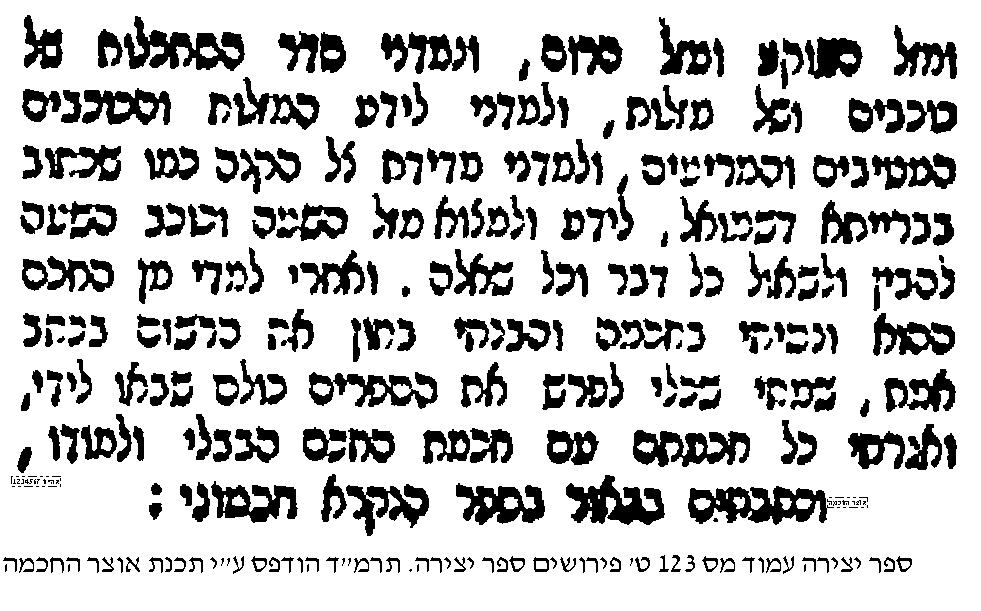 |
He explains that at first he had no knowledge at all, and so he went and studied the science of medicine and the lore of the stars. But he found no Jewish sage who understood the ancient astrological writings, at a time when there was no distinction between astronomy and astrology, physics and metaphysics. His main goal was to understand Samuel’s book of the zodiac (he probably means the Baraita of Shmuel HaKatan, or Shmuel Yarhinai). He went and studied the wisdom of Greece, Babylonia, Macedon, and India, and found that their contents were similar to those of the Jewish book. It appears that he also undertook various journeys around the world, and did not merely read books. In the end he found a Babylonian sage named Bagdash who was a great scholar, and although his words accorded with the content of the Baraita, he found that his wisdom was clearer, more intelligible, and better explained, and so he learned various things from him. Finally, out of the knowledge Rabbi Shabbetai acquired from Bagdash, he wrote the book Hakhmoni, which contains all that wisdom, and thus his work came into being.
The Correlation among Different Mystical Teachings
This description is thought-provoking. How does a correlation arise among different mystical doctrines? How does it happen that studying with a Babylonian sage enables a Jewish sage to understand a kabbalistic book like Sefer Yetzirah? Ostensibly this indicates that the different doctrines have common sources, that is, that there was some kind of influence among them in the past. Another possibility is that the different thinkers were endowed with a special mystical charisma that allows them to discern deeper layers of reality that others do not perceive. They all see the same thing and therefore speak in similar ways. True, the languages are different, but the resemblance hints that these are different descriptions of the same thing.
This is a common phenomenon among different mystical teachings. Many of them speak of male-female duality, yin-yang, good and evil, matter and spirit, mercy and judgment, and the like. Many of them rely on descriptions in terms of right and left, and this can be understood through our physical structure, which naturally gives rise to that mode of reference.[2] There are clear similarities between the sides in these various pairs, and therefore, even if the language is different and even if there are certain differences, it is still hard to avoid the conclusion that they have a common source in one of the two senses I described above.
This reminds me of something I once heard (see here) about the ayahuasca plant, which originates in Bolivia: the claim is that everyone who takes it experiences very similar hallucinations. A friend of mine who tried it many years ago claims that everyone sees the Merkabah (the kabbalistic Chariot), regardless of their cultural and religious background. Among those who came to that village in Bolivia and tried it were some German scholar a hundred years ago, my friend, who is completely secular, and others. Nowadays this matter is already better known.
Gurdjieff

In my youth I very much enjoyed reading the books of Ouspensky, an American of Russian origin, Gurdjieff’s most notable disciple (though in the end their paths diverged), through whom I became acquainted with his mystical teaching. His first and main book, In Search of the Miraculous, left a powerful impression on me (at that time I had not yet become familiar with the kabbalistic world and terminology).[4] This book contains an entire mystical structure of the human being and the world, and it uses terminology and principles very similar to those of our Kabbalah. As I recall, it has seven sefirot (emanations) arranged along the ray of creation (a line), and the whole world consists of different combinations of these elements. Ouspensky was one of a group of intellectuals from all over the world who gathered around Gurdjieff in order to learn his teaching from him. There were princes, generals, artists, university lecturers, and others there. All of them apparently found something interesting in this mystical doctrine.
Moreover, there is a book that Gurdjieff himself wrote, known in Hebrew as Meetings with Remarkable Men. In this book Gurdjieff describes journeys of exploration that he undertook with some of the above disciples in the deserts of Asia, Persia, the Caucasus, Mongolia, throughout the Middle East, and beyond. On these journeys he reached various temples and monasteries in remote places, where he met reclusive mystics, some of whom lived in caves in desolate locations. He came to them in order to learn and to discuss mystical matters together, and he drew from them information that was eventually synthesized into Gurdjieff’s own teaching. I remember that when I read the book I was impressed by the sense that these people knew of one another and found considerable similarity and shared elements among their different doctrinal systems. Without that, I assume, there would not have been much point in such meetings.
Gurdjieff’s teaching is now called, following Ouspensky, "the Fourth Way" (the title of one of Ouspensky’s books), because in his method he combines the three mystical paths of life and self-work, which are built on the person’s three components: the intellectual (cultivated, with the yogi, by study of various texts), the emotional (cultivated, with the monk, by prayers and solitude), and the bodily (cultivated, with the fakir, through pain and suffering). These syntheses were achieved through study and mastery of each of those techniques separately, among other things in the various encounters Gurdjieff conducted.[5]
The Significance of This Picture
The similarity between the mystical insights of different people and the various experiences that different people undergo with the ayahuasca plant can be explained in one of two ways. Either there is mutual influence among the various thinkers (which is unlikely in the case of the plant), or there are hidden mystical strata in reality, which only people with special spiritual charisma manage to encounter and discern. They have the ability to see these deeper layers with the eye of intellect or imagination. My claim is that this is probably not merely hallucination but a kind of cognition, except that the reality encountered through it is not a reality accessible to the ordinary senses. Ordinary people do not experience it and do not encounter it, apparently because they lack the tools for doing so.
There is no principled obstacle to positing the existence of such a reality, for just as the sense of sight cannot discern sounds and the sense of smell cannot discern sights, it may be that there is a kind of reality that none of our senses can perceive (like ultraviolet or infrared light). Assuming such a reality exists, it becomes easier to understand the correlation among different mystical thinkers. If these are not hallucinations but cognition of a reality that exists in an objective spiritual world (not merely within us), then it is no wonder that everyone who encounters it describes it in the same way, or at least in a similar one.
Can a Rational Approach Accept Such a Picture?
Among people trained in rational thought there is an aversion to accepting such a picture, and therefore they tend to classify it as subjective hallucination. But I have already distinguished here between rationality and rationalism.[6] Rationalism tends stubbornly to cling only to familiar forms of thought (scientific ones), but that is an irrational approach. Rationality accepts things that have a basis validating them (reliable testimony), even if they do not fit our mode of thought.
I illustrated this with the story of someone who studied with us in the yeshiva and had jaundice for a long time (I think about half a year), and despite repeated hospitalizations he was not cured of it. A mutual friend told me that when he visited him in the hospital, a young woman came with doves and placed them on his navel. The doves died one after another until they stopped dying. The claim was that the doves absorbed the bilirubin and thus cured him of the jaundice, and when the bilirubin was exhausted they stopped dying. Indeed, after a few days he recovered and returned to the yeshiva. I went home and told my parents the story. They immediately wrung their hands over their son, who had fallen captive among the obscurantists in the yeshiva (Har Etzion!!). Their son, who had received a scientific education, was absorbing irrational thinking and fairy tales like the worst of fools. I told them that in my view they were not being rational. A rational person ought to accept reliable testimony, even if it does not fit his mode of thought. That is how new scientific discoveries are made as well. If scientists did not accept reliable testimony that gives them information incompatible with current theory, we would still be stuck today with the science of Adam. I told them that their approach was rationalist but not rational. A rational person ought to accept reliable facts. What distinguishes him from an irrational person is that a rational person ought to think about how to explain these new facts, not to declare them a miracle and stop there.[7]
To be sure, suspicion toward such descriptions has a basis. Quite a few people tend to go wrong in attributing significance to such "testimonies," even when it is fairly clear that what is involved is hallucination or simple error. In particular, this tendency grows stronger when those "testimonies" reinforce beliefs that we already hold (such as testimonies about life after death, which people who believe in that to begin with are naturally more inclined to accept). It is quite easy to fall into this, especially for people who are not practiced in scientific and systematic thought, and therefore this suspicious attitude is indeed justified. But a suspicious attitude toward such testimonies is not the same as a principled unwillingness to accept them. Suspicion is rational; their a priori rejection is an unreasonable and unjustified rationalism. Even I, as someone who tends toward rationalism (in both senses), try to be careful not to dismiss reliable testimony about mystical phenomena out of hand, although I certainly always suspect it. For me, the burden of proof lies on whoever brings such testimony, and indeed in cases where I was able to investigate, I almost always found flaws in it.
If we return to our subject, a rational approach (and not a rationalist one) to mystical phenomena and teachings ought to be willing to accept them if they are given reasonable validation. For example, they can be put to comparative tests (asking people questions and cross-checking the answers). Even if the reality with which they deal is not scientific, the tests that validate it should be as rigorous as scientific ones. In this sense, the cross-checking among different mystical doctrines certainly strengthens the possibility that there is something objective in them (that is, that they are not merely hallucinations). Although of course this still requires examination.[8] Beyond all that, after adopting such a mystical doctrine, one must conceptualize and define its terms carefully, and make sure that these are indeed claims that are not empty. In the provinces of mysticism there is a significant concern that the discourse expresses no real content, but is rather a game of words that sounds profound while in fact expressing nothing at all. A rational person ought not to accept statements merely because of the feelings they arouse within him. He must define what he has learned and understand well what it means and what its implications are.
The Development of Mystical Teachings
If we return to our subject, the language of Hakhmoni is very similar to the languages current in ancient mystical traditions. Ostensibly this is a cross-check that gives those insights validity (assuming there was no direct influence between the sources). But today mystics use a different language and speak about different things. I think very few of them use the terminology of Hakhmoni and of the ancient books parallel to it. This may indicate that what we have here is in fact mutual influence rather than perception of something objective, or at least influence from the spirit of the age (Zeitgeist).
But even that is not necessary. It may be that the reality perceived in each period is different. Either people are exposed to a different layer (deeper or less deep, or simply different), or spiritual reality itself develops, and therefore those who perceive it see things in somewhat different forms. In the final analysis, the comparative question still requires further thought, in my view. But there is another aspect that must be taken into account when discussing these phenomena, namely their intersubjectivity.
Who Is a Significant Mystic?[9]
Up to this point I have spoken about comparing the doctrines of different mystics. But there is a matter rather similar to this, and yet different, that deserves attention.
Gershom Scholem writes in several places, when speaking about the definition of mysticism, that it is not simply something subjective to which no one, apart from the mystic himself, has access. Significant mysticism is a teaching that also has meaning for a wider public. That is precisely what characterizes a mystic of genuine stature. A mystic is someone who succeeds in exposing, from within himself and his experiences, the objective within the subjective, the inner truth shared by a broad public of people. This definition of course assumes that there is such a layer within every person, and in the world as well, and when the mystic reveals it we all understand that there is something real here that we too can perceive. His advantage over us is that he succeeds in formulating and conceptualizing it, but once he does so, we all find these things within ourselves and understand that there is something to them.
He cites there from Agnon’s Sefer HaMa’asim,[10] where Agnon testifies about himself that when he was shown Samaritan writings "that had been offered to him in the innermost depths of his being":
I read them and was amazed that I was reading and understanding, and I was amazed that everything written here was known to me: some of it consisted of things that I myself had written and that had been copied into their script, and some of it consisted of things that I had sought to write but had not written because the pen had not captured them.
The author of those writings is a mystic, an artist of formulation and contemplation. He succeeds in looking within himself and formulating outwardly things that others also see, or feel. Although they sound very familiar to them, they do not manage to bring them into verbal expression. But after the mystic formulates and describes them, the listeners/readers too are able to find them within themselves and identify with them.
I will conclude this column once again with our acquaintance Gurdjieff. In the middle of his life (1913) he settled in Moscow and drew closer to the center of Western civilization. After that he moved to Tbilisi, Constantinople, Berlin, London, and finally Gurdjieff reached the West and rented the Château du Prieuré near Paris, where he settled with his diverse group (which also expanded as more people drew close to them). He engaged in art criticism and his fame reached the wider public as well. It turns out that at this stage his mysticism found an echo in the hearts of many more people, that is, it became clear that he was indeed a significant mystic.
[1] See also the introduction to Abraham Davidovitch’s edition of Hakhmoni. There too one can find several notes and references to relevant sources regarding the remarks of Rabbi Shabbetai Donnolo that are cited below.
[2] In column 220, around note 3, I briefly discussed the mirror paradox (and in greater detail in my book What Is and What Is Not—see the reference there), and I explained there that its root lies in the influence of the structure of the human body (right-left symmetry) on our mode of thought.
[3] The photograph is taken from Wikipedia.
[4] I will tell an amusing anecdote here in connection with this book. One day I saw that a film called In Search of the Miraculous had arrived in Israel. Since I knew the book, I wondered how it was possible to make a film from a work of thought in which nothing happens. To my mind, that would be like filming Kant’s Critique of Pure Reason, or the Ari’s Etz Chaim. I persuaded several friends of mine to come see the film, and after a few minutes of a camel caravan in the desert at sunset accompanied by melancholy music—I fell asleep (apparently the root of my soul is not suited to such films). When I woke up, the guys wanted to stone me for the boring evening I had forced on them. To this day I wonder what happened later in that film (whether anything happened in it at all, or whether the camel caravan just kept walking on forever).
I have now seen on Wikipedia‘s page on Gurdjieff that the film is based on the book Meetings with Remarkable Men, although in Hebrew it is called In Search of the Miraculous. That perhaps explains the mystery a bit. In that book a few things do happen, although not very much there either.
[5] The Fourth Way is studied in the school founded by Ouspensky and, in Paris, in Gurdjieff’s own school; in Israel too there are groups that engage with Gurdjieff’s teaching, in Jerusalem, Tel Aviv, and Yodfat in the Galilee. They (the members of the circle for the study of Gurdjieff’s teaching in Israel) are the ones who translated the book In Search of the Miraculous into Hebrew.
[6] See my book What Is and What Is Not, Part III, chapter 3.
[7] My intention here is only to illustrate a mode of thought and the distinction between rationality and rationalism. On the substance of the matter, there is reason for suspicion regarding the issue of the doves and the jaundice. I recall reading once that Rabbi Tau investigated the matter thoroughly and reached the conclusion that it was nonsense. If I remember correctly, he was present and saw that the doves die of suffocation when they are pressed against the navel, and the cure is probably spontaneous or the result of a placebo. So I do not mean to claim here that this is an effective treatment. I have not checked it. But I do want to argue that if one investigates and does not find a flaw, one should accept such testimony and not reject it. Afterward, it is advisable to think about how it works and to find the scientific explanation (or another one, in the absence of a scientific explanation).
[8] It may be that all these are deep layers in the human psyche rather than in the world. All people undergo the same experiences not because they encounter the same objective reality, but because the human psyche tends to produce such images. Incidentally, some of the reports about life after death (clinical death) can also be explained in a similar way.
[9] See my book Two Wagons, Part II, chapter 3.
[10] Samukh VeNir’eh, Schocken, 5722. The passage is cited by Gershom Scholem at the end of Part I of his book There’s Something to It.
Discussion
Why is it more reasonable to assume the existence of an objective reality to which all human beings have access, rather than to assume that human beings respond much more similarly than they think to certain ideas, are attracted and repelled by these and other ideas in similar ways, and in general are far more alike than they think? To my mind, that is the rationally required response, given the findings.
Even if all the ground is of one kind, that doesn’t mean there exists another whole plane of being. Even if national archetypes exist, that doesn’t mean they really need to exist anywhere beyond our fictive cultural and social space.
Do these things connect to what you wrote here?:
"In general, I’ll only add (I have a plan to write a column about this) that sometimes we also have understanding in areas that are not morality or simple logic, such as impurity and purity or consecrated offerings. The fact is that there too we offer reasonings and choose among interpretive possibilities."
https://mikyab.net/%D7%A9%D7%95%D7%AA/%d7%9e%d7%95%d7%a1%d7%a8-%d7%95%d7%aa%d7%95%d7%A8%D7%94-2
They definitely connect. You’re reminding me that I left out what I intended to add to this column. Maybe I’ll still do something about it. Nice that you’re keeping up, because this is exactly the column I intended to put those things into.
I raised both possibilities, and not by accident. This connects to skeptical questions in general. After all, one can ask similarly why to prefer the option that our cognition correctly reflects the world over the solipsistic option (that there is no world and it’s all within us). Not to mention scientific generalizations that posit theoretical entities that are not directly observed, or mathematical Platonism.
"I told them that their approach is rationalistic but not rational."
When I read your description of the dialogue between you and your parents, I couldn’t help being reminded of the HaGashash HaHiver sketch "The Demon." In it, Gavri, the younger and educated brother, insists to his two older, dim-witted brothers, played by Shaike and Poli, that he saw a demon.
Maybe that sketch was disguised criticism of the rationalism of the time? I don’t know……
In any case—regarding the parallel between mystical systems and visions—Gershom Scholem brings quotations proving this in many places in his books. That, it seems to me, is not the innovation.
The bigger innovation is where one takes this. After all, the Torah, generally speaking, is also a kind of mystical and suprasensory reality (after all, we do not experience—at least I do not—the revelation at Mount Sinai every day, not even once a decade). Now—in light of the fact that mystical experiences are commonly experienced in similar ways by different individuals—shall we say that the Torah and revelation are something elementary, which sooner or later had to be revealed in the world, and God willed that Israel be chosen, and not, for example, the monks in India?
Or shall we say (as mentioned in the article) that identical mystical experiences are a layer that stems from the human soul—and from there project onto the Torah?
As for myself—I maintain the first side, both because in the end "He has not done so for any nation" [Psalms 147:20], and because I believe the words of the kabbalists (ours; as far as I recall this expression is brought in the book Avodat HaKodesh by R. Meir ibn Gabbai, and an illustrative story exists in the introduction to Sefer HaMiddot by Rabbi Nachman of Breslov) that while it is true there are "spiritual attainments" among the nations, most of them remain in the lower strata (relatively speaking) of consciousness/reality/soul/history, called in kabbalistic jargon "Asiyah," or "Nogah," or "Kelipot" (depending on the severity of the matter), whereas Jewish attainments are in higher strata ("Atzilut, Beriah, Yetzirah," or "from the side of holiness").
It would be interesting to hear the opinion of his holy honor, may he live long, regarding the implications of this parallel.
You can complete watching the film at: https://www.youtube.com/watch?v=uYhv0O0gUTk (though I’m afraid you’ll fall asleep again…)
Thank you. The whole column I was waiting for this part—and it isn’t there. I hope the rabbi adds something.
I don’t understand why and where this racism comes from. Jews are not better than gentiles in any way. Not even in potential holiness.
Do not take lightly the fact that Rabbi Michael David was privileged to fall asleep during the film. For sleep is the beginning of prophetic revelation, as it is written: ‘In a dream, in a vision of the night, when deep sleep falls upon men’ [Job 33:15]. When a person sleeps, he is freed from the shackles of preconceptions and conventions and opens himself to receive new ideas far beyond what he is accustomed to.
With blessings, Sim Shon
(I long ago brought clear proof for the words of Hazal that Abraham knew the entire Torah.
For in Sefer Yetzirah, attributed to our father Abraham, a verse from Ezekiel is quoted word for word, and from this it follows that he knew Ezekiel’s verses by heart. And how could he know that if not because he knew the entire Torah?
QED.)
I also don’t understand why and where this racism comes from. Ask Maimonides, who distinguished between the level of our teacher Moses and the other prophets, and most kabbalists, who take for granted the distinction between Israel and the nations….
I wouldn’t relate to the Torah as a mystical experience. True, its foundation is in divine revelation, but for me that was an occurrence in real reality. Therefore all the rest, which is not entirely clear to me, I do not see as having any real basis.
Many thanks 🙂
QED
See the attached letter of the Ramchal to Rabbi Isaiah Bassan:
https://drive.google.com/open?id=1ZibPvV0waKxxjfS0qGj-KyXwrgOR1Gyz
You can see here that people who were interested in mysticism didn’t take boundaries between religions into account at all.
Contrary to today’s basic assumption that Kabbalah is a wisdom intended only for the holy and pure, and that someone who hasn’t filled his belly with Shas and poskim and doesn’t conduct himself with stringencies and punctiliousness has no chance of understanding it—or that it will only harm him—the Ramchal had no problem spreading the wisdom among Christians (and even complaining that deniers of Kabbalah were interfering with him in this holy mission). He was also willing to say of a Christian princess that she "truly knows all the words of the Ari, of blessed holy memory, from beginning to end" [if he had paid me that compliment, I could calmly buy apartments for all my children and grandchildren with the money I’d make selling holy water].
If that was the approach, it is no wonder that various principles crop up in different religions in parallel. It’s not that each one came from a different intellectual history and there is some parallelism stemming from "realist" structures that each religion’s thought reflects, but from the free passage of ideas among people, each of whom saw himself as holding knowledge that made him immeasurably superior to members of his own religion who had not been exposed to it, and akin to members of other religions who expressed interest in this mysticism. There are similar statements, even far more explicit ones, by various Sufis in the tenth century and such, if that interests you.
Regards,
This is a very interesting comment.
This kind of contact was very common in Christian Kabbalah and in Italy around the Renaissance period (for example with Pico della Mirandola and others), and it is indeed a real phenomenon. Even so, I think that in many cases there was no direct contact between different mystical thinkers, and therefore the lack of attention to interreligious boundaries is not a sufficient explanation for the similarity between the doctrines.
With God’s help, 9 Tevet 5780
There is no proof from there that the Ramchal was willing to teach Kabbalah to gentiles. At that time the books of Kabbalah had been printed and spread widely, and non-Jews who learned Hebrew and Aramaic—as was customary for every Renaissance intellectual to know the "classical languages," Greek, Latin, and Hebrew—could access and study both the books of Kabbalah and the books of its opponents, and direct questions to the Ramchal about its truth, questions that required his response, just as earlier authorities before him had to answer Christian claims regarding the words of the Talmud and the Midrashim of Hazal that had come into their hands.
Regards, Shatz
Hello!
In relation to what you said: "…It is possible that there is a kind of reality that none of our senses can detect (like ultraviolet or infrared light). Assuming there is such a reality, one can more easily understand the correlation between different mystical thinkers"
True, one cannot see sounds, as you said, but the information received by the senses known to us is nevertheless measurable: light waves have wavelength, and the sense of smell detects molecules that can in principle be quantitatively characterized (mass, etc.). I would assume that if there is information that mystics can absorb with some special sense, then it too would in principle be measurable (though the mystics would have to be scientists accordingly).
Another point is that mystics usually describe the information they absorb in such a way that its qualitative characterization belongs to an existing sensory category: they see certain things (the sense of sight) or hear voices (the sense of hearing). If this were through a special sense unique to them, I would expect them not to have the ability to describe it to us, just as we cannot explain what red is to a blind person.
I see no reason at all to assume the picture has to be measurable. There are quite a few things we experience in our world that are not measurable—including things that many define as science (psychology).
As for your last question, you answered it yourself. Since it is impossible to convey the experience the mystic has undergone to people who have not experienced it themselves, he uses sensory terminology drawn from their world.
The issue was an additional sense. In this case the experiences are qualitative, but the information absorbed by the senses is definitely measurable. Of course there are experiences that are not absorbed by a sense, like love or fear, but as stated I was referring to the point where you spoke about information absorbed by a special sense. However scientific psychology may be considered, it is only when there are attempts at correlation between the experience and the external event attached to it—which, again, can be measured.
As for the question you said I answered myself, I’m not entirely sure. A) The impression is that they describe actually seeing things (a dream or something before their eyes, like a hallucination). That’s not an argument, of course, only a personal impression.
B) If I wanted to convey the experience of red to a blind person who has never seen in his life, I think it would be foolish of me to explain it to him in terms of another sense—for example, to tell him: "The red color of the flower before me creates in me an experience like the sound of a metal bell in my ear." That would be nonsense to the blind person. So I think that an attempt to convey information from a sense unknown to us in the form of appearance should not really succeed in creating a coherent picture; I find it hard to believe that translation between the senses would be understandable.
Even sensory information is not measurable in most cases (!), and here we are not talking about sensory information.
I am not impressed that they are describing sensory information. Just as the anthropomorphisms in the Torah are metaphors.
If you wanted to convey visual information to a blind person, the best way to do so would be precisely to use terminology appropriate to him, exactly like the anthropomorphisms in Scripture ("the hand of God").
I’m also not under the impression that they’re describing sensory information, but for the purpose of the present discussion I assumed so. The anthropomorphisms in the Torah are a good analogy, I think.
Thank you.
With God’s help, 10 Tevet 5780
I am no great expert either in mysticism or in Gurdjieff, but on the face of it his concept called "the Fourth Way," according to which man is intellect, emotion, and body, and therefore must advance on all three planes—intellectually, through study and reflection on books; emotionally, through prayer and solitude; and bodily, through deeds—this is almost "the whole Torah on one foot."
Except that unlike the "way of the fakir" (which Gurdjieff speaks about), where the correction of the body is done by causing suffering, in the Torah the correction of the body comes through acts of mitzvah and healthy conduct that bring balance to body and soul.
The correction of the three strata of the person is done, as Shimon the Righteous instructs, through Torah—the correction of the intellect; service—the correction of the heart; and acts of lovingkindness—the correction of the body and the world of action, by benefiting one’s fellow rather than through asceticism and suffering.
Regards, Shatz
I once read a book that slanders Gurdjieff and presents him as the head of a corrupt cult. Is that a baseless accusation, or is there something to it?
I have no information, so it’s hard for me to answer.
On the need for rectification of all layers of the human being—the intellect through Torah study and the body through practical mitzvot—the author of the Tanya writes in chapter 35:
‘Now when a person engages in Torah, then his soul, which is his divine soul, together with its two inner garments, namely the power of speech and thought, are encompassed by the light of the blessed Infinite One, and are united with Him in perfect unity, and this is the resting of the Shekhinah upon his divine soul…
But in order to draw the light and radiance of the Shekhinah upon his body and animal soul, which is the vital soul clothed literally in his body, one must fulfill practical mitzvot that are performed literally by the body, so that then the very power of the body involved in this action is encompassed by the light of God and His will, and united with Him in perfect unity.’
With God’s help, 10 Tevet 5780
Indeed, Moses requested, "And I and Your people shall be distinguished," that the Shekhinah not rest upon the nations of the world; but all the inhabitants of the world are invited to convert and join the people of Israel. After all, King David descended from Tamar and Ruth the Moabite, and King Messiah from Naamah the Ammonite; the prophet Obadiah was an Edomite convert, and from Rahab came the prophet Jeremiah.
Regards, Shatz
A nice book, with a sense of humor (and a bit of cynicism), about the groups of: Helena Blavatsky (Theosophy), Gurdjieff (the Fourth Way), Rudolf Steiner (Anthroposophy), and the connection between them: https://www.scribd.com/document/378044304/Peter-Washington-Madame-Blavatsky-s-Baboon-1995
It is possible that Gurdjieff’s "seven sefirot" derive from the seven days of the week, which were ingrained in worldwide human consciousness, both by the Torah, which organized time in a pattern of seven days of the week (as opposed to the heritage of ancient Egypt, China, and Japan, where days were organized in units of ten).
The days of the week were also paralleled in ancient European cultures (already in the pagan period) to the seven planets, and so in English (and in German) the first day is "sun-day," the second day is "mon-day," Wednesday is dedicated to the idol Woden, Thursday to the idol Thor.
The Maharal explains the meaning of the number seven as expressing the three dimensions—right-left, front-back, up-down—and the divine central point that unifies all being, the Sabbath that bonds all creation and connects it to its divine source.
Regards, Shatz
Not close to Shimon the Righteous and not close to the Maharal. His wisdom revolves much closer to music and dance. (His law of 7 is connected to the Western musical scale; the law of 3 is closer to the active/passive/neutral forces of the East; and the "enneagram" (9) is a combination of the two.) With all that, Gurdjieff’s wisdom is much closer to modern Gnosticism than to anything else.
With God’s help, 11 Tevet 5780
To dz—warm greetings,
It may very well be, as you say, that Gurdjieff drew the connection to seven from the Western musical scale, which has a scale of seven steps. It seems to me that the choice to divide the range of sounds into seven stems from the significance of this number in world culture; and just as there is also a scale of five steps and a scale of twelve steps, these too are numbers with meaning—five fingers and twelve months, and so on.
After all, one could divide musical intervals into infinitely many degrees (as indeed happens in Arabic-Turkish-Persian music, which Gurdjieff presumably also knew), but it is more convenient to work with a defined number—just as in the army everything is divided by three (except for the chicken, which is divided into 8 :).
As for the division of human personality into intellect, emotion, and body explicitly found in Gurdjieff’s words—this is a natural distinction that suggests itself, and presumably exists in many cultures. I brought Shimon the Righteous precisely in order to note the difference between Gurdjieff’s method and Judaism regarding the layer of bodily correction: for him it is done in the "way of the fakir" through suffering, whereas in Judaism the body is corrected through the performance of the mitzvot.
Regards, Shatz
I agree with you. It seems more correct to say that he used the Western musical scale in order to convey his wisdom. When I wrote the law of 3 in his method (active/passive/neutral), I did not mean the division into intellect/emotion/body that he uses in order to reach his fourth way, which includes them all, but another part of his method.
Bottom line, I objected to the comparison (or even putting him together) with Shimon the Righteous or the Maharal. For the big problem in Gurdjieff’s method is the moral aspect. (As can be seen in other esoteric/similar wisdoms that reached the West from the East in the last century: Theosophy, Anthroposophy, etc.)
It seems to me that the Ramchal’s letter says more like: "Even the gentiles believe in Kabbalah! How can the Jews not?!"
It’s also a bit hard for me to think of the Ramchal specifically as someone who could represent some kind of universal, worldwide kabbalistic brotherhood, since his teaching very much tends toward a dichotomy between Jews and others.
Though it could be that there were kabbalists who saw things that way; I heard something like that in the name of the Baal HaSulam.
"Intentional suffering" is a concept that, in order to understand it in its original meaning, one has to read about in Gurdjieff’s books Meetings with Remarkable Men and Beelzebub’s Tales to His Grandson.
Mentioning suffering in a bodily context isolated from the emotional and intellectual context contains an internal contradiction.
"The way of the fakir" is Ouspensky’s way of marketing specifically the fourth way, which is not included in the three ways mentioned.
According to Ouspensky, Gurdjieff had a shortcut for rising from the given human condition to a "higher" situation, whatever that may be.
By the way, to all the mitzvah-observant commenters: according to Gurdjieff, mitzvot require intention.
As for the latter part of your words (Shatz), Ram Dass says the same thing (acts of lovingkindness); it is not clear what his sources are (since he also studied Judaism), which may strengthen the claims raised in the article by Rabbi Michael.
Gurdjieff seeks access to places that naturally, for a natural person, there is no access to (awakening).
Is "awakening" possible בכלל?
For even if the rational claim supports this possibility, that does not compel the possibility itself.
In any event, since this possibility exists, and if it is realized, then all of our conduct proceeds according to what is natural and normal, and because of that our whole lives are conducted according to a distorted world-picture, since the fuller and truer reality is hidden from us.
Here there is room to introduce the "teacher," who in turn is exposed to the hidden layers. But this leads to complete submission before him, which very quickly leads to his becoming a cult leader whose words may not be challenged.
Ouspensky writes about a similar formulation of this problem, that every student draws to himself the teacher fit for him, and a fraud will draw a fraudulent teacher to himself—which is similar to the claim that "someone who asks heretical questions—their source is the evil inclination and not a genuine opinion."
It seems that the discussion of what is preferable, sage or prophet, becomes critical in Judaism for one who loves mysticism.
Your article is very interesting.
There is a very interesting parallel between Indian mystical thought of the 11th and 12th centuries and the early Kabbalah of the same period in Spain. The similarity cannot be explained by a connection of cross-cultural transmission of ideas.
By the way, parallel intellectual developments do not occur only in the field of mysticism. There are many such cases in the exact sciences no less than in general thought. Well known, for example, is the creation of infinitesimal calculus in parallel by two contemporaries, Newton and Leibniz, in almost exact simultaneity. From the last generation one can bring a nice example from theoretical physics, in the case of the parallel formulation of what was called the "Eightfold Way" in the early 1960s by Yuval Ne’eman (the Israeli—published first, and also predicted the existence of a new particle on the basis of the theory, and that prediction was indeed verified almost immediately) and Gell-Mann (the American—published second, a few weeks after Ne’eman’s publication, without knowing of Ne’eman’s research).
[A bit of piquancy: in both cases scandals arose. In the first case, Newton attacked Leibniz vigorously for supposedly "stealing" his scientific achievement—unjustly. (And incidentally, it was Leibniz’s formulation and system of concepts and symbols that was accepted for generations.) In the second case, the Nobel Prize for formulating the theory was awarded only to Gell-Mann, due to a conjuncture involving the American establishment and the Swedish prize committee, and Yuval Ne’eman was blatantly and tragically cheated. (The Americans were so embarrassed after the scandal exploded that they were forced to award Ne’eman the Einstein Prize, and he was the first non-American to receive it.) ]
As for various mystical doctrines: I myself studied Jewish Kabbalah of various kinds for many years, and I also published several books written בעקבות this study (Hayoshevet Baganim, Zechut LeYisrael, available in the National Library in Jerusalem). In parallel I studied other mystical doctrines. My view is that there is a certain common denominator among certain mystical doctrines despite the cultural differences among the mystics, just as there are great differences between such doctrines and other groups (for example: Jewish mysticism versus Tibetan mysticism, which is very strong and impressive in terms of its practical techniques). The main source of the difference lies in the dimension of height/depth, which stands out beyond the existing cultural differences. For example, there is no comparison between the height/depth of the Kabbalah of the Zohar and the early kabbalistic teachings preceding the formulation of the Zohar, and the achievements of the Indian mystical stream in parallel periods, whose perceptions and concepts are relatively crude, primitive, and general. It turns out that the Jewish mystics were significantly better than their Indian counterparts. Those of "Christian Kabbalah" were much less good still, and it is quite clear that their doctrines were developments of partial and distorted copies of the Jewish source, with the addition of Pythagorean and other elements.
For especially detailed and sophisticated mystical doctrines, it is hard to find parallels. For example—the Kabbalah of the Ari (insofar as it is distinct from the Kabbalah of the Zohar and the Ramak)—I have not found for it any complete external parallel, and there is similarity to external parallel ideas only at two points: A. the doctrine of tsimtsum (the idea is first expressed by John Scotus Eriugena, from the 9th century), B. the doctrine of the breaking of the vessels (the general idea is found in Manichaeism).
Another source of difference lies in the area of emphasis of the doctrines. There are doctrines that concentrate on the side of magic, and there are doctrines that focus on the theoretical sides of mysticism.
Finally, mystical doctrines are also being created in our own day. I know a creative mystic (a Jew, actually Haredi) who has been creating a mystical doctrine since 2012. In his case this is not a kabbalistic variation on the Zohar, the Arizal, or any other kabbalist, though there is a certain basic similarity between his doctrine and Zoharic Kabbalah. The interesting thing is that the doctrine is created not out of study and analysis of existing texts, but through direct communion with "telling" organs in the higher non-material levels of the persona, and in certain cases also outside the persona. Another interesting thing—there exists in the doctrine a technique of "communion" (= bonding for the production of insights), based on the principles of this doctrine. The technique is formulated there as a defined method, and can be learned and applied by any person with relative ease, certainly in comparison with techniques of contemplation formulated by mystics such as R. Hayyim Vital (as in Sha’arei Kedushah, part 4), the Ramak, R. Abraham Abulafia, or some of the great Hasidic masters. Another matter, and without entering into philosophical/relativistic questions about the dimension of time, the direction of time and events, consciousness, and causality—the man has clear predictive abilities, produced in his "communions." In this he resembles the kabbalist Rabbi Lasri from Beit She’an (died about a decade ago), who was actually a practical mystic, a truly exceptional wonder-worker (I was unable to determine how versed he was in theoretical Kabbalah, though it is reasonable to assume that he had attainments in that field as well).
With God’s help, 18 Tevet 5780
To Shmuel—warm greetings,
The common denominator of the three foundations established by Shimon the Righteous—Torah, service, and acts of lovingkindness—is that in them a person does not focus only on digging into the depths of his own soul, from which various mystics are accustomed to seek truth, but also opens himself to the thoughts and desires of others.
In Torah study, a person opens himself to the thoughts of the Giver of the Torah and to the reasonings of his teachers and companions; in service, a person gives thought to the greatness of his Creator and to the greatness of His aspirations for the repair and completion of the world; and in kindness, a person gives thought to the needs and thoughts of other people, and endeavors to understand what they need and how one can help them.
If mystics reach an exalted "experience of unity"—those engaged in Torah, service, and acts of lovingkindness reach the particular implementation of that unity in their whole being, through openness and attentiveness to find "favor and good sense in the eyes of God and man," and "the eyes of others" will complete for us our own "eyes."
It is not "shortcuts" to inwardness (as Ouspensky proposes in Gurdjieff’s name) that we need. We aspire to walk the "long and short way," to realize our capacities to look within ourselves and also to listen to and learn from others (in our encounters with remarkable people, and also simple ones 🙂), and through fellowship to draw a little closer to the divine truth.
Regards, Shatz
A—I would appreciate it, Rabbi Michi, if you could direct me to the email of the last person, called Y. Tz., who writes that he authored Hayoshevet Baganim and Zechut LeYisrael; I can’t manage to get hold of him.
B—You wrote that either the mystics experience some hidden mystical components, some reality that exists which our senses cannot sense and they can with their mind’s eye or imagination, or else it is just something in their souls, some hallucination.
And I ask: what practical difference does it make? It’s like saying that either there’s a teapot floating in space that every time people try to track it disappears, or there isn’t such a teapot.
That is, what difference does it make whether it is in their intellect or imagination—they see this "reality" that "exists" only there—or whether it exists in the depths and distortions of their souls, or whether it doesn’t exist at all?
It reminds me of the argument (apparently mine) against solipsism: what difference does it make if everything is just in consciousness? After all, I feel pain, I feel hunger, I feel satiety when I eat, etc.; I feel that I have children; I feel as though it’s not only consciousness… It’s like saying of a slice of bread that it’s only wood and you imagine it’s bread and imagine you’re full and imagine that earlier you were hungry and imagine you have more carbohydrates since you ate the bread, etc. etc.
There is no point in conducting the same discussion in several parallel threads. I’m done with it.
Okay, sorry, so we’ll leave it only here; if you could address it.
A—if you really could give me that person’s email.
B—and also regarding my question here in section B, the matter of hidden worlds that may exist and that they experience, if you could address it.
C—as for intuitions, I understood, but then the bread fell into the pit: how will I know what comes from intuition and what comes from experience and imagination, since I do not have their intuition?
A. He’ll write his email if he sees this here. I’m not supposed to pass along such information.
B. I didn’t understand the question. They are not hallucinating; they see it.
C. How do you know what you see and what is a hallucination? You understand it yourself from an inner feeling. If you don’t trust that, I have no other solution.
A—Obviously, but he won’t write, because this was 5 years ago, and there’s no reason he would suddenly enter this post and check, unless you believe in such miracles. After all, there is no email notification (only when opening a question the first time, when you reply, but not when someone replies to you; I commented on this to Oren, but he said that’s the system), unless you would be so kind as to send him this request to his email with my email, in which case I’d be grateful for the trouble.
B—you wrote: do they see it in their imagination or in their intellect, or is it a hallucination?
C—My question was not how I will know when I experience it, but how I will know, from what they write, what is intuition and what is from an attainment they experienced in their imagination during the trance, or just whatever it seemed to them; after all, they write everything in the same way.
I don’t have his email. Maybe Oren can send it to him.
Again regarding Kabbalah:
My intention was about your puzzlement over a certain correspondence between different methods.
And about this I wrote to you (elsewhere) that it is only because of a similar general background in philosophy, with its various schools; and just as in a dream a person is shown things from the thoughts of his heart, so in these meditative trance experiences, according to their various methods, they see from their own thoughts. And like the well-known phenomenon of the maggid, where "it" tells a person according to his desires, as is known from the maggid of Rabbi Yosef Karo. And about this I referred you to Shadal in his book The Debate on the Wisdom of Kabbalah.
And there too I was not convinced. Mysticism is not an expression of philosophy, nor of its "various schools" (which is of course an oxymoron, because you are trying to propose an explanation of why all mysticisms look similar, and you explain it by saying it is because of philosophy in its various schools). From which philosophy do ten sefirot emerge? Where do yin and yang, or lovingkindness and judgment in Kabbalah, come from? And how does this come out of philosophy "in its various schools"? You are simply insisting.
By "its various schools" I meant what Shadal mentions there, that there is a dispute between Averroes and Avicenna, and similarly the kabbalists disagreed about the sefirah of Keter; and concerning the ten sefirot too, he speaks about ten ranks of angels mentioned by the philosophers. And similarly, the worlds mentioned by the kabbalists above our world—the world of the angels and the world of the spheres—they copied this as well; and likewise the Ein Sof mentioned many times in their words is a concept from philosophy, and other things. I’m writing now from memory; when I have it in front of me, I’ll send clearer things from there.
And by the way, Abraham Abulafia also wrote a commentary on the Guide for the Perplexed, which he very much liked according to his kabbalistic way; and about the Ramak too, I once read elsewhere about an influence from the Guide on the structure of his book.
Bottom line, when are you coming to taste the ayahuasca (the Tree of Knowledge)? We’re waiting for you.