

Halakhic Leniencies in the Days of Corona—and Their Breakdown (Column 289)
Why the Zoom ruling triggered opposition even though the main difficulty is not halakhic
The column opens with three COVID rulings, but focuses on Zoom for the Seder night and home immersion during lockdown. In the Zoom case, it argues that the main opposition is not to the narrow halakhic question but to what may happen once the ruling is publicized. Halakhically, the lenient rabbis do not accept the Hazon Ish's approach to electricity, and the device is activated before the festival begins; afterward there is at most a change of state brought about by voice and image, not manual operation. Marit ayin and public noise concerns are also weakened when everyone knows there is a pandemic, a lockdown, and an open rabbinic discussion about such use. That is why the retreat of some signatories into the language of 'pikuach nefesh' looks, to the column, mainly like panic in the face of criticism; if this were truly pikuach nefesh, no special permit would be needed.
Why a future concern does not create prohibition without authority to enact a gezeira
From there the column moves to a principled question: even if the fears are real, may a posek forbid an otherwise permitted act because of a future slippery slope. Its answer is no. Such a prohibition is a gezeira or protective fence, and the authority to enact gezeirot belongs to the Sanhedrin or at least to an institution accepted by the entire public, not to a contemporary rabbi. A posek may therefore recommend caution, and perhaps a custom will emerge that way, but he cannot turn the permitted into the forbidden. In this view, the same applies to examples like banning umbrellas or bicycles when the argument is only that they may lead to another prohibition: even if the concern exists, we lack the authority to legislate on that basis. All the more so when the counterweight is severe loneliness, failure to fulfill Seder-night mitzvot, and real damage to the spirit of the festival.
Hardship according to the Rema: leniency applies only where the law fundamentally permits
To sharpen the point, the column uses the Rema: a pressing situation allows one to return to the baseline law where people customarily ruled or behaved stringently; it does not cancel an outright prohibition. So if Zoom is indeed permitted according to the law itself, then on ordinary days one might recommend stringency, but it is wrong to declare it forbidden. And during COVID, when people may miss biblical and rabbinic mitzvot and suffer emotionally, it is certainly wrong to convert a policy concern into a firm halakhic ruling. In the column's view, the slide from 'what might happen' to the language of legal prohibition distorts the boundaries of psak.
If something is fundamentally permitted, the posek does not decide for the questioner when to use the leniency
That leads to a broader conclusion: if an act is fundamentally permitted, the question of when it is right to rely on the leniency does not belong to the posek but to the questioner. The posek's job is to lay out the halakhic picture, the positions, the risks, and the costs; the decision whether one's personal situation justifies relying on the leniency belongs to the person himself. That is why the arguments about whether the ruling was meant only for extreme cases, or whether some signatory later withdrew, miss the point. Only where halakha itself already established leniencies for defined situations, such as illness or a certain kind of duress, is the posek not 'inventing a permit' but conveying an existing rule. In the Zoom case, the column holds, we are dealing mainly with the removal of a stringency, not the permission of a prohibition.
The immersion ruling rests on a different halakhic basis and on a public concern about stumbling in niddah
In the case of home immersion, the column stresses that this is a different kind of discussion. Here Rabbi Amsalem is not merely dropping a stringency but dealing with real prohibitions which, in his view, are mostly rabbinic: drawn water, the measure of forty se'ah, and perhaps even the status of tap water. He cites precedents for using tap water, adds precise conditions for immersion at home or in a pool, and places in the background an old public principle: preventing immersion for many people may lead many to fail in the severe prohibition of niddah, so there is a halakhic duty to look for a way to prevent a Torah violation even at the price of leniency in rabbinic law. So here the main discussion is indeed more halakhic than in the Zoom case, even though policy considerations are still present.
Why the claim 'let them abstain' misses the gap between a private couple and the public
The column rejects the simple response of 'let them abstain.' With regard to a single couple, one can demand abstention, and there is a meaningful chance it will actually happen; with regard to an entire public, especially under lockdown, it is statistically clear that many will not manage. A public ruling must therefore take account of those who are expected to fail, just as the column argued earlier about the difference between an individual consideration and a systemic one. In its view, some critics will have to join the lenient camp if and when a full lockdown arrives; part of the present anger comes from the fact that the issue is being exposed too early, before the distress itself forces people to deal with it in practice.
Against halakhic esotericism: better to tell the truth and prepare the public
At this point the column turns against an esoteric approach of 'halakha says so, but we do not teach it that way,' in the sense of hiding the truth from the public lest it use it improperly. In its view, that is bad strategy and also an ethical problem: it is better to tell the truth, prepare in advance for extreme cases, and try to manage the risks openly. Today, when information is accessible anyway, the attempt to hide things will not hold up for long. So publicizing the discussion in advance is not a failure but an advantage, even if it creates discomfort for those who would rather postpone the discussion until the last moment.
Instead of permitting invalid immersion: propose a way to reduce violations
Even so, because the immersion case involves an actual prohibition and not just a stringency, the column suggests framing it differently. One should not say there is a permit to immerse in a bathtub; one should present a way to reduce violations. The correct instruction to the public remains to abstain and not violate the laws of niddah. But if a couple sees that in practice it is about to fail in the more severe prohibition because there is no possibility of immersion, it is better to immerse under the proposed conditions and thus lessen the severity of the failure. If there were a Sanhedrin, it might perhaps enact a formal permit; in its absence, a posek is not authorized to permit a new prohibition, but he can propose a way to reduce the damage.
Advice to the public to minimize harm is different from permitting an individual to sin
The column connects that distinction to the discussion of Rabbi Ilai's statement and sources of the type 'better that Israel eat…' It is unwilling to turn those sources into a permit for an individual who wants to sin, and in that sense it leans against the expansive reading of them. But when the problem is public and many people may fall into a severe transgression, it is legitimate to give general advice that minimizes the violation without granting it the status of a permit. At the end it notes that Rabbi Amsalem accepted this change of wording, and so, from the column's perspective, the conclusion is twofold: halakhically there is a substantial basis for the proposal, and an open, exoteric policy is preferable here to concealment and blurring.
With God’s help
In recent days, rulings by various rabbis have been published that include special leniencies for the Corona period. Three of the most prominent are: the ruling of several Sephardi rabbis permitting including a person in a Zoom call on the seder night, Rabbi Sperber’s permission for limited physical contact between a man and his wife while she is a niddah, without immersion (see critiques here), and in addition, Rabbi Amsalem’s permission for a woman who is a niddah and unable to go to the mikveh (this is not currently the situation in Israel) to immerse in a bathtub at home (and here is the Chief Rabbinate’s response). In recent days I was asked on the site for my opinion about these matters, and I answered briefly. Naturally, a lively discussion is also taking place online. The mainstream, not very surprisingly, is sharply opposed to these rulings. Here I do not wish to enter into the details of the halakhic discussion, but rather into meta-halakhic aspects that bear on Jewish law in general as well.
In the first part of the column I will discuss the Zoom permission; in the second, the immersion permission, which is of a different character, and in that context I will try to examine the relationship between the two. The discussion will not be exhaustive, and will draw on principles developed more fully in my book Mahalakim Bein HaOmdim. One will be able to see here practical implications of the principles discussed there. We will also touch on principles I outlined in column 284 regarding systemic considerations and the difference between them and individual considerations. It seems that Corona is a situation that naturally brings these distinctions to the surface.
A. The Zoom permission on the seder night
The dispute surrounding the permission
The ruling permitting Zoom on the seder night received a few tepid endorsements, but in my impression it mainly aroused sharp criticism. There are also more moderate and constructive critiques, with alternative suggestions as substitutes. The criticisms range from a halakhic discussion of the permission itself (electricity on a festival day, misleading appearance, activation of a device by sound and image), to concerns about what it may lead to and slippery slopes.
Some raised concerns that people who do not need the permission would use it, because they would perceive it as sweeping, without the qualifications written there. Others raised concerns that Zoom might shut down and users would then come to activate the computer on the festival itself, and the like. And indeed, following the criticism, some of the signatories themselves somewhat retreated, or clarified that the permission was intended only for people in life-threatening situations, or in other extreme situations, and others backed away from publicizing the permission to the many (favoring instead a personal decision for each individual case). I must say that it does not sound plausible to me that someone would enter a life-threatening situation because he did not make a Zoom call on the seder night, especially since if this really were a matter of saving life, why would their permission be needed? It is obvious that the entire Torah is set aside in the face of saving life.[1]
In my assessment, what appears here is the well-known effect of panic in the face of criticism. A clear and very embarrassing example can be seen in the case of Rabbi Zalman Nechemia Goldberg, to whom the permission of the rabbinical court in Safed was brought, permitting a get to be effected on behalf of a husband in a vegetative state. Initially he agreed, and afterward retracted after the fierce criticism leveled at that permission. See here, where the rabbi explains that what he said was only theoretical dialectics. In all my days I have never heard of rabbinical judges bringing you a practical case and asking for your halakhic opinion, and you giving them a general lesson in abstract dialectics without making that clear to them. As I said, embarrassing.
There are also lengthy discussions about various applications of the permission, and about how extreme the situation that justifies it must be. By contrast, Rabbi Shlush writes that the six original signatories have remained in their position, including himself.
The main opposition is due to the concerns
In my impression, the actual halakhic questions are rather marginal in this discussion. First, the use of electricity on a festival day has been permitted by quite a few rabbis and halakhic decisors.[2] True, I am among those who maintain that this is forbidden at the Torah level because of building, following the opinion of the Chazon Ish, to which most decisors strongly object. But my opinion is not that of the decisors who dispute this permission. Beyond that, all we are really speaking about is activating the computer and the software before the festival; from that point onward the device itself films and transmits image and sound in both directions, without human touch. In such a case it seems obvious that the prohibited labor of building is irrelevant. On the festival the device is already operating; only its state changes by means of sound and image (and not by hand). On this matter several decisors have already written permissively (see a survey here, and my remarks in column 275 regarding a ‘smart home’). This is similar to activating a camera by passing in front of it, which quite a number of decisors have permitted. True, in our case the activation of the device is clearly desirable to all parties, since that is the whole point of the arrangement, and so there is certainly room to distinguish between this and the case of the camera. But beyond that, here we are speaking about a change in the device’s state, not about activating it (it was activated before the festival). To my mind this is similar to speaking to a person who has a cochlear implant in his ear (a hearing device, like a microphone and speaker in which the current changes as a result of the speech).
In my view, misleading appearance and public conspicuousness are also not relevant considerations here. People know that there is now Corona and lockdown, and that there is rabbinic permission (even if not universally accepted) to use a computer with Zoom on the seder night. Therefore, even if they hear the computer from the home of an elderly person living alone, they will not suspect him of desecrating the Sabbath; they will understand the background. So this halakhic problem does not exist here either. This is similar to turning on a light by means of a Sabbath timer, which almost no decisor forbids because of suspicion or public conspicuousness.
My conclusion from this is that the main opposition to this permission stems from fears about what may happen as a result of the permission, and less from opposition to the halakhic ruling itself. From here on I will assume this, at least for purposes of the discussion. This assumption brings me to the principled point I wanted to discuss in this context.
Is opposition based on concerns valid?
There is an important point here to which many people do not pay attention. We are very accustomed to rulings by decisors that hang on various concerns. They forbid one act or another out of concern that it may bring about such-and-such results. The Talmud, too, is full of rulings based on such concerns (indeed every rabbinic decree is of this kind). But I have never understood this mechanism. How can it be that a decisor forbids a permitted act because of concern about future consequences?!
For the sake of the discussion, let us assume that there really are substantial concerns that people will come to be lenient where it is not proper to do so. Let us also assume that there is a chance the software will shut down (screen saver), and people will come to activate the device on the festival itself. Does accepting these concerns necessarily mean that we must forbid the matter? Can we even forbid it at all? I will argue here that we cannot. I emphasize that I am speaking on the assumption, at least for purposes of the discussion, that these concerns are indeed correct and substantial.
One can raise a preliminary argument against that claim. There is room to reason that the countervailing considerations carry greater weight than these concerns. Does the fate of the lonely people who will not conduct a seder not outweigh the fear that someone may come to a doubtful violation of a rabbinic prohibition? And even if you say that in a public setting a possibility becomes a certainty (someone certainly will fail; see column 284 and the talkbacks that followed), still we are dealing with a doubtful rabbinic prohibition (since there are decisors who permitted turning on electricity on a festival day, and where there is no fire, for almost all decisors electricity involves only a rabbinic prohibition). Does the need of the many isolated individuals not stand against this consideration? At the very least, it is worth thinking about.
But my intention here is a more principled claim (which also arose in column 275), according to which even if such concerns exist, no decisor in our day has the authority to forbid something on account of concern. Imposing a prohibition on a permitted act because it may lead us to do a forbidden act is called in Jewish law a decree (or a fence). For example, the prohibition of fowl cooked with milk lest one come to eat meat with milk is a rabbinic decree. The institution authorized to establish decrees or fences is the supreme court, the Sanhedrin of ordained judges. At the very least, one can speak of an institution that has received the agreement of the whole generation (like the Talmud, although its sages were not ordained). So long as a decree has not been enacted by a competent institution, there is no prohibition in that act, even though factually the concern exists and does not depend on the court that decrees it. Of course, a person may be stringent on himself and refrain from eating fowl with milk, and perhaps it is even proper to do so. But by the same token, it is clear that no complaint can be directed at one who does not do so. All the more so when there is a countervailing reason not to be stringent in the matter. Thus, the prohibition of fowl with milk was not forbidden until they decreed it (and in Rabbi Yosei’s place they ate fowl with milk even after that). It is highly likely that the concern existed earlier as well, yet so long as they did not decree it, it was not forbidden.
Now I ask: from where does a rabbi today derive the authority to innovate a new decree? Since the end of the era of ordination and the Sanhedrin, and certainly after the Talmudic period, no rabbi or court has authority to create new decrees and prohibitions. The rule of “do not deviate” (‘do not turn aside’)—which obligates us to heed them and gives status to their decrees—was said only about the Sanhedrin. As noted, if a consensus of all the decisors of the generation (or the decisors of the Land of Israel) were to arise, that might serve as a substitute for ordination or for the Sanhedrin, and perhaps such consensus would have force. But this or that rabbi, however important, cannot invent decrees on his own. It is explicit in all the decisors that the authority to legislate decrees depends on “do not deviate”, and this prohibition was said only with respect to determinations of the Sanhedrin (or of another institution accepted by the entire public, like the Talmud). This or that decisor cannot decree decrees on his own.
Thus, for example, in my understanding one cannot forbid opening an umbrella on the Sabbath out of concern that one may come to make a tent, or riding a bicycle on the Sabbath out of concern that one may come to repair it.[3] Not because these concerns do not exist (that can be discussed), but because even if they do exist, no decisor in our day has authority to establish a new prohibition (unless he manages to subsume it under an existing prohibition). One can of course recommend acting that way, but not obligate it. Such recommendations can, of course, establish custom, and once it is established perhaps it will have force by virtue of “do not forsake” (‘do not forsake’). But the decisors forbid such acts halakhically, and one can understand that in their opinion they do have the authority to establish a new prohibition, or to make their own decree. I do not know from where they take this authority.
In some cases, those same decisors will tell you that Israel Independence Day has no force because there is no authority to establish a festival day (a matter that involves no prohibition at all, including “do not add”), or that there is no authority to establish Holocaust Remembrance Day. Yet they will announce to all the world that it is forbidden to use Zoom on the seder night out of concern that it may lead to one prohibition or another, or to use an umbrella or ride a bicycle. I do not understand that logic.
If we return to the Zoom permission, the situation is even much more severe. Assuming that there is no halakhic problem here (that is our assumption for purposes of this discussion), there is a very weighty consideration that quite a few people will not conduct a seder night and will not fulfill Torah-level and rabbinic commandments. This is in addition to the mood and the difficult feelings that will accompany them during the holiday (which, beyond the Torah commandment of rejoicing on a festival, may perhaps also endanger them to some degree).[4] In such a situation, is there room to forbid a permitted act because of future concerns? We have seen that even where there are no countervailing considerations, nobody today has authority to forbid the permitted. So when there are weighty considerations against that prohibition, certainly it has no force.
The Rema’s approach to halakhic leniencies
In the third book of the trilogy (p. 475) I discussed the Rema’s approach to leniency and stringency in Jewish law. The Rema, who is generally known as stringent in Jewish law, is no less well known for a number of leniencies that appear in his law books.[5] In the introduction to his book, Torat Chatat, he brings the words of Mahari Mintz (in his responsa, no. 15):
Now I will excuse myself regarding one matter, so that the reader not suspect me: namely, that at times I have written lenient rulings in cases of great financial loss, or for a poor person in an important matter, or in honor of the Sabbath. The reason is that in those cases it seemed to me that, according to the law itself, the matter was entirely permitted, and only the later authorities of blessed memory were stringent about it. Therefore I wrote that where there is no alternative, the matter should be left in accordance with its original law. And so too we find among the early and later authorities that they acted this way. Mahar”i Mintz wrote in his responsum, section 15, that one who is poor throughout the weekdays and rich on Sabbath eves are equivalent. Nevertheless, the custom is to explain the reason to them differently: in one case because of his poverty, and in the other because of the honor of the Sabbath, so that they should not wonder why sometimes he forbids and sometimes permits. End quote. (I will explain myself in one matter so that the reader not suspect me: sometimes I wrote leniently in cases of great loss, or for a poor person in an important matter, or for the honor of the Sabbath. The reason is that in those places it seemed to me to be fully permitted according to the law, only that the later authorities of blessed memory were stringent in the matter. Therefore I wrote that where there is no alternative, the matter should be left at its legal status. So too we find among earlier and later authorities, who acted in this way. And Mahari Mintz wrote in responsum no. 15 that a poor man on all weekdays and a rich man on Sabbath eves are equivalent; nevertheless the custom is to tell them the reason—this one because of his poverty, and that one because of the honor of the Sabbath—so that they should not wonder why one sometimes forbids and sometimes permits.)
The Rema and Mahari Mintz explain that leniencies in times of exigency and poverty, or on the eve of the Sabbath for the honor of the Sabbath (even for the rich), exist only where the matter is permitted by law, but for some reason the practice arose to be stringent. According to the Rema’s approach, when we see a statement like “Rabbi Shimon is worthy of being relied upon in pressing circumstances” (‘Rabbi Shimon is worthy to be relied upon in a time of exigency’), we must conclude that the law is actually decided in accordance with Rabbi Shimon, except that there is some side reason to act stringently like Rabbi Judah. But in a pressing circumstance one may nevertheless be lenient and follow the basic law. From this it follows that where the matter is actually forbidden by law, there is no room to be lenient in a time of exigency.[6]
In my understanding, our case resembles the situations described by the Rema. Here too, strictly speaking, there is no real prohibition. I am prepared to agree that in ordinary circumstances it may perhaps be proper to be stringent (although even then it is still incorrect to declare categorically that it is forbidden, because, as noted, that is not in our hands). But in our case there is not only distress; there is also a real concern of non-fulfillment of Torah-level and rabbinic commandments of the seder night. Therefore I do not understand the decisiveness of those who think there is no justification for leniency and for permitting the use of Zoom because of one concern or another. Even in the normal situation, a decisor should in practice write that it is proper to be stringent, and not that this is forbidden. But in a situation of distress and halakhic difficulty, all the more so he cannot use the terminology of halakhic prohibition. At most, if that is what he thinks (and I disagree with him), let him say that it is not proper to do so. The slippage from policy considerations to a definitive determination of Jewish law infuriates me, especially in a case like this.
Back to the concerns: who is supposed to make the decision?
Notice that the conclusion arising from this is that the concerns about publishing this ruling are indeed ‘justified’ on the factual plane. If there really is room to permit in a time of exigency, that means that strictly speaking this act is permitted. And from this one may derive permission for such an act even in a situation that is not as extreme as Corona. From this permission people can understand, and rightly so, that the prohibition in ordinary times is also only a mere stringency and not really part of the basic law. The critics fear that this will be the conclusion. The trouble is that this is indeed the correct conclusion. Therefore all the discussions about when and to what the permission applies (saving life or situations of severe distress), and the close readings of the wording of the rabbis who ruled, are emptied of content.
It is important to understand that if this is indeed an action permitted by the basic law, the question whether to be stringent and when is entrusted to each individual alone, not to the decisor. The decisor is supposed to lay out before the questioners the different possibilities and the prices attached to them. But only they themselves should choose what to do, according to their spiritual state, according to their evaluation of how difficult this is for them, and according to other parameters that only they know. Therefore the decisor’s opinion about whether this situation justifies using the leniency or not is of no importance whatsoever. This is an important point of which many people are unaware (or with which they disagree). In my book Mahalakim Bein HaOmdim I explained that a decisor cannot ‘grant permissions’ or deny them. He only tells the questioner what Jewish law says. The correct decision in different situations, at least in most cases, is not his business and is not entrusted to his decision, but to the questioners.[7]
Therefore, all the dialectical discussions you will find online that deal with the question whether the permission was given in this or that circumstance, and whether this rabbi or that one retracted the permission, are irrelevant. Once the matter is permitted, we need not really care what he himself thinks about when it is or is not proper to permit it. The question is what Jewish law itself says. The applications to the various situations are entrusted to the person himself, and only to him.
To complete the picture, I will only note that one must distinguish between such a situation and a situation in which there are actual halakhic prohibitions (usually rabbinic ones) that in certain situations of distress may be transgressed (this is probably the situation to be discussed in the next chapter of the column). These are leniencies stated by the decisors, for example in the case of a sick person who is not in mortal danger, and the like. So here again this is not the personal permission of the rabbi being asked to the particular questioner, but a general halakhic instruction. These leniencies are grounded in Jewish law itself, and therefore here too the decisor merely reveals the law to the questioner and does not ‘permit’ or ‘forbid’ him. But in my opinion it is clear that this is not the situation here. In our case there is no halakhic prohibition, only that it is proper to be stringent in an ordinary situation. And even if some prohibit it halakhically (contrary to my own view), they would concede that at the very least we have not escaped dispute, and it is permitted to rely on the lenient opinions (in the spirit of “Rabbi Shimon is worthy of being relied upon in pressing circumstances”).
As said, this is an important point of which many people are unaware (and many will presumably disagree with it). I discussed it at length in my book Mahalakim Bein HaOmdim, mainly in chapters 31-33.
B. The immersion permission
Rabbi Amsalem’s permission
The immersion permission I described above was published by Rabbi Amsalem in a brief answer to a question on Facebook. The permission deals with a situation in which there is no possibility of immersing in accordance with the law (in certain places abroad, and perhaps in the future, if a general lockdown is imposed, also in Israel), and therefore the response of the Chief Rabbinate (linked above) is irrelevant. They claim that at present there is an option to immerse, and therefore there is no room for such a permission. But in such a situation Rabbi Amsalem also did not permit it. The question that interests me here is the principled one: what is the law in a situation of lockdown and inability to immerse?
A few days ago Rabbi Amsalem sent me a detailed ruling (which has not yet been published), in which he explains his reasons at length and conditions the permission on the agreement of additional decisors. In his humility (and with excessive regard for me), he asked whether I would be willing to agree with him. The basis of his position is that the disqualification of a mikveh containing drawn water, even if all the water in it is drawn, is according to most decisors (including Maimonides and the Shulchan Arukh) only rabbinic. The required measure of forty se’ah is also rabbinic, and at the Torah level it suffices that the entire body enter the mikveh at one time (the measure of forty se’ah is what the sages estimated to be enough for the entire body of an average person to enter at once). It should be added that the measure of forty se’ah according to the lenient opinions is about 330 liters, which may be found in a large bathtub or jacuzzi. In addition, he argues that many decisors related to water coming from a tap as water that is not considered drawn, and even those who invalidate it do so mainly because of rabbinic disqualifications. Nowadays this is no longer permitted, because one can use hashakah and zeri’ah to validate the water. But the disqualification of tap water, in his view, is a stringency that arose because in our circumstances it is possible and easy to use those mechanisms. He cites there that in the past people made mikva’ot from tap water in many places around the world (without hashakah and zeri’ah), even not in exigent circumstances.
To complete the picture, I will only add that in his conclusion there are several conditions attached to this permission. I bring them without discussing them, only so that the reader not stumble. Rabbi Amsalem writes that he is not speaking about simply immersing in a bathtub or a pool, but about making sure, with supervision, that the entire body of the woman immersing comes into the water. In addition, there must be a minimum measure of forty se’ah according to the lenient measure (332 liters), the bathtub or pool must be attached to the ground, and there must be an opening in it the width of a skin-bottle spout (3 cm). In a pool, the water filtration system must be stopped during the immersion, and in a bathtub or jacuzzi the water faucet must be left open during the immersion. All these conditions are grounded in the laws of mikva’ot, into which I will not enter here.
In the background to the permission, he brings the principled approach of the sages in every generation, who saw the prevention of immersion for the public (as distinct from a particular couple that can restrain itself and abstain) as a great affliction and a situation that must be avoided at all cost. If we forbid such immersion, he argues, there will be a great stumbling block for all those who will not succeed in refraining (see column 284 regarding the probability of individuals stumbling when there is a problematic public situation), and they will be found failing in the grave prohibition of niddah. He further discusses the obligation resting on a decisor to find a way to prevent a Torah prohibition even if for that purpose he must permit rabbinic prohibitions (“Better that the people of Israel eat the meat of slaughtered moribund animals…”—’better that Israel eat a lesser forbidden thing’—Kiddushin 22a and more).
The critiques of the permission
It must be understood that we are dealing here with a different kind of permission from the Zoom case (at least on my assumption). Rabbi Amsalem himself says that there is a halakhic prohibition here (albeit a relatively light one—a double rabbinic issue, one aspect of which touches on a Torah-level doubt regarding drawn water), but in his view there is room to be lenient in a time of exigency such as ours. If so, unlike the previous case, in the matter of immersion we are not dealing with a mere stringency but with an actual prohibition. Except that in a time of distress, such as a full lockdown in which immersion is impossible, there is room to permit the prohibition.
The few critiques of this permission saw only the short answer on Facebook. As noted, the full ruling he sent me has not yet been published. In light of what I have described here, it goes without saying that those critiques differ in emphasis from the critiques of the Zoom permission. Here the discussion is more on the halakhic plane (whether this is permitted or forbidden), and less on the plane of future concerns (lest people come to sweeping permissions or to more severe prohibitions), although that element also exists. In addition, the critics also say that one can restrain oneself, and that when there is a grave issue involving niddah prohibitions, one sometimes reaches the level of accepting death rather than transgressing. They also mention, of course, the self-sacrifice of the Jewish people and of Jewish women, that when there is a prohibition they do not take lenient shortcuts by immersing in a mikveh that is not fully kosher, and the like. The main claim is that even in a situation where immersion is impossible, we must demand of the couple that they restrain themselves and not give up on Jewish law.
But in my view the last critique reflects a fundamental misunderstanding of the ruling. Rabbi Amsalem clearly distinguishes in his words between an instruction to a specific couple and a general instruction to the public. His assumption is (and this is grounded in many precedents, from the Talmud onward) that with respect to the public, the approach of saying they should restrain themselves is incorrect. The basis of this is what we saw in column 284: within an entire public there will always be not a few who will not succeed in restraining themselves and will fail in the grave prohibitions of niddah. A public ruling, as distinct from an individual instruction, must take them into account as well. This is not comparable to a specific couple, with regard to whom one can demand self-restraint, and there is also a significant chance that this is indeed what will happen.
I already mentioned that Rabbi Amsalem himself explicitly writes that his permission deals only with a situation that may arise here in the future if and when a full lockdown is imposed, and that already exists now in many places abroad. I will not refrain from noting that I have no doubt that in such a situation, if and when it arises, many of the critics will join this permission entirely. The current criticism, so emphatic, stems from the feeling that one must not publish these things, certainly not before their time. Premature discussion of the topic before the problem has arisen may lead to leniency in situations in which there is no justification for leniency. In my assessment, the main anger is that Rabbi Amsalem is revealing to the public things that it would be better for it not to know. This is the approach of halakhic esotericism, of “This is the law, but one does not instruct people to act this way” (‘the law is so, but one does not instruct accordingly’).
I have written here more than once[8] that I oppose the esoteric approach, both in general and certainly in our time. One should tell the public the truth, and at the same time try to prevent possible future consequences. Holy lies are a bad tactic, and in my opinion also something fundamentally and morally improper. Especially in our time, when information is available to everyone, even one who advocates the esoteric approach will not really be able to continue it over time. Therefore it is preferable to adopt an exoteric approach (not an esoteric one) and tell the truth, thereby preparing the public in advance for situations that may arise (rather than reacting late, after many have already stumbled in the grave prohibitions of niddah). In this way one can try to prevent the expected problems, rather than burying one’s head in the sand like an ostrich. Besides, even if that situation does not arise, there is room for open halakhic clarification even regarding wholly hypothetical situations.
Between a permission and a proposal to minimize prohibitions
I will mention again here what I wrote at the end of the previous chapter. In this case we are dealing with rabbinic prohibitions (or a Torah-level doubt) that Rabbi Amsalem permits in a time of public exigency. The matter of drawn water is a prohibition according to all opinions (unless one regards tap water in the way he describes. I am not sure that is really tenable). If so, this is not like the case of the Zoom permission, which dealt only with canceling a stringency (and not with permitting a prohibition) in a time of exigency, and therefore the situation there is easier.
When I received his detailed ruling, I wrote to Rabbi Amsalem that to the best of my judgment he is right in the halakhic discussion. He brings supporting evidence, precedents, and fairly persuasive arguments for his position (the critics I saw did not address them at all). But I wrote to him that in my opinion it would be better to present the matter differently (note that this is a real change and not merely a different presentation). I suggested to him that instead of saying he permits such immersion in a time of exigency, he should say that he is proposing a way to minimize transgressions. That is, in principle the act is forbidden and should not be done. We demand that everyone restrain themselves and not commit a transgression. But if there is a couple who sees that they cannot hold out and are about to violate the grave prohibition of niddah because immersion is impossible, it is preferable for them to immerse in the manner described above, in a bathtub at home or in a pool accessible to them, and thus the prohibition they will transgress will be lighter. In this way, the matter is not presented as a permission but as advice for one who is about to fail in a prohibition. That is a completely different world, and I think it removes the sting from the halakhic critique and returns us to a discussion of halakhic policy and of esotericism (mentioned above), that is, to the question whether it is proper to publicize such advice broadly or not.
It is important to understand that if we had the supreme court (the Sanhedrin) today, they really could enact a regulation that would permit such immersion as a matter of law, and there would be no problem at all. More than that: in my opinion, that is indeed what ought to be done. But today, when there is no competent court, nobody can permit a prohibition. True, one can ground this permission in permissions found in the Talmud in similar situations, but a smoother route is to present it as advice to minimize prohibitions and not as a permission. In that sense, despite the differences, there is a logic here similar to what we saw in the first chapter.
Advice for minimizing prohibitions
I will not elaborate on this matter here,[9] and will say only briefly that the basis of it is Rabbi Ila’i’s statement, in Mo’ed Katan 17a:
For it was taught in a baraita: Rabbi Ilai says: If a person sees that his inclination is overpowering him, let him go to a place where he is not known, and let him wear black garments and wrap himself in black, and let him do what his heart desires, but let him not desecrate God’s name in public. (For it was taught: Rabbi Ila’i says, if a person sees that his inclination is overpowering him, let him go to a place where no one knows him, wear black, wrap himself in black, do what his heart desires, and not desecrate the divine name in public.)
Rabbi Ila’i offers a revolutionary proposal: if a person truly sees that his inclination is overpowering him, he has permission to commit a transgression. On its face, this is completely unacceptable, since Jewish law demands that we overcome. How can it be that a person with an evil inclination is given permission to commit a transgression? Moreover, that very permission itself will give him legitimacy not to struggle and simply to give up. And in general, how can one know whether this is really an impulse that cannot be overcome?
It is no wonder that the medieval authorities disagreed about the interpretation of this statement. Thus, for example, Rashi there brings two explanations:
whatever his heart desires—that is, sin; and since no one knows him there, there is no desecration of God’s name. And Rabbi told us in the name of Rav Hai Gaon: “and let him do whatever his heart desires” means to say that certainly, since he has dressed in black, etc., I guarantee that from that point on he will no longer desire sin. (What his heart desires—that is, a transgression; and since no one knows him there, there is no desecration of the divine name. But our teacher told us in the name of Rav Hai Gaon: ‘and let him do what his heart desires’ means that once he has put on black clothing and so forth, I guarantee that from then on he will no longer desire the transgression.)
Rav Hai Gaon sees this as advice whose purpose is to prevent the transgression, not to grant legitimacy to commit it. But it is clear that the straightforward plain sense is that Rabbi Ila’i actually grants legitimacy, like Rashi’s own interpretation.
At bottom, it is very difficult to accept that such a halakhic permission exists. And indeed, the Rif and the Rosh write there:
But Rabbi Ilai’s ruling is not accepted; rather, even though his inclination overpowers him, he must bring himself to his senses, for we maintain that everything is in the hands of Heaven except the fear of Heaven. (Rabbi Ila’i’s view is not accepted; rather, even if his inclination overpowers him, he must steady his mind, for we hold that everything is in the hands of Heaven except the fear of Heaven.)
In their view, this statement was not ruled as Jewish law, because it stands in contradiction to another passage.[10] By contrast, from Tosafot (s.v. ‘Ve-ya’aseh’) in Chagigah 16a, who also brings the dispute regarding the interpretation of the statement, it appears that this is also their practical ruling.
This saying raises interesting philosophical and theological discussions (regarding human choice and his religious duty), and I will not enter into them here. But I will note that many decisors make use of this permission in various circumstances.[11] They also bring other Talmudic sources that take this path (for example “Better that the people of Israel eat slaughtered moribund animals…”). In my article there I criticized the conceptions of those decisors, both on the basis of the sources (the Rif and the Rosh) and on the basis of reason. But now I have thought of a distinction that may perhaps reconcile their rulings (I assume it has already been written. I did not check).
It may be that the root of the matter lies in the distinction I made above. When a private individual comes and asks me whether he may transgress a prohibition, I am forbidden to permit it, and I am even forbidden to give him advice for minimizing the prohibition. Therefore the decisors there ruled that the law does not follow Rabbi Ila’i. He was dealing with a private individual who sees that his inclination is overpowering him. But when we are dealing with an instruction to an entire public in a time of distress, for example in a situation where many of them may come to grave transgressions, then it is permitted to give them advice for minimizing the transgression (that is, to transgress the lighter prohibition so as not to reach the graver one). This is again in light of what I wrote in column 284: statistically there will probably be not a few who fail in the graver prohibition and/or bring about desecration of the divine name, and the like. As noted above, in such a situation a Sanhedrin can, and should, enact a regulation permitting the prohibition in those circumstances. But for an ordinary decisor (who is not a Sanhedrin) there is no possibility of truly permitting it. Nevertheless, if there is concern that many will fail, he may at least give the many a general piece of advice for minimizing the transgression, and each person will do what seems right in his own eyes. And the heart knows whether it is bending straight or toward crookedness.
In conclusion, I will note that afterward Rabbi Amsalem sent me word that he accepts my proposal and composed a revised formulation (which also has not yet been published), and indeed there the matter is presented as advice to minimize transgressions and not as a permission. Once those are his terms, I too, insignificant as I am, certainly agree. In my opinion he acted and ruled well and properly. He is right both halakhically and in the exoteric (not esoteric) policy he adopted.
___________________
I bring here Rabbi Shlomo Hecht’s proposed solution for the seder night, which is better than Zoom (where there is concern that it may shut down during the seder):
From the day Corona came into the world, I have been occupied with its halakhic aspects. I also had the privilege of being the first to raise some of the issues (Megillah reading in isolation, candle-lighting in isolation), and also to be part of several halakhic groups dealing with all these aspects.
The issue of people cut off from their families on the seder night surfaced and arose, and generated many disputes, rooted also in halakhic and philosophical outlook.
Bottom line, many decisors hold that there are certain situations in which we will permit a person to be in video contact with family members *during* the seder night.
At the same time, over the last month we have all become aware of the ‘Zoom’ software, which has become the representative symbol of remote contact, and of its limitations. It is almost impossible to imagine a seder night via Zoom that will function properly.
Here I added my software-manager hat to my rabbinic hat. I defined what, in my opinion, needed to be included in a successful solution (cheap, simple, stable, shuts itself off, and more), and I went looking for someone to implement it.
After a long search I found the solution nearby, with Roi, the best software engineer of them all, an architect and software engineer on my team at Twine Solutions Ltd.s in Petah Tikva.
Bottom line, the solution came into being and exists (link in the first comment).
I hope you will manage to operate it easily; we made an effort.
One can contribute in commemoration through this solution; the money will be used to improve the application.
Happy holiday!
Operating instructions:
Clicking on ‘Start’ will move you to a screen where you enter a name, email address, the time for the broadcast to begin for the host and the invitees,
and the length of the seder.
Clicking again on ‘Start’
produces a link.
This link should be sent to whoever is invited to the shared broadcast.
The invitee needs to open the link and leave a computer turned on, aimed at the table/the place of the seder.
The broadcast will begin at the scheduled time and will end after the time defined on the opening screen.
Link: https://machineservice-seder.azurewebsites.net/
___________________________
[1] One might perhaps say that a halakhic decision is needed as to how tangible the danger is, in order to determine whether it falls under the category of saving life (see, for example, in my article here, and much more on the site as well—mainly around the debate with Yoram Yovel in columns 25–26). But it does not seem that this was the root of the matter.
[2] I will not enter that discussion here. There was fierce criticism of it, and some claimed that the permission stemmed from a lack of understanding regarding electrical circuits. I do not agree, but I will not enter that here.
[3] Here I use the bicycle prohibition only as an example, and assume for the sake of the discussion that it is out of concern that one may come to repair them. True, some prohibited riding bicycles because of “weekday-type activities” (weekday-type activity), and such a halakhic prohibition can be innovated even today (because it is an interpretation of an existing prohibition). However, regarding “weekday-type activities”, see my remarks in column 275.
[4] The use of danger considerations here seems to me a bit tendentious. For all the desire to permit, it is hard for me to see danger here at a level that justifies transgressing prohibitions under the laws of saving life. Although for a sick person who is not in mortal danger one may also transgress rabbinic prohibitions on his behalf, and as noted, here we are speaking only of that.
[5] The Rema permitted several things because of human dignity, for example marrying a woman on the Sabbath when postponement might hurt her (responsa, no. 125), and permitting a kidney patient whose urine leaks to pray with the public in the synagogue, recite Shema, and put on tefillin (responsa, no. 98), and more. So too we find for him permissions to sleep outside the sukkah because of danger (Orah Hayyim, no. 639 section 2), permission to extinguish a fire on the Sabbath because of danger (Orah Hayyim, no. 334 section 26), permission to wear shoes on Tisha B’Av for one who is among gentiles (Darkhei Moshe, Orah Hayyim, no. 554 subsection 6), permission to light the Hanukkah lamp inside the house because of danger (Orah Hayyim, no. 671 sections 7-8), permission to conduct commerce with gentiles on their festival day (Yoreh De’ah, no. 148 section 12), permission to drink ordinary gentile wine (responsa, no. 124), permission to recite Shema facing the hair of women that customarily protrudes beyond their braid (Orah Hayyim, no. 75 section 2), and also two well-known leniencies in the laws of non-kosher defects (Yoreh De’ah, nos. 37 and 39), with which the Beit Yosef disagrees, and from which emerges the difference between Ashkenazim and Sephardim regarding ‘glatt’ meat. See on all these in Asher Ziv’s book, Rabbeinu Moshe Isserles, expanded edition, Yeshiva University Press, New York, 1972.
[6] In my article On Leniency and Stringency in Jewish Law I pointed out that in most of the topics listed in the note above, the decisors ruled in accordance with the stringent view and nevertheless allow leniency in a time of exigency, and that this is apparently not in accordance with the Rema. The exception is the passage in Berakhot 9a. See there for the entire discussion.
I also brought there in my book a well-known story that demonstrates the other side of the coin. The Brisker Rav (Rabbi Yitzhak Ze’ev Halevi Soloveitchik, the Griz) was known as extremely stringent (as is the way of the Brisk school). One day he was seen drinking water outside the sukkah, although, as is well known, the Shulchan Arukh (Orah Hayyim, no. 639 section 2) writes that a God-fearing person should be stringent and not drink even water outside the sukkah. When he was asked to explain this, he answered that he was not at all among the stringent. Everything he does is only in order that there be no concern whatsoever that he has not fulfilled his obligation according to any halakhic opinion. But an act that is defined from the outset as a stringency beyond the law—he does not see himself on the appropriate level to do it. Here we see the mirror image of the Rema: the Rema was lenient only where the matter is permitted by law, and the Griz was stringent only where there is an opinion that says the matter is forbidden by law. A stringency that is a pure stringency (not because there is an opinion according to which he has not fulfilled his obligation) he did not practice at all.
[7] All the praise that decisors receive for knowing how to give a ruling suited to the questioner, and to declare a chicken kosher for a poor woman, and the like, is an ethos with no substance. The permission does not depend on them and not on the woman’s situation. They need to give her the information about how forbidden the matter is, whether there are lenient opinions, and in what circumstances one may consider being lenient, but in the end only she herself can make the decision for herself.
[8] See, for example, in my book Mahalakim Bein HaOmdim, chapter 33, and also in chapter 38, the discussion regarding the publication of my article in Techumin.
[9] See on this in greater detail in the Middah Tovah essay on Parashat Chayei Sarah, 5767. Here, however, there will be a certain innovation relative to what I wrote there.
[10] I discussed this at length in the aforementioned Middah Tovah essay.
[11] In my article there (in footnote 10) I brought quite a few sources that make use of this permission.
Discussion
Daf Yomi, tractate Shabbat 21b: “Abaye asked Rabbah: regarding the oils about which the Sages said one may not light with them on Shabbat, what if one puts into them some amount of oil and lights? Do we decree lest he come to light with them as they are, or not? He said to him: One may not light. What is the reason?? Because one may not light!”
Hello Rabbi,
I wanted to ask: how do you align yourself with Rabbi Amsalem’s ‘leniency,’ which is based on minimizing transgressions, when you have written several times (I remember now in your book on derash, and I think also in the responsa) that you oppose rulings based on Rabbi Ilai, and you are not in favor of the ‘minimizing transgressions’ approach?
??
Is this an example of a rabbinic decree? There are many more like it. I explained the difference in the column.
Did you read the column? I explained it there very clearly.
Indeed, I know it very well.
First, one must distinguish here between the views of the Rambam and the Ramban. According to the Rambam, the basis of the binding force is “You shall not deviate.” If so, your questions can be directed at him and not only at me. And as for the Ramban, who explains that the binding force is because the Holy One, blessed be He, concurred with them—this is a thoroughly unconvincing explanation. Since when is there an obligation to obey based on conjectures about God’s agreement? And what if I think He does not agree? How do you know that He agreed? And with whom did He agree? His proofs are extremely weak, and the claim is implausible on logical grounds. I discussed this a bit in Ruach HaMishpat.
As for the obligation on the minor himself according to Rashi, in my view it is an obligation by virtue of command. The minor must heed the Torah like every person, and his exemption is only because the Torah exempted him. This is not a principled lack of authority, but a waiver of the authority in practice. And from whatever he was not exempted, he is not exempt. In general, there are views that he is exempt only from punishment, but not from the commandments themselves (Pri Megadim, general introduction).
Especially since, as I have shown in several places, the obligations of minors and women sometimes arise by virtue of the obligation of the public as a whole. Anyone included in the public is bound by its obligations. Therefore women would also be obligated in positive time-bound commandments if the obligation is communal. If so, the obligation of education, which is imposed on the public (for if his father does not educate him, the court does so), can also apply to the minor himself. What was imposed on the father is only to ensure that the minor actually fulfills his obligations. In several places I have distinguished between the duty to perform the commandment and the responsibility to ensure its performance, and this has quite a number of practical ramifications.
And one may further explain that the minor is obligated, but not halakhically—rather, like a moral obligation that exists even without command. But that would require a great deal of analysis.
As a side point, you could have challenged me based on the Ramban’s very own view that rabbinic obligations are not founded on “You shall not deviate.” But here I would answer in two ways: first, in my opinion even according to his view this is based on “You shall not deviate.” Beyond that, whatever the source of obligation may be according to the Ramban, I have no doubt that he too agrees that a halakhic obligation does not arise on its own, unless there is an enactment by an authorized institution. Reasoning has its own standing, and I discussed this extensively in my essay on sevarot. But the logic of a fence or a decree “lest” is not included among such sevarot (and the proof is that otherwise we would have had no need for the enactments of the Sages at all. The reasoning itself would have obligated us).
I am having trouble understanding: when it comes to a “leniency” out of concern that people will commit a transgression, here there is authority (or no authority is needed) at least to rank levels of severity, but to “forbid” because of concern lest people commit a transgression—that is beyond our power..? If these considerations—that they will very likely commit a transgression unless we partially permit something (immersion)—allow us to be lenient, then they should also suffice to allow us to use them to be stringent, because it is very likely (according to the opponents at least) that the leniency (Zoom) will lead to disrespect for the prohibition and transgressing it. There is also room here for halakhic judgment, and not only for authority that creates new prohibitions..
Why is the rabbi not concerned about the words of the Sefer HaChinukh, which opens mitzvah 495: “It is a commandment to obey the Great Court that will stand for Israel at all times.” And it concludes: “This commandment applies when the Great Court is in Jerusalem, to males and females, for all are commanded to do all that they instruct. Included in this commandment as well is to obey and do, at every time, according to the command of the judge—that is, the great sage who will be among us in our time—as they expounded, may their memory be blessed [Rosh Hashanah 25b], ‘and to the judge that shall be in those days’—Jephthah in his generation is like Samuel in his generation; meaning that we are commanded to obey the voice of Jephthah in his generation as we would Samuel in his generation. And one who transgresses this and does not heed the counsel of the great ones of the generation in Torah wisdom, in all that they instruct, nullifies this positive command. And his punishment is very great, for this is the strong pillar upon which the Torah rests; this is known to anyone who has understanding.”
According to the Chinukh, the positive commandment applies even with respect to every court in every generation.
And likewise regarding the parallel negative commandment, the Sefer HaChinukh opens (mitzvah 496): “That we not rebel against the ruling of the Great Court that will stand for Israel. We are forbidden to dispute the masters of tradition, peace be upon them, and to alter their words and depart from their command in any matter of the Torah. About this it is said [Deut. 17:11], ‘You shall not turn aside from the word that they tell you, right or left’; and our Sages, of blessed memory, said in the Sifrei: ‘You shall not turn aside,’ etc.—this is a negative commandment.”
And he concludes: “This commandment applies regarding the rebellious elder in Temple times; and regarding our obligation to heed the words of our earlier sages and our great Torah scholars and judges of our generation, it applies in every place and at every time, to males and females.”
In the Chinukh’s opinion there is an obligation to listen to the “great ones of the generation”; did Rabbi Amsalem ask their opinion?
With God’s help, 6 Nisan 5780
Regarding ‘Zoom’ on the Seder night: according to those who permit it, turning on electricity on a festival is also permitted, because in their opinion turning on electricity is nothing more than transferring fire, and this was the custom in North Africa in its time. If so, according to their view, all the more so they would permit ‘Zoom.’
However, according to the custom of most of Israel, that turning on electricity on a festival is forbidden—there is no reason at all to permit during the days of the coronavirus what was not permitted without it. One can and should hold the ‘Zoom’ conversation with grandpa on the eve of the festival or during חול המועד, just as the weekly phone call with parents or grandparents can be held on a weekday. As a father of three married children and another one in advanced yeshiva, I have long since gotten used to giving the ‘blessing of the children’ over the phone on Friday afternoon or Saturday night. Why should one turn on a television on Shabbat?
What surprises me is raising the discussion of permitting prohibitions where it is impossible to immerse. There is no health risk in immersion, for the simple reason that the coronavirus is not resistant to chlorine, and in all mikvaot there is supervision to ensure there is chlorine in the water. So when there is no problem immersing in a mikveh, merely raising the hypothetical discussion, ‘What shall we do if and when the authorities decree such a thing,’ is almost an explicit invitation to governments: ‘Ban it for us—and we’ll manage…’ 🙂
This reminds me of the story about the nobleman who kept urging his Moshke: ‘So when will you drink a glass of wine with us?’ Moshe answered him: ‘We are forbidden to drink wine touched by a gentile, unless the gentile threatens to kill me, in which case it is permitted because of saving life.’ The nobleman got the hint, and every time he wanted to honor Moshe with a glass of wine from his cellar, he would point his pistol at Moshe—and Moshe would happily drink “because of coercion and danger to life” 🙂
Instead of looking for leniencies for hypothetical cases that Heaven forbid should never come upon us, we should make it unequivocally clear that banning immersion would be a disaster for Jews who observe Torah and mitzvot and a severe violation of our religious freedom. And when Jews stand seriously on their right and duty to observe halakhically, even people who are not religious or are not Jews understand and respect it.
With blessing, Shatz
Besides the chlorine, which certainly neutralizes the coronavirus, there is also another factor that according to some researchers greatly reduces the possibility of infection: high temperature. Studies indicated that the major spread of the coronavirus was in places where the temperature was low (5–11 degrees) and the humidity high. Mikveh water is heated to 31 degrees, so besides the chlorine there is another supporting consideration for leniency.
Dear Shatz, please, update yourself on the procedure for women’s immersion in the mikveh and understand how dangerous it is. Regards.
I didn’t fully understand.
You wrote several arguments; I’ll focus on the answer that seems to me the one you presented as primary.
You wrote: “As for the obligation on the minor himself according to Rashi, in my view it is an obligation by virtue of command. The minor must heed the Torah like every person, and his exemption is only because the Torah exempted him. This is not a principled lack of authority, but a waiver of the authority in practice. And from whatever he was not exempted, he is not exempt.”
Let us take the obligation to sit in a sukkah. The minor is obligated in sukkah rabbinically. Did the Torah exempt him or not? If it exempted him, then why is he obligated rabbinically?
Perhaps you mean that it exempted him from the mitzvah of sukkah, but did not exempt him from the mitzvah of “You shall not deviate”? If so, then if he actually violates “You shall not deviate” (say, by disobeying a command of the Sanhedrin), would he be violating a Torah law?
As for the Kovetz Shiurim itself, you argued against it that the claim that “the Holy One agreed with them” is unconvincing. It seems to me that this is not the main point of his argument; I brought only a brief excerpt. He argues that every person has a moral command to fulfill the “will of God,” beyond fulfilling the “command of God.” When we suppose that we know His will, we are obligated to fulfill it. The obligation to listen to the voice of Hazal is a derivative of this substantive obligation, because we suppose that they are successful at correctly discerning His will. To the extent that a person indeed supposes that the words of Hazal are not the will of God, perhaps the obligation to obey them would not apply to him (were it not for “You shall not deviate,” according to the one who holds that way).
In my opinion, men’s immersion should also be permitted, if they are careful not to immerse more than one immersion, according to the following source:
A tradition from the Holy of Holies and the breath of our nostrils, the Baal Shem Tov, of blessed memory: when one needs a mikveh and immerses himself one time, it will not harm him in any way (Mishmeret Shalom, laws of rising in the morning, sec. 2).
(Brought in Baal Shem Tov al HaTorah, Yitro 15).
Ḥaz”b, as is known, the Baal Shem Tov never existed…
If so, then I too was not created, for I am his grandson.
Binyamin, what do you mean that the Baal Shem Tov never existed?
I didn’t understand the question.
Halakhic judgment always has its place. That is not what I was talking about.
As for permitting a prohibition when there is concern about a transgression, that is also not what I was talking about. I was talking about permission to give advice that would minimize prohibitions. That is precisely the difference.
The words of the Chinukh are well known, and very puzzling. There is universal agreement that “You shall not deviate” applies only with respect to the Sanhedrin.
Shatz,
I really don’t understand you. I explicitly wrote several times that I am not dealing with our current situation, in which immersion is permitted. Rabbi Amsalem’s discussion concerned a situation in which there is no possibility of immersing. Chlorine is not necessarily relevant here; the question is whether it would be permitted to go outside in order to immerse. As Rabbi Amsalem wrote, there are already places in the world where this is not possible.
No. It can be awkwardly reconciled by saying that he existed but was not created. In any case, you were created and now you exist. And everything is perfectly fine.
He means to say that the Baal Shem Tov was not “never existed and was not created,” but rather “existed and was also created.” Otherwise, you would be equating the formed thing with its Maker. Simple enough.
Noam, the Baal Shem Tov is not mentioned in any historical document… his figure is a later invention of his “students”…
Indeed. That is exactly what I meant. Your question was whether he would incur a Torah violation. I would answer as the Rambam would answer such a question regarding his own view (for according to his approach, every person is obligated by virtue of “You shall not deviate,” and the Ramban objected that according to this every rabbinic transgression would be a Torah prohibition). In my book Ruach HaMishpat (and also in the essay on the first root in the book on the roots), I explained at length that although the source is “You shall not deviate,” there is nevertheless no Torah prohibition here. This is a subtle logical move, so I will only refer you there.
As for your suggestion regarding the Kovetz Shiurim: according to your understanding, the Sages have no special significance at all. Whatever you think the Holy One wants, you are obligated to do. If by chance you think that what the Sages say is what God wants, then you must do it. And equally, if you think that what your neighbor says is the will of God, there is an obligation to do that. All this is very strange. And certainly his proofs there that the Holy One agreed with them prove nothing at all for this issue. Does the fact that He agreed with them in one case or another mean that they are always right? This logic is very weak.
He also begins there with a difficulty on the Ramban: what is the source of the binding force of rabbinic enactments? And he rejects all the sources: a verse cannot work, because then it would be de’oraita, and then the Ramban would face the same difficulty that he himself raises against the Rambam. And the same would apply to reason (since reason is de’oraita). So why is the reasoning he proposes different? In short, very puzzling things.
Especially when there is a much clearer and more correct explanation, with no need for this strange casuistry.
Does the population registry of Medzhybizh not contain an Israel?
At first I wrote that as a joke at the expense of this bizarre thesis. But then, for sport, I decided to dig a little, and look what I found on Wikipedia in a single moment:
Until recently there was a lack of historical proof regarding the Baal Shem Tov, beyond his gravestone and the writings of his students. In the 1980s, Moshe Rosman found in the archives of the town of Medzhybizh the inscription “Baal Shem, doctor” as someone exempted from paying taxes, and together with him appear other figures mentioned in In Praise of the Baal Shem Tov. He is mentioned continuously until 1760, when his name is absent [4].
And further there:
The Baal Shem Tov died on the festival of Shavuot, 5520 (1760). The accepted date among many, and as Dr. Yitzhak Alfasi proved from a manuscript written close to the date of death, is that it was on the first day of Shavuot (6 Sivan).
Hello Rabbi. The rabbi did raise the possibility that if all the sages of the generation agreed to forbid what is permitted, perhaps that would have halakhic force. I ask: why all? Seemingly a majority should suffice, no? And if we have reached that point, I can understand decisors who oppose it in the hope that a majority of the generation’s decisors will agree with them, and then it will have halakhic force. No?
Rabbi Amsalem conditioned the leniency on the agreement of additional decisors. If the criticism was merely a recommendation in hopes of creating a consensus, it should not have been written as a definitive halakhic ruling.
Rabbi Michi, until the 1980s there was no proof at all of the existence of the Baal Shem Tov, and then, surprisingly, Moshe Rosman discovered an archival document testifying to a Jew by that name (or another). Surely the rabbi will agree that for such a foolish proof he deserves an Ig Nobel Prize…
Had it not been for the archival document (the tax-payers list), would we have determined that the Baal Shem Tov “never existed and was not created”?
Then as long as we do not find Moses our teacher in a tax-payers list, we should assume likewise that he “never existed and was not created.”
Of course there was proof. The Hasidic tradition. What did you expect to see? A population registry? Now they found one. A speech at the UN? Photographs? And what about the date of death that Alfasi found close to the time of death itself?
The Hasidic tradition is based on a book called In Praise of the Baal Shem Tov; the book was brought to print about 60 years (!!!) after the death of the story’s hero. Of course the book is not a biography but a collection of tales…
By the way, what is written in that “population registry”?
P.S. Lest there be any doubt, I know what is written there.
Nonsense in the extreme.
The Hasidic tradition is not based on In Praise of the Baal Shem Tov, and there are many who accept those stories skeptically.
The tradition is based on teachings, guidance, and ideas transmitted orally and in writing through his students.
The first book that quoted his Torah teachings consistently was written by one of his greatest students, and is called Toldot Yaakov Yosef, and it was printed 20 years after the Baal Shem Tov’s death.
And his brother-in-law R. Gershon of Kitov was probably the brother-in-law of a ghost. His daughter and granddaughter, Adel and Feige, and his great-grandson R. Nahman were also apparently born by impregnation from the Holy Spirit.
It doesn’t really matter much in my humble opinion whether the Baal Shem Tov existed, because today there is no such thing as “the Hasidism of the Baal Shem Tov”; no one knows what his original teaching says, and it can be interpreted in millions of different ways
This is unlike other Hasidic schools that were influenced by him—Breslov Hasidism of Rabbi Nahman, who was claimed to be his grandson, Chabad Hasidism, and so on
With God’s help, 6 Nisan 5780
To R. M. A.—greetings,
I already answered you in my remarks that the hypothetical question, “what will happen if they issue a ban,” invites the imposition of such a ban. It should be made unequivocally clear, “before all the nations,” that there is no religious Jewish life without a mikveh.
The protective measures can be solved: the water by chlorine; the presence of only one woman at the time of immersion (even the attendant can be in another room and see the immersion via ‘Zoom’); and transporting the woman to the mikveh either by a member of the nuclear family or by a special community vehicle, with the woman traveling to immerse seated in a separate compartment from the driver.
When every government is presented with the vital importance of the matter for religious life and with appropriate solutions, there will be willingness to take it into account and make an exception, since we are talking about once a month.
And even if, Heaven forbid, there is some place where they cause problems, there too the likelihood is that a bit of effort and international pressure will thaw the rigidity, and in the end they will permit it. And if, Heaven forbid, there is some place where they cause problems—then they should wait for salvation, just as unmarried women and men wait for salvation, and yet it does not occur to them to permit contact involving sexual prohibitions.
And may God, the “Hope of Israel, its savior in time of trouble,” save us from this trouble and others, and hasten our redemption and the deliverance of our souls.
With blessing, Shatz
In paragraph 2, line 4
…the woman traveling to immerse should sit in a separate compartment from the driver.
I wanted to bring proof from the Gemara and the Rishonim for those who are stringent and decree: that very Gemara in tractate Sukkah, where Beit Shammai saw Rabbi Yohanan HaHorani sitting with his head and most of his body in the sukkah and his table inside the house, and they said to him: If that is how you behaved, you never fulfilled the mitzvah of sukkah in your life! But isn’t this only a decree lest he be drawn after his table? Rather, they upheld their words against the Torah, according to Tosafot there. And there too it is only a future concern..
There is no point in repeating things. I already answered everything in the previous comment.
What is this about? Please move the comment (or copy it) to its proper place. I’m not sure it even belongs to this column at all.
The rabbi wrote: “It is explicit in all the decisors that the authority to decree depends on ‘You shall not deviate,’ and this prohibition was stated only with respect to rulings of the Sanhedrin (or another institution accepted by the entire public, like the Talmud). This or that decisor cannot issue decrees on his own.”
This statement is not precise, for the Ramban’s position is that the negative commandment of ‘You shall not deviate’ did not include authority for the Sages to issue decrees, but only their authority as interpreters of Scripture.
And according to his view, it must be that the reason one must heed all sages is not because of the command of ‘You shall not deviate,’ but because wisdom obligates one to heed the voice of the sages; that is, a person ought to act as his conscience and intellect direct him. And wisdom says that if there is someone wiser than you, or someone who has examined the issue better than you, you should listen to him [for the same reason I should not listen to rabbis on medical matters but to doctors, because they are the experts in those matters].
According to this distinction, indeed even in our generation, if there is a sage more expert than I am in learning [both analytically and in breadth], wisdom tells me to listen to him [unless one has examined the subject thoroughly himself, etc. But that limitation does not undermine the starting point that one must recognize that there are sages wiser than oneself, and that wisdom says to heed the sages].
News: despite the loneliness of the elderly
Maran Rabbi Chaim Kanievsky: “‘Zoom’ is forbidden on the Seder night”
Rabbi Yitzhak Zilberstein with his brother-in-law Maran Rabbi Chaim Kanievsky (courtesy of the photographer)
The exceptional opinion of several halakhic authorities—that in the current situation it would be permitted to use the ‘Zoom’ program in order to remotely include elderly family members left alone in the Seder meal—is categorically rejected (Judaism)
Avi Ravina | 6 Nisan 5780 31.03.20 14:37
After several halakhic authorities from the traditional Sephardic public ruled that in the current situation, defined as an ‘emergency hour,’ it would be permitted to use the ‘Zoom’ program to conduct the Seder meal remotely with elderly family members left alone because of the danger of staying near them and infecting them, Heaven forbid, with coronavirus—today (Tuesday) the decisive opinion of Maran, the Prince of Torah, the gaon Rabbi Chaim Kanievsky, was published, ruling it forbidden.
The Seder night on ‘Zoom’? Rabbi Amar attacks sharply
And thus his brother-in-law, member of the Council of Torah Sages Rabbi Y. Zilberstein, wrote in his name: “Regarding the question whether it is permitted to use the Zoom program on the Seder night, operated from before the eve of the Seder, in order to connect between elderly people sitting in loneliness and their families, so that they can conduct the Seder together: my brother-in-law, the Prince of Torah, my teacher Rabbi Chaim Kanievsky, may he live long, instructed me to write publicly that the matter is absolutely forbidden.”
Rabbi Zilberstein elaborated, comparing the use of Zoom to use in factories and plants by means of a ‘Shabbat timer’ that would activate the machines in advance: “And I found that he was preceded by Igrot Moshe (Orach Chayim IV, sec. 60), who discussed a timer set before Shabbat that would turn on an electric oven and begin cooking on Shabbat about an hour before the meal, and he wrote: by means of such a timer it would be possible to operate all the factories on Shabbat, and there is no greater degradation of Shabbat than this. And clearly, if this had been in the time of the Tannaim and Amoraim, they would have forbidden this regarding activating a device from before Shabbat.”
‘Corona Responsa’ with the gaon Rabbi Ofir Malka
Rabbi Y. Zilberstein adds and refers: “See Chelkat Yaakov (Orach Chayim sec. 70), who said that if we permit this, and if we degrade the sanctity of Shabbat with technological leniencies because everything happens by itself, great desecration of Shabbat will come from this, such that a person sits on Shabbat in the study hall or at his Shabbat table, singing songs in honor of Shabbat, while his business or office works for him on Shabbat as on weekdays.”
“And in our case this is even more severe, because the children speak and it is heard on the other side, and it is considered as performing an act on Shabbat and the festival,” the rabbi rules in the name of Maran, the Prince of Torah. “It is told of one of the great ones of Israel who traveled with a caravan in the desert and arranged with the head of the caravan that they would rest on Shabbat, and he broke his promise, and the sage remained alone in the desert. On Shabbat night a lion came and sat opposite him to be his companion and guard him.”
And in conclusion: “Also all the Jews who sit on the Seder night without their families for the sake of protecting their health, and who do not desecrate the festival—the Holy One, blessed be He, will send them a heavenly lion to encourage them
At long last someone with a sane, rational approach—not dark and cowardly, and of course halakhically well grounded. Keep it up for all our sake. More power to you.
With God’s help, 6 Nisan 5780
To Ḥaz”b—greetings,
The Baal Shem Tov’s words that one immersion for a mitzvah does not harm were said regarding concern about catching cold, and they are accepted even by doctors today, that a brief immersion in cold water is not harmful.
I heard this from a friend of mine who told me (about 35 years ago) that he had passed the exams and been certified as a doctor. I asked him whether entering cold water is harmful, and he answered that a brief entry is not harmful. I told him that he had also been certified as a ‘doctor’ by Rabbi Nahman of Breslov, who said that “a doctor who says that a mikveh is harmful—is no doctor” 🙂
But regarding coronavirus, where there is concern of infection by the virus not only because of the cold—even according to the Baal Shem Tov there is here a common danger. If it were possible to ensure that only one person immerses at a time, it would be possible to allow immersion for men as well, but this is very impractical. And for Ezra’s ordinance, in a situation of concern about illness one may make do with a shower containing nine kav.
With blessing, Shatz
To Ḥaz”b—
Your proof that the Baal Shem Tov existed, based on the fact that you are his grandson, is insufficient. First, who says you are registered on the tax-payers list? And second, because only I exist.
With blessing, Soli Psist
Indeed, that is explicit in all the decisors. I also responded to your remarks about the Ramban above here in the discussion on the Kovetz Shiurim (see the first talkbacks). The Ramban does not ground the obligation to obey the sages in the fact that what they say is correct, because then there would be no authority of sages at all. It emerges from “You shall not deviate” indirectly, as I explained in my book Ruach HaMishpat. The words of the Kovetz Shiurim here are very puzzling. See the discussion there.
I liked “the rabbis of the traditional Sephardic public.” Such statements are insolence beyond measure, especially together with his and his brother-in-law’s promises of protection, of which we have already had our fill these very days. In general, their decision-making leaves them no room to do anything except repent and keep quiet for the rest of their lives.
If a resident of Bnei Brak donated 3,000 NIS to Kupat Ha’Ir in order to merit protection from infection (as was promised in Rabbi Chaim’s name), and despite this was infected, can he sue to get his money back?
Regarding Rabbi Kanievsky, it was reported that the entire reckless conduct was described in detail in the New York Times, in a critical and accusatory commentary.
The newspaper explains exactly Rabbi Kanievsky’s call, via his grandson, that “closing schools is more dangerous than leaving them open,” recounts the repeated violations and the disdain shown by the Haredi public, the calls by neighboring cities to impose a lockdown on Bnei Brak, and more and more.
In my opinion, Rabbi Kanievsky needs to do complete repentance for the enormous desecration of God’s name that was caused on such a large scale.
Quotes:
“The virus is spreading like mushrooms after the rain in Haredi communities, four to eight times faster than in other places in Israel”… “Experts attribute the spread of the virus among the Haredim to crowding and large families, deep distrust of state authority, ignorance of the health risks among Haredi leaders, and aversion to electronic and secular media.”
Attached is a link:
With God’s help, 6 Nisan 5780
To Chaim—greetings,
It is explicit in Bava Batra (10b) that if a Jew gives charity “so that his children may live,” he is a completely righteous person. And Rashi explained there (s.v. “this applies to a Jew, that to a gentile”) that a Jew directs his mitzvah to Heaven’s sake, and even if the sick person is not healed, the giver of the charity does not question divine justice and does not regret having given.
Repentance, prayer, and charity are the means by which believing people approach their Creator by way of supplication and request, with the understanding that “sometimes Father says: no.”
With blessing, Shatz
It reminds me of Mordechai the Jew in Shushan, who seemingly endangered the people of Israel by provoking Haman under a decree of annihilation that indeed was not long in coming. Yet the Jews nevertheless “fulfilled and accepted” what Mordechai told them—that the trouble came because of their enjoying Ahasuerus’s banquet nine years earlier—and they repented without saying to their leader that he should repent, and because of this all the Jews were saved, and we have Purim, and we have the possibility of writing here on the blog.
And to the anonymous preacher—
That is exactly the point: because of the large families and crowded housing, there is no way at all to maintain a real lockdown. It would have been better for the students to remain in the yeshivot even during the intersession days, while maintaining small groups and spacing between learners, and it would have been better for the children to be in cheder during the day in a supervised way, rather than being locked in small, crowded homes without the parents being able to control matters.
There is no possibility of preventing infection in crowded, closed areas; and as for those not in the risk group, there is also no problem with becoming infected. What perhaps should have been done is according to the “British model”: send the elderly and the sick to “corona hotels,” where they would be treated under medical supervision and with some degree of distancing.
In the end, everyone will be forced to adopt this method or something like it, because with the present method they are destroying the economy. It is no great trick that journalists, bureaucrats, and politicians—whose salaries are guaranteed even under a “lockdown”—support it. You cannot throw hundreds of thousands into unemployment that brings economic and emotional ruin (while the self-employed receive no compensation at all for the economic destruction), and in the end they will have to adopt solutions that allow a return to normal life.
With blessing, Shatz
Paragraph 2, line 4
…and maintaining a reasonable distance.
I will deal with this at length in the next column.
Rabbi Michi and all those concerned (including Ḥaz”b), what was the name of the Baal Shem Tov’s wife?
1) Hannah
2) Rebecca
3) Rachel Leah
It turns out that the settlement with the second-highest number of coronavirus infections in the country (after Kiryat Yearim) is… Efrat! A settlement of modern and educated religious people, who no doubt observe all the instructions of the Ministry of Health with scrupulous care, to the letter and in spirit, and the houses are large and not crowded. And yet the percentage of coronavirus infections is the second highest in the country!
So perhaps one needs to look for the reasons for the spread in other directions?
With blessing, Shatz
Oy vey, Rabbi Michi will delete this trolling soon…
Guys, what is this strange argument about the Baal Shem Tov? Purim was a month ago, and the petition to the High Court to force the Chief Rabbinate to intercalate the year (and celebrate a second Purim) was rejected. This is really plagiarism from my research years ago, in which I proved conclusively, using a similar methodology, that Beethoven never existed and was not created… (I would post it here if I could).
Shatzl
You really did not read what I wrote.
I did not enter at all into the question whether Rabbi Kanievsky’s instructions are correct from the medical and public perspective or not. It may be that from a utilitarian perspective he is right, because of the different reality in Bnei Brak, as you argued (I do not think so, but for the sake of the discussion).
I was talking only about desecration of God’s name.
This man caused enormous reputational damage to the Haredi public.
This is problematic from a halakhic perspective (desecration of God’s name).
It is problematic from a public utilitarian perspective (it makes it harder to draw distant Jews near, and it makes it harder for elected representatives to achieve results).
And it is problematic for the individual Haredi person, when he has interaction with a secular Jew, both emotionally and materially.
So beyond practical considerations, there are image considerations.
Instead of “for this is your wisdom and your understanding in the sight of the nations,” the newspaper (perhaps the most prestigious and widely read in the world) made the Haredi public and its leader an object of contempt throughout the whole world.
We became a reproach to our neighbors, a scorn and derision to those around us, a byword and a taunt among the nations.
I have two comments regarding the Zoom discussion:
1. The likelihood that Zoom will hold up from the beginning of the festival through the entire Seder night is extremely low. And whichever way you look at it, when it shuts off—if it is not restarted, we have only further harmed the well-being of the elderly; and if it is restarted, one has violated either a Torah prohibition or a rabbinic one. It seems to me this should be the main reason for forbidding it.
2. It seems to me one can argue that from the very fact that the sages of the later generations believe they have the authority to issue decrees, this is exactly the sense of authority that the Amoraim had when they ruled without semikhah. The Amoraim also had no halakhic justification, but since it was clear to them that they could do so, I do not see how that differs from the fact that it is clear to the decisors of our time. Therefore they too, even as individuals (when in the end it is accepted by all), are a kind of Sanhedrin. Of course, their consistent avoidance of leniencies does undermine this argument, and leads me to think that they are simply stringent because they know they can be, and not truly מתוך the conception that they are acting by virtue of being a kind of Sanhedrin.
With God’s help, 7 Nisan 5780
To Aharon—greetings,
Regarding Rabbi Kanievsky’s positions—
More than two weeks ago, when all businesses were open (with a limit of up to ten workers), and only the schools were closed by the government because in its opinion (or more accurately: in its lack of opinion…) schools are not “essential”—on this Rabbi Kanievsky disagreed and made clear that Torah study is no less essential.
Today, when the situation has worsened and almost everything is closed, Rabbi Kanievsky agreed to forbid even small prayer quorums and even in open areas, in accordance with the regulations that came into effect yesterday. And this was reported in the article to which you linked. All the complaints of the writers there are against the Haredi public, which according to them does not obey the instructions.
With blessing, Shatz
As for compliance in the Haredi public, from what I have seen—they do comply. But I know the situation in mixed neighborhoods. In all-Haredi neighborhoods—I do not know the situation. Perhaps there are people who think as you do, that all the distancing measures are ineffective and were done only because of the “reputational damage,” and if so, in “Haredi rooms,” where no outsider sees—there is no concern of reputational damage
And perhaps those Haredim who violate Rabbi Chaim Kanievsky’s instructions hold like Messrs. Gantz and Lapid and their camp, that where there is a “danger to democracy,” one need not heed the distancing prohibitions of the Ministry of Health, and therefore they permitted “black flag” demonstrations and the like; and like those secular people crowding the beaches and parks without anyone protesting—so those Haredim may hold that the synagogue courtyard is no worse than the plaza of the Knesset 🙂
Regarding Rabbi Amsalem’s leniency.
In my opinion, your suggestion to Rabbi Amsalem was not only a tactical suggestion but the only possible way, because truly, if there is a real rabbinic prohibition here (which everyone agrees exists), one does not simply permit rabbinic prohibitions in pressing circumstances (even Rabbi Stav answered Rabbi Sperber that way). Perhaps in a doubtful rabbinic prohibition where people customarily were stringent, and things like that, as the Rema wrote—but where is it written that in pressing circumstances one may simply violate any rabbinic prohibition? And this is not a case of two rabbinic factors, but different prohibitions unrelated to each other applied to the same thing. We are not talking here about telling a gentile to carry in a karmelit, but about immersion in a mikveh that is forbidden by two different rabbinic prohibitions; in a case of two rabbinic factors, I take one rabbinic prohibition and violate it not in the worst way but in a way that is only rabbinically prohibited, and therefore lighter. Here I take one rabbinic prohibition (drawn water) and violate it by way of not 40 se’ah but all the body (another rabbinic prohibition), but I have not violated the first prohibition in a way dependent on the second—it is not that the worse way to violate the prohibition of drawn water is with 40 se’ah and I only violated it with less and therefore it is lighter.
If you do not want to violate the rabbinic issue of 40 se’ah, it should be noted that according to what is written here ttps://www.ynet.co.il/articles/0,7340,L-3520228,00.html (the first source I found), an average bathtub contains about 130 liters of water, so it is definitely recommended to note that most people do not have such a quantity in the bathtub, and for most people, in terms of size, it is also quite a challenge not to touch any of the bathtub walls and also not to be at all outside the water at that moment.
That also reduces the number of people affected by the leniency to only those who have a 332-liter bathtub, are religious to begin with, and really cannot restrain themselves. I think that is very few people.
Everything is correct and all that is stated there explicitly.
But what you wrote, that one cannot violate rabbinic prohibitions in pressing circumstances, is not correct.
Many decisors, from the Rishonim onward, explicitly write that it is permitted. Just one overview I found immediately:
https://www.zomet.org.il/?CategoryID=259&ArticleID=276
And of course there are many more.
And besides, if tap water from the plumbing is not considered drawn water, then there is not even a rabbinic prohibition here. But it is true that in my view that is more comfortable.
1. I addressed that.
2. You can’t buy groceries with feelings. As I wrote, if a consensus emerges, perhaps there will be something to talk about.
With God’s help, 7 Nisan 5780
To Ariel—greetings,
Something like your point (in note 1) was written by Rabbi Y. Tz. Rimon: besides the halakhic problem in using ‘Zoom’ on a festival, its use is also impractical, because it may shut off באמצע, and then they will not be able to restart it and double distress will be caused.
With blessing, Shatz
As for turning Shabbat and the festival into an ordinary weekday in every respect by using electronic means—there is also a problem of violating the positive command of “rest” according to the Ramban, even in cases where there is no explicit Torah or rabbinic prohibition (see the words of Rabbi Yaakov Ariel, mentioned in the discussion on the post “The role of a decisor in our generation”). On discussions of these issues, see also Yehuda Yifrach’s article “Electric Shabbat” in the Mussaf Shabbat supplement of Makor Rishon, and the discussion there. And I do not understand why one should “conjure up” reasonings to permit what has already become universally prohibited in Israel.
“It is important to understand that if this indeed is an act that is permitted according to the basic law, the question whether to be stringent and when is entrusted to each person alone, not to the decisor. The decisor is supposed to present the questioners with the various possibilities and the prices attached to them. But only they themselves should choose what to do, according to their spiritual state, according to how difficult they assess the matter to be for them, and other parameters that only they know. Therefore the decisor’s opinion about whether this situation justifies using the leniency or not is of no importance whatsoever. This is an important point that many are unaware of (or do not agree with). In my book Mahalakhim Bein HaOmdim I explained that a decisor cannot ‘grant leniencies’ or withhold them. He only tells the questioner what the halakhah says. The correct decision in various situations, at least in most cases, is not his matter and is not entrusted to his decision, but to the questioners themselves.[6]”
End quote. Question: what about “make a guard for My guard”? Was that ruling directed only to a court, or does it also include the decisors of our time? For according to it, Hazal are clearly required to make fences beyond merely “laying out the halakhah before the questioner,” and sometimes to decide in his place.
Additionally,
“…indeed one can anchor this leniency in leniencies found in the Talmud in similar situations, but a smoother path is to propose this as advice to minimize prohibitions and not as a leniency”
Where does this authority come from? It rests on the very same principle you attack
No, it is not directed to the decisors of our time.
And my claim does not rest on the same principle. Interpretation is entrusted to every individual and every sage. Legislation is something entrusted only to the Great Court.
What? It does not say in the source you brought that one may violate a rabbinic prohibition in pressing circumstances. What it says there is that in pressing circumstances, regarding a rabbinic prohibition, one may rely on the lenient opinions—and perhaps even regarding Torah prohibitions. And clearly what is being discussed here is after the halakhah has actually been ruled like the stringent view because they are the majority (otherwise in the rabbinic case it would simply be an ordinary doubtful rabbinic matter).
So what he is perhaps trying to say is that one may rely on the lenient opinions in this case because the prohibitions are rabbinic. But to violate an actual rabbinic prohibition in pressing circumstances—that is not written in the source you brought.
In the case of drawn water, there is first of all a doubt whether the prohibition is Torah-level, and that needs to be clarified. Most decisors said that the prohibition regarding drawn water is Torah-level, and I am sure that according to certain decisors (you did not publish the full reasoning, so actually I don’t really have a way of knowing, because even by a simple Google search you don’t really find much) tap water falls under the definition of actual drawn water. And even if there were an earlier decisor who permitted it, we are dealing here with Torah prohibitions, so one at least needs to examine the reasoning thoroughly. So here we have a doubt whether we are dealing with a Torah prohibition or not, and here we need to ask whether this falls under the category of a rabbinic prohibition where one may follow the lenient opinions or not—and this also does not fall under the heading of doubtful Torah law for stringency / doubtful rabbinic law for leniency. It is hard to say, in my opinion. In short, there are many doubts here as to whether the matters themselves are Torah-level or rabbinic. In any case, this requires much deeper clarification as to what one does in such types of doubts, but it does not seem so simple to me that one is lenient in them when dealing with such severe possible prohibitions (and of course, if Rabbi Amsalem is mistaken, let me remind you that it does not become correct just because he is not a Sanhedrin, but he is actually causing people to incur karet).
I must say there is a certain absurdity here in not publishing the full ruling. After all, if he advocates not telling “holy lies” about the bottom line, why “lie” and hide the full ruling from the public? So that we can evaluate the ruling itself and not according to our stereotypes about the rabbi (who is somewhat anonymous, in terms of the strength of his reasoning—whether justly or unjustly, I truly do not know), Chaim Amsalem.
Yes, it is written there in several sources. And some say that this is only when the halakhah was not ruled explicitly (apparently only when it was ruled in the Talmud).
And in our case as well these are not laws in the Talmud, because we are dealing with interpretation regarding drawn water. And for a public need, many more agree as well.
He is publishing his ruling. I only brought it for the sake of my principled discussion. It seems to me there is no point to this discussion.
1. The Rema writes that there are things permitted according to the basic law but regarding which the custom is to be stringent, and in those cases he is lenient in pressing circumstances. From this I infer that in the Rema’s view authority is needed to define (perhaps by way of disclosure, though I cannot disclose it on my own) when one may be lenient and when one may not, even in matters not actually forbidden according to the basic law but only customarily treated stringently (like bicycles and umbrellas, and perhaps certain uses of electricity? maybe even the prohibition of legumes belongs to that category).
One can distinguish between introducing policy considerations (if we permit it, such-and-such will happen) and substantive considerations (is this a pressing circumstance), but my impression is that the Rema does not distinguish between them, and that is how decisors acted in all generations, understanding that they had the authority to define (again, perhaps as a disclosure entrusted to them because of their expertise) when to rely on this or that leniency.
When a decisor goes out of his way to permit something—usually that means he succeeds in finding the leniency (which of course requires willingness to exert effort and be creative), and is prepared to rely on his judgment in order to permit it. (Take for example an officer who uses judgment to launch an attack… he takes responsibility for something that is not his, but without him it would not happen, and his decision and others’ obedience are required.)
2. Regarding the halakhic problems involved in activating Zoom—if a permissive ruling can dismiss a concern of weekday activity or public appearance, when does such a problem exist? All that is needed is a halakhic book that says it is permitted…
3. In every generation there were prohibitions (mostly; perhaps also permissions) that were not from the Torah, as fences and safeguards for the Torah. Not by virtue of a rabbi as decisor but by virtue of a rabbi as leader—at the moment I remember a story about an instruction of the Arukh HaShulchan to pray the Shabbat evening service before nightfall only, in order to prevent desecration of Shabbat. Or the guidance of rabbis whether or not to close synagogues in the past week. Is there such authority?
1. There is no need for authority to define, but to advise the questioner. True, many decisors acted this way and think this way, but I disagree.2.
2. It also needs the ruling to be known and for a significant public to act on it. And indeed, if there is such a ruling, the matter would be permitted.
3. There is no such authority. A court accepted by the members of a community, city, or state can probably make such a decision (outside the strict law). But not a decisor responding to an individual who asks him.
On that same matter:
https://imagizer.imageshack.com/v2/320xq90/r/922/yHMKAD.jpg
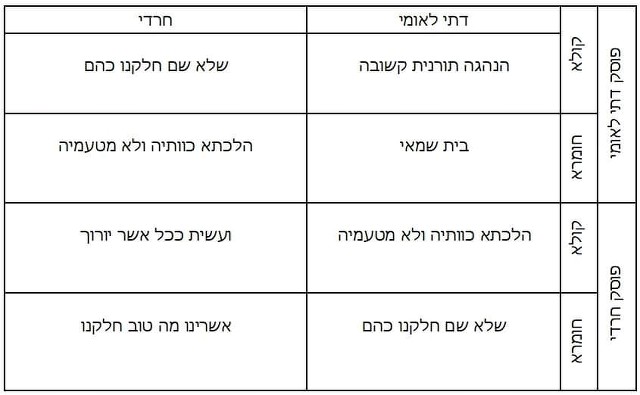
Hello,
I came across an article about a letter written by Rabbi Moshe Goldstein here:
https://www.bhol.co.il/news/1091032
And in it there is discussion of Passover in light of the coronavirus crisis (especially section b there). Under which category appearing in the post do these remarks fall?
Be healthy,
Yehuda
Quite bizarre and rather foolish. It seems to me that for most people making Passover improperly, even without the excessive stringencies, is a greater sorrow than the cleaning. Beyond his attitude to the media, which is of course foolish.
Our dear Rabbi Michi, hello,
Where can one read your full opinion regarding your agreement with the Hazon Ish’s prohibition of electricity as “building” on Shabbat?
https://soundcloud.com/mikyabchannel/mu38nc3axt6f
That is the Oral Torah
The rabbi wrote that one should not forbid riding bicycles, as some did, because of the concern that if they break they will require repair. Does the rabbi write this because in his opinion riding a bicycle is not forbidden as a weekday activity, or did the rabbi bring it only as an example of the view of those who decreed the prohibition out of that concern?
(In this it differs from the prohibition of carrying because of concern about opening an umbrella, for with bicycles (at least according to some decisors) besides the concern of repair there is also a prohibition on riding.)
I would note that if the rabbi agrees that riding a bicycle is weekday activity, then presenting matters in the body of the column as though riding was forbidden only because of the concern of repairing the bicycle may mislead readers who agree that no new decrees should be made but do not know there is another reason for the prohibition. (Perhaps this is a concern of damage that permits correcting a post. 🙂 )
Indeed correct. Although the prohibition of weekday activity is also very problematic in my view. I believe I wrote about that here in the past. In any event, I added footnote 3.
Why don’t you celebrate reforms built on Rabbenu Gershom, who came after the sealing of the Talmud?
By the way, why are you fixated on the Chamber of Hewn Stone as if every concern about a prohibition was legislated there, and every statement of the sort “and this matter one must not say before an ignoramus” was issued by Yavneh and its sages?
If you read the Rambam there, then you surely saw that the only practical difference is regarding the repeal of things depending on whether they were enacted after or before the Talmud; but it is obvious that every generation is obligated to stand guard and enact the needed enactments.
As for holy lies, I won’t enter the argument, especially since in your view you are an individual against Hazal and the Rishonim, who were in favor of it at least in your view, where the concept is so broad—before you have proven in practice a reason to oppose it.
But why are these lies? It is forbidden because of a stumbling block—is that a lie? Is saying it is better not to permit also a lie?
I didn’t understand. That is a ban, not a prohibition. The prohibition can be revoked, aside from the laws of customs (that spread throughout all Israel).
I explained the rest in the column and do not see any question here. Whether my opinion is solitary or not—one can discuss that (hint: absolutely not). I prefer to discuss whether it is correct, not whether it is the majority view.
Anything that is not forbidden, and is presented as forbidden, is a lie. And in certain circumstances there is also an issue of adding to the Torah (when the matter is not clarified and it is presented as a prohibition required by law). What is unclear here?
The conception you raise here is not historically and factually correct. Over the generations many decrees and enactments were added that were not established by the sages of the Sanhedrin nor by the sages of the Talmud—for example the decree regarding legumes, and many others, like the ban of Rabbenu Gershom. And also in smaller matters more generally, this dichotomous conception of “only what falls under the halakhic category of ‘You shall not deviate’ has force” is an unrealistic conception that uproots all the authority of the Geonim and the Rishonim and the Aharonim, and essentially the entire conception of the chain of generations through which the Torah is transmitted. As for the argument itself, it is obvious that the authority of the sages of Israel to establish decrees today is not on the same level of authority as that of the Sanhedrin, and it does not seem to me that anyone thinks so. But the level of obligation for an ordinary person from the masses is understood by any reasonable person and does not require a source in Hazal, because it is simply logical. Otherwise the Torah simply would not have developed as it did, and the will of God would not have been properly fulfilled. Of course, for a person who is wise and understands on his own and knows how to engage in halakhic give-and-take, today’s decisors do not have that level of authority to bind him; and indeed even the Rishonim and Aharonim do not have the same authority as the sages of the Gemara. But every period has a different kind of authority according to logic and according to how things were ultimately accepted in practice, and the level of obligation depends on each person according to his Torah stature and his standing among the people. This has no clear definition, but certainly the argument you are making would also uproot all obligation to the Amoraim, the Geonim, and likewise the Rishonim at any level whatsoever, and there is in this an uprooting of the Torah.
Since this conception is normative, not historical and not factual, the argument is irrelevant. In my opinion no prohibition was added in later generations, and regarding legumes in particular I already wrote sharply about it at the beginning of the site’s days. The fact that this mistake is widespread does not make it true.
I started reading, and I did not have the strength to continue because of the length.
I will try to comment and illuminate lovingly, with a few small remarks that occurred to me.
Regarding length, the Gemara at the beginning of Pesachim says, “A person should always teach his student in a concise way.”
[And although there is an opinion that clarity is preferable, the Rambam wrote:
“If we could have written the entire commentary on the Mishnah in one word, we would not have written it in two words.”
And in my humble opinion too, concise and somewhat clear is preferable to very clear but long and wearisome.]
As for permitting rabbinic prohibitions in order to prevent people from violating a Torah prohibition:
Perhaps the Sages permitted their own prohibitions in various situations of pressure and great need, and the like.
But together with the Gemara in Kiddushin, which you brought as proof, see also to take into account the Gemara in Shabbat:
“One does not say to a person: sin so that your fellow may benefit.”
They did not permit removing bread from the oven on Shabbat—a rabbinic prohibition—in order to save one’s fellow from a Torah prohibition.
And so later authorities discussed back and forth whether it is permitted to direct a person who is driving on Shabbat,
or whether that involves the rabbinic prohibition of “assisting transgressors,”
which is not permitted in order to help him reduce a Torah prohibition as above.
[And in my opinion and feeling, this is forbidden, and it is preferable to say to him pleasantly, “Shabbat shalom, my brother,” and the like.]
Regarding the approach that withholds from the public all the secrets of halakhic decision-making and the like, which you oppose:
You should know that many Rishonim and Aharonim held that there is a real need for it.
See for example Rambam, Yesodei HaTorah end of chapter 2, concerning the Account of Creation and the Account of the Chariot.
And as you brought, so it is also in halakhah, where people sometimes say, “It is the halakhah, but not for practical ruling,”
[as for example, so I heard, regarding eating חמץ on Shabbat when the seventh day of Passover falls on Saturday night.]
Or “It is the halakhah, but we do not instruct so” [as for example in matters of zealotry].
Because from the standpoint of leadership, sometimes one must instruct differently than the dry law.
And in Proverbs it says, “A talebearer reveals secrets,” etc.
Go and see what people permit themselves when they discover that there is an opinion that relations with an unmarried woman who immerses is only rabbinically forbidden.
And we become truly “scoundrels with the Torah’s permission,” Heaven forbid, may God save us, as the Ramban writes about the warning “You shall be holy.”
Therefore one must know that the Torah also carries with it a general spirit, which sometimes must be taken into account against the dry law.
And for example, there was once a case where they wanted to use the law of “he annulled them for us” to annul the kiddushin retroactively, by means of sending a get and canceling it,
in order to permit mamzerim. And seemingly this is a wonderful solution, but in the end they refused to use it, because it goes against the spirit of the Torah,
because if the Torah said there should be mamzerim, it is so that we understand that there are consequences to our actions,
and if we create the feeling that there are no consequences, where is the spirit of the Torah in that?
So think what can happen if such secrets fall into the hands of compassionate women.
And about this Hazal said, “Let words of Torah be burned rather than handed over to women, for they turn words of Torah into trivialities.”
[It is known that women’s minds are (more) light, for better and for worse, and also men whose minds are (more) heavy are also for better and for worse.]
Likewise, one must beware of ruling alone without discussion with the other decisors, for that is how the Sanhedrin operated—in deliberation.
And one who arrogantly ruled against them was a rebellious elder, who rules against what is accepted in Israel.
[And I am not saying that this is the situation now, or even anything like it, for many reasons I will not detail here.
But one should also know that all the authority of a decisor comes from the fact that there is a public in Israel that accepts his rulings.]
And also in matters of faith. One must beware of denying the accepted foundations of faith, for although Leibowitz liked to cite the Rambam,
who in three places in his commentary on the Mishnah said that in disputes in matters of faith one should not say the halakhah follows so-and-so,
still, the Rambam himself established 13 principles and ruled in the laws of repentance who falls under the category of heretic and unbeliever, etc.
And all this in matters agreed upon by the overwhelming majority of the faithful of Israel throughout the generations, as a tradition from Sinai.
Likewise one must beware with the power of wisdom lest it turn against him.
It was already said that there are “wise men to do evil, but to do good they have no knowledge”—those sort of clever fellows.
Like Jonadab son of Shimeah, Amnon’s friend, who gave him advice
[and perhaps also found him some cleverly reasoned halakhic permission] on how to rape his sister.
And they also say that the sin of the Tree of Knowledge was because the Tree of Life did not precede it.
And they say in the Zohar that matzah is the bread of faith, and the manna is the bread of wisdom [a bit odd].
And one must place faith before wisdom, so that we also know that wisdom is limited, etc.
And that it too is not from our own power, but from Him who grants knowledge to man: “For the Lord gives wisdom; from His mouth come knowledge and understanding,” etc.
[And I am not saying, Heaven forbid, that Rabbi Amsalem’s words or your words
are certainly guilty of any of the above,
but that in my understanding, certainly everyone (including the writer of these lines),
must constantly examine all his words in light of the above parameters as well.
And therefore one must be “one who speaks truth in his heart,”
and if a person sees that he is on a path that deviates from the Tree of Life, he should straighten his paths.
And the main thing is that one should direct himself to the question: what does God want in the Torah?
And not: what do I want to say, and how can I find support for it?
In conclusion, it seems that I sinned in what I opened with, and indeed “one who disqualifies, disqualifies with his own blemish,” and may God grant us to explain briefly and to abbreviate in explanation.
Hello.
First, know that I deleted the copy of this comment that you pasted elsewhere. There was no need for that.
Second, it really is strange to see a comment like this opening with a demand for brevity. It seems to me that not only is there an internal contradiction here, but in this itself lies the answer to your demand. Sometimes clarity of explanation requires length. Therefore the recommendation you cited from the Rambam is empty of content. He writes that if he could explain in one word he would not do it in two. The question is always whether one really can explain it (well) in one word. I think in his own writings you will find very great length in many places, but this is not the place. In any event, I adopt the approach of the clear path even if less concise (that dispute in Pesachim too is empty in the same sense).
Third, I am glad to see your response, in which you testify about yourself that you are a young yeshiva student. The youth shows between the lines (but it is a passing blemish, as Rabbi Maimon once said), and I appreciate it and wish you greatness yet to come.
And finally, I no longer remember the details of what I wrote, so I will answer off the cuff:
1. Even without remembering, it is quite clear that I did not write that one should permit a rabbinic prohibition in order to prevent a Torah prohibition. On the contrary, I have written more than once against that approach, which does things for side reasons and not substantive ones. Perhaps my length did not help the clarity of the explanation…
2. Esotericism in halakhah is an old and well-known matter. I expressed my opinion, especially for our times. Therefore precedents from the Rishonim and Aharonim neither add nor detract. I have explained this more than once here on the site. By the way, it is interesting—how did you hear about the contrary examples if “we do not instruct so”? And how is it that the Gemara and the Rambam explicitly write laws that “we do not instruct”?
3. As for the consequences of revealing the halakhah—go and see what the consequences of esotericism are: people who discover what was hidden from them abandon everything and lose trust in decisors. So if we are talking about consequences, in most cases the result of concealment is far more severe in my opinion. Besides, nowadays it is impossible to conceal, and this whole discussion is an anachronism. The example of canceling agency in a bill of divorce is nonsense, pardon me. It is unrelated to the discussion in any way. There the question is about the basic law, not whether to reveal it or not. By the way, it is an explicit Tosafot and not “a one-time case.”
4. Regarding the contradiction in the Rambam about ruling in matters of faith, there is an article by Henshke. In any event, there cannot be authoritative rulings in matters of thought and faith, and I have explained this well in several places. It is unrelated to the Rambam and to the contradiction in his words. Even if he said otherwise, it would still be true.
5. Indeed, one must beware in using wisdom, and no less so stupidity. About this I have written more than once that I am very fond of the dubious saying that it is better to suffer from baseless love than from baseless hatred. And even dearer to me is the addition: better to suffer from neither.
6. Just a note. You wrote that one should make sure to seek what the Holy One wants and not what I think, and to look for supports. I agree in principle, but this is again an almost empty recommendation. The Holy One wants what is proper and logical (unless proven otherwise). Therefore for both goals one has to seek what is proper and logical. Rabbi Joseph B. Soloveitchik once wrote (in my opinion by way of exaggeration) that there is no halakhic ruling by any decisor that was written without his knowing the answer in advance and only then looking for supports. This reminds me of the empty dilemma whether it is better to force the language or the logic.
6. Regarding the saying in the name of Rabbi Soloveitchik, proof that it is by way of exaggeration is that decisors did change their minds even on specific halakhic matters. Contradictions in their words also seemingly indicate that they did not come with a predetermined opinion, because with a preconceived but not explicitly reasoned view (rather based on an intuition that formed on its own over time), when it comes to relatively specific issues, it is usually rarer to retract or change, because there is no external pressure.
I wrote that it was by way of exaggeration, but if you want a legal answer, here it is: intuitions too can change.
I read it.
Thank you for the answers [may we merit fruitful discussion].
Sorry for the copy that was out of place [I thought you wouldn’t see it from two years ago].
I will say simply and innocently:
If it is a dispute for the sake of Heaven, then in the end it will endure.
And if not, etc.…
Success in everything!
[email protected]
Good and enlightened morning to Rabbi Michael,
You mix faith and science together on the spot!?
Leibowitz completely separates faith from science and claims:
that faith and science are two parallel lines that will never meet!
What is your opinion?
Likewise, you mix conclusions and value-decisions!
Leibowitz argues that conclusions go from the physical world to me, whereas decisions go from me to the world—that is, for any value-decision I sacrifice something of myself!
I would be glad for your response.
Meir
Thank you
These are far too general questions. Present one argument of mine or his, and we will discuss it.
Good evening,
Leibowitz argues that water boils at 100 degrees Celsius, and that is a scientific conclusion from the realm of science, meaning exact science!
By contrast, a judge in court decides in a divorce case to award custody of children to the mother because her family is of a higher cultural level than the father’s, and another judge may decide the opposite in favor of the father because his family is of a better economic level!
The first case is a precise scientific conclusion!
The second case is a decision that has no rationality!
And this connects for me with the Guide for the Perplexed: the difference between good and evil, and true and false—that is, if I say that this car is beautiful and my friend says it is ugly, both of us are right!
But if I claim the car is electric and my friend claims it is a regular gasoline car, it can be checked
to see who is speaking truth and who falsehood!
Therefore Leibowitz completely separates between conclusions and decisions, and he places all Judaism and religious matters within a person’s decision to accept upon himself the yoke of the kingdom of Heaven and Torah and mitzvot; and he will never connect that to scientific conclusions, certainly not conclusions from exact science!
The separation is absolute, unless we are speaking of the humanities—interesting academic fields like economics, political science, psychology, which can be interpreted in different directions according to different approaches…..
Therefore, in matters of decision, a person sacrifices something of himself for a value he believes in, no matter what the value is!
And in the exact sciences the matter is imposed on him, like the distance between the earth and the sun, etc.
What is your opinion?
Meir
This is not a difference between conclusions and decisions, but between facts and norms, or between ought and is, from the school of Hume and Kant (the naturalistic fallacy). This is not an innovation of Leibowitz, and anyone who says otherwise is simply confused.
You began by saying it seemed to you that I disagree with this? Where did you see that gem in my writings?
After every post of yours on whatever matter, it seems that you hit exactly on Leibowitz’s words, and in the end, with all the mixture of science and faith, you completely separate between conclusions and decisions,
between faith and science!
So they really are two parallel lines that will never meet!
Thank you for the timely post!
You wrote that in order to prohibit an act rabbinically because of the concern “lest one stumble into another prohibition,” authority is required.
You surely know סימן א’ in Divrei Sofrim within Kovetz Shiurim, and I’ll quote a small part of his essay:
Kovetz Shiurim, pamphlet Divrei Sofrim, סימן א
21) And this will explain an obscure matter: we find decrees of the Sages even before the giving of the Torah, for a gentile who has relations with a daughter of Israel was prohibited by the decree of the court of Shem, in the episode of Judah and Tamar. On what basis were they then obligated to obey the words of the Sages? Before the giving of the Torah they were commanded only in the seven Noahide laws, circumcision, and the sciatic nerve, and this commandment—to uphold the words of the Sages—is not among them. Likewise it is difficult regarding the fact that our teacher Moses added one day of his own דעת, which is rabbinic as above; for that too was before the giving of the Torah, so on what basis were they then obligated to obey his words?
And likewise according to those who hold that the rabbinic obligation upon a minor who has reached the age of education falls on the minor himself, and not like Rashi [Berakhot 48], who says that the obligation is only upon his father—since a minor is not at all personally obligated in commandments by Torah law, it follows that this commandment too, to obey the words of the Sages, is not binding on the minor.
22) However, according to what was explained above, it comes out well: everything the Sages commanded us, we know that this too is the will of God. And this matter—doing His blessed will—all inhabitants of the world stand commanded in from the beginning of their creation, for all beings were created to do the will of their Maker, and “The Lord has made everything for His own purpose.” The reason a minor is exempt from all commandments is because that is God’s will, to exempt him. But once the Sages decreed something upon him, and we know that their judgment accorded with the will of the Omnipresent, blessed be He, it follows that he is obligated to act according to their words, for that is His blessed will.
How would you explain the sources he brought up—say, the second example, the rabbinic obligation upon a minor to keep commandments? After all, you hold that in order to prohibit something rabbinically, authority is needed, and it is not enough that there be a substantive reason?