

On Critical Thinking in Light of the Coronavirus Crisis (Column 290)
Why corona sharpened the column’s fight against false reverence for tradition
The column opens with the claim that as religious Jews we are educated to trust what we have received, while criticism is treated as almost synonymous with heresy. Lip service is paid to questions and disagreements, but in practice accepted positions enjoy almost total immunity, and even when they are challenged the burden of proof always falls on the dissenter and his evidence is never enough. The corona events sharpened, in the rabbi’s view, why his supposedly destructive critical stance is not an intellectual hobby but an urgent necessity.
The Haredi conduct was not only a fringe problem but a failure of the mainstream
The rabbi acknowledges that the Haredi public has real constraints of crowding, poverty, media isolation, and poor understanding of the situation, and he also notes that the public condemnation of it is often accompanied by a lack of empathy. Still, in his view none of this begins to justify what happened: the initial instruction by Rabbis Kanievsky and Edelstein not to close educational institutions, the delay in reversing it, the violations, the riots, and the chaos in Bnei Brak. He rejects the apologetics that this was only a small extremist fringe: the supposedly sane mainstream Lithuanian stream also acted here beneath all criticism. The result was not only illness and pressure on the system, but also a severe desecration of God’s name in Israel and abroad. Within the Haredi world itself he sees only early signs of soul-searching, but almost no public examination of the roots of the problem, even though he thinks such a crisis may yet produce a beneficial break.
The main problem is the way decisions were made, not only the practical mistake
For this column, it is not enough to say that the rabbis made one mistake and then corrected it. Both the instruction to keep things open and the later turn to hysterical directives were made with the same recklessness: without sufficient understanding of epidemiology, without an orderly process, and without recognition that such decisions create heavy responsibility also toward people outside the community. The real question, then, is how an entire public continues to see such figures as supreme authority even after the failure was exposed for all to see, and who bears responsibility for the dead, the infected, the load on hospitals, and the desecration of God’s name.
This is not only a solidarity problem but a mix of stupidity, ideology, and at times malice
Against the background of Manny Mautner’s article, the rabbi distinguishes between different diagnoses: in Meah Shearim he sees more malice and defiance, in the mainstream more stupidity and disconnection, and in the Jerusalem Faction a combination of the two. Even so, he stresses that stupidity on this scale does not exempt one from moral responsibility. He also explains why Haredi apologetics outwardly are not credible in his eyes: not because every spokesman lies deliberately, but because there is a deep norm there of protecting the group and hiding the dirty laundry.
Roots of the failure: disconnection from the world, cultivated ignorance, and Da’at Torah without competence
The column lists a series of structural conditions that enabled the disaster: poverty and large families, lack of accessible communication, lack of basic education, failure to understand mathematics and exponential processes, and obedience to a scholarly leadership that has no tools for making decisions outside its narrow domain. In the secular world, even leaders who are not experts rely on experts; in the Haredi world, by contrast, the very thought of establishing a professional advisory body for rabbis seems almost foreign. To all this is added the theology of hishtadlut, which blurs practical causality and encourages the feeling that our actions do not really carry a price.
Religious dogmas become dangerous when read literally
From here the rabbi broadens the discussion to a series of traditional claims such as Torah protects and saves, agents of a mitzvah are not harmed, everything is in God’s hands, everything is in the Torah, and Israel as an essentially chosen people. In his view, when these are treated as straightforward descriptions of reality they collapse מול life; therefore either they are mistaken conjectures or homiletic-educational statements meant to encourage desired behavior. He himself objects even to such holy lies, but thinks this is still a more plausible reading than a literal one. The problem begins when sermons are turned into principles of faith and then used for practical decisions, as happened in the corona crisis.
The apologetic trick is to empty the claims of content so they cannot be refuted
The rabbi describes a fixed mechanism: every time reality contradicts a traditional thesis, qualifications, excuses, and epicycles are added until it becomes immune to refutation precisely because it no longer says anything clear about the world. He stresses that not every non-falsifiable claim is invalid in his eyes; belief in God is also not scientific in that sense, but he believes there are good arguments for it. By contrast, a claim that has no independent basis and in practice appears false does not deserve protection merely because it bears the stamp of tradition.
The practical lesson of the WhatsApp exchange: personal responsibility before automatic obedience
The anger that produced the column was sharpened in a discussion about prayer in a minyan and the reverence shown to Rabbi Kanievsky’s rulings. From there the rabbi formulates a threefold correction: it is proper to listen to rabbis as wise people, but their instruction is not binding in every matter; one must choose whom to ask according to the field, not according to headlines and public relations; and there is an obligation to draw lessons and apply criticism even toward great figures. One participant in the discussion formulated this as a move from protective dependence to personal responsibility for one’s life, and the rabbi adopts that insight.
The criticism also turns inward: not only the Haredim, and not only the leadership
Alongside the harsh attack, the column qualifies its claim: he does not blame only powerless individuals, but he is also not willing to absolve them entirely, because society is the sum of its citizens. Beyond that, the criticism is not aimed only at the Haredim; the broader religious public also at times clings to similar dogmas and continues to grant reality-based authority to disconnected rabbis. The rabbi is willing to hear a Talmudic lecture from them, but not to ask them for a ruling on a question that depends on understanding reality, such as corona or Zoom leniencies. The conclusion is that the criticism he proposes is not an attack on religion but a necessary service to religious society, before more people are forced to choose between denial and departure.
With God’s help
Yesterday or the day before, I was asked whether the radicalization of my views is the result of pure analysis or of bias (hidden?). I answered that I cannot say for certain, but I hope and try to be as clean as possible, and beyond that The Torah was not given to ministering angels. In recent days, in light of the coronavirus events, a point has become sharper for me regarding the importance of creating the radical counter-position and publishing it in public, and from that emerged a short WhatsApp thread that fathered this painful, long, angry, and unedited column.
The attitude toward tradition: on critical thinking
As Jews, we are educated to trust what we were taught. Tradition appears to us as something exalted, and in large measure our lives are determined by it. It is an inseparable part of being religious. A critical perspective is almost synonymous with heresy ("biblical criticism," "Talmud criticism," and perhaps also "theory and criticism"?). Of course, people always pay lip service to the god of critical thinking; it is very important to ask questions (provided they end with a question mark and not an exclamation mark. Not questions that are really answers), and there are countless disputes in Jewish law and These and those, and we practically invented all this, and so on and so forth. But at the end of the day, none of this is really true. Tradition stands above all criticism, and there is no possibility of disagreeing with accepted and agreed-upon things (at most, if you found a position already written somewhere—in other words, someone in the fifteenth century already did the work for you and took the yelling; and even then you have no immunity). Even against my radical positions, the conclusive claim is always raised that tradition says otherwise (see, for one example among many, Column 284), where the stringent reject my claims out of hand on that basis, and the lenient merely place the burden of proof on me (and of course accept no proof, however good, as admissible).
What raised this issue for me was the conduct of the Haredi public during the coronavirus days. These are truly hysterical events, which clearly demonstrate just how costly adherence to tradition without critical reflection can be. I think that in the discussion here you can also find an explanation of the importance of the "destructive" critical perspective that I present again and again, and of how necessary it is.
Introduction: on the Haredim and the coronavirus
The subject of Haredi conduct during these coronavirus days has already been chewed over and beaten to death, but it does not cease to infuriate. The press and the internet are full of condemnation and loathing toward this population (much more than usual), loathing accompanied by total lack of understanding and total lack of empathy. But this also appears in groups that usually did not speak of the Haredim this way, and in fact among them themselves as well. Everyone understands that the Haredi public faces difficult constraints: large families in small homes. Harsh economic conditions. A lack of available means of communication (internet, radio, television, smartphone), not to mention legitimate tools and means of entertainment (in their eyes). Because of the lack of exposure to the media, there is also little awareness of the general situation, and probably also little ability to relate critically to what is published (rumors are treated as Torah from Sinai). As a result, in recent days I have seen truly hysterical reactions online coming from Haredi sources. They express feelings of a terrible plague and of people dying of hunger. Including, of course, condemnation of the authorities, but also of the Haredi leadership itself.
All these well-known constraints do not even begin to justify the horror taking place these days in Haredi districts. The greatest lovers of the Haredim, and astonishingly moderate people, are expressing themselves in the sharpest possible ways toward them. I think that a desecration of God’s name like the one we have here has not existed in Israel since the state was founded. The matter has also reached the foreign press (there, too, there are severe problems in Haredi concentrations, mainly in the U.S. and London). The Haredim—and through them Jewish faith and those who bear its banner, the rabbinic leadership, in general—are being presented to the world as an empty vessel.
What is really happening there? First, the well-known spirit-guided ruling of Rabbis Kanievsky and Edelstein, the "Prince of Torah" and the "Rosh Yeshiva," from whom, as everyone knows, whoever takes counsel does not fail—not to close the various study institutions, contrary to the official directives. Beyond that, there are the riots of the intellectuals in Mea Shearim and in the Jerusalem Faction, who throw stones and keep the army and police busy these days with an intifada of their own. The Haredi ideology and bubble appear here in full force. Their price is now being exacted in cash, and if there were not sane people around to save them from themselves, as always, there would not remain much of the enemies of Israel—literally. There is now already some awakening, and Rabbi Kanievsky has changed his tune. Now it is apparently already worthwhile to shoot anyone who goes outside, because he has the status of a pursuer. I assume this awakening came after profound study of the situation, together with some of the fundamentals of epidemiology, and an understanding of how such large-scale processes operate. In his great wisdom, you can see how he managed to learn all this in ten seconds, from the moment his grandson came and asked until he issued the instruction to keep the institutions open. The tuition for that lesson is still being paid by the residents of Bnei Brak and by all of us, and will probably continue to be paid for a long time. True, they fully deserve it—but what did we do wrong? Why should we have to be infected and die, and along with that also bear all the costs on our shoulders? The Chinese are organizing shipments of masks and equipment to Israel, both from the founder of Alibaba and from Itzik and Yael the Chinese (for those unfamiliar with this heartwarming phenomenon, it is worth following), but Bnei Brak is not on the map. It is on Mars and takes no part in the general effort. On the contrary: everything is done for it, but all of us basically owe them our very existence. In their childish condescension, everyone is supposed to understand that the world exists because of them and rests on their shoulders.
As a result of this reckless and infantile conduct, we are being informed in recent days that in Bnei Brak, the city of Torah, charity, and piety, they have completely lost control of events. I am now seeing hysterical messages from Haredi internet users speaking of people dying of hunger, a terrible plague, loss of control and absence of leadership, great fear, and utter despair. I think these descriptions are not proportionate even to the situation in Bnei Brak, and perhaps some of them are trolling, but they certainly indicate the feeling that has been created there, and it is only to be expected in my view. It is no wonder that the evil Zionist army is mobilizing to distribute food to homes in Bnei Brak (and also to enforce the directives), apparently in order to lead everyone away from religion and conviction. The infection rate in Bnei Brak is, as is well known, enormous—because of the density, the failure to observe the directives and to understand them and the situation, and of course also the contradictory instructions of the Haredi leadership. It is no wonder that the wicked Zionist government is renting places to isolate people from Bnei Brak who require quarantine (all in order to lead them away from religion, etc.), and more. We have now been informed that the municipality there has enlisted Major General (res.) Roni Numa—he and not an angel, not a seraph; not a rosh yeshiva, not a political fixer, not a spiritual supervisor—to help and coordinate the desperate efforts to do something about the chaos created there.
How wonderful that Torah protects and saves, and that nothing will happen in Bnei Brak (at least not to those who donated to Kuppat Ha’ir, did not enlist in the army of destruction, and went around with X-denier stockings—fill in the blank), and of course all this happens solely thanks to the Torah and its pure students, and thanks to our holy rabbis and the meticulous obedience to their directives, given with their crystal-clear eyes. One cannot help but recall Yigal Allon, who said that Safed in the War of Independence was saved by deed and by miracle. The deed was that the elders of Safed tore open the gates of heaven with their prayers, and the miracle was that a Palmach unit arrived in time and did the job. I assume that afterward it got stones and cries of "Nazis, Nazis" from the locals, and rightly so. It is presumed that whatever they did, they did only for themselves.
The picture being formed in the world—literally, not only in Israel—is horrific. A desecration of God’s name without equal. People in Israel and around the world are really exploding at the sound and sight of these things. The rage is terrible, and if we were in nineteenth-century Russia or Ukraine, I think massacres and pogroms would have broken out here. Suddenly I begin to understand how that happened then (and not entirely to understand why it is not happening today). The world sees before its eyes a herd of willingly and deliberately infantile fools, devoid of understanding and devoid of solidarity, and at the same time swollen with self-importance and lacking any capacity for self-criticism. A collection of small, irresponsible children who toss around slogans they themselves do not really believe and certainly do not live by (until the moment of truth arrives and it becomes clear what they really believe in). No wonder people feel that this society is stuck somewhere in the prehistoric age, and the main problem is that they themselves have made an ideology of it.
One must understand that in the age of global communication everything is filmed and everything is known. People feel that there is here a wicked, stupid, and ungrateful population, despite the unimaginable consideration and help of general society toward these phenomena. So it is hard for me to say that they are making too great a mistake. The things sound almost antisemitic (except for the fact that they are entirely justified), but it seems to me that one viral image is worth a thousand words:

It seems to me that here too the internet humor serves as a catharsis that prevents violence.
The Haredi defenders tell us, of course, that this behavior belongs to only a small minority. Most of them observe the directives and behave properly. This is nonsense. True, there are small crazed minorities that run wild, but I am not speaking about them; I am speaking about the "sane" Lithuanian mainstream, like the sect led by Rabbi Chaim Kanievsky. Their behavior too is beneath all criticism, and among them as well there was a serious deviation from the directives for most of the time. These days everyone is very enthusiastic about the return to the straight path and about the strict instructions not to pray with a quorum, to close haderim, kollels, and yeshivot, and the like, and to obey the directives of the wicked Zionists, who in the Haredi press have been transformed from antagonistic expressions like "the authorities" into more neutral descriptions like "the doctors" or "the Ministry of Health." As remembered, following the deep and balanced judgment of the rabbis, today those who violate the directives—the righteous and self-sacrificing heroes of yesterday—already fall under the law of a pursuer. But the return to these hysterical directives is no less problematic than the previous directives that flatly contradicted them. The problem lies both in the hysterical and unbalanced content, and in the way the decisions were made in both directions.
The problem that arises here is not only the content of the instructions. One can debate whether it is right to impose a lockdown or not. The question is how those earlier directives were adopted. And how was the retreat from them made? What was the mode of decision-making? On the basis of what information and what considerations were they adopted? Did those rabbis, who took for themselves the authority to decide for the public as a whole (not only the Haredi public), take into account that they owe duties to others as well (see Column 284)? How is it possible that the masses obey such foolish directives, adopted in such an irresponsible and childish way, and continue to see them as exalted rabbis whom one must obey in all matters, light and severe alike?
I ask: who will be held accountable for all those who will die (and have already died) because of the delay of those weeks during which many became infected—Haredim and non-Haredim—who continue and will continue to infect others at an exponential rate (of course they do not know what that is)? What about the indirect damages of the hysteria that is being created there? And what about the burden on the hospitals (the failure to flatten the curve) that was and will be caused as a result of this scandalous conduct? Who will answer for reckless decisions in matters of life and death, made with unbearable ease, out of a stupid worldview and with disastrous stupidity? And who will answer for the terrible desecration of God’s name (and this time, justified) that has been created here because of it? Who will answer for the miserable people shut in frightened inside crowded homes without communication in Bnei Brak?
But what amazes me most is that the striking of the breast in confession is not so widespread within the Haredi world itself. There are some beginnings, but self-examination of the roots of their worldview and way of life is hardly taking place at all (though in my estimation there is a decent chance of a welcome rupture in that world following these events, once things calm down a bit). It certainly is not happening in a public and organized way. The mantras about the "Prince of Torah" and according to all that they instruct you continue to be proclaimed in the streets of the city with the same infantile pathos as in previous years. No wonder that on the margins of the road the human savages of Mea Shearim and the Jerusalem Faction continue their rampage (though in the Jerusalem Faction some moderation is noticeable. Apparently even for the extremity of madness and stupidity found there, there are certain limits).
Again and again I am astonished by the phenomenon of how a rational society in the twenty-first century, many of whose members are fine scholars with impressive analytical talent and both feet on the ground, obeys two disconnected figures like Rabbis Kanievsky and Edelstein, when it has been proven before all the world that they do not have the faintest clue, right or left, about the world in which they live. This instead of sending them to repent in exile until the end of their days. These two rabbis are directly responsible, by their own mouths, for the death and illness of people (unintentionally, of course) and for a terrible desecration of God’s name such as there has never been. Are there transgressions in the Torah graver than murder (accidental, but close to deliberate) and a mass desecration of God’s name?
So since these people have never heard of drawing lessons and self-criticism, I will take that role upon myself and do it for them (yes, yes, I am beating on their chests. Spare yourselves the preaching). If this is not what the Sages meant by Where there is a desecration of God’s name, no honor is given to the rabbi, I do not know what they did mean.
The roots of the phenomenon
In recent days I have seen two articles surveying the phenomenon and its roots (and I assume there are and will be several more). One of them, "Standing for Our Lives," from the pen of Rabbi Moshe Yitzhak Farkash in the online journal Tzarikh Iyun, courageously criticizes the phenomenon and its roots from within. The second is by Dr. Shuki Friedman, "How Is the Haredi Public Coping with the Coronavirus?", published by the Israel Democracy Institute.
Whoever manages to read the first article, written with courage and honesty worthy of appreciation, will be able to see that contrary to Haredi apologetics, the phenomenon is very far from marginal. We are dealing with broad layers of the Haredi public of every type and kind. The claims as though this is fringe behavior are typical of the apologetics common there (he himself writes this). In my response to him I was reminded of a joke told about Nixon: what is the indication that Nixon is lying? When he moves his lips. A Haredi spokesman speaking outward should be treated the same way. Everything is presumed false until proven otherwise. This is not wickedness, but a result of an ethos according to which there is a duty to defend the community against the wicked outside, and dirty laundry is washed only indoors (actually, not even there).
The public reaction
As noted, the broader public is appalled by these phenomena. See, for example, in the frame below an article written by Prof. Meni Mautner (I know him; he is an astonishingly moderate person), and you can get a sense of what this behavior produces.
| On the Haredim’s Lack of Solidarity
Meni Mautner, "Haaretz", Tuesday, 2020.3.31
One could not help but be appalled (yes, exactly that) by the television report, which showed how Rabbi Chaim Kanievsky, leader of the Lithuanian stream in the Haredi public, decided not to close the yeshivot at the beginning of the plague. A young attendant approached him and said: "Grandfather, the government has decided that because of the plague the yeshivot need to be closed. Close them?" "No," ruled the 92-year-old rabbi in less than a second. There are many problems with the process by which that fateful (yes, fateful) decision was made. With speed, without weighing or hesitating, out of deep fanaticism embodied in belief in one value alone—Torah study—and in an inability to contain other values and take them into account. But the main problem with this decision is the lack of solidarity toward all the other citizens of the state that it embodies. For because of the Haredim’s reckless behavior, in the end they—who are not properly following the directives of the Ministry of Health—will fill the hospitals en masse and clog them in a way that will prevent treatment for the non-Haredim who obeyed the directives. In this there will be not only lack of solidarity, but also lack of justice. Much has been written in recent decades about the lack of solidarity of the Haredim who do not enlist in the army. That lack of solidarity expresses itself in abstention, in omission. But Haredim who do not observe the instructions of the Ministry of Health and cluster together en masse display an active lack of solidarity, in deed. Their active behavior endangers the lives of many others who are not Haredi—not because of fear of infection, but because of the possible clogging of the hospitals. True, one must always beware of generalizations, and remember that the Haredim, like any human group, are divided into many subgroups, and the great majority of those subgroups obeyed the isolation directives. But one cannot avoid thinking about the reckless way in which the leader of the Lithuanian public, Rabbi Kanievsky, acted, and one also cannot help thinking about those subgroups among the Haredim—even if they are minority groups—which even at this relatively late stage still continue to act in ways that violate the directives. These events must not, of course, harm the continuation of the blessed processes of integrating the Haredim into the institutions of civil society and politics. Those processes began before the plague, and it is important that they continue after it ends as well. And still, when this difficult period reaches its end, we will not be able to avoid asking ourselves once again questions concerning the extent to which the Haredim are part of Israeli society and display responsibility and solidarity toward it. Nor will we be able to avoid comparing Haredi behavior with the behavior of another minority group, which is also in accelerated processes of integration into civil society and politics—the Arab citizens. These are behaving in these difficult days in exactly the opposite way from the Haredim. Many of them, in the hospitals, are showing active solidarity, in deed, and are even risking their lives as they staff the medical and administrative teams. This comparison must also have political consequences regarding each of the two groups. |
When I received the article I wrote in response that, in my opinion, Mautner is making a bitter mistake in his diagnosis. In most cases this is not a matter of lack of solidarity, but of combinations in varying proportions of stupidity and wickedness. The fanatics of Mea Shearim are mainly wicked and lacking in solidarity, but the mainstream (that of Rabbi Kanievsky) are mainly stupid. The Jerusalem Faction, standing in between, are a winning combination of the two. Of course, in each there is something of the stupidity, but schematically this is not a bad description. By the way, stupidity is a general characteristic there, but wickedness, in my estimation, is not found in all of them. And still, there are certain levels of stupidity that one cannot help seeing as an expression of some degree of wickedness. Intelligent people cannot end up in such stupid situations, act and make decisions with such negligence, and in the end not take responsibility for it.
The roots of the problem
This is not the place to enter into all the roots of the problem. But I will nevertheless point to some of them. The Haredi population preserves ideological poverty, an ideological separation from the media (internet, radio, and television) and from the general public. It does not provide its members with even minimal education and minimal understanding of the world, and above all it obeys a leadership that has no qualifications whatsoever to make intelligent decisions in areas beyond the narrowest Talmudic minutiae. That leadership is secluded within the four cubits of Jewish law and scholarship (this is presented as an ideal, of course), and feeds on rumors without the tools to understand their significance. Rabbis Kanievsky and Edelstein cannot understand what flattening the curve is, what exponential growth is, or the mathematical basics of epidemiological processes, and therefore cannot understand the considerations that lead to decisions in circumstances like ours. None of this prevents the Haredi public from seeing in them super-sages who never err and whose instructions must be obeyed by force of Do not deviate, as though this were the Great Sanhedrin. They and their decision-makers do not know mathematics and are not exposed to the news. But none of this is supposed to lead to soul-searching and real change—not in the worldview, which of course all descended from Sinai, and not in the practical conduct whose basis is the doctrine of Da’at Torah of the all-knowing leadership (though in the long term I do think this will contribute something).
In the secular world too not everyone is a great mathematician, but those who make the decisions at least make use of professionals who are supposed to understand the material and make an informed decision. Netanyahu, with all the criticism I have of him, understands mathematics very well, and I am sure that he does not make decisions through a question from his grandson that receives an answer within a second, as described in the video linked above and in Mautner’s article. He relies on professionals, who can of course err, but at least do the best they can within the framework of what is known. There, at least, they fulfill the duty of making an effort.
And since we have already reached that point, add to it the bizarre conception according to which the Holy One, blessed be He, runs everything, and all that is incumbent upon us is the duty of effort (see Column 280 and the comments after it). One must understand that this distorted and self-contradictory conception is not only stupid. The problem is not only on the intellectual plane (and I am the last person to belittle problems on that plane). It brings people to great confusion on the practical plane. The reason is that it simply does not work, and everyone understands that it does not work, but of course the dogma must be defended, since it descended from Sinai (through the Torah loudspeakers mentioned above). This leads people to add epicycles and deferents to the theory (see Column 281), but in the end they allow themselves to behave as though their actions have no consequences. From their point of view, studying Torah and praying with a quorum are the ultimate form of effort, and if that does not prevent the coronavirus, what will?! Therefore, if someone "decrees" that they must not do so, he is certainly a persecutor, is he not?!
On critical thinking
No one there even imagines the possibility of thinking critically about these "fundamentals of faith." The obligation to live in poverty is a sacred obligation (and the state is the one responsible to get them out of it and help them function). The obligation to remain boorish and without minimal education is also sacred (and the state is the one that must provide them with medical services, defense and security, police, psychology, science and technology, and even answers to theological questions where their infantile "worldview" fails). And I have not yet even spoken of the poverty and the large families that do not allow proper isolation, as I described above, and the lack of mathematical understanding that does not allow them to understand the reality around them (see the article I happened to see only today on the matter). And what about the unlimited trust in their incapable leadership? Has anyone entertained the idea—if one is already leaving them in Haredi public leadership—of establishing an orderly advisory body on the basis of relevant professional information in order to assist them in decision-making? It seems that this public is doomed to conduct itself until the end of its days according to the dubious holy spirit of these figures.
The Haredim are of course unwilling to use the internet and "non-kosher" mobile phones, and therefore of course they do not have SMS either, and no possibility of updating themselves on the directives and the news regarding the situation (except through their slanted channels), but those are our problems, of course. Anyone who wants to set a meeting or notify something to a Haredi person knows this very well. He has no minimal means of communication, but all of us are of course supposed to accommodate him (he is not supposed to accommodate you by holding standard means of communication). There are such people even on my site, whose filters do not allow them to browse, and then one has to send them articles and responses by other means. Therefore, if the Ministry of Health wants to update them about directives or notify them that they should be in quarantine because they passed near a confirmed patient, that is its problem and the responsibility is on it.[1]
All this is made possible, among other things, because of excessive respect for tradition and the view of critical thinking as negative. They really are stuck in the tenth century, and are not even aware of it. On the contrary, that is their ideology. No one may shake the dust off the sanctified worldview (which, by the way, is partly a product of the twentieth century). I think that if we do not stop respecting this distorted and infantile conception and place things honestly on the table, we are sinning against general society, but also against Haredi society itself. The main justification for publishing my radical views is that I am tired of this pact of silence and bogus respect for "tradition" and those who bear its banner. Beyond the terrible implications of these conceptions, I encounter intelligent people who suddenly understand that they are living in a movie and were sold nonsense, but they have no possibility of criticizing the system, and of course the system does not criticize itself. The obvious exit is to leave, and indeed this is being done at a growing pace. And all this thanks to our honoring of tradition and the moderate opposition to my "extreme radicalism." These days we see costs in human life and desecration of God’s name, but this exists all the time on a lower flame as well.
At the margins of these matters it is important for me to say that I do not directly blame the private individuals, who ostensibly cannot change the situation. I blame Haredi society as a whole, and especially its leadership, which acts on the basis of disconnected assumptions and primitive ideology without even minimal criticism, and thus gets itself into a ghetto that cannot function (even with all the outside assistance). But at the same time it is also important for me to recall what I explained in several previous columns:[2] in the final analysis, one cannot absolve even the simple citizens of blame. Society is nothing other than the sum of its citizens.
WhatsApp conversation
What aroused in me all the rage that I am unloading on you here, beyond the events of these days themselves, lies in a WhatsApp conversation in which I took part a few days ago. Since it describes my feelings well and gives background to what I wrote here, I bring it (with comments) almost in full.
It all began with an innocent question: is it proper today to pray with a quorum (outside)? Someone there immediately added an emphasis: "Especially since Rabbi Kanievsky now judges a person who belittles the matter as a kind of pursuer." At that point I could no longer restrain myself and wrote: "I think that in recent days it has become clear that Rabbi Kanievsky’s and his colleagues’ words have no importance whatsoever, certainly on these subjects. They are simply fed by rumors" (I tried to choose mild language, compared to my feelings as described here).
Then someone remarked: "Actually, some of them do consult professionals," and linked to this item, containing a letter that Rabbi Gershon Edelstein, one of the leaders of the central faction in the Lithuanian stream, received from the Ministry of Health:
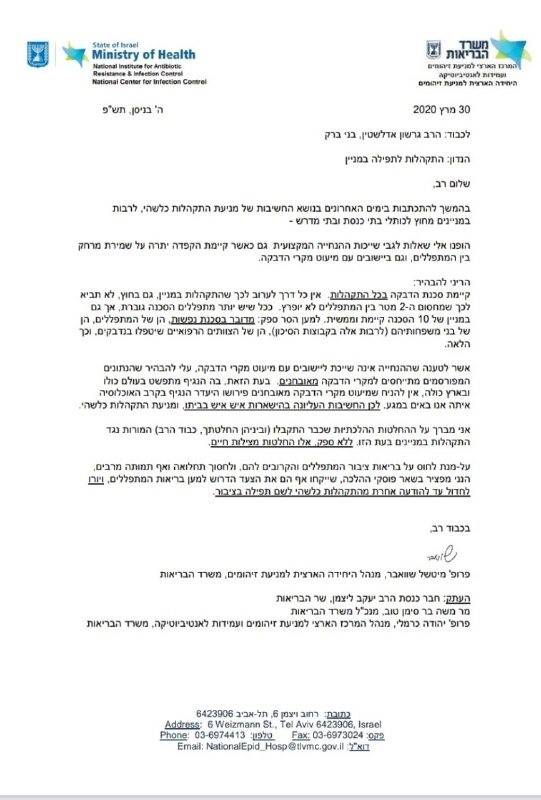
Faced with that "conclusive" claim, I could no longer restrain myself, and wrote at greater length and with less restraint:
This is not called consulting. He received the general directives in a personal letter and repeated them with a rabbinic stamp. Did one need a special letter to know that these were the directives? Is there any specific discussion there beyond the instructions given to all people?
This only points to the cheapness of these rulings. Fine—if he had really entered into the substance of the matter and examined it in depth and then expressed an opinion. He receives a letter of instructions and signs it. Quite a Da’at Torah.
I am sorry for the anger, but they really annoy me. People who do not understand their right hand from their left. They do not have the faintest clue how things operate and how decisions are made (flattening the curve, data from around the world, principles of epidemiology). So at least let them keep their mouths shut. And certainly the herd of fools that follows them blindly with the slogan according to all that they instruct you, when any novice scholar knows that this was not said about such matters. Simply a disgrace.
31.3.2020, 8:09 – Michael Abraham: Especially in light of the terrible desecration of God’s name for which he and his colleagues are themselves responsible. In my opinion, such a person should impose exile on himself and not rule on Jewish law anymore, and certainly not on public conduct. If there were a drop of integrity there, that is what should have happened.
And if that society had advanced to the tenth century at long last, it seems to me that they should have drawn a few deeper and more fundamental conclusions about their entire infantile path...
Then I was asked:
The question is what needs correcting here:
- Does this indicate that the very norm of turning to a rabbi with non-halakhic questions is harmful (note: harmful, not "merely" incorrect/non-obligatory); or:
- that the norm itself is beneficial, except that here a mistake was made because the decisor did not properly examine the data and/or did not rule generally that one must adhere to the directives of the Ministry of Health.
To that I replied:
The mistake is threefold: 1. Turning to rabbis on any subject is a good thing. But one should know that their instruction is not binding. It is always worthwhile to hear an opinion from wise people. 2. One must choose correctly which rabbis one asks, and perhaps this too depends on the subject of the question. Yated Ne’eman does not determine which rabbi is worth asking. 3. It is also important to draw lessons and exercise critical thinking. No one is free of mistakes, but without critical thinking and a willingness to learn lessons, it will simply recur again and again.
Here I will bring a short poem from one of the participants in the discussion, which really did put its finger on the most important lesson from the events of these days, and gave me (without his knowing it) some of the inspiration for this column:
From a poet’s diary:
If there is one good thing that has grown for me out of the coronavirus, it is the loss of confidence in the judgment of great rabbis. Suddenly I began to think about my life out of personal responsibility and not out of reliance on others, however great they may be. True, these thoughts of repentance will probably dissipate with time, but a little is better than none at all. What over time served as a defense mechanism against taking responsibility for life was suddenly shattered. Suddenly the "escape from freedom" (my poet brothers will probably understand the hint ?) returned to appear and I notice how frightening it is to take responsibility for life. And in general, what a protective power there is to the religious experience in which I grew up …
At this point someone inserted the following picture:

And beneath it a cynical note was added:
Confirmed that Torah protects and saves.
To which another response came:
Confirmed that where the danger is definite, no.
[Meaning: why are you blaming the Sages? They are certainly right. They themselves wrote that where danger is present there is no protection. So what is the problem at all?!]
That completely blew my already shaky fuse:
Confirmed that in every situation in which one can test this thesis (that Torah protects and saves, and likewise that Agents engaged in a commandment are not harmed), that is, where danger is common, it does not work. a lion in hiding.
Our situation now is the following:
The Torah protects whenever one does not see and cannot see it.
Prayer helps only when no one is looking.
Tithing makes one rich only when one does not check.
All the other commandments may not be tested (Do not put [the Lord] to the test).
In the sixth year before the Sabbatical year there is blessing, but that was only once, long ago (when the Sabbatical year was of Torah origin).
God’s involvement is everywhere and always (Above every blade of grass there is an angel that tells it: Grow), but only when one does not look.
The great sages of the generation, with their crystal eyes, do not err (the one who takes counsel from the elders does not fail), except when they do.
Israel possesses a special quality, except when one looks and checks. (cf. the Beit Yosef at the beginning of Even HaEzer: Israel are compassionate, modest, and performers of acts of kindness, and one who is not so should have his lineage examined, except when not.)
Israel is not under the stars, except when one checks.
All our occurrences are nothing but miracles, except for the cases that are not.
Everything is in the Torah (for everything is in it. He looked into the Torah…), except for what is not in it, and even what is in it no one has ever seen.
The sages of the Talmud possess divine inspiration, except in the places where they erred.
And so on. Intellectual integrity at its finest…
Then someone added (apparently from the root of Harvona’s soul):
And Blessing rests only on something hidden from the eye; if one checks, the blessing function collapses.
One could add many more such theses from our tradition, every last one of which evades empirical and critical testing. Every such statement comes prepackaged with a perfect set of excuses for why one cannot see its fulfillment. Thus our theory remains perfect and unfalsifiable. And heaven forbid that we should doubt "tradition" (cf. tradition).
So how should one nevertheless relate to these statements?
My point of departure is that the Sages themselves did not know and could not have known all this. So why did they write such statements? First of all, I do not know. I can raise a few hypotheses.
One possibility is that they wrote this from their own reasoning, and at least in our day it has become clear that they were mistaken (perhaps once some of it really was true. But for our purposes what matters is how we ought to conduct ourselves today, not what was in their time). Another possibility, which seems more plausible to me, is that their intention was homiletic and educational. In Column 284 I brought several examples of sermons, and there I raised hypotheses regarding the nature of the aggadic literature of the Sages. Here you have a concrete application. Sages in our own time use such loaded formulations to encourage people to do the right thing. They tell us that the Torah protects, promise us livelihood and success, and also explain to us various events and disasters that occurred because of one sin or another. In order to judge them favorably, I propose seeing all these as educational homilies, whose purpose is to spur us to act rightly. For my own part I strongly oppose such holy lies, but it is hard to deny that various sages do this in every generation down to our own day (see the examples there). If so, in these contexts too one can certainly see these statements not as descriptions of reality but as educational homilies.
Thus, for example, in order to give motivation to study Torah and to undertake a mission of commandment and not hesitate because of difficulties, we are told that it protects us. Though not in a place of where the danger is definite, that is, where there is real danger. For it is forbidden to enter into danger for the sake of a commandment. According to this homiletic approach, it is permissible to tell a few holy lies in order to spur people to do positive things. But when it is dangerous, of course there is no permission to lie. That, to my mind, is certainly a possible interpretation of these baseless statements. But relating to these statements literally leads to phenomena like what we saw in the coronavirus—until we reached a state of where the danger is definite, that is, until we really needed that protection.
Let us take another one. In order to spur us to study Torah and not engage in other things, we are told that everything is contained in the Torah, since it is divine wisdom. He looked into the Torah and created the world (which of course can be interpreted in countless other ways). I already mentioned here in the past that my friends in the Netivot Olam yeshiva in Bnei Brak used to ask me why I went to the university in the afternoon—after all, everything is in the Torah. To that I replied that if so there is no problem, because I am studying Torah at the university. Does location itself create anything? Besides, I told them, if by chance you find in the Torah the solution to Schrödinger’s equation for a rotating square potential well, I would appreciate an update, because that would save me a great deal of time in research and I could stay in the yeshiva studying Bava Kamma. Needless to say, none of them has yet found the desired solution (I, actually, did—through the holy spirit that rested on me at the university). By the way, although they understood that saying literally, I do not think I am taking much of a risk in saying that none of them really believed what he himself said (I do not know many people who use medicines mentioned in the Talmud instead of what modern medicine offers. Well, I forgot, nature has changed).
Further. In order to build our self-confidence, they invented for us the idea that Israel is a chosen people in an essentialist sense. There is a difference of kind between Israel and the other nations and other people. In the second book of the trilogy I argue that in the Torah this does not appear as an essential difference but as a difference in role, but why not use it to give self-confidence. Except that after some time this becomes a principle of Jewish law: Israel are compassionate, descendants of the compassionate, and performers of acts of kindness, and the Beit Yosef at the beginning of Even HaEzer rules that one who is not such should be suspected and his lineage examined. By the way, beyond declarations, I have never in my life heard of a halakhic decisor who ever worried about this (and if you know of such a person, please do not say his name, for that would be slander).
As part of that same matter, the Gentiles are of course wicked in their very essence, and among Israel evil—even if it exists (what are you saying? I have never seen a wicked Jew; after all, that would contradict the Beit Yosef)—is "external" (the devil knows what that means). By the way, factually this probably was even true once, for evil is a factual description and not metaphysics. The Sages describe to us the Gentiles they met, and I have no reason to assume they were lying. But the metaphysical interpretation that sages gave to these phenomena, as though there were here something in essential nature and not a cultural matter, becomes doctrine. Today it is already an article of faith that something in the nature of Gentiles is wicked. Moreover, even when they perform kindness, they are like that pig who stretches out its hooves and says: look, I am pure. Suppose the Sages really thought that this difference was not cultural-social but metaphysical. I still have no reason whatsoever to assume that they could know this. Therefore either they were mistaken, or this too is only an educational homily meant to strengthen our self-confidence.
Want more? One who observes a commandment will know no evil thing. Such statements have a clear purpose. Again—to give self-confidence and strength in the service of God. One should not be ashamed because of those who mock. Do not be afraid of damages that may be caused to you by the service of God. As stated, none of this really works, but instead of saying honestly that perhaps these are mere conjectures, or homiletic-educational statements, we add epicycles and deferents in order to armor these theses and turn them into articles of faith immune to refutation (that is, statements that say nothing).
And what about the thesis of effort? Well, I already spoke about it briefly above. Its goal is entirely clear. True, it is stupid (and almost self-contradictory) and does not hold water. So what? We have a tradition. So the thesis is armored in such a way that it cannot be refuted. Every exceptional event that occurs is explained as the hand of God, and what does not fit this thesis is explained, of course, by saying that the Holy One does not work for us and that we do not understand His ways.
All these are theses that cannot be refuted. Some of them are empty metaphysics with no practical implication (at least not one that stands a test), and some are factual theses emptied of all content and thus remaining immune to refutation. In fact, it would be more accurate to say that most of them are refuted anew every day (at least from the perspective of common sense), but the ultimate excuses that accompany them armor them by burying them under a very thick shell of anti-refutability that cannot be penetrated. They are simply emptied of factual content, and thus they become absolutely true while saying nothing.
I need only sharpen and say that I have no principled problem with claims that cannot be refuted. Not all the world is science. But in my view such a thesis is suspect on its face, and the burden of proof rests on the one who claims it. I am willing to hold such a thesis only so long as there is good reason to hold it. For example, belief in God is a thesis that cannot be refuted, but since in my opinion there are good arguments in its favor, I certainly adopt it warmly. I am even willing to provide answers to various difficulties (such as evil in the world or in Scripture). But that is only because I have good reasons to think it is true. By contrast, claims that have no basis and that in practice seem not to be true and not to work—why should one hold them? Ah yes, I forgot: tradition. The burden of proof is on me (and on reality). Do not confuse me with facts; I have a tradition.
What does this have to do with the coronavirus?
How did I get from the coronavirus to all these disconnected dogmas? Very simply: because the whole matter of the coronavirus is a result of blind and uncritical faith in dogmas that seem to people like tradition from Sinai. True, not all of us are Haredim and not all of us are believers in Rabbis Edelstein and Kanievsky, and perhaps not all of us believe in the dogmas I brought here as examples, and indeed my criticism is not directed at all of us, certainly not equally. I am criticizing conservatism and lack of critical reflection, and especially the feeling that this approach is required by faith and loyalty to it.
Beyond that, one must remember that we too have similar files. We too cling to certain theses by force of tradition even if they do not really stand the test of reality (cf. providence and effort, and more). And in the end, we too continue to relate to these disconnected and bizarre rabbis as great Torah scholars and to ask them Jewish-law questions (even if not public ones). I would certainly be happy to hear from Rabbi Edelstein an erudite lesson in a Talmudic topic. But if I had to determine whether one may pray with a quorum on balconies or via Zoom, or how to conduct oneself in a coronavirus situation, the last people I would ask would be Rabbis Kanievsky and Edelstein. Their understanding of reality is deficient in so many ways that there is no standing at all to an answer they would give me on such a subject, which requires familiarity with a reality utterly foreign to them. I remind you that the WhatsApp thread began with a remark about Rabbi Kanievsky’s opinion regarding prayer with a quorum at this time (and I do not think it was written by a Haredi person). I refer you to the latest comments on the previous column, where the opinion of Haredi rabbis (including Rabbi Kanievsky) was brought concerning Zoom leniencies on Seder night. My trilogy ends with a discussion of who is truly great in Torah. I think that in this matter too we are stuck hundreds of years behind, and the time has come to wake up.
That is it, I have finished pouring it out. Forgive me, everyone, but I had to bring this out into the town square.
An addition summarizing the results, which I added later (mid-May):
https://www.themarker.com/coronavirus/.premium-1.8840658
Deri reveals that 70% of those infected with coronavirus were Haredim!!!
[1] Because of the choice to live in these ways, the Haredi public falls as a burden on general society, but whoever says so is of course an antisemite. You are supposed to pay, die in the army and from coronavirus, and keep quiet. And all this parasitic hanging upon general society is done, of course, without a drop of gratitude for the resources and efforts invested on their behalf, and without acknowledging the sometimes unimaginable consideration that Haredi society receives (such as exemption from military service, perceived as some sort of fundamental right). In return, the Haredim kindly present the secular as wicked and self-interested people who do everything for their own benefit and against the Torah (upon which the entire world stands, and only because of us).
[2] See on this in Column 67, and also in columns 61, 34, 258 ,117, 238, 283 and perhaps others.
Discussion
The sentence "and I really don’t understand how this doesn’t happen today" could inspire people… I recommend deleting it immediately.
Very sharp, it’s just a shame that none of those who need to read this will read it, and even if by chance they do – they won’t respond, and even if they do – they won’t internalize it.
I’ll throw one more spark into this blazing fire:
Five years ago, when I was caring for my good friend before she died of cancer, I was troubled by the cost of a certain medication that isn’t included in the national health basket, and might perhaps have helped her. At the time I spoke with my friend Malka Puterkovsky, who was a member of the ethics committee for the health basket, and for the first time I became closely acquainted with the discretion that committee members must exercise in funding medications. The blanket is too short. When you put one medicine in, you take another out. In doing so, you determine who will live and who will die. At a certain moment a harsh realization pierced me: someone who doesn’t work, and therefore doesn’t pay taxes and help increase the national product per capita, etc. etc., is an active partner in not increasing that blanket. People are used to accusing Haredim of not serving in the army, of not standing under the security stretcher; I accuse them of not carrying the economic stretcher. If the state budget were larger, it would be possible to increase the health and welfare budgets. People who cannot afford life-saving medications would receive them through the funded health basket. It would be easier. And fewer people would die. Is it not fitting to accuse an entire society that behaves this way of violating “Do not stand idly by the blood of your fellow”? A society that sanctifies poverty decrees the fate of its members – and of society as a whole – to illness, suffering, and death as well.
Wicked villain, troubler of Israel, mixed multitude, religion-hater, etc.
Just kidding,
Rabbi, I’m Haredi and I agree with a substantial percentage of what you say here (and with some of it regarding the words of Chazal, but this is not the place).
There are quite a few more like me.
And the reason there is no rebellion of individuals is that this is the less bad alternative, nothing more!
After all, in what is called Religious Zionism (which I know very, very well), conservatism has pretty much taken the disadvantages of both sides (though of course not everything), and openness…
So that’s it, there’s no choice.
Again, there are quite a few more like me.
Still, the situation is deteriorating, [beyond the decline since the days of Rabbi Shach] from lack of understanding and brutishness…
Robust health.
Are you justifying pogroms? I’m rubbing my eyes. If you had written this about Arabs at the height of the intifada!!!! you would have been defined as a racist fascist and more and more, and here it is certainly serious, but this is mainly negligence and ignorance.
In my opinion you did not emphasize enough what I think is the main cause of the indifference and contempt of Haredi society – total disconnection from the media. As a Haredi woman who is exposed to it, I see that the media, meaning television and internet sites, are these days busy frightening the public and making people understand the gravity of the situation and stay home. Many Haredim simply are not exposed to this, and it is very hard to get a person to obey such strict guidelines without properly scaring him and causing the hysteria and fear to act as the policeman that keeps him at home.
In the broader sense – the lack of critical communication is a serious problem in our public, and sometimes I see in the Haredi press truly disgraceful expressions of racism that, if they made their way outside, would create a horrifying desecration of God’s name. It is amazing that this comes from a society that never stops claiming racism and hatred of minorities directed against it. The inability to understand that speaking this way about Arabs/Russians/secular Jews is just as shocking as when people speak that way about Haredim stems from a lack of critical thinking and basic self-awareness – and of course this is only one example. If we had decent and critical media, it would look different.
Thank you for the article, I agreed with every word.
You referred us to an article in Tzarikh Iyun; I liked Dr. Shlomo Tikochinsky’s response there. Attached:
Shlomo Tikochinsky
27.03.20
Shlomo Tikochinski
The human mind, observing and seeking to understand religious phenomena, usually makes a basic mistake: it runs straight to the theological phenomenon, tries to understand the faith-idea, and from there continues on to the social-sociological plane, to the political, historical, and economic consequences.
The mistake is that it begins the other way around. Every human phenomenon has first and foremost a rather obscure group-organizing principle, what anthropologists call “habitus,” a primal cultural-conscious foundational paradigm, elusive and not fully characterizable, upon which religion and all its host are built.
In the Jewish case, I do not think I would be mistaken in saying that its formation as a religion over the last two thousand years is based on a foundational, existential group-experience of counter-culture vis-à-vis majority culture. This foundation appears in every ritual and prayer and in dozens of variations: “who has chosen us from all the nations,” “has separated us from all the nations,” “for You have chosen us,” “You have chosen us,” “for we are Your people and You are our God,” You are ours, we are Yours, there is “everyone” and there is us, there is “the world” and there is us, there is the Jew and there is all “the rest,” “the gentiles,” “the nations of the world.” An entire language of deeply ingrained terms and concepts has developed around the consciousness of separation. Midrashim represent this well: “Why is he called Abraham the Hebrew? Because the whole world was on one side and he was on the other side” (Genesis Rabbah 42:8), and many more like it.
The written Jewish tradition is first and foremost a profusion of symbols and conceptual representations describing all the “others” against the Jewish collective “I.” Even in modern secularized Hebrew, there is no other nation that has an intimate nickname for its homeland: “the Land,” and alongside it a whole range of names for the world outside it: exile, foreign lands, diaspora, dispersion, the land of the nations, idolaters, the nations of the world, the peoples of the lands, the families of the earth, and more and more. Language is culture, and a multitude of names for a certain phenomenon is extraordinary testimony to its centrality in the culture.
This foundational experiential group principle has traversed the full range of historical Jewish identities from one end of the globe to the other, and to this day it underlies every Jewish community. The experience of a conserving minority, culturally persecuted, surviving, defensive, separate, drawing its strength solely from cleaving to its counter-culture. It is therefore no wonder that with the arrival of the era of Jewish sovereignty there was a deep and essential break in the continuity of Jewish traditional thought, and the whole spectrum of solutions and syntheses and interpretations and theologies and ideas still buzzing around this issue only proves that this is still a metamorphosis not yet digested. Digesting it is quite simply the cutting off of a two-thousand-year-old continuum of foundational Jewish experience. This, of course, aside from the built-in paradox latent in Jewish nationalism, since the yeast on which it rose was, of course, Jewish counter-culture, whose realization also contained its destruction: the transition to an independent majority culture. Gershom Scholem already touched on this in his famous letter to Rosenzweig, in which he predicted that the ancient Jewish God “will not remain silent,” precisely because of the renewal of the Jewish language as a sovereign tongue.
Much is now being said about Haredi and other groups that do not obey the authorities’ isolation and lockdown orders. I am not speaking only about Kanievsky-ism in Bnei Brak; that is only the tip of the iceberg. The group’s deep foundational consciousness is the issue. Preserving Jewish continuity is first and foremost preserving a mental continuity of counter-culture. Upon this consciousness historical Judaism developed in all its forms: halakha and custom, mysticism and Hasidism, and the approaching festival of Passover will prove it. To cut all this off and begin thinking like a majority culture means to strip the Jew of the most basic primary foundation, the unconscious collective “habitus,” the uncaused cause of all his tradition. The degree to which conservative Jewish groups respond to the urgent directives restricting group activity in every country across the globe is a direct function of their level of suspicion toward government wherever there is cultural threat, together with testing the limits of its power, of course. “Israel is not governed by the stars” (Babylonian Talmud, Shabbat 156a), believers keep quoting, except that anyone who looks there in the Talmud finds that the matter is disputed – but who cares? Deep, multigenerational consciousness is what determines.
In the twentieth century something interesting happened. The modern age famously brought with it protest movements and great ideals, into which many Jews were swept and which they even led. Even among strict traditionalists, hidden undercurrents of anti-establishmentarianism for its own sake, of anarchism and protest, suddenly awakened. Such was, for example, the Novardok movement, a stream within the Musar movement that took separation from “the world” and from the establishment as such to the extreme, and its people were activist “freaks” of fear of Heaven and bringing people back to religion. So too the zealot streams in the Old Yishuv in Jerusalem; so too Chabad Hasidim under Soviet Russia; so Satmar מול Zionism, and so on. What all these share is this: the establishment is marked as threatening their religious-cultural path, and the war against it became the center of gravity of the religious experience of the group’s members.
This is what is happening now with the Jerusalem “faction” of Lithuanian Haredi society. The establishment is suspect in their eyes by virtue of being an establishment. It does not matter what it decides or on what issue; it is our duty to rebel against it, as part of a deep expression of traditional Jewish separateness. This is our Judaism, this is “Abraham the Hebrew,” Israel above the stars, above the law, above norms – otherwise what have we accomplished?
Hello Rabbi,
A. A little optimism. At the moment there is a high number of sick people in Bnei Brak, but *at least for now*, thank God, the hand of Providence is operating there. We do not hear about severe cases in Bnei Brak and in Haredi settlements in the quantities we have heard about abroad.
B. The style is very blunt and exaggerated; someone should have censored this.
C. In my opinion the responsibility lies with the fixers who whispered in the rabbis’ ears. The rabbis dwell in the exalted worlds of Torah, and at first they did not understand the severity of the situation. If someone had hinted to them from the outset that this was an extremely serious situation, there is no doubt they would have gotten to the heart of the matter from the very beginning and ruled for stringent isolation conditions.
With God’s help, 7 Nisan 5780
When one looks at the situation critically, questions arise about all the distancing decrees. The closing of synagogues is enforced without exception, but supermarkets remain open under restrictions. Is stocking up on spiritual nourishment not essential? After all, a considerable part of the body’s immunity depends on one’s mood. What “state of mind” can there be when a family of 10 souls is imprisoned in a crowded apartment with children lacking patience and occupation, and without peace of mind to study and pray?
And after all, we live among our people. We all know that one funeral attended by a few dozen people made a “fair,” but the “black flag” demonstrations that drew hundreds at the call and in the presence of left-wing leaders in order to expedite some political grab – that was truly “saving life,” for fear of “danger to democracy”; and that in the army they are not careful about crowded gatherings of dozens and hundreds of soldiers, and when a soldier leaked the video to the media – they gave him 28 days of confinement!
Haredi society is critical enough to see that the seriousness of the distancing measures is highly questionable. Fortunate is one who has unquestioning faith in the sages, and if Rabbi Moshe Sternbuch (head of the rabbinical court of the Edah HaHaredit), Rabbi Chaim Kanievsky, Rabbi Gershon Edelstein, Rabbi David Yosef, and Rabbi Shalom Cohen say, “Do not pray with a minyan” – then they obey despite the obvious bewilderment: “Supermarkets are open but synagogues are not?”
Critical thinking leads to “each man will do what is right in his own eyes,” whereas obedience to Torah leadership – can lead to correct public conduct.
With blessings, S.Tz.
I have a bad feeling that R. Chaim Kanievsky is not subscribed to the site and did not read the post.
As a matter of fact, it has now been published that in his opinion there is a simple and practical solution to stop the epidemic:
"The mashgiach of Orchot Torah Yeshiva, Rabbi Chaim Mishkovsky, today (Wednesday) conveyed a recorded message to his students and the yeshiva’s alumni from the master, the great Torah sage Rabbi Chaim Kanievsky. ‘If they study Torah – the epidemic will stop,’ it said.
‘I am excited and stirred by words I heard just now,’ the mashgiach began: ‘I asked his attendant, Rabbi Gedalia Honigsberg, whether he had a word from the master, and he said that he asked him, “The whole world is afraid, what do we do?” and the master answered him in these exact words: “Let them study Torah – the epidemic will stop.”’
https://www.kikar.co.il/354102.html
It is worth noting that whoever finds it difficult to study Torah can wait; perhaps later there will be additional segulot.
At first it was promised that whoever voted for Gimel would be saved.
Afterwards, that whoever donated 3,000 NIS to Kupat Ha’Ir would be saved.
Now it depends on Torah study.
Maybe tomorrow it will be promised to whoever undertakes to wear a frock coat? Who knows.
And if we were in Russia or Ukraine of the nineteenth century, in my opinion massacres and pogroms would have broken out here, and justifiably so. Suddenly I’m beginning to understand how that happened back then (and I really don’t understand how it doesn’t happen today).
Well, here I recoiled a bit and stopped reading for a moment in order to respond.
It is clear to me that you did not mean to say that people should now go out and carry out pogroms, and it is clear to me that you do not support the atrocities of the Khmelnytsky massacres.
But from a sentence like that, that is how it can sound.
And I think you will agree to the following two points:
1. That no acts of ignorance, stupidity, foolishness, idiocy, or even wickedness by a certain population justify another population attacking them, raping their women, and slitting the throats of their children… certainly not, and all the more so not acts like those of the Ukrainians who, according to reports, threw human limbs to dogs for food, roasted them over fire, and other horrifying descriptions that Satan himself did not create.
2. I think you also would not dispute the simple fact that pogroms were carried out against Jewish populations by Europeans (both Eastern and Western Europe) not because European politeness and refinement could not tolerate primitiveness, but simply because of antisemitism, and educated Jewish communities also suffered pogroms and of course in the end the Holocaust as well. Besides which the Poles and Ukrainians of that period – and in truth even today – were themselves a very primitive and inferior culture.
There is a very dangerous hint here toward justifying antisemitism against the “primitive Jews of the Diaspora from previous generations who brought it upon themselves.”
As much as I support not sparing any criticism of any public in the world, and I’m completely in favor of speaking without a filter about population groups when there is evidence for it, there are certain boundaries.
And not a word about the fact that incomplete information was brought to the rabbi and he ruled on that basis – a judge has only what his eyes can see.
(Not that people die from it – “only a concern that they’ll infect one another,” not data about what happened abroad – nothing.)
If anyone should be stoned, it’s the grandson who asked such a weighty question with such lightheadedness.
From the string of examples (which ended with the Beit Yosef’s recommendation to investigate lineage), one large bead is missing. Deuteronomy 18:21-22: “And if you say in your heart, ‘How shall we know the word that the Lord has not spoken?’ When a prophet speaks in the name of the Lord and the thing does not happen and does not come to pass – that is the thing the Lord has not spoken!”
These things are certainly painful, and I also had WhatsApp conversations like this (though presumably less aggressive…)
One thing that was rightly pointed out to me is the great difference between Bnei Brak and Modi’in Illit in terms of the percentage of infected people.
After all, there too they faithfully follow the rabbis’ instructions blindly.
Which shows that the number of infected is greatly related to the density of the city and the fact that there are very central streets.
This does not excuse the unfortunate ruling, but it should also be taken into account.
The recommendation is rejected.
I’m actually optimistic. Even if they don’t read this, someone who did read it and/or thinks this way will write something that will influence someone else to write something, and in the end maybe the grassroots will bring about some kind of change. How long can intelligent people remain stuck in such a foolish framework without a drop of criticism?
This is actually a criticism that requires clarification. According to this, every person should try to contribute as much as possible to output. If a person works in a non-productive field, he too does not contribute to increasing the medication basket. I do agree that as a society, if there is a policy of non-contribution, that is problematic. But it is important to understand that this is a more complex criticism.
I’m not sure I agree with your claim that this is the lesser evil. In my view, it isn’t. But that is another discussion. Still, I don’t think this necessarily has to be a package deal. One can and should also fight for change from within and not from outside. For example, establishing a body to assist the rabbinic leadership is a totally Haredi step. It involves no breaking of the framework. Just a little responsibility.
With God’s help, 7 Nisan 5780
I will propose here a solution that seems practical to me under the conditions of Haredi society.
Since corona is dangerous only to the elderly and the sick – we can ease the terrible overcrowding in the Haredi neighborhoods by concentrating all the boys and young men in their yeshivot under a “no exit” curfew. After all, no disaster will happen to them if they contract “corona.” And when the Torah students themselves are confined in the study hall “until the wrath passes” – there is no concern at all that they will infect others.
The synagogues in the neighborhoods could be operated under strict limitations enforced by ushers subordinate to a neighborhood “committee of rabbis,” independent of the local sexton. A precise registration system would be arranged in which each person would be assigned a place to pray, so that the same people would regularly staff the same minyan, and thus there would be no “chain infections.” The usher would take the temperature of everyone entering to pray and make sure he has no suspicious symptoms, as is done in open workplaces.
The children too would be distributed in “cheders” of up to ten, including the teacher, who could be a volunteer or a paid worker for symbolic wages, and here too the danger of spreading the illness is limited, since it is a fixed group. It is also possible to create a mixed-age group, so that the entire “cheder” would consist of the children of two or three neighboring families, with the older children helping to keep the younger ones occupied.
One must understand: it is impossible to hermetically shut life down. When a limited and supervised routine of life is permitted by people trusted by the public – then full compliance with instructions can be achieved. When exaggerated instructions are given – the whole framework is breached. When you “fill the measure to overflowing” – it spills out.
With blessings, S.Tz.
The success of such a model in Haredi neighborhoods could also serve as a model for the general public in returning to a controlled routine of life.
Your humble servant does not justify pogroms. Your humble servant is only beginning to understand where they grow from. Just as I do not justify murder, but if there is enormous provocation it gives an understanding of the murderer’s motives. Better to rub your brain and not your eyes, since reading comprehension is mainly in the brain and not in the eyes.
I agree with every word. But the decision to forgo critical media is also a Haredi policy decision. In that too Haredi society bears blame. It is true that after such decisions, the results can be understood. This is the halakhic concept of “placing oneself into coercion.”
I strongly agree. And still, of course, there is room for criticism. A person is required to overcome even deeply rooted ethoses if they are indeed harmful and unjustified.
Of course this is a policy of non-contribution, a policy of poverty and lack of proper livelihood (apropos the density and the burden on National Insurance). Every society may, and in my opinion must, fund exceptional individuals who engage in non-productive fields for the sake of spiritual life, morality, religion, inspiration, creativity, and the like. But here we have a non-working society as an ideology, where non-productivity and lack of simple earning a living are the ideal from the outset.
If they are so disconnected, then they should not be issuing instructions to the public.
Unfortunately, the only censor here is me (and Oren). To me this actually seems acceptable, though certainly sharp.
After all, we are dealing with a desecration of God’s name on a colossal scale, and with lives that were and will be lost because of stupid decisions.
Correct. When they obey Torah leadership, no one will remain alive, and then there will be no mistakes.
Your proposal has been written by many people, and even in the column itself I noted that it has merit. I haven’t checked and I don’t have enough data, but it seems more reasonable to me too. But the question of what the correct policy is is not relevant to the discussion. The question is how decisions are made and who makes them. The content of the decision is one matter.
I have no problem with that statement. Even if it is not true, it is certainly not harmful, and perhaps even helpful (like the examples I brought in the column of homiletic-educational sayings). As long as there is no promise here, only a blessing.
I already explained above that I do not support pogroms. I only understand them.
Anyone may ask, and the questioner bears no responsibility. The responsibility lies with the rabbi who answers and with the public that obeys instructions given in this way.
It won’t open for me.
Nice.
If the rabbi chose to rely on such nonentities as fixers, then a) that is entirely his fault. b) It testifies that in other matters too one cannot rely on his rulings being serious. We are not talking about an accomplished and expert fixer who in one rare and exceptional case happened to take a bribe to mislead.
To glorify the quotation, let me mention a particularly nice verse from Job according to the Malbim’s interpretation. Job is astonished at how a righteous man like him suffers and God perverts justice. He proposes that God has handed the world over to natural conduct (“the system of the stars”), and that uncircumcised power is not interested in his righteousness. And from this he pleads that God Himself should watch over him and thereby repay him according to his righteousness (“God has delivered me to the unjust… my eye pours tears to God”).
Elihu son of Barachel the Buzite does not accept the excuse, and wonders: “Shall one who hates justice govern? And will you condemn the Mighty Righteous One?” To appoint one who hates justice (that is, a corrupt or blind person) as judge is itself the evil. This may justify God in Job’s particular case, but it convicts Him of an even greater wickedness, namely appointing one who hates justice.
In this specific example one can discuss it on its own terms (for perhaps there are certain purposes in setting up natural behavior), but the argument is still an argument in its place.
By the way, the Book of Job is in my opinion a marvelous example of how unwilling people are to learn anything from the Bible. An entire book is devoted to the problem of suffering and reward and punishment, and no answer is really derived from that book; rather, answers are shoved down the throats of the verses like force-feeding geese.
The Malbim goes to an extreme there and orchestrates the verses to play the books of thought that existed in his time, including a wonderfully detailed discussion of the problem of foreknowledge and free will. [The creative force-feeding there reaches its peak in the verses: “Which wise men have told and have not hidden from their fathers, unto whom alone the land was given, and no stranger passed among them.” The Malbim explains: “Which wise men have told” (that there is free will) and have not hidden it from their own willing and desiring force. The earth was given to the people themselves, and no foreign force passed among them to compel them in their actions.]
I am a regular reader and a proud Haredi from birth.
I am full of appreciation for Rabbi Michael, and precisely for that reason I was very saddened and offended by what I read.
There is not the slightest doubt that a spirit of irrational hatred wafts from many statements in the column, foremost among them the following horrifying formulation (which others have already commented on):
"In my opinion massacres and pogroms would have broken out here, and justifiably so."
The writer testifies about himself that he loves and appreciates Haredi society. But the things he signed his name to testify a thousand times over that the opposite is true. No one speaks this way about people he loves and appreciates.
The column began with a remark about tendentiousness, but everything that came after that remark shows as clear as day that the writer himself is suffering here from severe tendentiousness.
Of course, almost all the facts mentioned in the column are correct, but the way they are presented and the expressions surrounding them indicate, as stated, that these words are being said by a sworn hater of the Haredim in Israel, and not by someone who wants their good.
I completely agree that claims should be examined on their merits, and criticism may be accepted even from haters, but I think it is highly recommended to take into account the fact that this is a hater, if only so that we ourselves, the criticized, remember to relate critically to his words and to suspect him (justifiably :)) of tendentiousness.
Quite right. But as I wrote, the density and poverty are also part of the results of Haredi policy. Especially since if the rabbi understands that the city is crowded, then his instructions should from the outset be given in a far more responsible manner.
My solution proposal is based on Rabbi Chaim Kanievsky’s statement at the time not to shut down the Torah institutions. In my opinion (in paragraph 1), specifically canceling the bein hazmanim break and keeping everyone in their yeshivot would be more effective, even from the health perspective.
In my proposal (in paragraph 3) regarding the children, I am basically suggesting a return to the traditional “cheder,” in which a “teacher” really sat together with a handful of students in a room in the literal sense. And thus this could be carried out “close to home.”
And in paragraph 3 (based on what they tried to do in the synagogues of Kochav HaShachar before a comprehensive ban was imposed on synagogues) – I took the sages’ instruction to “establish a fixed place for one’s prayer” as advice for reducing infection.
With blessings, S"}tz
Not hatred, but anger.
As for the pogroms, I already explained that this is not justification but understanding. When there is a public that endangers your life and does not do what is required to prevent it – would you not expect pogroms to break out against it?
Dear Rabbi Michi, I hope the wonderful article will not be censored by the site’s general censor on the grounds of “trolling”…
Regarding the pogroms, you used the word "justifiably."
That is probably a mistake, but the rest of the column reinforces the impression that this is a mistake that teaches us about the spirit of the piece.
Even if this is anger and not hatred, such rage also brings immense tendentiousness, and we the criticized should take into account that the words are spoken in rage and are highly suspect of tendentiousness.
One must also take into account that there is almost no chance that a Haredi person like me will be convinced by things said in such a blunt and insulting tone, and that is a shame.
And I still have a thick skin (not by chance is that animal my screen name).
By the way, regarding the censor, there is a persistent rumor from Rabbi Ovadia’s sons that in the days when Rabbi Ben-Zion Abba Shaul was alive, he would receive the booklets of books and delete harsh expressions from them (in books Rabbi Ovadia Yosef was generally restrained, unlike his spoken language). But after Rabbi Abba Shaul’s passing, the censor was removed and the proofreading lifted, and sharp insults remained. Among them are the diagnoses of Rabbi Mordechai Eliyahu (“pretends to be called a rabbi,” “it cannot be believed,” “everyone who hears will laugh at him”) and of Rabbi Eliyahu Tofik (“a fledgling whose eyes have not opened… an ignorant youth”).
The word "justifiably" was written in the sense of understanding and not justification. I understand that it could be taken otherwise (though I do not see how that understanding can be attributed to me), but I have now changed it.
By the way, the harsh expressions only mediate to the Haredi public the typical reactions in the general street. It is worthwhile to know that these are exactly the feelings.
I would very much like, Rabbi, to understand which pogroms you justify and for what reason?
I’ve now finished reading the entire post, and quite apart from my previous comment I agree with everything said in it… the infantilized way of thinking according to which loyalty to tradition should mean being completely disconnected from reality and making stupid and dangerous statements (like that the Torah contains all wisdom, and every good gentile wisdom whether philosophical or scientific)… a view that is in my opinion systematic but legitimate. But when it reaches the level of books like HaMahapech (a book written for young people by a kiruv rabbi who supposedly tries to prove that scientists today admit the truth of the Torah of Israel and that everything was encoded there in advance, written so childishly that an educated 17-year-old could refute it), all the way to charlatans of the most dangerous sort like Amnon Yitzhak, who “educates” an audience of thousands of students to base its faith on idiotic miracle stories that he supposedly performs from phenomena – this fosters a public (even if small) that bases faith on the most absurd and stupid folly imaginable – and indeed the phenomenon of the response to corona in the Haredi public is also something of that kind of education, where sages, even in our day, simply cannot err.
But regarding larger issues such as the question of the authority of Chazal in factual determinations for which they have no evidence in reality (like the example of the inwardly righteous Jew versus the inwardly wicked gentile, through divine inspiration that rested on Chazal and even on modern greats like the Maharal, the holy Ari, Rabbi Baal Shem Tov, and the like – who even performed miracles and revealed to us secrets and mysteries of Torah that no person knew, and were reincarnations of biblical figures), and of course also the chain of transmitters of tradition and great sages whose authority one must obey in every matter – these are things that exist in a less extreme form also in the Religious Zionist public (and even more in the traditional-light sector, where their entire faith is expressed in bombastic declarations of belief in “principles” of this kind) –
The assumption of the holy Jew versus the wicked gentile is brought up a lot on Religious Zionist youth sites in thought experiments like: imagine there is a king and he has a son who is “close” to him and a few other guests in the “courtyard”; and contemplate your own inwardness as the king’s son versus the inwardness of an ordinary gentile, and other childish parables. In fact, I would not be exaggerating if I said this is one of the central educational foundations there in schools and the like. But not only there; even among very smart people this idea receives a deep ideological-philosophical elaboration. For example, Rabbi Cherki, who is one of the proponents of this idea and tries to give it a more mature version, tends to say that Jewish nationalism is based on a desire to benefit everyone, whereas other nationalisms are based on “egoistic desire,” or that the image of God in the Jew is whole, unlike the image among the nations, where it is enslaved to matter. And also “greats of the generation” and people endowed with divine inspiration exist there. Rabbi Kook’s ideas are so exalted and their source is in a hidden spiritual world greater than ours, “things few are capable of understanding and which must not be interpreted literally.” Great halakhic decisors whose rulings must not be doubted because they have learned more and understand more, and of course also the approach that Chazal were the most upright and wisest of human beings – these things are found there too.
The point is that such things can neither be proven nor disproven, and many times people speak about them in a kind of esoteric language –
and therefore a person
who is committed to observing the 613 commandments also accepts all these underlying assumptions –
In my view, the difference between Haredi extremism in a certain kind of disconnection from the world and the Religious Zionist version is that the Haredim do not have another sacred value that can balance out extremism. The Religious Zionists have nationalism, and the moment there are two values they live with together, the outlook naturally becomes more moderate.
By the way, the fact that secular cults and elites bring better alternatives (garbage in the style of Hare Krishna, pathetic conferences for grounding secular Jewish identity that boil down to the saying “my great-grandfather was a rabbi”) and so on…
With God’s help, 8 Nisan 5780
To Ehud – greetings,
With all due respect to the fixers surrounding Rabbi Chaim Kanievsky, I do not think any fixer would suggest to the rabbi that he openly defy the government’s instructions. Fixers generally try to live in peace with the authorities.
Rabbi Chaim Kanievsky’s advice was ingenious in its prudence. Closing the yeshivot and educational institutions would have caused tens of thousands of children and youths to be stuck in crowded homes or wander the streets unsupervised, thereby exposing them both to a spiritual and physical epidemic – all of which could have been avoided had the youths and children continued to be occupied in supervised frameworks.
Even from the value perspective, Rabbi Chaim Kanievsky’s instruction was correct, at least at the time. Then the entire economy was open. Most workplaces were open while maintaining a limit of up to 10 in a room. Rabbi Chaim simply argued that a place of Torah is no less essential, and a yeshiva and cheder could also operate in the same careful format in which every workplace operated. Torah is no less essential than money.
After the fact, it may well be that the high infection rate in Bnei Brak was caused דווקא because they did not follow Rabbi Chaim’s advice and instead flooded the crowded neighborhoods with tens of thousands of unemployed children and youths, whom no parent could supervise or keep from roaming outside the home.
And see below in my comment “A Proposal for a Practical Solution,” in which I tried to take Rabbi Chaim’s principle of not shutting down Torah study and use it to reduce infection.
With blessings, S.Tz.
Dear Binyamin, today you asked the rabbi what the definitions of “trolling” are and when a question is deleted. If you want a precise answer, I would recommend that you contact him by private email.
In any case, in my own opinion, and as a very long-time subscriber to the site:
1. Do not use nicknames like “Chareidi” or “gedoylei hador,” or slang and a low register.
2. Do not disguise expressing an opinion under the cover of a question. Expressions of opinion belong in comments to posts or to existing questions, not in opening a new question on the site.
3. Do not return again and again to the same question with different implications (for example, obedience to great rabbis in various directives is usually the same question). If it was answered once, do the analogy yourself.
4. In every question, make sure to provide a substantive rationale and to express the position clearly and concisely. The various options, and the reasoning for inclining this way or that, should be clear.
5. Beyond that, one may ask in any field and matter and raise any argument, even if it is extreme or unconventional, if it seems possible that the matter is within the rabbi’s sphere of knowledge and/or judgment. In any event, if he does not know how to answer, he will not be embarrassed to say that he does not know.
Density is a matter related to culture; people pay a lot of money to live in that density, and today Bnei Brak is one of the most expensive cities (that is, poor people would not even think of buying an apartment there…). That is already a social issue, and the criticism seemingly has less to do with it.
Of course, what I meant to write was that they do not bring better alternatives – and from that I learn that every public and every stratum in the country today suffers from a certain kind of stupidity.
"And justifiably so." Isn’t that a justification?
And the truth is that even expressing understanding of why the pogroms happened and not understanding why they have not happened today reasonably implies equipping such pogroms with justification even today.
And this in an article that criticizes the lack of moderation of a rabbi who says that someone who does not follow the Health Ministry guidelines has the law of a pursuer…
And you yourself wrote that the only reason the things are only “almost antisemitic” is that they are true. Surely it seems that all antisemites have always claimed that their words were justified.
True, in the comments you wrote that you do not justify.
Therefore I suggest: if you do not justify, do not write words of justification. And do not phrase yourself in a way that will be understood as if you do justify.
And perhaps it is not a good idea to publish everything you say in your anger, especially when those words do not express your true opinion.
And this is only one especially extreme example of similar phenomena, in my opinion, in your writing in recent years. I will be brief for now.
I call on you to retract the harshness of the remarks.
I would further note that it is not fitting to say “a justified desecration of God’s name,” Heaven forbid.
To the honorable Mr. Muallem Mikhail Ibrahim – salaam alaikum wa barakatuh,
And surprisingly, the second place in the country in terms of the percentage of infected is… Efrat. A settlement of educated modern religious people, with spacious homes and streets, and a population that follows the Health Ministry instructions scrupulously. So shall we organize a pogrom there? 🙂
With blessings, Shams Razel, al-Khadr
I explained in the post, and if you want, read the comments.
Aharon, thank you. I couldn’t have phrased it better.
Mushik,
Even if the cause of the density is not poverty but a Haredi mentality, still Haredi society is what caused it. But that is not the point. Given that there is density, this must be taken into account when giving instructions.
Dear Shmuel. I deleted that expression, although everyone understands what is meant there unless he insists on being naive.
All my other words remain as they are. By the way, I did not criticize lack of moderation, and certainly not manner of expression. So do not compare unlike with unlike. When I criticized the law of a pursuer, it was not a criticism of extremity but of lack of judgment. Long live the small difference.
What is written here fully expresses my true opinion, like the rest of what is written on the site (except in places where I may perhaps have erred. We are all human).
And it is certainly proper to say “a justified desecration of God’s name,” without any “Heaven forbid.” There are acts that cause a justified desecration of God’s name. What is unclear here? And what is “Heaven forbid” here (apart from the result)?
You are repeating my criticism. After all, I said there is something like this among all of us, not only among Haredim. I very much disagree that commitment to the 613 commandments necessarily entails those things.
As for other cults, I assume you do not suspect me of sympathizing with them. I write this because in my opinion Judaism is not supposed to be a cult, and unfortunately sometimes it looks that way.
There is something to what you say,
but there is still a difference between minyanim and synagogues, which by their nature operate with crowds, density, and very high frequency,
as opposed to supermarkets, where they are careful not to have more than 4 people per checkout line, they do not allow children in (I saw it with my own eyes), which causes people to consolidate shopping to once a week or something in that direction (and of course, each person at a different time), and not three times a day concentrated in the same area for hours…
Hello Rabbi!
Let me preface that I am Haredi, though that has nothing to do with my comment.
I agree with the criticism, and I too felt anger in light of R. Chaim Kanievsky’s “ruling,” and not for the first time. Still, I would like to judge him favorably. If I understand correctly, you have no real complaints about a person who independently decides to disconnect himself from reality and immerse himself in the world of Torah. Of course you think, rightly, that this is unnecessary and bad, but a person may behave this way for himself – not as general leadership, but for himself. The conclusion up to this point is that one cannot fault R. Chaim Kanievsky for being disconnected from the world; that is his right. All of your criticism of him is about how he rules for the public when he has no idea either about the public for whom he rules or about the world in which that public lives. My point is that in my opinion R. Chaim Kanievsky truly is not at all aware that his grandson passed his ruling onward, and he does not have the faintest idea how much his rulings change things in reality and how large and blind the herd that follows him is. He thinks he is a nice grandfather answering questions and that this has no implications.
(Perhaps this is a reason why it is forbidden not to be connected to reality, but still that is only indirect causation, and it is not his fault that they listen to him.)
Therefore, the only criticism I agree with is of the public, which does not open its eyes and understand by now that R. Chaim’s rulings pertaining to reality obligate no one – except death for anyone over 60 who happens to be living in the year 2020.
In addition, of course, one must criticize the fixers around him, who in my opinion understand his perception of reality very well, and nevertheless use it in their dreadful way.
P.S. Even though I agree with a substantial percentage of what is written, and even though I sometimes phrase myself sharply as well about the Haredi public and am at times angry at the public in which I live no less, I really had to hold myself back in order to read the article objectively and derive benefit from it, and that is a shame…
With God’s help, 8 Nisan 5780
For the problems you raised regarding the synagogue, I suggested (in “A Proposal for a Practical Solution”) two effective means:
To “Mitzad Revi’i” – greetings,
A. Supervision by an usher in every synagogue, an usher who would be appointed and receive instructions from a central authority (a neighborhood “committee of rabbis” or the municipality), who would supervise those entering. Unfortunately there is no shortage of unemployed people who could serve as “ushers.”
B. Advance registration of the participants in the minyan, which would lead to a situation where every minyan would have ten fixed participants, in accordance with the sages’ instruction: “Whoever establishes a fixed place for his prayer – the God of Abraham helps him.”
And when the youths and young men are closed in the yeshiva (as I proposed there) and the children who are not yet of bar-mitzvah age pray with the teacher in the “cheder” (as I proposed there) – the pressure on synagogues is greatly reduced, since adults tend to pray in fixed minyanim.
In short: where there’s a will, there are solutions.
With blessings, S.Tz.
Michi,
Even though from the outset I understood that you did not mean that you encourage or justify pogroms, and even though בעקבות the many comments here on the matter you corrected the word, the puzzlement that I too share is: what is the connection?
After all, it is clear that pogroms carried out in Ukraine in the 18th century against Jews did not stem from the fact that they were ignorant, selfish, childish, arrogant, primitive Haredim and a burden on general society, but because of entrenched Christian antisemitism (and the proof is that even when Jews integrated and contributed to society, they still suffered pogroms for exactly the same reason). Therefore it is hard for people to understand the statement that because of certain Haredi behavior today one can understand the antisemitic murder of Jews in earlier periods. (That is roughly equivalent to saying that Hamas hates Jews and wants to destroy the state not because of Muslim ideology but because of the occupation of ’67.)
I am not among those who can be called defenders of the Jewish people, and I oppose attempts to stick labels of condemnation such as antisemitism onto anyone every time someone has criticism of Jews or of a certain Jewish group. I also do not think your statement is antisemitic; it is simply hard for me to understand the historical connection being made between Christian antisemitism arising from almost theological and mystical motives and the stupidity with which Haredim behave today. In light of events that happened not so long ago, like the Holocaust, in which Jews were murdered all across Europe even though they tried to integrate into the general culture, this connection also angers some of the commenters, and that can be understood.)
When they ask him whether to close the yeshivot and cheders, he doesn’t understand that this isn’t a difficulty on the Ketzot or a question about the kashrut of a chicken? He doesn’t understand that his answer means an instruction to open the institutions, that is, a public question? He thinks they ask him and won’t carry it out? The grandson asks him whether it can be stated as an instruction in his name. In your opinion, is he an idiot? In my opinion he may be disconnected, but not an idiot.
Unfortunately I have to say that the Haredi public, at least in part, is not accustomed to being disciplined and orderly,
and therefore it is hard to believe that the idea is practical.
Especially in light of the point Michi made, that decisions are made through a ten-second conversation with Rabbi Chaim Kanievsky, I find it hard to see how suddenly the entire Haredi public becomes “yekke” and so orderly…
Also, the idea that the yeshiva boys would remain in yeshiva during bein hazmanim, including the Seder night, may suit an idealistic Hardal public, but I do not see all the Haredi yeshiva boys, who are accustomed to living freely, agreeing to such a thing – and we haven’t even begun talking about the elderly heads of yeshivot…
With God’s help, 8 Nisan 5780
To “M.Tz.R.” – greetings,
You nicely outlined the solution: a brief “conference call” of Rabbi Chaim Kanievsky with the chairman of Agudat Yisrael’s Council of Torah Sages, the chairman of the Council of Sages, and the head of the rabbinical court of the Edah HaHaredit – and the Haredi world would “fall into line” according to whatever the four great men determine.
With blessings, S.Tz.
In fact, this would amount to returning the Torah world to what it was about a hundred to a hundred and fifty years ago. People would go off to yeshiva for months and years; the “teacher” would sit in the “room” in the literal sense, and every Jew would pray in a fixed minyan and run off to his work. I’m a bit of a historian. If the epidemic has returned us to an archaic reality – then the solutions will also be archaic 🙂
To S.Tz.,
since you too know that this won’t happen (if only because we have not really seen anything at all beginning to move in the direction of what you proposed),
it follows that Michi’s criticism is basically correct: that R. Kanievsky and also Rabbi Edelstein are not all that familiar with the material and practical world, and presumably do not fully understand the challenge posed by the virus, and certainly know less about methods of dealing with it; and even if they did know, it is hard to believe they would organize practical solutions like the ones you presented.
And therefore it is a problem that the Haredi public takes them as leaders to decide questions like these…
Okay, so a few comments…
I don’t think it is wise to criticize the past from the balcony of the present.
People acted at that point in time according to what was known to them then.
To focus on one video clip and see it as the whole picture is more than a sin against the truth.
If Bnei Brak were unique in the world in the data of spread, fine.
But when you see frightening mortality rates all over the world,
then maybe blame Trump’s grandchildren and the grandchildren of the presidents of Italy and Spain.
Just to remind you, the rabbis’ instructions received the approval of the Ministry of Health,
and studies took place with 10 children in a classroom,
and the moment an order was given to close, they closed both the institutions and the synagogues.
Bottom line, with all due respect, the rabbis are not the ones in control here.
So if anyone deserves to be attacked, it’s the heads of the health system, who understood reality well,
and nevertheless dragged their feet until we reached the breathing lockdown we have today.
And they behaved in a similar pattern toward the secular public as well, with gradual closure along a particularly flat curve, without taking into account that the State of Israel is not just families with two parents, a child, and a dog.
Why they acted that way and didn’t make a sharp cut, I don’t know, but hesitation is a well-known trait of the occupants of Balfour across the generations.
Not to mention failed, late, and partial public messaging toward the Haredi public, which did not get to watch Netanyahu’s frightening speeches every evening over the past weeks.
Until the last week, Haredi thinking was: if at Rami Levy there are 100 or 200 customers at once (today no longer), and no one says a word, then why is a synagogue or a cheder different? So apparently the virus isn’t that dangerous.
And if sports teams were allowed to train together, why not us?
In one sentence: when the relationship fails, in times of crisis the situation is a catastrophe.
And in conclusion:
A. Lack of trust or partial trust between the Haredim and the authorities.
B. A slow decision-making system.
I have a lot of appreciation for thinking people by virtue of their being thinking people, though not for what they think…
I actually do not agree with you.
My criticism is of Netanyahu and Trump and Putin and Johnson and the rest of the world’s leaders who, for economic considerations, let so many people fall ill and die. Instead of declaring a full lockdown all at once and thereby saving masses of people, they agonized and are still agonizing over considerations of the economy and finance. But what can you do: if there is no flour, there is no life, and the economic consideration is not merely a luxury consideration but a basic condition of life. So there are those for whom there is an additional saying: if there is no flour there is no Torah, and if there is no Torah there is no need for flour and life. For them, the consideration of shutting down synagogues and batei midrash overlaps with not shutting down the economy. One can disagree, one can argue, one can be persuaded. But one cannot simply stand in the position of “only I am right” and from there criticize those for whom religious community is no less important than economic community. Just a point for thought.
So many Americans are expected to die because in Bnei Brak they feel a theological need for one more sunrise prayer with a minyan or one more connection to the God of Sinai. Sorry, they are expected to die because of the liberal idea that advocates individual freedom even at the expense of public health. Ah, that really is something serious, not some religious fanatic thing.
Someone wrote about this on Facebook: “If the people of Bnei Brak won’t come to the IDF – the IDF will come to the people of Bnei Brak”
makorrishon.co.il/news/217211/
Thank you for the point for thought. But it seems you didn’t read what I wrote.
I myself wrote that one can argue about the decisions. Everyone is human and everyone can make mistakes. You should just note that alongside your firm and learned criticism of excessive openness there are equally firm criticisms of excessive closure (for the economy is not a technical matter; life depends on it). The point I criticized is how decisions are made and who makes them. It seems the rabbis there invested about ten seconds of thought to arrive at their learned policy. And thus after a day or two the sanctifiers of God’s name in public and saviors of the nation received the status of pursuers. And the question is how an entire public reaches a state where it has no ability to cope without latching onto the surrounding public (which it looks down on and to which it shows no gratitude). How does one come today to a press conference of the Prime Minister and the Director General of the Ministry of Health whose main topic is the catastrophe in Bnei Brak?
I did not criticize the fact that religious community matters to them (nobody’s perfect).
Wow, I would recommend that Rabbi Michi breathe, drink a glass of water, and then read what he wrote, and spend the rest of the time in somber reflections on proportionality. It has been a few years since Rabbi Michi left Bnei Brak; it is a little hard for me to believe that he really thinks all this angry froth-dripping nonsense of his. One can write substantive claims even without this deranged coarseness that the best of our haters would die to adorn themselves with.
I assume you do not expect a response to this cheap demagoguery.
Thanks.
With God’s help, 8 Nisan 5780
To Mitzad R. – greetings,
Cooperation among the Haredi streams exists all the time, both on the part of the fixers and on the part of the spiritual leaders, who have known one another for decades.
Even in the matter of Rabbi Chaim Kanievsky’s decision not to close the yeshivot, there was a development that constituted a kind of compromise between the aspiration to continue learning without change (as the initial publications in Rabbi Chaim’s name seemingly implied) and the aspiration to obey the Ministry of Health’s instructions (as they did in Gur).
In the middle stood the position of the Belz Rebbe, who instructed that learning continue, but while maintaining the restriction of 10 students in a room. And this position was accepted (apparently afterward) by Rabbi Chaim Kanievsky and Rabbi Gershon Edelstein, who also accepted the restrictions imposed in Belz.
In practice, this compromise did not take hold, because the authorities refused it categorically. And it is clear that my plan too (which came up only this evening) would require overall agreement both from all the Haredim and from the government. And that is very far from simple. Here one needs a fixer who knows how to “connect all the ends.” Perhaps Rabbi Aryeh Deri is the right man, of course if he thinks my proposal is practical. Maybe I’ll send him an email in that direction.
The difference between me and Rabbi Michael Abraham is that I am looking for a solution to the problem, whereas he proposes that the public throw the rabbis’ opinion to the winds, which would increase the chaos, because one person will do what is right in his own eyes and obey the instructions, and another will ignore the instructions and pray with a minyan to his heart’s content. You do not solve chaos by adding more chaos 🙂
With blessings, S.Tz.
In the past I sent him an email with my proposal for solving the problem of “drafting yeshiva students” raised by the High Court. My proposal was to enact that every two years of Jewish studies (even in a secular institution) would count as a year of service in the IDF, and thus every person, religious or secular, would have the option of replacing military service with Jewish studies, and there would be one law for the Haredi, the Religious Zionist, and the secular Jew. I received a reply from his office saying they would think about this direction. But nothing came of it. In any case, writing an email and making a suggestion costs me nothing. If they accept it, good; and if not – with God’s help another solution will be found, perhaps a better one….
In the last paragraph, line 1
In the past I sent Rabbi Aryeh Deri an email…
There, line 6
… with God’s help a solution will be found …
By the way, one can say that the central problem is the Torah-world Gehazi figures who are found in the courts of the rabbis. The fact that the rabbis’ word is the final word is an axiom that cannot be changed. But since (and presumably Rabbi Michi would also agree with this premise) these are not stupid people, one may assume that it is all a matter of presentation. The grandson Yanki presented the issue before the rabbi as though it were a minor matter that the wicked authorities were pouncing on like one who finds great spoil in order to exploit the opportunity they had presumably waited for a long time and close the yeshivot, and of course the answer followed accordingly. When the situation worsened, that same Gehazi apparently grasped the consequences of his actions and “saw to it” to extract an alternative answer from his grandfather that would fit the situation. Corona is one example among many that the problem is not the rabbis but the reckless youths who mill around them, and these suffer at best from excessive smugness and at worst from wickedness and stupidity. As for all the rest of the criticism, it seems to me more like venting for all sorts of repressed reasons; the style is unjustified.
Ha ha ha.
Two hundred thousand people have to work all their lives so that some old man will live to 88 instead of 86, or some rare cancer patient will get his medicine at the public’s expense?
That’s the logic of leftists.
Everyone lives first of all for himself, not as a slave of the institution of “contributing to society” or the other joke, “national service.”
Kanievsky prayed with a minyan in his home this morning too.
We will see his genius and cleverness when he soon follows his colleague Y.T. Weiss, who, with God’s help, will already be delivering his Shabbat HaGadol sermon in the heavenly academy.
As for the matter itself, regarding a minyan in an open area, it has already been argued that a demonstration is still permitted even according to the new instructions, and if so all that remains is to declare the prayer a demonstration – say, a demonstration against the ban on minyanim.
A mad desecration of God’s name and causing people’s death and illness through criminal negligence do not justify my style. Right, obviously. It’s always the poor messenger boy. In the IDF they call it blaming the sergeant. With this level of Haredi thinking you’ll go far.
Good that you clarified yourself regarding the justification for pogroms, that you meant understanding and not really justification. It’s just a shame that you do not even justify=understand those who, Heaven forbid, think it’s possible to ignore the laws of the holy High Court…
Tell me, and the fact that rabbis who in practice lead communities – really an entire public – “fall” for “fraud”/become victims of their grandchildren, household members, and family members, as many followers of those rabbis have been claiming for years – does that seem reasonable to you at all? That an elderly person, certainly not stupid, certainly full of Shas and halakhic decisors, certainly more God-fearing than you and me, and above all – I repeat – leads a community of a million people, where every word of his has an effect on that public, and in cases like this one, on their lives.
The very fact that you are forced to explain that those leaders and great rabbis fall into a situation where their grandson dupes them for his wicked needs – that alone is a desecration of God’s name – and presents Haredi Judaism today as a kind of cult.
Hello Rabbi!
I agree with almost every word you wrote. But I always have a thought experiment in which I press a button and Haredi society disappears. What happens then? What do you think would happen to our Jewish identity? Would it weaken until it disappears, or alternatively would a new modern and progressive Judaism be woven? I think that in every ideological group there needs to be a very conservative group in order to preserve the center. Without such an ideologically infantile group, the chance of that ideology and religion surviving is very small. What does the rabbi think?
I didn’t understand: in the post that dealt with Rabbi Rafi Peretz and Rabbi Druckman, you argued that the Haredi method of turning to da’at Torah is a good one and that rabbis who are not learned are unsuitable. Have you retracted that?
With God’s help, 8 Nisan 5780
It is an excellent thing for a Torah leader to consult with younger people than himself in worldly matters. And in this case they explained to the rabbi, entirely correctly, that all businesses were open under restrictions of up to 10 workers (that was the situation then), and only educational institutions were being closed. The rabbi therefore rightly ruled that Torah institutions should not be closed, since study is no less essential. And as was cited here, the Ministry of Health agreed to authorize Torah study under this restriction.
This instruction changed with the change in reality, when almost the entire economy was shut down, and then too Rabbi Chaim Kanievsky agreed and instructed as well that the distancing decrees be observed: at first – small minyanim in open areas, and now – to refrain from any public prayer in the public sphere.
Aside from a day or two in which there was lack of clarity or misunderstanding, there has been full “alignment” between Rabbi Chaim Kanievsky and the Ministry of Health. If there are complaints, they can be directed at Haredim who do not obey the agreed instructions, both by the Torah greats and by the government, but instead go according to their “autonomous opinion,” as Rabbi Michael Abraham wants 🙂
With blessings, S.Tz.
S.Tz., was your response directed at me?
Maybe it’s good that there were advisors; it doesn’t seem good to me (as the commenter who testified about himself that he is Haredi said, I don’t know the society there from the inside) that he got into a situation where his grandson plays tricks on him which in the best case stem, as that commenter described, from “excessive smugness,” and in the worst case from “stupidity and wickedness.”
A good thing? I’m amazed.
We do not find that in times when sages deliberated over life-and-death decrees, the young grandchildren of the sages of Israel would sit around playing amusing tricks on them.
Hello Rabbi,
Let me briefly introduce myself: I studied for two years in Slabodka’s junior yeshiva. They moved me up there to the senior yeshiva. After that I studied two years in Ponevezh and many years in Mir.
Today I live a life of Torah and mitzvot and work for a living in computer engineering. Some of my very best friends are Haredim.
I do not think Gershom Scholem was right that what kept us going for two thousand years was mysticism. Perhaps it is our collective madness, whose eruption you are now encountering…
But it pains me to see what energies you invest in still remaining attached by the umbilical cord to Haredi society.
After all, it is clear that you are right in every word of your current criticism, but between the lines I read your disappointment with yourself – meaning your inability to free yourself emotionally from belonging to this society.
Take my advice: take the next, liberating step. Look at this society from “outside.” Do not try to be apologetic, do not try to be a sharp internal critic, and do not try to be a local fixer of the world. Leave all that.
Draw the obvious conclusion and you will gain relief. I know how interesting and challenging it is to be part of this amazing society, but that’s life. One has to draw conclusions and move on.
In light of my experience I can say of the above advice, in the style of Ta’amei HaMinhagim: “Tested and proven.”
Hello Rabbi. Two points.
Doesn’t the very fact that you continue even now to call Kanievsky a rabbi prove that you too are not prepared to take the required step and declare that the man is the greatest pursuer in Bnei Brak? The man is responsible for and conducts this entire desecration of God’s name, and you still address him with a title of honor.
Aside from all the damage the man caused in this world, he also caused enormous damage to the Torah world by publishing responsa without any reference to reason or source. This instills the lack of any need for intellectual criticism of the ruling.
Here comes the second point for the religious public: it too has not been wise enough to throw Haredi superiority off the agenda. Kanievsky will never cite Rabbi Melamed; Rabbi Melamed will cite Kanievsky. In my eyes this is the phenomenon of the battered wife, a bit like Bennett with Bibi….
At the end of Mikra’ei Kodesh by Rabbi Harari there are examples of such responsa by Kanievsky, without rationale or reasoning, if I remember correctly.
Hello Isser!
Your idea is meant to answer a psychological need, and in my opinion it really does not answer it. Many times when I argue with my Haredi friends about the problems within our society, every now and then when they no longer have an answer they say, “If you are so against Haredi conduct then go become a Mizrachnik.” I think the problem with that claim is that it ignores something very simple: we all have a sense of identity that can hardly be uprooted. We all grew up in Haredi society and feel part of it. The Harediness we are criticizing is not their Harediness – it is ours. When I expect Haredi society to look different, I am really claiming that I am the elevated Haredi, and they have stolen that Harediness from me. And if you want it to be clearer, just replace the word Haredi with the words “a true God-fearing Jew.” Every one of us Haredim has an ideal picture of what a true Haredi is supposed to look like, and we feel that we are part of that ideal and represent it in the most faithful way. When we see something that contradicts it, we feel that they have stolen that ideal from us and distorted it. In short, you cannot detach from your identity; at most you can deny it. When you say you criticize the Haredim from outside, you are really saying that you are not Haredi, while inside you are sure that you are the ultimate true Haredi. That is just self-deception, and there is no solution here. The greatest proof of this is of course Rabbi Michi, who, although outwardly he does not identify himself with any society, still speaks like a person whose identity is deeply rooted everywhere. Because Michael Abraham is also religious and also Zionist and also Haredi, and he has a clear ideal of how each part of his identity should look. But the great sorrow is that the religious distort for him the true religious, the Haredim distort for him the Haredi image, and the Zionists steal from him his Zionist identity – and for that, in my opinion, there is no solution apart from endless pain and anger.
Wow, what a scathing column, one that would not shame a run-of-the-mill antisemite.
Sorry for the bluntness, but you trashed an entire public without living with it.
I live in Bnei Brak, and the strict regime of distancing and cancellation of minyanim exists and is stable.
When there is a report about mentally ill people known as “the Jerusalem Faction” holding a prayer gathering of 15(!) people,
we all cry out, block the passageways, and call the police.
It’s a shame to soil the keyboard without checking the facts on the ground.
And truly – regarding you, Rabbi Michi, the astonishment is great, that as an investigator of truth, you feed on hostile media,
and draw false and misleading conclusions.
Of course my words do not interest you and will not change anything, but as someone said:
I had to bring out the ark into the town square… (ibid., ibid.).
Dear Elchanan!
I also live in Bnei Brak, and indeed I agree that the streets are now empty in a most strange and historic way and that everyone is keeping the rules, but unfortunately that is only now. Until two weeks ago the street looked completely normal, when throughout the country the streets were already empty.
Aside from that, it seems to me that the main thrust of Rabbi Michi’s criticism is toward the way R. Chaim makes decisions, and toward the public that follows them, and less toward the question of what exactly the factual reality in Bnei Brak is in full accuracy. From his perspective this is only an illustration. The main point is that an overwhelming majority of the public thought that if R. Chaim ruled that minyanim continue as usual, then that is how one should behave, even though Chaim ruled this offhandedly and without even knowing the name of the methodology by which such a question ought to be decided.
As for the excessive bluntness, I agree that it is unnecessary.
With blessings and sorry for intruding; I’m sure Rabbi Michi will reply to you as well…
Good night! ?
Well, there is a lot to write about this angry post…
I’ll begin by saying that in my opinion one can never accept rudeness and condescension as justified criticism (I didn’t count how many times the word “infantile” recurred in all its forms, but clearly the writer considers himself wiser than “Haredi society,” which still has not yet glimpsed the light…)
Usually, such a style says more about the writer than about the object of his criticism.
Clearly there is much to criticize in Haredi society and in the way decisions are made there, but two things are lacking here in this case: 1. The facts. 2. The completely different way of viewing reality from the Haredi prism.
As for the facts,
the video that was published of Rabbi Kanievsky was preceded by about an hour’s discussion in which the main points were presented to the rabbi. Obviously such a discussion would not be published or documented, for the simple reason that the public only cares to know the final question and answer.
And the writer should have understood such a thing and not relied on whatever video the media puts out as if it were Torah from Sinai…
Rabbi Chaim knows and understands very well his status and the implications of his ruling. But in the rabbi’s world, and in the world of Haredim in general, to cancel Torah study on such a scale is virtually equivalent to destruction, and there is real grave danger in that.
Whoever does not understand this and does not live in such a conceptual world has a problem with the place of Torah in his own worldview and with its importance – not with the rabbi.
It is completely clear that definite danger to life of the many overrides the entire Torah, and there is no dispute about that. But as others have already written before me, at the time the consideration was presented to the rabbi, the dimensions of the problem were not known, and clearly when the state closes the educational institutions this still does not mean that Torah students too must close the shtender and leave.
(And this is not the place to elaborate how many times the decisions turned out to be mere stringency and hysteria…)
Many have written here that the Haredi public is not connected to the news, etc. As someone who is very connected to WhatsApp and all the rest… I can say that precisely in normal times this is a point of strength of the public!! that it is not exposed to all the hysteria over every shred of an idea that comes up in the media and inflames the whole country… but rather takes things with a delay and with a little more proportion.
After the dimensions of the story became clear – and let me remind you that this issue is still being studied everywhere and we are in an ongoing event and no one can claim ownership over the matter and say “I told you so” – the information was brought to the rabbi’s attention, and he made a completely different decision: that one really has to change gears and understand that this is danger to life and the rules are entirely different.
All the new statements by Rabbi Chaim that this has the law of a pursuer, etc., are statements rooted in halakha and in the rabbi’s world, and it is foolish to derive from here some sort of “upheaval” in the rabbi’s approach – really now.
Criticism can always be offered, and in my opinion one must use common sense in every matter, but this event is unlike any other in scope, and therefore the decision-making process is different. And if anything, on the contrary, this way more than anything shows that Rabbi Kanievsky does not rule from “divine inspiration,” but according to Torah judgment and according to the data given to him at the time.
Just one note:
You mentioned Yitzik the Chinese in the post; I would recommend taking what he says with reservation:
https://www.epochtimes.co.il/et/269226
"If Yitzik shows you videos from the streets of Beijing, it is because the Communist Party wants to show you those particular images. And if Yitzik updates you about the number of dead, it is because the Party wants you to believe the numbers it releases. Yitzik is aligned with the Party line, and he wants to align you too"…
The same applies to the donations. It is cheap money to buy support and goodwill for a regime that suppresses human rights.
This post is like Tractate Eruvin: I see diagrams and get scared.
It really is infuriating. I hope it helped “pour out the wrath you vented,” because apparently changing anything is impossible…
You used the expression “the Haredi ideology” – perhaps that is exactly it. The problem with every worldview is that it becomes an ideology. And in the name of ideologies (also, and perhaps especially, non-religious ones) terrible injustices are committed, which to an outside observer look awful.
The notion that Torah protects and saves seems infantile. And indeed, it is not clear how a learned society, which is presumably rational, arrives at this. Perhaps it is only a matter of dosage? What is extremism? And what is revulsion at extremism? Is it only a combination of stupidity and wickedness?
When confronted with this picture of Haredi behavior, it is indeed infuriating, as one sees across the internet, but it is also fascinating. How do rational people behave this way?
Nadav Shenarav, in his book Keren Zavit, if I am not mistaken on Parashat Beshalach, writes about the dissonance between the logic of the home or office and the logic of the synagogue and study hall. It is not uncommon to see modern Jews who, in the course of their work, operate with cold business logic, go to some rebbe or baba whose fraudulence cries out from all his ways, and are even willing to hand over a respectable donation in order to receive a blessing or segulah.
Blind, uncritical faith is relative. One must remember that granting authority to the Written Torah or the Oral Torah, and not offering an archaeological-critical analysis of the formation of the Torah, may also appear as blind and infantile faith.
It is only a matter of threshold. One crosses the threshold the moment one idealizes a certain principle and turns it into absolute truth. Most of us, I think, are guilty somewhere or other of idealization. It is a virus for which there is no vaccine, and herd immunity is no help; it only intensifies the phenomenon.
The only way to fight this is personal and not herd-like. It is a bit of modesty and skepticism toward our own absolute truth.
Mr. Man-is-a-Wolf-to-Man Petsh Geber. Are you for real?
The questions about Haredi society are undoubtedly difficult.
There are infuriating things that may well arouse anger.
But… “Take off your shoes” before you come close to pronouncing things about the rabbis at its head, those who occupy themselves all their days with only one thing: how to fulfill the will of their Creator, and for that give up all the pleasures of the world.
If there is a Creator of the world, then He is the one who said: “And why then were you not afraid to speak against My servant Moses?”
It is permitted and necessary to criticize and ask, but one must do so with proper respect.
I agree with everything you wrote (disclosure: I am a Lithuanian Haredi “kollel man”)
But
Everything you wrote is also exactly true of the million-plus Blue and White voters!
How long did it take them to decide that they were moving aside a talented and experienced CEO (Bibi) for someone whose qualifications are unknown and who lacks experience??
How long did they think before deciding that it is legitimate for people who encourage their friends to crush small children to death (Yazbak, Samir Kuntar) to have real influence over the security of the state???
In other words: these days I am ashamed to be Haredi, but even more ashamed to be human!
More power to the rabbi for writing a column every day..
I live exactly on the seamline of the Haredi world (“working Haredim”), and naturally many of my friends also criticize the behavior of the Haredi public now, with great shock, as you do.
I do not know why, but despite the fierce criticism I have of the Haredi world, I did not feel this shock over what is happening with corona.
This can be explained in two ways.
A. I had no expectations of them at all. I was even rather prepared for how they would deal with it.
B. I have hope that perhaps this will cause some sort of explosion in that society. Perhaps the hope is greater than the anger.
And it seems to me that both are words of the living God.
What do you think?
Hello Rabbi,
You omitted a few points.
1. Amusing: the sect of those who know the mind of the Most High.
Under every leafy tree a prophet arises and explains why God did such-and-such. At times he finds some startling Tosefta, an explicit Zohar, or a comforting Rashi. Usually he makes do with his clear mind (or stupidity). Before we’ve even finished, he’s already running to tell the chevra.
And all this in the clumsy holy-language jargon that today is obligatory in the camp of the Torah world.
2. Disgusting: the gold rush, or Kupat Ha’Ir.
Donate a meaningful sum to this fund and only this one, and you will be saved from the evil decree; as proof you will receive a signed certificate of protection. (What is this? Where do you hang it? On the doorpost or on the mezuzah?)
Never in my life have I seen the performance of a “mitzvah” with such lust and such brutality. And all under the auspices of Rashbam 10.
To add a name for prayer, press 1 (Visa or MasterCard). To burn Chanukah wicks together with all the troubles of Israel, press 2 (the holy one)
3. Troubling: white lies, or kosher phones.
Haredi society accepts understandable hypocrisy. For example, who doesn’t have two phones? One for life, the other for the cheder principal?
And how many phones does the cheder principal have? How do all the video clips from the homes of Rabbi Chaim, Rabbi Gershon, Rabbi Aharon Leib make it to YouTube? By kosher phone? Are they themselves unaware that their preaching against “and the like” is being recorded live by “and the like”?
This is just one small and not even the most significant example of an agreed-upon lie.
In my opinion I sense a deep hatred toward the Haredi public beyond criticism that is mostly justified. Try, especially if you are offering criticism of a public that does not accept criticism, not to drip hatred between the lines – that is what brings pogroms….
And at the very same time that Rabbi Kanievsky said to continue studying, a basketball game was taking place in Tel Aviv with a significant number of fans, and likewise in England and elsewhere… But in your usual Mizrachi way of always currying favor with the secular so that they will say how nice you are, you did not pass even a single criticism of the secular public, which lies in the darkness of sports enthusiasm… Just know that if the public in Gush Katif had been Haredi, the Gush would not have been evacuated, because their way is not sycophantic like yours…
And regarding the content of the article, a bit of defense: know that the Haredi public is so hurt and feels so alienated from the secular public that rules, whether through the legal system or the media etc. So when some decree arrives… of the laws of corona from the authorities – there is immediate resistance… who are you to decide for us when and how much and how…? You, who hate us, suddenly come for our benefit???
Rabbi Kanievsky is holy of holies… and many heretics who were better scholars than you disappeared from the landscape long ago….
The question was presented to the rabbi incorrectly, and on the questioner you should place the criticism…
And yes, they are not in this material, false world of 2020; they are already in the entirely good world within the four cubits of halakha…
And in general I enjoyed the article and most of the justified fractures.. thank you.
Maybe it will weaken, but there will also be improvement in many respects. I really would not be alarmed by that.
But even if you are right and there is a need for every kind of group, that does not prevent criticism of it. That criticism too is needed for that same reason itself.
Not at all. What I said is that it is worthwhile to consult them, and especially to choose carefully whom to consult. Not people who have no idea about the world.
This is the answer:
https://he.wikipedia.org/wiki/%D7%A4%D7%A8_%D7%94%D7%A2%D7%9C%D7%9D_%D7%93%D7%91%D7%A8_%D7%A9%D7%9C_%D7%A6%D7%99%D7%91%D7%95%D7%A8