

Another Look at the Identity Seamline (Column 665)
Why the Haredi–Religious-Zionist line no longer maps the field correctly
The column notes that we are used to building identity around the line between Haredi and Religious-Zionist, a line that shapes matchmaking, education, rabbis, dress, communities, and sometimes also voting. But, schematically, Haredi identity is made up of two different axes: opposition to Zionism and opposition to modernity. So even on the conceptual level one should have expected more than two camps, not one partition that organizes everything around the Zionist axis, even if in practice the old two-camp division remained in place for years.
The live disputes have shifted from Zionism to modernity
He argues that most of the real disputes today are not about saying Hallel on Independence Day, Atchalta DeGeula, or participation in the state as such; Haredim already operate within state institutions, and politically there is often harmony between Haredim and non-Haredi religious parties. The live disputes concern women, equality, attitudes toward others, democracy and liberalism, halakhic openness and flexibility, attitudes toward science, fields of knowledge and art, and moderation versus dogmatism. Precisely here, modern Haredim and modern Religious-Zionists are closer to one another than either is to the conservative camp within its own side.
Rotating the axes: the new fault line and the false consciousness
The column proposes seeing this change as a rotation of the fault line itself, not merely of the point of view. Right now the thick line still divides Zionist from non-Zionist, and that creates a false consciousness: the modern Haredi identifies with a conservative Haredi who is far from him in values, and the modern Religious-Zionist identifies with a conservative Religious-Zionist, while those actually closest to them are presented as belonging to another camp. If the thick line moves to the axis of modernity, two more coherent coalitions emerge: moderns on both sides versus conservatives on both sides, while Haredi and Zionist differences remain secondary shades.
How the old map erases the modern camp and entrenches conservative leadership
He argues that the old map allows conservative rabbinic and political leaderships to present themselves as representing the entire camp. This leaves modern Haredi society with almost no representation or voice, while modern religious society is often pushed to vote for non-religious parties; the point is not primarily political but social and ideological, and politics only illustrates it. Within this structure, the modern groups are repeatedly tagged as lite or as deviants, because they insist on remaining a sub-group inside a camp whose fault line is no longer theirs.
The Third Path as a religious alternative that unites moderns on both sides
From here comes the call to synchronize lived reality and consciousness: to recognize that a modern religious group already exists, Haredi and non-Haredi, and to organize it as an alternative in its own right. The Third Path seeks to unite people who want education, believe in democracy and equality in varying degrees, reject religious coercion, consume art and value science, and relate to tradition in a critical and open way without being any less committed. In this position, the attitude toward women, LGBT people, secular Jews, or non-Jews is not a mechanical application of old categories, but a complex Torah judgment that is sensitive to current social reality and accumulated knowledge. The column suggests that if such an alternative is placed openly on the table, many who now feel lite will discover that this is a well-grounded religious stance rather than religious weakness.
Not Reform but a Torah claim about proper application in the present
The column stresses that this is not compromise, flattery toward modernity, or Reform. The claim is the opposite: at times it is precisely a simplistic and rigid reading of formulas from the past that departs from the Torah's will in the present, and therefore tradition must be adapted responsibly to new life circumstances. For that reason, replacing political representatives is not enough; anyone who belongs to this camp must be ready to stop seeing the rabbis of the conservative camps as decisive authorities for him, even if he remains Haredi or Zionist in a theological sense.
In response to Tamar Katzir: she describes a conservative merger, while he calls for a modern one
In response to Tamar Katzir, the column distinguishes between two different processes of convergence. He accepts the diagnosis that the Zionist axis has weakened, and even thinks that the conservative convergence on both sides stems from their understanding that the current struggle is about conservatism rather than Zionism; he also doubts that this really involves Haredim adopting a Zionist theology. But in his eyes this is precisely the troubling direction: Katzir sympathetically describes a union of the two conservative poles, whereas he calls for a union of the two modern poles. Such a conservative merger deepens chilul Hashem and strengthens the image of Judaism as immoral, corrupt, intolerant, and detached from common sense, even if not every accusation is justified; by contrast, a modern merger may rescue both Judaism itself and its public image.
Between sociology and essence: stay in the same social place, but stop subordinating truth to it
Still, the column does not ignore sociology and does not necessarily propose creating a third sociology immediately. One may remain socially in the familiar and comfortable place, but one must not subordinate ideology and moral backbone to it. The question each person must ask is how much truth and Torah he is willing to sacrifice in order to keep belonging comfortably to the old Haredi or Religious-Zionist camp.
Rav Kook as a historical anchor: after holiness and nation, universality must also enter
At the end, the column relies on Rav Kook and his three forces: holiness, nation, and humanity. In his reading, Orthodoxy first carried only holiness, Religious Zionism then brought nationhood into the religious world, and now the next stage has arrived: to bring universality and humanity inside as well, in a selective and disciplined way. This, for him, is the deep meaning of the Third Path: not surrender to progressivism and not throwing out every external value, but sifting grain from chaff and further expanding Torah so that it can become a worthy framework of life for one people in its land.
In column 500 I presented my manifesto, in which I tried to define a modern alternative to the dichotomous division of religious identities between Religious-Zionists and Haredim. A few months ago I read an article by Tamar Katzir in the journal Tzarikh Iyun, which dealt with “people of the seam.” She points to a process of rapprochement between the National-Religious public and the Haredi public that has been occurring in recent years. She described it through “seam people” who exist in both groups, whose positions are drawing closer and closer to one another. She also expressed optimism and noted the importance of this phenomenon for solving various problems in our time.
At the beginning of my reading I identified very much with the description and found in it an echo of thoughts that have been percolating within me for a long time (and of the manifesto). But as I read on, I realized that Katzir went in quite the opposite direction from what I am speaking about, in a way that is in some sense even harmful. In this column I wish to comment on her remarks and thereby sharpen my own words in the manifesto. This article was originally intended to be published in Tzarikh Iyun, but I was told that the editorial policy is to publish only articles by Haredim. I therefore decided to publish it here on the site as a column.
Before I address Katzir’s remarks, I would like to preface a schematic description of the existing ideological map—the one that the “seamline” cuts across (I will do so briefly, since the matter is elaborated in the manifesto). From this I will try to clarify why, in my opinion, the importance of the “seam” lies not where she locates it but elsewhere—indeed, almost the reverse. Finally, I will also point to the practical implications of this analysis and connect it to the Third Path movement that has been taking shape in recent months. On this occasion I invite my readers to join the movement (see there) and to invite others to join.
An Ideological Identity Map of the Religious World
For several generations we have been accustomed to identifying ourselves according to the division of Haredim versus Religious-Zionists (or National-Religious). This is the division that we all perceive as the identity watershed (“seamline”). Although of course there are different shades on each side, still almost every religious person identifies himself on one side of this line. This identity determines almost our entire religious way of life. It determines whom we will marry, what clothes we will wear, where and with whom we will send our children to play or study, which newspapers and books we will read, which rabbi we will consult, in which synagogue we will pray, where, how, and with whom we will socialize, which party we will vote for (lately this is a bit less clear, mainly on the non-Haredi side), and the like. Yet on a second look one can see that this seamline is anachronistic, and it is not clear why it is still seen as the relevant watershed on the map of our religious identities.
To understand this better, let us look a bit at the concept “Haredi.” In a very schematic and general way one can say that two main ideas shelter under Haredi-ism: opposition to Zionism (in various shades) and opposition to modernity and its ideas (perhaps to the surrounding world altogether; Judaism as “Noah’s Ark”). Clearly there are different shades (certainly today), and different forms and degrees of opposition to these two ideas, and yet to my understanding this is an accurate description of Haredi-ism. In every Haredi person or group there are, in different degrees and shades, these two directions. For simplicity, I will refer to these two axes below as the Zionism axis and the modernity axis (with modernity including the adoption of contemporary values of equality, attitudes toward “others,” a favorable view of the sciences and the arts, halakhic flexibility and openness, and the like).
Consequently, one would expect that in the non-Haredi religious world there would be two subgroups: Religious-Zionists (not necessarily modern) and Religious-Moderns (not necessarily Zionist). Overlap between the groups is of course possible, and therefore in principle there should be three distinct non-Haredi groups: Zionist–Modern, Zionist–Non-Modern, and Non-Zionist–Modern. The fourth group, Non-Zionist–Non-Modern, is the Haredi world. In practice, the division I described assumes only two groups: Haredim and Religious-Zionists (or National-Religious). In recent years, groups with diverse characteristics are indeed coalescing on this more complex map, and therefore today one can discern three non-Haredi groups and not just one; yet the basic identity division remains that between Haredim and National-Religious. There are Modern Haredim, New Haredim, Haredi-lite, and more, but all of these still see themselves as Haredi groups (just as there are different Hasidic courts and groups with different views that all see themselves as shades within the Haredi world). Among the National-Religious as well there are right and left, more or less messianic, more or less liberal/modern, more or less statist (“mamlachti”), and the like, but all of these still define themselves as groups within the National-Religious world.
The conclusion is that despite the (welcome, in my view) decentralization that has been occurring in recent years, the principal identity seamline continues to stretch between Haredi and National-Religious—that is, around the Zionist axis (and not the modernity axis). We are still divided around it in all the parameters I described above (matchmaking, education, reading material, communities and rabbis, parties, and so on). When a religious person is asked about his identity, the first words he will say (or that others will say about him) will be “I am Haredi” or “I am National-Religious,” and only afterwards may he add various shades. Note that when the identity watershed is presented thus (internally or outwardly), this means that our identity is stretched along the attitude toward Zionism (Haredi versus National), whereas the modernity axis does not appear here. Modernity is a collection of shades within the two subgroups on either side of the seamline. There are modern and non-modern Haredim, and modern and non-modern Religious-Zionists, but the moderns (and likewise the non-moderns) on both sides see themselves as belonging to two different identity camps, albeit with lines of resemblance such as can be found between any two different groups.
Current Situation: This Map Is Anachronistic
If we look at the current situation in religious society in Israel and beyond, we will find that this division is anachronistic. Almost all of the issues on the agenda about which a person is required to form a position do not touch Zionism. There is no longer a debate about whether to say Hallel on Independence Day. Those who want to say it do so, and those who do not—do not. This hardly looks like an important question, and certainly has no impact on our lives. Nor is there any sane person who does not want the success of the state, regardless of whether it is the athalta de-geula (the beginning of redemption). That is the interest of every reasonable citizen, Haredi or not. The same applies to theological conceptions such as athalta de-geula, ikveta de-meshicha, and other terms that, to my judgment, no one really understands. Even participation in the institutions of the state (and in recent years even in the government) is no longer a matter of dispute between Haredim and Religious-Zionists. Moreover, in the current coalition there seems to be a remarkable harmony between the Haredi parties and the non-Haredi religious parties. On almost every issue they vote together and act together (apart from marginal matters).
The main difference between them is the question of where the money is allocated and whose interests are served, but it is very odd, logically, to build the identity of camp X or Y on the question of whether money is transferred to camp X or to camp Y. There must be some substantive, value-laden difference between the camps in order to define these identities in a non-circular way, and only then can one argue about where the money should go. Yet substantive and value differences are hardly to be found. There still remain differences in clothing, newspapers, matchmaking, rabbis and communities, educational institutions, and the like, but all of these are supposed to be expressions of a difference, not the difference itself. What, then, is supposed to be taught in the various schools and yeshivot? What are the different clothes supposed to express? The content and the values on both sides are not essentially different. The differences between the Haredim and the Hardalim (Haredi-Religious-Zionists) are rather minor, and certainly do not find real expression in ideology and politics. In my estimation, the differences between them are smaller than the differences between various Hasidic courts, or between Hasidim and Litvaks or Sephardim within the Haredi camp.
So what do the disputes in the religious world revolve around? Attitudes toward women, equality, the “other,” democratic and liberal values, moderation, halakhic flexibility and openness, attitudes toward various branches of knowledge and the arts, and so forth. Note that all these controversies revolve around points on the modernity axis and not on the Zionist axis. With respect to these controversies, one can indeed find substantial identity between the modern streams on both sides of the seamline: Modern Haredim and Modern Religious-Zionists. Opposite them stand the conservatives (=the non-moderns) on both sides: conservative Haredim and conservative Religious-Zionists (broadly, those who are currently represented politically in the coalition).
We therefore learn that the identity seamline around the attitude toward Zionism is no longer really the principal line. That line reflects a state of affairs that has mostly passed and vanished—a relic of a period when we still argued about whether to establish a state and whether to cooperate with the Zionist enterprise. As is known, we have had a state for almost eighty years, and the debates today, almost without exception, revolve around questions of modernity and not Zionism. I would expect that today the identity seamline would cross the modernity axis and not the Zionist one, but at least in terms of consciousness this is not really happening. We continue to identify ourselves primarily around the Zionist axis.
A Schematic Presentation of the Shift
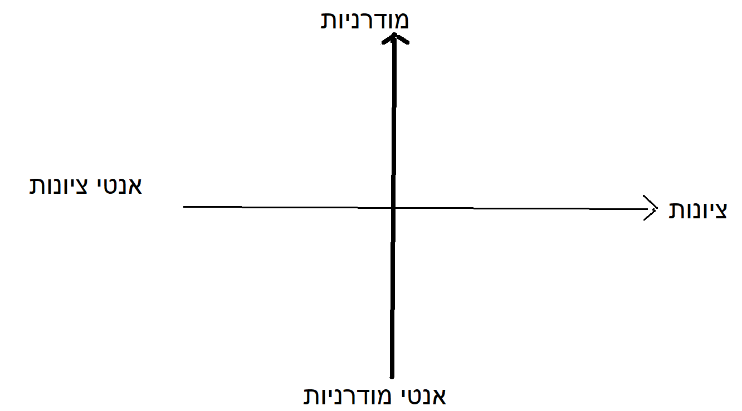
We can clarify the picture and my claim more pictorially. The accepted (and anachronistic) identity map looks like this:
But the real map I described above is apparently the very same map, only rotated by 90 degrees:
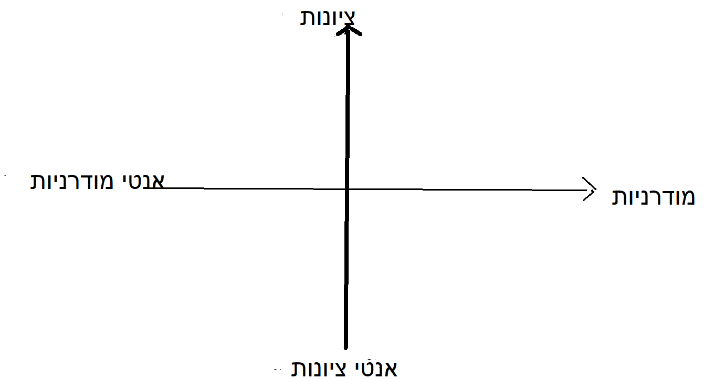
This is a rotation of the axes,[1] and ostensibly it is only a change of perspective. We still have four quadrants—so why should it matter whether we place one above the other or to the right of it? Seemingly it does not matter which we choose to be the X-axis and which the Y-axis. But on a closer look you will notice that there is nonetheless an important difference between the diagrams, one that is easy to miss: in the top diagram, the bold line that defines the principal identity seamline divides between Zionism and anti-Zionism, whereas in the bottom diagram the bold line remains vertical (the Y-axis), except that now it divides between modernity and anti-modernity (conservatism). Therefore this is not merely a rotation, i.e., a change of perspective alone. These are different identity maps. What has changed is the seamline (the bold line).
The top diagram shows us that we live with a false consciousness. Our feelings of partnership and identification at the sociological level are divided around the Y-axis. That is, Modern Haredim see themselves as part of a common group with conservative Haredim. Modern Religious-Zionists see themselves as part of a group with the non-modern Religious-Zionists. Our identification revolves around the attitude toward Zionism, and thus turns toward groups that are distant from us in the relevant value-ideological sense (those separated by a bold line), while those who are close to us ideologically (those between us and whom there is only a thin line) are perceived by us as belonging to a different identity group. My claim is that we must rid ourselves of the false consciousness according to which the Zionist identity axis is the principal seamline, and we must redefine our identity groups and religious consciousness around the modernity axis. This is the relevant seamline, and therefore it should be the bold line. The identity groups should be rearranged such that the coalitions are between moderns on both sides and between conservatives on both sides. Each of these two coalitions is bisected by a thin line. Far more sensible.
This false consciousness enables the conservative leaderships to lead both camps. The conservative rabbis and the politicians who represent them are considered the representatives of the entire identity group. The Haredi parties, all of which belong to conservative Haredi-ism, are the representatives of Haredi society. Modern Haredi-ism has no representation and no voice—not only in the Knesset but in public discourse generally. The same holds for Modern National-Religious, whose members find themselves voting for parties that are not clearly religious. I should note that my claim is not political but social-ideological. Recourse to politics serves only to illustrate the claim.
This situation enables the leadership (rabbinic and political) on both sides to label the moderns as a fringe group that deviates from the path. Modern Haredim are presented as “Haredi-lite” (not truly Haredi), and similarly modern religious people are presented as “Dati-lite” (not truly religious). All this is because they insist on belonging to the Haredi and the National-Religious groups respectively, and therefore condemn themselves to be considered a religiously weak periphery. Time and again we can see protests and dissatisfaction with this labeling, but it does not really change. In my view, the reason is that we insist on constructing the ideological-identity map around the old and irrelevant seamline.
The Third Path
The necessary solution is to synchronize the reality on the ground with the discursive consciousness. On the ground, these groups already exist, but they do not identify themselves correctly. We must, at long last, rotate the axes, as I did above. If we redefine our identity, this time around the more relevant axis—the modernity axis—there will emerge a Modern Haredi group that is not a (marginal, “lite”) part of Haredi-ism, and a Modern Religious group that is not a (marginal, “lite”) part of National-Religious-ness. If these two join together into a single group—Modern Religiosity—with two different hues (Haredi and non-Haredi), they will stand together as an alternative in their own right, rather than being two fringe groups in opposing camps. This of course requires from each of us the willingness to put on the table our dissatisfaction with the existing ideology and leadership (rabbinic and political), and to stop grumbling behind closed doors. Courage is needed to reorganize, to declare publicly that we do not accept the existing religious-rabbinic and political leadership, for we belong to a different ideological direction. From now on, the fact that Rabbi Landau says something is not a knock-down argument for me, if I am a Modern Haredi; and even if Rabbis Lior or Tau say something, that does not really interest me, as a modern religious person.
It is important to understand that this identity does not require someone to stop being a Zionist, nor someone else to stop being Haredi (in the theological sense). Each person can retain his previous identifications, but see them as marginal shades rather than the central seamline. A journal like Tzarikh Iyun is not an organ for Haredim in a modern hue (a subgroup of the Haredim) but for moderns in a Haredi hue (a subgroup of the moderns). It may even become somewhat superfluous, since at least part of this thought already exists on the modern National-Religious side (apart from theology), and vice versa.
This brings me to an initiative I have been involved with in recent months: establishing a movement called “The Third Path – Torah with Derekh Eretz.” This movement is meant to connect the modern groups on both sides—those who are interested in education, who believe in the values of democracy and equality (as much as possible and in varying degrees), who reject religious coercion, who consume art and value science, who relate to our tradition in a more critical and open and less dogmatic way (but not necessarily less committed), and who are prepared to make adjustments to it for present circumstances (which are not necessarily negative in their eyes)—into a third identity alternative alongside the two existing ones. This is a union of the two upper quadrants in the first diagram; in effect, a rotation of the consciousness to the second diagram and taking up position to the right (above or below) of the new seamline.
The attitude of this group toward phenomena such as LGBT or secularism, or toward women or non-Jews, is not a simplistic application of existing halakhic and theological categories, but a complex position that arises from awareness of and sensitivity to the factual and value situation in contemporary society, and also to the scientific knowledge accumulated over the years. To give a sense of what this means, I will add that its conceptions regarding providence, security, and human effort are not adherence to slogans so disconnected from common sense as those cited in Rabbi Pfeffer’s article on the subject. Judaism is not exhausted by modesty and eating kosher; it has moral dimensions and is obligated also to contemporary “external” values.
Such a perspective is presented by conservatives—Haredi and non-Haredi alike—as “lite.” “What, do you not believe that everything is in God’s hands and that human effort is false? After all, so said our sages.” They of course did not say so (at least many of them), but this has become a new Haredi article of faith. Contrary to the tendentious “lite” labels that people try to attach to these processes and this approach, this is neither a compromise nor an attempt to curry favor with anyone. There is here a different religious stance, which claims that the Torah and our tradition require today a different treatment from what was customary in the past. This is part of the reason why the existing religious leadership cannot provide an answer for this group, since by its nature it relates to reality in a more fixed and conservative way and is committed to accepted dogmas. Therefore it leads an anachronistic path that does not suit the will of the Torah in our circumstances. This obligates us to detach from the existing rabbinic leadership, not only from the political representatives who represent it and its path. It is important to understand that this is not Reform in any sense whatsoever. On the contrary, the claim is that those who conduct themselves today according to a simplistic interpretation of accepted past references are the ones who deviate from the will of the Torah—they are, essentially, the reformers. This is neither a slogan nor an apology. I have dealt at length elsewhere with the question of Reform versus modernity (see, for example, the third book in my trilogy, Walking Among the Standers), but this is not the place to elaborate.
The establishment of “The Third Path” is joined by figures and groups from the Haredi side and from the National-Religious side, and I suggest that readers who identify with what is said here join us as well. Our feeling is that if and when this alternative is put on the table, and it is clear that it is halakhically and Torah-based—and it is—many will find that within themselves they identify with this direction and will join it too. We are speaking of not a few people who are perceived, and perceive themselves, as “lite,” simply because no other model has ever been placed before them to show that their stance is a well-grounded religious and Torah stance. They repeatedly measure themselves against conservative standards set by the conservative leadership, and therefore feel “lite” and peripheral. At least in the Haredi world this is a relatively small number of people, but my sense is that this is the result of the anachronistic map presented to us. When people understand that there is another religious identity, and that if they identify with it this does not mean that they are “lite” but rather that they have a different religious conception, I suppose that many others who support this path will come to light.
Back to Tamar Katzir
In recent years a similar process has been unfolding on both sides of the ideological (and political) spectrum. The conservative extremes on both sides are drawing very close, but so too are the modern extremes. The Hardalim and the Haredim act together on the political plane, and their positions are drawing very close to one another, to the point of forming one conservative group (which contains different shades). From time to time proposals to merge (at least politically) are raised, and in the past the heads of the Hardali camp (mainly Rabbi Tau) even called for voting for Haredi parties. Tamar Katzir describes this process. She is very pleased by the rapprochement between conservatives from both sides. In her words I saw that certain Haredi groups are beginning to believe in the miracle of the establishment of the state and that it is part of the redemption. Factually, I am not sure of this, though I do not know enough about the groups she describes. I do not think that the rapprochement of her “seam people” is on the level of Religious-Zionist theology. The convergence is mainly in the sense of recognizing the value and similarity between the groups, and the understanding that the attitude toward Zionism is no longer the essential identity line (in my view this is happening mainly from the Haredi side toward the Hardali side, and not the other way around). They understand that the current battle is about conservatism and not about Zionism, and therefore it is right and proper for them to unite and struggle together.
I fully agree with the basis for this rapprochement, since as I explained the line regarding the attitude toward Zionism is indeed anachronistic. In any case, it is important to understand that Tamar Katzir describes a rapprochement between the two conservative groups, from the Haredi side and from the Religious-Zionist side (Hardalim). In terms of the upper diagram, she describes a rapprochement between the two lower quadrants and their becoming one group (with shades). In contrast, what I described above is precisely the mirror image. I am speaking about a rapprochement between the two modern groups on both sides, that is, a union between the two upper quadrants in that same diagram. There too there is very significant convergence, and there it is even more substantive. It seems that these two groups genuinely believe in closely aligned values, the essence of which I described above. Note that after uniting the two lower quadrants into a single conservative group and the two upper quadrants into a single modern group, one essentially gets the lower picture. The bold line there separates these two groups, and the faint line describes the internal split within each of the two groups (the moderns split into Haredi and non-Haredi, and the conservatives split into Haredi and non-Haredi).
From my perspective, the process that Tamar Katzir describes is very saddening and very worrying, since it strengthens the conservative component in religious Judaism and produces the terrible desecration of God’s name (hillul Hashem) that has been occurring in recent years. This is what creates the perception, in Israel and throughout the world, that Judaism’s image is that of its leaders (both rabbis and politicians): conservative, closed and intolerant, rigid and non-adaptive, acting in corrupt ways, immoral and focused on narrow interests, disconnected from common sense and from realistic considerations, and caring mainly for itself. It is important for me to note that I do not agree with all of these accusations. In my view, many of them are exaggerated and unjustified, and they stem from political tendentiousness. But as is told about the Chafetz Chaim: they do not say this about me and you. The religious rabbinic and political leadership has “earned” these accusations—both those that are true and those that are not—fair and square. Their outrageous conduct truly suffers from many of these flaws.
By contrast, the rapprochement that I describe around the modernity axis (the two upper quadrants in the first diagram) is very encouraging, and it is important to strengthen it and to join it. This is a sane and balanced voice that can save Judaism itself and also its image in the eyes of others, in the face of the problematic alternatives that represent it today. The rapprochement between conservatives on both sides should encourage the rapprochement between moderns on both sides. For this we must stop complaining and start taking action. We must put things honestly on the table and define ourselves anew and openly, and be prepared to detach ourselves from parts of the education we received and from the pressures placed upon us, and from the tendentious labels attached to modernity by the conservatives. We must stop apologizing and stop seeing ourselves as a fringe group within a “more religious/Haredi” world, and understand that we are talking about an alternative—a third path, different from the two existing ones.
A Note on Sociology and Essence
This article is written through the prism of ideology. I do not ignore the fact that the definitions of Haredi-ism and National-Religious-ness are saturated with sociology, and one cannot ignore that. Therefore I am also not proposing to manufacture a third sociology. That may develop over time, or it may not. What I am proposing is to stop enslaving ideology to sociology. Let each person remain where is comfortable for him socially and sociologically, but it is important that we examine what ideological prices we are willing to pay for that, and whether we have crossed the reasonable threshold. Each of us must ask himself how much he is willing to compromise on his truth and his values for the sake of belonging to the anachronistic ideological comfort zone (Haredi or National-Religious). People have a tendency to enslave essence to sociology, and in my view the prices this exacts from all of us—and especially from the Torah truth itself—are enormous. It is important that we muster courage and examine this honestly, and also draw conclusions. It is possible to remain in the existing sociological camp without giving up one’s value and ideological backbone. But even if this is not possible, one must draw the necessary conclusions.
Conclusion: Three Forces in Our Camp
There is nothing more fitting than to end such an article with the words of Rabbi A. I. Kook in Orot Ha-Techiyah 18 (see detailed discussion here):
“Three forces are currently wrestling in our camp; their struggle is most apparent in the Land of Israel, but their action extends from the life of the nation as a whole, and their roots are fixed within the awareness that penetrates the expanses of the human spirit. Wretched will we be if we leave these three forces—which must be unified within us, each assisting the other and perfecting it, with each one fortifying the extremity that its fellow could bring in a corrupted form if its path is not bounded—to remain scattered, in rebellion against one another, divided, each into a separate camp standing as an adversary to the other camp.”
“The holy, the nation, and humanity—these are the three principal demands of which all life, ours and every person’s, of whatever form [of human life], is composed. Whatever the proportions of this composition may be, and even if one part occupies a more central place for a given individual or public, we shall not find and cannot find any form of life that is not composed of all three.”
“The necessary blending of these three great demands must come about in every group that has hope for future life. And whenever we survey our lives and see how these forces, instead of being destined to blend, are going and separating, we are called to come to the rescue.”
“Wretched will we be if we allow these three forces—which must be unified within us, each assisting his fellow and perfecting him, each one fortifying the extremity that his fellow could bring in a corrupted form if his path is not bounded—to remain scattered, in rebellion against one another, and to be divided, each into a separate camp (=party), standing as an adversary (=a bitter rival) to the other camp.”
“The three most official factions in the nation are:
First, the Orthodox, as it is commonly called, which bears the banner of the holy, and argues with courage, zeal, and bitterness for the Torah, the commandment, faith, and all that is holy in Israel;
Second, the new national faction, which fights for everything that the national tendency aspires to, which includes within itself much of the pure naturalness of a nation that wishes to renew its national life after it was long concealed within it by the harsh hand of exile, and much of its desire to acknowledge for the good what it has absorbed from the spirit of other peoples, to the extent that it recognizes that these are good and suitable for it as well;
Third, the liberal faction, which bore the banner of enlightenment in the not-too-distant past and still has a strong hand in broad circles. It does not confine itself within the national framework, but demands the human content of enlightenment, culture, morality, and more.”
“It is obvious (!) that in a healthy state there is a need for all three forces together. And we must always strive to achieve this healthy state, in such a way that these three forces together will rule us in all their fullness and goodness, in a corrected harmonious state in which there is neither deficiency nor excess; then the holy, the nation, and the human being will cling together with a noble and practical love, and individuals and factions alike—each of which has found its talents more suited to one of these three parts—will convene together in the proper friendship, recognizing with a generous eye each the positive role of his fellow.”
“And this recognition will continue to develop, until it is not enough to recognize the positive side that each force has for a worthy and accepted matter and that is worthy of being put to use… but that we go further, to the point that we also recognize for good, according to the proper measure, the positive content that exists in the negative (=critical) side of each and every force; for the sake of the benefit of the particular force to which one tends more, one must also be influenced, to some extent, by the negating (=critical) force opposed to it, because in its negation it sets it upon its proper measure and saves it from the dangerous defect of excess and exaggeration.”
We must understand that the relationship among the three forces develops over generations. At first, religious Judaism held only to the holy (=Orthodoxy). The nation and universality were left to the secular. Thereafter Religious-Zionism came and established the striving for the nation (nationalism) as part of its religious world, while leaving Haredi-ism focused only on the holy. Universality remained at this stage for the secular (and for the non-Jews). In recent years, another step in this process has been unfolding. The time has come to recognize it—to “convert” universality as well and bring it under the wings of the Shekhinah. Modern religiosity in the spirit of “The Third Path” seeks to do precisely this.
When the National-Religious movement began, it was criticized by the Haredim for expanding the religious circle into the profane. This was seen as secularization and desecration of the holy. Today the Haredim and the (conservative) National-Religious criticize the moderns in exactly the same way, and try to block the necessary further expansion in the universal direction. The time has come for another rebellion/liberation, and for a further expansion of the Torah toward the universal.
This is not a spreading thin of Torah values but, on the contrary, a deeper understanding of them and their proper application in the realities of our time. Our concern is the selective and calibrated adoption of universality—sifting the wheat from the chaff—and its insertion into the Torah world. Universality need not remain outside, as the conservatives (on both flanks) claim. That claim is itself part of their conservatism, which prevents us from moving forward by presenting today’s Torah as a sad, anachronistic blot cast on the margins of history.
These forces are wrestling today more than ever in our camp, but the time has come to bring this struggle into the holy itself. There is tension between commitment to our religious tradition and openness to the contemporary world and its values, but we should not fear a tension that is fertile and beneficial. Not every external value is “progressivism” (or “leftism”), God forbid, as the conservatives try to persuade us. Indeed, there is wheat and there is chaff there; but they throw everything out, whereas what is more correct is to sift the wheat from the chaff.
I have nothing left but to conclude in the words of Rabbi A. I. Kook at the end of his discussion there:
“Only in this manner can we hope for a state of life worthy of one nation in its land.”
[1] The mathematicians among us are surely squirming. So for their sake I will add that it is indeed not really a rotation (but also a reflection). But for our purposes here the simplistic description suffices.
Discussion
How does one join? What does joining mean?
See the website. For now, only WhatsApp groups. Later there will be activities, local cells, etc.
Very nice, but one central comment: unfortunately I’m very skeptical. Unity of the modernists on both sides seems impossible because of the gaps in modernity; it really doesn’t boil down to not accepting what Rabbi Lando says. There’s much more to it—in books, in dress, in those same things that indeed aren’t essential but have already become such. Broadly speaking, where Haredi modernity ends (for example, Yehoshua Pfeffer, who is an academic, is a modern extreme—the top one percent among the Haredim; among the religious Zionists he would be considered very conservative), there are Haredim who are truly modern, but they are devoid of ideology. It is not progress or science that motivates them, but what is called “they just don’t have a God.” There’s nothing to work with there.
The people at Tzarich Iyun aren’t telling the truth; there are non-Haredi writers there (Aharon Ariel Lavi, even Rabbi Chaim Navon). Apparently it’s fear of the rabbi that keeps them in line.
A. In my opinion it is simply not true that the question of Zionism has no importance nowadays, or that there is no significant difference between Haredim and Hardalim. It is much more than saying or not saying Hallel. After all, the Hardali serves in the army and the Haredi does not, and the main reason for this is that the Haredi—unlike the Hardali—does not see the state as “his” project, and therefore feels no responsibility to participate in this project, even if in principle he wants it to succeed. (Torah study is not the real reason for not enlisting, since in the Haredi mainstream even those who do not study do not enlist. And fear of secularization is also not the real reason, because if they saw enlistment as something intrinsically important, they would at least try to find solutions.) Similarly, the Hardalim as a public invest greatly in settlement in Judea and Samaria, the Negev, and the Galilee, out of national considerations, whereas the Haredim are not interested in this at all. And so it is with all the other national tasks, such as encouraging and absorbing immigration. Even the struggle over the Jewish identity of the state has become mainly a Hardali project (together with the traditionalists), and the Haredim have stopped participating in any struggle that does not directly concern their own shtetl. Therefore the seam line between Haredim and Hardalim is still very significant.
B. One should also note that opposition to Zionism among the Haredim—or more precisely, opposition to participating in the Zionist project—is itself really just one סעיף of the opposition to modernity, since Zionism itself is a modern phenomenon. At bottom, opposition to Zionism stems from conservatism and from the view that “anything new is forbidden by the Torah.” The other side of the coin is that the Hardalim, too, are basically modern, though mainly on national issues and less on social and religious issues.
C. Based on the above one can also understand why Hardalim, too, can be innovative on certain issues. Tekhelet in tzitzit, for example, is practiced mainly among the Hardalim (except for the Har HaMor circles), whereas among the Haredim it is “not done.” Ideas of updating halakhah receive much more of a hearing in the Hardali public than in the Haredi public, although for them this is not out of acceptance of modern values but for other reasons, and this is not the place to elaborate.
D. In practice, culturally and socially as well, most Hardalim are very different from the Haredi mainstream. Almost all of them study in yeshiva high schools and take matriculation exams, and many also have academic education. Despite their principled opposition to media and secular culture, their exposure to the secular world and to general culture is still much greater. There is also a big difference in self-consciousness: the Hardalim see themselves as part of the modern world, only they critique it by the power of the ancient tradition they hold. This is unlike the Haredim, whose self-consciousness is that of people from the 18th century who somehow fell into the modern world and are trying to survive in it. Therefore the statement that “the differences between them are smaller than the differences between different Hasidic courts, or between Hasidim and Lithuanians or Sephardim within the Haredi camp” seems to me very far from reality.
Well, that isn’t really the topic. That’s the subject of column 500. But I’ll respond briefly.
Let me preface this by saying that when I talk about identity, I’m talking about the watershed line. There are differences between every person and every other person, and certainly between groups. The question is where the identity lines run and what is most essential among all these differences.
In my opinion enlistment is really not an essential difference. The proof is that the Hardalim support draft evasion by Haredim. And as for enlistment itself, there are already Haredim who enlist, and were it not for politics there would be more. And the Hardalim (those who study) enlist in a fairly limited way. So I repeat that there is no essential difference between them even on the issue of enlistment. These are two Hasidic courts within Agudat Israel.
The rest of the differences are really trifles. There is also a difference between me and my neighbor who belongs to the same identity. Completely negligible differences. If you want to build an identity around the attitude toward tekhelet—be my guest.
In addition, of course, you need to distinguish between different shades of Haredim. That is the whole thesis of the third path: that there are many sociological Haredim who do not really belong there. So even if you are right about the Haredi core, the thesis still stands. The question is what to do with the people on the seam.
I agree with Yosef’s remarks, with two small additions:
A. The Hardalim support non-enlistment for Torah scholars—those who truly learn and teach Torah as a way of life, whose Torah is truly their craft. It seems to me that even the lightest religious people and even secular people would agree with that; it’s just that in practice almost only Hardali boys choose this way of life.
B. The claim that modern religious people are considered “light religious” is incorrect, at least in the religious society I live in. “Light” simply means less strict observance of halakhah (for example, prayer with a minyan or at all, selecting on Shabbat, etc.).
It is true that there are areas in which the modern-halakhic dispute causes modern religious people to be considered less careful about details of halakhah—for example in leisure culture or modesty—but (again, from what I know) there are quite a few modern rabbis who, as far as they themselves are concerned, are the most “conservative” possible.
Perhaps that is the case among the traditionalists, where there is a combination of conservatism with being light in halakhah. Many of them can look down on a modern religious person and think his behavior stems from laxity—a kind of “everyone who disqualifies does so because of his own blemish.”
The whole thesis (I mean column 500) is built on a mistaken assumption, according to which there is no connection between one’s attitude toward Zionism and one’s attitude toward modernity.
In fact there is a very deep connection between the two approaches, stemming from the deep connection between Judaism (at least Orthodox Judaism) and Zionism (apart from two marginal groups I’ll mention at the end).
The Land of Israel, redemption, the ingathering of the exiles, a Jewish kingdom—all these are among the principles and foundations of the Torah and the teachings of Hazal, and even among the thinkers of the Rishonim period there was no one who tried to refute this connection.
Therefore one would seemingly expect to see religious Judaism harnessing all its strength to realize the Zionism of Hovevei Zion and Herzl; except that a “malfunction” occurred, and the Zionist movement was distinctly secular and “modern” (at first socialist, and later liberal).
Therefore the test of the religious connection to Zionism is directly proportional to the connection to modernity—whoever sees modernity as a “work of Satan,” a terrible threat, cannot accept Zionism even though it is among the principles of Judaism, simply because it is modern.
Conversely, whoever is prepared to be Zionist, even at a basic level of cooperating with the State of Israel, sees modernity as a problem that does not overshadow the good (from a Jewish point of view) to which Zionism leads.
In my assessment, the path of the modern Haredim is דווקא through Zionism—it turns out that the Zionist state is actually good for Judaism and Torah (as opposed to the situation in the 1950s that led Israeli Haredim to disconnect from the state), so perhaps modernity is not so terrible after all.
Who is exceptional?
So there is the group of believers in the “Three Oaths”—those for whom this non-halakhic midrash is equivalent to an explicit Mishnah, and therefore Zionism is, for them, a transgression.
And there is another group (apparently) that defines itself as religious but secularly Zionist. It is unclear to me how they sever the Judaism-Zionism connection; I would be happy to hear explanations.
This discussion is not relevant, because conceptually it is obviously possible to separate the ideas. And factually too, it is clear that you can hold the anti-Zionist Haredi theology and be modern, and after all there are quite a few such people. It’s not only the Three Oaths and the secularism of the Zionist movement; there is also the question whether the mission is incumbent upon us or not. But as I said, this discussion really changes nothing. Even if it were only because of secularization, there would still be a distinction between one’s attitude toward Zionism and one’s attitude toward modernity.
Factually there is a connection, and it is very strong—even among modern Orthodoxy, where surprisingly everyone (as far as I checked) is Zionist to one degree or another, and also among the religious in Israel.
I don’t connect with the excuses that “they’re really modern but they’re uncomfortable with the rabbis”; as someone who grew up all his life in light religious society, the last thing you can say about it is that it obeys or defers to rabbis.
It reminds me of the claims that Likud voters vote according to sociology—after all, it’s obvious that everyone is socialist, so how can it be that they don’t vote Labor???
I’m trying to understand what the new message is in the Third Path beyond the fact that the “light” people will start feeling more comfortable with themselves—which is important, but in practice doesn’t change anything about the religious and Haredi hegemony. The institutions and communities will remain as they are, and so will all the nuances and the social and cultural codes, and above all the education in the institutions will continue to preach the ideologies of the sector to which they belong and continue cultivating the ethos of their society and their cultural heroes (in the Talmudei Torah they’ll tell stories about the Hazon Ish and Rabbi Steinman, and in the religious schools about Herzl and Jabotinsky).
Another thing: when I look at the roster that makes up the forum, it’s evident that there are some there who are the lightest of the light—people whom I am convinced are lax in halakhah not מתוך תורה סדורה but because they are very far from that world, or because what mainly motivates them is to inject progressive values (Efrat Shapira Rosenberg, for example) into the religious strongholds rather than to reestablish halakhah.
Hi, in my opinion you forgot an important distinction between a modern Haredi and a light religious person. For a modern Haredi, modern values are not all that critical, and he truly thinks the most important value is Torah study and observance of halakhah; whereas a light religious person makes himself into an ideal and crowns rabbis of his own choosing…
See what each one gives his money to, see who dresses more modestly and is more careful about praying with a minyan, and on the other hand who volunteers in all sorts of things and who is more opposed to religious coercion, etc.
I agree with the third identity you spoke about, but in my humble opinion it has nothing to do with light religious people. What you’re talking about from the religious side ought to be “commitment to halakhah + modernity,” whereas for light religious people it’s just modernity, and one should not try to blur that. Your definition of the third identity seems more suited to the “Yeshiva University” style; an American friend told me that on Independence Day they split, so that half say Hallel and half don’t. That is exactly the definition of people who do not see the institutions of the state as “holy institutions” but very much want it to succeed, like any sane person, and the commitment there to halakhah and Torah study is very strong. And in Israel, examples of this are the spectrum of hesder yeshivot from Kerem B’Yavneh to the Gush.
But again—not light religious people. Think about it..
You may be surprised, but I had already thought about that earlier. I don’t assume you thought I’m unfamiliar with light religious people. But a little reading comprehension has never hurt anyone. My claim is that many who are called “light” are not really such. Just because they are not Hardalim, they are classified that way. Others became “light” because they were presented only with the Haredi/light alternative.
And finally, your rosy description of the modern Haredim is a sad and tendentious joke.
Come and I’ll show you who is more careful about prayer with a minyan—you’ll be surprised.
Maybe the response will sound clownish, but still.
Since it seems the world is heading toward Islamic rule in large parts of it, and we can already see early signs in Europe, perhaps the concept of humanity is supposed to be Islamic humanity and not Western humanity.
For example, in a few years the more universalist forces will preach abolishing Rabbeinu Gershom’s bans, and דווקא the conservatives will support them. The universalist forces will preach hijab and veils, and the conservatives will oppose them.
Such things have happened before.
Hello,
I find myself connecting very much, from a religious standpoint, to the idea of the Third Path movement. However, in our unfortunate situation in the State of Israel, politics—for many people, myself included—is not a matter for amateurism, but is highly significant in the fabric of life. The political polarization and the almost unavoidable preoccupation with political discussions create discomfort with belonging to one group of people from both sides of the political divide.
I opened the Third Path website and saw the names displayed there. I don’t know all of them, but everyone I do know is, to one degree or another, on the political side to which I do not belong (it is obvious which side I belong to). Except for you, whose position is more complex. Seemingly, what does politics have to do with religion? But the current situation is that I, as someone who supports a certain political side, feel uncomfortable belonging to a group most of whose members support the other side. And this is not because I am unwilling to hear left-wing opinions, but for another reason. Apropos your article about Prof. Vogel’s podcast: I move around in circles where the left-wing view dominates, and my feeling is that their attitude toward people with right-wing views on the issues currently under discussion is awful. They treat them, at best, as barbarians, and at worst as corrupt, evil, and Nazis.
I am incapable of belonging to any group whose attitude toward me is like that, even if the center of gravity of the group is not in the political sphere. In the end, political issues in Israel always come up on the table. I am also less naive and tend to think that some of the people whose pictures are displayed on the site have political goals and not only religious ones. It is enough that, in such a sensitive period, the movement’s manifesto on the site opens by saying that rabbis, in the name of “national” values, seek to trample religious and moral values, in order to link this to the current dispute over returning the hostages (which in itself is not connected in any way to religious issues, but rather to security conceptions), or to other disputes that concern security matters more than religion and morality. As someone who does not support a hostage deal in exchange for ending the war, I have already heard from some people that I am practically a Nazi, and more recently they have gone so far as to claim that I am also not Jewish.
It seems to me that the description above may reflect the position of many people today (although I must admit that most of those who ideologically support the Third Path probably hold the opposite political opinion from mine on the burning issues at hand). Therefore, it seems to me that in the current situation they would do well not only to talk, if indeed they would put the political issue on the table and clearly prove that there is no connection whatsoever between this movement and one political stance or another. And even someone who—God forbid—thinks Netanyahu is a good prime minister and not corrupt belongs among the members exactly as much as someone who thinks the opposite. This cannot be swept under the table, because in the end it will erupt. Part of the movement’s basic values, as I understand them, is also political tolerance—which is not found today in the political arena (in my humble opinion mainly on one side, but I am biased).
It seems there is a fundamental problem in the ideological move of the “Third Path,” a problem that has existed in all ideological movements of a similar kind, in Judaism and outside it, from time immemorial. The problem is that the main source of influence on those who identify themselves with this current is the majority culture surrounding us, and this influence is stronger than the influence of tradition. This fact leads us to a reality in which the values of tradition are increasingly pushed aside by the values of the surrounding culture.
In this reality there is a double problem—both philosophically and practically. Philosophically, if we want to examine external values in a neutral way, we must neutralize the strong social influence of the culture in which we live, which cannot be done when we see ourselves as part of that culture. And practically, the values of tradition will not survive over time when they are subject to the intense pressure-cooker of the worldview and spirit of the surrounding culture, which generally conflict with the outlook and values of tradition.
Rabbi Michi writes from a purely philosophical standpoint, and from that point of view there is much truth in adopting many values of the modern world and integrating them into the Jewish spiritual world (which is also what happens in practice in all circles). The problem is that if we adopt his approach practically and advocate social and ideological integration into the surrounding culture, what will actually happen is that very quickly we will lose the ability to examine things from a purely philosophical standpoint and to preserve the worthy values of tradition, and instead we will find ourselves surrendering to the majority culture. This is not a futuristic prediction, but a reality that has happened again and again throughout our history.
The reason it is very hard to find people immersed in Torah and punctilious in mitzvah observance among the people of the Third Path, who see themselves as part of Western culture, whereas one can find them in abundance among the public that separates itself from that culture, is not connected to the dichotomous division around Zionism, since this reality existed long before Zionism. The reason is simply that the surrounding culture is stronger, and sooner or later overcomes the traditional values of Judaism that do not fit it.
You are making assumptions that have no basis. Apparently this is the result of the social brainwashing we are all immersed in, according to which anyone who opposes Bibi or Smotrich is a leftist.
The tendentious, dismissive attitude toward the other side is shared by both sides of the divide. But you yourself suffer from this failing, since you are unwilling to sit with people who hold different political positions—even though you agree with them on the issues under discussion (those you imagine they are)—just because of their political opinions. You also accuse everyone on the basis of remarks and attitudes of a few people around you. This is a magnificent case of “disqualifying others because of your own blemish.” You should look in the mirror from time to time.
In any case, nobody intends to prove anything to you. A person has to deal with his own delusions by himself.
Well, here there really is a collection of typical slogans. I’ll respond briefly.
First, the Third Path arose in order to integrate modern values that fit into the religious world around us. Therefore those are what we mainly talk about. The Third Path did not arise in order to strengthen the prohibition of selecting on Shabbat or nat bar nat, not because these are treated with contempt but because they are agreed upon and there is no discussion about them.
Your assumption that tradition is minor compared to what surrounds it is an empty declaration. What do you base it on?
Your assumption that tradition will not survive this way is also, in my view, groundless. The opposite is true: it will not survive without this. We have already seen the collapse that occurred in the Jewish people because of conservatism and ossification in the face of the Haskalah and Reform. That is also what is happening in our own day, but the conservatives keep stuffing their own minds and ours with the idea that the innovators are to blame.
The assumption that among the conservatives there is more meticulous mitzvah observance is also incorrect. It depends on what you call meticulous mitzvah observance. In their narrow, ant-like religious world, maybe that is true. But in the real world, definitely not.
To sum up: the surrounding culture is indeed strong and attractive, but that is also because of strengths it has. It is not only the evil inclination (though of course that too is there). The way to deal with it is to recognize this and adopt, in a controlled way, what is worthy of adoption—not to boycott and separate ourselves as was mistakenly done in the period of the Haskalah. Just as you do not flee to caves in the desert to avoid gossip or interpersonal sins, because the Torah is meant to be implemented in life and in the world, not in the world of ideas and not in monasteries or Noah’s arks. It is simply a warped conception—though unfortunately a very characteristic one—of the Torah.
The Third Path has come to wipe away the filth of the other two paths, so it is no wonder that it gets a little dirty too.
A. I base my statement on the familiar reality that the average person finds it difficult to hold firmly to his personal values in the face of strong social influence surrounding him from every direction. I would be very surprised if you denied this familiar reality.
B. Notice that I did not speak about conservatism but about separatism. I agree with your words that ossified conservatism is dangerous to Judaism (besides being mistaken in itself). My claim is that since, socially speaking, one who integrates into the majority culture will not have the strength to resist it when it conflicts with his values (and even if he succeeds, the next generation will not), if we want to bring about changes we must specifically make sure we are immunized as much as possible from the social influence of the majority culture, because without such immunization the changes will not strengthen Judaism but collapse it.
C. “Meticulous mitzvah observance” means taking the fulfillment of mitzvot seriously because of commitment to God, not because of commitment to the values of general culture. A person who enlists in the army because of national values or gives to the needy because of socialist values is not meticulous in mitzvot but in nationalism and socialism. It is the intention that defines the act.
There is no point arguing about what percentage among those integrated into general culture fit the above definition, as opposed to those who separate themselves from it at least partially (and do not answer me from your personal conduct, since you have a unique personality that does not represent the כלל).
D. I agree that the surrounding culture has many good things to offer, and that what is worthy should be adopted in a controlled way. But in order to do this in a controlled way, one needs to minimize as much as possible the emotional influence, which tends to greatly weaken the control system, and for that one must separate socially from general culture. An attempt to live within that society while constantly policing its outlook and values is doomed to conspicuous failure.
A. Read my remark again before responding to it.
B. Conservatism and separatism are different terms, but they point to the same society and the same ideology. Conservatives preserve the existing situation and separate themselves from what is happening around them so that it will not influence them. If you are recommending separatism without conservatism, then one can adopt all Western values and simply do so within a closed Haredi group. That is mere casuistry.
C. Commitment to mitzvot includes avoiding desecration of God’s name, carrying one’s share of the burden, not being parasitic, not lying, not neglecting problems (such as sexual harassment and deviance), not abusing individuals who do not fit the system, and not persecuting anyone who thinks differently. And all this is done in the name of the command at Sinai. So we have different concepts of careful mitzvah observance.
D. Here I saw nothing that has not already been answered.
I brought my own case as an example of something broader. Since the aim of the movement (as I understood it) is religious and not political, and as someone who is in principle identified with the idea of the movement and wants it to succeed, I came to offer general advice based on my test case. If you think my case is unique, or if you think the movement need not prove anything even if this is a broad phenomenon, then excellent. Be that as it may, from your words it seems you did not really read what I wrote, or did not understand it. I only hope that this message, at least, you will read with greater attention, if only because of its brevity.
I am making a simple claim: if we want to make positive changes and updates and adopt good ideas from outside, and at the same time seriously preserve the values of tradition, we must neutralize as much as possible the powerful emotional influence of the surrounding culture. Otherwise, what happened to all such movements in the past will happen again: a gradual surrender to general culture until the values of tradition that conflict with that culture are completely nullified.
The only way I know to neutralize the emotional influence of a society is not to be part of it. Do you think there is another way?
That is a childish dichotomy. Roughly like saying that the only way to stay alive is not to eat cakes (because they make you fat).
Aviad, more power to you for your words. I really connected with your way of thinking…
I was just reminded of my column 597. It’s worth looking there.
https://mikyab.net/posts/83136/
After strongly identifying at the time with the manifesto, I hastened to look at the Third Path website as soon as I read the recommendation for it here. And again I definitely identified with the chapter “Our Values” until I reached the following sentence: “
Out of a deep identification with the importance of Torah study, there is room to exempt an agreed quota of Torah scholars from military service. This group will be built by screening for ability, motivation, and diligence, according to transparent criteria. It is also proper to reward its members appropriately and enable them significant Torah growth.”
I did not understand how this sentence accords with the idea of Torah im Derekh Eretz on which, according to the chapter “Come Get to Know Us,” the movement is based.
Let me hang my hat on a great tree and quote the well-known words of Rabbi Amital: “Regarding the question whether people who serve in the army can grow in Torah… in my opinion this ideology involves a diminution of the honor of Torah.”
And now in my own words—Torah without Derekh Eretz with it (that is, at age 18 military service, and afterward academic study in some field, or even broad self-taught general education) is deficient Torah. The diligent, talented, highly motivated Torah people should be encouraged to become army officers and afterward return to the world of Torah while doing significant reserve duty (cf. “the Religious Zionist candidate for the office of chief rabbi”)—not be exempted from military service. And this is out of a deep identification with the view that Torah study has added value if it is accompanied by engagement in “Derekh Eretz.”
Please clarify this matter.
You are using empty slogans. Already on the Rambam’s well-known words about one who thinks he will make a living from charity, the Kesef Mishneh comments that many did so and it did not work out for them. It is obvious that one can grow in Torah even while engaged in military service and Derekh Eretz, and nevertheless there is no doubt that there is a great advantage for those who invest their whole being in study, and their growth can be greater. By the way, Rabbi Amital himself exempted some of his students from service under the heading “essential.”
Beyond that, the priest should not be treated worse than the innkeeper. If outstanding people in other fields are exempted from service, there is no reason not to exempt outstanding Torah scholars.
In general, the division of tasks is not imposed on an individual person but on the public, and the public can set aside people to engage in Torah and still have this be a general framework of Torah im Derekh Eretz. There is no necessity that every person engage both in Torah and in Derekh Eretz. This zealotry is childish, foolish, and unnecessary.
You, and all the other Torah scholars whose names and pictures appear on the Third Path website—and likewise all the heads of the important Zionist yeshivot (I do not know whom Rabbi Amital exempted; I do know to whom he handed over the leadership of the yeshiva)—served in the army and acquired wisdom and education, and only thanks to these did you arrive at the basically correct conclusions of the framework you established.
You are the proof that the advantage is specifically for those who do not invest all their energy in Torah study.
And on the contrary, the fact that there is no Torah scholar among you who invested his entire self in study, and the expectation that there also will not be such a person who identifies with the values of the Third Path, teaches that your statement that there is no doubt, etc., is mistaken.
Could it be that you did not notice Catch-22: those few students who would want an exemption from service would be precisely those who are incapable of growing and developing unless they invest themselves totally, and those by definition fall short in motivation, ability, and diligence compared to those who are capable—so the exemption will go to the less capable. Then why do they deserve the exemption?
Of course the public should set aside people to engage in Torah and support them no less than support for the general academy—but after and during military service. Therefore the Kesef Mishneh’s words, like the Rambam’s, are not relevant—they deal with the question of livelihood, not the obligation to contribute to the public.
Are those who invest their whole selves in Torah study exempt from (or forbidden to) establishing a family and raising children?
There is no necessity that every person engage both in Torah and in Derekh Eretz, but the great ones (like you, the founders of the Third Path) are those who do. I have no interest in cultivating the not-great ones.
And regarding the innkeeper—an argument of “then why them?” is not a moral argument (as the expression means in its original context, and as is known, the Sages rejected that argument there too). In any case, I am not familiar with “other fields” that receive exemptions besides musicians and athletes—and the distinctions between them and Torah scholars are too many to list here, if there is any justification at all for that exemption in their case.
And by the way, how is it even possible to identify a boy’s motivation and abilities at ages 18–20? Who will be given the authority to exempt, how many will be exempted (400 boys?), and one could go on and on—there is no greater opening than this for rot and corruption, and we are back again at the starting point. Did someone here mention the phrase “empty slogans”…?
And one final comment: it seems to me it is still too early for you to adopt the style of Prof. Leibowitz in his old age, and Torah with Derekh Eretz is good too (in the additional sense of derekh eretz, i.e. basic decency) even with young students like me.
I repeat again that this is childish zealotry typical of “young students.” If you think a bit, you will surely understand that this is empty casuistry. The fact that those who signed are army veterans does not mean they got there because of military service, but the opposite. They got to military service because of this.
Factually one cannot deny the advantage of someone who devotes his whole self to Torah (in the object itself), at least in terms of knowledge. Of course he also has disadvantages, like all of us, and there is no overall hierarchy on the basis of one parameter. Therefore we need both kinds.
If someone does not serve but recognizes the importance of service and does not disparage those who do serve, there is no reason he should not grow in Torah also in the broader aspects, like those who serve. He can grow more.
By the way, all those Torah scholars who are signed onto the Third Path and who grew in Torah (because of military service) arrived at the conclusions you are criticizing. Did someone mention Catch-22 here?…
And one more thing: it is not true that they all served in the army. There are also many Haredim there.
Oh, now I understand (what can I do—when things are explained crookedly, I understand slowly).
Putting together all your answers, and especially the repeated use of the term zealotry (childish, fine—that’s just a meaningless word, but “zealotry,” I didn’t understand the connection, since the difficulty I raised did not stem from zealotry for equality for all and for drafting Haredim, but from a conception about the notions of Torah / Torah study / greatness in Torah and their derivatives—and after all, you people in the Third Path also demand enforcing access to higher education for all, even by means of sanctions—so to what value exactly am I childishly zealous?).
I understood that the paragraph I pointed to in the chapter “Our Values” on the Third Path website is not a formulation of the value, but the opposite!—a list of conditions (agreement, screening, transparency—perhaps even utopian conditions and impossible in practice) whose purpose is to preemptively cancel the possible criticism that the value as formulated earlier, “the state will require every citizen and group to fulfill obligations, such as military and/or civilian service equally,” is zealotry; or the criticism that the people of the Third Path do not respect Torah study (whereas regarding higher education they explicitly demand “access to higher education for all”), and so on.
More power to you.
I probably really do explain things very crookedly, because even slowly you still didn’t understand.
So I’ll try again, and if I still don’t succeed this time then I’ll probably move on to talking to walls.
You are zealous for a very particular model of Torah and greatness in Torah. And that is childish. There is not one single model, and certainly not one single practical mode of conduct for realizing the model(s). There is a general value direction, but it can be realized in many forms, with a division among different people.
As for the quotation you brought, it seems your reading comprehension also suffers from similar childishness.
“I have written more than once that there is great value in people who are secluded in their rooms and devote themselves entirely to Torah and its study (‘Everyone needs the masters of wheat’; see Horayot 14a and parallels), but that is only so long as they and we know their place and do not allow them to make decisions, issue halakhic rulings, or lead the public as leaders. When they themselves do not understand that they should not engage in such areas, and enter domains in which they do not have a drop of understanding, their value as Torah scholars is greatly diminished. When they speak in areas of thought and express ideas there at the level of small children—which naturally receive an aura of sanctity by virtue of the speakers’ authority—when they make bizarre and irresponsible decisions and perceive their surroundings with appalling childishness, they disgrace themselves, their Torah, and all of us. This is a terrible desecration of God’s name, truly in the category of ‘a Torah scholar who lacks understanding’ (see the epigraph to this column). In short, what is said in this column should arouse in us new (and sad) thoughts about what greatness in Torah is and who the great Torah figures are.” (Rabbi Dr. Michi Abraham, column 655)
Wonderful—let’s exempt a group from military service so they can devote themselves to Torah, but let them know their place: not to make decisions, not to rule on halakhah, not to lead as leaders—very important.
Bravo, you matured within 9 columns, and only I remained childish in my zealotry for the demand that Torah scholars be complex people (oops, I think that’s an oxymoron).
But actually this is again my childish reading comprehension….
Or perhaps—just perhaps—it’s all because “once the wording on the Third Path website is set, it cannot be taken back”?
A good and blessed year.
I agree with modern religiosity, but it is hard for a modern society to keep itself religious. (This is connected to your debate with Moshe Koppel about Haredi and Shimon.) Therefore I think it would be proper to stop the connection between the two groups, which is a connection based on the conservative component (among the Haredim too there are many more conservatives), and from within the religious-Zionist or Haredi society, modern people like you will make change. The change will be slower, but surely much safer.
Isn’t that so?
That is a tactical consideration. The connection for us is essential.
Very nice. It would also be worth looking at Tehila Gado’s article, which distinguishes between two currents within modern Haredism—a distinction that has significant implications for what was written here. There she also mentions and uses your theory of the “third identity.”
https://www.leshem-shinui.sites.tau.ac.il/%D7%A9%D7%A0%D7%99-%D7%96%D7%A8%D7%9E%D7%99%D7%94-%D7%A9%D7%9C-%D7%94%D7%97%D7%A8%D7%93%D7%99%D7%95%D7%AA-%D7%94%D7%9E%D7%95%D7%93%D7%A8%D7%A0%D7%99%D7%AA