

On Translating Moral Ideas into Ontic Terms (Column 168)
With God's help
Dedicated to the commenter with the nickname Y.D., in his comment here
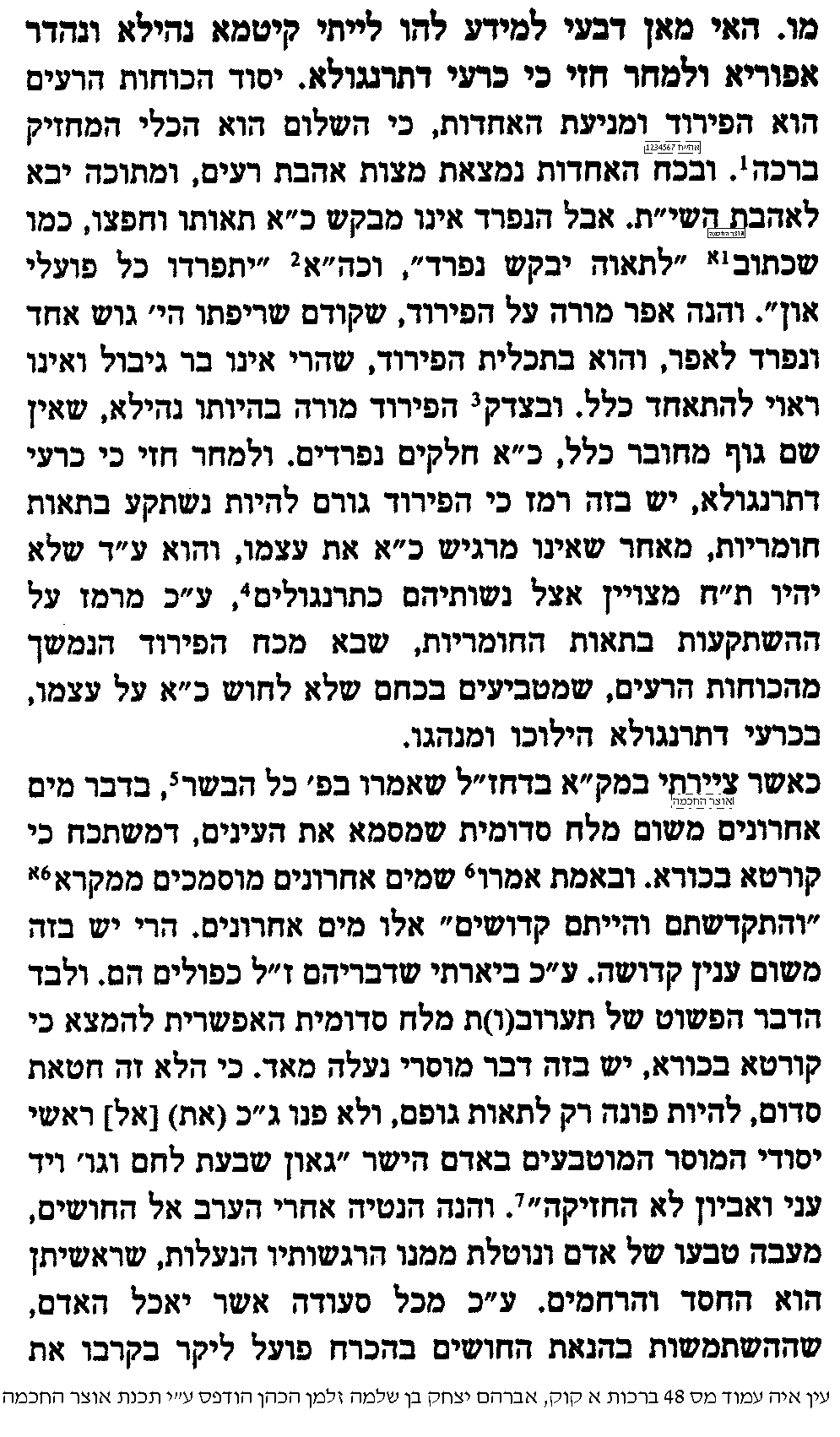
On one of the recent Sabbaths we studied in class the passage in Ein Ayah by Rabbi Kook that deals with the algorithm for detecting demons in Berakhot 6a in the Talmud. The Talmud says there that in order to see the traces of their footsteps one should scatter ash before the threshold of the door and inspect in the morning. And on this Rabbi Kook writes in section 46:
 |
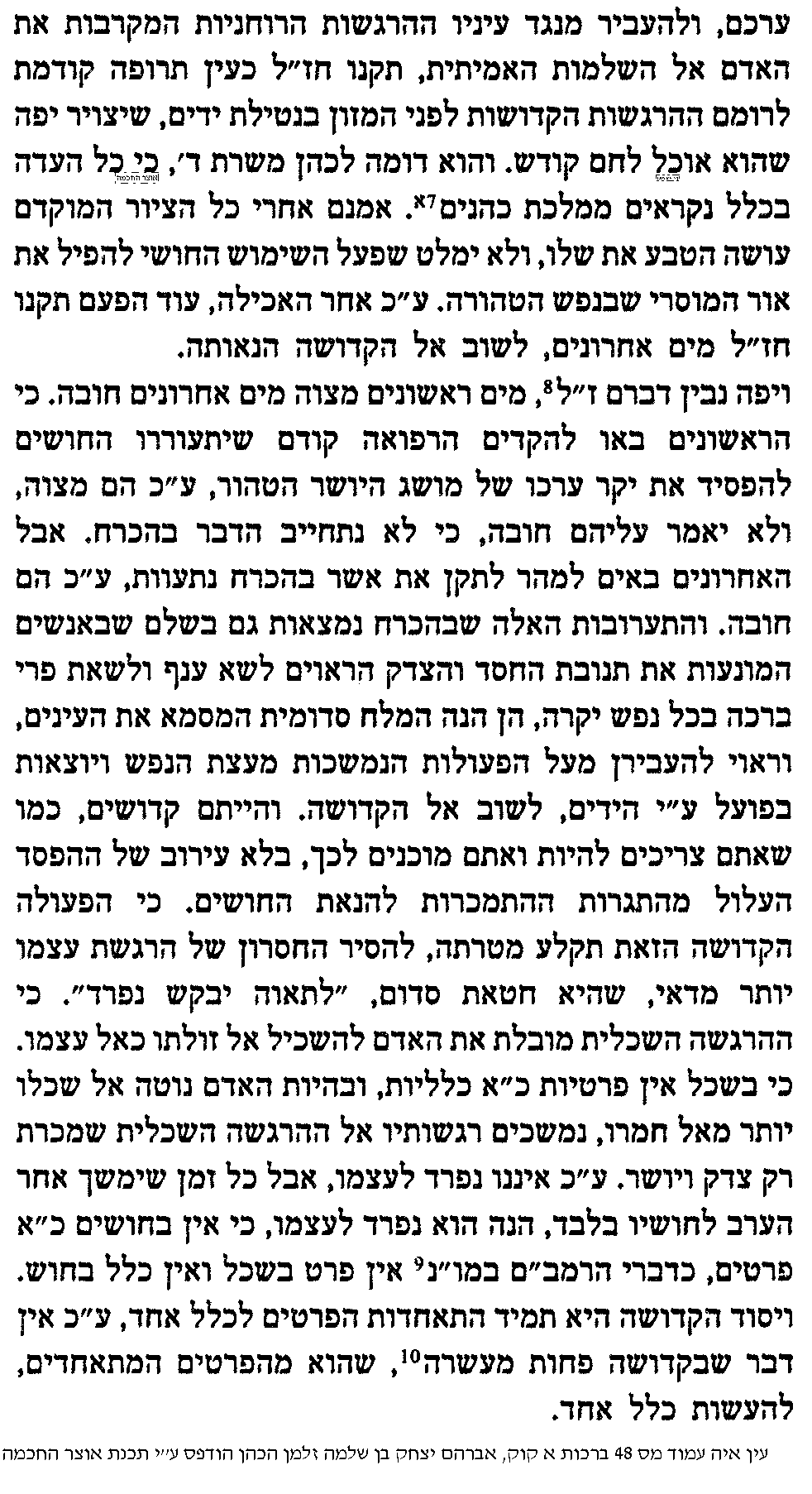 |
One of his claims here is that altruistic behavior is rooted in seeing oneself as an organ within a broader collective, whereas egoistic behavior is rooted in an individualistic self-conception. He also cites the Guide of the Perplexed , which argues that "there is no particular in the intellect and no universal in sense perception" ("there is no particular in the intellect and no universal in sense perception"). Someone who follows the senses sees every object as an isolated entity, that is, through an individualistic perspective. Intellectual contemplation, on the other hand, enables one to grasp collections of objects as a collective entity. Therefore, in order to discern the demons and harmful forces that cause impulsive behavior, one uses ash, which symbolizes separation. Ash does not cohere (that is, if you soak it in water, no lump of mud is formed, only a collection of wet granules). Earth, by contrast, which is the fertile and positive element, is an intellectual element, since it does cohere (soaking it in water turns it into a lump of mud).
"There is no particular in the intellect and no universal in sense perception"
Rabbi Kook relies here on a statement by Maimonides in the Guide of the Perplexed. Maimonides there draws a very important and very profound distinction between the intellect and the senses. Intellectual treatment of concepts or ideas is always in general terms. When we describe an object or a concept, we always do so in terms of its properties. But a property is always a general concept. When we say that the table is long, low, has four legs, brown, useful, and the like, we have characterized it in terms of general concepts that concern groups of objects: the group of brown things, of long things, of things with four legs, and so on. The table belongs to each of these groups. A full description of the object will include enough group-characteristics such that their intersection yields only one object (otherwise the description does not uniquely identify the object before us). The same is true when we explain some phenomenon: the explanation is always given in terms of general principles. According to Carl Hempel, a scientific explanation of a phenomenon is always deductive-nomological in character, that is, one explains a phenomenon by means of a general law (= nomos), from which the phenomenon can be deduced as a particular case. For example, this body fell to the ground because of the gravitational force that exists between any two bodies with mass. If one adopts this general law, the specific phenomenon under discussion can be derived from it as a particular case. If the explanation is not given in terms of general principles, it is not an explanation.
By contrast, observation of an object or even of an idea (or an idea presented before our consciousness) is always individual. I see Reuven, Shimon, the specific table before me, or one specific event or another. The senses apprehend concrete reality, and only the intellect ties it to general ideas or to the characteristics of groups of specific particulars.
In the second section of my book Two Carts I explained that this distinction is related to Bertrand Russell's well-known analytic distinction between two modes of referring to objects: by description and by name. Referring to an object by description means giving a collection of features that can identify it sharply and clearly. Each of those features links our object to an entire group of objects (that resemble it with respect to that particular feature). Referring by name, on the other hand, points to the specific object without any connection to other objects. Therefore a person's or object's name has no meaning. It does not describe; it points. An arbitrary name is attached to an object or person so that we can point to it in a particular and individual way.
From this it follows that, unlike a name, a description has meaning. When I say "the first prime minister of the State of Israel," I have referred to David Ben-Gurion by means of a uniquely identifying description (there is no other person who fits that description). Each detail in this description is a property or predicate, and as such it does not single out one object but a group of such objects. Head — that is a term for the heads of various groups or bodies. And the same is true of the concepts government and state. (By contrast, the State of Israel is already a name and not a description. In fact, it is more accurate to say that it is a nominal description: the state whose name is Israel.) If I had used only some of those properties — that is, if I had described him as a prime minister, or even as a prime minister of the State of Israel — I would have described him correctly, but not uniquely (there are other figures who fit those descriptions). But the totality of the features creates a uniquely identifying description. Each of those features has its own meaning, and the combination of the meanings (the intersection of the groups) uniquely identifies the object we have described.
This is one form of reference. But one can refer to that very same person in another way, simply by saying his name: David Ben-Gurion. Reference by name does not concern the descriptions and predicates that apply to him jointly with other objects. A name is a specific reference to the individual himself, isolated from those who resemble him.[1]
This is what Maimonides means when he says that there is no particular in the intellect and no universal in sense perception. The sense sees the specific person or object, and the linguistic reference to what is perceived by sense is the name. This is "there is no universal in sense perception." By contrast, the intellect sees the person, object, or event in a more general context, and classifies it through general characteristics. Therefore, "there is no particular in the intellect."
The Meaning of This
Rabbi Kook's claim is that the morality of our behavior is rooted in the use of the intellect as opposed to the use of the senses. We have seen that a simple use of the senses sees separate human beings and relates to them as individuals. That is the picture in its plain sense, as the senses see it. By contrast, as we saw above, the use of the intellect enables us to see them as organs within a collective organism (the human being is an organ within the collective called humanity), and in fact compels us to see them that way.
From another angle, I would put it this way. The collective is an entity that cannot be grasped by the senses, and therefore radical empiricists deny its existence. At most, they see it as a useful fiction. What collectivists and Rabbi Kook call the use of the intellect is regarded by empiricists as nothing but the operation of imagination. This is essentially a dispute between radical empiricism and rationalism. The rationalist is willing to see the conclusions of his intellect as claims about the world, whereas the empiricist sees them as subjective imaginings. In his view, only sensory observation is a basis for claims about the world.
For this reason, radical empiricists see the general laws of science as claims about us rather than about the world, since no one has ever seen gravitational force, frustration, or an electromagnetic field. We see concrete phenomena that are derived from these theoretical entities (for after all, there is no universal in sense perception), and from them infer their existence (because there is no particular in the intellect). The rationalist thinks they do in fact exist, because in his view the intellect that reached these conclusions is a tool for knowing the world, whereas the empiricist claims that this is only our subjective processing of sense data, and not a claim about the world itself. This is again an expression of the Maimonidean principle that there is no particular in the intellect and no universal in the senses. The empiricist, who privileges the senses, sees individuals, whereas the rationalist tends toward a collective perspective, because he sees the individual as an organ within a collective, that is, within a broader group (which shares his characteristics, or at least some of them).
Targeted Killings
In column 5 I used a similar argument to explain why there are disputes between people on the right and people on the left over questions that seemingly are unrelated to policy and politics, such as the question of targeted killings, which is a moral-security question. I explained there that underlying these moral positions is an ontic conception: the Right sees the Israeli-Palestinian conflict as collectives fighting one another, and is therefore prepared in certain cases to accept harm to individual persons who are not guilty (uninvolved parties) in order to win the war (I explained there that, given its ontic conception, the legal category of a pursuer applies to them). The Left sees the world through "empiricist" lenses, and therefore from its perspective this is harm to an uninvolved party, which is of course morally forbidden (for on its ontic view this is saving oneself at the cost of another's life, which is of course forbidden).
This was an example of translating a moral claim into an ontic claim: what at first appears to be a moral dispute turns out to be a dispute over a metaphysical worldview. Everyone agrees that one must not harm an uninvolved party, and everyone agrees that there is justification for harming a pursuer. The question under dispute is the status of the individual uninvolved Palestinian: is he indeed a third party, uninvolved, or is he a pursuer? But that is no longer a moral dispute, but an ontic-metaphysical one.
Back to Our Topic
At first glance, Rabbi Kook in the words cited here broadens the scope and grounds all morality in an ontic-metaphysical picture. For him, someone who performs an altruistic act for the sake of another is in fact proceeding from a collectivist-intellectual worldview. And someone who does not behave this way is simply not an intellectual person but a sensuous one — or, in my terms here, an empiricist rather than a rationalist.
It is important to understand that these are not synonymous distinctions. The distinction between a sensuous person and an intellectual person sounds like the distinction between a fool and a wise person. But the second distinction is between two worldviews held by intelligent people. The question is whether you cling to the senses or are prepared to accept the intellect as an instrument for knowing the world. That is a question of philosophy and worldview, not of wisdom or stupidity. It seems to me that Rabbi Kook mainly intends the second distinction.
The Problem with Rabbi Kook's Approach
As stated, this is apparently only an expansion of my remarks about targeted killings. If I suggested there that an ontic dispute lies at the basis of the moral dispute, Rabbi Kook argues that this is so regarding morality in general. Every moral action is driven by a collectivist ontic conception. But with this expansion I do not agree at all, and I would even say that it is highly objectionable.
One could attack his remarks empirically, and say that there are many people who espouse metaphysical individualism and empiricism yet behave morally. The link between metaphysical individualism and morality does not withstand the test of the facts. But that is not necessarily an objection to him. It may be that those people are really covert collectivists. They themselves are not aware that they do in fact believe in collectivism.
I make a similar claim in the fourth notebook regarding morality. I explained there that a consistent moral outlook is impossible for materialist atheists, but factually it is clear that quite a few people who espouse such views do behave morally. I explained there that, in my opinion, they are simply inconsistent. They are covert believers; that is, even they themselves are not aware of their belief in God, but their actions reflect such a belief (or simply inconsistency).
Two Problems
In my opinion there are two serious problems in Rabbi Kook's analysis, both in his conception of wickedness and in his conception of righteousness:
- On his view, the wicked person is not wicked at all but merely mistaken. He holds an incorrect worldview or metaphysics, but what does that have to do with wickedness? He simply acts in accordance with his metaphysical view (albeit a mistaken one). Why should a person who holds an incorrect metaphysics be considered wicked? This is exactly like the dispute over targeted killings, regarding which my own remarks really imply that we are dealing not with a righteous person and a wicked person, but with two different metaphysical conceptions held by righteous people. It is a moral dispute, not a dispute between righteous and wicked people. The problem is that for Rabbi Kook this applies to every moral dispute, and therefore on his view it turns out that there are no wicked or righteous people in the world at all. There are only those who are mistaken and those who are correct in their metaphysical conception.
- On his view, the righteous person is not righteous either. For on his view the righteous person is an egoist exactly like the wicked person; the difference between them lies only in the question of which entity your egoism is directed toward. If you see yourself as an organ within a collective, then your egoism is directed toward the good of the collective, just like an ant or a bee in a colony. And if you are an individualist, then your egoism is naturally directed only toward yourself. Once again we find that the righteous person and the wicked person are both egoists, and the difference between them lies only in the metaphysical picture they hold. It is implausible that this is what defines righteousness or wickedness.
These two problems in Rabbi Kook's picture can be summed up by saying that he falls into the naturalistic fallacy. He grounds the moral norm in facts. But morality is a category different from the factual category. Beyond the facts there is always a normative principle that defines us as righteous or wicked. The facts themselves cannot by themselves be responsible for those definitions.
And yet, one must understand that the two problems I have presented here are not symmetrical. In the first problem, he seems mistakenly to focus on facts instead of ethics, that is, he falls into the naturalistic fallacy. That problem exists with respect to righteous and wicked alike. But from the second problem something more extreme emerges, which concerns mainly the righteous: not only is it impossible to characterize the two types morally, but it also seems from here that both are in fact wicked. After all, both act in a clearly egoistic manner, and the difference between them lies only in the question of who the "I" is whose welfare the egoist seeks.
In Rabbi Kook's remarks here there is both a naturalistic fallacy and a pessimistic view (as though all people are egoists, that is, as though there are no righteous people in Sodom). In the next section I will sharpen further the meaning of the second difficulty.
Altruistic Acts
In column 120 I addressed the question of whether there are altruistic acts. I argued there that anyone who accepts the existence of a moral category must assume that a person can sometimes act without a motive. A moral act is done for the sake of an end and not out of a cause. An action done out of a cause is not moral, because the person did not decide to perform it. An action for the sake of an end is one that a person decides upon in striving for the end that appears proper in his eyes (that fits his values).
The second difficulty I raised above in effect denies the existence of altruistic acts. We are all presented there as egoists who act out of self-interest and self-concern. So not only is there a confusion here between facts and values and norms, but there is also a general pulling of the ground out from under the very possibility of moral action, which by its essence is supposed to be altruistic — that is, done for the sake of the other and not for my own sake (or for some interest of my own).
See in this regard Y.D.'s remarks in his comment here on my article that dealt with the full and empty cart of liberalism, and also my response immediately afterward. This article is an expansion of my answer there.
[1] Of course there are people with a similar or identical name (in Talmudic terminology: "two Joseph sons of Simon in one city" ("two Joseph sons of Simon in one city")), but then as far as I am concerned the name has to include more of the lineage (Joseph son of Simon son of Israel son of David) until a uniquely identifying description is obtained. A name, by its essence, is particular reference.