

A Look at Postmodernism and Truth – fake news (Column 53)
From the essay on Athens to the distinction between bias and fake news
The essay opens with a historical example: the same political figures in Athens were described by different historians, at times as righteous and at times as scheming, because the very same actions received different interpretations according to political positions. From here, the rabbi notes that there is indeed almost no completely neutral report: historians, journalists, judges, and everyone else color reality through their worldview. But it still does not follow that every report is fake news. To speak about FN, he says, two more precise conditions are needed: not merely a different interpretation but a distortion of the facts themselves, and not merely error or unconscious bias but deliberate, agenda-driven lying.
The internet did not necessarily worsen everything—it changed the type of problem
The essay describes the internet age as a paradoxical condition: there is more information, more testimony, and more channels of mediation, but less control over their reliability. In the past, information was concentrated in the hands of a few—journalists and editors—so there may have been less deliberate factual fabrication, but also less balance and less ability to correct monochromatic interpretive bias. Today both dimensions are wide open: interpretations are highly diverse, and the facts themselves are sometimes presented irresponsibly. On the one hand, a multiplicity of interpretations can actually help a critical reader form an independent view; on the other hand, when the facts themselves conflict, we end up in a situation akin to “two against two,” where we have no direct access to reality, only to intermediaries.
Why the postmodern conclusion is too hasty
Faced with this confusion, postmodernism offers what seems like sobriety: if everything is biased, then there is no truth, only narratives. The rabbi accepts the partial starting point—indeed, all our judgments are saturated with assumptions and hermeneutic circles—but rejects the conclusion. The fact that human judgment depends on prior positions does not require us to discard the concept of truth or turn every position into a subjective story equal to all others. The more correct conclusion is a constant effort to criticize our sources of information, to neutralize our biases as much as possible, and to remain aware that even critical judgment itself is never fully immune.
Skepticism with a question mark versus doubt that turns it into an exclamation point
To sharpen the alternative, the essay distinguishes between skepticism and radical doubt. Skepticism is a healthy stance: it rechecks itself again and again, fears excessive certainty, and leaves a small question mark at the end of every claim. Radical doubt, by contrast, turns uncertainty itself into a rigid ideology and loudly declares with certainty that there is no truth, or that there is no way to reach it. In the rabbi’s view, this is a destructive move, because it does not merely describe the situation but also deepens and produces it.
How postmodern relativism gives practical license to fake news
The essay adds that postmodernism is not only a theoretical mistake but also a mechanism that legitimizes lying in practice. If there is no truth anyway, it becomes easy for journalists, public figures, and activists to permit themselves to present a partial picture, hide inconvenient data, and justify it by saying that the other side does the same. Thus even diversity in information channels, which is supposedly a remedy, can become part of the disease: every distorter reassures himself that he is merely “balancing” a competing narrative. In this sense, postmodernism builds for itself the very world it claims merely to diagnose.
The Israeli-Palestinian conflict as an example of a world where narrative overrides facts
From here the essay moves to a central contemporary example: discourse about Israel and the Palestinians. The rabbi argues that the Palestinians invent for themselves history, heritage, victimhood, and fabricated facts, and that the world adopts this easily because discourse no longer examines who is right but who appears to be the underdog. Added to this are post-colonial guilt feelings, politically correct culture, and a consistent preference for the supposedly weaker narrative even when it is blatantly false. Therefore, in his view, facts, history, and questions of justice are pushed aside in international discourse by spin, image, and identity-based classification.
Political correctness and academia: not always conscious lying but replacing reality with wishes
The essay brings examples from Western academia to show that sometimes the problem is not דווקא malice or conscious propaganda, but deep captivity within a postmodern language. When a lecturer or student voices absurd claims about terror, Hamas, or Israel, it may be that they are not lying maliciously but truly live in a world where narrative equality replaces checking facts. For them, the mere fact that a certain position is “not equal” or “does not respect a narrative” is enough to disqualify it, even if it describes reality correctly. The rabbi sees this as an extreme example of how intellectuals can believe absurd ideas when they are wrapped in moral and fashionable language.
The New Historians: from criticizing myths to erasing the difference between truth and falsehood
The rabbi then returns to the internal Israeli debate and the phenomenon of the “New Historians.” He concedes that shattering myths and exposing silenced zones can sometimes be a welcome move, but argues that this school moved from specific criticism to a sweeping conclusion: that there is no historical truth, only competing narratives. Once one adopts that framework, an artificial symmetry is created between the Zionist and the Palestinian, between aggressor and victim, between falsehood and truth. In his view, even if the theoretical foundation of this approach has weakened in academia, its political legacy is still very much alive in public discourse.
The Zionist ethos also sold us falsehoods, but not every correction justifies equality between narratives
The essay stresses that the critique is not one-sided: Israeli society and the Zionist ethos also sold themselves overly clean stories—about absolute purity, about never harming Arabs, and about our justice without qualification. The multiplicity of information in our time has indeed exposed that our own narrative too contains shadows, interests, and distortions. But the rabbi opposes moving from that recognition to the postmodern conclusion that “everyone is the same.” In his view, the mere existence of lies or gray areas within a certain camp does not erase the possibility of judging who is more right on the larger questions.
Four ways to respond to a complex picture—and a clear preference for the fourth
Toward the end, the essay proposes four possible responses to a worldview that has begun to crack: reject the whole framework because of its shadows; cling to the old framework and ignore the shadows; declare the framework a “narrative” that is not subject to refutation at all; or recognize that the picture is more complex, that it contains light and shadow, and still form a principled, non-dogmatic position willing to stand critical testing. The rabbi rejects the first three options and adopts the fourth. The difference between it and old dogmatism is twofold: it does not deny the difficulties, and it does not ascribe absolute certainty to itself.
From politics to religious tradition: criticism of the postmodern defense of faith
He says this move is also correct regarding religious tradition. One can leave tradition because of difficulties; one can fortify oneself within it and ignore them; and one can, in a postmodern spirit, present faith as a subjective narrative that does not claim truth and therefore cannot be refuted. The rabbi sharply criticizes the third option, mentioning in this context the path of Rav Shagar: true, this saves faith from refutation, but only at the price of emptying it of content, because it ceases to be a claim about reality and normativity and becomes merely an identity story. Therefore, with respect to tradition as well, he recommends the same fourth way: confront the difficulties, build a more complex picture, and remain ready for renewed examination.
The practical conclusion: do not deny doubt, and do not surrender to it
The essay’s final conclusion is that there is no human way to avoid doubt, biases, and intermediaries altogether. But from that fact it does not follow that we should declare the death of truth, nor that we should shut ourselves inside ideological certainty. The proper stance is to live with a certain degree of doubt, to criticize ourselves and our sources of information, to correct where necessary, and nevertheless not to give up on the very attempt to distinguish between truth and falsehood, between what is right and what is misleading. In the rabbi’s formulation: skepticism—yes; radical doubt—no.
With God’s help
In an interesting article I read this Sabbath,[1] Rachel Tzelnik Abramovitz (from the Department of Classical Studies at Tel Aviv University) describes the difference in the way ancient historians related to two central political figures in fifth-century BCE Athens, Aristides and Themistocles. Regarding each of them we find descriptions that portray him as a virtuous man, and others that see him as a schemer and populist. Her conclusion is that the differences in the descriptions of the two figures stemmed from rivalries and from differing political worldviews. Sometimes the very same modes of conduct receive opposite interpretations (for example, advancing the status and influence of the broader public at the expense of the aristocracy is seen by some historians as populism, and by others as democracy at its best). The article reminded me of the phenomenon of fake news, which has been in the headlines lately, and prompted a few thoughts about it.
Fake news
There are sites on the internet known as fake news sites (= FN), whose purpose is to spread forged, fabricated, and distorted news for various reasons (usually in order to generate web traffic). The term made headlines during the last US presidential race (Donald Trump versus Hillary Clinton), when various sources circulated false reports in order to promote their preferred candidate and damage the other one. Since then the term has not left the headlines. Trump accused many of spreading FN, and is himself accused of it (see the cartoon below).
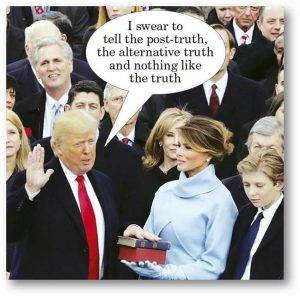
An illustration of the FN phenomenon, this time in a parody of Trump.
But the phenomenon of FN is not new, and it is also rather hard to define. Journalists, and even historians, when reporting events, tend to color them differently according to their worldview and their agenda. Over the past century this has become a worldview and even an ideology, as those who subscribe to what is called postmodernism speak of there being no truth, only each person’s own narrative. The more extreme among them claim that there really is no such thing as history or news reporting, and that everything is tendentious narrative. Note that they do not mean to say that everyone is wicked, but rather that we have no other option. We are captive to our conceptions and worldviews, and therefore one should not expect fair and upright reporting from anyone.
And yet, setting aside that bizarre sect, there is a certain truth in what they say. One really does see that people report events and interpret them in ways that depend on their worldview. This is true of historians, journalists, and everyone else. Even in Israel’s Supreme Court we recently received a fine example of the matter, in the petition against the Amona plan, heard by Justices Neil Hendel, Salim Joubran, and Yoram Danziger. For some reason, after a professional, matter-of-fact, and impartial legal discussion, the decision reached was to freeze the plan. Dear reader, guess how the opinions divided: what was Neil Hendel’s view (the religious judge)? Salim Joubran’s (the Palestinian)? And Yoram Danziger’s (the secular Jew—precisely the sort one expects to find on the High Court)? Indeed, you guessed exactly right (I also know what you guessed, and it probably does not even depend on your worldview but simply on familiarity with reality). So who said High Court decisions depend on worldviews?! Everything is purely professional. Incidentally, who do you think determined the result of that petition: the judges? Not at all. The one who assembled this marvelously balanced panel (allow me to wager that it was not accidental) largely dictated the result, and this is only one example among quite a few.
So what are fake news?
The conclusion is that one really cannot accept any report or information as unbiased. Everything that reaches us is colored by the channel that mediates it to us. But this raises the question whether every news item is fake. What exactly do we mean when we say FN?
It seems to me that when people speak about FN they mean something more specific. First, this is not about a difference in interpretation given to actions, but about inventing actions that never happened at all. The difference is in the facts, not in the interpretation. Second, even when there is a difference between the treatments given by historians, jurists, or journalists, I would like to believe that this usually happens unintentionally. But in cases of FN it happens deliberately, meaning that we are dealing with intentional, tendentious distortion of facts. That, and only that, is what should be called FN.
But does that matter? At the end of the day, the information that reaches us is unreliable, whether by accident or on purpose. So what do we do? Apparently everything really is fake. This is indeed what those who advocate postmodernism sell us. If everything is biased, we should not ignore that. We must grow used to there being multiple truths, with no one right and no one wrong, and to the fact that no information reaching us can be believed. Every bit of information presented to us is nothing but a subjective narrative.
Fake news then and now
In the internet age we are indeed flooded with information, but we have less and less control over its quality. The web is fertile ground for distorters of all kinds, and sometimes we lose the ability to know which of them is speaking truth and what the truth is. You can no longer know who is deceiving whom, or which report can be trusted and which cannot. The web is made of piles upon piles of distortions, but the visual immediacy it allows (‘I saw it with my own eyes’, ‘I read testimony from unbiased eyewitnesses’) makes all of this look credible and persuasive.
Is our current situation worse than it used to be? I am not sure. In the past, the lines of information were in the hands of a small minority that controlled them—a few journalists and editors—who were supposedly more reliable because, as journalists, they were expected to conduct themselves according to ethical rules and were under some degree of supervision (the Press Council, guild rules, and libel laws). But at the same time, if someone in that minority did not act properly, whether intentionally or unintentionally, there were no alternative channels of information to provide proper balance. We were all captive to those same journalists, for better and for worse.
It seems to me that the change in our time exists on both of the planes I described above (facts versus interpretation, and deliberate versus inadvertent), but their effects differ from one another. True, fewer information channels used to give us false information deliberately, since oversight over that is relatively easy and effective (though of course not perfect). But the coloring and interpretation given to events were entirely in the hands of the journalists and editors, and they, as is well known, had very definite and quite monochromatic worldviews. By contrast, in the age of the web both the interpretation and the factual description are completely unrestrained. As for interpretations, we receive a broad variety, and even if each is biased and agenda-driven, the balance and diversity can give us tools to read the different arguments critically and form a position of our own. But with regard to facts, the situation seems truly hopeless. People describe patently false facts without batting an eyelid, and even if another information channel gives us different facts, we have no tools to know who is right and who is wrong or misleading. In the case of interpretation, we can exercise judgment, hear the considerations on all sides, and form a position. But with respect to facts, our own impression has little value. Facts must be known, not formed. Yet the facts are not accessible to us except through various intermediaries. This is what Jewish law would call a situation of ‘two against two’ (when there is a set of witnesses—the best possible clarification there is—for each of the two opposing directions). Well, that is quite a headache.
Is postmodernism right?
What does one do in such a situation? The postmodernist joyfully announces that we have no choice but to wake up and join the forces of light (those who recognize that there is no truth and everything is narrative). The only way out left to us is to exercise judgment and form a position about the information according to our impression of its reliability. But that impression itself, of course, also depends on starting point, worldview, and basic assumptions. The problem of the hermeneutic circle accompanies us at every step of everyday life.
Our world has for some time been moving toward a postmodern conception that advocates a plurality of truths, and it is supposedly more sober and less naive. Many feel that we truly have no way of knowing what the truth is, and they fall into the arms of postmodernity. Their feeling is that this is the sober conclusion in light of the situation. In a world like ours, relativistic postmodernism is the absolute truth.
Is there an alternative? I think that at least partially there is. True, there is no avoiding taking the decision into our own hands—that is, deciding for ourselves what the facts are. But is that not itself the postmodern recommendation? That each person should formulate his own facts for himself? Postmodernism refuses to accept the possibility of exercising judgment regarding our sources of information. But that itself is a rather hasty conclusion. Almost every conclusion we reach about the world is saturated with basic assumptions, but that does not mean we must throw all those conclusions away or see them as subjective narrative. We should try to form a position, neutralize our assumptions as much as possible when it comes to facts, and at the same time be aware that our judgment is biased and standpoint-dependent. We must constantly reexamine the facts as we know them, and check again and again whether what we hold is merely something very convenient for us to believe, without any real evidence that it is true.
Those of a more skeptical bent among us say that we have not solved the problem, since this judgment itself (regarding our assumptions and our sources of information) is also tainted by biases and agendas, and therefore there is no way out. But that is a black-and-white way of seeing things, and it seems to me exaggerated even in our time. True, we must be skeptical, but it is wrong to identify skepticism with radical skepticism.
Between skepticism and radical skepticism
Skepticism checks itself again and again and is wary of feelings of certainty (for these are usually illusory); that is, it leaves a small question mark at the end of every claim. But radical skepticism turns the question mark into an exclamation point: it loudly proclaims the one certain truth and none besides it—that there is no truth, or at least no way for us to reach it. Skepticism is healthy and correct, and, as noted, our present condition even requires it. But radical skepticism is crippling and destructive. It turns this condition into an ideology, and in fact itself contributes to creating and intensifying it. Postmodernism builds itself, while at the same time proudly declaring its own justice. This is not a diagnosis of the human condition but an approach that constructs itself into it.
Postmodernism constructs itself
Postmodern radical skepticism itself gives license to FN, for if there is no truth anyway, then one can say whatever one wishes. If there is no truth, then by the same token there is also no falsehood, of course. In a postmodern atmosphere, journalists allow themselves to present a partial and distorted picture simply because it advances their worldview, and they conceal information that interferes with that worldview. If reporting cannot in any case be true, that gives ideological sanction to lies and distortions. The diversity of information channels, which is supposedly a blessing, also serves to whitewash the whole business, for every person who distorts information reassures himself by claiming that his opponents do the same and that he must balance the picture. A newspaper like Haaretz can present a partial and distorted picture to one side on the grounds that Israel Hayom or Makor Rishon present a picture biased to the other side. The diversity of channels and the abundance of information, which are ostensibly blessed phenomena that ought to address the confusion I have described, in fact not only do not solve the problems, they also play a role in creating and intensifying them.
Who profits from all this? A bit of current affairs after all
Those who benefit from such a situation are the liars. They feel at home in this ocean of lies, and in fact they flourish precisely in this stagnant puddle.
We have a very close example. Our Palestinian cousins invent for themselves a history and a heritage out of thin air. They make a carnival out of the Philistines in order to create an ancient Palestinian-Philistine heritage, and nobody says a word. They can make claims that are utterly baseless factually—not only about their glorious heritage, but about oppression, exiles, massacres, desecration of holy places, and the destruction of the al-Aqsa Mosque—and nobody says a word. They bring pictures of children supposedly slaughtered intentionally by Israel’s Nazis, and it is no wonder that these FN take hold in the brainwashed minds of people throughout the wider world. After all, they saw pictures, did they not? The ‘facts’, after all, say that Israel slaughters Palestinians by the thousands, deprives them of their rights, destroys Haram al-Sharif every week, does not allow freedom of religion and worship, and of course also violates Palestinian property rights. In the world of FN, the Palestinians are simply innocent sheep being slaughtered for no fault of their own. They are really champions of women’s rights, of freedom of worship and property, a glorious democracy. That is also how the idea of the ‘occupation’ took root. No one in the world remembers any longer that the Palestinians were never the sovereigns of the occupied territories. No one remembers who started the wars against us, who is right and who is not. The discussion is not about who is right, only about who is miserable. Who remembers that the 1967 lines are arbitrary and have nothing to do with the UN decision of 1948? Talk about justice and facts has long ceased to be relevant in global discourse. Spin answers everything. Incidentally, on our side too.
Add to this the fact that the Palestinians are the underdog: Israel is a military and technological power, and they are miserable and helpless, lacking rights and lacking a state. This feeling is fueled by postcolonial pangs of conscience in Europe, and therefore the natural inclination—especially among those educated in Christian culture—is in their favor. Facts play no role whatsoever. It is no wonder that postmodern criticism and thinking (?!) are much more common throughout the world in left-wing circles. They use facts for their purposes quite freely, present meaningless numbers with creative interpretations (such as comparing the number of casualties in Gaza to those in Ofakim and Sderot), and juggle the facts in a way that is perfectly politically correct.
It is rather amusing to see those same leftists drawing cartoons like the one of Trump shown above, in which they themselves, the knights of narrative discourse and alternative truths, accuse him of spreading FN. Many have already written and said that Trump rose to power on the waves of disgust toward political correctness (PC), which so characterizes the left-wing establishment, and now, in a kind of ironic inversion, he himself is accused of exactly that (and it seems to me with some justice, though I have heavy suspicions regarding everything that comes out of these ‘information’ sources).
Different expressions of this phenomenon
A particularly bizarre expression of the phenomenon of political correctness replacing facts can be seen in this video, in which an American commentator named Dennis Prager speaks at a conference held in Oxford. The conference dealt with the fascinating question of who does more harm to peace: Israel or Hamas. But what chiefly concerns us here is the woman questioner there, who for almost the entire talk can barely contain herself. It is clear that she is convinced she has a knockout question that will send the speaker to the mat in a breath. Eventually she is allowed to ask it, and you will not believe what you hear. She asks Prager (with an expression of triumph and undisguised delight at the knockout she expects to deliver): why does he mention only violent Arab or Muslim terrorist organizations? Indeed, she caught him red-handed.
If such a question were asked in kindergarten, the child asking it would be thrown out or kept back another year. But it is worth remembering—though it is a bit hard to believe (for all we know, perhaps it is a cooked video, FN)—that the questioner here is a professor at Oxford University. How can one understand this astonishing phenomenon? It may be that we are dealing with a woman whose intelligence is that of a worn-out slipper (in any case, I would wager she does not belong to one of the physics or mathematics departments there). It may also be that she is receiving a salary from the Palestinians, or from ordinary antisemites, and is brazenly lying. The problem is that such statements are quite common there in Oxford, as in other leading academic institutions around the world. It is unlikely that all of them are endowed with intelligence or wickedness at such levels. Therefore it seems to me that the correct interpretation is different, and more troubling. It may be that we are dealing with a woman captive to the delusions of narrative political correctness. For her, desires (the politically correct ones) replace facts. For her, it cannot be that the phenomenon of terror and violence exists only on one side of the global map. That is not egalitarian. After all, we are all human and all equal, are we not? So how does that wicked demagogue (Prager) mention only Muslim and Arab beheaders? Why does he not mention the dozens and hundreds of murderous organizations operating openly in Britain, Japan, the Netherlands, Australia, Canada, China, Germany, and, of course, Israel? He crudely ignores Christian, Jewish (Bentzi Gopstein, as already noted?), and atheist organizations that behead people all over the world before the cameras, and for some reason focuses specifically on Muslims and Arabs. Pathetic distorter. What is most troubling is that this idiot quite clearly is not lying. She genuinely believes that this is an excellent question. These people are living inside a postmodern movie. Real internet-noir. George Orwell once said that there are ideas so foolish that only intellectuals can believe them.
See another example in this video, in which a student from an American university attacks the lecturer who linked her student organization to the Muslim Brotherhood and to terrorism; when he asks whether she condemns the terrorism of Hamas and Hezbollah, she replies that she cannot support them because she fears for her life. At first I thought she meant that she cannot condemn them because she fears for her life, but no—she says that she cannot support them. In addition, she offers another gem: she supports the extermination of all the Jews in the world (efficiently, by concentrating them in Israel), all this together with the claim that her positions have nothing to do with terrorism. This is while the Palestinian Authority—the moderate part of the Palestinians—is perceived as murdering whoever opposes it. And none of this prevents her from protesting the link made between her and terrorist organizations and declaring that Israel is not a democratic state (certainly not in comparison with Hamas and the other serene democracies around us, which naturally enjoy the sympathy of the enlightened world). Such absurd statements trouble no one, because logical consistency and facts long ago ceased to play any role in public discourse—especially around our absurd conflict with the Palestinians, in which the aggressive, corrupt, primitive, and violent side wins the world’s sympathy because of its ‘narrative’.
The New Historians and post-Zionism
About twenty or thirty years ago, the phenomenon of the New Historians began, and they explained to us that there is no factual truth, only narratives. Most of them presented facts selectively, and tried to show that history is nothing but FN. The representatives of this loathsome group in Israel presented the Palestinian narrative without any criticism of its truth. Criticism was directed only toward the Zionist narrative (because only there, apparently, truth in the classical sense had to exist). But even the minority among them who behaved symmetrically were no less destructive. Once positions are presented as competing narratives, truth has no advantage over falsehood, since there is no such thing as truth. It is an outdated and anachronistic concept. The New Historians did not content themselves with shattering myths—which in itself is a blessed act—but turned the question mark into an exclamation point. They declared that there is no right and no wrong, and that everything is a matter of parallel narratives. So there is a Zionist narrative and a Palestinian narrative. Once that is the basic premise, the facts too are colored accordingly. Thus we received bereaved families on both sides, suffering on both sides, desire for peace or for war on both sides, moderates and extremists on both sides, pragmatists and fanatics on both sides, and so forth.
By the way, have you noticed that the phenomenon of the New Historians has disappeared from the map? To the best of my impression, the discourse claiming that there is no historical truth is today the possession of a small and extreme, though somewhat vocal, minority. It seems to me that the historians caught themselves in time, before the prostitution of their profession was complete, and just before they and their discipline would descend from the world stage into the garbage bin of pseudo-history (how good it is that people have interests). But surprisingly, their legacy—at least with respect to the Israeli-Palestinian conflict—is alive and well. The symmetrical treatment of the two sides remains in place, even if the postmodern platform on which it was built is no longer really relevant. With respect to the Israeli-Palestinian conflict, that bizarre egalitarian discourse has remained exactly as it was. The ‘new’ historical thought is no longer particularly popular except in esoteric academic departments, but in political discourse the fabricated symmetry created on that platform has turned from a claim about facts into an ideological perception. We are now told that even if there is truth, it is not important. What matters is the narrative, and we must respect it. True, the Palestinians have a bizarre narrative that has nothing whatever to do with reality, but it is their narrative and they have a right to hold it. Why does anyone have a right to hold a falsehood and make claims on its basis? The postmodernist will say that if everything is false and everything is narrative, then indeed it is meaningless to say that something is false or that it is a fictional narrative. But now, after the age of the ‘new history’, it turns out that there is still very impressive inertia to its ‘achievements’. The respectful attitude toward the Palestinians’ fabricated narrative remains intact even after it is clear to everyone that it is fiction. The discourse remains unchanged. Intelligent people can tell fairy tales confidently before the camera, and nobody says a word because of the obligation to respect their narrative (lest one be suspected of racism, heaven forbid). Historical research is for the most part conducted reasonably (apart from particularly avant-garde ‘thinkers’, who continue with their relativist nonsense), but the political consequences remain as they were. It seems to me that we do not pay sufficient attention to the fact that postmodern and post-Zionist discourse is still alive and kicking, even though its conceptual infrastructure was shattered long ago.
Back to ourselves
Of course, we must be honest and admit that plenty has been sold to us too, and still is. Within the framework of the Zionist ethos, we were sold quite a few tall tales about our absolute righteousness, about how we never harmed an Arab for no reason, that our pre-state fighting organizations acted with perfectly clean hands, that no Palestinians were ever expelled from their lands (they all fled on their own), and more. To this day they explain to us that we are entirely fine and only the Palestinians are disturbing the pastoral calm here. Well, today it is already quite clear that the picture is not nearly as rosy as we once thought. Here, then, is one benefit of the abundance of information and media channels. Despite all the warnings above, it turns out that they also have benefits.
It is indeed true that no one is immune to FN and to self-interested ideological constructions. Even so, with respect to the big questions of right and wrong, aggressor and victim, it is wrong to draw the postmodern conclusion that there is equality between the narratives. This is precisely the turning of a question mark into an exclamation point mentioned above. One of the most basic techniques of postmodernism is to take genuine question marks and, by virtue of them, undermine the entire picture. Thus one can take various disputes in ethics and use them to undermine the existence of agreed morality, or the very validity of morality altogether. Likewise, people take question marks about tradition, or about certain details within it, and on their basis undermine the whole tradition. Similarly, question marks in various sciences ‘prove’, in the mouths of some bizarre critics (= the new criticism), that science as a whole is nothing but speculation. Interestingly, there is here an unholy coalition between religious apologists and feminist critics or activists for various minorities—Mizrahi Jews, blacks, and the like. The former speak about tendentious science created by atheists, and the latter respond with claims about a science built for privileged white males that excludes women.[2]
So what, after all, is the right thing to do with all these insights? Anyone who wants to preserve a sane balance should understand that there is truth, but that it is usually more complex than we think. It contains light and shadow. Therefore, even if we reach the conclusion that in the big picture we are right, it is still true that there are aspects requiring correction and improvement. It is not worth denying their existence, but at the same time it is wrong to give up the ability to form a position and judge who is right and who is wrong or misleading.
Four ways of relating to a complex picture
To summarize, there are four ways to relate to such a complex picture:
- To reject the entire framework because of the shadows. If details in our narrative have broken down, then in fact everything has failed. These are the post-Zionists.
- To adopt the framework and ignore the shadows. These are the classic Zionists who cling to the picture on which we were raised. Of course, these are also a large majority of the Palestinians (as far as I understand), who embrace their picture with far too little criticism.
- To declare the framework a narrative and continue to champion it. That is, to declare that our position is a narrative, and as such it is not meant to stand the test of falsification. Facts and rational considerations are irrelevant to it. This is the Palestinian position among the more clear-eyed of them (Ahmad Tibi has said so more than once), but there are also such approaches on the Israeli Left. These are people who read Haaretz and became convinced that there are problems in our narrative, but still want to cling to it.
- To understand that the picture is more complex than we thought, that it contains light and shadow, and still to form a not overly dogmatic position on the big questions while trying to improve the details.
What is the difference between this position and position 2? It seems to me that the main difference lies in two respects: (a) position 4 does not ignore the shadows; (b) one who holds position 4 knows that even his own stance on the big questions is not certain. It must always stand up to critical scrutiny, and we must be ready to abandon it entirely if it turns out that we were wrong. Neither of these exists in the dogmatism of those who hold approach 2.
Implications for the traditional religious picture
These points are true with respect to the Israeli-Palestinian conflict, but also with respect to our tradition. There are difficulties and hard questions regarding the picture on which we were educated, and one can relate to them in all the ways we saw in the previous section: one can leave the tradition because of them. One can also cling to the horns of the altar of tradition while ignoring the difficulties and the questions. A third possibility is to declare religious faith to be a narrative, thereby presenting it as a position that need not stand rational and empirical testing and therefore cannot be refuted. Nowadays, more and more choose the third path: a postmodern defense of tradition. Rabbi Shagar, of blessed memory, chose this path, and to the best of my judgment he threw the baby out with the bathwater. Faith indeed remains unfalsifiable, but at an impossible price. It has been entirely emptied of content, for it has turned from a collection of claims about reality and normative claims into a subjective narrative that is no more and no less right than its opposite (the atheistic one). You become a Jew roughly the way the Palestinian is a descendant of the Philistines of the Hebrew Bible (Tanakh). That is, of course, a Pyrrhic victory.
All three of these are serious mistakes, and it seems to me that one can see these three approaches in the discussion I conducted here on the site about the missionary video of the ‘Messianic Jews’. Most of the arguments are downright foolish, which makes it very easy for people to cling to approach 2 and adopt our tradition at face value. In some of their arguments they attack a common approach in our tradition regarding the Oral Torah (as though all the details were given to Moses at Sinai), which indeed does not withstand critical scrutiny. The conclusion of the Messianics is that this tradition should be abandoned. Their opponents often prefer to cling to the horns of the altar and ignore the difficulties. But as I argued there, what is more correct is to reexamine our conceptions, try to confront them with the difficulties, and, if necessary, build a more complex and truer conception.
And after everything, even if one adopts approach 4, we must not be afraid of doubt. Many feel that if we allow a certain measure of uncertainty to seep into our worldview (Zionist or religious), we will lose our grip on it. Thus the post-Zionists are accused of distortions—an accusation with some truth in it, but one that allows us to ignore the real shadows they expose. And thus the critics of tradition too are accused of heresy, which allows us not to deal with the relevant claims they raise. It seems to me that here too there is no escape from a more sober conception. We can all be wrong. Not only are there shadows in the picture, but it is possible that even the answers we give to the big questions—even the answers formed through grappling with the difficulties—are not correct. We are human beings, and as such we are condemned to live with some degree of doubt. It is wrong to deny that doubt, but even more wrong to surrender to it. Skepticism—yes; radical skepticism—no.
[1] ‘The Age of the Fathers’ – Image and Reality in Classical Athens, in the collection: Literature and History, Raaya Cohen and Yossi Mali (eds.), Zalman Shazar Center, Jerusalem 1999.
[2] It is worth reading about this in Gadi Taub’s book, Ha-Mered Ha-Shafuf.
Discussion
Many thanks. But before founding the party, please be so kind as to explain to me what “syntants” are? And before founding the Hasidic sect, one has to find a rebbe. Though for a symbolic sum, I assume you’ll find two or three.
Hello Rabbi Michael,
I would appreciate some elaboration or a link regarding the subject that not all the details were given to Moses at Sinai.
Hello Ma’oz. I brought a few sources in my reply to Shatz”l in the talkbacks here: https://mikyab.net/%D7%9B%D7%AA%D7%91%D7%99%D7%9D/%D7%94%D7%AA%D7%99%D7%99%D7%97%D7%A1%D7%95%D7%AA-%D7%9C%D7%A1%D7%A8%D7%98%D7%95%D7%A0%D7%99-igod/%D7%94%D7%AA%D7%99%D7%99%D7%97%D7%A1%D7%95%D7%AA-%D7%9C%D7%A1%D7%A8%D7%98%D7%95%D7%A0%D7%99-%D7%94%D7%A2%D7%A8%D7%95%D7%A5-%D7%94%D7%9E%D7%99%D7%A1%D7%99%D7%95%D7%A0%D7%A8%D7%99-igod-%D7%AA-2/
Read not “syntants” but “synthetic.”
(They need to outlaw this autocorrect.)
I outlawed it.
Straight to processing as an appendix to the next edition of ‘Stable Truth and Not Truth’
Yosef, the other way around: this is adapted from there. 🙂
I would add a tiny footnote regarding the Palestinian narrative. Namely, that a great many people make their living from this narrative, including UN refugee organizations, Palestinian organizations such as Hamas and Islamic Jihad, as well as Jewish Israeli and non-Israeli organizations, usually funded by European money, known as “implanted” groups. All these factors depend entirely for their existence on the continued existence of the narrative, and they will do everything possible to preserve it forever. And if a force is found that can stop or significantly reduce the flow of money in that direction, there is a chance that this narrative will disappear, or at least weaken greatly.
Many thanks for the fascinating article.
I would like to highlight another aspect of the fake-news phenomenon that did not find expression in the article. In an average Western country, the media map is built roughly like this: a number of powerful media outlets with abundant money, talent, and ratings attract most media consumers and purport to represent the entire spectrum of views existing in that country, and the character of their broadcasts is usually aimed at the lowest common denominator. Alongside them, a number of smaller media outlets exist, usually of higher quality, that clearly take a side on that country’s political map. As a result of processes that this is not the place to detail, in recent years even the supposedly mainstream media outlets have become media outlets identified politically in a blatant way, in most cases with the left-wing side, and examples are not lacking—see the 2015 elections in Israel, Brexit in Britain, and of course the elections in the U.S. During them, the media ran blatant campaigns on behalf of one side while carrying out blatant character assassination against the other side and turning its worldview into something insane at best, or racist, fascist, Nazi at worst. In such a situation, the average media consumer whose worldview is attacked morning and evening flees to media outlets identified politically with him in order to escape what he perceives as media filth, and thus it turns out that he is actually more exposed to his own views and less confronted with views opposed to his, which prevents him from getting as close as possible to the objective truth, because in order to do that he must be exposed to the full spectrum of views and from them assemble some picture as close to reality as possible. Recently it was published that in the U.S. there is a rush to bizarre conspiracy sites on the right and on the left, and in my opinion that is the real trouble with the fake-news phenomenon.
Yoram Eshet writes and lectures about learning and filtering information, sifting serious material out of the abundance of nonsense.
For example:
http://www.isoc.org.il/internet-il/articles-and-research/magazine/digital-literacy-a-conceptual-framework-for-thinking-skills-in-the-digital-age
With God’s help, on the eve of the holy Sabbath, “and they too will trust you forever,” 5777
And the fifth way is not to define what we do not understand as “shadows,” but as things we still do not understand. Just as in the study of the natural sciences, when we encounter situations that seem to contradict the known order, we do not cast renewed doubt every moment on the very basic assumption that there are rules and orders; rather, we understand that the rules are more intricate and complex, and we try to understand the order of the world better.
So it is with God’s will as revealed in nature, and so too with God’s will as revealed in the Torah. The apparent difficulties do not lead us to question the truth of the Torah; rather, they call upon us to delve more deeply, both into the expanses of the Torah and into the understanding of reality, and thereby we will stand better upon the depth of our Creator’s will, the giver of the Torah.
As creatures formed from matter, we understand that perhaps we will not fully understand the intention of the Creator and Lawgiver, but we are not free to desist from the constant striving to understand more and more; and when one labors, one understands. Clear understanding grows, and the fog diminishes.
With blessings, S.Z. Levinger
As long as this is only a fifth way (and not the only way, one that comes to freeze thought and the drawing of conclusions), I have no problem with it. The four ways are meant for someone who has already decided there are shadows after checking and thinking. One should remember that almost all of our Torah and tradition is the work of human hands, since even Torah laws, and certainly non-halakhic practices and morality, did not come from the Giver of the Torah but were created by human beings, who can err just like you and me.
After all, one need not be especially wise to dismiss the words of the written and transmitted Torah with a wave of the hand. Any ignoramus who encounters a question he found on some website does not exert himself too much and decides that the tanna’im and amora’im, the early ones and the later ones, were mistaken. It takes a great deal of labor and deep thought to understand the depth of the sages’ words, founded on the principles of the divine Torah. Thus did the great ones of Israel in every generation, and they found pearls that are not revealed through superficial thinking. And even when they did not find an answer to their questions, they concluded, “and this requires further study,” and they asked, “May the Lord enlighten my eyes.”
There is one who asks provocatively, “What is this service to you,” and with brief thought he will conclude that the commandment is the work of human hands, “to you and not to Him, blessed be He”; and there is one who understands that we are speaking of “the testimonies, the statutes, and the ordinances that the Lord our God commanded,” and he will labor for days and years until he merits to understand. May our lot be with them.
With blessings, S.Z. Levinger
Nor does one need to be a great genius to say that everything the sages said is the absolute truth. The question is not what one needs to be in order to say something, but whether that something is true. Note this well.
That loathsome group in Israel—really to that extent? Not polite.
Palestinians—everyone understands that this is a fiction? Not everyone. Certainly not they themselves—the right of self-definition.
The Palestinians have a delusional narrative that has absolutely nothing to do with reality—specify, explain, and demonstrate.
Of course, we must be honest and admit that we too have been fed, and are still being fed, quite a few lies. Within the framework of the Zionist ethos, they sold us quite a few fairy tales about the absolute justice of our cause, that we never harmed an Arab who had done us no wrong, that our fighting organizations before the establishment of the state acted with complete purity of hands, that Palestinians were never expelled from their lands (rather, they all fled on their own), and more. To this day they explain to us that we are completely fine and only the Palestinians are disturbing the pastoral calm here. Well, today it is already quite clear that the picture is not quite as rosy as we once thought. Here, then, is one benefit of the abundance of information and media channels. Despite all the warnings from above, it turns out that they also have benefit.
A fair admission, Michi, but what did we (the government, the IDF) do in the Qibya operation, Kafr Qasim, and more.
And initiatives by Jews—al-Khiriyya, and uprooted olive trees.
And today in the “neighbor procedure,” among other things. Or Azaria, as a fig leaf.
[By the way, Haaretz is not Der Stürmer. And Makor Rishon is not the visage of truth—Pravda.
Anyone who wants to maintain sane balance needs to understand that there is truth. How do you know? By your own testimony, you have not yet met “remember the pure one.”
Whoever holds position 4 knows that even his own position on the big questions is not certain. It must always stand the test of criticism [for example, Torah from Heaven], and we need to be ready to give it up [as it is said, “And Jacob was left alone”—all in all, he delayed over some small jars] completely if it turns out that we were mistaken. These two do not exist in the dogmatism held by those of approach 2. And as for those who exalt approach 4 with their throat while a double-edged sword is in your arguments, dear Michi, may you continue to enrich us with the abundance of your endeavors (and I am not being cynical. That at least is a truth from the mouth that spoke it).
Michi,
You’re absolutely awesome.
It seems to me I should work on getting donors and then we’ll found the Syntants party for the prime ministership.