

Shabbat Desecration in the Police: A. An Overview of Pikuach Nefesh Considerations (Column 529)
From the report about unusual noise to clarifying the basis of the permit
The column opens with a report about the police rabbi, which presented a permit to contact the police on Shabbat when unusual noise is heard from an apartment. At first, this seemed to support the position the rabbi himself had formulated in the past: allowing police officers to operate on Shabbat even when there is no direct concern for pikuach nefesh, but in order to preserve public order. But after examining the rabbis' letters mentioned in the report, together with an article by Rabbi Rami Barkiyahu, he realized that their permit is based only on pikuach nefesh, even if they extend that category to such cases. From here he begins a systematic discussion of police activity on Shabbat, a discussion that will also lead to the question of the relationship between the individual and the public and will continue in the next column.
Pikuach nefesh overrides Shabbat because halakhic reason says so, not because of a decisive derasha
The column returns to the sugya in Yoma about the source for the rule that pikuach nefesh overrides Shabbat. Its claim is that the law itself is not really derived there from verses but already taken for granted: the amoraim and tannaim debate the scriptural anchor, not the halakha itself. This also explains why the proposed sources are rejected if they do not include doubtful pikuach nefesh, and why Shmuel's derasha of 'and live by them' is ultimately accepted despite its relatively weak exegetical force. The conclusion is that the law rests mainly on sevara or a meta-halakhic intuition according to which human life overrides the commandments, while the exceptions – the three cardinal sins – are what require special justification.
Even doubtful pikuach nefesh overrides Shabbat, but not every remote concern
The column stresses that halakha expands the permit very far: even doubtful pikuach nefesh, and even a double doubt, overrides Shabbat, and in this area one does not follow the majority. But that expansion is not limitless. If every remote possibility counted as doubtful pikuach nefesh, almost all normal conduct would have to be forbidden because faint risks are always present. The rabbi therefore suggests distinguishing between a real doubt and a possibility that is too remote. This is how he explains cases in which one does follow the majority of doctors: not because pikuach nefesh suddenly yields to majority rule, but because in such cases there is no genuine doubt before us. As with melakha done in an unusual manner or the rule that even a tiny amount of chametz is forbidden, there still has to be a reasonable boundary, and the same sevara that created the permit is also what limits it.
The metal ember sugya opens the door to public-harm considerations
From there the column moves to the sugya of a metal ember in the public domain, which Shmuel permits one to extinguish so that the public will not be harmed by it. The standard explanation sees this as a permit only for a rabbinic prohibition, but the Behag and Rabbeinu Chananel understand that even a Torah prohibition can be permitted, because harm to the public takes on the status of pikuach nefesh. The Ramban is deeply troubled by that reading and asks how one could allow a full melakha when there is no clear danger to life. On the common reading in the poskim, the point is not that every public harm becomes pikuach nefesh, but that a remote danger, which would not justify violating Shabbat for an individual, may justify it when many people are involved. But the rabbi hints that a broader reading may be possible.
Two ways to explain why the public carries more weight than the individual
The column distinguishes between two basic ways to understand the claim that harm to the public counts as pikuach nefesh. One way is probabilistic: each individual faces only a small risk, but once an entire public is aggregated, the expected harm becomes high, so the permit does not stem from the public's special status but from the fact that, in practice, it is almost certain that someone will be injured. In that context he also mentions the need for something like the categorical imperative: even a single person must act as though the entire public were acting as he does. The second way is essential: the public has an independent halakhic standing, and therefore even a low risk, or harm that would not justify a permit for an individual, can justify one when the damage is directed at the public as a public. This yields a further distinction: sometimes the threat is to many individuals, and sometimes it is to the public way of life itself, for example when a public road effectively becomes unusable. In the rabbi's view, the broader possibility – that critical public harm may justify violating Shabbat even without recasting it as ordinary pikuach nefesh – is usually not stated explicitly in the poskim, but it is present in the subtext and is the position he wants to defend.
A critical reading of the rabbis' letters: the permit still remains within pikuach nefesh
At this point the column examines the letters published by the police rabbinate. Rabbi Zilberstein writes that if the police officers were non-Jews, one could contact them even without a danger to life, but since they are Jewish officers, the permit exists only where there is a quarrel or violence that might develop, even with low probability, into danger. The rabbi criticizes the formulation that speaks about contacting them in an unusual manner: if this is truly pikuach nefesh, one does not begin looking for a shinui but acts immediately; and if the permit is only for rabbinic prohibitions, it is unclear how the officers themselves could drive and handle the event. He also doubts the force of Rabbi Zilberstein's proofs from verses and poskim: the permissibility depends first of all on assessing the facts of the specific case, not on an abstract proof that quarrels may deteriorate. Still, Rabbi Zilberstein's notes make it clear that he relies on the probabilistic model: since among the total pool of cases there will also be lethal edge cases, one may already violate Shabbat at a low level of risk. Rabbis Weiss, Amar, and Shabtai Levy, each in his own way, remain within the same framework. So from the column's standpoint, this is not an adoption of a broad public-needs permit, but only an expansion of the laws of doubtful pikuach nefesh.
The interim conclusion: police activity should be discussed through public needs, not only through pikuach nefesh
The conclusion of this part is twofold: on the one hand, the column sharpens how much the laws of pikuach nefesh themselves rest on sevara and include broad doubts; on the other hand, it argues that discussion of police activity on Shabbat need not depend only on that framework. If an institution exists in order to preserve the very possibility of a public living normal and secure lives, the right category may be critical public needs rather than pikuach nefesh in the ordinary sense. The full positive argument for that claim is deferred to the next column.
A few weeks ago I saw a report about a visit by Rabbi Rami Berachyahu, the Police Chief Rabbi, to the town of Harish. The report briefly raises the issue of operating the police and turning to them on Shabbat:
At a meeting initiated by Chief Inspector Shimon Levy, head of the Haredi sector, topics were raised relating to police activity and the need to maintain a fabric of life in which everyone can live safely on weekdays, and on Shabbat—filing complaints at the police station on Shabbat and police activity in the public sphere.
The Police Rabbi presented to the rabbis the staff work carried out in recent months within the police, the essence of which is making police services accessible while adapting them to halakha. He presented to those present the halakhic ruling that obligates calling the police on Shabbat and holidays when an unusual noise is heard from apartments. The halakhic ruling is backed by leading decisors in the Haredi public, among them Rabbi Asher Weiss, Rabbi Yitzhak Zilberstein, Rabbi Shlomo Moshe Amar, and Rabbi Shabtai Levy. The rabbis were exposed to the halakhic solutions in the form of a “Shabbat patrol car” operated by non-Jewish officers, and more.
Reading this reminded me of an article I wrote many years ago for the IDF Rabbinate journal, Machanech, in which, among other things, I discussed operating the police on Shabbat. My claim there was that in many cases police officers should be permitted to act as usual on Shabbat, even when there is no concern for pikuach nefesh (life-saving). Before taking up his position, Rabbi Berachyahu headed a Torah framework that examined these issues, and at that time he corresponded with me about that article.
Returning to the report, I was left with the impression that there are rabbis who support my aforementioned position, since it discussed filing complaints with the police due to unusual noise even on Shabbat, and the simple reading is that this is not specifically about saving lives but about maintaining the ordinary fabric of life. I was surprised to discover such broad agreement with my position and I did not know. I therefore sent him a question: do the rulings cited there indeed address Shabbat desecration in the case of noise that disturbs neighbors even when there is no concern for pikuach nefesh, or are we dealing with a fear that something dangerous is occurring inside the apartment? Rabbi Berachyahu sent me the source of the matter from the journal of the Police Rabbinate (Mashav Ruach, issue 5), at the end of which appear several letters from rabbis whose positions were described in the report.
From a review of the letters it became clear to me that their consideration is exclusively one of pikuach nefesh, though they broaden it in such contexts. He later also sent me his own article in Techumin 39 (5779), “Sovereignty as a Halakhic Consideration,” which deals with guarding non-Jews on Shabbat. In the course of that piece he also addresses the permissibility and scope of operating the police on Shabbat. One can see a description of the matter from other angles as well here.
In this column I will begin a systematic discussion of operating the police on Shabbat, which will also take us to a discussion of the relationship between the individual and the public. The discussion will continue in the next column.
General Background
The Talmud in Yoma 85a–b discusses the question of the source for pikuach nefesh overriding Shabbat (as it does any other prohibition—Shabbat is only an example):
“It once happened that Rabbi Yishmael, Rabbi Akiva, and Rabbi Elazar ben Azariah were walking along the road, with Levi the arranger, and Rabbi Yishmael the son of Rabbi Elazar ben Azariah walking behind them. This question was asked before them: From where do we derive that saving a life overrides Shabbat?”
The sugya then brings several possible sources proposed by Tannaim (some of which appear rather forced, and at first glance seem easy to refute), and ultimately we are left with Shmuel’s (the Amora’s) exposition: “‘and you shall live by them’—and not die by them,” and perhaps also with the source of R. Shimon ben Menasia, “Desecrate one Shabbat for him so that he may keep many Shabbatot” (at least regarding definite pikuach nefesh).[1] Note that Shmuel is an Amora who disputes Tannaim, and in the end specifically his source is accepted.
Already from the formulation of the question one sees that the sugya is not discussing the ruling itself—whether pikuach nefesh overrides Shabbat—but only its source (“from where?”). The formulation indicates it was obvious to them from the outset that this is the law, and the question was only about the source. This is likely the reason Shmuel, an Amora, permits himself to disagree with Tannaim, since there is no dispute among them about the law but only about the source for the law (“the significance of exegesis”). Moreover, the sources brought there are all rejected on the claim that they cannot teach that even doubtful pikuach nefesh overrides Shabbat. If these were the sources that created the law, it is doubtful an Amora would allow himself to reject them in this way. The conclusion would have been that only definite pikuach nefesh overrides Shabbat—full stop. It is therefore more reasonable that the law was known beforehand, and it was clear that all mitzvot are to be set aside in the face of pikuach nefesh, even doubtful, and the sugya is only about the source.
But this raises the question: how was the law itself determined? Why was it so clear to them in advance? One might suggest it was a tradition from Sinai, and then the whole discussion is a “rigged game,” whose aim is only to anchor this known halakha in Scripture (supportive derivations). But this is less plausible, since this law is not presented anywhere as a halakha to Moses at Sinai. Moreover, if it were a tradition, there would be no necessity for a scriptural source or derasha, so why does the Gemara assume there must be such a source?!
It is therefore more reasonable that this law arose from sevara—a halakhic or meta-halakhic intuition. It was obvious to the Sages that pikuach nefesh, even doubtful, should set aside the entire Torah. Only afterwards does the discussion begin about whether and how this can be anchored in Scripture. Indeed, R. Shimon ben Menasia’s “Desecrate one Shabbat” is a sevara and not a scriptural source. And the derasha “‘and you shall live by them’—and not die by them” is not very convincing as a derasha (especially when one examines the context). I therefore think all these are ex post facto anchors for a law that was clear from the outset, and thus there was no strict insistence on their cogency.
Note that according to this, all the sources brought to establish that the three cardinal sins (murder, sexual immorality, and idolatry) are not set aside by pikuach nefesh are the novelty (at least regarding murder; there too the limitation is based on sevara: “Who says your blood is redder?”): the basic foundation is the sevara that everything is set aside in the face of pikuach nefesh or doubtful pikuach nefesh, and any deviation from that requires a source or explanation.[2] In any case, bottom line: as a matter of halakha, pikuach nefesh, definite or doubtful, overrides Shabbat and any other prohibition except the three cardinal sins—and apparently the whole matter is grounded in sevara.
Doubtful Pikuach Nefesh
As I noted, the sugya assumes throughout that doubtful pikuach nefesh also overrides Shabbat. All the sources except Shmuel’s are rejected on the grounds that they cannot be used to derive that doubtful pikuach nefesh overrides Shabbat. From here the decisors learned that one desecrates Shabbat even for a safek sefeika (a compounded doubt) of pikuach nefesh, and of course we do not follow the majority. Sevara leads us to an even more far-reaching conclusion: any doubt of pikuach nefesh, however remote, sets aside all the prohibitions of the Torah (except the three cardinal sins).
Thus, for example, the Shulchan Aruch, Orach Chayim 329:1–3, writes:
1. Any saving of life overrides Shabbat, and one who is quick is praiseworthy. Even if a fire fell in another courtyard and one fears it will spread to this courtyard and lead to danger, we extinguish so that it will not spread.
2. We do not follow the majority in matters of saving life. Even if there were nine non-Jews and one Jew in a courtyard, and one of them separated to another courtyard and a collapse fell on him there, we clear [the rubble], since the original presence remained fixed in its place we consider it as half and half. But if all moved away and at the time of their moving one of them went to another courtyard and it fell on him, we do not clear it for him; since the original presence moved from its place, we say: anything that separates is presumed to have separated from the majority.
3. One upon whom a collapse fell—whether doubtful he is alive or dead, doubtful he is there or not there—even if, if he is there, doubtful [whether he is] a non-Jew or a Jew, we clear [the rubble] for him, even though there are many doubts.
This is a very far-reaching conclusion, and it is quite clear that it does not emerge from the sources brought in the sugya. Again we see that this is a law whose foundation is sevara, and the sevara says that any concern of pikuach nefesh overrides all prohibitions (besides the three cardinal ones).
Despite all this, common sense says there are situations in which the risk is so remote that we do not desecrate Shabbat; otherwise we would desecrate Shabbat for everything, since it is always possible to imagine a remote scenario that leads to danger to life. Is it permitted to desecrate Shabbat to prevent a person from leaving his home to the street lest he be run over?! This risk cannot be denied—traffic accidents occur all the time, including on Shabbat. Clearly that is beyond the boundary (otherwise even on weekdays we would be forbidden to leave the house except for critical needs). Thus, for example, halakha states that if there is a disagreement among physicians we follow the majority opinion; i.e., even if one doctor says we must desecrate Shabbat for the patient before us, if he is in the minority we do not desecrate. In light of what I explained here, it seems that in such cases we are dealing with situations where there is no real doubt, even though one doctor is concerned. When there is a real doubt, we certainly take into account the minority view as well.[3]
An analogy is the license to perform a prohibited labor with a shinui (an atypical manner). Any labor done on Shabbat with a shinui is rabbinically prohibited. But clearly, if the change is so great that the act no longer resembles the original labor at all, there will be no prohibition whatsoever. There is a slope of degrees of change; if we do not set a reasonable line in the middle, any act we perform on Shabbat will be prohibited because it can be described as some labor performed with a shinui. Along similar lines, R. Ben-Zion Abba Shaul wrote regarding the prohibition of chametz on Pesach “in any amount.” He said it is permitted to drink water from the Kinneret even though fishermen throw pieces of bread into it. He explains that even “any amount” has a threshold (I cited his words here).
Accordingly, the fact that we do not follow the majority and that we desecrate Shabbat even for a compounded doubt does not mean there is no limit. There are risks so remote and minor that we do not desecrate Shabbat for them. The sevara that created this law is also the one that limits it—the mouth that forbade is the mouth that permitted.
A Metal Ember: Public Pikuach Nefesh
Shabbat 42a cites a dictum of Shmuel (our acquaintance from the sugya in Yoma):
“Is it to say that Shmuel holds like Rabbi Shimon? But did not Shmuel say: One extinguishes a metal ember in the public domain so that the many not be harmed by it, but not a wooden ember. And if it enters your mind that he holds like Rabbi Shimon—then even a wooden ember should be permitted, as an unintentional act. [Answer:] With regard to unintended acts, he holds like Rabbi Shimon; with regard to a labor not needed for its own sake, he holds like Rabbi Yehuda.”
Shmuel rules that if there is a metal ember (i.e., one that has not become charcoal) in the public domain, one may extinguish it on Shabbat out of concern that the many may be harmed by it. The law for a wooden ember (which has become charcoal) depends on the law of “a labor not needed for its own sake” (melacha she’eina tzericha legufa): if one extinguishes to produce charcoal, that is a Torah prohibition; if one extinguishes for another purpose, it is a labor not needed for its own sake—about which the Tannaim dispute, and according to most opinions is only rabbinically prohibited.
At first glance, we see here that the leniency applies only to rabbinic prohibitions; otherwise it should not hinge on the dispute about a labor not needed for its own sake. This is the usual explanation of the Gemara, which assumes that with a metal ember there is no Torah prohibition, as there is no charcoal. But some Rishonim discussed the prohibition of tempering (metzaref—purifying/strengthening the metal), which exists even with a metal ember. For example, the Ramban here cites in the name of the Ba’al Halakhot Gedolot that one may extinguish even if it constitutes a Torah-level labor (of tempering):
“But in the Halakhot Gedolot I found regarding a wooden ember: there is no harm to the public in it. What is the reason? As long as it has not become extinguished, it is red and they see it and will not come to be harmed by it. But a metal ember—even though its redness fades and they do not see it—people will come to be harmed by it. And Rabbi Yehuda does not accept ‘harm to the public,’ whereas Shmuel—where there is ‘harm to the public’—disagrees with him. And even though in other matters he holds like Rabbi Yehuda regarding a labor not needed for its own sake, concerning a metal ember—since there is ‘harm to the public’—he disputes him. And likewise regarding trapping a snake—where there is harm—Shmuel permits. And so wrote Rav Ḥananel in accordance with his words.”
The Ba’al Halakhot Gedolot and Rav Ḥananel write that the Gemara distinguishes between a metal ember and a wooden ember not only because of the severity of the prohibition, but also because with a wooden ember there is no concern for the public. It follows that if there were “harm to the public,” they would permit even a labor needed for its own sake, i.e., even a Torah prohibition. Therefore, the Gemara permits extinguishing a metal ember even though, in their view, this entails a Torah-level labor. See also the Tur, Orach Chayim 334, who cites this view, as well as the dispute between the Rambam and Ra’avad, Shabbat 12:2, and the Kesef Mishneh and other commentators there.
The Ramban wonders where we find that a full Torah prohibition is permitted because of harm that is not pikuach nefesh:
“It is astonishing: how do we permit a full labor due to harm not in a place of danger to life? Perhaps any ‘harm to the public’ is considered danger to life for Shmuel. But this is not correct; if so, whence do we know that Rabbi Yehuda himself would not agree in this case? One could say that, according to them, the case of a scorpion so that it not bite (later, 121a) is ‘harm to the public’…”
He explains that according to the Ba’al Halakhot Gedolot, any “harm to the public” has the status of pikuach nefesh. It is not, however, clear what kind of “harm” is meant here. Seemingly it also includes harm that is not danger to life; otherwise even for an individual this would permit Shabbat desecration. Yet most commentators understand that this refers to a remote danger to life—something that for an individual we would not permit Shabbat desecration, but for the public we do. That is, with regard to the public we broaden the license to violate prohibitions in a case of pikuach nefesh to situations of danger with a low probability; and according to this, we cannot learn from here that any harm to the public is considered pikuach nefesh (even where there is no real danger to life). Below I will suggest that one may also understand this as referring to public harm that is not pikuach nefesh, but before that I will preface an important distinction.
Two Aspects of the Public’s Priority over the Individual
According to Rav Ḥananel and the Ba’al Halakhot Gedolot, any “harm to the public” is considered pikuach nefesh. This claim can be read in two ways (see on this in column 284): 1) Even harm that is not pikuach nefesh—when it concerns the public—has the status of pikuach nefesh. 2) The common explanation: regarding the public, even a remote concern of danger to life is treated as pikuach nefesh (unlike danger to an individual).
Explanation 2 can itself be read in two ways:
- Probabilistic reading. When the concern affects the public, then even if the chance that someone will be harmed is small, when many people pass by, the expected value of harm is high. To illustrate: if the chance that a passerby will be harmed by the ember is 1/1000, then if ten thousand people pass there daily, the expected number of injuries per day is 10. That certainly justifies permitting Shabbat desecration, as this is like definite pikuach nefesh. Note that in this approach there is no special virtue to the “public” vis-à-vis an individual. The public is merely an aggregation of many individuals; the rest is a statistical matter.
For example, in column 284 I cited Rabbi Mordechai Eliyahu’s ruling permitting an IDF officer to check a weapon with a flashlight on Shabbat. The risk of an accidental discharge after checking without a flashlight is very small, and for an individual we certainly would not permit Shabbat desecration for it. But when dealing with the public—many soldiers and commanders—if we forbid using flashlights in weapons checks, it is almost certain that some soldiers will be harmed.
One may wonder, however, why a particular officer should comply with such a ruling, since for him, even if he does not use a flashlight, the risk to life is very small and does not justify Shabbat desecration. That officer is a single individual, and his reasoning should be like an individual’s, not the public’s. It seems we cannot avoid invoking the categorical imperative, which says that each person should act as if everyone were to act as he does (see on this in my article “The Categorical Imperative in Halakha,” and in columns 13, 122, 209, 344, and others). Note that the categorical imperative, an extra-halakhic principle, suffices to permit a Shabbat desecration that would otherwise be forbidden.
- Essential reading. Even if we are dealing with a situation where the chance of harm to life is small (though it is a case of public harm), nevertheless because it concerns the public we permit what we would not permit for an individual. Note that here the leniency is based on the public’s special standing, not on a probabilistic/statistical calculation. Although the chance of harm to life is small, because it concerns the public we permit prohibitions we would not permit to an individual in such a case.
There is room to distinguish between two meanings of “public harm” in this context. An unchecked weapon or a metal ember in the public domain are seemingly threats to individuals, since the harm—if it occurs—will be to a particular person, not to “the public.” And yet, since the threat addresses the public at large, halakha may treat this as a threat of public harm (even without the statistics used in explanation 2a—by virtue of it being the public). But even if one disputes this, there are situations in which the expected harm is to the public as a public, not only to individuals within it; and there, perhaps all will agree it has the status of pikuach nefesh. Thus, for example, if we forbid extinguishing an ember in the public domain, beyond the concern for an individual passerby, a problem arises regarding the use of that public thoroughfare. People will fear to pass there, and the road will not be serviceable to the public. That is already an impairment of the public’s fabric of life, not merely of individuals.[4] For a use of a similar sevara, see my response here regarding doubtful impurity in the public domain.
I will note that explanation 1 above also presumes the essential foundation: we permit the public things we would not permit the individual because of the public’s virtue. In fact, explanation 2b is a special case of explanation 1; the difference between them concerns whether public harm that is in no way connected to danger to life also justifies Shabbat desecration. According to 1—yes; according to 2b—perhaps not. Still, even if we adopt explanation 2b, we must account for why a small chance of harm to life—which would not permit Shabbat desecration for an individual—does permit it for the many. Recall there is no statistical consideration here; we are speaking of cases in which even for the many the chance of harm is small. We are compelled to say that underlying 2b there is also a conception that sees a special status in the public; if so, there is no principled barrier to extending this also to harms that are not about life (thus arriving at conception 1). Among the decisors, conception 2 is common, and it can be understood via 2a or 2b. I did not find conception 1 explicitly in the decisors (though in my view it exists in the subtext—see more below), and I supported it in my aforementioned essay.
We can now return to the question of calling the police on Shabbat, beginning with a discussion of the letters of the above rabbis. Below is an image of Rabbi Zilberstein’s letter (you can see it and the others here).
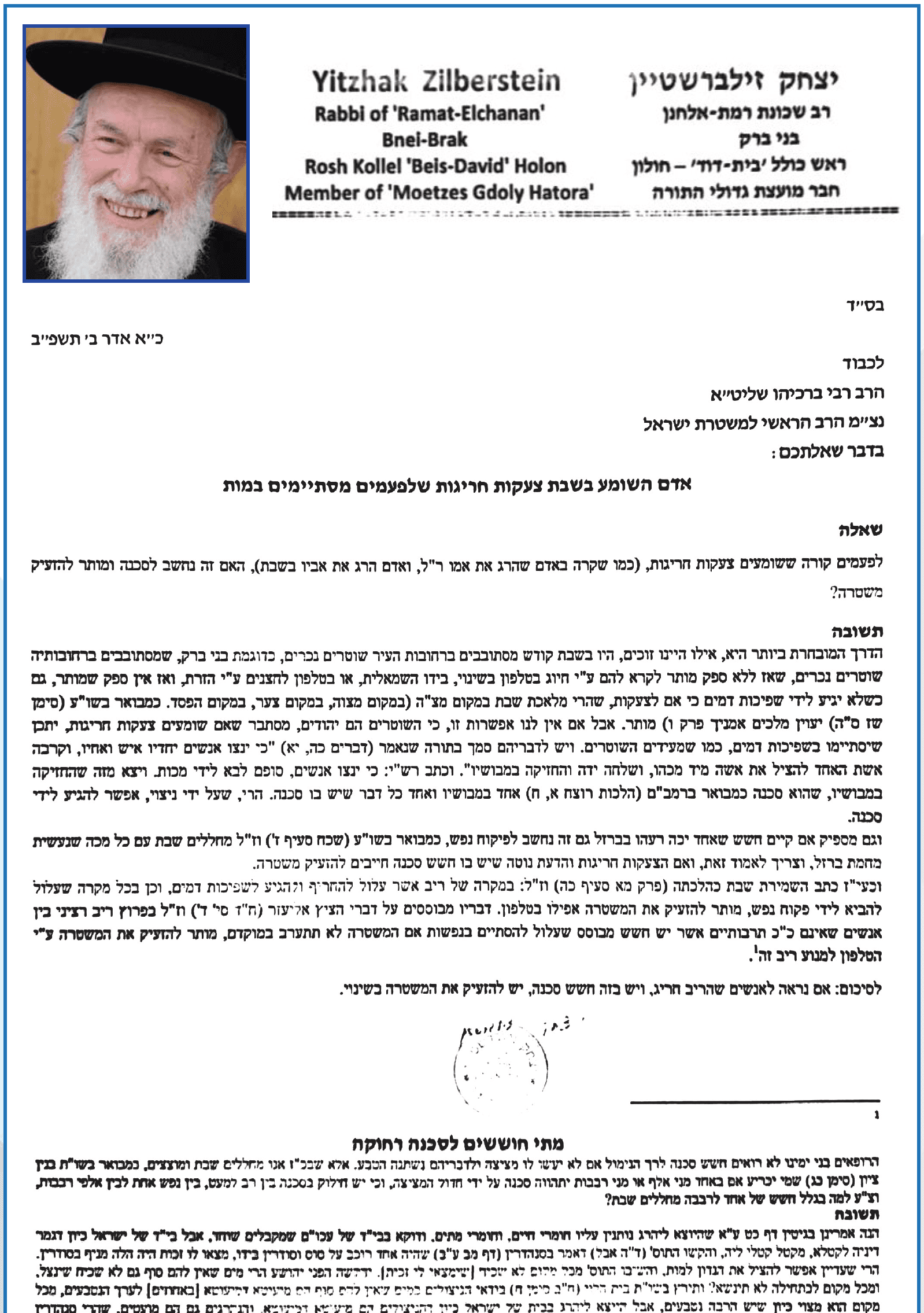
A Critical Review of the Rabbis’ Letters
Rabbi Zilberstein writes that the ideal situation (“had we merited”—his golden phrase) would be that the officers were non-Jews; then one could turn to them even on Shabbat and even when there is no concern for lives, since telling a non-Jew (amira le-nochri) and a rabbinic prohibition are permitted in a case of mitzvah, suffering, or loss (mitzvah, tza’ar, hefsed—an acronym for mitzvah, suffering, and loss). But unfortunately “we have not merited,” and the officers are Jews (though, to our “delight,” “we have merited” that almost none of them are religious—quite the opposite of Rabbi Berachyahu’s own agenda); therefore, as a matter of halakha, one may turn to them in any situation of quarrel or violence in which there is a concern, even remote, that it could lead to danger to life.
He does, however, write that in such cases turning to them is permitted only with a shinui (atypically), which would imply he does not see this as a full pikuach nefesh allowance (otherwise he would permit it in any manner). Perhaps, in his view, we are dealing with a remote concern that does not enter the category of regular pikuach nefesh, yet rabbinic prohibitions were permitted even in such a situation. But if so, it is unclear how, in his view, the officers should respond to such a call, for their very service—and certainly their arrival at the scene—are certainly carried out through full Torah prohibitions (and, as noted, we have not “merited” that they are non-Jews). If only rabbinic prohibitions are permitted, there is neither license nor point in calling—even with a shinui—since the officers themselves will not be able to come.
Perhaps his intention was only to say that if it is possible to call in a rabbinically prohibited manner, that is preferable—not that the situation permits only a rabbinic prohibition—though his wording does not read that way. But even that phrasing is problematic, since when there is danger we do not hesitate or ask—we do whatever is required immediately. Instead of thinking how to dial the police with the pinky of the left hand, one should simply dial normally. There are people in danger.
Indeed, in the letters of Rabbis Weiss and Amar that follow his, they fully agree with Rabbi Zilberstein’s words, and both explicitly write that dialing with a shinui is only if it is truly feasible (“begin with the lighter [violation] first”—see Yoma 83a). But when necessary, desecrating Shabbat at a Torah level is also permitted for this. It is possible that Rabbi Zilberstein meant this as well and simply did not word it carefully.
The proofs Rabbi Zilberstein brings are also problematic to me. One proof is from the Torah (Deut. 25:11), where “men struggle, a man and his brother”—there is a fight between them—then a woman grabs the attacker by his genitals. The Torah views this as a case of a pursuer (rodef) in which the pursuer’s life may be endangered (grabbing the genitals is a risk—see Rambam, Laws of Murder 1:8). He then cites the Shulchan Aruch, Shemirat Shabbat Kehilchatah, and Tzitz Eliezer, all of whom wrote that when there is a quarrel it can spiral into danger, and that justifies Shabbat desecration. I fail to see the point of these proofs. Either way: if, in our assessment, the situation presents a danger to life, there is no need for proofs—we must act. And if, in our assessment, there is no danger—we should not call, despite those proofs. Are those decisors better positioned to assess the facts than we are? What grounds the assumption that the reality they addressed is equivalent to the one I am in? Ultimately everything depends on my assessment of the reality of the particular situation: if in my view there is a danger to life, I must call without these proofs; if there is no danger, one should not call notwithstanding those proofs. Therefore, as I understand it, these proofs neither add nor detract.
One could explain that he does not bring proofs for the factual claim that a quarrel may escalate into danger, but for the halakhic determination that even such a remote concern justifies Shabbat desecration. That, too, is problematic, since the question is how remote the risk may be and still justify desecrating Shabbat; thus we still cannot escape evaluating the level of risk in the particular case before us. Beyond that, he himself writes that his proof addresses the factual claim, in his words: “It follows that through quarreling one can come to danger.”
Moreover, these proofs demonstrate that the conclusion is that the permission extends even to Torah-level prohibitions. The source he cited from the Shulchan Aruch (O.C. 328:7) states that one desecrates Shabbat for a “blow of iron,” and the simple reading is that this includes a complete labor (see Atret Tzvi ad loc. §10, who writes explicitly: “By a Jew—even for a Torah-level labor”). It is not reasonable that he would take from there only the factual assessment and not the halakha that pertains to it; apparently he too permits desecrating Shabbat with a Torah-level labor when necessary.
Incidentally, note that in footnote 1 at the bottom of his letter he invokes explanation 2a to justify desecrating Shabbat for a remote danger (see his proofs there). From this he concludes that, in the matter of calling the police on Shabbat regarding brawls—though the danger in a given case is remote and rare—since these are numerous cases (across the entire public on all Shabbatot), the expected harm is that some people will lose their lives; therefore Shabbat desecration is permitted even for a remote danger. Again, it is unlikely that the license is only for rabbinic prohibitions.
In any event, this response seems to me rather odd. It is not clear whether his intention is merely to innovate that a remote degree of pikuach nefesh justifies Shabbat desecration, or to the very fact that such a situation constitutes pikuach nefesh, and what the relevance of his proofs is (in fact, the footnote presents highly relevant proofs). Either way, it is clear that his license is grounded in a concern for pikuach nefesh, and concerns not involving danger to life do not justify calling and operating the police on Shabbat. The last letter there, by Rabbi Shabtai Levy, distinguishes between two types of situations. I am doubtful how significant that discussion is to our case, but what is relevant for us is that he too stakes his argument on considerations of doubtful pikuach nefesh.
In contrast, I contend that there is no need to resort to the standard laws of pikuach nefesh when discussing operating the police on Shabbat. In the aforementioned essay (Machanech 3, 5768), I argued that one may operate the police on Shabbat even when there is no concern whatsoever for pikuach nefesh, simply because these are critical public needs. We already saw such a direction in the sugya of the metal ember above, and in the next column I will present the main points of my argument in that essay.
[1] See column 421 regarding the relationship between these two rationales.
[2] In column 291 I noted that, according to several decisors, even infringement of another’s rights is not set aside in the face of pikuach nefesh.
[3] This is reminiscent of a distinction I once made regarding “reasonable doubt” in criminal conviction. In criminal law, the decision is made by majority: if one judge dissents against two, the verdict follows the two. This seems puzzling, since the very existence of a dissent indicates at least some doubt, and the rule in criminal law is that a verdict is delivered only when it is beyond a reasonable doubt. I explained that there is a difference between a situation in which two judges say they have no doubt and one says he has a reasonable doubt—then we follow the majority who have decided there is no reasonable doubt—and a situation in which the dissenting judge claims certainty of the defendant’s innocence (and not merely the existence of a reasonable doubt about his guilt). In the latter case we do not follow the majority, since there is a reasonable doubt. See an extensive discussion in column 327. Accordingly, if there is a physician who says there is danger (and not merely a concern), we do desecrate Shabbat on his say-so. See the letter by Rabbi Shabtai Levy (the last among the rabbis’ letters mentioned below), which is devoted entirely to this point.
[4] A similar consideration appears in the sugya of “damage by sight” at the beginning of Bava Batra. This refers to the harm caused by a neighbor’s looking into his fellow’s property. Seemingly the harm is that he observes him while engaged in modest activities on his property. But some commentators explain that the harm is that the neighbor will refrain from using his courtyard due to the concern that his fellow will see him. Thus, “damage by sight” is not the observation of concealed activities, but the loss of use of the courtyard.
Discussion
This is not about any specific situation. The question is what the contours are for operating the police and essential services on Shabbat. The situation is far from as simple as you describe, and it is not true that if there is no life-threatening danger then everything is forbidden. In the coming columns I will sharpen the focus further.
Once again I was forced to read in haste due to pressing circumstances, and perhaps I missed something; and in any case I am neither a rabbi nor a halakhic decisor, and beyond that—it is possible that I agree with the main points (except for the tone of disparagement toward Torah scholars, which would have been better left unsaid), and this requires further study.
I came only to comment on note no. 3. It seems to me that there is a difference between secular criminal law and the law of the Torah. Under Torah law, conviction is not based on proof “beyond a reasonable doubt,” because there is always doubt and the doubt is always reasonable (and see in the holy book True but Unstable, that the same applies even with respect to built-in reality). The pretension of flesh and blood to be able to prove something “beyond a reasonable doubt” gives off a smell of “I will be like the Most High.”
Conviction in Torah law is not based on considerations of (imagined) probabilities such as “near certainty” or “reasonable doubt,” but on a different principle—the prosecution’s success in clearing the hurdle of the laws of evidence in halakhah. It may still be that the witnesses are plotting falsehood, or that the court erred (as with Yehudah ben Tabbai), or that it was later clarified that the trial had been staged (as in the incident with the son of Shimon ben Shetach). But “a judge has only what his eyes see,” and if the prosecution has passed the test of the laws of evidence, judgment is rendered on the basis of those proofs. (Of course, the judge does have an escape hatch of a “deceitful case,” but this is not the place to elaborate.)
It seems to me that this difference explains why in Torah law there is no appellate court, even though there is reconsideration and they reopen the judgment “even a hundred times, provided there is substance in his words”; why the halakhic laws of evidence are so stringent and the judges’ discretion is quite limited (relative to other legal systems); and more—but I do not have the time at present to elaborate, and enough said for the wise, etc.
Apparently you really did read it superficially, and that is a pity.
First, I did not merit to understand where you saw any tone of disparagement here. Second, your comment on my note 3 is irrelevant and also not necessarily correct. I did not compare the law of evidence in secular law to the law of evidence in the Torah—not even by hint. I gave an example of the logic of a certain distinction. That is why the comment is irrelevant. Why is it not necessarily correct? Because, plainly speaking, in the Torah too the purpose of evidence is to arrive at the truth. The fact that formal rules are defined in the law of evidence exists in many legal systems, and that does not contradict this. As for the question whether one may not convict on the basis of circumstantial evidence, you are assuming Maimonides’ position (and even there I am not sure he rejects it except because of concern over the reliability of the evidence), but Tosafot disagrees with him on this. Beyond that, in columns 227–8 I showed that even in ordinary legal systems there is a situation in which evidence at the level of good evidence is not accepted. And there is more room for analysis here.
And your comment on the demand for certainty beyond a reasonable doubt is a ridiculous criticism. It is obvious to everyone that a person can make mistakes, and it seems to me that legal systems are far more aware of this than halakhic authorities are. Still, one must set a threshold for criminal conviction as best one can. This has nothing whatsoever to do with arrogance. Moreover, even in halakhah we find similar requirements, and the assumption that the threshold is always merely formal is simply incorrect. Beyond that, the law of a deceitful case—which you yourself mentioned—proves this. If indeed the judge is supposed to follow the formal threshold and pay no attention to his own perceptions, as your demand for humility would require, then there would be no law of a deceitful case.
In short, next time it would be advisable to read more carefully, and if you do decide nevertheless to comment, it would be worth investing a bit more thought in it—certainly when you are disqualifying other people and other systems because of hubris.
Apparently you too read my comment superficially…
The aspiration to arrive at the truth exists (theoretically) in every worthy legal system. The difference is, of course, first and foremost in the underlying assumptions. The secular system (that is, the state’s system) assumes that judges are capable of weighing evidence, among other things on the basis of their own subjective intuitive feelings. Thus, for example, a judge may decide that a certain witness is unreliable on the basis of an “impression,” even though no contradiction was found in his testimony; or decide that another witness is reliable even though his testimony is riddled with contradictions and flaws, and “repair” his testimony as needed for conviction or acquittal (as with the testimony of the main complainant in the Katsav affair, which was described as an “evolving version”)—and these things happen every day.
In halakhah, this simply cannot happen. Contradicted testimony is void; testimony that is partially invalid is entirely invalid, etc. The judges’ discretion in the face of contradictions and flaws in testimony is very narrow. The judges are not permitted to believe or reject testimony on the basis of a subjective intuitive impression of “the impression the witness made on them.” (I am speaking here about Torah law, not enactments that were added over the generations.) Halakhah also disqualifies a whole series of witnesses a priori (women, slaves, relatives, etc.), even if the judge “feels” that they are speaking the truth.
These differences, and others like them, stem—as noted—from the fact that secular law assumes that a judge is capable of “balancing” evidence and deciding whether a “reasonable doubt” still exists or not. The Torah does not give judges such great credit. From its point of view, they are to examine in a technical way whether the prosecution has passed the test of the laws of evidence, whether the witnesses’ testimony is coherent and without material contradictions, etc. The question whether despite the testimony a “reasonable doubt” remains simply does not arise in Torah law (except for a “deceitful case,” where the judge does not decide to reject the claim but simply withdraws from the case and transfers it to another judge). Judges, according to halakhah, are nothing more than “legal technicians.”
Perhaps one could summarize the difference by saying that in Torah law the aspiration is to substantive justice but the emphasis is on procedural justice, whereas in secular law there is also a pretension to substantive justice. This requires further study.
To be sure, over the generations various enactments were instituted that allow judges to rely to some extent also on their intuition, such as reversal of the oath and the like. As stated, my remarks referred to Torah law without the enactments and additions made to it by the sages of the generations, almost all of which were intended to prevent abuse of the legal process by swindlers, and did not stem from increasing the credit given to judges’ ability to read minds and the like.
I read your remarks carefully and also answered them. But you are ignoring that, and you keep making the same mistake.
- I disagree with your claim that the Torah system gets closer to the truth than the system that gives the judge discretion. In my view, the opposite is true.
- But even if you were right, I already answered that in my remarks. The law of a deceitful case stands against you. After all, in a deceitful case the judge does act on the basis of what he himself thinks and assesses. So what difference does it make whether this is part of the law or beyond the law? In the end, judgment is still cut according to what the judge sees.
- You wrote that reversal of the oath is an enactment instituted over the generations, but that is of course a patent mistake. Precisely the opposite is true. As is well known, Maimonides wrote at the beginning of chapter 24 of the laws of Sanhedrin that, fundamentally, even in Torah law one follows what the judge sees, in an even more extreme way than in general law:
“A judge may adjudicate monetary cases according to matters toward which his mind inclines, that they are true, and when the matter is firmly fixed in his heart as being so, even though there is no clear proof there. Needless to say, if he knows for certain that the matter is so, he judges according to what he knows. How so? If a person became liable to take an oath in court, and someone whom the judge trusts and on whose word he relies told the judge that this man is suspect with regard to oaths, the judge may reverse the oath onto the other litigant, who will swear and collect, since the judge relied on this person’s statement. Even if a woman or a slave was trusted by him, since he found the matter strong and correct in his heart, he relies on it and judges accordingly; needless to say if he himself knew that this person was suspect. Similarly, if a debt document came before him and someone whom he relied on—even a woman or a relative—told him, ‘This has been paid,’ if the judge relies on his words, he may say to the holder, ‘You shall collect only with an oath’; or if there was another debt document against him, he may give to the one whose document was not impaired and leave the one whose document was impaired on the basis of that one person’s statement, or throw the document before him and not adjudicate by it, according to what he sees. Likewise, one who comes and claims that he has a deposit with So-and-so who died without leaving instructions, and he gives clear identifying marks, and this claimant was not accustomed to enter that deceased person’s house—if the judge knows that the deceased was not presumed to possess such an item, and his mind is convinced that this item was not the deceased’s, he removes it from the heirs and gives it to the one for whom possession of it is presumed and who gave the identifying marks. And so in all similar matters, where the matter is entrusted only to the judge’s heart according to what appears to him to be the true law. If so, why did the Torah require two witnesses? Because when two witnesses come before the judge, he judges according to their testimony, even though he does not know whether in truth they testified or lied.”
This is reversal of the oath, and it is part of the original law. Precisely the situation in which one follows formal evidence and not the judge’s own perception is a secondary, post facto development resulting from Israel’s dispersion among the nations, as he wrote there in halakhah 2:
“All these matters are the essence of the law. But once courts multiplied that were not fit—and even if they were fit in their conduct, they were not sufficiently wise and discerning—most Jewish courts agreed that they would not reverse an oath except on the basis of clear proof, nor impair a document and weaken its presumption on the testimony of a woman or other disqualified person, and so too in all other judgments; and that the judge should not judge on the basis of his own reliance or knowledge, lest any ignoramus say, ‘My heart believes this person and my mind relies on him.’ And likewise, one does not extract from orphans except on the basis of clear proof, not by the judge’s opinion nor by estimation regarding the deceased or the claimant. Nevertheless, if a trustworthy person testified regarding any matter, and the judge’s mind inclined that he was speaking the truth, the judge delays the case and does not dismiss his testimony, but negotiates with the litigants until they admit the witness’s words, or reach a compromise, or he withdraws from the case.”
And only in halakhah 3 does the law of a deceitful case appear:
“And from where do we know that a judge who knows a case is deceitful should not say, ‘I will decide it and let the responsibility hang on the necks of the witnesses’? Scripture says: ‘Keep far from a false matter.’ What should he do? He should examine and investigate extensively, with the examination and inquiry of capital cases. If it appears to him, according to his judgment, [that there is no deceit in it, he decides the case according to the testimony; but if his heart misgives him] that there is deceit in it, or that his mind does not rely on the witnesses’ statements, even though he cannot disqualify them; or if his mind inclines that this litigant is a swindler and schemer who coached the witnesses, even though they are fit and testified innocently—and this is the reason; or if from the totality of the matter it appears to him that there are other hidden things that they do not wish to reveal—all these matters and the like, it is forbidden for him to decide that case. Rather, he should remove himself from this case, and let one whose heart is whole in the matter adjudicate it. For these matters are entrusted to the heart, and Scripture says: ‘For the judgment is God’s.’”
And in halakhah 4 he speaks about punishment not according to the strict law:
“And from where do we know that a judge who knows a case is deceitful should not say, ‘I will decide it and let the responsibility hang on the necks of the witnesses’? Scripture says: ‘Keep far from a false matter.’ What should he do? He should examine and investigate extensively, with the examination and inquiry of capital cases. If it appears to him, according to his judgment, [that there is no deceit in it, he decides the case according to the testimony; but if his heart misgives him] that there is deceit in it, or that his mind does not rely on the witnesses’ statements, even though he cannot disqualify them; or if his mind inclines that this litigant is a swindler and schemer who coached the witnesses, even though they are fit and testified innocently—and this is the reason; or if from the totality of the matter it appears to him that there are other hidden things that they do not wish to reveal—all these matters and the like, it is forbidden for him to decide that case. Rather, he should remove himself from this case, and let one whose heart is whole in the matter adjudicate it. For these matters are entrusted to the heart, and Scripture says: ‘For the judgment is God’s.’”
So there you have it: fundamentally (and not merely in a deceitful case), halakhah follows what the opinion of our arrogant judge inclines toward, when the matter is strong in his heart. Is this not equivalent to the formulation “beyond a reasonable doubt”? And in practice it is clear that there is a law of a deceitful case and punishment beyond the strict law, both of which are based on what the judge sees, even nowadays. In short, it is simply the complete opposite of what you wrote.
With God’s help, 4 Tevet 5783
“And at the end of the day,” Maimonides concludes that although a judge has the authority, as a matter of the original law, to judge based on his strong impression, most Jewish courts feared the “slippery slope” of judges who are unfit or insufficiently wise, and therefore refrain from ruling on the basis of estimations, but instead pressure the litigants to reach a compromise. And if that was so in the days of the Geonim and the Rishonim—what can we say after them?
With blessings, Yifa’or
What is the source for the claim that if there is a disagreement among the doctors and the majority say there is no need to desecrate Shabbat, we follow the majority? Is this a primary source, in the Gemara?
I wanted to ask about the halakhah you cited from the Shulchan Arukh:
B. In matters of saving life, we do not follow the majority. Even if there were nine gentiles and one Jew in a courtyard, and one of them went from there to another courtyard and a building collapsed on him there, we clear away the rubble for him, because since the original fixed group remains in its place, we regard it as half and half. But if they all left, and at the time they left one of them separated to another courtyard and it collapsed on him, we do not clear away the rubble for him; for since the original fixed group was uprooted from its place, we say: whoever separated, separated from the majority.
Regarding the latter clause, where it says that if they all left and at the time they left one of them separated—one does not clear away the rubble for him: statistically, there could be a situation where there is a one-in-three chance that a Jew is buried under the rubble, and only because of the rule that “whoever separated, separated from the majority,” one does not clear away the rubble. How does this fit with what you wrote, that wherever there is a reasonable concern for danger to life, we desecrate Shabbat?
Indeed, that is a very puzzling halakhah. It seems to assume that the difference between “fixed” and “separated” has a statistical basis, rather than being a purely halakhic distinction (I discussed this in previous columns). It seems to me that perhaps one can distinguish between a situation where a person is in a small possibility of mortal danger, and a doubt whether mortal danger will come upon him. In the first case one desecrates Shabbat, but in the second case one judges according to the laws of doubt. It seems to me that this is somewhat similar to the explanations I offered for the law of “fixed” (in columns 227–8), but it requires more thought. I made a similar distinction in column 325 between a doubtful inevitable result and a result that is not inevitable. If there is doubt whether there are flies in the box, then closing the box is forbidden as a case of a doubtful inevitable result, and one judges according to the laws of doubt. But if it is clear that there are flies in the box and the doubt is whether they will be trapped by closing it, that is an unintended act and is permitted.
I am convinced that if such a case were to come before a halakhic decisor for a practical ruling, he would find grounds to permit—and even require—the desecration of Shabbat even in the second case.
What do you mean by the words “the doubt whether mortal danger will come upon him”?
As I explained, like a doubtful inevitable result. There is doubt whether he will be in a state of mortal danger, as opposed to his being in a state where it is doubtful whether he will die. Something like Tosafot’s distinction in Bava Kamma between shooting an arrow at the vessel and throwing the vessel from the roof.
I read it twice, and I didn’t understand what situation is being discussed. What prohibition does it involve? The case is not sufficiently clear in my view. What is the dilemma at all? After all, the answer is obvious: if this is a case of saving a life (even if only possibly), then everything is permitted, and if not then everything is forbidden. What is the problem?